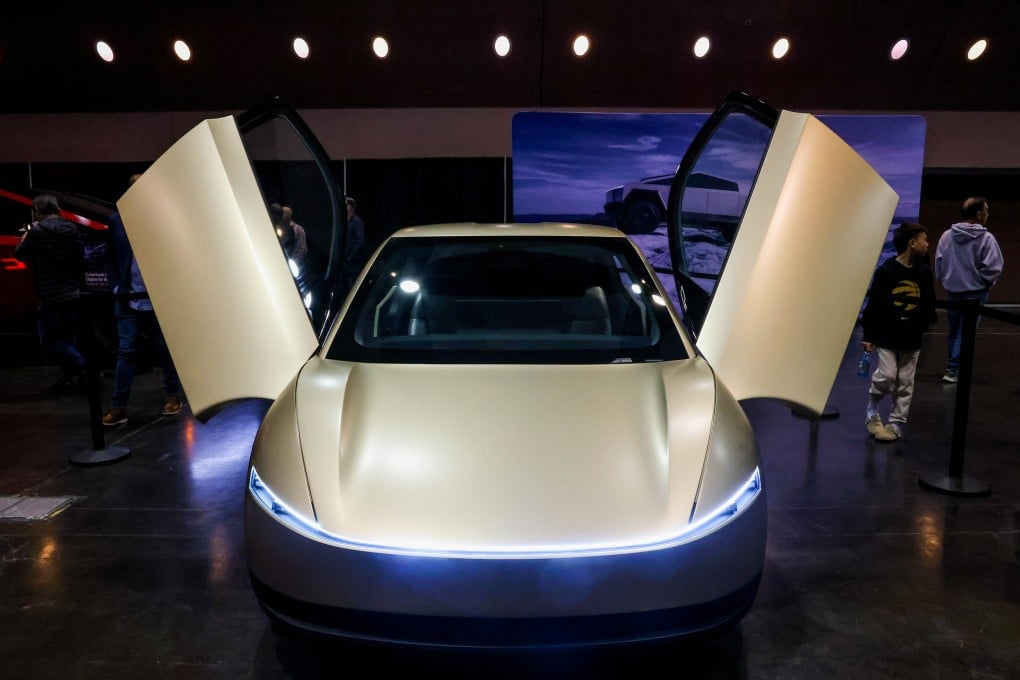
At first, it sounded like just another line buried beneath the spectacle of Tesla’s Cybercab.
No steering wheel. No pedals. A body shaped around efficiency rather than tradition. A robotaxi designed to move people without ever asking them to drive.
Those were the obvious headlines.
Then Elon Musk dropped a sentence that may eventually matter far more than the shape of the car itself.
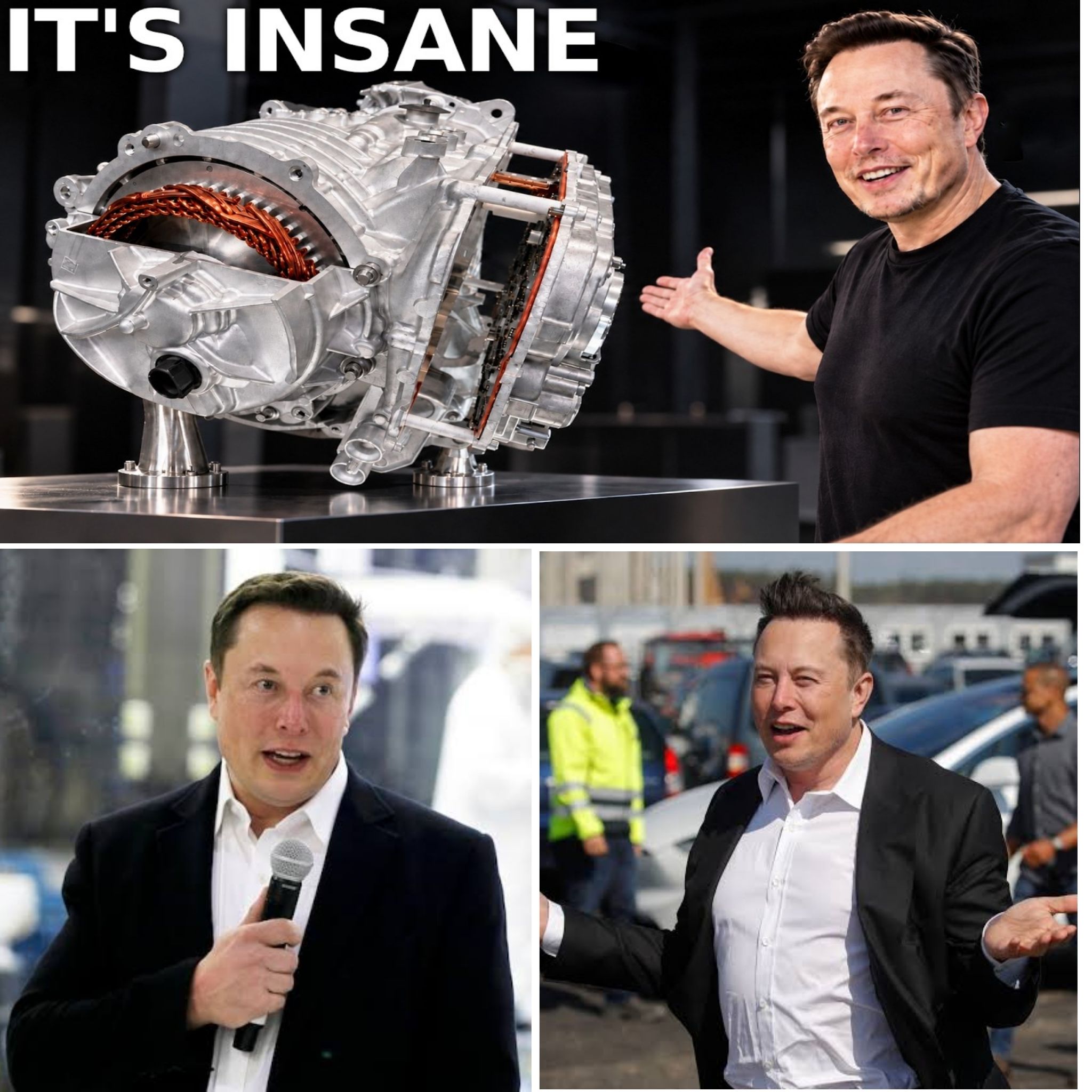
The Cybercab’s electric motor, Musk said, uses no rare-earth metals while maintaining the same range.

He added that achieving it had been “extremely hard.”
That single detail changes the story.
Because Tesla was not merely saying it had made another efficient electric motor. Technical information circulating after the Cybercab launch described a drive unit rated around 163 kW, reportedly 18% smaller and 25% lighter than the comparison unit Tesla used, with a simplified bar-wound stator and a design intended for highly automated manufacturing. Reports from the launch also attributed an extraordinary production target to Tesla: automated assembly in under ten seconds.
Read those claims too quickly and they sound almost absurd.
Smaller.
Lighter.
Highly efficient.
No rare earths.
Designed for assembly in seconds.
Normally, engineering does not give you all five.
Usually, removing one constraint creates another. Make a motor cheaper and it gets larger. Make it smaller and cooling becomes harder. Remove powerful permanent magnets and efficiency can suffer. Lose efficiency and you need more battery. Add battery and the vehicle becomes heavier. More weight requires stronger structures, larger brakes and more energy.
One compromise starts a chain reaction.
Tesla is claiming it has broken that chain.
And if it has, the most important part of the Cybercab may not be the computer driving the vehicle.
It may be the machine turning its wheels.
The tiny component sitting inside a global geopolitical choke point
To understand why this matters, forget Tesla for a moment.
Forget autonomous driving.
Forget Elon Musk.
Think about magnets.
For years, some of the world’s most efficient electric-vehicle traction motors have relied on powerful permanent magnets containing rare-earth elements. Neodymium-based magnets can provide enormous magnetic strength relative to their size, helping engineers build compact motors with excellent power density and efficiency.
An individual vehicle does not require a truckload of the material.
That is precisely why the problem was easy to underestimate.
A few hundred grams here. Another small quantity there.
Multiply it by several million vehicles, however, and a minor engineering ingredient becomes an industrial dependency.
Then geography enters the equation.
The International Energy Agency says China accounted for about 60% of global mined production of magnet rare earths in 2024, 91% of refined output and roughly 94% of sintered permanent-magnet production.
That last number is the one that should make automotive executives uncomfortable.
Mining is only the beginning.
The real power lies in processing, separation, refining, alloying and turning those materials into high-performance magnets at enormous scale.
This is the first plot twist in the rare-earth story.
The central problem is not that rare-earth elements are literally disappearing from the planet.
The problem is that the industrial infrastructure required to turn ores into sophisticated magnets is astonishingly concentrated.
For an automaker, that distinction is everything.
You can know that mineral deposits exist somewhere else in the world and still be unable to obtain a qualified magnet for your production line at the price, volume and schedule you require.
And in 2025, the theoretical risk stopped being theoretical.
China introduced export controls affecting several heavy rare-earth elements, compounds and magnets. Export volumes dropped sharply. Automakers and suppliers in the United States, Europe and elsewhere scrambled for licenses. Some suppliers cut utilization or temporarily stopped production.
Reuters reported warnings from automotive groups that shortages could spread into critical components ranging from motors and sensors to power steering systems and other equipment.
Eventually, some licenses were granted and flows recovered.
But the lesson was impossible to miss.
A magnet weighing a fraction of what a battery pack weighs could become a bottleneck capable of slowing an entire automobile factory.
Suddenly, Tesla’s strange promise from three years earlier did not look strange at all.
It looked timed for a world that had changed.
Tesla actually announced this years ago — and almost nobody knew how it would work

The Cybercab revelation appears dramatic in 2026.
But the story actually began in March 2023.
During Tesla’s Investor Day in Texas, powertrain executive Colin Campbell stood before investors and displayed a comparison between the materials used in a Model Y motor and Tesla’s proposed next-generation drive unit.
The Model Y slide showed roughly 500 grams of one rare-earth material and around 10 grams each of two others.
Then came the next slide.
Zero.
Zero.
Zero.
Tesla said its next-generation permanent-magnet motor would use no rare-earth elements at all.
Not less.
Not a redesigned supply chain.
Not magnets from another country.
Zero.
Campbell said Tesla had designed its next drive unit “to not use any rare earth materials at all.” The presentation also promised lower cost and higher efficiency, along with a roughly $1,000 all-in drive-unit cost target, 75% less silicon carbide and a smaller manufacturing footprint.
That announcement created an immediate problem.
Almost nobody outside Tesla understood what the magnets were supposed to be made from.
A permanent-magnet motor still needs a permanent magnetic field in its rotor.
If Tesla was abandoning rare-earth permanent magnets, what was replacing them?
Ferrite?
A new magnet chemistry?
A sophisticated magnetic arrangement?
Something proprietary?
Tesla did not say.
IEEE Spectrum spoke with magnet specialists at the time, and the reaction was not universal applause. Some experts were openly skeptical about whether a non-rare-earth permanent magnet could deliver the characteristics expected of a high-performance traction motor without significant compromises.
And their skepticism was reasonable.
This was not an industry refusing to imagine alternatives.
It was an industry that understood the physics.
Rare-earth magnets are popular for a reason.
Here is the second twist: rare-earth-free EV motors were never impossible
There is an important correction to one of the most common versions of this story.
Tesla did not invent the idea of an electric vehicle motor without rare-earth materials.
BMW already uses current-excited synchronous motors that eliminate permanent magnets and therefore avoid rare-earth magnetic materials in the rotor. BMW has said its fifth-generation eDrive system can achieve around 93% motor efficiency while avoiding rare earths in the motor’s magnetic components.
Renault has also spent years developing and manufacturing wound-rotor electric motors that do not depend on rare-earth permanent magnets. Its next-generation program with Valeo has targeted a 200 kW rare-earth-free motor using an electrically excited rotor and a high-copper-density stator.
Even Tesla itself began its modern EV history using induction motors, a design that does not require permanent magnets in the rotor.
So the real engineering question was never:
Can an electric car move without rare-earth magnets?
We already knew the answer was yes.
The much harder question was:
Can you remove rare earths while preserving the compactness, efficiency, cost, manufacturability and power density Tesla wants for a mass-produced next-generation vehicle?
That is an entirely different challenge.
An induction motor avoids permanent magnets, but rotor losses can make it less efficient in important operating regions.
An electrically excited synchronous motor can eliminate rare-earth magnets too, but it requires a system to energize the rotor. That adds engineering complexity.
A conventional ferrite permanent magnet is inexpensive and widely available, but its magnetic energy density is far below that of premium neodymium-iron-boron magnets.
Every route has consequences.
And consequences matter enormously in an EV.
Lose only a few percentage points of drivetrain efficiency and the effect can spread through the entire car.
A larger battery may be needed to preserve range.
The larger battery adds mass.
The additional mass increases rolling demand.
Structural components may need strengthening.
Suspension requirements change.
Tires work harder.
Cost rises.
The motor may be cheap while the vehicle becomes expensive.
That is why Tesla’s 2023 promise caused so much skepticism.
It was not because engineers believed rare-earth-free motors violated the laws of physics.
It was because Tesla was effectively promising to escape the normal penalty.
Three years later, the Cybercab may be the first physical evidence that Tesla found a way.
But there is one detail Elon Musk still has not revealed
This is where the story becomes even more interesting.
A popular explanation spreading through engineering discussions is that Tesla may be using ferrite magnets arranged in an advanced configuration, potentially with a Halbach-style magnetic geometry.
It sounds convincing.
Ferrite is cheap, abundant and does not depend on rare-earth elements. A Halbach array can arrange magnets so the magnetic field is strengthened on one side and weakened on another, allowing designers to concentrate useful magnetic flux.
Combine that with clever rotor geometry, sophisticated electromagnetic simulation and very high rotational speed, and perhaps a weaker magnet can be compensated for at the system level.
It is a compelling theory.
But it is still a theory.
As of the Cybercab disclosure, Tesla and Musk have confirmed the important outcome — zero rare-earth metals in the motor without a range penalty — but they have not publicly confirmed that the permanent magnets are ferrite, nor that the rotor uses a Halbach arrangement.
That distinction matters.
Because the easiest way to turn an extraordinary engineering story into misinformation is to take a plausible expert hypothesis and quietly promote it into an official specification.
Tesla’s secrecy here may itself tell us something.
If the company has solved the problem through a particular magnet composition, rotor topology, manufacturing method or combination of all three, that solution could be strategically valuable.
Tesla spent years building expertise not just in motors, but in simulation software, power electronics, thermal control and manufacturing equipment.
The magic, if there is any, may not be one magic material.
It may be the interaction of dozens of ordinary decisions.
That would be very Tesla.
Look at the copper, because the copper tells another part of the story
One confirmed clue is the stator.
Technical details disclosed around the Cybercab point to a bar-wound stator, often discussed in the same family as hairpin-style winding technology.
Instead of filling stator slots with bundles of conventional round wire, engineers use precisely formed rectangular copper conductors.
Why does that matter?
Imagine trying to fill a box with drinking straws.
Round objects leave gaps.
Flatten the conductors into rectangular shapes, and significantly more copper can be packed into the available space.
More copper in the right geometry can reduce electrical resistance and allow engineers to move more current through a compact stator. The larger conductor surfaces can also help the thermal design when paired with appropriate cooling.
Manufacturing becomes different too.
Instead of manipulating large quantities of flexible wire through traditional winding processes, automated equipment can form, insert, join and inspect standardized copper bars at enormous speed.
Renault and Valeo have independently highlighted similar high-density copper approaches in their rare-earth-free motor programs, showing why stator packing density has become such an important battlefield in modern EV engineering.
Tesla appears to have pushed this philosophy particularly hard.
And that leads directly to the number that may be even more provocative than “zero rare earths.”
Ten seconds.
No, Tesla probably does not turn raw copper into a finished motor in ten seconds
The phrase travels beautifully online:
Tesla builds a motor every ten seconds.
It sounds like science fiction.
It also needs context.
Reports from the Cybercab launch say Tesla described the drive unit as being designed for automated assembly in under ten seconds.
That does not necessarily mean a pile of electrical steel, copper, bearings, magnets, gears and aluminum enters one end of a machine and a completely finished motor exits ten seconds later.
Modern manufacturing lines operate through parallel stations.
While one stator is being processed at one location, another rotor may be undergoing work elsewhere, another unit may be entering final assembly and another may be undergoing inspection.
The meaningful number is often the cycle time or takt-like output interval of a highly optimized process.
In other words, after the line is fully loaded and running, a completed unit can potentially emerge at extraordinarily short intervals even though each individual part has spent far longer moving through the entire production system.
That clarification does not make the claim less impressive.
It may make it more important.
Because the great industrial revolutions are rarely about making one prototype quickly.
They are about arranging a production system so that the thousandth product is almost boring.
A brilliant motor that requires specialists, hand assembly and slow calibration is interesting.
A slightly less exotic motor that machines can reproduce every few seconds is an industry.
Tesla has always understood that difference.
Elon Musk’s obsession has never really been the car
This is one of the most misunderstood elements of Tesla.
People see a Model 3, a Cybertruck or a Cybercab and naturally assume the vehicle is the product.
Musk has repeatedly treated the factory itself as part of the product.
That changes how Tesla evaluates engineering.
A conventional engineering team might ask:
How do we make this component perform better?
A manufacturing-driven team adds several more questions.
How many parts can we remove?
How many fasteners disappear?
Can the assembly orientation stay constant?
Can robots reach every interface?
Can inspection be performed automatically?
Can one casting replace dozens of stamped and welded components?
Can a cooling circuit be integrated?
Can copper be inserted in a form that is friendlier to automation?
Can the design tolerate manufacturing variation without expensive manual rework?
That is why the “under ten seconds” claim deserves attention even if the internet version of the phrase is oversimplified.
The breakthrough may not be that Tesla discovered a mysterious motor nobody else can understand.
The breakthrough may be that Tesla designed a motor backward from the factory that must manufacture millions of them.
And that brings us to another twist.
Rare-earth elimination may be only one benefit of the design.
Manufacturing simplification could be the bigger one.
The Cybercab’s efficiency number makes the claim harder to dismiss
If Tesla had eliminated rare earths and produced a vehicle with terrible efficiency, the story would be far less interesting.
But the Cybercab gives Tesla an unusually powerful piece of evidence.
Tesla vehicle-engineering chief Lars Moravy said the Cybercab achieved 165 watt-hours per mile, describing it as the most efficient production EV yet certified.
That is an extraordinary consumption figure.
For comparison, efficient conventional electric sedans typically sit significantly higher.
But here comes yet another necessary plot twist.
The Cybercab’s 165 Wh/mile figure does not prove the motor alone is dramatically more efficient than every competing EV motor.
The entire vehicle is engineered around efficiency.
It has two seats.
It does not need a steering wheel.
It does not need pedals.
Its body is compact.
Its aerodynamic profile can be optimized without accommodating many of the compromises required in a traditional family sedan.
Its battery is relatively small.
Its mass is lower.
Its mission is narrow.
Comparing a Cybercab directly with a five-seat luxury sedan is therefore not a perfect apples-to-apples test of motor technology.
But that does not weaken the engineering accomplishment.
It changes what the accomplishment means.
Tesla did not optimize a motor in isolation.
It optimized a system.
Motor.
Battery.
Aerodynamics.
Mass.
Thermal management.
Power electronics.
Vehicle architecture.
Manufacturing.
Every kilogram removed from one subsystem can make another subsystem smaller. Every watt saved by the motor can reduce battery demand. Every improvement to aerodynamics reduces the work the motor needs to perform at highway speed.
This is the opposite of the penalty spiral that traditionally scares engineers away from weaker magnet materials.
Instead of accepting a worse motor and compensating with a larger battery, Tesla appears to have attacked enough variables simultaneously that the complete vehicle still lands at an exceptionally low energy consumption.
That may be the deeper explanation behind Musk’s statement that maintaining range was extremely difficult.
Range is never just a battery number.
It is the final score of the entire machine.
And then China changed the value of the achievement
Had Tesla introduced this motor in a world of completely unrestricted, geographically diversified magnet supply, it would still be an impressive engineering story.
But that is not the world in which the Cybercab arrived.
The rare-earth disruptions of 2025 exposed how fragile portions of the automotive supply chain had become.
The IEA noted that China’s export controls caused sharp declines in some rare-earth and permanent-magnet exports during April and May 2025, leaving manufacturers searching for material and, in some cases, reducing or stopping output while licenses were processed.
This does not mean China is somehow a villain for possessing industrial capability that other countries allowed themselves to lose.
That version of the story is too simple.
China spent decades building mining, separation, refining, alloy and magnet manufacturing capacity. Other countries benefited from the resulting economics and increasingly concentrated their sourcing.
The vulnerability is the concentration itself.
If one geography controls more than nine-tenths of a critical processing stage, anything affecting that geography — export rules, political conflict, natural disaster, domestic demand, industrial policy or logistics — can propagate through the rest of the world.
Automotive executives learned that lesson painfully.
A company can build battery plants in America.
It can source steel domestically.
It can manufacture seats near the assembly line.
It can write its own software.
And it can still discover that production depends on a specialized magnet whose value is tiny compared with the price of the vehicle.
That is what makes elimination so powerful.
Diversification asks:
“Where else can we buy this?”
Elimination asks:
“Why do we need to buy it at all?”
Those are not the same strategy.
The cost equation could be just as disruptive as the geopolitical one
Rare-earth permanent magnets can represent a substantial share of the materials cost of a permanent-magnet traction motor.
The exact percentage varies dramatically with design, magnet grade and commodity prices, so simplistic claims should be treated cautiously. But rare-earth magnets are sufficiently expensive and volatile that removing them can materially alter the bill of materials.
And the commodity price itself is only part of the calculation.
Automakers pay for certainty.
They pay to qualify suppliers.
They hold inventory.
They hedge against disruption.
They redesign around shortages.
They negotiate long-term contracts.
They may accept higher prices from geographically diversified suppliers to reduce concentration risk.
Supply-chain resilience has a cost even when no factory is actually stopped.
Eliminate the material and part of that invisible cost disappears too.
Then combine that with aggressive automated production.
A cheaper magnet system.
A smaller drive unit.
Less material.
Fewer manufacturing steps.
Fast automated assembly.
A small factory footprint.
Those improvements compound.
This was visible in Tesla’s 2023 Investor Day presentation. The company did not discuss rare earths as an isolated environmental project. It placed the zero-rare-earth motor inside a broader strategy of reducing constrained commodities, lowering drive-unit cost and making factories more compact and scalable.
That context matters.
Tesla was not trying to win an award for magnet chemistry.
It was trying to make the next million cars easier to build than the previous million.
But this is where Tesla’s competitors deserve more credit than the viral headlines give them
There is a temptation to tell this story as if Elon Musk announced something in Texas and the rest of the automotive industry suddenly realized its motors were obsolete.
That would be dramatic.
It would also be wrong.
BMW has already commercialized rare-earth-free current-excited synchronous motors.
Renault has long experience with wound-rotor machines and continues to develop more powerful versions.
Other manufacturers and suppliers are researching induction motors, switched-reluctance architectures, alternative magnet materials and hybrid designs.
The industry has not been asleep.
Tesla’s possible advantage lies somewhere more specific.
It appears to be combining the supply-chain benefits of a rare-earth-free architecture with a permanent-magnet motor, extreme packaging efficiency and a production philosophy optimized for very high automation.
If the Cybercab hardware performs at scale as claimed, that combination deserves attention.
But scale is the word that matters.
A motor surviving an engineering validation program is one milestone.
Ten thousand vehicles are another.
A million motors operating for years through heat, vibration, road salt, repeated acceleration and hundreds of thousands of miles is another level entirely.
Tesla now has to prove not only that the motor works, but that the manufacturing system works.
That is where many “revolutionary” technologies become ordinary.
Or disappear.
The most revealing moment may come years from now
Tesla has done something similar before.
When the Model 3 arrived, its motor architecture represented a major step in Tesla’s search for better efficiency and mass-market economics. Technologies developed for one program rarely stay isolated if they prove superior.
They migrate.
Manufacturing equipment is redesigned around them.
Suppliers adapt.
Software is recalibrated.
Engineers carry the lessons into the next vehicle.
That creates the biggest unanswered question surrounding the Cybercab motor.
Is this a special-purpose solution for a lightweight robotaxi?
Or is Cybercab simply the first vehicle allowed to reveal Tesla’s next global drive-unit architecture?
If the design eventually appears in future Model 3s, Model Ys or other high-volume Tesla products, the significance changes dramatically.
Cybercab volumes alone may not transform the rare-earth market.
Model 3 and Model Y scale could.
And a successful Tesla design would not remain a Tesla story for long.
Automotive engineering is brutally competitive but also highly imitative.
When one company proves that a technology can achieve better economics at scale, competitors do not need ideological persuasion.
Finance departments do the persuading.
Purchasing departments do the persuading.
Factory managers do the persuading.
If eliminating rare-earth magnets saves money, reduces geopolitical risk and simplifies manufacturing without destroying efficiency, every serious automaker will examine the path.
That does not mean everyone will copy Tesla’s motor.
BMW may continue refining electrically excited machines.
Renault may push wound-rotor technology.
Others may develop new ferrite architectures.
Some may still decide rare-earth permanent magnets provide the best overall trade.
But the assumption changes.
Rare earths stop being treated as inevitable.
That is how industries shift.
Not when everybody immediately adopts the same technology, but when an old design constraint stops being accepted as a law of nature.
And this could reach far beyond automobiles — with one giant caveat
Electric motors are everywhere.
Industrial machinery.
Robots.
HVAC systems.
Drones.
Wind-energy equipment.
Factory automation.
Aerospace.
Defense systems.
The obvious question is whether Tesla’s work could push rare-earth-free motor concepts into those markets too.
Possibly.
But no single motor architecture fits every application.
A robot joint may prioritize torque density differently from a Cybercab.
A wind turbine generator operates under different speed and maintenance conditions.
An aircraft propulsion motor lives under weight constraints far beyond those of a road car.
Military systems may value temperature resistance and compactness more than commodity cost.
So Tesla has not “solved rare earths” for civilization.
It may have demonstrated something narrower and potentially more consequential for one enormous market:
A highly efficient mass-production electric vehicle does not necessarily have to be chained to a rare-earth permanent-magnet supply chain.
That alone would be a major change.
The strangest part is how quietly the breakthrough arrived
Think about what normally receives attention around Elon Musk.
A rocket launch.
A humanoid robot.
A steering-wheel-free vehicle.
A controversial post.
A massive factory.
A new AI model.
A promise about autonomy.
Rare-earth elimination does not photograph well.
There is no dramatic explosion.
No robot walking onto a stage.
No stainless-steel truck racing a sports car.
The motor sits underneath the vehicle where almost nobody will ever see it.
Yet hidden components often determine who wins industrial battles.
The lithium-ion cell was once an obscure component.
The inverter was an obscure component.
Silicon carbide power electronics were obscure.
Gigacasting sounded like factory jargon.
Then enough small improvements accumulated and changed what an electric vehicle could cost.
The same may be happening again.
When Tesla announced its zero-rare-earth permanent-magnet plan in 2023, experts had good reasons to ask hard questions.
What material?
What power density?
What efficiency?
What thermal behavior?
What cost?
What production process?
Tesla answered almost none of them publicly.
Then three years passed.
China’s rare-earth export controls exposed the exact supply-chain vulnerability Tesla had been designing around.
Cybercab reached the road.
Its energy consumption landed around 165 Wh per mile.
And Musk confirmed that the motor inside it contained no rare-earth metals.
Suddenly, the old 2023 slide looked different.
Not like a distant research objective.
Like a warning.
The final plot twist is that the motor may not be the breakthrough at all
The internet will focus on the magnet.
Engineers will debate ferrite.
Investors will debate China.
Tesla fans will repeat the ten-second number.
Skeptics will point out, correctly, that rare-earth-free motors already existed.
All of them may be looking at different pieces of the same machine.
The real breakthrough could be the integration.
A rare-earth-free magnet solution is useful.
A densely packed bar-wound stator is useful.
A high-efficiency vehicle is useful.
A simplified thermal system is useful.
Aggressive automation is useful.
A ten-second-class assembly cycle is useful.
A lightweight robotaxi platform is useful.
But combine them, and the economics begin multiplying rather than adding.
A lighter motor reduces vehicle mass.
A more efficient motor reduces battery requirements.
A smaller battery reduces cost and weight.
Lower weight improves efficiency again.
Simpler manufacturing reduces factory investment.
Faster assembly raises output per machine.
Removing rare earths reduces exposure to a concentrated supply chain.
Lower operating energy reduces the cost per mile of a robotaxi.
Now the pieces are no longer separate.
They become a system.
That is exactly why the Cybercab matters.
Tesla is not merely trying to build a car that drives itself.
It is attempting to combine autonomy, extreme vehicle efficiency, simplified manufacturing, low operating cost and supply-chain independence into the same product.
The robotaxi is only commercially revolutionary if the economics work.
A Cybercab that can drive without a person but costs too much to build is a technological demonstration.
A Cybercab that can drive itself, consume very little electricity, use a smaller battery, require fewer constrained materials and emerge rapidly from an automated factory is something else.
It is a business model encoded in hardware.
Whether Tesla can manufacture it at the volume Musk ultimately wants remains unanswered.
Whether the zero-rare-earth motor maintains durability across massive fleets remains unanswered.
Whether the mysterious permanent-magnet chemistry can migrate economically into larger and heavier Tesla vehicles remains unanswered.
And the exact rotor design remains one of the most fascinating secrets in the EV industry.
But one fact is becoming difficult to ignore.
In 2023, Tesla put three zeroes on a presentation slide and promised that its next permanent-magnet motor would need no rare earths.
At the time, skepticism was easy.
In 2026, Elon Musk says that motor is now inside the Cybercab — a vehicle delivering exceptional energy efficiency — while Tesla is simultaneously pushing an automated manufacturing strategy aggressive enough to talk about drive-unit assembly in seconds rather than minutes.
Three years ago, the question was whether Tesla could actually do it.
Now the question is far more uncomfortable for the rest of the industry:
What happens if Tesla can do it millions of times?
Because technological revolutions rarely begin when somebody builds one impossible machine.
They begin when the impossible machine becomes cheap enough, simple enough and fast enough to build that everyone else has to change.