The final appeal failed, the last plea for mercy was denied, and Robert Allan Fratta, a former Texas police officer who traded his badge for a hitman’s contract, was executed by lethal injection on Tuesday evening. He died without uttering a single word of remorse, apology, or explanation, leaving the family of his murdered ex-wife, Farah Fratta, to find closure in the cold finality of the state’s ultimate punishment.
The execution, carried out at the Huntsville Unit, brought a definitive end to a case that had haunted Harris County for nearly three decades. Fratta, 65, was pronounced dead at 7:49 p. m.
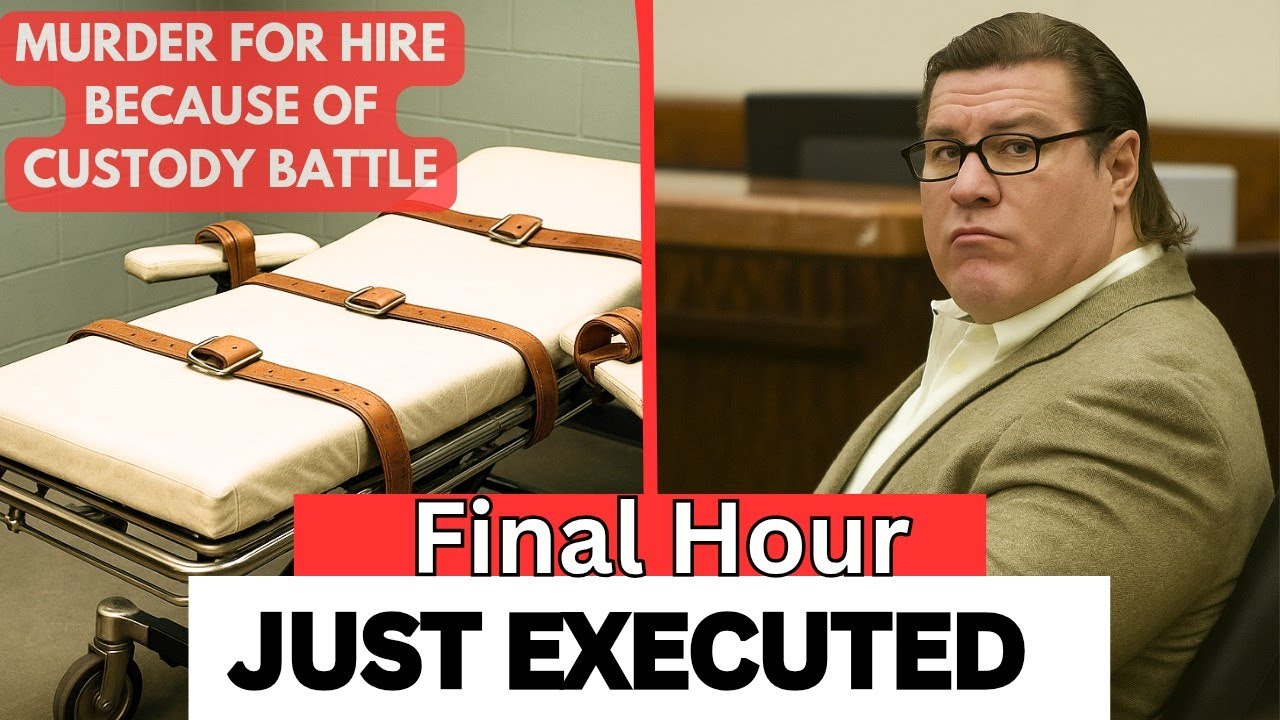 after a brief and quiet procedure. Witnesses reported that he took several deep breaths and then went still, offering no final statement as the lethal dose of pentobarbital began to flow. The silence was a stark and chilling echo of the emotional detachment he displayed throughout his trials and the years he spent on death row.
The crime that led Fratta to this moment was as calculated as it was brutal. On November 9, 1994, Farah Fratta, a 33-year-old mother of three, returned to her home in Atascocita, Texas, after a visit to a hair salon. As she stepped out of her red Mustang in her garage, a masked gunman rushed in and fired two shots at close range, striking her in the head and neck.
She died instantly, leaving her three young children motherless. The murder was not a random act of violence but the culmination of a sinister plot orchestrated by the man who had once vowed to love and protect her.
At the time of the murder, Robert Fratta was at a church service with their children, an alibi he believed was ironclad. He had been embroiled in a bitter divorce with Farah, who had filed for custody and expressed genuine fear for her life. She had told friends and her attorney that she believed her husband was capable of killing her.
Her father, upon arriving at the crime scene, immediately declared that Robert Fratta was responsible. Despite his calm demeanor and seemingly solid alibi, investigators were deeply suspicious of his lack of emotion and his cold, detached responses during questioning.
The case remained stalled for months until a break came in March 1995, when 17-year-old Howard Guidry was arrested for an unrelated bank robbery. Ballistics testing on a revolver recovered from Guidry matched the weapon used to kill Farah Fratta. Under pressure, Guidry confessed to being the triggerman, revealing a conspiracy that involved a middleman named Joseph Prystash and, ultimately, Robert Fratta as the mastermind.
Guidry claimed he was paid with cash and a Jeep for his role in the murder, a transaction that painted a picture of a life traded for a few thousand dollars.
 The investigation revealed that Fratta had been actively shopping for a hitman for months, often approaching acquaintances at a local gym in Humble, Texas. He reportedly asked at least seven people if they knew someone who could “take care of” his wife. His persistence eventually connected him with Joseph Prystash, a fellow gym-goer with a criminal history, who then recruited the teenage Guidry to pull the trigger.
Phone records and witness testimony placed Fratta in contact with Prystash in the days leading up to the murder, sealing the conspiracy narrative for prosecutors.
The trial of Robert Fratta was a spectacle of grim revelations. Prosecutors painted him as a manipulative and controlling man who saw his wife as an obstacle to be removed rather than a person to be divorced. They presented evidence of a $235,000 life insurance policy on Farah, a bitter custody battle, and a history of threats.
The testimony of Prystash’s girlfriend, Mary Jip, proved to be a devastating blow to the defense. She testified that she overheard Fratta and Prystash planning the murder and that on the night of the killing, Prystash came home, tossed a revolver into her bedroom, and calmly emptied the spent shell casings into her trash.
In April 1996, Robert Fratta was convicted of capital murder and sentenced to death. Joseph Prystash was also convicted and sentenced to death, while Howard Guidry, the teenage shooter, received the same fate. However, the initial convictions were overturned years later by the Fifth Circuit Court of Appeals due to issues with how co-conspirator confessions were introduced.
All three men were retried, and all three were convicted again. Fratta received his second death sentence in 2009, maintaining his silence and showing no emotion as the verdict was read.
 The final hours of Fratta’s life were marked by a flurry of legal activity. His attorneys filed last-minute appeals challenging the use of expired pentobarbital in the execution process, arguing it could cause excruciating pain. A federal judge briefly paused the execution, but the Texas Court of Criminal Appeals and the U.
S. Supreme Court swiftly rejected the appeals, clearing the way for the sentence to be carried out. The Texas Board of Pardons and Paroles had also previously denied a request for clemency, ensuring that Fratta would face the ultimate consequence for his actions.
Fratta’s last meal was not a matter of choice. Texas had abolished the tradition of allowing death row inmates to select a final meal years earlier, after another inmate abused the privilege. He was instead served the standard prison fare of a peanut butter and jelly sandwich, scrambled eggs, cereal, and milk.
The lack of a special meal seemed fitting for a man who had shown no special regard for the life he had extinguished.
The execution was witnessed by members of Farah Fratta’s family, including her brother and her now-adult children. They had been unwavering in their support for the execution, stating that their mother was robbed of the chance to see them grow up, attend their proms, or meet their children. In a statement released prior to the execution, Fratta’s daughter expressed that her father’s death would not bring her mother back, but it would ensure that he could never harm anyone again.
The family’s presence in the witness room was a powerful testament to the enduring pain caused by the murder.
 As the lethal drugs were administered, Fratta’s demeanor remained consistent with the image he had projected for years. He offered no final words, no apology, and no acknowledgment of the family he had shattered. His silence was a final act of defiance, a refusal to grant the closure that his victims’ family so desperately sought.
The state of Texas, however, saw his silence as the end of a long and torturous legal battle, a definitive conclusion to a case that had tested the limits of justice.
The death of Robert Fratta does not close the book on this tragic story entirely. Joseph Prystash, the middleman in the murder-for-hire plot, died of natural causes in June 2025 at the age of 70, while still on death row. Howard Guidry, the triggerman who was only 17 at the time of the murder, remains on death row, his fate still pending.
The ripple effects of the crime continue to be felt, but the execution of the mastermind provides a measure of finality for those who loved Farah Fratta.
The case of Robert Fratta serves as a grim reminder of the depths of human cruelty and the long arm of the law. A man sworn to uphold the law chose to break it in the most heinous way possible, using his knowledge and connections to orchestrate a murder while creating a false alibi. His journey from a respected public safety officer to a condemned killer is a cautionary tale about the destructive power of hatred and obsession.
The state of Texas, in carrying out his sentence, affirmed that such actions carry the ultimate price.
For the family of Farah Fratta, Tuesday evening brought an end to a nearly 30-year wait for justice. The man who took their mother, sister, and friend from them is gone, executed by the state he once served. While no execution can undo the pain of losing a loved one to such a violent act, the finality of the sentence offers a sense of closure that has been elusive for decades.
The silence of Robert Fratta in his final moments will forever be remembered as the last word from a man who had nothing left to say.


