A few months ago, I found myself walking the decks of the USS Intrepid in New York City. It is an excellent museum, well worth anyone’s time. But as I moved through that vast steel hull, a question kept nagging at me. If the Royal Navy was once even more powerful than the United States Navy, why is there not a single British aircraft carrier preserved as a museum ship?
The United States is clearly a nation proud of its naval heritage. Today, not one but five of its aircraft carriers are preserved as museum ships, floating monuments to the very symbol of modern naval power. Britain, the nation that actually invented the aircraft carrier, and whose fleet was every bit as powerful as America’s during most of World War II and long afterwards, has saved none. Not one.
All of them gone to the breakers’ yards. Later this year, I will visit the US again, and one thing I intend to see is a battleship. It is a class of warship I have always wanted to see in person, but it simply is not possible in Britain. The United States has eight preserved battleships.
Britain has none, despite keeping this ultimate class of warship in service until 1960. Britain did get off to a fine start back in 1922 when our most famous museum ship, HMS Victory, was preserved for the nation. Completed in 1778, this 104-gun first-rate ship of the line was Admiral Lord Nelson’s flagship at the Battle of Trafalgar in 1805, and it was on her deck that Nelson was killed. Her later years were rather sad.
She was used as a prison ship, then as a floating headquarters until 1830. But her association with Trafalgar ensured she was not broken up, despite the best efforts of the Admiralty. She served as a static flagship, then a school ship, but fell into very poor condition and was damaged in a collision in 1903. The Admiralty again wanted to scrap her, but King Edward VII personally intervened to stop it.
She took part in the Trafalgar centennial celebrations in 1905, but continued to deteriorate throughout World War I and afterwards. It was only in 1921 that shipping magnate Sir James Caird donated generously to the Save the Victory Fund, and the process of dry docking and restoration began in 1922. She has remained in number two dry dock at Portsmouth ever since, progressively restored and open as a museum for a hundred years. HMS Victory is still a commissioned warship of the Royal Navy and serves as the headquarters of the Second Sea Lord.
Imagine if not a single Royal Navy ship of the line had survived from that glorious period of our history. It was very nearly the case. As for more modern battleships from the First and Second World Wars, not one has survived the scrappers. The Americans have preserved eight.
The US Navy kept its last class of battleships, the Iowa class, throughout the Cold War and beyond. They were famously used in 1991 to bombard shore targets in Iraq during the First Gulf War with their massive 16-inch guns. The last vessels, USS Missouri and Wisconsin, were retired in the 1990s due to budget pressures, but neither was scrapped. Instead, they were preserved for future generations as symbols of US naval might.
As for Britain, we built the world’s first modern battleship, and her name became synonymous with the type: HMS Dreadnought. But when she was decommissioned in 1920, she was not preserved for the nation. She was sold for scrap in 1921. Britain was essentially bankrupt by 1941, struggling to pay for World War II.
Due to the severe economic crisis during and after the war, it lost its place as the world’s supreme military power to America. There was no money for sentiment. A nation that still had rationing well into the mid-1950s and was building the National Health Service and the welfare state set about scrapping enormous numbers of warships after the war, voluntarily relinquishing its role as world policeman and beginning its withdrawal from the empire. Battleships were seen as expensive relics, for aircraft carriers had replaced them as the capital ships of the Cold War.
No thought was given to keeping a single battleship as an example of the type and its importance to British history. The famous World War II battleships all went the same way. HMS Warspite was scrapped in 1946. HMS Queen Elizabeth, Valiant, and Malaya were scrapped in 1948, along with HMS Revenge and Ramillies.
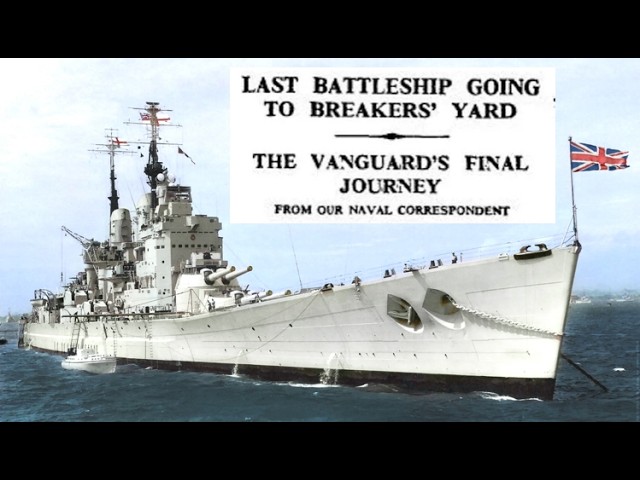
Next went HMS Royal Sovereign and Resolution in 1949, with HMS Nelson and Rodney following. More went in the 1950s: HMS King George V, Duke of York, and Anson in 1957, HMS Howe in 1958. By 1960, the Royal Navy had one battleship left, the only one built after the war, HMS Vanguard, a vessel of 44,500 tons armed with eight 15-inch guns. By mid-1962, she too had been cut up for scrap, earning the government 560,000 pounds.
The British battleships all went before the idea of preserving big warships as museums had even taken hold in the UK. The case of the aircraft carriers, however, is hard to justify. Successive governments have shown no interest in preserving examples of these vital British warships for future generations. The Ministry of Defense also blocks preservation efforts, unable and unwilling to shoulder the costs of preparing these vessels to meet museum standards due to its own budget constraints.
So it has been left to a series of organizations attempting funding campaigns to try and save what can be saved of British history. There have been multiple attempts over the past fifty-odd years in the UK to preserve at least one aircraft carrier, and all have failed. Out of roughly forty aircraft carriers of all classes that have served in the Royal Navy since World War II, only two remain today. HMS Queen Elizabeth and Prince of Wales are the current serving carriers.
I say serving, but that is a relative term when it comes to these two behemoths, which still do not have enough aircraft and constantly break down. They are, in many ways, a bit of a national embarrassment compared to earlier British carriers. A seven-billion-pound national embarrassment. But opportunities have existed to save at least one World War II-era British aircraft carrier.
For example, the Colossus class light fleet carrier HMS Vengeance, built during the war and sold to Brazil in 1956, remained in operation until 2001. Several British naval associations sought to return her to the UK as a museum, but failed to raise enough money and received absolutely no assistance from the British government. At Christmas 2003, the carrier was listed on eBay. Bidding reached four million pounds before the auction was removed under eBay’s rules against promoting the sale of military ordnance.
Auctioned at Rio de Janeiro in February 2004, the ship failed to sell. She was then towed to India and scrapped. The last British carrier with conventional catapult and arrester gear for fast jets was HMS Ark Royal, laid down in World War II and commissioned in 1955. In 1979, she was decommissioned as the government retired the Fleet Air Arm’s catapult-launched Phantoms and Buccaneers.
There was strong public demand to preserve her, and a proper proposal was put to the Ministry of Defense to save her as a museum ship to be moored at Greenwich in London. The Ministry of Defense blocked this in March 1980, arguing that the carrier was worn out and that the costs would be exorbitant to get her into a condition suitable for opening to the public. However, a private bidder estimated that 750,000 people a year would have visited the ship, generating considerable revenue. The Ministry of Defense, nevertheless, decided instead to scrap her for a paltry 2.
5 million pounds. She was broken up in Scotland, finally disappearing in 1983. It happened again, this time with a Falklands War veteran. In fact, the flagship of that campaign, HMS Hermes, a Centaur class light carrier laid down in 1944 and commissioned in 1959, had operated the vertical takeoff and landing Sea Harrier.
Following service in the Falklands War, Hermes was offered for sale to Australia, but that was turned down. In 1984 she paid off, and in 1986 she was sold to India, serving in that navy until 2017. India initially wanted to preserve her as a museum herself, but in 2019 the Indian government decided to scrap her instead. A bid had been made by British groups to raise 100,000 pounds to begin the process of moving her to the UK as a museum, but only a tenth of that money was raised.
In 2021, the ex-Hermes was scrapped. Efforts were made again more recently when the government decided to dispose of Britain’s three Invincible class carriers that had served from 1980 to 2017. HMS Invincible was also a Falklands War carrier, serving alongside Hermes, but her historical significance did not save her. Laid up in 2010, she was offered for sale in 2011, then scrapped in Turkey that same year.
The second ship of the class, HMS Illustrious, was decommissioned in 2014, and the Royal Navy said it was interested in preserving her. Two British organizations submitted bids, but the Ministry of Defense judged both to be unworkable and offered her for recycling instead. Three months later, she was sold to a Turkish scrapyard and broken up in 2016. The last and most recent attempt to preserve an aircraft carrier for the nation involved the third ship of the Invincible class, HMS Ark Royal, named for the earlier carrier scrapped in the 1980s.
Due to defense cuts in 2010, Ark Royal was decommissioned, ending Britain’s carrier force for the time being until the arrival of the massive Queen Elizabeth class carriers in 2017. Ark Royal was decommissioned in March 2011. The Ministry of Defense stated that options were being considered: scrap her, sell her, or preserve her, with the latter hopefully mooring her in London as a museum ship. The Ministry stated that turning Ark Royal into a museum would require at least 18 million pounds initially to replace stripped equipment, along with 2.
5 million pounds in annual maintenance. In March 2011, the MOD placed Ark Royal for sale by auction. Then in September 2012, the MOD announced she had been sold to a Turkish scrapyard for 2. 9 million pounds.
Scrapping began in 2013. America has preserved two cruisers. Incredibly, so has Britain. The first and most famous is HMS Belfast.
Laid down in 1936, this Town class light cruiser served throughout World War II, escorting Arctic convoys to the Soviet Union, fighting at the Battle of North Cape where she helped destroy the German battleship Scharnhorst, and providing bombardment support during the D-Day landings in June 1944. She later joined the British Pacific Fleet at the end of the war and saw action in the Korean War. She was only saved from scrapping by chance when Imperial War Museum staff visited her in 1967 as she lay laid up awaiting the breakers. They were actually there to see another ship held alongside, HMS Gambia, interested in preserving one of her gun turrets.
But Gambia was in very poor condition. Belfast, on the other hand, looked to be in much better shape. Upon examining the vessel, they discovered her hull and machinery had been well looked after because she had been used as an accommodation ship. A decision was made to try and preserve the entire ship for the nation.
The Ministry of Defense agreed and in 1971 proposed this to the government. However, Treasury officials, who controlled the money, blocked the plan in March 1971, determined to scrap the cruiser for 350,000 pounds. A former Belfast captain and sitting member of Parliament, Rear Admiral Sir Morgan Morgan-Giles, established the private HMS Belfast Trust. He managed to secure a temporary stay of execution for the ship just twenty-four hours before scrapping was due to begin.
The trust raised sufficient funds and gained ownership of Belfast in July 1971. She was transferred to London and moored on the Thames, opening to the public for the first time on Trafalgar Day, 21 October 1971, making her the first Royal Navy ship saved for the nation since Nelson’s HMS Victory in 1922. The other light cruiser saved for the nation sits, ironically, in Belfast. HMS Caroline was commissioned in 1914 and fought at the Battle of Jutland in 1916.
She was first saved from the breakers’ yard in 1923 when the government wanted an old vessel to serve as a static headquarters and training ship in Belfast, where a new division of the Royal Naval Volunteer Reserve had just been established. In 1924, she was towed to Belfast and has remained there ever since. She served as a headquarters vessel for the Reserve until 2011, when the Ministry of Defense, facing the costs of maintaining such an old ship, decided to scrap her. But the National Museum of the Royal Navy stepped in, and armed with 15 million pounds from the Heritage Lottery Fund and the National Heritage Memorial Fund, successfully purchased the vessel and converted her into a museum in the Titanic Quarter.
She remains the last significant British World War I Royal Navy ship still in existence today. Though both carriers involved in the Falklands War, Britain’s greatest naval feat since the end of the Second World War, were scrapped, at least one naval vessel from that campaign was preserved. HMS Plymouth, a frigate, was preserved as a museum ship, but even that did not save her in the end. Plymouth was significant because it was aboard her that Argentine forces signed the surrender of South Georgia in 1982.
After decommissioning in 1988, she was operated as a museum ship by the Warships Preservation Trust in Birkenhead. I visited her back in the 1990s, where she was displayed alongside the recently recovered German U-boat U-534, which was then complete and extremely spooky inside. However, in 2006, the trust went into liquidation, and HMS Plymouth ended up owned by Peel Ports Group, which operates the Birkenhead Docks. They had no interest in preserving the warship.
A preservation trust was founded to raise 250,000 pounds to move her to the city of Plymouth, which had offered a berth, but that offer was withdrawn in 2007. In 2012, Peel Ports signed a contract with a Turkish scrapper to recycle HMS Plymouth. Despite last-minute crowdfunding campaigns and legal injunctions, all efforts were dismissed. In 2014, Plymouth was towed away for scrapping in Turkey.
Britain did manage to preserve one destroyer from World War II, HMS Cavalier. In 1972, she was decommissioned at Chatham Dockyard and moved to Portsmouth to be paid off. In 1971, she had been named the fastest ship in the fleet, making her very popular with the public. A PR campaign was launched led by Earl Mountbatten of Burma, former British Supreme Commander Southeast Asia and, in the 1960s, head of the Royal Navy.
The Cavalier Trust purchased the vessel in 1977 for 65,000 pounds, saving her from the breakers. Since 1999, she has been at Chatham Historic Dockyard in Kent as a museum ship and is well worth a visit. Thankfully, I can end with a little good news. Another Falklands War veteran, another frigate, has been found and is in the process of becoming a museum.
HMS Ambuscade served in the Falklands War and was sold to Pakistan in 1993, serving in the Pakistan Navy until 2023. Rather than scrapping her, Pakistan donated her back to Britain. She is now the responsibility of the Clyde Naval Heritage Organization and is being returned to the United Kingdom, where she will become a museum on the River Clyde in Scotland.
That is fantastic news.