Twice in the space of a decade, the same proposal was placed before the same people. In 1937 and again in 1947, plans were drawn up to divide the land of British Mandatory Palestine into two states, one Jewish and one Arab. On both occasions, the Jewish leadership said yes. On both occasions, the Arab leadership said no.
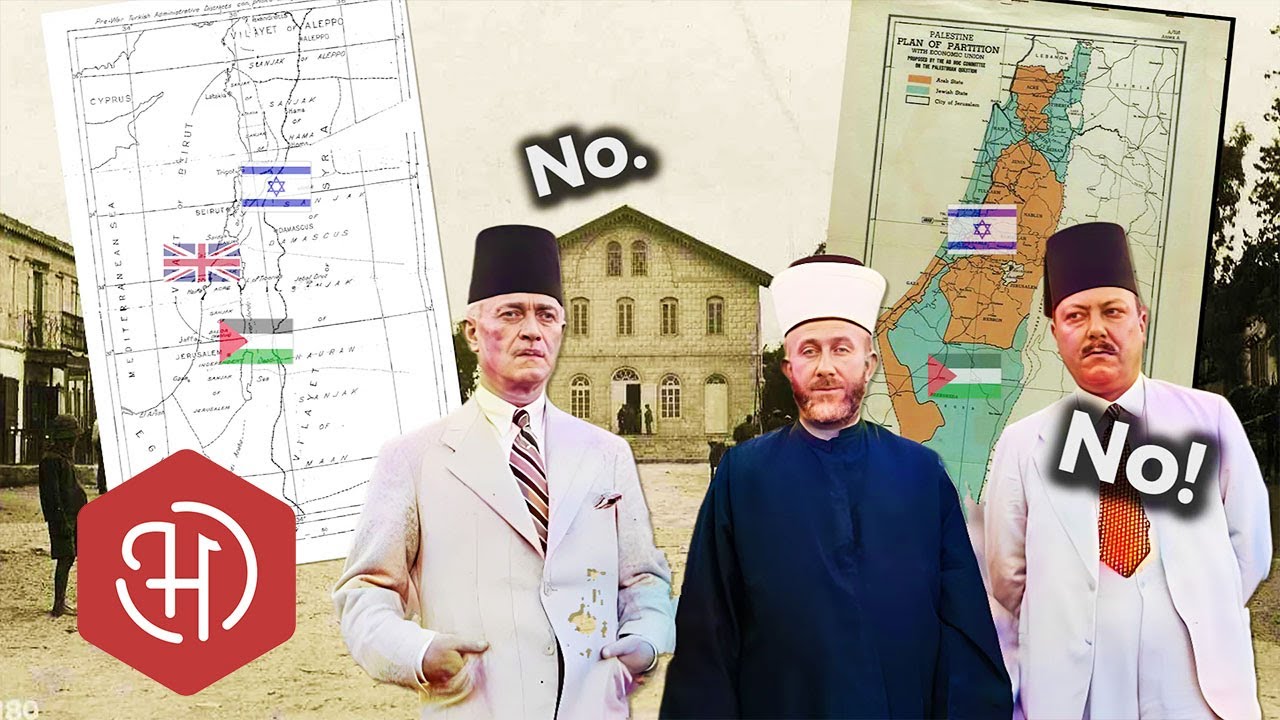
Given how the conflict looks today, it is reasonable to ask why the Arab Palestinian leaders were so determined to reject every offer of partition. The roots of the problem go back further than most people realize. When Britain received the mandate over Palestine after World War One, the territory it governed actually included land on both sides of the Jordan River. The area east of the river, known as Transjordan, was part of the mandate on paper.
But as early as 1922, the British decided to govern it separately, excluding it from Jewish immigration and settlement and handing it to Emir Abdullah of the Hashemite dynasty. In practice, it was a separate administrative unit from the start. In 1946, Transjordan became fully independent and was renamed the Hashemite Kingdom of Jordan, cutting its ties with the mandate entirely. West of the river, the situation grew more explosive with every passing year.
Jewish immigration increased during the 1920s and 1930s, driven largely by persecution in Europe, and each wave of newcomers deepened Arab fears of being displaced in their own land. Violence broke out early and often. In April 1920, dozens were killed in Jerusalem during a Muslim festival as tensions over growing Zionism boiled over. The following year, clashes in Jaffa and the surrounding areas, which began during a May Day parade, spiraled into Arab attacks on Jews that left almost a hundred people dead and more than two hundred wounded.
In 1929, the Hebron massacre occurred. Nearly seventy Jews were killed by Arabs, many were injured, and Jewish homes and businesses were looted. The violence was part of the wider Palestine riots, which claimed the lives of over a hundred Arabs as well. In some mixed cities, what remained of Jewish-Arab coexistence collapsed.
The deadliest outbreak came in 1936, when the Arab Palestinians launched a major revolt against the British. It began as a general strike accompanied by anti-Jewish and anti-British violence, and from 1937 it grew into a large-scale rebellion targeting both British forces and Jewish settlements. The British responded with a brutal counterinsurgency campaign that included curfews and collective punishments. According to official British reports, the army and police killed more than two thousand Arabs in combat, over a hundred were hanged, and nearly a thousand died in what the authorities described as gang and terrorist activities.
Around five hundred Jews and roughly two hundred and fifty British soldiers also lost their lives. It was during the early stages of that revolt that the British formed the Peel Commission. Its stated purpose was to study the causes of the conflict. It was the most thorough inquiry into the Palestine question that had been carried out to that point, and its report remains one of the most important sources for understanding the period.
But there was something misleading about the entire exercise. As one observer put it, the Royal Commission had not come to study anything at all. It had come to help the government divest itself of Palestine. Lord Peel seemed to have arrived with a foregone conclusion.
The social, moral, and political gaps between the Arabs and the Jews, he wrote to the colonial secretary, were already unbridgeable. The report issued at the end of the investigation quoted an English proverb: half a loaf is better than none. It recommended that Palestine be divided between the two communities. Over the previous decade, at least ten different schemes had been floated to split the country into regions, cantons, autonomous areas, or independent states.
The Peel Commission produced a document of about four hundred pages, dense with information and intelligent analysis, including maps that traced possible borders between two states. Under its proposal, the Jews would receive Tel Aviv, Haifa, the coastal plain, the northern valleys, and part of the Galilee. The Arabs would receive the West Bank of the Jordan River, the mountainous region, and the desert in the south. The British would keep Jerusalem and a narrow corridor linking it to the sea.
The commission also recommended restricting Jewish immigration to a political high limit of twelve thousand per month during the interim period, depending on the establishment of the independent Arab and Jewish states. The British government accepted the recommendations. To many observers, the proposal seemed to give the Arabs a great deal, leaving the British with only Jerusalem, largely as a sentimental gesture. Yet the Arabs were not interested.
Many Jews were not either. Edward Keith-Roach, a British colonial administrator who served during the mandate, summed up the reaction with a striking image. The Jews, Christians, and Muslims, he said, were like three bewildered children at a party. We don’t want jam.
We don’t want honey. We don’t want cake. We want jelly. Alas, there is no jelly.
The Jewish and Arab responses were shaped by internal politics on both sides. Among the Arabs, leadership under the Mufti of Jerusalem, Amin al-Husayni, opposed partition and made sure that anyone in favor of it was silenced. Among the Jews, the leaders of the Zionist movement, including David Ben-Gurion, were inclined to support the idea but were forced to express reservations under pressure from opponents. The Arab opposition was unbending.
Arab leaders could not agree to cede any part of their country to the Jews. But the partition plan was not the only reason for the Arab fury. The Peel Commission also suggested a population transfer. Thousands of Arabs living in the territory allocated to the Jews would have to leave their homes.
The commission pointed to the population exchanges between Turkey and Greece in the early 1920s as a model. The English missionary Frances E. Newton described the Arab sentiment plainly. Everyone is simply appalled by the recommendation for partition, she wrote.
A friend of mine said to me, the report is like a toxic fly killer, and we are the flies on the floor. The Zionist movement did not reject the plan outright, but it disagreed with some of the details. For the Jews, the plan was the realization of a dream. A Jewish state would finally become a reality.
Ben-Gurion wrote in his diary that it would give the Jews something they had never had, even under their own authority, neither in the period of the First Temple nor in the period of the Second Temple. For the Arabs, it meant giving up part of the land to what they saw as foreign invaders. It must be said that Jews already inhabited the land, but their numbers were growing steadily, and would only grow more as Europe became an increasingly dangerous place for them. Because of the Arab rejection, the plan was never put into practice.
As the Arab revolt gradually fizzled out, the British themselves eventually turned against the idea of partition. In 1939, they issued the White Paper. It rejected partition and proposed limiting Jewish immigration to fifteen thousand per year for the next five years, while also restricting the ability of Jews to buy Arab land. As one British diplomat stated, the White Paper was meant to placate the Arabs so they would be willing to fight on the British side in a possible confrontation with Hitler.
It was issued in mid-May 1939. World War Two broke out a few months later. During the war, some Arabs aligned with the Axis powers, most notably the Mufti al-Husayni, who collaborated with Nazi Germany. In 1945, the war ended.
Six million Jews had been murdered by the Nazis. The survivors wanted to move to Palestine and establish their own state. Britain, however, was exhausted. It had emerged victorious but financially and morally drained.
Violence between Jews and Arabs was spiraling out of control, and the British were desperate to leave the area altogether and hand the matter to the newly established United Nations. The UN formed the United Nations Special Committee on Palestine, known as UNSCOP, which came up with a new partition plan that was put to a vote on November 29, 1947. A year before that, the Morrison-Grady plan had been drafted, proposing a federated solution or canton system. The Arabs rejected it, as they rejected any plan that recognized Jewish political autonomy in any form.
The writing was already on the wall for another Arab rejection. What did the UN plan entail? Palestine would be divided into two states, one for the Jews and one for the Arabs. Jerusalem was to remain under international control.
The proposed boundaries assigned the Jewish state almost twice as much territory as the British plan had offered ten years earlier. And the Arabs had turned that earlier proposal down as well. The Arabs opposed partition and continued to demand independence in all of Palestine, promising to respect the rights of the Jewish communities within it. Although there were Jews who opposed partition too, the Zionist movement accepted the plan.
But many knew it could not be implemented peacefully. The border between the two states was long and hard to defend. The Jewish state would include more than half a million Arabs, slightly more than the number of Jews then living within the proposed boundaries. About ten thousand Jews would be living within the Arab boundaries.
There was also little reason to trust that international control of Jerusalem would be viable. No one believed in the UN’s map. Everyone knew there would be war. The Arabs rejected the 1947 partition plan for several reasons.
At the time, Arabs made up about sixty-five percent of the population of Palestine and owned most of the land. Yet the UN plan awarded the proposed Jewish state around fifty-five percent of the territory, including the fertile coastal and northern areas. To Arab leaders, this seemed deeply unfair. A minority, many of whom were recent immigrants, was being given more than half of the country.
Beyond the question of fairness, most Arabs rejected the very principle of partition. They considered all of Palestine to be Arab land, part of a larger Arab nation, and they opposed the recognition of a Jewish state in any form. There was also the fate of the Arabs who would find themselves living inside the borders of the proposed Jewish state. Many feared displacement or becoming a vulnerable minority.
The rejection was led by the Arab Higher Committee and supported by the Arab League, which included neighboring Arab nations. Some leaders, like King Abdullah of Transjordan, had their own ambitions for parts of Palestine, but the Arab states presented a united front in refusing the plan. More broadly, the Arabs saw the UN proposal as another form of Western colonial interference, imposed without their consent after decades of British control. Accepting the plan would have meant legitimizing Jewish statehood in Palestine, something Arab leaders simply were not willing to do.
War was on the horizon. At the end of April 1948, the British paid off their local staff and prepared to leave. On May 14, as promised, the British High Commissioner left Jerusalem by plane. The mandate had ended.
At the Allenby Bridge, King Abdullah of Jordan raised his revolver, fired into the air, and shouted, Forward. Overnight, US President Truman recognized the state of Israel. On May 15, the first Arab-Israeli war formally began. More Arab nations would join in the fighting.
Israel won that war. Over seven hundred thousand Palestinians fled and were expelled from their homes. Armistice negotiations followed. Arab states signed ceasefires, but they refused to sign peace treaties recognizing Israel.
In 1967, at the Khartoum Conference, the Arab League declared the famous three noes: no peace with Israel, no recognition of Israel, no negotiations with Israel. The partition plans of 1937 and 1947 were both rejected by the Arab leadership. Each rejection was driven by a mix of fairness, principle, fear, and pride.
The result was war, displacement, and a conflict that has not ended to this day.