“Do you even know how to cook? I mean, Greg is always taking clients out to eat. Usually, that’s a bad sign. ”
The voice cuts through the smooth jazz spilling from the ceiling speakers.
Blake Whitmore, a real estate broker with too much pomade in his hair and a mouth that runs far ahead of his brain, raises a crystal flute of champagne toward my end of the long mahogany table. Every eye in the Dallas penthouse shifts to me. A few throats clear. The air turns thick as wet cement.
My right knee throbs. A dull, heavy, rhythmic ache. Titanium screws grinding against damaged bone. A parting gift from a life these people know nothing about.
I don’t look at Blake right away. My eyes sweep right first. Muscle memory. Counting exits.
Two heavy oak doors. One floor-to-ceiling window overlooking the skyline. Six potential threats armed with serrated steak knives. The smell of overpriced cologne mixes with charred ribeye.
Suffocating. I sit perfectly still. The ice water in my glass sends a bitter cold through my fingers. Fingers covered in thick, faded scars.
The table is set with imported white silk and polished silver. The women wear designer dresses and heavy diamonds. The men debate golf handicaps and stock portfolios in custom-tailored suits. And then there’s me.
A plain black dress. The standard uniform for a CEO’s wife, designed to fade into the background. Designed to make the man beside me look larger than life. I look at Greg.
My husband. The man I’ve shared a home with for two decades. In the military, when you’re caught in the crosshairs, your unit steps up. They lay down suppressing fire.
They throw their bodies in front of flying shrapnel. You don’t have to ask. It’s the code. You protect your own.
I watch Greg. I wait for him to set down his fork. I wait for him to clear his throat, to shift the attention, to say something. Anything.
To shut Blake down. He doesn’t. Instead, the corner of his mouth twitches upward. He shrugs, his tailored jacket pulling tight across his back.
A low chuckle escapes his throat. He laughs with them. He serves me up on a silver platter. He throws me under the bus to save face in front of a man who sells luxury condos.
Greg chose the crowd. He chose the cheap applause of empty suits over the dignity of his wife. The pain doesn’t hit me like a bullet. Bullets are honest.
They come at you straight from the front. This is a rusted knife slipped quietly between the ribs by the very person who’s supposed to guard your blind spot. Laughter ripples across the dining room. Polite, condescending rich people laughter.
They look at me like I’m a broken appliance. A woman with no value because she can’t baste a turkey. To them, a silent woman is an empty woman. My stomach twists, but my heart rate stays steady.
Fifty-eight beats per minute. I know because I’m counting. Drilled conditioning. When the world catches fire, you don’t panic.
You slow down. You analyze. I release my grip on the steak knife and let it drop. Click.
The sharp sound of heavy metal hitting fine porcelain slices through the chuckles. The laughter falters. I place both hands flat on the table. The thick calluses on my knuckles, the rigid burned skin on my palms, look out of place against the immaculate white silk.
They’re the hands of a mechanic, a fighter, a survivor. Not a socialite. I breathe in through my nose, dragging the air deep into my lungs. I lock the anger, the humiliation, the disgust into a steel box in the back of my mind.
I don’t yell. Yelling is what weak minds do when they lose control. The room still vibrates with their hollow amusement. I finally turn my head and look dead into Blake Whitmore’s eyes.
Not at his expensive suit or his flashy watch. I look through the soft, sagging fat of his neck and his fragile, inflated ego. The way a predator watches a loud, oblivious animal grazing in the open. I don’t blink.
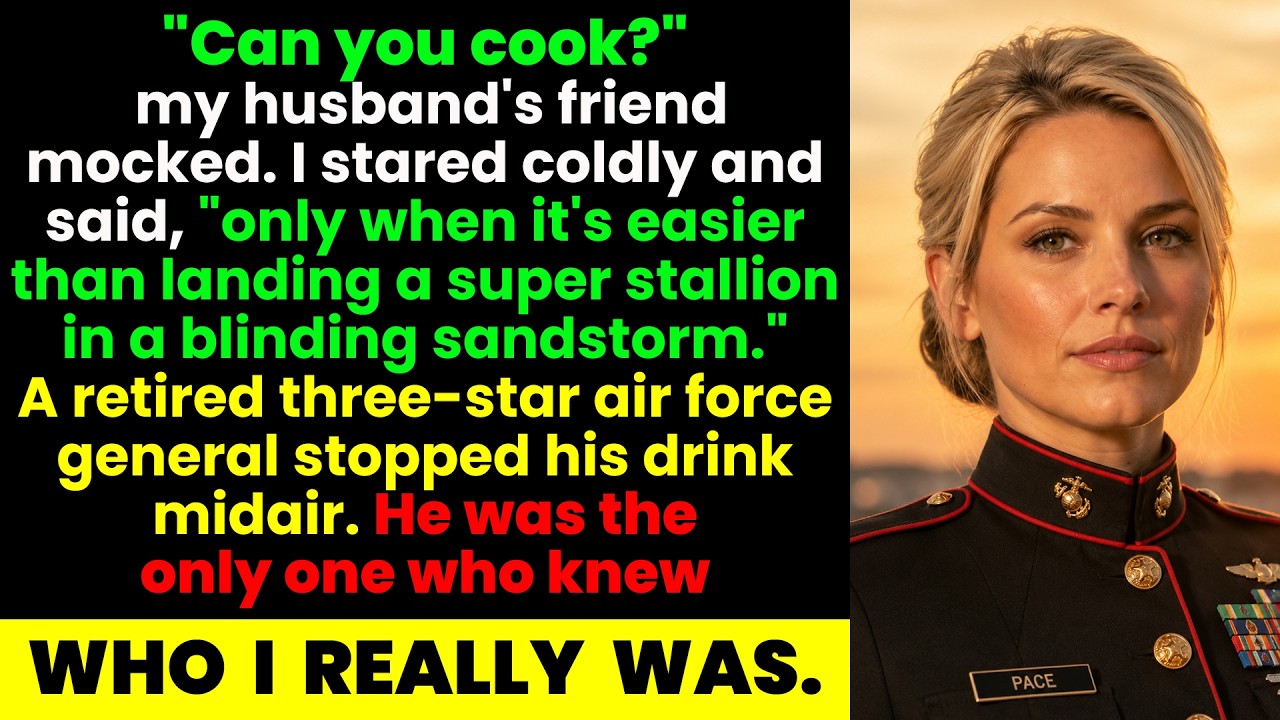
I don’t raise my voice. I don’t have to. “My specialty was landing a thirty-ton helicopter in conditions where the visibility was exactly zero. It’s actually easier than landing a CH-53E Super Stallion in the middle of a blinding sandstorm.
That’s only difficult when it’s easier than dealing with people who mistake silence for weakness. ”
The words drop heavy onto the table. For a second, nobody breathes. The jazz fades into the walls.
Then Blake snorts. Someone at the far end chuckles. They think it’s a joke. They think the quiet wife who can’t bake a casserole just made a sarcastic comment about some action movie.
I sit perfectly still. My scarred hands remain flat on the silk. Greg raises his wine glass to his lips, oblivious to the shift in pressure. They sip their champagne, chew their beef, flash their empty smiles.
They think they’re mocking a harmless shadow. They have no idea the monster they’re laughing at just pulled the safety pin. The laughter begins to die out. Not because they realize they’ve crossed a line, but because the atmospheric pressure in the room drops.
Across the table, past the empty glasses and half-eaten ribeye, sits a man who didn’t smile. Didn’t chuckle. Didn’t even blink. Frank Dawson.
Sixty-eight years old. Retired Air Force general. Three silver stars that no longer appear on his collar but still weigh heavy on his shoulders. He holds a crystal glass of bourbon.
The ice cubes clink against the rim. The only sound left in the room. He stops the glass halfway to his mouth and sets it down slowly. He leans forward, resting his forearms on the white silk.
A small, quiet movement that crushes the room into silence. His eyes lock onto mine. Eagle eyes. Sharp, calculating, unforgiving.
He looks past the stupid black dress, past the carefully constructed facade. He sees the phantom rank pinned to my collar. He sees the dirt, the grit, the blood. He clears his throat.
The sound is like boots over crushed gravel. “Major Pace. ”
The dining room freezes solid. The word drops into the middle of the table like a live grenade.
Major. The syllables hit the fine china and bounce off the crystal flutes. For a fraction of a second, my heart skips. A hard, painful scratch.
How many years since someone in this city called me by that rank? How long have I played the silent background prop in Greg’s corporate theater? Blake opens his mouth. No sound comes out.
The smug confidence melts off his face. Greg stares at the general, jaw slack, his brain failing to process the military title attached to his own wife. I keep my face flat. Cold control.
I look directly at Dawson and give him a slow, measured nod. “Not here, sir. ”
The corner of Dawson’s mouth twitches. A bitter, knowing half-smile.
He leans back in his leather chair. “I figured as much,” he says. He picks up his bourbon and drinks. He doesn’t look at Blake.
He doesn’t look at Greg. He dismisses them completely. In a matter of seconds, he draws a hard, invisible line in the sand. General Dawson and I are on one side.
The rest of the room is on the other. Three hours later, the party’s over. A sudden Texas storm rolls through the city. Cold rain whips across the dark valet lot.
I stand under a dim orange streetlamp, pulling my coat zipper to my chin. My right knee grinds with every step. The cold always makes the titanium screws ache deep in the bone. Greg is twenty yards away, arguing with a valet over a microscopic scratch on his Porsche.
He’s loud. Throwing his weight around. Using his money as a weapon against a kid making minimum wage. A shadow steps out from behind a concrete pillar.
General Dawson. No umbrella. The rain runs off his broad shoulders. He doesn’t waste time with pleasantries.
He steps into my space, presses a small piece of card stock into my palm. “We need to talk about Kandahar. 2011. ”
The words hit me like a steel wrench to the gut.
Kandahar. The Dallas rain disappears. My lungs fill with the thick, choking smell of burning aviation fuel. I taste metallic sand and hot copper blood.
I hear the grinding of torn aluminum rotors. I feel the dead weight of a bleeding mechanic slumped across my shoulders. I look down at the card. It feels like lead.
I flip it over. A direct phone number is written in black ink. I look up. Dawson is already gone, swallowed by the rain and shadows.
At two in the morning, the storm hammers against the windows of our suburban house. The rain sounds like television static. I sit alone in the dark kitchen, perfectly still. The business card is pinched between my fingers.
The sharp edges dig into my calloused skin. Footsteps shuffle across the hardwood. The refrigerator door pulls open. A blinding beam of fluorescent light spills across the dark kitchen.
Greg stands there in his silk pajamas, grabs a bottle of water, twists off the cap, drinks. He yawns. He squints, noticing me in the shadows. He doesn’t ask why I’m awake.
He doesn’t ask what Dawson said. He sighs. “Come to bed, Hannah. You need to let it go.
Blake was just making a joke. Don’t make a big deal out of it. ”
The cold water drips from his hand onto the floor. Tick.
Tick. Tick. “Just forget it. ”
He pushes the refrigerator door shut.
Slam. The light vanishes. The kitchen goes pitch black. I sit in the dark.
My breathing stays even. Fifty-eight beats per minute. That wasn’t advice. That was a command.
A cowardly demand for my silence. He wants me to erase my history. He wants me to swallow the insult so he can sleep soundly. He wants me to be nothing.
My thumb traces the raised ink on the card. Kandahar. Ten years of keeping the nightmares locked in the basement. Ten years of making myself small so my husband could feel big.
I place the card flat on the marble counter. Greg thinks he just ended a minor domestic disagreement. He doesn’t know he just handed a match to an arsonist. Nine a.
m. The sun cuts a bright white line across the kitchen floor. My coffee sits cold. My phone buzzes.
Unknown number. I answer and set the phone on the counter. “Major Pace. ”
General Frank Dawson’s voice, rough as tires on broken glass.
“Sir. ”
“The Heritage Council finally pushed the paperwork through. Kandahar, Operation Desert Rescue. It’s officially declassified.
Ten years in the dark, Major. They’re pulling it into the light. We’re honoring you next Friday night. ”
My lungs stop working.
A decade for the government to admit we were even in that valley. That mission cost me a right knee. It cost two crewmen their lives. I still see their faces when I close my eyes.
“And Major,” Dawson adds, a bitter edge creeping in. “You should know the primary sponsor writing the check for this gala. It’s LoneStar Corporate. Your husband’s firm.
”
The line goes dead. I stand alone in the kitchen. Lonestar. Greg’s company.
They sponsor military events for the tax write-off and the PR photos. They buy their patriotism with company credit cards. At two that afternoon, I drive downtown. I push through the glass doors of the LoneStar executive suite.
The receptionist barely looks up. I walk down the carpeted hallway and push open Greg’s office door. He’s out playing golf. The room smells of stale cigar smoke, leather conditioner, and unearned arrogance.
Framed certificates cover the walls. Sales milestones. Regional leadership awards. Meaningless plaques bought with company money to make small men feel important.
I walk past his mahogany desk to the oak filing cabinet in the corner. For eight years, a single silver picture frame sat on that cabinet. The only piece of my actual life allowed inside his carefully curated world. A photograph taken on the burning tarmac at Bagram.
Me covered in brown sand and engine grease, in desert combat uniform, standing next to the shattered fuselage of my CH-53. Visual proof that I bled for something real. The frame is gone. In its place sits a cheap plastic trophy.
A molded golden man swinging a golf club. First place at a charity scramble. The fake gold paint is chipping. Right next to the plastic base, there’s a perfect rectangular outline in the dust.
The exact dimensions of my silver frame. He didn’t misplace it. He didn’t pack it away. He erased it.
He wiped away the blood I left in the desert to display a cheap plastic toy. He traded my sacrifice for a golf swing. My jaw locks. I drop my hand and walk to his desk.
I touch the mouse. The monitor flares to life. I open the file explorer. I navigate to the folder labeled “Family.
”
I scroll. Click. Click. Click.
Nothing. The photo of my promotion ceremony to Major. Gone. My formal photograph in Marine Corps dress blues.
Gone. The unedited shot of my flight unit from basic training. Erased. Every single piece of digital evidence tying me to the United States military has been systematically wiped from his hard drive.
Every rank. Every uniform. Every scar. Instead, I see a curated lie.
A fabricated existence built to stroke his ego. A photo of me in a floral sundress standing on the patio with grilling tongs. A photo of me out of focus at a corporate Christmas party while Greg holds up expensive wine in the foreground. A photo of me handing him a birthday cake.
He didn’t just hide my uniform. He designed a completely different woman. He took a combat commander, a woman who held the bleeding severed arteries of dying Marines in her bare hands, and digitally reconstructed her into a harmless prop. He’s terrified.
He’s terrified his wealthy friends will realize his wife has more courage in her shattered right knee than he has in his entire body. He feels small, so he shrank me down to fit his comfort zone. I take my hand off the mouse. No tears.
No sadness. Soldiers weep when they lose brothers in the dirt. They don’t cry over the actions of a coward. I reach into my coat pocket.
An hour ago, I drafted a text to Greg. About the gala. About Dawson’s call. I was going to give him a chance to be a husband.
I stare at the blinking cursor. My thumb moves. Delete. Delete.
Delete. I erase the entire message. I lock the screen. If my husband wants to play a game of shadows, I’ll let him.
If he wants to pretend I’m just a quiet little wife who can’t fight, I’ll give him the greatest stage in Dallas to prove it. I press the power button. The screen snaps black. I walk out and pull the door shut behind me.
The latch clicks into place. The silent campaign has officially begun. Brook Haven Country Club. Saturday afternoon.
The Texas sun beats down on the manicured grass. The air smells of expensive cigars, fresh turf, and unearned confidence. Greg and his associates gather around the tee box on the fourteenth hole. I stand by the golf cart with a bottle of mineral water.
The invisible wife. The silent spectator. Duke Hollander is holding court. Mid-level investment banker.
Buys military-grade tactical gear to visit the indoor shooting range on weekends. He leans on his titanium driver, waving his hand. “I’m telling you, these modern pilots have it completely easy. It’s all computers now.
Fly by wire. Autopilot. The machine practically does all the heavy lifting. It’s basically a video game.
”
Greg chuckles. Sips his overpriced beer. Nods along because Duke just bought a second home in Aspen. “Back in Vietnam, those guys actually had to fly.
Today, if the computer fails, these kids completely panic. ”
I look down at my hands. The thick white scars catch the sunlight. I flex my fingers.
The joints pop. For ten years, I’ve swallowed this garbage. I’ve stood in the background while men who’ve never thrown a punch debated the realities of war. I’ve let them pretend they’re predators because they know how to manipulate the stock market.
Not today. I pull off my sunglasses. The sunlight hits my eyes. I don’t blink.
I drop the water bottle on the golf cart seat. I step forward. The crunch of my shoes on gravel makes Duke pause. Greg looks at me, eyebrows pulling together.
He’s used to me fetching tees. He’s not used to me entering the circle. I walk straight toward Duke. I don’t stop at polite conversational distance.
I step into his personal space, forcing him to lean back against his golf bag. “You think flying a combat helicopter is like steering your Porsche down the interstate, Duke? ”
My voice is flat. It doesn’t rise.
It cuts through the humid air like a blade. The group goes silent. The clinking of clubs stops. Duke’s face flushes.
“Come on, Hannah. I was just talking about the technology. It’s a known fact—”
“Have you ever had to auto-rotate a thirty-ton machine into a brownout? ” I step one inch closer, locking onto his eyes.
“Have you ever had to drop a Super Stallion into a wall of desert sand with a forty-knot tailwind pushing you toward a rock face while your landing gear is blown to useless pieces by a rocket-propelled grenade? ”
Duke freezes. The blood drains from his face. A bead of sweat breaks along his hairline.
“Because the computer doesn’t fix a shattered rotor blade, Duke. The computer doesn’t stop your co-pilot from bleeding to death on the instrument panel. When the alarms are screaming and the sky is raining burning metal, you don’t look at a screen. You fly the damn aircraft.
”
I hold his gaze for three full seconds. The silence is crushing. Greg stares at me, paralyzed. Like a man who just found a rattlesnake on his front porch.
I don’t wait for an apology. I don’t care about Duke Hollander’s opinion. I turn my back, slide my sunglasses on, and walk to the golf cart. The next morning at seven, I sit in a worn vinyl booth at a cheap diner on the outskirts of Dallas.
The place smells of burnt bacon grease and strong coffee. General Dawson slides into the booth across from me. Faded flannel shirt. An old mechanic holding on to his last good wrench.
He slides a glass of black iced coffee across the scratched table. “You’re playing with them,” Dawson says. His voice is a low rumble. I pick up the glass.
The cold bites into my scarred fingers. “I’m not playing, sir. I’m establishing a perimeter. ”
Dawson nods.
He taps his thick finger against the front page of a discarded newspaper. “A real enemy is easy to fight, Major. You see a guy with a rifle, you know what to do. You shoot first.
But a man carrying a fragile ego? That’s a highly unpredictable threat. ”
I sip the bitter coffee. No sugar.
No cream. “A man can handle being defeated by a superior enemy,” Dawson continues. “He can survive losing his business. He can even survive losing his money.
But a man like your husband will absolutely lose his mind if he realizes he’s just a minor apprentice standing next to his own wife. You’re pulling the rug out from under his entire reality. ”
“He pulled the rug first,” I reply. “He erased my photographs.
He wiped my files. He tried to delete Kandahar. ”
Dawson leans back, looking out the window at the empty highway. “Then you make him eat it.
Don’t let him hide behind his money. Put him in the spotlight and let him burn. ”
When I return home late that afternoon, the house is quiet except for running water from the master bathroom upstairs. Greg is in the shower.
Whistling a cheerful tune. Getting ready for his big corporate gala Friday night. He thinks he’s the star. He thinks he’ll stand on a stage, shake hands with veterans, smile for the cameras while holding an oversized novelty check.
I walk into the kitchen and drop my keys on the counter. There’s a stack of mail by the sink. Catalogs. Credit card offers.
Utility bills. In the middle, a heavy envelope. High-quality textured parchment. Sealed with a gold embossed Air Force logo.
I pull it out and run my thumb over the raised letters. Guest of Honor. Major Hannah Pace. My heart doesn’t speed up.
My hands don’t shake. I’m perfectly calm. The kind of calm that comes right before a devastating air strike. Greg keeps whistling upstairs.
I don’t call out his name. I don’t show him the invitation. I open the junk drawer and slide the envelope deep into the back, burying it under old electric bills and expired coupons. I push the drawer shut.
It closes with a soft final click. The safety pin is pulled. The bomb is sitting quietly in the dark. All Greg has to do is step exactly where I want him to.
Dallas Aviation Museum. Friday night. The massive steel hangar is packed with three hundred guests. Wealthy donors.
Local politicians. Corporate executives pretending to care about the military. A decommissioned helicopter sits in the center of the room, polished and lit like a museum piece. Down in the VIP section, Greg holds court.
Custom-tailored tuxedo. Slicked-back hair. Heavy gold watch. He stands with Blake Whitmore and Duke Hollander, bragging about his company’s commitment to the armed forces.
“LoneStar has always supported the troops,” Greg says, gesturing grandly with his scotch glass. “It’s about giving back. Honoring the guys who actually put it on the line. ”
He uses their blood to buy public relations.
He writes a corporate check to buy patriotism. I don’t stand with him. I stand in the complete darkness of the backstage wings. The air is cool, faintly smelling of heavy machine oil.
I’m not wearing a modest black dress. I’m not wearing a floral apron. For the first time in ten years, I’m wearing my Marine Corps dress blues. The heavy dark blue wool fits perfectly.
The high red collar bites into my neck. The gold buttons run down the center of my chest. Pinned to the left side of my jacket is a thick stack of ribbons and medals. The Bronze Star.
The Purple Heart. The Air Medal. I’m a ghost. None of Greg’s friends know what I look like without a frying pan in my hand.
The house lights cut out. The hangar goes pitch black. The conversation stops. Three hundred people fall silent.
A single spotlight snaps on, hitting the center of the wooden stage. General Frank Dawson walks out in full Air Force dress uniform. Three silver stars gleam on his shoulders. He grips the podium and leans into the microphone.
When he speaks, his voice echoes off the metal roof like thunder. It’s not a speech. It’s a sentencing. “Kandahar.
2011. Operation Desert Rescue. ”
He pauses. “Visibility was absolute zero.
A massive brownout. Two dozen Rangers pinned down in a rocky valley, taking heavy RPG fire. Command ordered all birds to return to base. The risk was too high.
The mission was considered a total loss. ”
I close my eyes in the dark. I can still smell the burning sand. “One pilot refused to turn around.
” His voice drops an octave. “One pilot took a CH-53 Super Stallion, dropped it through a wall of blinding dust, took a direct hit to the landing gear, and held that crippled thirty-ton machine steady while taking heavy ground fire. That pilot saved twenty-six lives that night, taking a piece of shrapnel to the knee to do it. ”
The crowd is breathless.
Dawson looks up, staring directly into the front row. At Greg. “This event is sponsored by LoneStar. ” His tone drips with cold contempt.
“But the hero of that operation has been hidden in the dark for far too long. Ladies and gentlemen, please welcome the commanding pilot of that mission. ”
Dawson steps back from the microphone. “Major Hannah Pace.
”
The curtains pull back. A second spotlight snaps on, hitting me dead in the chest. The light catches the gold rank on my shoulders. I step out of the shadows.
The applause starts slow, then erupts. Deafening. Three hundred people get to their feet. The sound of metal chairs scraping concrete echoes like a localized earthquake.
The cheering bounces off the high metal ceiling. I walk to the center of the stage. Back straight. Steps measured.
My black shoes click sharply against the wooden floorboards. I stop at the podium. I look down. The VIP section looks like a car crash in slow motion.
Blake Whitmore is frozen, jaw hanging open. The crystal flute slips through his fingers and shatters on the concrete. He doesn’t blink. Duke Hollander looks like he’s going to be sick, staring at the stack of combat ribbons on my chest.
The woman he tried to lecture about aerodynamics is staring down at him in full military dress. And then there’s Greg. My husband. His face is pale as a corpse.
He grips the back of the chair in front of him so hard his knuckles turn blue. The expensive tuxedo, the slick hair, the arrogant CEO persona. All stripped away in seconds. He’s not a powerful man making a charitable donation.
He’s a fraud. A small, pathetic coward who spent ten years deleting files and hiding photographs because he was terrified the world would realize his wife was twice the man he could ever hope to be. I wait for the noise to die down. It takes almost a full minute.
When the room settles into heavy silence, I lean forward. “I didn’t fly that aircraft alone,” I say. My voice is calm, flat, devoid of ego. “I’m here tonight to read the names of fourteen combat mechanics and two field nurses.
They’re the ones who held the bleeding together. They’re the ones who pulled the dead out of the dirt. ”
I pull a folded piece of paper from my pocket. I don’t tell stories about my own bravery.
I don’t mention my shattered knee. I read the names of the dead. The absolute humility of it acts like a knife driving into the arrogant heart of the room. I don’t need to brag.
The truth is heavy enough to crush them all. I look down at Greg one last time. He’s trembling. I finish reading the final name.
I fold the paper. I step away from the microphone. I don’t stay for the handshakes. I don’t stay for the photos.
I turn my back on the spotlight and walk off the stage, heading for the dark corridor leading to the parking lot. I pull the white gloves off my hands. It’s time to finish this. The applause still thunders behind the double doors.
The muffled roar of three hundred people chanting my name vibrates through the wood. But out here, the silence is absolute. The air conditioning vents push freezing air down the long hallway, chilling the sweat on my neck. I stop under a flickering light.
I fold the gloves into a neat square and tuck them under my arm. I don’t feel triumphant. I just feel tired. Fast, erratic footsteps echo from the far end of the corridor.
Leather shoes slipping and squeaking against the marble. Greg bursts through the doors, letting them slam. He’s gasping for air. The tuxedo that made him look like a titan ten minutes ago now looks like a cheap rental.
His bow tie hangs undone. His hair falls messily across his forehead. He looks like a cornered animal. He stops a few feet away.
The smell hits me. Expensive scotch mixed with the sharp sour stench of fear. He swallows. His eyes dart around the empty hallway before dropping to the toes of my glossy black shoes.
He can’t look at my face. He can’t look at the medals on my chest. “Hannah. ” He wheezes.
Raises a trembling hand, then pulls it back. “I didn’t know. ”
The oldest, cheapest lie. He wants to play dumb.
He wants to pretend the erased hard drives, the hidden photographs, the endless humiliating jokes were all accidents. The oblivious bumbling husband. I don’t move. I cross my arms over my chest.
The Bronze Star presses cold against my forearm. “Ignorance is a liability, Greg. ” My voice is flat. Dead.
It echoes off the marble walls like a gunshot. “It’s not an excuse. Especially not after twenty years. ”
He shivers.
The freezing air hits the sweat soaking through his dress shirt. The last layer of his armor cracks. “I was scared. ” He chokes on the words, staring at the floor.
“I was terrified. If they saw you. If they really saw who you are and what you did over there, they’d see how huge you are. They’d look at me and see that I’m nothing.
Just a guy in a suit. I’d be nothing next to you. ”
The confession hangs in the air. Raw.
Pathetic. He expects pity. He expects the good, quiet, traditional wife to step forward, place a soft hand on his cheek, and tell him it’s okay. He expects me to shrink back into my box.
I don’t. I don’t shed a tear. My heart rate rests at fifty-eight beats per minute. “The fact that you felt small doesn’t disgust me, Greg.
” Every word is a calculated strike. “What disgusts me is that you spent ten years trying to shrink me down. You tried to step on my neck and bury me in the dirt so you could look in the mirror and feel tall. ”
Greg’s legs give out.
He collapses onto his left knee. One hand scrambles against the drywall to keep from falling completely. The great corporate provider, the wealthy alpha of the Dallas elite, reduced to a trembling mess on a museum floor. He looks up at me.
Eyes red and leaking. “Are you going to leave me? ”
I look down at him. In the military, deserting your post under fire is a capital offense.
You abandon your unit, you lose your honor forever. Greg deserted me a decade ago. He just did it in slow motion, wiping away my history one photograph at a time. “I’m currently deciding if I have a single drop of respect left for you,” I reply.
I don’t wait for a response. I uncross my arms. I turn my back on him. I walk away.
The rubber heels of my uniform shoes strike the marble in a sharp, rhythmic cadence. Clack. Clack. Clack.
The sound echoes down the long corridor, drowning out his ragged breathing. There’s no cheap forgiveness tonight. No screaming argument. No dramatic presentation of divorce papers.
I’m leaving him in a psychological prison of his own making. An indefinite sentence. Tomorrow morning, that plastic golf trophy goes straight into the garbage disposal. Tomorrow morning, the photograph from Bagram goes right back on that oak cabinet in his office.
I spent ten years hiding my scars in the dark to protect a coward. I’m done. He’ll spend the rest of his life walking on eggshells. Waking up every day looking over his shoulder, living in the massive suffocating shadow of the monster he foolishly tried to bury.
Major Pace is back.