Massive Ancient Tunnel Near Jerusalem Raises New Questions About Engineering, Purpose, and Lost History
On the outskirts of Jerusalem, near Kibbutz Ramat Rachel, archaeologists have uncovered a vast and puzzling underground tunnel carved directly into bedrock—an enigmatic structure that is now forcing researchers to reconsider what ancient builders in the region were capable of, and why such a complex passageway was created in the first place.
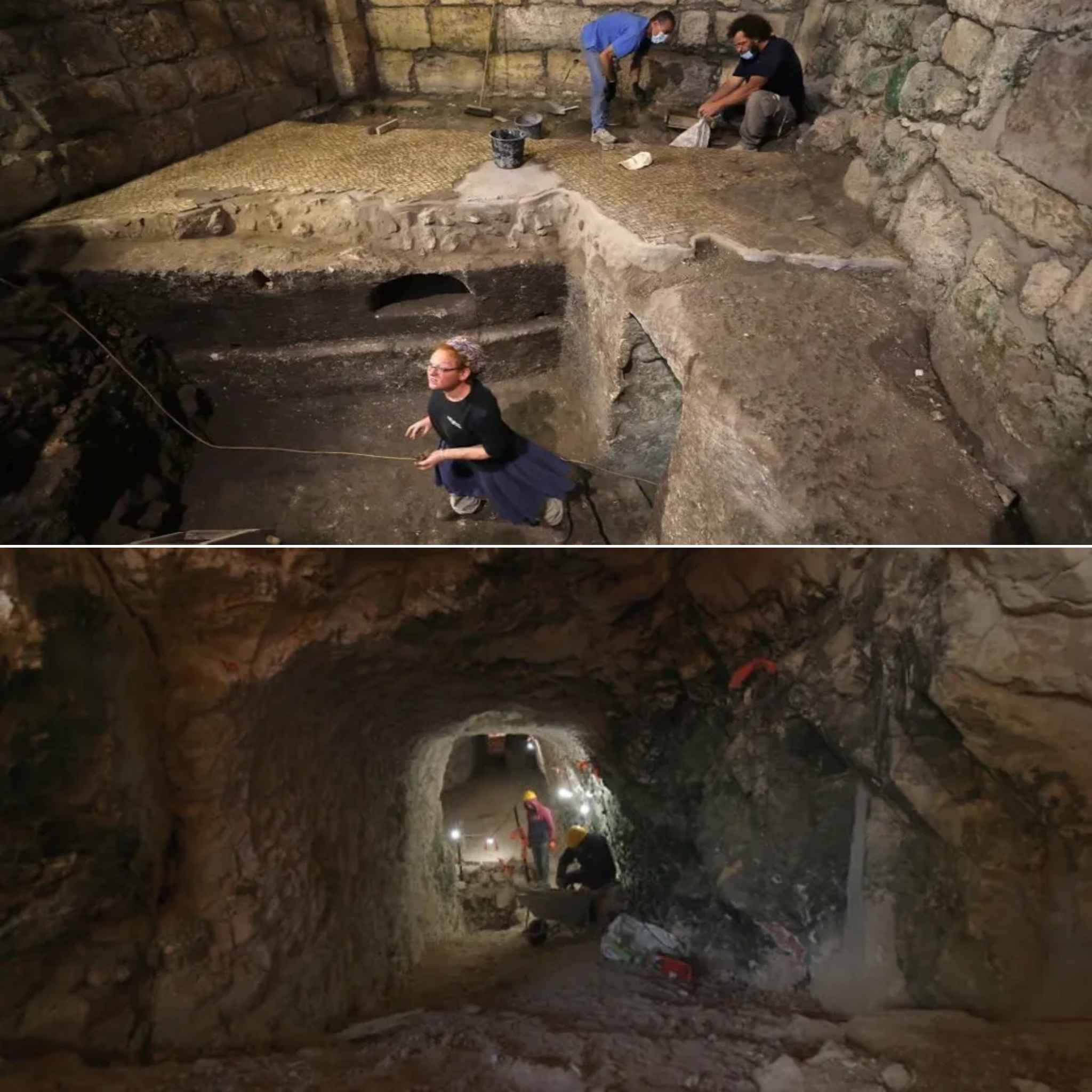
Stretching roughly 50 meters beneath the surface, the tunnel was initially discovered during salvage excavations conducted by the Israel Antiquities Authority ahead of modern residential construction. What began as a routine archaeological survey quickly turned into one of the most intriguing finds in recent years.
Beneath layers of soil and collapsed rock, researchers uncovered a carefully engineered subterranean passage featuring a staircase leading down into a hewn entrance. In some sections, the tunnel reaches up to five meters in height and three meters in width—large enough for movement, labor, or transport, but with no immediately obvious function.
A discovery hidden in plain sight


Excavation directors Sivan Mizrahi and Zinovi Matskevich described the moment of discovery as unexpected. What appeared to be a natural karstic cavity quickly revealed itself to be a human-made structure extending deep into the rock.
As the excavation progressed, the cavity transitioned into a long, engineered tunnel system, with signs of deliberate carving and careful planning. Archaeologists noted the precision of the excavation, suggesting that whoever constructed it had both technical skill and access to significant resources.
However, despite the scale of the structure, the tunnel has not yet revealed its purpose.
A structure without a clear function
One of the central mysteries surrounding the tunnel is its intended use. Early hypotheses suggested it may have been part of an ancient water system designed to access underground springs. Yet this theory was quickly challenged when researchers found no plaster lining—an essential feature of ancient water installations in the region.
Geological surveys also failed to identify any nearby water sources that would support such an explanation.
Alternative theories have included agricultural storage, industrial production, or a specialized infrastructure project. But each idea has encountered obstacles, largely due to the lack of comparable structures in the immediate vicinity.
The most widely considered hypothesis at this stage is that the tunnel may have been part of a quarrying operation, possibly intended to extract chalk for building stone or lime production.
Evidence supporting this includes a shaft carved into the ceiling—possibly for ventilation or access—and scattered quarry debris found along the floor.
Still, even this interpretation remains uncertain.
Researchers now entertain the possibility that the project was never completed, leaving behind an unfinished structure whose purpose was never fully realized.
A tunnel without time: dating the unknown
Perhaps the most frustrating aspect of the discovery is its lack of clear chronological context.
No pottery, coins, inscriptions, or organic remains have been found within the tunnel that could help determine when it was built. Without these markers, archaeologists are unable to confidently assign it to any known historical period.
The site’s proximity to other important archaeological locations adds to the complexity. Nearby lie remains of an Iron Age public building and layers of occupation at Tel Ramat Rachel, where evidence spans from the Iron Age through the Islamic period.
Yet the tunnel itself remains disconnected from these known timelines, as if it exists outside the established archaeological narrative of the region.
Engineering skill in ancient bedrock
Despite the uncertainties, one fact is not in question: the tunnel required extraordinary effort to construct.
Carving a structure of this size into solid bedrock would have demanded coordinated labor, planning, and tools capable of sustained excavation. The smoothness of certain sections suggests deliberate shaping rather than random digging, indicating that the builders had a clear design in mind—even if that design is now lost to time.
Archaeologists emphasize that such construction implies a level of organization and technological capability that challenges simple assumptions about ancient infrastructure in the Jerusalem region.
Competing theories and unresolved debate
Several interpretations remain under consideration:
- A water system, now largely rejected due to lack of hydraulic features
- A quarry or industrial site, extracting chalk or lime
- An unfinished construction project, abandoned before completion
- A specialized underground facility, possibly linked to nearby settlements
Each theory has partial support but fails to fully explain all observed features.
This uncertainty has made the tunnel a focal point of debate among archaeologists working in the region, particularly those studying ancient urban development and resource extraction systems.
Archaeology under modern development pressure
The discovery was made during preventive excavation work ahead of new housing development by the Israel Lands Authority. As is increasingly common in Jerusalem’s expanding urban areas, archaeology and construction are closely intertwined, with heritage teams racing to document remains before they are impacted by modern infrastructure.
Shikma Sig, a Jerusalem region planner, stated that the tunnel and surrounding finds will be integrated into a public archaeological park within the new neighborhood. The goal is to preserve the site while allowing development to continue around it.
This reflects a broader trend in the region: transforming archaeological discoveries into accessible heritage spaces embedded within modern urban life.
A city built on layers of mystery
Jerusalem’s archaeological landscape is famously complex, with thousands of years of continuous human activity layered beneath and above one another. The tunnel near Ramat Rachel adds yet another unresolved chapter to this long history.
Amit Re’em, Jerusalem district archaeologist for the Israel Antiquities Authority, summarized the sentiment among researchers:
“Usually we have explanations for the discoveries we uncover, but sometimes, as in this case, we stand astonished and amazed.”
The statement captures a recurring theme in archaeology: even in one of the most heavily studied regions in the world, major discoveries can still defy interpretation.
Heritage, identity, and interpretation
The discovery has also drawn attention from political and cultural figures. Israeli Heritage Minister Amichai Eliyahu described the tunnel as part of the long continuum of human presence in Jerusalem, emphasizing its symbolic connection to historical identity and construction activity in the region.
While such interpretations often extend beyond strict archaeological analysis, they reflect the broader significance of discoveries in Jerusalem, where history, heritage, and identity are deeply intertwined.
What the tunnel might still reveal


For now, the tunnel remains an unresolved puzzle. Further excavation may yet uncover artifacts, inscriptions, or structural clues that could clarify its age and purpose. Advanced techniques such as 3D scanning and micro-analysis of rock layers may also help reconstruct its history.
Until then, it stands as a reminder of how much of the ancient world remains hidden beneath modern cities—and how even in well-explored regions, archaeology still has the power to surprise.
The tunnel near Ramat Rachel is not just a structure waiting to be explained. It is also a reflection of a broader truth in archaeology: that history is often incomplete, and some of its most impressive creations leave behind more questions than answers.