The Lie Beneath the Victory
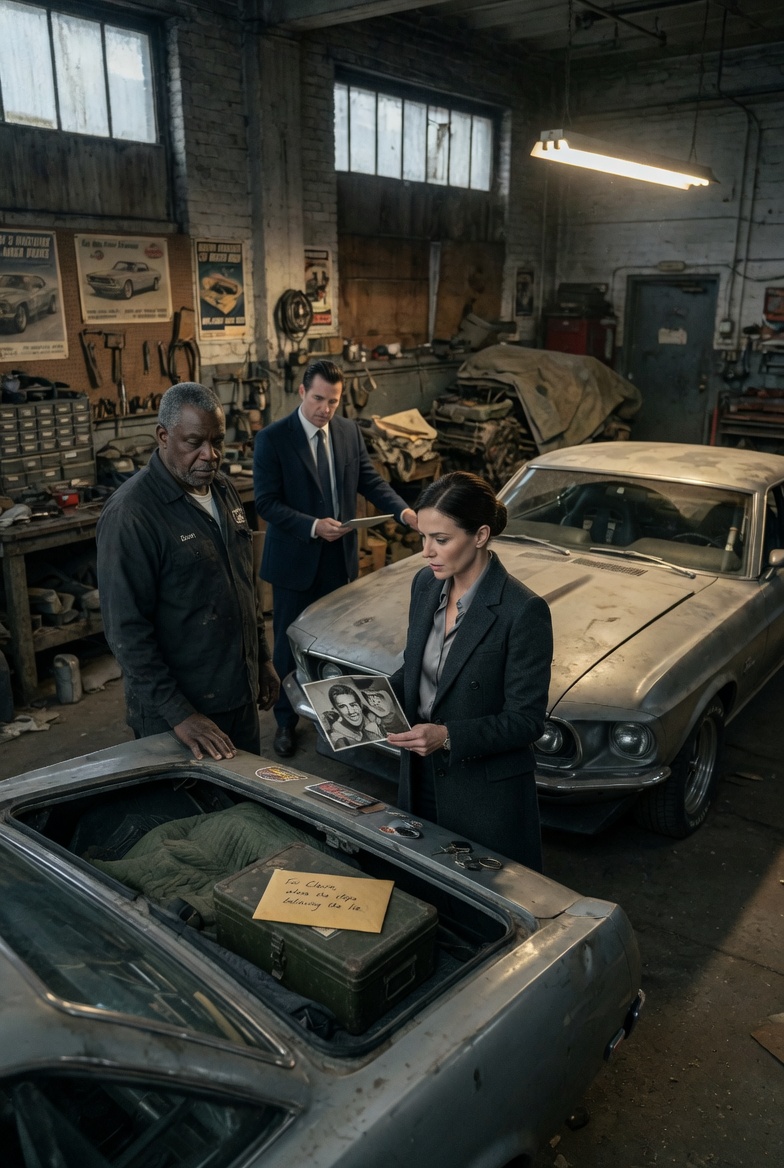
Claire did not open the envelope in the shop.
She told herself it was because Tyler was standing too close.
That was not the whole truth.
The truth was, the moment she saw her father’s handwriting, she felt thirteen years old again, waiting at the top of the stairs in a house too large for a family that rarely sat at the same table. She remembered hearing her mother say, “Your daughter needed you tonight,” and her father answering with silence so complete it became part of the walls.
Claire had spent most of her adult life turning that silence into discipline.
She did not cry in board meetings. She did not raise her voice in negotiations. She did not allow family history to leak into company strategy. That was how she became the woman investors trusted and competitors underestimated.
But that night, in her hotel room overlooking downtown Detroit, the envelope sat on the desk like a living thing.
Tyler had called three times.
She did not answer.
At 9:17 p.m., he texted her.
We need to discuss Mercer. Do not engage emotionally with undocumented claims.
Claire looked at the message for a long time.
Then she turned the phone face down.
The envelope remained unopened.
For Claire, when she stops believing the lie.
The lie.
At first, she tried to make it small.
Maybe her father had lied about knowing Dean. Maybe he had hidden some sentimental car project from the family. Maybe the Mustang was one of those harmless secrets men kept when they did not know how to speak honestly about grief, failure, or youth.
But the longer she sat there, the larger the word became.
Lie.
Not secret.
Not mistake.
Lie.
By midnight, she had pulled out her laptop and searched the Vaughn Motorsports private archive.
Richard Vaughn. 1969 Mustang. Dean Mercer. Detroit privateer racing. 1989 fuel investigation.
The first three searches gave her almost nothing.
The fourth gave her a headline from an old motorsports weekly, scanned so badly that half the letters were blurred.
VAUGHN DISQUALIFIED AFTER FUEL VIOLATION — PROMISING PRIVATEER PROGRAM COLLAPSES
Claire stared at it.
She knew the story, of course. Everyone inside the company knew the cleaned-up version. Richard Vaughn had been a talented but inconsistent young driver. He had made technical mistakes. He had been disqualified from a regional endurance event in 1989. The embarrassment pushed him out of privateer racing and into manufacturing, where his real genius had emerged.
That was the official company myth.
Failure became discipline.
Discipline became business.
Business became legacy.
It had always sounded neat.
Too neat.
At 12:42 a.m., an email arrived from an address Claire did not recognize.
Subject line: You found the car.
There was no greeting.
Only one paragraph.
Ms. Vaughn, my name is Naomi Pierce. I’ve spent seven years trying to verify what happened at the 1989 Great Lakes Challenge. If Dean Mercer let you see the trunk, then Richard wanted you involved. I have copies of documents you will not find in your corporate archive. Do not let Tyler Knox control the chain of custody.
Claire read the last sentence twice.
Do not let Tyler Knox control the chain of custody.
The next morning, she met Naomi in a hotel restaurant before sunrise.
Naomi was younger than Claire expected, maybe late thirties, with tired eyes, a canvas messenger bag, and the focused patience of someone used to being dismissed by powerful people. She did not carry herself like a gossip writer. She had no dramatic entrance, no recorder shoved across the table, no hunger for a scandal.
She ordered black coffee and placed three folders between them.
“I’m not here to ruin your father,” Naomi said.
Claire kept her hands folded. “That’s usually what people say before they ruin someone.”
Naomi accepted that without offense. “Then don’t trust me. Trust the documents.”
She opened the first folder.
Inside were photocopies of technical sheets, fuel logs, inspection forms, and timing records from the 1989 Great Lakes Challenge. Some were clean. Some were marked in red. Some were stamped with old sanctioning-body seals that Claire recognized from framed photos in Vaughn’s headquarters.
Naomi pointed to a fuel specification sheet.
“This is the pre-race submission. Legal blend. Legal additives. Legal density range. Signed by the inspection lead at 7:11 a.m.”
Claire scanned the page.
She did not know vintage fuel regulations well enough to judge the numbers, but she knew documentation. She knew signatures, timestamps, procedural language, the tiny habits of bureaucracy.
This looked real.
Naomi slid over another sheet.
“This is the document used after the race to disqualify your father.”
Claire compared the two.
At first, she saw only forms.
Then she saw it.
The number in the density field was different.
Not wildly different. Not enough for a casual reader to notice.
But enough.
“There’s also an added notation here,” Naomi said, tapping the lower margin. “Different ink. Different pressure. Different slant. It appears in the investigation copy, but not in the original pre-race packet.”
Claire said nothing.
Naomi continued carefully. “Your father’s Mustang passed pre-race inspection. It passed random mid-event sampling. It won on track. The disqualification happened after a protest was filed by a factory-backed team that had a lot to lose if a privateer Mustang beat them in front of regional sponsors.”
Claire looked up.
“And you can prove that?”
“I can prove enough to reopen the question,” Naomi said. “But there’s someone you need to hear it from.”
They drove to Warren Hail’s house two hours later.
Warren lived outside Ann Arbor in a narrow ranch home with a detached garage and a flagpole in the yard. He was eighty-one, thin but upright, with a voice like gravel and eyes that had not softened with age. When he opened the door and saw Claire, he did not ask who she was.
He only said, “You look like him when you’re trying not to feel anything.”
Claire almost left.
Instead, she stepped inside.
Warren’s kitchen smelled of burnt toast and machine oil. Old racing photographs covered one wall. Not framed elegantly. Just pinned, taped, stacked, layered over each other like memory refusing order.
In one photo, Richard Vaughn stood beside the silver Mustang with Dean Mercer and Warren Hail.
In another, Richard sat on the hood, laughing with his head tilted back.
Claire had never seen her father laugh like that.
Warren watched her notice.
“That car was the first thing your father built that wasn’t designed to impress anybody rich,” he said.
Claire turned. “I was told he raced prototypes.”
“He did later. When people started watching.” Warren lowered himself into a chair. “But the Mustang was personal.”
Naomi placed a recorder on the table. “Warren, tell her about the build.”
Warren took his time.
“That car started as a wreck Richard bought for almost nothing. Everyone laughed. Heavy body. Old platform. Wrong image. But he had a theory.” Warren tapped one long finger against the table. “He said American muscle had been misunderstood. People treated it like a hammer. He wanted to make it into a scalpel.”
Claire pictured the dust-covered hood. The clean panel gaps. The roll cage. The careful geometry hidden under neglect.
“He worked with Dean’s father at Mercer,” Warren continued. “Dean was just a kid then, but he had hands. Some people touch machines like they’re forcing them to obey. Dean listened first. Richard liked that.”
Claire stayed very still.
“What happened in 1989?” she asked.
Warren’s jaw tightened.
For the first time, the old man looked tired.
“We won.”
The word landed harder than accusation.
Claire blinked. “The record says he was disqualified.”
“After we won.”
Warren leaned back, eyes fixed somewhere beyond the kitchen wall.
“Your father drove the last stint himself. Rain started at dusk. Two cars went off. One factory Porsche spun at Turn Seven. Richard kept that Mustang so smooth it looked slow until you checked the clock. We crossed the line first by twenty-three seconds.”
Naomi did not interrupt.
Claire could hear the refrigerator humming.
“Inspection took longer than normal,” Warren said. “Then longer. Then men started going into rooms and closing doors. By midnight, they said our fuel numbers didn’t match the submitted spec.”
“Did they?” Claire asked.
Warren looked at her, and his face hardened.
“No.”
He pushed a folder toward her.
Inside was a copy of a handwritten crew log.
Fuel loaded: legal batch B-17. Sealed drums checked. Inspector initials verified.
The handwriting was not her father’s.
“Mine,” Warren said. “I logged every drum. Every seal. Every top-off. That car was clean.”
Claire looked down at the pages.
For years, Vaughn Motorsports had built brand language around precision, integrity, disciplined engineering. She had repeated those words in keynote speeches under her father’s portrait.
And here, in a retired crew chief’s kitchen, was the possibility that the company’s origin story had been built on a wound nobody had been allowed to name.
“Why didn’t he fight it?” she asked.
Warren’s expression changed.
That question had waited in him for decades.
“He wanted to.”
The old man reached for a photograph and slid it across the table.
Richard stood outside a trailer at night, still in his race suit, face pale with fury. Dean was beside him, younger, scared, holding a clipboard to his chest. Behind them, two men in suits were walking away.
“Richard knew the paperwork had been switched,” Warren said. “He had the original. He had my logs. He had Dean’s notes. But the protest wasn’t just about fuel. There were sponsors involved. Investors. A supplier deal. Men who had already put money into the first version of Vaughn Motorsports.”
Claire frowned. “So he protected them?”
“No,” Warren said. “He protected the company before it was strong enough to survive the truth.”
Naomi looked at Claire, but said nothing.
Warren continued.
“Your father was told if he challenged the disqualification publicly, the whole operation would be dragged into hearings. Sponsors would walk. Early contracts would freeze. The people backing him would turn on each other. He was young, but he understood something ugly.”
Claire’s throat tightened.
“What?”
Warren’s voice dropped.
“A man can survive being called a cheat if he has already decided to bury himself in work. A new company can’t.”
Claire looked toward the photographs again.
Richard laughing beside the car.
Richard furious outside the trailer.
Richard in the lobby portrait, older, colder, polished into myth.
All of them were the same man.
None of them were the father she had understood.
“And Dean?” she asked.
Warren nodded slowly. “Dean kept the car.”
“Why?”
“Because Richard asked him to.”
The room seemed to close in.
Warren reached into a drawer and removed a small photocopy of an old note.
Dean —
Keep the Mustang as-is. No restoration. No public display. No sale.
If Claire ever comes asking the right questions, give her the box.
R.V.
Claire touched the edge of the paper but did not pick it up.
“Why didn’t Dean tell me?”
Warren’s answer came without hesitation.
“Because you wouldn’t have believed him.”
It hurt because it was true.
If Dean Mercer had walked into Vaughn headquarters five years earlier with a dusty photograph and a story about Richard Vaughn being framed, Claire would have had security escort him out politely. Tyler would have drafted a warning letter. The legal team would have buried the matter under reputation management language.
And Claire would have called that leadership.
After leaving Warren’s house, she sat in Naomi’s parked car for several minutes without speaking.
Naomi waited.
Outside, dry leaves scratched across the curb. A school bus passed. Somewhere nearby, a dog barked with ordinary morning urgency, as if the world had not just shifted under Claire’s feet.
Finally, Claire took the envelope from her bag.
Her father’s handwriting looked different now.
Less like a threat.
More like a door.
She opened it carefully.
The paper inside was thin, folded twice, and beginning to yellow along the edges.
Claire,
If you are reading this, then Dean kept his promise longer than I deserved.
I do not know what version of me you were given. I know only that silence has a way of becoming someone else’s truth.
I let you believe I chose racing, then business, then reputation over you. Some days, maybe I did. I will not excuse that. But the story you were told about why I walked away from the Mustang was not the truth.
That car was the last place I felt honest before I learned how much dishonesty success could require.
In 1989, we won clean.
They changed the record.
I let them.
Not because I was innocent of pride. Not because I was brave. Because I was afraid that if I fought, the company would die before it could become something that might one day belong to you.
I thought I was protecting your future.
I did not understand that children do not measure love by what their parents build for them.
They measure it by who comes home.
Claire stopped reading.
The page blurred.
She pressed two fingers to the bridge of her nose, angry at herself for the weakness, then angrier because she knew exactly whose definition of weakness that was.
Naomi turned slightly toward the window, giving her privacy without pretending not to notice.
Claire read the rest.
The Mustang is not valuable because it is rare.
It is valuable because it knows the part of me I did not know how to give you.
When you are ready, ask Dean to show you the fuel system, the logbook, and the box.
Do not let men who worship the appearance of integrity decide what truth is allowed to cost.
I am sorry, Claire.
Not for losing the race.
For letting you think I never tried to find my way back.
— Dad
Dad.
Not Richard Vaughn.
Not Founder.
Not Chairman.
Dad.
That was the word that undid her.
Not loudly.
Nothing dramatic happened. Claire did not sob into her hands or collapse under the weight of revelation. She only folded the letter back along its old creases and sat very still while thirty years of certainty quietly came apart.
When she finally looked up, Naomi was watching her with the expression of someone who had spent years chasing a story and suddenly remembered that stories have daughters inside them.
Claire wiped one tear with the side of her thumb.
Then she reached for her phone.
There were six missed calls from Tyler.
One new message.
Claire, we need to move quickly on Mercer before outside parties complicate acquisition.
Claire stared at the word acquisition.
Yesterday, Mercer Performance Works had been a property.
The Mustang had been an asset.
Dean had been an obstacle.
Now the whole thing looked different.
Not softer.
Sharper.
She stood, placed the letter back into the envelope, and looked toward the road leading back to Detroit.
Naomi asked, “Where are you going?”
Claire’s voice was calm again.
But not cold.
“Back to the shop.”
At Mercer Performance Works, Dean was alone when she arrived.
He was adjusting a carburetor on a customer’s old Chevelle, sleeves rolled to the elbow, hands steady under the shop light. He looked up once when she entered, then returned to the work as if he had expected her.
Claire walked to the Mustang.
For the first time, she did not see dust.
She saw restraint.
Every untouched bolt, every faded mark, every piece of grime Dean had refused to polish away suddenly looked less like neglect and more like testimony.
“You kept it exactly the same,” she said.
Dean tightened one screw, then set the tool down.
“That was the promise.”
Claire turned to him. “You let me think you were just being difficult.”
“I’ve been called worse.”
“Why didn’t you tell me the moment I walked in?”
Dean looked at the Mustang, not at her.
“Because truth handed to the wrong person at the wrong time becomes another thing they can reject.”
Claire absorbed that.
Then she reached into her coat and held up the letter.
“I read it.”
Dean’s face changed only slightly.
A small release in the jaw.
A breath he had been holding for years.
Claire looked back at the Mustang.
The car no longer felt like a relic.
It felt like a witness.
And witnesses, she knew, could be silenced.
Or they could be put on the stand.
After a long moment, she asked the question that made Dean finally turn toward her fully.
“Does it still run?”
Dean studied her face, as if measuring whether she was asking as CEO, daughter, or judge.
Then he reached into his pocket and took out the keys.
“It will,” he said.
“But once it does, everyone will hear it.”