“You’re not authorized to be here.”
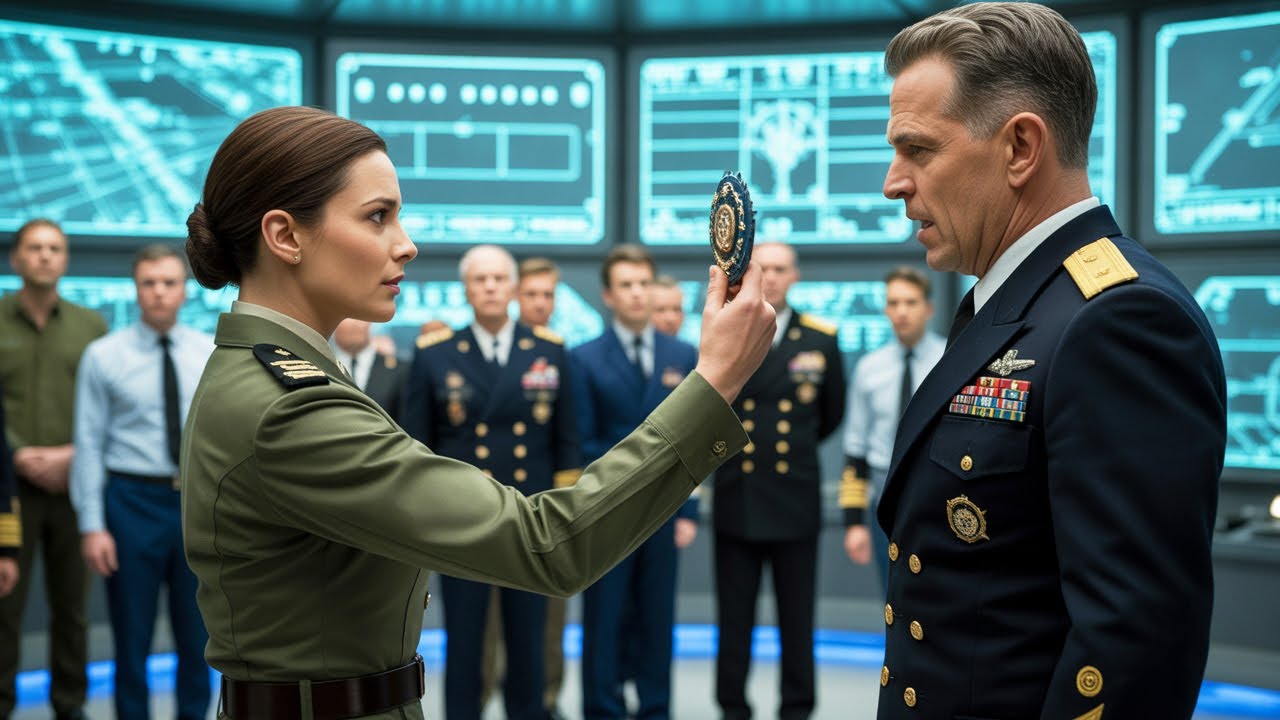
Colonel Richard Hale didn’t raise his voice.
He didn’t need to.
The six-foot-three commander stood at the entrance of the Strategic Operations Center with his arms folded across his chest, blocking the doorway while eight senior officers watched from inside the room.
The woman standing on the other side looked completely out of place.
No dress uniform.
No visible rank.
No entourage.
Just a dark blazer, a travel bag slung over one shoulder, and a calm expression that seemed oddly unaffected by the confrontation.
For a few seconds, neither moved.
The hallway outside the operations center was crowded with personnel rushing between briefings.
Several slowed their pace.
People always slowed down when a colonel was dressing someone down.
Especially when that someone appeared to be a civilian.
“Ma’am,” Hale said, his patience visibly thinning, “this meeting is restricted to senior command personnel.”
The woman nodded.
“I know.”
“Then you understand why you can’t enter.”
“I don’t believe that’s correct.”
Several officers inside exchanged glances.
That response wasn’t what they expected.
Most civilians became nervous around high-ranking officers.
Most immediately apologized.
Most backed away.
This woman simply stood there.
Calm.
Almost bored.
The colonel’s jaw tightened.
“Your name?”
“Eleanor Grant.”
“Position?”
“Consultant.”
That earned a few smirks inside the room.
Consultant.
The word carried very little weight on military installations.
Especially among officers who spent decades climbing command structures.
Colonel Hale looked over his shoulder.
Several officers were already amused.
One leaned back in his chair.
Another crossed his arms.
The atmosphere had shifted from concern to entertainment.
“Ms. Grant,” Hale said, “this facility is handling active operational planning. Civilian consultants don’t attend these briefings.”
“Usually,” she replied.
The answer landed like a pebble tossed into still water.
Small.
But irritating.
Hale took a step forward.
“Usually?”
“Yes.”
“What exactly does that mean?”
“It means there are exceptions.”
Several officers chuckled.
One captain whispered something that made the others grin.
Eleanor noticed.
She ignored it.
That somehow made it worse.
People who were intimidated followed predictable patterns.
She wasn’t following any of them.
“Let me save everyone some time,” Hale said.
“You can leave now.”
“No.”
The hallway suddenly became very quiet.
Nobody spoke.
Nobody moved.
Colonel Hale stared at her.
“Excuse me?”
“No.”
The answer was so calm it almost sounded polite.
For the first time, irritation became anger.
“Are you refusing a direct order from a commanding officer?”
“No.”
“Then explain yourself.”
Eleanor glanced at her watch.
“Because the meeting is already seven minutes behind schedule.”
The room erupted.
A few officers laughed openly.
Others shook their heads.
The colonel looked ready to explode.
“Do you have any idea who you’re speaking to?”
“Yes.”
“Then perhaps you’d like to explain why you think you belong in this room.”
For the first time, Eleanor shifted her travel bag onto a nearby table.
Then she unzipped a side compartment.
Several officers watched with curiosity.
One major rolled his eyes.
Another muttered, “This should be good.”
Eleanor removed a small black credential wallet.
Nothing flashy.
Nothing dramatic.
Just a worn leather case.
She opened it.
Then handed it to Colonel Hale.
The amusement vanished immediately.
Hale looked down.
His expression didn’t change at first.
Then it did.
The transformation was subtle.
His eyebrows lowered.
His eyes widened slightly.
The color drained from his face.
The room gradually grew silent.
Because everyone could see something had changed.
The colonel looked at the credential again.
Then again.
As if hoping he had misread it.
He hadn’t.
Slowly, he looked up at Eleanor.
The confidence that had dominated the conversation moments earlier was gone.
“What…”
He stopped himself.
Tried again.
“What exactly is this?”
“You already know.”
The room became uncomfortably still.
Every officer was now watching.
Nobody understood what was happening.
But everyone understood something extraordinary had just occurred.
Colonel Hale swallowed.
Then turned the credential toward himself once more.
The badge contained no military rank.
No branch insignia.
No decoration ribbons.
Only a name.
A clearance designation.
And an authorization level so high that most people in the room had never actually seen one.
The realization hit him all at once.
His stomach dropped.
The consultant standing in front of him wasn’t reporting to anyone inside the building.
Everyone inside the building reported upward into systems she could access.
Including him.
“Good Lord,” one lieutenant colonel whispered.
Hale shot him a warning glance.
Too late.
Several officers had heard.
And now curiosity spread rapidly through the room.
“Colonel?” one major asked.
No response.
“Sir?”
Still nothing.
Finally, Hale stepped aside.
Completely.
The hallway seemed to freeze.
Nobody could remember the last time they’d seen him surrender authority so quickly.
“Ms. Grant,” he said carefully.
“Please come in.”
The room fell silent.
Eleanor took back the credential.
Picked up her travel bag.
Then walked through the doorway.
No smile.
No victory lap.
No sign that she enjoyed what had just happened.
Which somehow made the moment even more powerful.
As she entered, officers shifted uncomfortably in their seats.
Some looked away.
Others tried to hide their curiosity.
None succeeded.
Eleanor reached the front of the conference room.
The main screen displayed an operational map covered in red threat indicators.
A multinational crisis was unfolding.
Intelligence failures were multiplying.
Decision-makers were running out of options.
The reason for the meeting was simple.
Nobody knew what to do next.
Eleanor studied the display for less than thirty seconds.
Then pointed toward a cluster of highlighted locations.
“These aren’t the targets.”
Several officers frowned.
One general leaned forward.
“What?”
“These locations are distractions.”
She pointed again.
“The real objective is here.”
The room erupted into immediate debate.
Arguments.
Questions.
Objections.
For nearly ten minutes officers challenged every assumption she made.
Eleanor listened quietly.
Then answered every criticism with dates.
Satellite data.
Intercept reports.
Logistics records.
Patterns nobody else had noticed.
One by one, objections disappeared.
Then the room became silent again.
Because she was right.
The intelligence everyone had been analyzing for weeks suddenly aligned into a single coherent picture.
The general slowly leaned back.
“My God.”
No one laughed this time.
No one smirked.
No one questioned why she was there.
They were too busy realizing how close they had come to making a catastrophic mistake.
The briefing lasted another two hours.
By the end, the operational plan had been completely rewritten.
And every major recommendation originated from the woman who almost got turned away at the door.
When the meeting finally concluded, officers began gathering their documents.
Conversations remained unusually quiet.
People were still processing what they had witnessed.
As Eleanor packed her bag, Colonel Hale approached.
The room subtly watched.
Everyone wanted to know what would happen.
The colonel stopped in front of her.
For a moment, neither spoke.
Then he extended his hand.
“I owe you an apology.”
Eleanor looked at him.
Then shook his hand.
“You made a decision based on the information you had.”
“Still.”
He glanced around the room.
“I should have asked before assuming.”
Several officers lowered their eyes.
Because they knew the apology wasn’t just for him.
It was for all of them.
Hours earlier they had judged a person based on appearance.
Based on assumptions.
Based on titles they couldn’t see.
Then a single badge had shattered every conclusion they thought was obvious.
As Eleanor headed toward the exit, one young captain finally asked the question everyone had been wondering.
“What was on that credential?”
The room turned.
Eleanor paused at the doorway.
A faint smile appeared for the first time all day.
Then she answered.
“The part that mattered wasn’t the clearance.”
The captain looked confused.
“What was it?”
She adjusted her bag.
“Twenty years of work that nobody in this room ever bothered to ask about.”
Then she walked away.
And not a single officer had a response.
Because sometimes the loudest person in the room loses to the quietest one.
And sometimes all it takes is a single badge to reveal who was really carrying authority all along.