
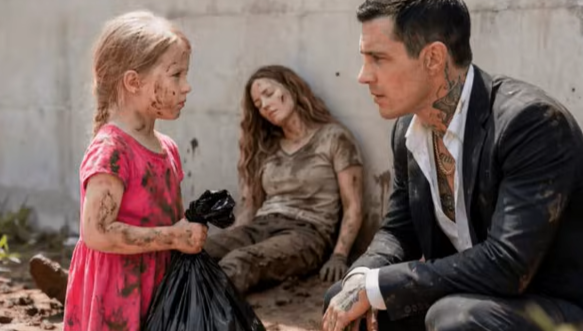
 The first thing Marco Bellini noticed was not the rain.
It was the way the little girl held the trash bag open with both hands, like she had done it before.
She was small enough that the black plastic nearly swallowed her arms. Six years old, maybe. Seven at most. Her hair was dark, soaked flat against her cheeks, and her shoes did not match. One was a pink sneaker with the laces gone. The other was a gray canvas shoe split open at the toe.
Nobody stopped.
Not the businessman stepping around the puddle. Not the woman pulling her coat tighter. Not the delivery driver who cursed when the child bumped his cart by accident.
Only Marco stopped.
His men noticed it immediately.
For twelve years, people in San Vittore had learned to read Marco Bellini’s silence. When he went quiet, rooms emptied. Men apologized before knowing what they had done. Bankers changed loan terms. Club owners found missing payments. Police officers suddenly remembered other appointments.
But that evening, outside a closed bakery on Via Larga, Marco’s silence was different.
It had no anger in it.
Only shock.
“Boss?” Luca said softly from behind him.
Marco did not answer.
The girl reached deeper into the bin and pulled out a paper bag. She opened it carefully, not greedily, as if hoping the world might have left her something kind. Inside was half a sandwich, flattened and wet at one corner.
She looked at it.
Then she looked around to make sure no one was watching.
Marco could not move.
Because when she turned her face toward the streetlight, his chest tightened so violently that he almost forgot how to breathe.
Her eyes.
The same wide, brown eyes Isabella had.
His daughter had died seven years earlier, two weeks before her fifth birthday, in a hospital room that smelled of disinfectant and lilies. Marco had been standing there in an expensive black coat with blood on his cuff from a meeting that had gone badly. Isabella had asked him why he looked sad.
He had told her he was just tired.
She had smiled and said, “Then sit down, Papa.”
That was the last full sentence she ever said to him.
After she died, Marco stopped keeping photographs in his office. He stopped celebrating birthdays. He stopped letting anyone mention her name unless they wanted to see the old Marco, the one even criminals feared.
And now, seven years later, a child with Isabella’s eyes was digging through trash ten steps away from him.
The girl tucked the sandwich into the pocket of her oversized jacket.
Then something slipped from inside the jacket and fell near the gutter.
A photograph.
The child froze.
She dropped to her knees in the dirty water and grabbed it before the rain could ruin it. But she was too late. The corner had already darkened. She wiped it with her sleeve, panicked, whispering something Marco could not hear.
Marco took one step forward.
Luca moved with him automatically, scanning the sidewalk. Two other men shifted their hands beneath their coats. It was habit. In Marco’s world, nothing innocent stayed innocent for long.
The girl saw them.
Her whole body stiffened.
She clutched the photo to her chest and backed against the bakery wall.
“I’m not stealing,” she said.
Her voice was thin, but she did not cry.
Marco stopped a few feet away.
Up close, the resemblance was worse.
Not just the eyes. The shape of her face. The small crease between her brows when she was afraid but trying not to show it. Isabella used to make the same face when the nurses came in with needles.
Marco looked down at the sandwich in her pocket.
Then at the torn shoe.
Then at the photo in her hand.
“What’s your name?” he asked.
The girl did not answer immediately. She looked at Luca first, then at the black car idling by the curb, then back at Marco.
“Sophia,” she said.
“Sophia what?”
Her fingers tightened around the photograph.
“Sophia Reyes.”
The name meant nothing to Luca.
But Marco felt something shift in his memory.
Reyes.
A hospital badge. A woman with tired eyes. A nurse who had once stayed past her shift to bring Isabella an extra blanket. Carmen Reyes. Quiet. Careful. The only person in that hospital who never looked at Marco like he was a monster or a wallet.
He had not thought of her in years.
Marco lowered his voice.
“Where is your mother?”
Sophia looked toward the end of the alley.
“At work.”
“What kind of work?”
“She cleans rooms,” Sophia said. “At the hotel near the station. At night.”
Luca glanced at Marco.
A small movement. Almost nothing.
But Marco caught it.
A child outside alone, in the rain, searching bins behind restaurants while her mother cleaned hotel rooms. In Marco’s city. On Marco’s streets. Under the eyes of men who paid him weekly for protection.
Something hot moved through him, but he kept it buried.
He held out his hand.
“May I see the photograph?”
Sophia shook her head.
“It’s mine.”
“I won’t take it.”
“That’s what people say before they take things.”
For the first time in years, Marco did not know what to say.
So he did something that made Luca’s eyebrows lift.
He crouched.
The most feared man in San Vittore lowered himself onto one knee in the rain, his Italian leather coat brushing the wet pavement, so he could meet a frightened child at eye level.
Sophia watched him carefully.
Marco extended his hand again, palm up.
“I give you my word.”
She studied his face.
Children could see things adults trained themselves to ignore. Marco knew that. Isabella had always known when he was lying about being fine.
After a long moment, Sophia loosened her grip and turned the photograph just enough for him to see.
Marco’s world went silent.
The picture was old. Creased. Worn soft at the edges from being touched too many times. It had been taken outside the hospital seven years ago, near the west entrance, on a spring afternoon. Marco remembered that day because Isabella had been well enough to sit in the courtyard, wrapped in a yellow blanket.
In the photograph, Marco stood beside a woman.
Carmen Reyes.
Her hair was tied back. She was not looking at the camera. She was looking at him.
And Marco was smiling.
Not the cold smile he used in negotiations. Not the public smile people photographed from a distance. A real one. The kind he had forgotten his face could make.
His hand went still.
Sophia pulled the photograph back quickly, afraid she had made a mistake.
“That’s my papa,” she said.
The words landed harder than any bullet ever had.
Luca stopped breathing behind him.
Marco looked at the girl again.
At Isabella’s eyes.
At Carmen’s mouth.
At his own face, staring back from the photograph in her small hand.
“Who told you that?” Marco asked.
“My mama.”
“When?”
Sophia looked down.
“Always.”
A taxi passed too fast through the gutter, splashing water across Marco’s trousers. Nobody moved. Nobody spoke.
Then Sophia tried to step away, but her torn shoe caught on a broken piece of metal near the bin. She stumbled and hit the pavement with her knee.
The sound was small.
A child’s gasp.
Marco reacted before any of his men could.
He reached her first.
Sophia flinched, but he did not grab her. He only took a clean handkerchief from his coat pocket and pressed it gently near the scrape. Blood mixed with rainwater and ran down her shin.
“It’s nothing,” she said quickly.
The words were too practiced.
Marco’s jaw tightened.
Children said that when they had learned pain made adults angry, tired, or absent.
He folded the cloth smaller and tied it around her knee with the same care he had once used tying Isabella’s shoelaces before hospital appointments.
Luca looked away.
Across the street, two teenagers had stopped filming whatever they had been laughing at. An old woman under a green umbrella paused near the bakery entrance. Even the delivery driver slowed down.
They all saw it.
Marco Bellini, kneeling in the rain before a child from the alley.
Sophia stared at him as if she did not understand why a stranger with dangerous eyes would be gentle.
Then she whispered, “Do you know him?”
Marco looked at the photograph still clutched in her hand.
His own face.
Her father.
He opened his mouth, but before he could answer, a voice cut through the rain from the alley.
“Sophia!”
A woman came running, breathless, coat unbuttoned, hair escaping from a loose bun. She stopped so suddenly when she saw Marco that her hand flew to her chest.
Carmen Reyes had aged.
There were lines around her eyes now. Her cheeks were thinner. Her uniform was stained from cleaning chemicals, and one sleeve was ripped near the wrist.
But Marco knew her immediately.
Carmen looked at Sophia.
Then at Marco kneeling beside her.
And every bit of color drained from her face.
“No,” she whispered.
Marco slowly stood.
The rain fell between them like a curtain.
For seven years, he had believed the last piece of his heart was buried beside Isabella.
But Carmen Reyes was staring at him like a woman whose secret had just stepped out of the grave.
And Sophia, still holding the photograph, looked up at both of them and asked the question that made every person on that sidewalk go still.
“Mom… is he my papa?”


