Japan’s Kofun Period: The Ancient Tomb Builders Who Shaped Early Japanese Civilization
Across Japan, more than 160,000 ancient burial mounds rise from the landscape—silent reminders of a transformative era that helped lay the foundations of the Japanese state. Built between the third and sixth centuries A.D., these monumental tombs reveal the emergence of powerful rulers, expanding political networks, and one of the most ambitious construction traditions in ancient Asia.
Long before Japan became a unified imperial nation, its islands were divided among regional clans, local chiefs, and competing centers of power.
Rice-farming communities spread across fertile plains. Coastal settlements thrived through fishing and trade. Small political alliances connected neighboring regions, but no single government controlled the entire archipelago.
Between approximately A.D. 250 and 538, however, a dramatic transformation began.
During what historians call the Kofun Period, powerful rulers in the Yamato region gradually expanded their influence over western Japan. As their authority grew, they commissioned some of the most impressive funerary monuments in world history.
Today, these massive earthworks remain among the most recognizable archaeological features of Japan.
Known as kofun, meaning “old mound,” they served as burial places for kings, queens, military leaders, and elite families whose influence helped shape the future Japanese state.
The Age of the Great Tomb Builders
The Kofun Period takes its name directly from these enormous tombs.
While many ancient societies built monuments to honor their rulers, few created burial landscapes on the scale seen in Japan.
Archaeologists estimate that more than 160,000 kofun survive across the country.
They vary greatly in size and design.
Some are modest earthen mounds.
Others are among the largest tombs ever constructed anywhere in the world.
The most famous examples are found in the Mozu-Furuichi Kofun Group, located near modern Osaka.
These monuments demonstrate a highly sophisticated funerary tradition and provide valuable insight into the political and social organization of early Japan.
Recognizing their importance, UNESCO designated a collection of these tombs as a World Heritage Site.
The selected kofun illustrate the development of a complex society capable of organizing vast amounts of labor and resources.
Monumental Designs Across the Landscape
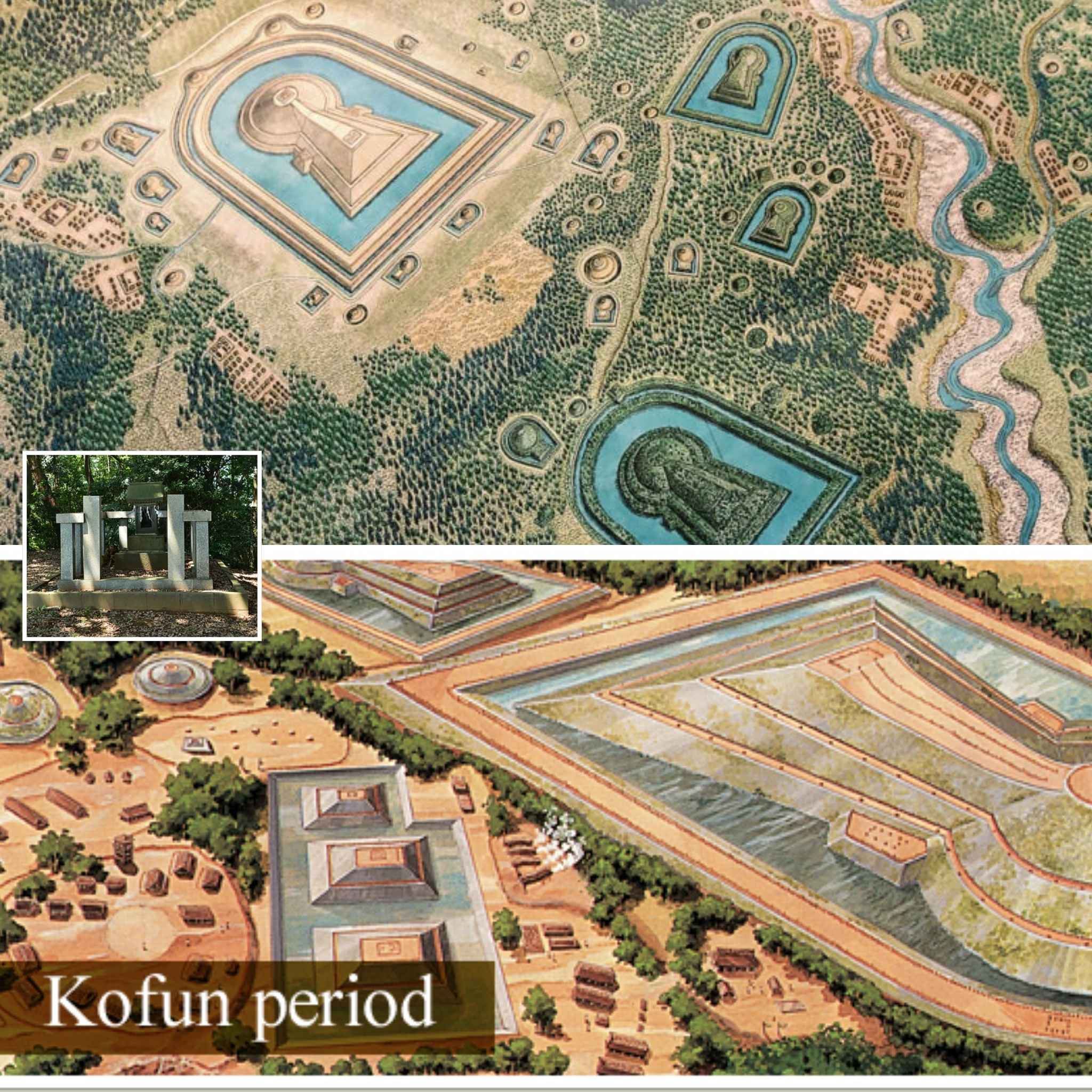
Seen from above, many kofun display striking geometric forms.
Their builders created several distinct shapes:
- Keyhole-shaped mounds
- Circular mounds
- Square mounds
- Scallop-shaped mounds
The most iconic design is the keyhole-shaped kofun, which combines a circular rear section with a rectangular front platform.
Surrounding many tombs are elaborate moats, embankments, and ceremonial spaces.
The scale of these structures is remarkable.
Some required moving enormous quantities of earth using little more than simple tools and human labor.
These projects demanded careful planning, engineering expertise, and centralized authority.
They were not simply graves.
They were public statements of power.

The Role of Haniwa Figures
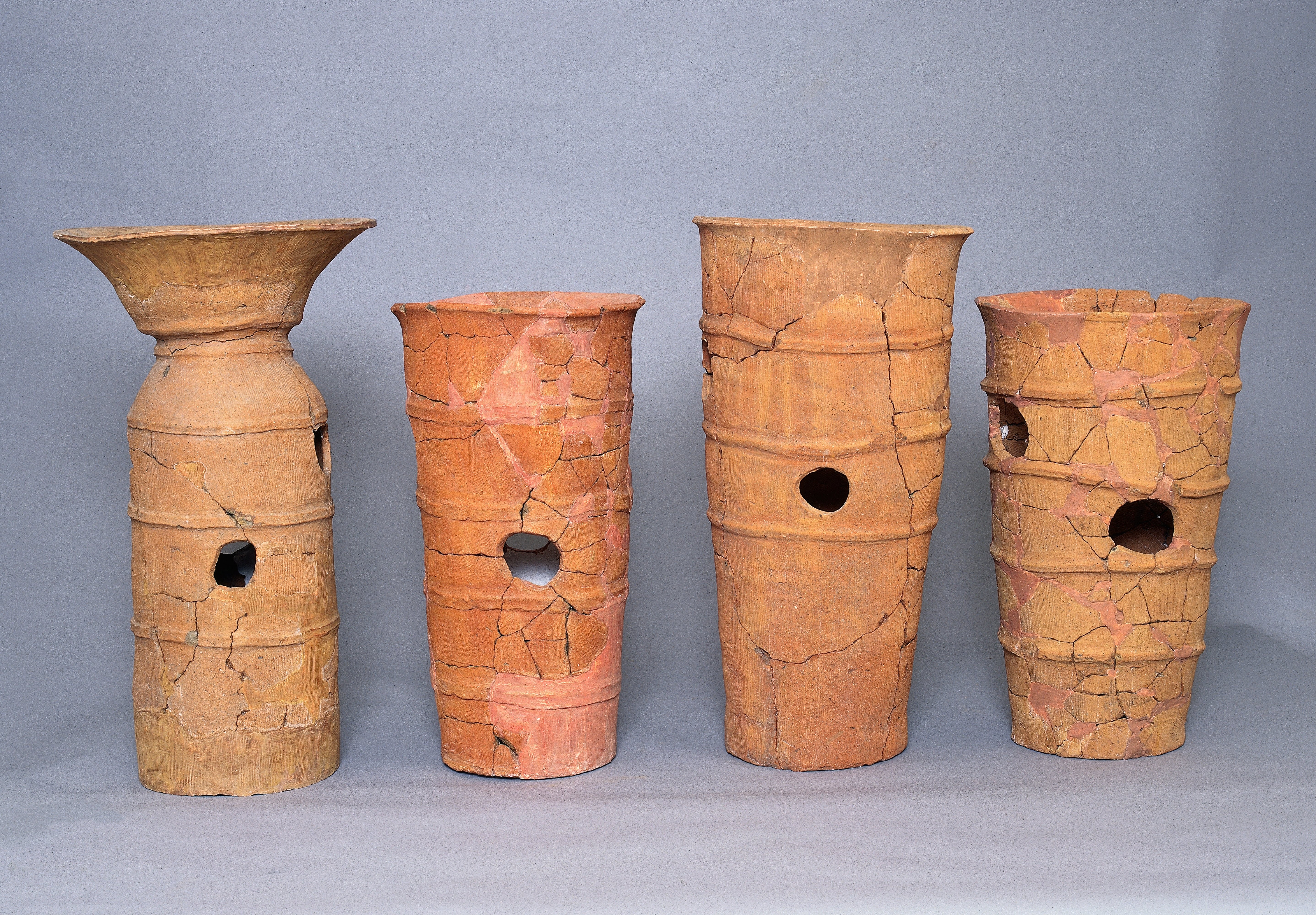
One of the most distinctive features of kofun tombs is the presence of haniwa.
These terracotta figures were placed around the burial mounds during funerary ceremonies.
Archaeologists have discovered haniwa representing:
- Warriors
- Horses
- Houses
- Birds
- Priests
- Everyday people
Their exact purpose remains debated.
Some scholars believe they marked sacred boundaries around the tomb.
Others suggest they represented attendants serving the deceased in the afterlife.
Another theory proposes that they acted as spiritual guardians.
Regardless of their precise meaning, haniwa provide an extraordinary glimpse into the culture, clothing, weapons, and social life of Kofun-period Japan.
The Daisen Kofun: Japan’s Greatest Tomb
Among all kofun, none is more famous than the Daisen Kofun.
Located in Sakai near Osaka, it is traditionally associated with Emperor Nintoku.
Stretching approximately 486 meters (1,594 feet) in length, it ranks among the largest tombs ever built.
By total area, it surpasses many of the world’s most famous burial monuments.
The tomb consists of:
- A massive keyhole-shaped earthwork
- Multiple concentric moats
- Extensive ceremonial zones
Construction likely required thousands of workers over many years.
The project demonstrates the extraordinary organizational abilities of Kofun-period rulers.
Yet despite its fame, much remains unknown.
Japan’s Imperial Household Agency restricts excavation of many imperial tombs, including Daisen Kofun.
As a result, archaeologists cannot confirm whether Emperor Nintoku was actually buried there.
Seven Remarkable Kofun
While Daisen Kofun attracts the most attention, several other tombs offer valuable insights into early Japanese society.
Hashihaka Kofun
Located in Sakurai, Hashihaka is considered one of the earliest giant keyhole-shaped tombs.
Some researchers suggest it may be connected to Queen Himiko, the legendary ruler described in third-century Chinese records.
However, this identification remains controversial.
Ōjin Tennōryō Kofun
Traditionally associated with Emperor Ōjin, this enormous tomb measures roughly 425 meters in length and is Japan’s second-largest kofun.
Richū Tennōryō Kofun
Another major monument within the Mozu cluster, Richū Tennōryō remains exceptionally well preserved and demonstrates the mature architectural style of the period.
Ishibutai Kofun
Located in Asuka, this tomb is famous for its gigantic stone chamber.
Visitors can walk inside and experience one of Japan’s most impressive ancient burial structures.
Konabe Kofun
Surrounded by a broad moat, Konabe represents one of the best-preserved examples of middle Kofun-period elite architecture.
Sakurai Chausuyama Kofun
One of the earliest royal tombs, it contained important grave goods including bronze mirrors linked to elite authority.
Sengenzuka Tomb
Located in Ibaraki Prefecture, this site illustrates how kofun traditions spread beyond the political core of the Yamato region.
The Rise of Yamato Power
The enormous scale of these tombs reflects more than religious beliefs.
They reveal the emergence of a powerful political order.
During the Kofun Period, leaders in the Yamato region expanded their influence through:
- Military force
- Marriage alliances
- Diplomatic relationships
- Ritual authority
- Control of trade networks
By coordinating massive construction projects, these rulers demonstrated their ability to mobilize labor across wide territories.
The tombs became symbols of political legitimacy.
Their size reflected the status of the individual buried within.
The largest monuments likely belonged to rulers whose authority extended across multiple regions.
Trade and International Connections
The Kofun Period was not an isolated chapter in Japanese history.
Evidence shows increasing interaction with neighboring societies on the Korean Peninsula and in China.
Archaeologists have identified imported technologies and cultural influences including:
- Ironworking techniques
- Metallurgy
- Writing systems
- Political institutions
- Religious ideas
Trade networks supplied materials needed for elite lifestyles and monumental construction.
These connections helped accelerate social and political development across the archipelago.
The rulers of Yamato increasingly positioned themselves within broader East Asian networks of power and exchange.
Grave Goods and Beliefs About the Afterlife
The contents of kofun tombs reveal much about ancient Japanese beliefs.
Burials often included rich collections of grave goods:
- Bronze mirrors
- Jewelry
- Weapons
- Armor
- Ceremonial objects
- Horse equipment
These items suggest that social status continued to matter after death.
Elite individuals were buried with symbols of power and authority.
The tombs also reflect indigenous spiritual traditions associated with ancestors, sacred landscapes, and supernatural forces.
Many scholars view these practices as precursors to later Shinto beliefs.
The placement of grave goods may have served both ritual and symbolic functions, reinforcing the prestige of ruling families even after death.
Horses and Warriors
One of the most important developments during the Kofun Period was the introduction of horses.
Archaeological evidence indicates that horses arrived through contacts with societies on the Korean Peninsula during the fourth and fifth centuries.
Their impact was profound.
Horse riding improved:
- Military mobility
- Communication
- Transportation
- Regional administration
Elite warriors adopted mounted combat and incorporated horse equipment into their burials.
Excavations have uncovered:
- Saddles
- Bridles
- Armor
- Helmets
- Iron swords
- Spears
The growing importance of cavalry reflects the increasingly militarized nature of Yamato expansion.
Military power became a key tool for consolidating political authority.
From Villages to State Formation
Before the Kofun Period, much of Japan consisted of farming communities organized around local clans.
People cultivated rice, crafted tools, and maintained regional traditions.
Political organization remained relatively fragmented.
The Kofun era marked a major transition.
Local leaders forged alliances with stronger regional rulers.
Power gradually became concentrated in larger political centers.
Noble families known as uji claimed divine ancestry and developed close ties to emerging Yamato rulers.
Over time, these relationships contributed to the formation of a centralized political system.
The process was gradual, but the foundations of the later Japanese state were taking shape.
A Society Capable of Monumental Achievement
The sheer scale of kofun construction demonstrates a society with remarkable organizational capabilities.
Building these monuments required:
- Skilled engineers
- Labor coordination
- Resource management
- Political leadership
- Long-term planning
Thousands of workers likely participated in the largest projects.
Food, tools, and materials had to be supplied continuously.
Only powerful leaders could mobilize such efforts.
The tombs therefore provide direct evidence of growing social hierarchy and centralized authority.
Legacy of the Kofun Period
The Kofun Period occupies a unique place in Japanese history.
It was an age of transition between prehistoric societies and the emergence of an imperial state.
During these centuries, Japan witnessed:
- The rise of powerful rulers
- Expansion of trade networks
- Adoption of new technologies
- Development of military elites
- Increasing international connections
- Growth of centralized political authority
The monumental tombs scattered across the landscape remain the most visible symbols of these transformations.
More than 160,000 kofun survive today, preserving the memory of a society undergoing profound change.
They tell the story of rulers who commanded immense resources, communities that participated in extraordinary construction projects, and a political system that would eventually evolve into one of the world’s longest-lasting imperial traditions.
Far more than ancient graves, the kofun are enduring monuments to the people who helped shape the foundations of Japan itself.

