After 3,500 Years — The Face of a Mycenaean Noblewoman Revealed
A vivid digital reconstruction has brought to life the face of a Mycenaean woman who lived more than 3,500 years ago, offering a rare and poignant glimpse into the world of Bronze Age Greece, long before Homer set down the Iliad or the Trojan War entered legend. For centuries, Mycenae has been synonymous with kings, warriors, and epic battles, yet the lives of ordinary citizens—and even the powerful women behind these societies—have remained largely invisible. This reconstruction changes that.
Looking Into the Face of Bronze Age Greece
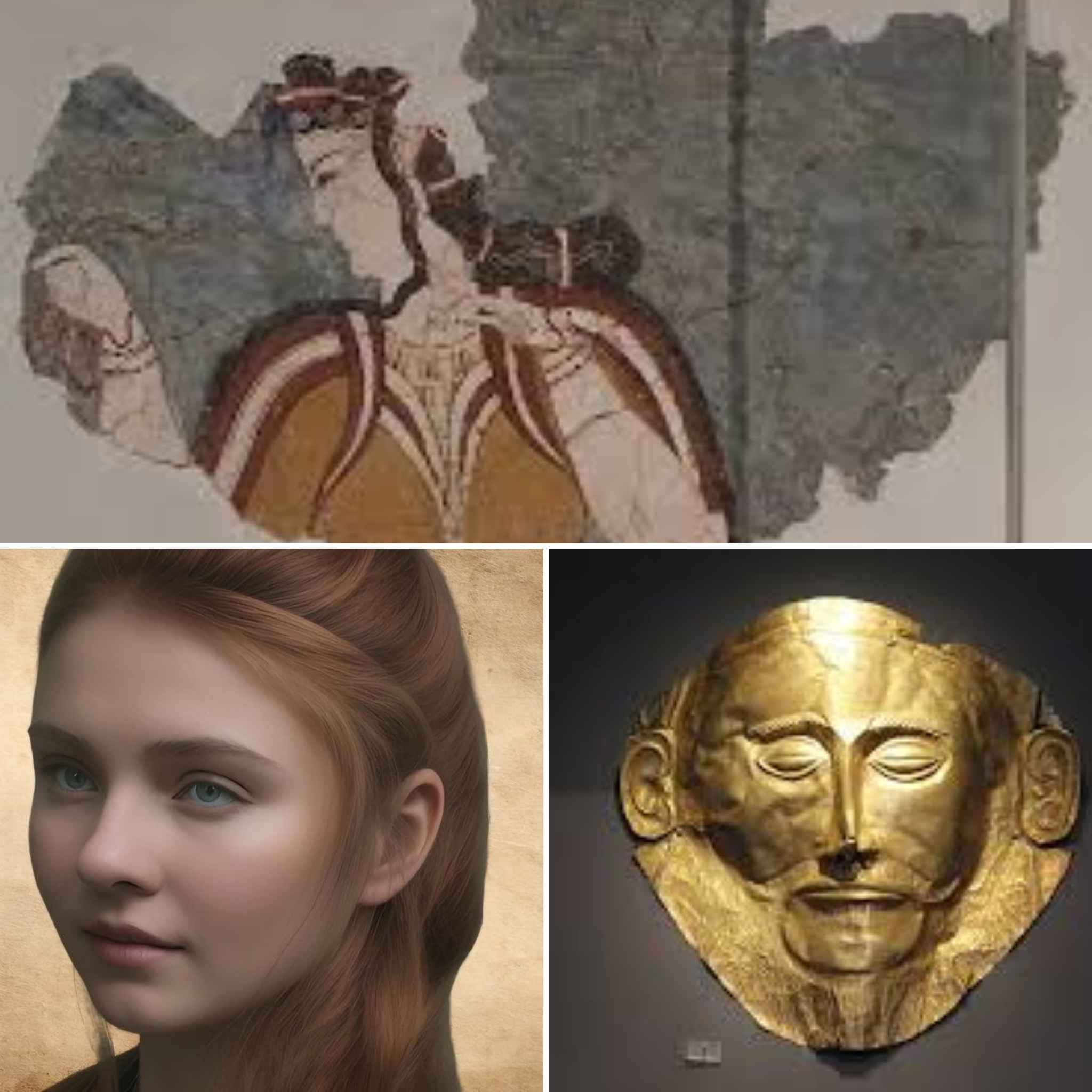
The project was initiated by Dr. Emily Hauser, historian and lecturer in Classical Studies at the University of Exeter, who sought to give the Mycenaean past a human face. “It is incredibly exciting,” Hauser said of the project, “and the final image was unexpectedly modern—striking, poised, and commanding, the face of someone who could have inspired legends.”
The reconstruction is rooted in forensic science, archaeology, and digital artistry. Its foundation was a clay replica of the woman’s skull, created in the 1980s by researchers at the University of Manchester. Using this model, Spanish digital artist Juanjo Ortega refined the features, integrating data from skeletal analysis, DNA testing, and artifacts from the tomb. The result is a lifelike portrait of a woman who lived and moved in a world long vanished, yet whose presence now feels remarkably immediate.
The Tomb That Revealed a Family Secret
The woman was buried in a royal Mycenaean cemetery, along with another skeleton. Previously, scholars had assumed the two belonged to a husband-and-wife pair. Recent genetic analysis overturned that notion: the individuals were siblings. DNA testing clarified familial relationships, challenging longstanding assumptions about gender roles and burial practices in Mycenaean society.
“The traditional story was that if you had a woman next to a man, she must be his wife,” Hauser explained. “But genetics told a very different story: they were brother and sister.” This revelation adds a new dimension to understanding the social dynamics of elite Mycenaean families, showing that women could be buried alongside male relatives without implying marital status, while still enjoying considerable prestige.

Evidence of Status and Agency
The woman, who died at approximately 35 years old, was interred with high-status grave goods, including a gold mask made of electrum and three swords. Interestingly, researchers now suggest that some of these items may have belonged to the woman rather than the male burial.
Recent studies indicate that weapons appear in female burials more frequently than previously thought. This challenges assumptions about the roles of women in Mycenaean society, suggesting that elite women could wield symbolic or even practical authority in ways previously unrecognized.
Skeletal analysis revealed arthritis in her spine and hands, likely the result of repetitive labor-intensive tasks such as textile production—a cornerstone of Mycenaean female life. Dr. Hauser drew parallels to Homeric descriptions:
“It is a reminder of the physical strain on women of that time, much like Helen in the Iliad, who is described as weaving.”
A Face That Feels Modern
One reason the reconstruction has captivated global attention is that the woman appears strikingly modern. She is not a distant historical stereotype, but a fully realized person with expressive eyes, subtle bone structure, and a commanding presence.
“This is a face that could have inspired legends,” Hauser said. “She is not merely a shadow of the men of her time, but the protagonist of her own story.” Her appearance invites scholars and the public to rethink female agency in Mycenaean society, suggesting a complexity that literary sources often overlook.
Context: Women in Mycenaean Society
The Mycenaean civilization, flourishing between the 17th and 12th centuries BC, was dominated by palace-centered political and economic networks. Kings, warrior elites, and scribes oversaw trade, military campaigns, and religious rituals. Writing in Linear B, the Mycenaeans recorded inventories, tribute, and offerings, giving us glimpses into palace administration.
Yet these records rarely reveal the daily experiences of women. Burials, however, tell another story. The reconstructed woman’s high-status grave goods indicate that elite Mycenaean women could possess wealth, wield influence, and participate in ritual practices. The combination of weapons, jewelry, and imported items suggests both practical and ceremonial roles.

Myth and Reality Intertwined
While the woman predates the traditional date of the Trojan War, she occupied a cultural landscape later immortalized by Homeric poetry. Palaces like those at Mycenae, Tiryns, and Pylos became the backdrop for legends of Agamemnon, Helen, and Achilles. The reconstructed face reminds us that behind these myths were real people: women managing households, participating in ritual life, and shaping their society in tangible ways.
The tomb was first excavated in the 1950s, yet the woman’s identity remained hidden until modern forensic and digital technologies allowed researchers to “see” the individual behind the remains. According to Hauser, such reconstructions are more than technical exercises—they are tools for empathy, allowing us to engage with the lived experience of those long gone.
“Digital reconstructions persuade us that these were real people,” Hauser said. “This is a wonderful way to connect the experiences of women to the myths and stories that have survived.”
Technology Meets Archaeology
Advances in genetic sequencing, 3D rendering, radiocarbon dating, and skeletal analysis have revolutionized the study of ancient individuals. In the case of this Mycenaean woman, these techniques have enabled a high-resolution reconstruction that is both scientifically grounded and aesthetically compelling.
Hauser emphasized that these methods do more than reconstruct appearances. They reveal details about health, labor, diet, and social status, transforming our understanding of gender and power dynamics in ancient Greece.
A Window Into Bronze Age Life
The reconstruction is part of a broader effort to humanize Mycenaean civilization. By visualizing individuals, archaeologists and historians can explore questions of identity, agency, and social hierarchy in ways that textual records alone cannot illuminate.
For instance, the presence of arthritis in the woman’s hands suggests a lifetime of manual labor, while her prestigious burial objects indicate elite status. Together, these findings complicate the simplistic portrayal of Mycenaean women as passive figures, revealing them instead as active participants in political, economic, and ritual life.
Conclusion: The Power of Seeing
The reconstruction of this Mycenaean noblewoman demonstrates the combined power of science, art, and archaeology to illuminate the past. It is more than a visual exercise—it is a reclamation of female history, giving voice to those who shaped society yet remained absent from the record.
As technology continues to evolve, reconstructions like this will help historians revisit assumptions about gender, status, and daily life in ancient civilizations. By giving a face to the long-dead, scholars bridge the gap between myth and reality, reminding us that every legend, every epic, every story ultimately rests on the lives of real people.
“Perhaps now, at last, we can see history not only as a series of events but as the lives of individuals—women and men alike—whose experiences shaped the world we inherit,” Hauser said.