Chapter One — Seat 3A
The silver watch hit the carpet with a sound too small for the trouble it was about to cause.
No one heard it fall.
Not the woman in 2B laughing into her champagne. Not the banker in 4C tapping furiously at a laptop covered in privacy filters. Not the toddler behind the curtain who had been crying since boarding at Reagan National. And certainly not Marcus Ellison, seated in 3A, his hands folded around a paper cup of black coffee, his eyes fixed on the rain sliding down the oval window.
The watch lay half-hidden beneath the edge of a business-class seat, its face catching the soft amber cabin light each time the aircraft trembled in the wind.
Outside, Washington, D.C., looked washed and bruised under a November storm. The runway lights bled red and gold across the glass. Jet engines groaned beneath the fuselage. Somewhere in the cabin, ice clinked in a plastic tumbler.
Marcus watched one raindrop chase another down the window.
He had flown too many times to be impressed by leather seats, polished panels, or the quiet choreography of people pretending discomfort did not exist at thirty thousand feet. He wore a navy wool blazer, charcoal slacks, and old brown shoes that had been resoled more than once. His beard was trimmed close, silver beginning to show at the jaw. A small scar cut through his left eyebrow, pale against dark skin.
He looked like a professor. Or a tired consultant. Or a man who had learned not to invite questions.
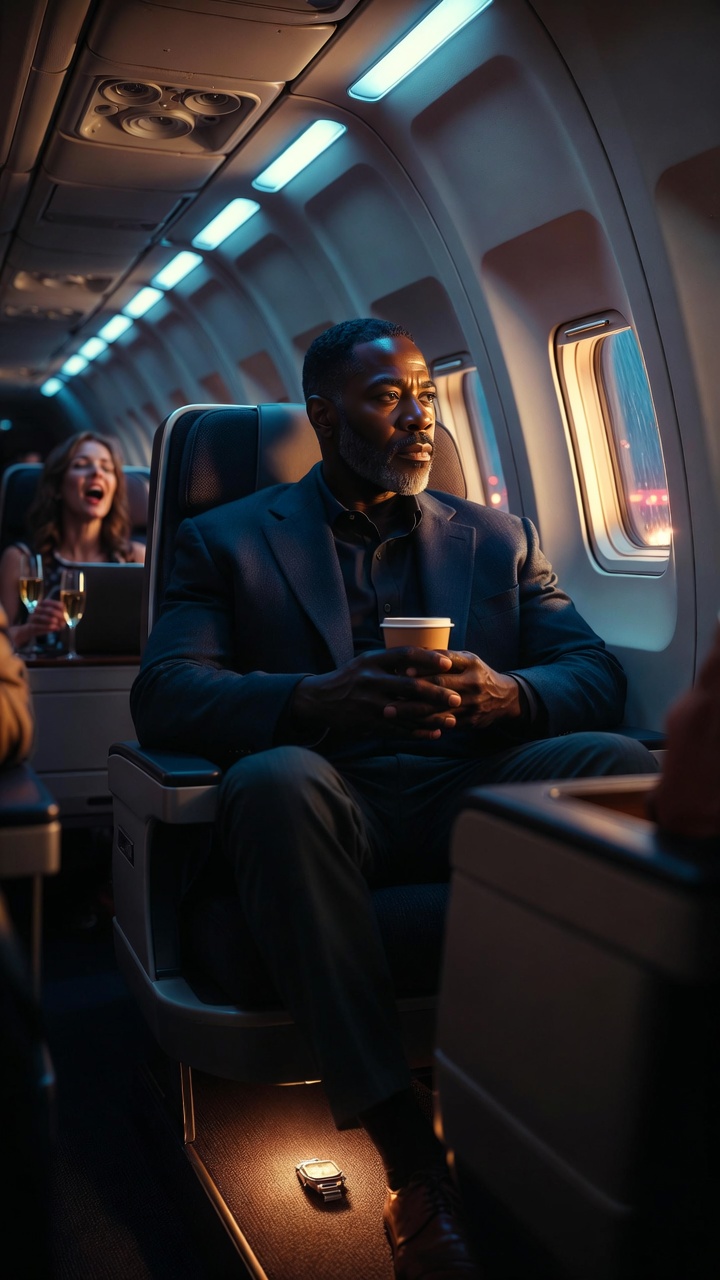
That was the point.
A flight attendant stopped beside his row.
“Can I take that, sir?”
Her voice was polished smooth, but her fingers were tight around the trash bag.
Marcus lifted his paper cup. “I’m still working on it. Thank you.”
Dana Whitaker smiled without showing her teeth. Lead flight attendant. Forty-two. Honey-blonde hair pulled into a regulation bun. Red lipstick perfect enough to look like armor. Her navy uniform jacket had been pressed so sharply it could have cut paper. A tiny gold wing pin sat over her heart.
She glanced at the cup, then at Marcus’s shoes, then at the worn leather briefcase under the seat in front of him.
The glance lasted less than a second.
Marcus noticed it anyway.
Dana moved on.
Across the aisle in 3D, a broad man in a cashmere quarter-zip patted his chest, then his lap, then the empty space beside him. His face changed shape. First confusion. Then irritation. Then something sharper.
“Where is it?”
His voice carried over the engine hum.
The woman in 2B stopped laughing.
The man in 3D shoved his hand beneath his thigh, checked his jacket pocket again, then leaned into the aisle.
“Excuse me,” he snapped. “Miss?”
Dana turned. The smile returned.
“Yes, Mr. Breen?”
Todd Breen was the kind of man airline crews remembered before he reminded them. Fifty-one, private equity, platinum status, loud cufflinks, louder opinions. He had boarded late, holding his phone to his ear and making everyone wait while he finished a sentence about “dead weight on the payroll.” His cologne now fought the smell of warmed bread and cabin air.
“My watch is gone.”
Dana’s smile faded a carefully measured inch. “Your watch?”
“My Patek.” He tapped his bare wrist as if showing her an injury. “It was right here.”
A hush opened in business class.
Passengers loved two things on an airplane: free alcohol and someone else’s problem.
Dana lowered her voice. “When did you last have it?”
“When I sat down.” Todd twisted toward the aisle. “I took it off because the clasp was pinching. Set it right here.” He slapped the armrest. “Now it’s gone.”
Marcus lifted his coffee to his lips.
The plane rocked gently. A baby cried behind the curtain. Rain ticked against the window in frantic bursts.
Dana looked down the aisle, then back at Todd. “I’m sure it’s nearby. Let’s check around your seat.”
Todd did not move.
His eyes crossed the aisle and landed on Marcus.
It was not a dramatic stare. Not at first. Just a man looking for a place to put his suspicion.
Marcus had seen that look in department stores. In courthouse elevators. At hotel front desks where his reservation suddenly required extra confirmation. It always arrived dressed as reason.
Todd’s gaze dropped to the briefcase under the seat in front of Marcus.
“Maybe check there,” Todd said.
The cabin seemed to inhale.
Marcus kept the cup near his mouth, but he did not drink.
Dana turned slowly toward him.
“Sir,” she said, “would you mind checking around your feet?”
Marcus looked at her. “I haven’t moved from this seat.”
“I understand.” Her voice softened, but not kindly. “We’re just trying to locate a missing item.”
Marcus set the cup down on the tray table. His movements were precise. Quiet. A man placing each action where no one could accuse it of being sudden.
“You’re welcome to look on the floor,” he said. “My bag stays closed.”
Todd scoffed. “Convenient.”
A few passengers shifted. One woman pretended to look for her phone while aiming its camera.
Dana noticed the phone. Her shoulders tightened.
“Mr. Breen,” she said, “please let me handle this.”
“Then handle it.”
Marcus looked out the window again. On the rain-streaked glass, his reflection stared back at him—calm eyes, still face, jaw working once beneath the skin.
Dana stepped closer.
“Sir, for everyone’s comfort, could you open your bag?”
Marcus turned from the window.
“For everyone’s comfort,” he repeated.
He did not raise his voice. That made the words travel farther.
Dana’s cheeks colored. “A passenger has reported a valuable item missing.”
“And you’re asking only me to open my bag.”
“You’re seated closest to him.”
Marcus looked across the aisle at Todd. Then toward the woman in 2B, whose purse was large enough to hold a laptop. Then toward the banker in 4C, whose roller bag sat partly open under his seat. Then back to Dana.
“No,” Marcus said.
The word landed clean.
Todd laughed once. “There it is.”
Dana’s face hardened. The polished smile disappeared, and beneath it stood a woman who had slept four hours, missed two meals, and been warned by her supervisor that one more passenger complaint would put her on unpaid review.
“Sir, refusing to cooperate doesn’t help you.”
Marcus’s fingers rested on the tray table edge. “I don’t need help.”
The phone in 2B lifted higher.
Dana saw it. Todd saw it. Marcus saw it.
Behind Dana’s eyes, a calculation moved too fast and chose the wrong answer.
“If you have nothing to hide,” she said, “then open the bag.”
Marcus leaned back.
The engines deepened as the aircraft began its slow push from the gate. The cabin lights dimmed slightly, giving every face a courtroom shadow.
“My name is Marcus Ellison,” he said. “I’m seated in 3A. I boarded with the same briefcase I have carried through three security checkpoints, one lounge, and your gate. I have not touched that man’s watch. I will not open my private property because another passenger looked at me and decided I should.”
Dana swallowed.
Todd pointed across the aisle. “Are you serious right now? My watch costs more than his entire outfit.”
A sound came from 2B. Not quite a laugh. Not quite shock.
Marcus looked at Todd for the first time fully.
Todd’s face twitched, as if he expected anger and found something worse.
Pity.
“Mr. Breen,” Marcus said, “you should hope your watch turns up before your character does.”
The cabin went silent.
Dana stepped into the space between them. “That is enough.”
“No,” Todd snapped. “What’s enough is letting people like—”
He stopped himself.
Barely.
But the unfinished word hung there, ugly and visible.
Dana’s hand went to the interphone mounted near the galley wall.
Marcus watched her thumb hover over the call button.
“You don’t want to do that,” he said softly.
Dana looked at him. “Are you threatening me?”
“No. I’m giving you a chance.”
Her thumb pressed the button.
A chime sounded through the cabin.
The watch still lay beneath Todd’s seat, hidden by the shadow of his own leather loafer.
And in Marcus Ellison’s breast pocket, his phone began silently recording.
Chapter Two — The Passenger Who Wouldn’t Bow
The captain’s voice came over the speakers, warm and false.
“Ladies and gentlemen, we’re going to hold position here for just a few minutes while our crew takes care of a passenger matter. We appreciate your patience.”
Passenger matter.
Marcus almost smiled.
His father had once been called a matter.
It had happened in 1989 at Newark Airport, before terminals had glass walls and boutique coffee shops. Marcus was nine. His father, Raymond Ellison, had worn his best suit because they were flying to Atlanta for Marcus’s grandmother’s funeral. At security, an officer had pulled Raymond aside, opened his garment bag, dumped his shirts on a metal table, and asked why a janitor needed a suit that nice.
Raymond had said nothing.
That silence had frightened Marcus more than shouting would have.
Later, in the men’s room, Raymond had washed his hands for a long time. Marcus had watched water run over his father’s dark knuckles.
“Remember this,” Raymond had said, drying his hands with a paper towel that tore apart in his grip. “A man can take your seat, your coat, your ticket. Don’t hand him your dignity too.”
Now, thirty-seven years later, Marcus sat in 3A and kept his hands visible.
Dana stood in the aisle with another crew member, Javier Morales, younger, dark-haired, nervous around the eyes. Javier held a small tablet with the passenger manifest. He looked at Marcus, then at Dana.
“What happened?” he asked quietly.
Dana kept her voice low, but the cabin had leaned toward her.
“Passenger in 3D reports a missing luxury watch. Passenger in 3A refuses a basic search of his bag.”
Marcus said nothing.
Javier looked at Todd. “Sir, have you checked under your seat?”
Todd’s jaw flexed. “I checked where I needed to check.”
“That isn’t an answer,” Marcus said.
Todd pointed. “Nobody asked you.”
Javier crouched slightly, trying to look beneath Todd’s seat.
Todd shifted his feet, blocking the view without seeming to.
Marcus saw it.
So did Dana.
But Dana was no longer looking for a watch. She was looking for control.
Her life had narrowed in the past six months. Her mother’s medication cost more than rent. Her divorce attorney had advised her to stop “appearing unstable.” The airline had changed scheduling software, cut staffing, raised service expectations, and punished complaints faster than safety violations. Last month, a diamond bracelet had gone missing on her flight from Miami to New York. Corporate security had treated Dana like she had sold it herself.
The bracelet had never been found.
The warning letter remained in her file.
So when Todd Breen, a top-tier passenger with an executive liaison number attached to his profile, said his watch was gone, Dana felt the floor open beneath her.
She chose the person least likely to cost the airline money.
That was the first truth.
The second truth was uglier, and she had spent years teaching herself not to look directly at it.
“Sir,” Dana said to Marcus, louder now, “this aircraft cannot depart until we resolve this.”
Marcus looked down at his coffee. Steam no longer rose from it.
“Then resolve it correctly.”
Todd barked a laugh. “Unbelievable.”
The woman in 2B spoke for the first time. “Maybe just open it? Then we can all get home.”
Marcus turned to her. She wore pearls, a cream blazer, and the expression of someone who believed peace was what happened when other people accepted humiliation quietly.
“What’s your name?” Marcus asked.
She blinked. “Excuse me?”
“You’re comfortable asking me to surrender my privacy to speed up your evening. I’d like to know who’s asking.”
Her mouth closed.
Javier straightened. “Ms. Whitaker, maybe we should check the entire area.”
Dana’s eyes flashed. “We are.”
“No,” Marcus said. “You’re staging a search around an accusation.”
Javier’s tablet pinged. He glanced at it, then at Marcus’s name on the manifest.
Something changed.
It was tiny, but Marcus caught it.
Javier had recognized something.
Dana didn’t.
“What?” she whispered.
Javier turned the tablet slightly away from Todd.
“Dana,” he said under his breath, “we need to call the purser.”
“I am the lead.”
“We need to call operations.”
Dana’s nostrils flared. “For a missing watch?”
“For him.”
Todd leaned into the aisle. “What does that mean?”
Marcus looked at Javier.
The younger flight attendant’s throat moved. He had the face of a man who had opened the wrong door and found a room full of witnesses.
“Mr. Ellison,” Javier said carefully, “would you be willing to step into the forward galley so we can discuss this privately?”
“No,” Marcus said.
Dana stared. “Sir—”
“No more private rooms. No corners. No closed curtains.” Marcus lifted his phone from his pocket and placed it on the tray table, screen down. “Anything you need to say to me, you can say where you accused me.”
The cabin shifted again.
Now curiosity had teeth.
Dana saw the phone and went pale.
“Are you recording crew members without consent?”
“We are in a public commercial cabin with multiple passengers already recording.” Marcus’s eyes moved briefly to 2B. The woman lowered her phone into her lap. “But if you prefer, we can wait for airport police. They have body cameras.”
Todd muttered, “Good. Let them drag him off.”
Marcus looked at him.
Todd’s face reddened.
The cockpit door opened.
A tall man stepped out in a pilot’s uniform, silver hair at his temples, four stripes on his shoulders. Captain Alan Price had the weary calm of someone who had survived thunderstorms, mechanical delays, and men in suits who thought status could change physics.
He stopped at the edge of the galley.
“What’s the issue?”
Dana turned, grateful and frightened. “Captain, Mr. Breen in 3D has reported a missing Patek Philippe watch. Mr. Ellison in 3A refuses to allow inspection of his bag.”
Captain Price’s eyes moved to Marcus.
Then to Todd.
Then to Javier.
Javier gave him the smallest shake of the head.
Price’s face tightened.
“Mr. Breen,” the captain said, “please stand up.”
Todd blinked. “What?”
“Stand up, sir.”
“I’m the victim here.”
“Then help us locate your property.”
Todd’s mouth opened, closed. Slowly, with great offense, he unbuckled and stood.
The moment his right shoe moved, the watch flashed under the seat.
Everyone saw it.
The cabin went still.
Javier crouched, picked it up by the band, and held it out.
“Is this your watch, sir?”
Todd’s face drained in uneven patches.
Dana’s lips parted.
Marcus did not move.
The watch had been six inches from Todd’s heel the entire time.
A tiny object. A simple answer. A disaster with a silver face.
Todd snatched it. “Well—obviously it must’ve slid.”
No one responded.
Dana turned toward Marcus.
For the first time, she looked at him not as a problem to manage, but as a person she had injured in public.
“Mr. Ellison,” she began, “I—”
The cabin phone rang.
Javier answered it near the galley. He listened, eyes fixed on the floor.
Then he looked at Captain Price.
“It’s operations,” he said. “They’re asking why the independent federal compliance monitor assigned to this flight is being detained before departure.”
The words moved through business class like cold air.
Todd stared at Marcus.
Dana gripped the seatback beside her.
Marcus picked up his coffee, found it cold, and set it down again.
Captain Price turned slowly.
“Mr. Ellison,” he said, voice careful now, “are you here on behalf of the Aviation Civil Rights Compliance Office?”
Marcus reached into his blazer and removed a slim leather credential wallet.
He opened it with two fingers.
The badge inside caught the cabin light.
“Not on behalf of them,” Marcus said. “By appointment of the federal court.”
Dana closed her eyes.
When she opened them, the aircraft no longer felt like a plane.
It felt like evidence.
Chapter Three — The Man Behind the Seat Number
They returned to the gate.
No one announced why.
The jet bridge rolled back with a metallic groan. Rain battered the windows. Ground crew in reflective vests moved like ghosts beneath floodlights.
Business class stayed seated, held in place by the strange gravity of shame. Todd Breen stared at his watch as if it had betrayed him. The woman in 2B kept her hands folded over her phone. Javier stood by the forward galley, silent, his jaw tight.
Dana Whitaker remained near the cockpit door, her face stripped of color.
Marcus Ellison did not look victorious.
That unsettled people most.
They expected anger. A speech. A demand. Some performance that would let them decide how much sympathy he deserved.
He gave them none of that.
He opened his briefcase slowly and removed a blue folder, a digital recorder, and a printed copy of his boarding pass. His hands were steady, but his thumb paused for half a second against the folder’s edge.
Inside it was a photograph.
Not evidence for the airline. Evidence for himself.
Raymond Ellison, Newark Airport, 1989. His father in a brown suit, one hand on young Marcus’s shoulder, the other holding two paper boarding passes. A man smiling because he still believed dignity could protect his son.
Marcus had carried the photo through law school, Air Force officer training, divorce court, his mother’s funeral, and more hotel conference rooms than he could count. He had carried it into hearings where executives used phrases like “isolated incident” and “customer perception” until human beings disappeared behind slide decks.
He did not take the photo out now.
Some things were not for the cabin.
A woman in a gray suit entered from the jet bridge, followed by two airline supervisors and an airport police officer. The woman had cropped black hair, a tablet pressed against her ribs, and the expression of someone who had been awakened into a nightmare.
“Mr. Ellison,” she said. “I’m Karen Liu, station director.”
Marcus stood.
He was taller than most had expected. Six-foot-two, broad-shouldered but not bulky, with the stillness of a man trained to make rooms reveal themselves.
Karen extended a hand. He shook it.
Her eyes flicked to Dana, then Todd, then the passengers.
“We need to speak privately,” Karen said.
Marcus looked at the cabin.
“No.”
The word did not need volume.
Karen understood faster than Dana had.
“Of course.” She swallowed. “Then we can speak here.”
Todd stood abruptly. “This is ridiculous. I found my watch. We’re done.”
The airport police officer, a woman with kind eyes and a square jaw, looked at him. “Sir, sit down.”
Todd hesitated.
The officer did not repeat herself.
He sat.
Karen turned to Dana. “Ms. Whitaker, did you accuse Mr. Ellison of theft?”
Dana’s mouth trembled. She pressed her lips together until they whitened.
“I responded to a passenger complaint.”
“That isn’t what I asked.”
Dana looked at Marcus.
Something in her face folded inward. Not enough to fix anything. Enough to show there was a human being trapped behind the uniform.
“I asked him to open his bag,” she said. “Repeatedly.”
“Did you ask any other passenger to open their bag?”
Dana’s silence answered.
Karen’s tablet reflected blue light against her chin.
“Did Mr. Ellison touch the missing item?”
“No.”
“Did you observe suspicious behavior?”
Dana’s eyes dropped. “No.”
The cabin air seemed thinner.
Todd shifted. “Hold on. I was the one missing property.”
Marcus turned toward him.
“You were missing patience,” Marcus said. “The property was under your seat.”
A few passengers looked down.
The police officer’s mouth twitched, but she suppressed it.
Karen faced Marcus again. “Mr. Ellison, I want to offer our immediate apology on behalf of Atlantic Meridian Airlines.”
Marcus looked at her for a long moment.
“An apology is what people give when a waiter brings the wrong soup.”
Karen absorbed that like a slap.
“What would you like us to do?”
It was the first intelligent question anyone had asked.
Marcus closed the folder on his tray table.
“I want the crew removed from this flight pending investigation. I want the cabin recordings preserved. I want all passenger video requested before anyone deletes anything. I want Mr. Breen’s statement taken before his attorney improves his memory. I want the airline’s incident report to use the words racial discrimination, not passenger misunderstanding. And I want every person in this cabin who watched this happen to ask themselves why they were comfortable with my bag being searched before his floor was.”
No one moved.
Outside, rain hammered the jet bridge roof like thrown gravel.
Dana stared at the carpet.
Her voice emerged small. “Mr. Ellison.”
Marcus waited.
“I was wrong.”
He looked at her.
She forced herself to continue.
“I thought I was controlling the situation. I wasn’t. I was making it worse.” Her fingers tightened around the edge of her uniform sleeve. “That doesn’t undo it. I know that.”
Todd rolled his eyes.
Marcus saw it.
So did Dana.
And something in her changed.
She turned on Todd, not dramatically, not theatrically, but with the exhausted fury of someone seeing the full shape of her own cowardice.
“And you,” she said, “knew you hadn’t checked under your seat.”
Todd stiffened. “Excuse me?”
“You blocked Javier when he tried to look.”
“I did not.”
“Yes,” Javier said quietly. “You did.”
Todd’s face went red again, but this time the room did not move to protect him.
Karen nodded to the officer. “Please take Mr. Breen’s statement outside the aircraft.”
Todd stood, furious. “I have meetings in Chicago.”
Marcus looked at the watch on Todd’s wrist.
“Then you’ll want to keep better track of time.”
No one laughed.
That made it worse.
Todd stepped into the aisle. As he passed Marcus, he leaned close enough for only him to hear.
“You people love making everything about race.”
Marcus did not turn his head.
His voice was low. “And people like you love making race invisible right after using it.”
Todd’s eyes flickered.
The officer guided him forward.
At the aircraft door, Todd looked back once. The cabin looked away from him.
All except Marcus.
Marcus watched him leave.
Not because Todd mattered.
Because witnesses mattered.
Chapter Four — What the Camera Saw
The video reached the internet before the aircraft took off.
It began with shaky framing from seat 2B. Marcus in 3A, calm and still. Dana standing over him. Todd’s voice off-screen, sharp and entitled.
Maybe check there.
Then Dana’s voice.
If you have nothing to hide, then open the bag.
The clip was twenty-eight seconds long. It did not show the watch under Todd’s seat. It did not show Dana’s warning letter, Todd’s blocked foot, Marcus’s credential, or Javier’s quiet attempt to slow the disaster.
The internet did what it always did.
It chose a fire and poured gasoline with both hands.
By the time Marcus arrived in Chicago on a different flight, Atlantic Meridian’s stock had dipped, three cable networks had requested comment, and his ex-wife had sent him one text.
Saw the video. You okay?
Marcus stood near baggage claim at O’Hare and read the message twice.
People flowed around him in winter coats, dragging suitcases over polished floors. The terminal smelled of coffee, wet wool, jet fuel, and cinnamon pretzels. Holiday decorations hung from the ceiling too early, silver stars turning slowly in the draft.
He typed: I’m fine.
Then he deleted it.
He wrote: Not yet.
He sent that.
A minute later, she replied.
That sounds more honest.
Marcus put the phone away.
He had not planned to become the face of anything that day. The court had appointed him as an independent monitor after a class-action lawsuit accused Atlantic Meridian of repeatedly mistreating Black passengers, disabled travelers, and customers with non-English accents during “security-sensitive service events.” The airline had settled without admitting wrongdoing. The judge had required unannounced audits.
Marcus had spent months sitting quietly in cabins, lounges, and ticket counters, watching how policy became behavior when no supervisor was nearby.
Most flights revealed small things.
A wheelchair passenger left waiting too long. A Spanish-speaking grandmother ignored until her bilingual grandson intervened. A Black college student asked twice if he belonged in first class while his white friend was offered orange juice.
Not always cruelty.
Often reflex.
That was harder to fix.
Cruelty knew it was cruel. Reflex believed it was normal.
At 9:40 p.m., Marcus checked into a hotel facing the river. The lobby glowed with brass lamps and dark wood. Snow had begun mixing with rain outside, leaving white streaks on the windows.
He entered his room, set the briefcase on the desk, removed his blazer, and stood in the quiet.
Then his phone rang.
Unknown number.
He answered.
“Mr. Ellison? This is Dana Whitaker.”
Marcus looked at the city lights beyond the glass.
“How did you get this number?”
A pause.
“From the incident report. I know I shouldn’t have used it.”
“No,” he said. “You shouldn’t have.”
Her breath shook. “I’m not calling to ask you to go easy on me.”
“Good.”
“I’m calling because there’s something you need to know.”
Marcus remained still.
On the other end, a muffled announcement echoed—airport terminal noise. Dana had not gone home.
“What is it?” he asked.
“The airline is going to blame me alone.”
Marcus said nothing.
“They already started. Karen told me I violated procedure. That’s true. I did. But there’s a service bulletin from corporate. It came down after the Miami bracelet incident. They told us high-value customer complaints had to be resolved before departure whenever possible. They told us refusal to cooperate could be treated as suspicious behavior.”
Marcus’s eyes narrowed.
“Do you have the bulletin?”
“Yes.”
“Send it to your union.”
“I did.” Her voice cracked. “They told me to keep quiet until disciplinary review.”
Marcus walked to the desk and opened his briefcase.
“Why call me?”
Dana was silent long enough that he heard her crying before she spoke.
“Because I know what I did to you. And because if they make this only about one bad flight attendant, nothing changes.”
Marcus sat slowly.
Outside, a siren moved along the river, red light flashing across the hotel ceiling.
“What exactly did the bulletin say?”
Dana inhaled.
“Page two. ‘Crew should use visual assessment, passenger demeanor, and cooperation level to determine escalation risk.’”
Marcus closed his eyes.
Visual assessment.
Passenger demeanor.
Cooperation level.
Words clean enough for a boardroom. Dirty enough for a cabin.
“Send it,” he said.
“I already did.”
His laptop chimed.
Marcus opened the email.
The bulletin loaded on-screen with Atlantic Meridian’s logo at the top.
Dana had highlighted one paragraph.
Marcus read it once.
Then again.
His face did not change, but his hand moved to the old scar in his eyebrow.
He had received that scar at seventeen outside a gas station in Baltimore, after telling a man to stop pushing his younger cousin. The man had worn a county sheriff’s deputy jacket. Off duty. Drunk. Certain. Marcus had learned that night that authority did not need a badge to leave marks.
He printed the bulletin.
Then he called Judge Eleanor Voss.
She answered on the fourth ring, voice rough with sleep.
“Ellison, someone better be on fire.”
Marcus looked at the airline logo cooling in the printer tray.
“Not someone,” he said. “A policy.”
Chapter Five — The Hearing
The emergency hearing took place three days later in a federal courtroom where the windows were tall, the benches were hard, and every whisper sounded guilty.
Rain had cleared from Washington, leaving the sky a pale winter blue. Sunlight fell through the glass and cut bright rectangles across the floor. Reporters crowded the hallway outside. Inside, the air smelled of old wood, wool coats, and burnt coffee from the clerk’s desk.
Marcus sat at counsel table, not as a plaintiff, not as a passenger seeking attention, but as the court’s monitor.
That made the airline’s attorneys sweat.
Across the aisle, Atlantic Meridian’s legal team arranged binders in a defensive wall. Karen Liu sat behind them, eyes shadowed. Dana Whitaker sat two rows back with a union representative, hands clasped so tightly her knuckles looked bloodless.
Todd Breen was not there.
His attorney had sent a statement describing him as “deeply regretful for any misunderstanding.”
Marcus had placed the word misunderstanding in a folder labeled LANGUAGE THAT HIDES HARM.
Judge Eleanor Voss entered without ceremony.
Seventy years old, silver hair cut short, black robe flowing around her like weather. She had spent thirty years listening to powerful people explain why consequences were complicated.
“Be seated,” she said.
Everyone sat.
Judge Voss looked over her glasses at the airline’s lead attorney.
“Mr. Halpern, I read your filing at 5:12 this morning. It uses the phrase unfortunate customer interaction eleven times. If you say it in my courtroom, I will assume you have run out of facts.”
The attorney’s mouth closed.
Marcus looked down to hide the faint movement at the corner of his lips.
The judge turned to him.
“Mr. Ellison, proceed.”
Marcus stood.
He did not begin with the viral video.
He began with the bulletin.
A courtroom deputy displayed it on a large screen. Atlantic Meridian logo. Corporate formatting. Friendly font. Language designed by committee.
Marcus walked toward the screen.
“Your Honor, three days ago I boarded Flight 417 as part of an unannounced compliance audit ordered by this court. During boarding, a first-class passenger misplaced a watch under his own seat. Without evidence that I had touched it, without asking surrounding passengers to open their belongings, and without checking beneath the complainant’s seat, crew demanded that I open my briefcase.”
He turned slightly.
“The airline now argues this was a deviation from policy.”
He lifted one page.
“It was not.”
The courtroom shifted.
Marcus pointed to the paragraph.
“This bulletin instructed crew to use visual assessment, passenger demeanor, and cooperation level to determine escalation risk in high-value complaints.”
Judge Voss leaned forward.
Marcus continued.
“Visual assessment is not a neutral standard when employees receive no guardrails against bias. Demeanor is not neutral when a calm refusal can be labeled suspicious. Cooperation is not neutral when asserting a constitutional boundary becomes evidence of guilt.”
The airline attorney rose. “Your Honor, commercial airline cabins are not constitutional courtrooms.”
Judge Voss looked at him.
“No, Mr. Halpern. They are smaller, more crowded, and full of witnesses with phones. Sit down.”
He sat.
Marcus pressed a remote.
The screen changed.
A still image from the passenger video. Dana standing over him. Todd pointing from across the aisle. Marcus seated, hands visible.
The image froze the cabin at its worst moment.
Marcus did not look at it.
“Ms. Whitaker made the accusation visible,” he said. “But corporate policy loaded the weapon.”
Dana flinched.
Not because he had attacked her.
Because he had not.
The next slide showed complaint data from the previous eighteen months. Marcus had spent two nights building the chart with his team. Patterns appeared in numbers that executives had called anecdotes.
Black passengers were five times more likely to be asked to verify premium seating after boarding.
Passengers with accents were three times more likely to be described as “non-compliant” in crew reports.
Disabled passengers who requested assistance were twice as likely to be coded as “service disruption.”
The courtroom air changed as the chart remained on-screen.
Numbers had no trembling voice. That made them harder to dismiss.
Judge Voss looked at the airline table.
“Is this data accurate?”
Mr. Halpern stood slowly. “We have not had time to fully validate—”
“Did it come from your records?”
A pause.
“Yes.”
Marcus clicked again.
Now the cabin audio played.
Dana: If you have nothing to hide, then open the bag.
Marcus: I don’t need help.
Todd: My watch costs more than his entire outfit.
A murmur moved through the courtroom.
Dana’s head bowed.
Marcus stopped the audio before it reached the credential reveal.
Judge Voss looked at him. “Why stop there?”
Marcus turned.
“Because the harm did not begin when they learned who I was. It began when they thought I was nobody.”
The courtroom fell silent.
In the second row, Dana wiped one tear with the heel of her hand and looked furious at herself for needing to.
The judge removed her glasses.
“Mr. Ellison, what remedy does the monitor recommend?”
Marcus returned to the table and lifted a final page.
“Immediate suspension of the bulletin. Mandatory bias-resistant incident protocol. Independent review of all passenger misconduct reports from the last twenty-four months. Compensation fund for affected passengers. Public correction using accurate language. And disciplinary review that includes management decisions, not only frontline crew.”
The airline attorney rose again.
“Your Honor, this is an overreaction to one event.”
Judge Voss leaned back.
“Mr. Halpern, one event is a spark. The question is whether your client soaked the building in gasoline.”
No one wrote for a moment.
Then every reporter in the back row began typing at once.
Chapter Six — The Price of an Apology
The settlement number arrived on a Friday morning.
Seven hundred fifty thousand dollars.
Not because Marcus asked for it.
He had not filed a personal lawsuit at first. The court’s sanctions, the compliance reforms, the airline’s public pressure, and Todd Breen’s private settlement offer had all moved along separate tracks. But after the hearing, two more passengers came forward. Then nine. Then thirty-one.
A retired Army nurse from Atlanta who had been removed from a premium seat after a gate agent claimed her upgrade “looked unusual.”
A Nigerian engineer asked to show additional identification after a white passenger complained he had been “hovering” near the overhead bin.
A grandmother from Puerto Rico marked “hostile” in an incident report because she could not understand rapid English during a delay.
Marcus’s own case became the door other people walked through.
The airline wanted the door closed.
The conference room where they met overlooked the Potomac. Floor-to-ceiling windows. Gray river. White sky. A long walnut table polished so brightly it reflected everyone’s hands.
Marcus sat on one side with his attorney, Leah Grant, a compact woman with copper curls and a stare that could peel paint. Across from them sat Atlantic Meridian executives, their lawyers, and a crisis consultant who looked as if he had been assembled from expensive fabric and fear.
Dana Whitaker was not in the room.
Marcus had asked about her before sitting down.
“She remains on administrative leave,” one executive said.
Marcus remained standing.
“Then we’re not ready.”
The executive blinked. “Excuse me?”
“You want my signature on a settlement connected to an incident where you plan to sacrifice one employee for following the culture you built.” Marcus buttoned his blazer. “Call me when you’re ready to discuss the whole truth.”
Leah gathered her folder.
The crisis consultant leaned forward. “Mr. Ellison, this is a substantial offer.”
Marcus looked at him. “So was my seat.”
They called Dana in an hour later.
She entered wearing a plain black coat over her uniform blouse. Without the jacket, without the wing pin, she looked smaller. Tired. Human. Her eyes went first to Marcus, then to the executives.
She did not sit until someone told her to.
The airline’s chief operating officer, Martin Vale, cleared his throat. Sixty, polished gray hair, athlete’s posture softened by board dinners. He had built his career on operational efficiency. He believed systems failed because individuals failed to execute them. It had made him rich. It had also made him blind.
“Ms. Whitaker,” Vale said, “the company acknowledges that internal guidance may have contributed to confusion aboard Flight 417.”
Dana looked at him.
“Confusion?” she said.
The word was quiet.
Vale’s jaw tightened.
Dana placed both hands on the table. “I accused a man of stealing because a rich passenger pointed at him and because your policy told me to treat refusal like guilt. I still made the choice. Don’t insult everyone by calling it confusion.”
No one breathed for a second.
Leah Grant’s eyebrows rose a fraction.
Marcus watched Dana carefully.
This was not redemption. Not yet. Maybe not ever. Redemption was not a speech. It was the bill paid over years.
But truth had entered the room, and it had used Dana’s voice.
Vale looked at Marcus, then at the lawyers, then out at the river.
“What do you want, Mr. Ellison?”
Marcus slid a document across the table.
“Terms.”
Vale read.
His face changed with each line.
Public apology using the words racial profiling.
Passenger compensation fund.
Reinstatement option for Dana Whitaker after retraining, without making her the sole cause.
Management accountability review.
Release of revised protocol.
Three-year independent monitoring.
Scholarship fund in Raymond Ellison’s name for Black students entering aviation law, safety, or compliance.
Vale stopped reading at the name.
“Raymond Ellison?”
Marcus’s voice remained steady. “My father.”
Vale nodded slowly, not understanding but sensing that he should.
The lawyers whispered.
The number rose.
Four hundred thousand.
Five hundred fifty.
Six hundred twenty-five.
At seven hundred fifty thousand, Leah touched Marcus’s sleeve under the table.
That was the number.
Not because pain could be priced. Pain resisted currency. But numbers forced institutions to admit weight. They entered annual reports. They angered shareholders. They made executives remember.
Marcus signed at 4:17 p.m.
The same number as the flight.
Outside, the river carried thin sheets of ice beneath the bridge.
Dana approached him near the elevators.
“I don’t expect forgiveness,” she said.
Marcus pressed the down button.
The elevator doors remained closed.
“Good,” he said.
She nodded. Her eyes shone, but no tear fell.
“I’m going to testify in the policy review.”
“That will cost you.”
“I know.”
“Maybe your job.”
“I know.”
The elevator arrived with a soft chime.
Marcus stepped inside.
Dana did not.
Before the doors closed, she said, “Why did you make them keep me?”
Marcus looked at her.
“Because throwing you away would let them feel clean.”
The doors slid shut between them.
Dana stood in the hallway, reflected in the polished metal, holding herself together with both hands.
Chapter Seven — Raymond’s Gate
Six months later, Atlantic Meridian opened a training center outside Atlanta.
They named one wing after Raymond Ellison because Marcus had insisted and because the airline had learned, painfully, that refusal would cost more than agreement.
The dedication ceremony took place on a warm April morning. Dogwoods bloomed white along the driveway. The air smelled of cut grass, jet fuel from the nearby airport, and coffee from a folding table near the entrance.
A brass plaque stood covered by a blue cloth.
Marcus arrived alone.
He wore the same navy blazer from Flight 417, but the shoes had been polished. In his breast pocket was the photograph of his father at Newark.
Reporters gathered near the rope line. Airline employees stood in clusters, whispering. Some watched Marcus with admiration. Others with discomfort. A few with resentment they were too smart to show on camera.
Dana stood near the back.
She had returned to work after four months, not as lead crew at first. She now helped teach incident response training twice a month. Some colleagues called her a traitor. Others pulled her aside after sessions and confessed the things they had seen, done, excused, regretted.
She did not ask Marcus for friendship.
That was one of the reasons he respected her attempt.
Captain Price attended in uniform. Javier stood beside him, now promoted to cabin safety trainer. Karen Liu had left station operations and joined the compliance team. Todd Breen was not invited.
Judge Voss sent a note instead of attending.
Mr. Ellison, try to enjoy one ceremony without cross-examining the catering.
Marcus smiled when he read it.
The ceremony began with speeches.
Most were tolerable.
A few were not.
Martin Vale spoke last. He had aged in six months. Or perhaps consequence had removed the lighting he used to stand under.
“We failed Mr. Ellison,” Vale said into the microphone. “We failed other passengers whose names did not become headlines. We failed employees by giving them policies that sounded neutral and operated unfairly. Today is not proof that the work is finished. It is proof that denial is finished.”
Marcus watched him.
Not bad.
Not enough.
But not bad.
Then Marcus was called to the podium.
He stepped up as cameras clicked.
For a moment, the old fear moved through him. Not fear of speaking. He had addressed generals, judges, hostile boards, grieving families. This fear was older. A boy’s fear. The fear that his father’s pain would be turned into a plaque and everyone would go home feeling noble.
Marcus unfolded one sheet of paper.
Then folded it again.
He looked at the crowd instead.
“My father never worked in aviation,” he said. “He cleaned office buildings at night. He fixed sinks on weekends. He ironed his suit before flights because he believed travel deserved respect.”
The crowd quieted.
“When I was nine, I watched him humiliated in an airport. He did not shout. He did not curse. He did not make a scene. For years, I thought that meant the moment had not broken him.”
Marcus touched the photograph in his pocket.
“I understand now. Some breaks are quiet because a man is trying not to frighten his child.”
Dana lowered her eyes.
Marcus continued.
“Flight 417 became public because I had a title powerful enough to make people uncomfortable after they mistreated me. But the measure of an airline, a company, a courtroom, or a country is not how it treats people after reading their credentials.”
He looked toward the covered plaque.
“It is how it treats them before.”
A breeze moved across the grass.
Somewhere overhead, a plane climbed into the blue, its engines fading into distance.
Marcus stepped away from the podium and pulled the cloth from the plaque.
RAYMOND ELLISON TRAINING WING
DIGNITY IS NOT AN UPGRADE.
The words shone in the morning sun.
For a few seconds, no one clapped.
Not because they disapproved.
Because the sentence had found them before their hands did.
Then applause rose slowly, uneven at first, then full.
Marcus stood beside the plaque and let the sound pass around him.
He did not imagine his father smiling from heaven. He did not believe pain became beautiful because time had passed. He believed only that a boy had remembered, a man had refused, and a door had opened wide enough for others to walk through.
After the ceremony, Dana approached.
She held a small envelope.
“I found this in an old crew manual archive,” she said. “From 1989. Passenger dignity policy. Before all the new language buried it.”
Marcus took the envelope.
Inside was a faded page.
At the bottom, in blue ink, someone had written a note during a training session decades earlier.
Treat the passenger in front of you like he may be the reason your job exists.
Marcus stared at the handwriting.
Dana spoke softly. “I thought you should have it.”
Marcus folded the page with care.
“Thank you.”
She nodded.
Then she walked away, not waiting for more.
Leah Grant appeared beside Marcus, sunglasses on, coffee in hand.
“You okay?”
Marcus looked at the plaque.
This time, he did not delete the first answer that came to him.
“No,” he said. “But I’m closer.”
Leah nodded as if that made perfect sense.
Across the training center, a group of new flight attendants entered the glass doors, laughing nervously in fresh uniforms. Young faces. Pressed jackets. Wing pins bright over their hearts. They passed beneath Raymond Ellison’s name without yet understanding the weight of it.
One of them, a tall young Black man with careful posture and a shy smile, paused to read the plaque.
DIGNITY IS NOT AN UPGRADE.
He touched the strap of his bag, straightened his shoulders, and walked inside.
Marcus watched him go.
Above, another aircraft lifted into the sky, silver belly flashing in the sun, climbing hard toward weather no one on the ground could see yet.
And this time, when Marcus looked up, he did not think of the seat they tried to take from him.
He thought of the gate his father had never stopped walking toward.