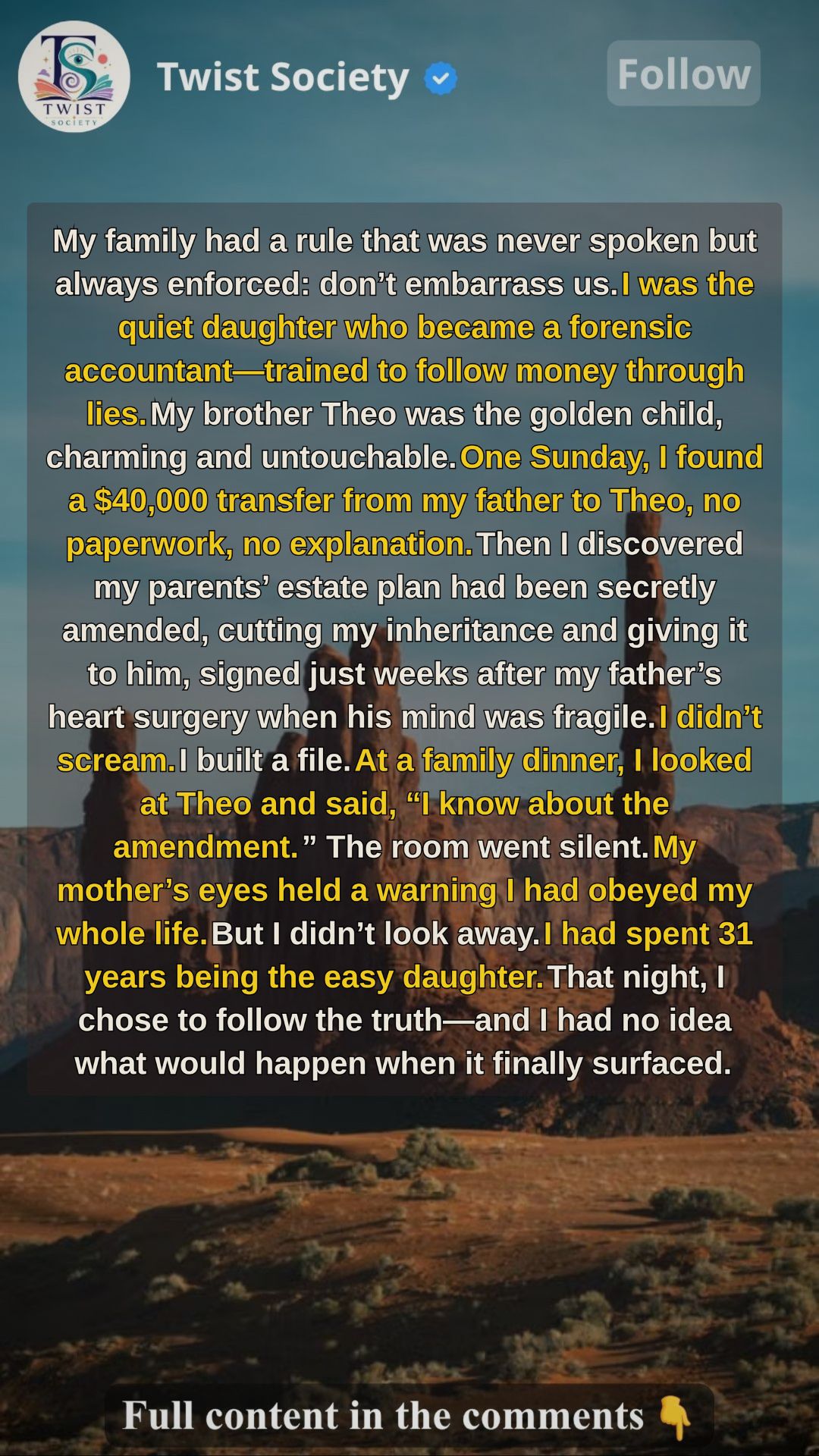
My brother smiled across the dinner table and told my father he needed another $40,000.
My father, who had suffered a cardiac episode three weeks earlier and was still forgetting which medications he had already taken, nodded like Theo had just asked to borrow the lawn mower.
My mother kept slicing roast chicken like nothing strange had happened.
And when I asked one simple question — “What exactly is the investment structure?” — the entire table turned on me like I had insulted the family name.
That was always the rule in our house.
The truth didn’t matter as much as the appearance of peace.
My mother had built her whole life around that appearance. The house was always spotless. The holiday cards always showed four smiling people in coordinated sweaters. The neighbors saw a stable family, a successful father, a gracious mother, a charming son, and a serious daughter who had always been “a little difficult.”
That daughter was me.
My brother Theo was the star.
He had the kind of confidence people mistook for competence. He could arrive twenty minutes late to dinner and somehow make everyone grateful he came at all. He forgot birthdays, missed deadlines, borrowed money, and still my father would say, “He’s just figuring things out.”
I became a CPA at twenty-four.
By twenty-eight, I was working in forensic accounting, tracing hidden assets, fraudulent transfers, fake invoices, inflated valuations, and all the small lies people tell when they think numbers can be bullied into silence.
My job wasn’t glamorous.
No one clapped when I found a suspicious wire transfer buried under six layers of corporate language. No one toasted me for noticing that a signature date didn’t match a bank deposit. I worked quietly. I noticed patterns. I followed money because money almost always tells the truth before people do.
In my family, that made me inconvenient.
Every Sunday after my father’s first heart scare, my mother insisted we have dinner together. She said it was important “while we still had time.” What she meant was that we needed to perform closeness in the dining room she polished like a showroom.
Theo sat at my father’s right hand, as always.
That night, he talked about a startup his friend was building. Something involving “AI-driven wellness analytics,” though he couldn’t explain what that meant without using six other phrases that also meant nothing.
“It’s early stage,” he said, leaning back in his chair. “But this is the kind of opportunity people regret missing.”
My father’s eyes lit up.
My mother smiled.
I asked, “What’s the revenue model?”
Theo laughed.
“Relax, Elena. Not everything is an audit.”
“I’m not auditing,” I said. “I’m asking how the company makes money.”
“They’re pre-revenue.”
“What’s the burn rate?”
He looked at me like I had brought a tax form to a birthday party.
“Again,” he said, “this is why people don’t talk business with you.”
My mother gave me that tight smile I had known since childhood.
“Sweetheart, let Theo be excited about something.”
My father patted the table.
“Theo has good instincts.”
That sentence followed him everywhere.
When Theo dropped out of two graduate programs, he had good instincts. When he lost money day trading, he had good instincts. When he convinced my father to co-sign a lease for an apartment he couldn’t afford, he had good instincts.
When I asked questions, I was negative.
Three weeks later, my father had another mild episode. Nothing catastrophic, but enough for my mother to ask me to come over and help organize his paperwork because she “couldn’t deal with all the medical forms.”
I was sitting at their kitchen table, sorting insurance statements and prescription receipts, when I saw the copy of the check.
$40,000.
Payable to Theo.
The memo line read: seed investment.
My hands went cold, but my face didn’t move.
That’s one thing my work had taught me. The moment you react too early, people start hiding things better.
I placed the copy back exactly where I found it.
Then I asked my father about it later, when my mother was making tea.
He was in his recliner, wearing the blue cardigan he wore after every doctor’s appointment, looking smaller than I remembered.
“Dad,” I said carefully, “did you invest forty thousand dollars in Theo’s startup?”
He blinked.
“Oh. That. It’s nothing.”
“It’s forty thousand dollars.”
He waved his hand.
“It’s a small decision. Your brother needed support.”
“Did you review any documents?”
“Elena.”
That tone. The exhausted tone people use when they want your concern to become your flaw.
“I’m just asking.”
My mother appeared in the doorway.
“Your father doesn’t need stress right now.”
“Then he probably shouldn’t be making large financial decisions without documentation.”
Her face hardened.
“There it is.”
“There what is?”
“You always do this. You turn everything into an investigation.”
I looked at my father.
“Dad, do you understand what you invested in?”
He looked away.
My mother answered for him.
“Theo explained it.”
That was when something shifted inside me.
Not anger. Not yet.
Recognition.
The numbers did not match the story.
And when numbers don’t match the story, someone is usually depending on love to cover the gap.
I didn’t argue that night. I drove home in silence, with both hands locked on the wheel, while my phone lit up twice with messages from my mother.
Please don’t make this ugly.
Your father is fragile.
For two months, I said nothing.
But I started looking.
Not illegally. Not dramatically. I didn’t break into accounts or steal passwords. I simply paid attention to documents I was asked to help manage, dates on envelopes, copies left in folders, and statements my mother forwarded because she still wanted me to handle “the complicated things” without ever asking complicated questions.
That was when I found the estate plan amendment.
My parents’ original estate documents, drafted years earlier, split everything equally between Theo and me. That had never mattered much to me. I made my own money. I did not build my life around inheritance.
But the new version was different.
A large portion of liquid assets had been moved into a joint account with Theo’s name on it.
I had not been told.
The amendment had been notarized shortly after my father’s first cardiac episode, during the window when his cardiologist’s notes mentioned confusion, fatigue, and difficulty managing medications.
The notary date bothered me.
The account structure bothered me.
The fact that Theo’s name appeared everywhere while everyone insisted nothing important had changed bothered me most.
I called Mr. Weston.
He was an estate attorney I had worked with years earlier during a fraud case. Calm, precise, allergic to drama. His office smelled like old paper and expensive coffee.
He reviewed the documents without interrupting.
Then he took off his glasses.
“If your parents were competent and acting voluntarily, they can change their estate plan,” he said.
“I know.”
“But if someone influenced the change while one of them was cognitively impaired, that’s different.”
I slid the medical notes across his desk.
He read them twice.
“Who initiated the amendment?”
“Theo says it was Dad’s idea.”
“And do you believe that?”
I thought of my father in the recliner, unable to remember whether he had taken his blood thinner that morning.
“No.”
Mr. Weston leaned back.
“Then stop thinking like a daughter for a moment.”
I looked at him.
“Think like a forensic accountant.”
So I did.
I built a timeline.
Cardiac episode. Discharge. Medication confusion. Theo visiting more often. Small transfers. Then larger ones. Then the $40,000 check. Then the estate amendment. Then the joint account.
It wasn’t one dramatic theft.
It was a slow rearranging of power.
The next Sunday, Theo called a “family catch-up.”
He said it lightly, like he was inviting us to coffee. But I could hear the calculation underneath. He wanted everyone in one room. He wanted to control the frame before I did.
Dinner was salmon, asparagus, and my mother’s lemon potatoes. The kind of meal she made when she wanted people to behave.
Theo was charming for twenty minutes.
Then he said, “So, Dad and I have been talking about formalizing the next investment round.”
I set down my fork.
“What legal structure?”
Theo’s smile thinned.
“Here we go.”
“No, really. Equity? Convertible note? SAFE agreement? Is there a valuation cap? Who drafted the paperwork?”
My father rubbed his forehead.
My mother said, “Elena, this is dinner, not a courtroom.”
“Then why is Theo asking for more money at the table?”
Theo laughed, but his eyes were flat.
“You’re unbelievable.”
I turned to my father.
“Dad, did you understand the estate amendment you signed?”
The room went silent.
My mother’s fork hit the plate.
Theo said, “What the hell is wrong with you?”
I kept my voice even.
“The joint account. The amended estate plan. The forty-thousand-dollar check. The smaller transfers before that. We should talk about all of it.”
My father said my name softly.
“Elena…”
It was not anger in his voice. It was pleading.
Please don’t force this into the open.
Please let the family remain what we pretend it is.
I felt something break, but not loudly.
“I love you,” I said. “That’s why I can’t ignore this.”
My mother stood.
“You should be ashamed of yourself.”
Theo leaned forward.
“You think because you count other people’s money for a living, you get to come in here and accuse your own family?”
“No,” I said. “I think because I count other people’s money for a living, I know what this looks like.”
I left before dessert.
In the car, I did not cry right away. I sat with the engine running and felt a kind of grief I had no name for.
Not grief for what had happened.
Grief for how long it had probably been true.
Theo left me a voicemail that started soft and ended ugly.
He said I was stressed. Then jealous. Then greedy. Then unstable. Then cruel.
My mother texted: Your father is very upset. I hope you’re happy.
I did not respond.
The next week, Mr. Weston brought in an elder law attorney named Priya Shah.
She was small, direct, and had the unsettling ability to make silence feel like evidence.
We gathered what we could legally obtain. Transfer histories. Medical notes. The timing of the estate change. Copies of correspondence. The name of the attorney Theo had “helped coordinate.” The fact that no neurologist had assessed my father, even though cognitive concerns appeared in the notes.
Priya called it what I had been afraid to say.
“This has the indicators of financial elder abuse.”
The words sat in the room like a verdict.
Not theft in a ski mask.
Not a forged signature in a movie.
Something quieter. More common. More family-shaped.
Pressure. Dependence. Isolation. A weakened parent. A favored child. A paper trail dressed up as love.
We filed in probate court to challenge the amendment based on undue influence. A formal notice went to my parents’ estate attorney demanding that no further changes be made while the matter was reviewed.
Theo hired his own lawyer.
His response painted me as bitter, jealous, and financially motivated. According to him, I had always resented his closeness with our parents. I was using my professional background to intimidate the family.
It was almost impressive.
He had turned concern into ambition, caution into cruelty, and documentation into betrayal.
The hearing was on a Thursday morning at the county courthouse.
I remember the fluorescent lights. I remember my mother’s pearl earrings. I remember Theo wearing a navy suit and the expression of a man who still believed charm could work on architecture.
The courtroom did not care who had been popular at family dinners.
That was the first time I saw him look uncertain.
Theo’s attorney argued that my father had been cleared by his cardiologist, that the estate changes were voluntary, and that I was an unhappy daughter upset about receiving less money.
Priya did not argue feelings.
She presented the timeline.
Date of cardiac event.
Date of discharge.
Doctor’s notes mentioning confusion.
Date Theo contacted the estate attorney.
Date of the amendment.
Date of the joint account.
Transfers before and after.
The $40,000 check.
Then the judge began asking questions.
“Who first contacted the attorney regarding the amendment?”
Theo shifted.
“I helped coordinate.”
“That wasn’t my question.”
His lawyer touched his arm.
Theo swallowed.
“My father had expressed interest.”
“In what specifically?”
“In simplifying things.”
“Simplifying for whom?”
The room went still.
The judge looked down at the file.
“Was any cognitive evaluation performed?”
Theo’s attorney said, “He was cleared by his cardiologist.”
The judge looked up.
“I asked about cognitive evaluation.”
“No, Your Honor.”
She turned back to Theo.
“Why was your name added to the liquid account?”
Theo’s confidence flickered.
“To protect my parents.”
“From what?”
He opened his mouth.
Closed it.
For the first time in my life, Theo had no performance ready.
His eyes moved from the judge to my mother, then to my father, then finally to me.
And there it was.
The moment of recognition.
Not remorse. Not exactly.
Recognition.
His face changed when he realized the room was no longer arranged around him. My mother could not rescue him with a sharp look. My father could not smooth it over with tired forgiveness. His lawyer could not turn a timeline into sibling rivalry.
The numbers had entered the room.
And numbers did not love him.
The judge found serious grounds to question undue influence during a period of cognitive vulnerability. She suspended the amendment pending review, appointed an independent guardian ad litem, and referred the matter to Adult Protective Services.
My mother gasped like someone had opened a window in winter.
My father stared at the table, looking older than ever.
Theo’s jaw tightened so hard I could see it from across the aisle.
Outside the courtroom, he walked up to me in the parking lot.
“You won,” he said.
His voice was low.
“I hope it was worth losing your family.”
For a while, that sentence followed me everywhere.
APS moved slowly, but steadily. The guardian interviewed doctors, reviewed documents, spoke to my father separately, and reconstructed the sequence without the emotional fog my family had used for years.
My mother called twice.
Both times, she cried. Both times, she asked if I understood what I had done to the family.
Neither time did she ask what Theo had done to our father.
The guardian’s report eventually concluded that my father had significant cognitive vulnerability when the amendment was made, and that the process did not reflect independent intent.
The amendment was invalidated.
The estate reverted to the original equal split.
Some prior transfers were flagged for possible civil recovery, but I did not pursue every dollar. People expected that to be the point, but it never was.
I did not need to win money from my brother.
I needed the truth to stop being treated like bad manners.
Nearly two years later, my father and I have lunch once a month at a small café near his cardiologist’s office.
We talk about his health. My work. Books. The weather.
We do not talk about Theo.
My mother sends birthday texts with perfect punctuation and no warmth.
Theo and I have not spoken since the courthouse parking lot.
For a long time, I wondered if he was right. Maybe I had won the case and lost the family. Maybe peace would have been cheaper. Maybe silence would have kept the holiday cards intact.
Then one afternoon, while reviewing a corporate fraud file at work, I saw the same pattern again.
Small transfers. Convenient timing. Vague explanations. A person in power asking everyone else to trust them because questioning them would be “hurtful.”
And I understood something I wish I had learned earlier.
You do not destroy a family by exposing the truth.
You only expose what was already destroying it.
My brother thought love meant never asking questions.
My mother thought loyalty meant protecting the image.
My father, in his weakest season, needed someone willing to be hated loudly rather than watch him be harmed quietly.
So yes, I followed the money.
Not because money mattered most.
But because people can deny conversations, rewrite memories, and weaponize guilt.
Money keeps receipts.
And sometimes the person who “breaks the family apart” is the only one brave enough to stop pretending it was ever whole.