The first thing Daniel Whitaker noticed was not her face.
It was her feet.
Bare, bleeding, and gray with dust.
She stepped down from the stagecoach in front of the Belle Creek post office on a Wednesday afternoon in 1878, holding a small cloth bundle against her chest as if it contained everything she owned.
Because it did.
The driver did not help her. He tossed one torn valise onto the ground, spat into the dirt, and shouted for the horses to be watered before sundown. A few men outside Harlan’s General Store turned their heads. Mrs. Finch, the postmaster’s wife, pulled back the curtain just enough to stare.
Everyone knew why the woman had come.
Belle Creek was too small for secrets and too cruel to pretend it did not enjoy them.
“She’s the one from St. Louis,” someone murmured.
“Whitaker’s bride.”
A laugh followed. Not loud. Just sharp enough to cut.
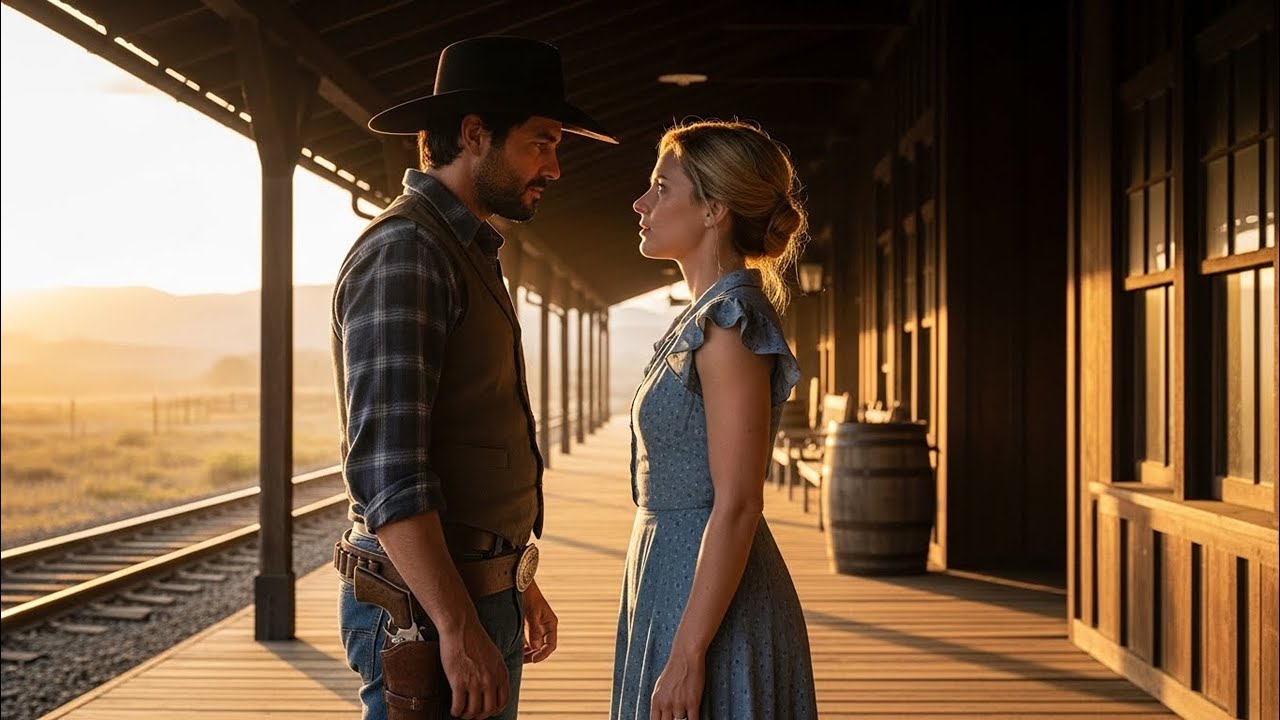
Daniel Whitaker stood across the street near the hitching rail, his hat low over his brow and his hands still at his sides. He had been expecting a woman named Clara Bell, age twenty-four, widowed, able to cook, sew, and keep a household. That was what the letter had said. That was what the agency had promised.
But the woman in front of him looked barely strong enough to stand.
Her dress hung off her shoulders, brown at the hem from mud and travel. One sleeve had been stitched with thread that did not match. Her hair, dark and loose from its pins, clung to her temples in damp strands. There was a bruise along her jaw, yellowing at the edge. Her lips were cracked.
And her feet.
Daniel looked down once, then looked away quickly, as if staring would make him part of the crowd.
The woman lifted her eyes and scanned the faces watching her.
No one stepped forward.
Not even the man who had paid for her passage.
For a moment, Belle Creek held its breath.
Daniel moved first.
He crossed the street without haste, ignoring the whispers that followed him. When he reached her, he did not ask if she was Clara. He did not ask why she was barefoot. He did not ask why the agency had sent a woman who looked less like a bride and more like someone who had escaped a locked room.
He took off his coat and held it out.
“You’re cold,” he said.
She stared at the coat as if it might be a trick.
Then she whispered, “I’m not stealing it.”
Daniel’s face did not change. “I know.”
That was all.
Something in her eyes shifted, not trust exactly, but the faintest pause in fear.
She took the coat.
It swallowed her frame.
Behind them, Harlan from the general store leaned against his doorframe and called out, “Better check the goods before you claim them, Whitaker.”
A few men laughed.
Daniel turned his head slowly.
The laughter died before he spoke.
“Harlan,” he said, calm as still water, “bring out a pair of women’s boots. Smallest you have. Wool stockings too.”
Harlan’s grin came back. “That’ll be two dollars if they fit, three if they don’t. Credit’s been tight since your last harvest.”
Daniel reached into his vest, pulled out a coin purse, and tossed it. It hit Harlan in the chest hard enough to make him fumble.
“Then count it twice.”
No one laughed after that.
The woman beside him lowered her eyes. Her fingers tightened around the coat.
Daniel noticed she had not moved from the same spot. Not one inch. As if she had learned somewhere that movement without permission brought punishment.
He softened his voice.
“There’s a bench inside the store,” he said. “You can sit while he finds the boots.”
She looked at him then, really looked.
“What is your name?” she asked.
Daniel paused.
It struck him that he had bought shoes before asking hers.
“Daniel Whitaker.”
Her mouth trembled slightly, but she pressed it flat before anyone else could see.
“I was told your name was Elias Boone.”
A strange silence fell between them.
Daniel heard the stage driver curse near the water trough. He heard a horse stamp. He heard Mrs. Finch’s curtain drop behind the post office glass.
Elias Boone.
That name was known in Belle Creek, though not spoken kindly. A gambler. A land speculator. A man who smiled too much and paid too little. He owned the saloon at the far end of town and half the debts of the people who drank there.
Daniel’s jaw tightened.
“I’m not Elias Boone,” he said.
The woman’s face drained of what little color she had left.
She took one step back, and pain shot through her so visibly that even Harlan stopped smirking. She swayed. Daniel reached out, then stopped himself before touching her.
Her breath came shallow.
“Then there has been a mistake,” she said.
It was not a complaint.
It was a sentence.
As if mistakes had followed her all her life and this was simply the newest one.
Daniel glanced toward the stagecoach. The driver avoided his eyes.
“What name did you travel under?” Daniel asked.
She swallowed. “Clara Bell.”
“That is the name in my letter.”
Her brows pulled together. Confusion crossed her face, then fear returned sharper than before.
From the end of the street, the saloon doors opened.
Elias Boone stepped out.
He was dressed too well for Belle Creek, with a silk waistcoat, polished boots, and a gold watch chain that flashed in the sun. He looked at Daniel first. Then at the woman in Daniel’s coat.
A smile spread across his face.
Slow.
Satisfied.
“Well now,” Elias called, walking toward them, “looks like my package arrived at the wrong porch.”
The word package changed the air.
Daniel did not move.
The woman did.
She flinched so hard the coat slipped from one shoulder.
Elias noticed. His smile widened.
“Come along, Clara,” he said. “You’ve caused enough confusion.”
She stared at the dirt between them.
Daniel watched her hands. They were gripping the cloth bundle so tightly her knuckles had gone white.
“You know this man?” he asked quietly.
She did not answer.
Elias laughed. “She knows who paid for her.”
Daniel turned his eyes on him. “Did you?”
Elias’s smile thinned. “That’s a private matter.”
“Not if she arrived under my contract.”
A few more townspeople had gathered now. Mrs. Finch had come out of the post office. The blacksmith stood with a hammer still in his hand. Two boys sat on the fence near the livery, pretending not to listen.
Elias took another step closer.
“She belongs with me,” he said.
The woman’s face lifted at those words.
Not much.
Just enough for Daniel to see something behind the fear.
Not weakness.
Recognition.
The kind a person has when the cage they ran from appears at the end of the road.
Daniel’s voice stayed low. “No one belongs with anyone unless they choose it.”
Elias stared at him.
For the first time, his smile disappeared.
Harlan came out of the store then, holding a pair of dark leather boots and folded stockings. He looked from Daniel to Elias to the woman, suddenly eager to be nowhere near the center of the street.
Daniel took the boots from him and set them on the bench outside the store.
The woman did not sit.
So Daniel stepped back.
He gave her space in front of the whole town.
It was a small thing, but Belle Creek saw it.
So did Elias.
The woman slowly lowered herself to the bench. She winced as the wood touched the backs of her legs. When she reached for the stockings, her sleeve slipped again, revealing a dark ring around her wrist, like the mark of a rope or a hand held too tight.
Mrs. Finch covered her mouth.
Daniel saw it.
Elias saw that Daniel saw it.
“Careful, Whitaker,” Elias said, his tone losing its polish. “You don’t know what kind of woman you’re defending.”
Daniel looked at the woman putting on the stockings with trembling fingers.
“No,” he said. “I don’t.”
Then he looked back at Elias.
“But I know what kind of man needs to call a bruised woman his property in the street.”
The crowd went silent.
Elias’s face hardened.
The woman froze with one boot halfway on.
For one brief second, she looked at Daniel as if she wanted to believe the world could still contain men who spoke like that without wanting something in return.
Then the stage driver cleared his throat.
“Sheriff ought to see the papers,” he muttered.
Elias turned sharply. “Stay out of this.”
But the damage was done.
Papers.
Daniel looked toward the driver.
“What papers?”
The driver’s eyes flicked to the woman, then away. “Agency papers. Transfer letter. Passenger receipt.”
Elias stepped closer to him. “You were paid to drive, not talk.”
The driver shut his mouth.
Daniel understood then that whatever had brought this woman to Belle Creek, it had not been simple. It had been arranged, paid for, hidden under names, and delivered in daylight because Elias Boone believed daylight made a crime look respectable.
The woman finished tying the second boot.
They were too large.
She stood anyway.
For the first time since stepping off the coach, she faced Elias directly.
“My name is not Clara,” she said.
The words were quiet.
But every person on that street heard them.
Elias stopped.
Daniel turned toward her.
She held the cloth bundle against her chest, and for a moment her courage seemed to cost her more than the journey had. Her lips parted again, but no sound came out.
Elias recovered first.
He smiled once more, but it was no longer charming.
It was a warning.
“Now, sweetheart,” he said softly, “you’re tired. You don’t want to start telling stories.”
The woman’s eyes dropped to the bundle in her arms.
Daniel saw it then.
Not clothes.
Not keepsakes.
A corner of paper had slipped through the cloth.
A document.
Folded, sealed, and stained at the edge with what looked like dried blood.
Before Daniel could speak, Elias moved.
Fast.
He reached for the bundle.
The woman stepped back.
Daniel stepped between them.
And from somewhere inside the cloth, a small silver locket fell open onto the dirt, revealing a name engraved so clearly that Mrs. Finch read it aloud before anyone could stop her.
“Margaret Boone.”
Elias went pale.
The entire street seemed to stop breathing.
And the barefoot mail-order bride, standing in boots bought by a stranger, whispered the sentence that would turn Belle Creek against its richest man.
“She was my sister.”