My sister laughed before the casket reached the altar.
Not loudly.
That would have made her look cruel.
Vanessa Lewis had mastered the kind of laugh that wore white gloves. A soft breath through the nose. A slight tilt of the chin. Just enough for the people nearest her to understand who was being judged.
Me.
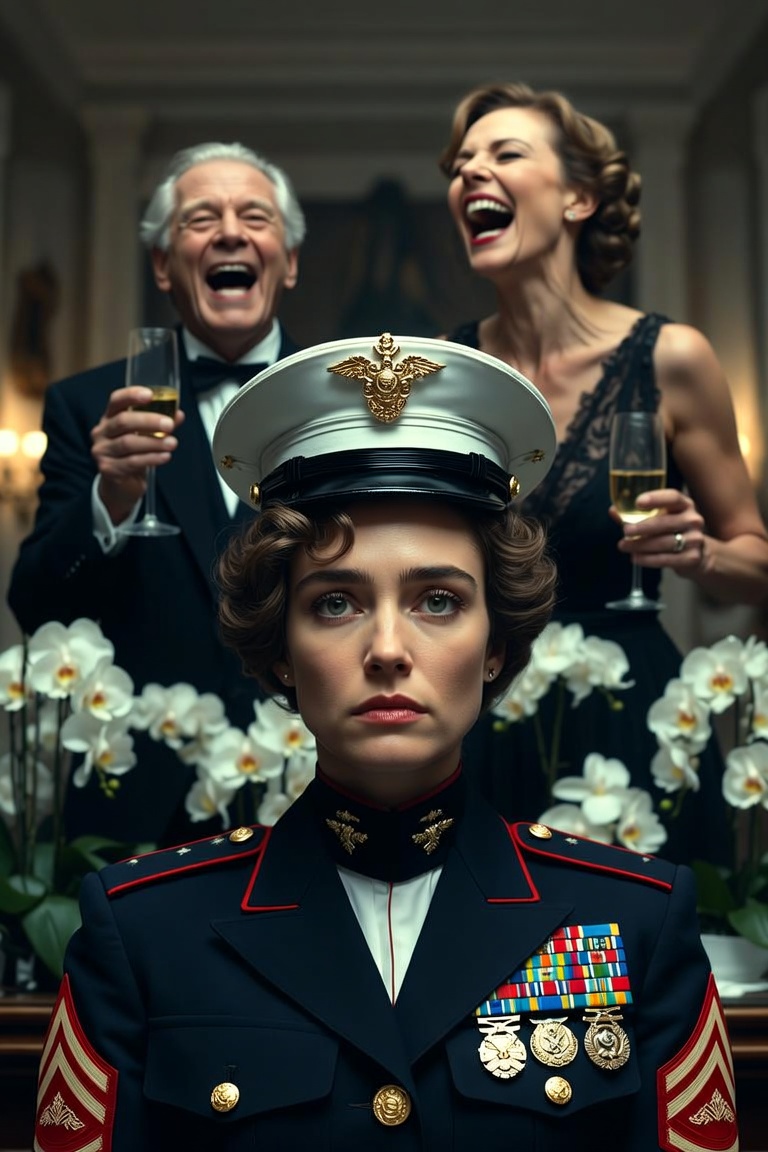
I stood near the back of Grace Memorial Chapel in my Marine dress blues, white gloves folded over my left hand, black mourning band wrapped around my sleeve.
Rain struck the stained-glass windows in silver lines. The church smelled of lilies, candle wax, damp wool, and expensive perfume. My father’s flag-draped casket moved slowly down the aisle between two rows of people who knew him as Dr. Harold Lewis: respected surgeon, hospital board member, quiet donor, man of few public mistakes.
They did not know him as Dad.
Not the man who taught me to tie my boots when I was twelve. Not the man who mailed me handwritten letters through three deployments. Not the man who once sat in my hospital room at Walter Reed and read baseball scores to me because he was afraid silence would make me remember the blast.
The pallbearers passed.
I lifted my chin.
I did not cry.
That was when Vanessa turned.
Her black hat had a small net veil that softened her face, making her look tragic instead of satisfied. Beside her stood her husband, Andrew, a defense contractor with perfect teeth and the nervous posture of a man who owed more people than he trusted.
Vanessa looked me up and down.
Then smiled.
“Sophie,” she whispered, loud enough for the first three pews to hear, “you’re not at war. It’s a funeral.”
My fingers tightened around the gloves.
Only once.
Then they relaxed.
Andrew glanced at my uniform.
His eyes paused on the ribbons.
Then on the insignia.
Then on my face.
Something moved through him.
Recognition.
Confusion.
Fear.
Vanessa didn’t notice.
She lifted her chin toward my medals.
“Did you wear all that because Dad isn’t here to tell you not to make everything about yourself?”
A woman in the second pew lowered her eyes.
My mother, seated in front, did not turn around.
Of course she didn’t.
Eleanor Lewis had always believed conflict disappeared if respectable people refused to look directly at it.
The casket reached the altar.
The honor guard folded into position.
The chapel quieted.
I stepped into the aisle.
Vanessa’s hand shot out and caught my sleeve.
“Where are you going?”
“To my father.”
Her nails pressed lightly against the fabric.
“You sit with the rest of the family.”
“I am family.”
Her smile hardened.
“Then dress like it.”
I looked at her hand on my sleeve.
She released it.
Slowly.
A lifetime of insults passed between us without a sound.
Tomboy.
Attention-seeker.
Dad’s disappointment.
Government girl.
Pretend soldier.
Too rough.
Too cold.
Too much.
I took one step forward.
Vanessa whispered, “You always did love a stage.”
Before I could answer, Andrew made a sound beside her.
A sharp inhale.
Like a man seeing a shadow move where no shadow should be.
He stared at me now, not as a brother-in-law, not as a man watching family tension, but as someone watching a locked file open in public.
His mouth barely moved.
“The Colonel?”
The words cut through the chapel.
Vanessa turned toward him.
“What did you say?”
Andrew’s face had gone pale.
He looked at me as if the church floor had dropped away between us.
“You’re Colonel Lewis.”
The chapel shifted.
A murmur moved through the pews.
My mother finally turned.
Vanessa’s eyes flicked from Andrew to me.
Her laugh came back, brittle now.
“Colonel? Don’t be ridiculous. Sophie works in logistics.”
I looked at my sister.
Then at Andrew.
Then at the flag over my father’s casket.
“No,” I said quietly.
The rain tapped harder against the glass.
“I did work in logistics. That was the cover.”
Andrew stepped back.
Vanessa’s face emptied.
And in the silence that followed, my father’s attorney rose from the front pew holding a sealed envelope with my name on it.
My name is Sophie Lewis.
I was forty-two years old when my father died.
For twenty-three years, my family introduced me as “the military one,” the way people say “the difficult one” when they want to sound polite. They never mentioned rank unless it served them. They never asked where I had been unless they could interrupt the answer. They liked patriotism framed on walls, sung before football games, printed on napkins in July.
They did not like it at the dinner table in the form of a daughter who had chosen duty over being ornamental.
Vanessa was thirty-nine, three years younger and born with the kind of beauty that taught adults to forgive her before she asked. Soft brown hair. Wide green eyes. A voice that could turn helplessness into a room’s assignment. She was not stupid, though people mistook her prettiness for innocence. She saw weakness quickly. She saw attention faster.
As children, we lived in a brick colonial outside Arlington, Virginia, where every room smelled faintly of lemon polish and my mother’s gardenias. My father worked long hours at the hospital. My mother managed reputation the way other women managed finances.
Vanessa learned piano.
I learned how to reset the breaker when storms knocked the power out.
Vanessa cried when she wanted to avoid consequences.
I stopped crying when I realized nobody came faster because of it.
Dad noticed more than he admitted.
When I was sixteen, I told him I wanted to join the Marines.
He was cleaning mud from his gardening shoes on the back porch. Fireflies flickered over the yard. Vanessa was inside practicing a recital piece badly and loudly.
Dad did not look surprised.
He set one shoe down and asked, “Do you want to run away, or do you want to serve?”
I hated him a little for knowing there was a difference.
“Both,” I said.
He nodded.
“Then wait until one of those answers gets quieter.”
Two years later, I enlisted.
Then college.
Then officer training.
Then places my mother could not pronounce and Vanessa called “dramatic” when relatives asked why I was missing Thanksgiving.
I became useful to rooms that could not afford vanity.
Convoys. Evacuations. Intelligence logistics. Hostage recovery coordination. Humanitarian corridors after floods. Quiet operations with names that never appeared in newspapers.
My official biography was plain.
Colonel Sophia M. Lewis, United States Marine Corps.
My family knew only pieces.
Not because I lied.
Because they stopped listening whenever the answer did not make them feel central.
At thirty-four, I came home on medical leave with shrapnel still in my left shoulder and nightmares sharp enough to wake me standing in the hallway.
My mother told me not to wear short sleeves because the scars upset guests.
Vanessa told me, “You chose that life.”
Dad found me in the garage at three in the morning, sitting on an overturned bucket, trying to remember whether the sound of rain on the roof was rain or debris falling after the blast.
He did not ask if I was okay.
He sat on the concrete beside me in his pajamas and said, “Tell me what the room looks like.”
I described the garage.
Oil stain near the tire pump.
Green garden hose looped twice.
Box of Christmas lights sagging on the shelf.
Cold floor.
Dad nodded.
“Good. Stay here.”
He stayed until morning.
That was love.
Not enough to repair everything.
But enough to keep me alive.
The funeral service began with Psalm 23.
The minister’s voice floated under the chapel arches, soft and practiced. People bowed their heads. Vanessa dabbed beneath her veil. My mother sat rigid, her black dress perfect, her pearls resting at her collarbone like small moons.
Andrew kept glancing at me.
The third time, Vanessa elbowed him.
He stopped.
But his hands were shaking.
That mattered.
Andrew had married my sister twelve years earlier. He worked for Orison Global Defense, a company that made its money selling logistics software, security systems, and the kind of moral flexibility that looked clean in annual reports. My family thought Andrew was impressive because he wore tailored suits and said “classified” at parties.
I thought Andrew was a man who liked standing near power more than earning trust.
After the hymn, the minister invited family members to speak.
Vanessa rose first.
Of course.
She walked to the lectern like a woman stepping into light designed for her. Her heels made tiny, precise sounds on the stone floor. She placed one hand on the edge of the lectern and looked at the casket.
“Daddy believed in grace,” she began.
Daddy.
She had not called him that in public since she was seventeen.
“He believed family should stay together, no matter what storms came.”
My mother closed her eyes.
I stared at the flag.
Vanessa’s voice trembled beautifully.
“He taught us that anger divides, pride wounds, and love means showing up with humility.”
The words moved through the chapel like perfume sprayed over smoke.
Then she looked at me.
Just for a second.
A blade wrapped in silk.
“My father did not care about titles,” she continued. “He cared about the heart beneath them.”
Andrew lowered his head.
The attorney, Mr. Graham, sat unmoving in the front pew.
Vanessa finished to soft applause.
My mother stood to embrace her when she returned.
No one asked if I wanted to speak.
Mr. Graham did.
He rose slowly, one hand on the pew for support. He was seventy, narrow-shouldered, with silver hair and the steady eyes of a man who had watched families become animals over furniture.
“Reverend,” he said. “Dr. Lewis left specific instructions that Colonel Sophia Lewis be given the opportunity to speak.”
The chapel went silent.
My mother’s head turned sharply.
Vanessa’s face went still.
Colonel.
There it was again.
Not from Andrew this time.
From my father’s lawyer.
The minister blinked.
“Of course.”
Mr. Graham looked back at me.
I stood.
My boots sounded louder than they should have.
Each step down the aisle carried me past people who had accepted Vanessa’s version of me for years because it was easier than asking questions. I stopped beside the casket.
My father’s photograph sat on an easel near the flowers. He wore an old navy sweater, not a suit. His smile was tired and real.
I touched the edge of the casket once.
Then I faced the chapel.
“I wrote three speeches on the plane,” I said.
My voice sounded calm.
It always did when my heart was breaking.
“One was formal. One was angry. One was honest enough that my father would have told me to sleep before delivering it.”
A few people shifted.
“Dad was a surgeon. People often called him a healer. I think he was better described as a man who believed repair was possible if you were willing to look at the wound.”
My mother’s fingers closed around her handkerchief.
“He was not perfect. He saw harm in our family and sometimes treated it like a bruise instead of a fracture. He loved quietly when some of us needed him to speak loudly.”
The chapel seemed to hold its breath.
“But he learned. Late, maybe. Imperfectly, yes. But he learned.”
I looked at the casket.
“He once told me that courage is not the absence of fear. It is refusing to make someone else pay for your fear.”
The words found Vanessa.
I saw them land.
“Dad paid for some of his fear with silence. I paid for some of mine with distance. Today, I choose not to pay anymore.”
My eyes moved over the pews, then settled on my mother.
“I loved him. He loved me. Whatever else this family chooses to remember, that remains.”
I stepped back.
No applause came.
Good.
Applause would have made it smaller.
As I returned to the pew, Andrew stood halfway, then stopped himself. His face had lost color again. Vanessa whispered something to him, but he kept staring at the ribbons on my uniform.
Like they had become evidence.
The burial took place under a gray sky.
Rain softened to mist over Arlington’s private cemetery, silvering the grass and darkening the shoulders of everyone’s coats. A bugler stood beneath an oak tree, horn lowered. The honor guard moved with quiet precision. The folded flag was presented to my mother, who accepted it with both hands and a face carved from stone.
I stood behind her left shoulder.
Vanessa stood on the right.
That was how our family had always arranged itself.
Me near duty.
Her near display.
After the final prayer, guests began drifting toward black cars. Umbrellas opened. Heels sank into wet earth. Someone murmured about the reception. Someone else said the service was beautiful, which is what people say when they mean they survived it.
Mr. Graham approached me near the cemetery path.
“Colonel Lewis.”
“Mr. Graham.”
He held out the sealed envelope.
“Your father asked that you receive this privately before the reading of the will.”
I took it.
My name was written in Dad’s hand.
Sophie.
No title.
No rank.
Just me.
Vanessa appeared beside us before I could put it away.
“What is that?”
Mr. Graham’s expression did not change.
“A private letter.”
“From Dad?”
“Yes.”
Her eyes narrowed.
“Why does she get one?”
I looked at the envelope.
Then at her.
“Maybe because he wrote one.”
Her face tightened.
My mother joined us, flag pressed against her chest.
“Not here,” she said.
It sounded like a plea.
Or an order.
With her, they often wore the same coat.
Andrew approached last, his shoes wet with cemetery mud, his tie slightly crooked.
“Sophie,” he said.
Vanessa’s head snapped toward him.
He had never called me Sophie with that much care.
“Could we speak for a moment?”
“No,” Vanessa said quickly.
He ignored her.
That was new.
“Please.”
I studied him.
His eyes kept shifting toward the envelope.
Not curiosity.
Fear.
“About what?” I asked.
His throat moved.
“Orison.”
My mother frowned.
Vanessa’s lips parted.
The cemetery seemed to quiet around us.
Orison Global Defense.
The company Andrew worked for.
The company whose logo I had seen once on a redacted procurement report tied to missing equipment from a humanitarian evacuation route.
The company that had almost gotten six Marines and twenty-three civilians killed.
The company I had quietly testified about before a closed Senate committee nine months earlier.
Andrew looked at me with the sick understanding of a man realizing the person he had mocked at dinner had been behind the locked door where his future was discussed.
“You knew,” I said.
Not a question.
Vanessa looked between us.
“Knew what?”
Andrew whispered, “I didn’t know it was you.”
The wind moved mist across the graves.
I stepped closer.
“What did you do?”
He opened his mouth.
Then closed it.
Vanessa grabbed his arm.
“Andrew, stop.”
He looked at her.
Something in his face broke.
“You don’t understand. If she’s the colonel from the hearing—”
“What hearing?”
My mother’s voice cracked through the air.
No one answered.
Mr. Graham watched all of us, still as a judge.
I slipped Dad’s envelope inside my coat.
“Andrew,” I said quietly, “if you need to talk, call my office tomorrow.”
He let out a strange laugh.
“Your office?”
Then he looked at Vanessa.
“Vanessa, your sister is not some desk officer. She’s the reason Orison is under federal review.”
My sister’s face went white.
The folded flag trembled in my mother’s hands.
And across the wet cemetery, two men in dark coats who had been standing near a black sedan turned their attention toward us.
Federal investigators.
Andrew saw them too.
His knees almost gave.
The reception was held at my parents’ house.
I did not want to go.
But Dad’s letter sat inside my coat like a pulse, and Andrew’s fear had changed the shape of the day. Leaving now would have meant surrendering the battlefield to people who had spent years pretending there wasn’t one.
The house looked exactly as it always had after a family death: too clean, too warm, too full of food. My mother had hired caterers. Silver trays lined the dining room sideboard. The air smelled of coffee, ham biscuits, lilies, and the lemon polish she used when grief needed choreography.
Guests spoke softly in clusters.
Every few minutes, someone looked at my uniform and then looked away.
Vanessa stood near the fireplace with a glass of white wine she had not touched. Andrew was nowhere in sight.
My mother found me in the hallway outside Dad’s study.
“Sophie.”
I turned.
She held the folded flag against her chest as if it were a shield.
“Your sister is upset.”
I stared at her.
The old sentence in a new dress.
Vanessa is upset.
Chelsea is grieving.
Olivia is fragile.
The golden child’s weather report, delivered like an evacuation order.
“So am I,” I said.
Mother’s eyes flickered.
“Today has been hard for everyone.”
“Yes.”
“You could have worn a black dress.”
Rain tapped softly against the hall window.
I looked at her pearls. Her controlled mouth. Her grief folded as neatly as the flag in her arms.
“Dad asked me to wear the uniform.”
Her face changed.
“What?”
“He wrote it in his instructions.”
“That can’t be right.”
“It is.”
She swallowed.
“He never told me.”
I did not say: Maybe he knew you would object.
I did not need to.
She heard it anyway.
Her jaw trembled once.
“You and your father had secrets.”
“No,” I said. “We had conversations you left when they became uncomfortable.”
That hurt her.
I saw it.
Part of me was glad.
Part of me was ten years old again, wanting to apologize for making my mother’s face change.
I did not.
From the study, Mr. Graham appeared.
“Mrs. Lewis,” he said gently. “The family should gather. Your husband requested the will be read today.”
Mother blinked.
“Today?”
“Yes.”
“I thought next week.”
“He was specific.”
Of course he was.
Dad had learned something before he died.
And he had set the table himself.
We gathered in the study.
The room smelled like leather, paper, and the faint cedar oil Dad rubbed into his bookshelves every winter. Rain darkened the windows. A brass lamp cast warm light across his desk, where his reading glasses still rested beside a stack of medical journals.
Mother sat in Dad’s chair because no one told her not to.
Vanessa sat on the sofa, ankles crossed, face pale but composed.
Andrew stood near the door, sweating.
I remained by the window.
Mr. Graham opened a folder.
“I will summarize Dr. Lewis’s estate instructions and then distribute copies.”
Vanessa lifted her chin.
“Can we please not make this dramatic?”
Mr. Graham looked at her over his glasses.
“Your father made decisions in response to specific concerns. Those concerns may feel dramatic to people who created them.”
Vanessa’s mouth closed.
I almost smiled.
Mr. Graham began.
The house went to my mother for her lifetime, then to a charitable medical scholarship trust.
The investment accounts were divided into three portions: one for my mother’s care, one for me, one for Vanessa.
Vanessa’s portion would be placed in a managed trust, not given directly.
She sat upright.
“What?”
Mr. Graham continued as if she had not spoken.
Certain family heirlooms went to each daughter. Dad’s surgical watch to me. Grandmother Lewis’s pearls to Vanessa. His personal workshop tools to me. His journals to my mother.
Then Mr. Graham paused.
“There is also a sealed memorandum regarding matters involving Mr. Andrew Caldwell’s employer, Orison Global Defense.”
Andrew whispered, “No.”
Vanessa turned on him.
“What did you do?”
Mr. Graham looked at me.
“Colonel Lewis, your father instructed that this section be read only if Mr. Caldwell was present.”
Andrew gripped the doorframe.
“He can’t—he didn’t—”
“He did,” Mr. Graham said.
Mother’s voice trembled.
“Read it.”
Mr. Graham unfolded a document.
My husband by marriage to my daughter Vanessa, Andrew Caldwell, approached me six months ago seeking informal medical board connections to support a private defense contract involving rehabilitation services for injured service members.
He represented the project as beneficial.
I later discovered Orison Global Defense was under scrutiny for supply chain manipulation related to overseas civilian evacuations and possible diversion of medical resources. When I refused further involvement, Andrew suggested my daughter Sophie’s name could be used to “smooth” concerns due to her Marine Corps position.
I did not consent.
Sophie was not informed.
If you are hearing this, Andrew, then you are in the room where truth finally caught you.
The study went silent.
Vanessa stared at her husband.
My mother’s face collapsed in slow motion.
Andrew shook his head.
“He misunderstood.”
Mr. Graham reached into the folder and removed copies of emails.
“I’m afraid Dr. Lewis kept records.”
Andrew’s hand moved toward the door.
I spoke once.
“Don’t.”
He stopped.
Not because I shouted.
Because he recognized command when he heard it.
Vanessa stood.
“Andrew.”
He looked at her.
For the first time, I saw their marriage clearly.
Not the polished holiday cards.
Not the charity gala photographs.
A frightened man and a woman who had spent her life confusing status with safety.
“I didn’t use Sophie’s name,” he said.
Mr. Graham placed one email on the desk.
Subject line visible.
RE: Leveraging Col. Lewis connection.
Vanessa read it.
Her lips parted.
Andrew stepped forward.
“Vanessa, listen—”
She slapped him.
The sound cracked through the room.
My mother gasped.
Andrew froze, one hand lifting slowly to his cheek.
Vanessa looked almost as shocked as he did.
Then she whispered, “You made me look stupid.”
Not: You betrayed my sister.
Not: You used my father.
You made me look stupid.
There she was.
Still.
Human. Hurt. But not yet free of herself.
Andrew looked toward me.
“Sophie, I can explain.”
“I know.”
Relief flashed across his face.
I continued.
“You can explain it to the investigators waiting outside.”
His relief died.
Two federal agents entered the study three minutes later.
They did not arrest Andrew in the dramatic way my sister’s pride deserved. They asked him to accompany them for questioning. He went because men like Andrew understand when power has changed hands.
As he passed me, he whispered, “I didn’t know you were that colonel.”
I looked at him.
“That was your mistake?”
His face reddened.
“No. I mean—”
“No,” I said. “That is exactly what you meant.”
He had not regretted using a Marine’s name.
He regretted choosing one with teeth.
The agents led him out through the rain.
Vanessa stood in the study doorway, shaking.
My mother sank into Dad’s chair.
Mr. Graham quietly closed the folder.
And I finally opened my father’s letter.
Sophie,
If you are reading this, then I have left you with trouble instead of peace. I am sorry. I hope by now you know peace built on silence is only a room waiting to collapse.
I asked you to wear your uniform because I failed to honor it properly while I was alive.
I was proud of you. Not politely. Not abstractly. Proud in the way that made me afraid because your courage showed me where I lacked it.
When you came home wounded, I told myself sitting with you in the garage was enough. It was not. I should have told your mother to stop treating your scars like a social inconvenience. I should have told Vanessa that mocking what she did not understand made her smaller, not you.
I did not.
I was a surgeon. I repaired bodies. I often neglected rooms.
Forgive me if it frees you. Do not if it costs too much.
There is one more truth.
I knew Andrew had tried to use your name. I knew Vanessa would protect the appearance of her marriage longer than she protected you. I knew your mother would ask you to be quiet.
So I made noise in the only way I had left.
The documents are in Graham’s hands. The choice is in yours.
You are not at war, my daughter.
But you have always known how to stand guard.
Love,
Dad
I read the letter once.
Then again.
By the third time, the words blurred.
The study had emptied except for my mother.
She sat in Dad’s chair, folded flag on her lap, face stripped of its careful composure.
“Sophie,” she said.
I folded the letter.
Not neatly.
I could not make my hands obey that well.
Mother looked at the uniform she had wanted me not to wear.
“I thought if I didn’t ask questions, I was protecting myself.”
I said nothing.
She touched the flag.
“Your father used to tell me you were doing important work. I told him all mothers think their children’s work is important.”
A sad smile moved over her mouth and disappeared.
“He stopped telling me.”
“That was easier for him.”
“Yes.”
Rain moved against the windows.
Mother swallowed.
“When you came back injured, I was afraid to look at you.”
I felt the old garage floor under my body.
Cold concrete.
Rain overhead.
Dad breathing beside me.
“You looked at Vanessa when she cried.”
Mother flinched.
“That was easier.”
There it was.
Not love.
Ease.
The altar where families sacrifice the child who can survive it.
“I need to ask you something,” she said.
I waited.
“Did your father love me at the end?”
The question was so small I almost hated her for it.
Then I saw she was not asking as the mother who failed me.
She was asking as a widow sitting in a room where every certainty had been rearranged.
“Yes,” I said.
Her eyes filled.
“But he stopped trusting your silence.”
She closed her eyes.
A tear slipped down her cheek.
“Fair.”
It was the first fair thing she had said all day.
The investigation into Orison Global Defense became national news three weeks later.
Not because of my family.
Because the company had been careless in six countries and arrogant in three congressional districts. Andrew’s emails were not the center of the case, but they were one thread in a rope already tightening.
Vanessa’s marriage collapsed publicly.
That wounded her more than the betrayal at first.
She moved into my mother’s house “temporarily,” which in Vanessa’s language meant until someone else solved the next problem.
I returned to base.
Work did not pause because my family had discovered I was real.
There were briefings, personnel reviews, a training accident report, a memorial for a Marine whose mother hugged me so hard my ribs hurt. The world remained large. My family’s cruelty, which once filled every room, became one room among many.
That helped.
Distance is not always avoidance.
Sometimes distance is scale.
A month after the funeral, Vanessa called.
I almost didn’t answer.
Then I did, because avoidance had begun to feel too much like letting her decide the shape of us.
“What?” I said.
She inhaled sharply.
“Hello to you too.”
“I’m busy.”
A pause.
Then, quieter, “I know.”
That was new.
“I found something in Dad’s desk,” she said.
“What?”
“A photograph. Of you. In uniform. He kept it behind his medical license.”
My throat tightened.
“What do you want me to do with that information?”
“I don’t know.” Her voice thinned. “I thought you should know.”
I sat at my desk, fluorescent lights humming overhead, Marines moving beyond the glass wall outside my office.
“What picture?”
“You’re standing in front of a helicopter. There’s dust everywhere. You look…” She stopped.
“I look what?”
“Like someone I didn’t know.”
I closed my eyes.
That could have become another insult.
Instead, she whispered, “I’m sorry I didn’t.”
The apology was incomplete.
But it had arrived without an audience.
That mattered.
“Vanessa.”
“Yes?”
“Why did you mock the uniform?”
Silence.
Long enough that I thought she might hang up.
Then she said, “Because when you walked in, people looked at you differently.”
I opened my eyes.
She laughed once, miserable.
“I hated that. I was wearing the right dress. I had planned the flowers. I had handled the caterer, the music, Mom’s pills, Andrew’s mood. And then you walked in wearing something I couldn’t buy, couldn’t borrow, couldn’t understand.”
My anger shifted.
Not vanished.
Shifted.
“You could have asked.”
“I didn’t want to know the answer.”
“Why?”
“Because then I would have to admit you had become something without me noticing.”
There it was.
Small. Ugly. Honest.
“I didn’t become it at the funeral,” I said.
“I know.”
“No, Vanessa. I don’t think you do.”
She was quiet.
“I became it while you were laughing.”
Her breath shook.
“I know that now.”
Not enough.
But more than before.
I looked at the stack of reports on my desk.
“What do you want from me?”
“I don’t know.”
“Figure that out before you call again.”
I hung up.
My hands trembled afterward.
Not from weakness.
From the strain of not turning truth into a weapon bigger than necessary.
Command teaches restraint.
Family tests it.
Summer arrived hot and bright.
My mother invited me to Dad’s memorial dedication at the hospital in August. The new rehabilitation garden would carry his name. I almost declined. Then Mr. Graham sent a note saying Dad had helped design the first version.
So I went.
Not in uniform.
A dark blue dress. Low heels. My scars visible because it was too hot for sleeves and I was done dressing for other people’s comfort.
The hospital courtyard smelled of cut grass, roses, and warm stone. Patients in wheelchairs sat beneath umbrellas. Nurses lined the walkway. Doctors stood in clusters, white coats bright in the sun. A bronze plaque waited beneath a cloth near the fountain.
Mother stood at the front beside Vanessa.
Vanessa wore a simple black dress. No hat. No dramatic veil. Her face looked thinner, less arranged.
When she saw my scars, her eyes flicked down.
Then up.
She did not look away.
Progress can be rude in its smallness.
Mother spoke first.
Her voice shook but held.
“Harold believed healing required more than medicine. He believed spaces mattered. Light mattered. Dignity mattered.”
I looked at the garden.
Wide paths for wheelchairs.
Benches with arms to help patients stand.
Shade where families could sit without feeling watched.
Dad had thought of those things.
Maybe because of me.
Maybe because he had finally understood too late what wounded people need.
Then Mother said my name.
I froze.
“Colonel Sophia Lewis helped us understand the importance of trauma-informed recovery for service members and civilians alike.”
Every head turned.
Not all at once.
Softly.
Respectfully.
I stood very still.
Mother looked at me.
Her mouth trembled.
“She has served this country with honor. Her father was proud of her. I am learning how to say that out loud.”
The courtyard blurred.
Vanessa lowered her head.
I could have rejected it.
Part of me wanted to.
Late praise can feel like theft if you are not careful.
But then I saw a young Marine in a wheelchair near the fountain, his mother standing behind him with both hands on his shoulders. He was watching me like the words mattered.
So I nodded once.
Not for Mother.
For him.
After the plaque was unveiled, people approached me. Veterans. Nurses. Hospital board members. An older woman who said Dad repaired her husband’s heart valve and then sent flowers when he died anyway.
Vanessa waited until the crowd thinned.
Then she walked over.
“I owe you more than one apology,” she said.
“Yes.”
She blinked.
Then nodded.
“I’m starting with the funeral.”
“Okay.”
Her fingers twisted together.
“I mocked your uniform because I wanted to make you small before anyone else could make you important.”
The sentence was so precise it startled me.
Therapy, I guessed.
Or pain.
“I humiliated you beside Dad’s casket. I used Mom’s silence as permission. I used Andrew’s status as proof I had chosen better. I was wrong.”
The wind moved through the garden.
A fountain murmured behind us.
I looked at my sister.
She did not ask me to forgive her.
That helped.
“Thank you for saying it,” I said.
Her eyes filled.
“Is there any way we become sisters again?”
I thought of childhood. Of garage windows. Of birthday cakes where she blew my candles too. Of her laugh at the funeral. Of Andrew gasping, The Colonel?! Of Dad writing that peace built on silence collapses.
“I don’t know,” I said.
Her face fell, but she nodded.
“That’s fair.”
I almost smiled.
Everyone was discovering fair lately.
“It would have to be new,” I said.
She looked up.
“What?”
“We were never good sisters. So we can’t become that again. We would have to build something new.”
Her eyes shone.
“I can try new.”
I studied her.
“Can you try quiet?”
A laugh broke through her tears.
“Probably badly.”
“That sounds honest.”
For the first time in years, we stood beside each other without performing a role assigned by our mother.
Not reconciled.
Not healed.
But standing.
The final hearing involving Andrew took place in October.
He was not the central defendant. Men above him had signed bigger contracts and told larger lies. But he had cooperated late, and late cooperation has a specific smell: fear dressed as civic duty.
I attended because my testimony was required.
Vanessa attended because divorce teaches people that closure is often just paperwork with witnesses.
The federal courthouse was all marble, glass, security checkpoints, and cold air. Andrew avoided looking at either of us until the recess.
Then he approached.
His suit hung looser now. His face had aged. Without confidence, he looked like a man assembled from apologies he did not know how to deliver.
“Colonel,” he said.
“No.”
He stopped.
“My name is Sophie.”
His face reddened.
“Sophie.”
Vanessa stood beside me, arms folded.
Andrew looked at her.
“I’m sorry.”
She laughed once.
“You’ll need to be more specific. The court reporter has limited time.”
I almost looked at her.
That sounded like me.
Andrew swallowed.
“I used your family. I used your father. I tried to use Sophie’s name. I told myself everyone does it in that industry.”
I said nothing.
He looked at me.
“I didn’t think of you as a person connected to the uniform. I thought of you as…” He stopped.
“As what?”
His throat moved.
“As Vanessa’s difficult sister.”
Vanessa closed her eyes.
There it was.
The family myth had traveled.
Put on a suit.
Entered federal contracting.
My sister’s casual cruelty had become part of someone else’s risk assessment.
I felt that.
So did she.
“I’m sorry,” Vanessa whispered.
Not to him.
To me.
Andrew continued, “I know that’s no excuse.”
“No,” I said. “It’s evidence.”
He nodded as if he deserved that.
Maybe he did.
When the hearing resumed, I testified clearly.
Dates.
Reports.
Supply failures.
Chain-of-custody gaps.
Names.
No rage.
No embellishment.
Truth does not need decoration when it has documents.
Afterward, Vanessa and I walked outside together.
October wind moved dry leaves across the courthouse steps. The sky was bright blue, indifferent and clean.
She stood beside me in silence.
Then said, “I used to think you were cold.”
I looked at her.
“And now?”
She watched a leaf scrape down the step.
“Now I think you were carrying things without spilling them.”
My chest tightened.
I looked away.
“That’s not always healthy.”
“No,” she said. “But it was never nothing.”
We stood there a moment longer.
Then she asked, “Do you want coffee?”
I almost said no.
Habit.
Then I said, “Somewhere quiet.”
She smiled faintly.
“I can try quiet.”
She was bad at it.
She talked too much after the first six minutes.
But she listened better than before.
That counted.
One year after Dad’s funeral, I returned to Grace Memorial Chapel.
Not for a service.
For the installation of a veterans’ support fund my father had endowed in his final documents. The fund would cover emergency housing, family travel, and trauma recovery support for injured service members passing through the hospital system.
He had named it Standing Guard.
I hated the name at first.
Then I cried in my office for twenty minutes and approved it.
The chapel looked different in morning light. Less severe. Dust floated in sunbeams. The stained-glass windows glowed blue and red instead of bleeding rain. Lilies had been replaced by simple white roses. The air smelled of beeswax and old wood.
I wore my dress blues because I chose to.
My mother arrived early.
She walked toward me slowly, holding a small box.
“Sophie.”
“Mom.”
She opened the box.
Inside was Dad’s surgical watch.
Mr. Graham had already given it to me months earlier. I kept it in my apartment. This was something else.
“Your father had the band repaired before he died,” she said. “He told me to give it to you when I was ready to understand why.”
The watch face was old, scratched, practical.
I touched it.
“Do you?”
She breathed in.
“I think so.”
I looked at her.
She met my eyes.
“He spent his life measuring time in emergencies. You spent yours answering them. I spent mine arranging rooms afterward and pretending that was the same as courage.”
My throat tightened.
“That’s a lot of therapy talking.”
A small smile appeared.
“Vanessa gave me the number.”
We both laughed softly.
It felt strange.
Not false.
Just new.
She fastened the watch around my wrist.
Her fingers trembled against my skin, near the scar she once asked me to cover.
This time, she touched it gently.
“I am sorry I looked away.”
I said nothing.
She did not rush to fill the silence.
Good.
Across the chapel, Vanessa entered carrying coffee trays and looking deeply uncomfortable about being useful.
“Don’t start,” she called when she saw my expression. “I carried all of them without spilling.”
“Proud of you,” I said.
She rolled her eyes.
Then smiled.
The ceremony began at ten.
Veterans came. Families came. Doctors, nurses, Marines, old neighbors, people whose lives had brushed against Dad’s hands in operating rooms and hallways.
I gave the closing remarks.
Not because anyone forced me.
Because this time, I wanted to speak.
“My father once told me courage means refusing to make someone else pay for your fear,” I said, standing beneath the same arches where Vanessa had mocked me. “I have spent a year learning that families, institutions, and nations all fail when fear becomes policy.”
The chapel was silent.
“Standing Guard exists for people who return from service and discover the battle followed them home. It exists for families who want to help but don’t know how. It exists because honor cannot end at applause.”
I looked at my mother.
Then Vanessa.
Then the Marines seated near the aisle.
“My uniform does not mean I am at war. It means I made a promise. Some promises are made in public. Some are kept quietly. The quiet ones are often the hardest.”
Afterward, a young woman approached me.
Her husband stood behind her in a wheelchair, one leg gone below the knee. She held a toddler on her hip.
“Colonel Lewis,” she said, voice shaking, “thank you.”
I shook her hand.
“No,” I said. “Thank you for letting us stand with you.”
Her eyes filled.
That was when I saw Vanessa watching from near the coffee table.
Not jealous.
Not performing.
Watching like she was finally willing to learn the shape of honor without owning it.
Later, as we left the chapel, Vanessa fell into step beside me.
“Dad would have liked today,” she said.
“Yes.”
“He would have cried but pretended it was allergies.”
“Yes.”
She hesitated.
“Can I ask you something?”
I braced myself.
“What?”
“When Andrew said ‘The Colonel,’ did you already know what he meant?”
I looked at the chapel doors opening to sunlight.
“Not all of it.”
“Were you scared?”
I thought about the cemetery. Andrew’s pale face. The agents by the sedan. Dad’s letter. My mother’s silence. My sister’s laugh.
“Yes.”
Vanessa looked surprised.
“But you didn’t look scared.”
I stepped outside.
The sun warmed the medals on my chest.
“Looking scared and being scared are different things.”
She nodded slowly.
“I’m learning that too.”
We stood at the top of the chapel steps.
Cars moved along the street beyond the iron gate. A dog barked somewhere. Wind lifted the edge of Vanessa’s scarf.
She looked at me.
“I don’t know if I deserve to be in your life.”
“You don’t.”
Her face fell.
Then I added, “But deserving is not the only measure. Behavior matters too.”
She absorbed that.
“Okay.”
“Start there.”
She nodded.
And for once, she did not ask for more than I offered.
My mother joined us moments later, moving carefully down the steps. Vanessa took one arm. I took the other.
Mother looked startled.
Then she let us.
Three women descended together.
Not healed into a greeting card.
Not erased of history.
Not suddenly perfect.
But no longer arranged around silence.
At the bottom, my mother squeezed my arm once.
Vanessa held the car door.
I looked back at the chapel.
A year earlier, I had stood inside those doors while my sister mocked my uniform and her husband gasped at the truth he feared.
Now the same place held a fund that would keep families from standing alone in hospital corridors and airport motels and recovery rooms where courage looked less like medals and more like staying.
My father had left trouble instead of peace.
But he had also left tools.
Documents.
A letter.
A watch.
A name spoken out loud.
Colonel.
Daughter.
Sophie.
All mine.
I touched the watch on my wrist and felt its steady tick beneath my glove.
Not loud.
Not dramatic.
Just time moving forward.
And this time, no one in my family told me to make myself smaller for the room.
The room had finally grown.