The first thing Kofi Mensah did that morning was throw his breakfast on the floor.
Not drop it.
Throw it.
The plate hit the white marble tiles with a sharp crack, sending eggs, toast, sausage, and sliced mango across the kitchen like the wreckage of something that had offended him.
“I said I wanted pancakes,” Kofi shouted.
The house went silent.
His nanny, Adjoa, stood near the stove with the spatula still in her hand. The driver stopped at the doorway. One of the housemaids froze beside the sink, a glass halfway under the tap.
Kofi was nine years old, small for his age, dressed in a perfectly pressed school uniform, with shoes polished so brightly they reflected the kitchen lights. His backpack sat on a chair behind him, already packed by someone else. His lunchbox was on the counter, already filled by someone else. His water bottle had been chilled, his tie had been tied, and his cereal had been removed from the pantry because he had complained the previous week that it was “too boring.”
But now he stared at the food on the floor as if he had been wronged.
“I don’t eat eggs on Mondays,” he said.
Adjoa’s lips parted, then closed again.
Nobody moved.
Nobody wanted to be the first adult to correct the only son of Kwame Mensah.
Kwame was standing at the far end of the kitchen, wearing a navy suit and reading an email on his phone. He was the founder of Mensah Foods, a chain of restaurants and grocery suppliers across Accra. His face was familiar from billboards. His signature appeared on contracts that fed thousands of people. His company donated to schools, sponsored youth programs, and printed the word “community” on every branded paper bag.
Yet in his own kitchen, his son had just thrown a full plate of food onto the floor.
Kwame slowly lowered his phone.
“Kofi.”
The boy folded his arms.
“I wanted pancakes.”
Kwame looked at the broken plate, then at the eggs smeared across the tile, then at his son’s untouched face.
“Pick it up.”
Kofi blinked. “What?”
“Pick it up.”
Adjoa stepped forward quickly. “Sir, I can clean—”
“No,” Kwame said without raising his voice. “He threw it. He will pick it up.”
Kofi’s cheeks flushed. “That’s the maid’s job.”
The words landed harder than the plate.
Adjoa looked down.
The driver’s jaw tightened.
Kwame’s eyes changed.
Not anger first.
Disappointment.
That was worse.
“Go to the car,” he said.
Kofi looked relieved, thinking he had escaped punishment.
Then Kwame added, “No breakfast.”
The boy’s face twisted. “But I’m hungry.”
“You were hungry five minutes ago too.”
“That food was wrong.”
Kwame stepped closer.
“No. Your attitude was wrong.”
Kofi grabbed his backpack and stormed toward the door, muttering loudly enough for everyone to hear, “This house is so unfair.”
Nobody answered.
Adjoa knelt to gather the broken plate.
Kwame watched her for a moment, then crouched beside her and began picking up the larger pieces himself.
“Sir,” she whispered, embarrassed. “Please.”
“I’m sorry,” he said quietly.
She shook her head. “He is a child.”
Kwame looked toward the door where his son had disappeared.
“Yes,” he said. “That is why today matters.”
That morning was supposed to be ordinary.
A school drop-off.
A meeting with suppliers.
A quick stop at one of Kwame’s restaurants before noon.
But the image of food spread across his kitchen floor stayed with him as he sat beside Kofi in the back seat of the car.
Kofi kept his face turned toward the window, arms crossed, determined to prove that hunger was a form of injustice only he had ever suffered.
Kwame said nothing.
He had learned in business that silence could reveal more than lectures. People filled silence with who they really were.
Kofi lasted six minutes.
“Are you still angry?”
Kwame looked at him. “Are you sorry?”
Kofi shrugged. “The plate broke by accident.”
“The plate did not throw itself.”
“I didn’t mean to break it.”
“That is not what I asked.”
Kofi stared out the window again. “It was just food.”
Kwame did not reply.
That sentence followed him all day.
It was just food.
At 11:45, Kwame picked Kofi up early from school for a dentist appointment. Kofi was thrilled because it meant missing mathematics. He was less thrilled when the dentist finished quickly and Kwame said they would stop by Golden Spoon, one of the family restaurants, before going home.
Golden Spoon sat near a busy road in Osu, bright and clean, with big windows, yellow signage, and the smell of grilled chicken drifting onto the pavement.
Kofi liked going there because the staff knew him.
They gave him extra juice.
They called him “young boss.”
They let him sit in the corner booth with the padded seat.
As the car pulled up, Kofi was still sulking from the morning, but his hunger had made him practical.
“Can I get jollof?” he asked.
Kwame looked at him. “Are you asking or ordering?”
Kofi hesitated.
“Can I please get jollof?”
“That is better.”
They stepped out of the car.
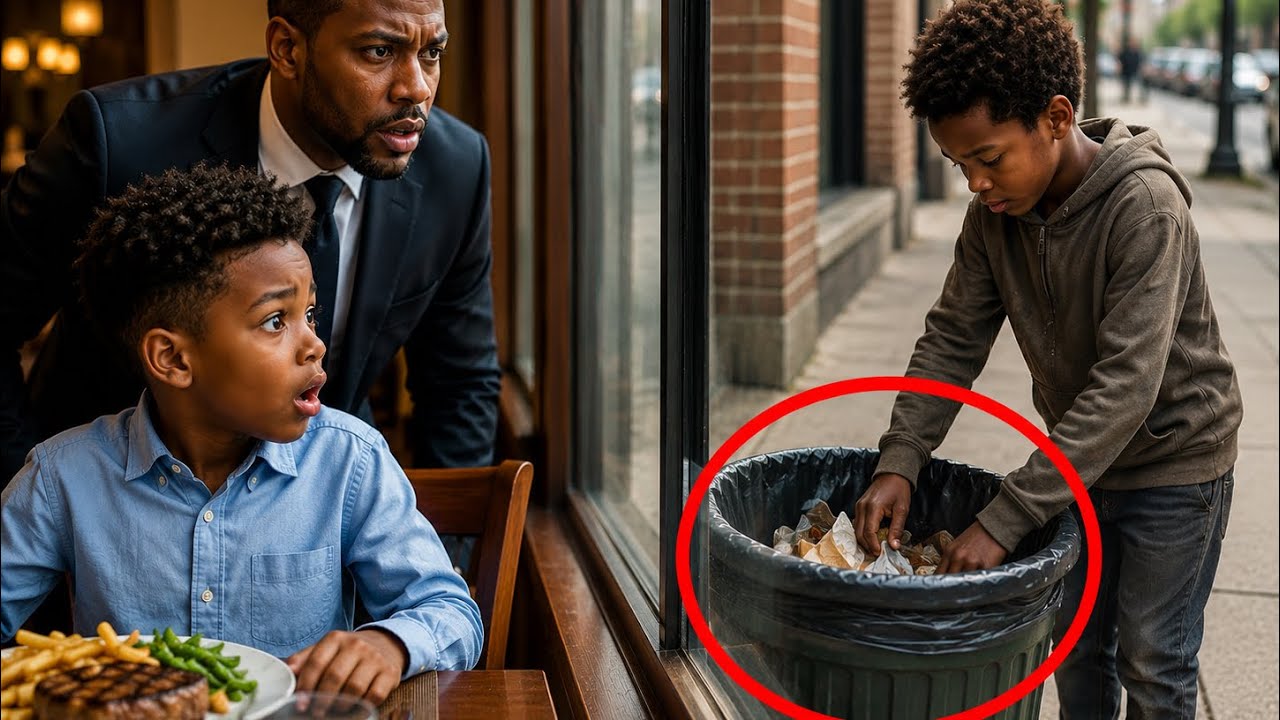
That was when Kofi saw the boy at the trash can.
The boy looked around twelve, maybe thirteen, though his thin frame made it difficult to tell. He wore a faded green shirt with one sleeve torn at the seam, shorts too large at the waist, and sandals held together with a piece of blue string. His skin was dusty from the road, and his elbows were sharp beneath the fabric.
He stood beside the metal trash bin near the side of the restaurant, one hand holding the lid open, the other reaching carefully inside.
Kofi stopped walking.
The boy pulled out a paper food container.
He opened it.
Inside were leftover rice, a small piece of chicken bone, and sauce smeared against the corner. He looked around again, then used his fingers to scrape the rice into a plastic bag he had tucked under his arm.
Kofi’s face changed.
It was not disgust.
Not exactly.
It was confusion first.
The kind a child feels when the world reveals a rule nobody taught him.
“Dad,” Kofi whispered.
Kwame had seen the boy too.
The restaurant manager, Mr. Boateng, rushed toward them from the entrance.
“Mr. Mensah, welcome, welcome. Your usual table is ready.”
Kwame raised one hand without looking away from the trash can.
“Who is that boy?”
Mr. Boateng followed his gaze and frowned.
“Oh. Him. He comes sometimes. We chase him away, but he returns. I will call security.”
The boy heard the word security.
He flinched.
His hand tightened around the plastic bag.
Kwame turned sharply. “No.”
Mr. Boateng froze.
Kwame walked toward the boy.
The boy stepped back at once, holding the bag close to his chest.
“I didn’t steal,” he said quickly. “It was thrown away.”
His voice was steady, but his eyes were not.
“I wasn’t taking from inside. Only the bin.”
Kofi stood behind his father, staring at the plastic bag.
Thrown away.
Only the bin.
The words did something strange to him.
That morning, he had thrown food onto a clean floor because it was not pancakes.
Hours later, another boy was explaining why he deserved food from a trash can.
Kwame slowed his steps.
“What is your name?”
The boy looked at the restaurant entrance, then at the road, then back at Kwame.
“Jabari.”
“Jabari what?”
“Jabari Owusu.”
“How old are you?”
“Twelve.”
Kofi whispered, “He’s only three years older than me.”
Jabari glanced at Kofi’s shoes.
Clean. New. Expensive.
Then he looked away.
Kwame pointed gently to the plastic bag. “Is that for you?”
Jabari’s grip tightened.
“No.”
That surprised Kofi.
Kwame’s voice softened. “Who is it for?”
“My father.”
The manager looked uncomfortable. “Sir, perhaps we should not do this outside. Customers are watching.”
Kwame turned and saw faces through the restaurant window.
People were watching.
Some with curiosity.
Some with pity.
Some with the relieved expression of people glad the problem was not theirs.
Kwame looked back at Jabari.
“Have you eaten today?”
Jabari did not answer.
That was answer enough.
Kofi’s stomach tightened.
He had complained about being hungry in a leather car with air conditioning.
Jabari was hungry beside a trash can.
Kwame said, “Come inside.”
Jabari stepped back. “No, sir.”
“I’m inviting you.”
“I can’t pay.”
“I did not ask you to pay.”
Jabari looked at Mr. Boateng. The manager’s face had the tight discomfort of a man who wanted the situation handled politely and quickly.
“I’ll leave,” Jabari said. “Please don’t call anyone.”
Kwame looked at his son.
Kofi was still staring at the bag of scraps.
“Kofi,” Kwame said quietly, “what do you think we should do?”
The question startled him.
Usually adults told him what would happen. They did not ask him.
Kofi swallowed.
The memory came back with painful clarity: eggs sliding across marble, toast broken under his shoe, Adjoa kneeling to clean what he had ruined.
He looked at Jabari.
Then at his father.
“Can he eat with us?”
Jabari’s eyes moved to Kofi.
For a moment, neither boy spoke.
Kwame nodded.
“Yes,” he said. “He can.”
Inside Golden Spoon, everything became awkward.
The staff tried not to stare.
Customers tried not to look like they were staring.
Jabari stood just inside the entrance, holding his plastic bag, as if the polished floor might reject him.
Kofi walked to his usual booth, then stopped.
The booth suddenly looked different.
Too big.
Too clean.
Too comfortable.
He slid in slowly.
Jabari remained standing.
“You can sit,” Kofi said.
Jabari looked at Kwame for permission.
Kwame nodded.
Only then did he sit, carefully, on the very edge of the seat.
A waitress came over.
Her smile flickered when she saw Jabari, then returned when she saw Kwame watching.
“What can I bring you, sir?”
Kwame handed the menus back without opening them.
“Bring jollof rice, chicken, plantain, stew, water, and fruit juice. Three plates.”
Kofi glanced at Jabari.
The boy’s eyes had gone still, fixed on the table.
Not excited.
Not greedy.
Still.
As if showing too much hunger might make the food disappear.
When the plates arrived, Jabari did not reach for his.
He looked at the food, then at the bag of scraps beside him.
Kwame noticed.
“Eat,” he said.
Jabari shook his head. “I need to take some to my father.”
“We can pack food for him too.”
Jabari looked up quickly. “Fresh?”
“Yes.”
Kofi’s throat tightened at the word.
Fresh.
For Jabari, fresh food was not assumed.
It was a question.
Jabari picked up his fork.
His hand trembled once before he steadied it.
He took a small bite.
Then another.
Then he stopped himself and sat back.
Kofi knew that stop.
He did it when adults were watching and he wanted to seem well behaved.
But this was different.
Jabari was not trying to look polite.
He was trying not to eat too fast because hunger had made him ashamed.
Kofi pushed his own plate slightly toward him.
“You can have mine too.”
Jabari stared at him.
Kofi looked down. “I mean, only if you want.”
Kwame watched his son closely.
That morning, Kofi had thrown breakfast on the floor.
Now he was offering his lunch.
Not because someone told him to.
Because he had seen what waste looked like from the other side of the trash can.
Jabari shook his head. “You should eat.”
Kofi picked up his fork, but every bite felt different.
He could taste the food now.
Not just flavor.
Work.
Hands.
Money.
Luck.
A full plate no longer looked ordinary.
Kwame waited until Jabari had eaten half his meal before asking questions.
Not all at once.
Not like an interrogation.
Gently.
“Where do you live, Jabari?”
“Near Kaneshie. Behind the old mechanic yard.”
“With your father?”
“Yes.”
“And your mother?”
The fork stopped.
Kofi noticed.
Jabari placed it down carefully.
“She died.”
Kwame’s expression softened. “I’m sorry.”
Jabari nodded once.
People said sorry when someone died.
It did not change where you slept.
“What happened?” Kwame asked.
Jabari looked at the restaurant window.
“She was sick for a long time. First coughing. Then fever. Then pain. My father took her to a clinic, but the medicine cost too much. They said she needed more tests. More money. More everything.”
His voice stayed flat, the way children sound when grief has been repeated so many times it becomes a report.
“My father sold his tools. Then our television. Then her phone. Then we borrowed. Then there was nothing left to sell.”
Kofi stopped eating.
Jabari continued, “She told me not to worry. She said she would get better when the rains came. She liked rain.”
He looked down at his plate.
“She died before the rains.”
No one at the table spoke.
Even the restaurant sounds seemed to fade: the clatter of plates, the low voices, the soft buzz of the refrigerator near the counter.
Kwame’s face had changed.
He was not looking at a poor boy anymore.
He was looking at a system he had driven past in tinted cars.
“What does your father do now?” he asked.
Jabari’s mouth tightened.
“He used to fix refrigeration units. Hotels. restaurants. shops. He was good. Everyone called him Kojo the Cooler Doctor.”
For the first time, there was pride in his voice.
“What happened?”
“He got hurt carrying a compressor. Then after my mother died, he couldn’t pay people back. Some men came and took most of his tools. He still tries to find work, but without tools…” Jabari shrugged.
Kofi thought about the kitchen that morning.
The chilled water bottle.
The cold fruit.
The refrigerator humming in the pantry.
He had never wondered who fixed things when they stopped working.
Kwame leaned back slowly.
A refrigeration technician.
His company owned restaurants.
Many restaurants.
All with refrigerators, freezers, cold rooms, ice machines, display coolers.
For a moment, the solution seemed so obvious that it embarrassed him.
“Would your father speak with me?” Kwame asked.
Jabari’s eyes narrowed.
“Why?”
“I may have work for him.”
That should have made Jabari smile.
It did not.
Instead, he looked away.
“People say that.”
Kwame nodded. “I imagine they do.”
“They say, ‘Come tomorrow.’ Then tomorrow they are busy. They say, ‘Leave your number,’ but we don’t have a phone. They say, ‘I’ll help,’ then they forget.”
His voice was quiet, but each sentence carried a bruise.
“My father stopped believing people.”
Kofi looked at his own father.
Kwame did not argue.
He did not say he was different.
He did not make a speech about opportunity.
He simply said, “Then we will go to him.”
Jabari looked back.
“Now?”
“After lunch.”
Mr. Boateng, who had been hovering near the counter, stepped forward nervously.
“Sir, your two o’clock call—”
“Move it.”
“And the supplier meeting—”
“Move that too.”
The manager glanced at Jabari, then lowered his eyes.
“Yes, sir.”
Kwame turned to the waitress.
“Pack a full meal. Chicken. Rice. Stew. Water. Fruit. And bread.”
Jabari leaned forward. “Not too much. He won’t take it if it looks too much.”
Kwame looked at him carefully.
“Then we will make it look like lunch.”
Kofi listened to that sentence and learned something else.
Helping was not only giving.
Sometimes helping meant giving in a way that allowed the other person to keep their dignity.
After lunch, they drove to Kaneshie.
Jabari sat in the front passenger seat because he said his father would panic if he saw him step out of the back of a rich man’s car like he had been kidnapped by a politician.
Kofi sat beside his father in the back, silent.
The city changed as they drove.
The smooth roads near the restaurant gave way to rougher ones. Painted storefronts became rusted roofs. The smell of grilled meat and petrol mixed with open drains and dust. Children ran barefoot between parked cars. Women balanced bowls on their heads. Men sat beside repair shops, waiting for work that might not come.
Kofi pressed his hand against the window.
He had passed places like this many times.
But passing was not seeing.
The car stopped near an old mechanic yard behind a row of kiosks. Jabari opened the door quickly.
“Let me talk first,” he said.
Kwame nodded.
They followed him down a narrow path between broken appliances and stacked tires. At the back, under a sheet of corrugated metal, sat a man on a low wooden stool, cleaning a small screwdriver with a rag.
He was thin but broad-shouldered, with tired eyes and hands marked by years of work. One of his knees was wrapped in faded cloth. Beside him sat a small box of old tools, too few for the trade he once had.
When he saw Jabari, his face changed with relief.
Then he saw Kwame’s suit.
The relief vanished.
“Jabari,” he said slowly. “Who are these people?”
Jabari lifted the food bag.
“They bought lunch.”
The man stood, anger rising before understanding could catch up.
“I told you not to beg.”
“I didn’t beg.”
“Then why is a rich man standing here?”
Kwame stepped forward. “Mr. Owusu?”
The man looked him up and down.
“Who is asking?”
“My name is Kwame Mensah.”
Recognition flickered in his eyes. Not admiration. Suspicion.
“Mensah Foods.”
“Yes.”
The man’s mouth hardened. “We don’t owe your company anything.”
“I’m not here about a debt.”
“Then you are lost.”
Jabari moved closer. “Papa—”
The man snapped, “Did you take money from him?”
“No.”
“Did you steal?”
“No!”
“Then what?”
Jabari’s face tightened. “I was getting food from the trash.”
The words stopped his father as if someone had struck him.
His eyes moved to the food bag.
Then to his son.
The anger drained from his face, leaving something much more painful.
Shame.
He sat back down slowly.
“Jabari,” he whispered.
“I was saving it for you,” the boy said.
His father covered his mouth with one hand.
Kofi watched from behind Kwame, unable to look away.
This was not like the charity videos his school sometimes showed, with sad music and children smiling after receiving bags of rice.
This was a father finding out that his son had been digging through trash because he was too hungry to ask.
Kwame stepped closer, but not too close.
“Mr. Owusu, Jabari told me you repair refrigeration systems.”
The man’s eyes sharpened.
“I used to.”
“I own restaurants. We always need skilled technicians. I came to offer you work.”
Kojo Owusu laughed once.
It was not a happy sound.
“Of course.”
Kwame did not react.
Kojo stood again, pride returning like armor.
“A man in a suit sees a poor man and suddenly wants to save him. Then tomorrow, his assistant says the job is filled. Or he wants me to work two months before payment. Or he wants me to smile for a photo so people can clap for his kindness.”
Kofi looked at his father.
Kwame’s face remained calm.
Kojo continued, voice rising. “Do you know how many promises came after my wife died? Church people. Politicians. Businessmen. Friends who used to eat at my table. They all came with words. Words are cheap when your children are not hungry.”
Jabari whispered, “Papa, please.”
“No,” Kojo said. “You are a child. You still think people come back.”
That sentence landed heavily.
Kofi felt it in his chest.
You still think people come back.
Kwame looked at Kojo’s small box of tools.
“I understand why you don’t trust me,” he said.
Kojo’s eyes flashed. “No, you don’t.”
“You’re right. I don’t understand your pain.”
The honesty pulled some of the heat from the moment.
Kwame continued, “But I understand business. So let me speak plainly. I have twenty-four restaurants in the region. Each one has refrigeration units. We currently outsource repairs to a company that overcharges and arrives late. If your skills are what Jabari says they are, I can pay you for trial work today. Not a promise. A job order. You inspect the cold room at Golden Spoon this afternoon. You tell us what is wrong. We pay you for the inspection before you leave.”
Kojo stared at him.
“No photos,” Kwame added. “No speeches. No charity. Work.”
The word changed the air.
Work.
Not pity.
Not rescue.
Work.
Kojo looked down at his wrapped knee.
“I don’t have proper tools.”
“I can provide tools owned by the company.”
“I won’t be treated like a beggar.”
“You won’t be.”
“I will not have my son looked down on.”
Kwame glanced at Kofi.
Kofi lowered his eyes.
He knew, somehow, that this part included him.
Kwame said, “Then let my son learn better.”
Kojo studied him for a long time.
Then he shook his head.
“No.”
Jabari turned to him. “Papa.”
“No,” Kojo repeated. “We are not going anywhere with them.”
Kwame accepted the answer with a nod.
“I’ll leave my card.”
Kojo did not take it.
Kwame placed it on the wooden stool.
“We will go now.”
Jabari looked devastated.
He followed them back toward the car, carrying the lunch bag.
Kofi waited until they were away from Kojo, then whispered, “Why did he say no?”
Jabari’s jaw worked.
“Because hope made him tired.”
Kofi did not understand fully.
But he understood enough to feel afraid of it.
At the car, Jabari stopped.
“I should stay.”
Kwame nodded. “Of course.”
Jabari handed him the food bag back.
“My father won’t eat it if he thinks it came from you.”
Kofi looked at the bag.
Then at Jabari.
He stepped forward.
“What if it came from me?”
Jabari frowned. “What?”
Kofi held out his hands.
“I wasted food this morning.”
Kwame turned toward him.
Kofi’s voice became smaller, but he kept going.
“I threw breakfast on the floor because it wasn’t what I wanted. Then I saw you at the trash can. And I felt…” He searched for the word and could not find one big enough.
So he used the truth.
“I felt ugly inside.”
Jabari looked at him carefully.
Kofi took the lunch bag from his father.
“Can you tell your father this is not charity? Tell him it is from a boy who didn’t know food could be missing from someone’s house.”
Jabari’s face changed.
Not forgiveness.
Not yet.
But something softened.
He took the bag.
“I’ll tell him.”
Kofi nodded.
Then he added, “And tell him… my father comes back when he says he will.”
Kwame looked at his son sharply.
Jabari looked too.
Kofi did not know where the sentence came from.
He only knew it mattered.
“My dad said work,” Kofi continued. “Not promise. Work. Maybe your father doesn’t have to hope in all people. Maybe just one.”
Jabari stared at him.
His eyes filled, but he blinked quickly and turned away.
“I’ll tell him,” he said again.
They left Jabari standing near the path with the food bag in his hand.
In the car, Kofi did not ask for juice.
He did not complain about the smell outside.
He did not ask for his tablet.
He only sat quietly, looking at his own clean shoes.
That evening, dinner at the Mensah home was banku and okra stew.
Kofi ate every bite.
Adjoa noticed.
Kwame noticed.
Neither said anything.
After dinner, Kofi carried his own plate to the sink.
The housemaid looked so surprised she nearly dropped a spoon.
“I can wash it,” Kofi said.
She blinked. “Young master?”
“My name is Kofi.”
She smiled a little. “Yes. Kofi.”
He did not do a good job washing the plate.
There was still stew on the back.
Adjoa quietly washed it again after he left.
But Kwame had seen enough.
That night, after Kofi went to bed, Kwame sat in his study with Kojo Owusu’s name written on a notepad.
He made three calls.
One to his operations director.
One to the head of maintenance.
One to his accountant.
He did not announce a charity project.
He did not create a campaign.
He did not tell his social media manager to prepare a post.
He simply gave instructions.
If Kojo Owusu called, he was to be given a paid diagnostic job immediately.
If he needed tools, company tools would be issued and signed for like any contractor.
If he performed well, he would be offered ongoing work at fair rates.
And all outstanding debts related to predatory tool seizures were to be reviewed quietly.
Then Kwame turned off his desk lamp and sat in the dark for a while.
He had spent years expanding a food company.
That day, his son had met hunger.
Not the word.
The person.
The next morning, Kofi came down early.
Adjoa had prepared porridge, bread, and fruit.
Kofi looked at the bowl.
For a second, old habit flickered across his face.
Then he sat.
“Thank you,” he said.
Adjoa stared at him.
“You’re welcome.”
He ate slowly, seriously, as if breakfast had become an exam.
Halfway through, the gate intercom rang.
The security guard’s voice came through the kitchen speaker.
“Sir, there is a man here. Kojo Owusu. And the boy from yesterday.”
Kofi stood so fast his chair scraped the floor.
Kwame entered from the hallway, already adjusting his watch.
“Let them in.”
Kojo looked different in the morning light.
Still tired.
Still proud.
But wearing a clean shirt and carrying his small box of tools.
Jabari stood beside him, holding the business card in both hands.
Kojo did not enter the house fully.
He stopped at the doorway.
“I am here for the inspection,” he said.
Kwame nodded.
“Good.”
Kojo lifted his chin. “One job. Paid today.”
“One job. Paid today.”
“No favors.”
“No favors.”
Kojo glanced at Kofi.
“My son said something last night.”
Jabari looked embarrassed.
Kojo continued, “He said maybe I don’t have to hope in all people. Maybe just one.”
Kofi swallowed.
Kojo’s eyes moved back to Kwame.
“I don’t know if you are that one.”
Kwame said, “Then let the work decide.”
Kojo nodded.
That was the beginning.
Not a miracle.
Not a movie scene where poverty vanished before sunset.
A beginning.
Kojo inspected the Golden Spoon cold room that afternoon. He found a faulty relay, a poor wiring repair from the previous contractor, and a condenser problem that had been ignored for months.
The head of maintenance stood beside him, skeptical at first.
By the end, he was taking notes.
Kojo completed the repair with borrowed tools and hands that remembered who they were when given proper work.
He was paid before he left.
In cash and by receipt.
He counted it twice, not out of greed, but disbelief.
Jabari watched his father fold the money carefully and place it in his shirt pocket.
For the first time in months, Kojo bought food on the way home.
Not scraps.
Not credit.
Food.
Rice. Beans. Oil. Tomatoes. Eggs. Bread.
That night, Jabari ate until he was full and then stopped because there would be breakfast.
That fact alone nearly made him cry.
Within two weeks, Kojo had completed repairs at four restaurants.
Within a month, he had a contract.
Within six weeks, Kwame’s accountant discovered that one of the men who had “collected” Kojo’s tools after his wife’s death had done so illegally, using inflated debt claims and intimidation.
Kwame did not send thugs.
He sent documents.
Receipts.
Lawyers.
Pressure applied in the clean language of people who could not be easily dismissed.
The debts were reviewed.
Several were reduced.
Two were erased.
Some of Kojo’s tools were returned.
Others were replaced through a company equipment loan program, the same program offered to all approved contractors.
Kojo signed every paper slowly.
He trusted ink more than speeches.
Kwame respected that.
Jabari returned to school regularly.
At first, his teachers noticed only attendance.
Then they noticed his work.
His math teacher wrote, “Jabari is focused again.”
His English teacher wrote, “He has begun submitting assignments on time.”
Nobody wrote, “He is no longer hungry,” but that was the sentence beneath all the others.
As for Kofi, change came in small, uncomfortable pieces.
He began noticing things.
He noticed Adjoa ate standing up after serving everyone else.
He noticed the driver sometimes waited for hours without water.
He noticed his closet had shoes he had forgotten owning.
He noticed his toy room contained boxes of things he had begged for and abandoned within days.
Seeing was exhausting at first.
Once you started, you could not stop.
One Saturday, Kwame found Kofi sitting in the middle of his toy room surrounded by remote-control cars, action figures, building sets, footballs, puzzles, and unopened birthday gifts.
“What happened here?” Kwame asked.
Kofi looked up.
“I have too many things.”
Kwame leaned against the doorway.
“That is true.”
Kofi picked up a red toy truck.
“I wanted this so badly last year.”
“I remember.”
“I cried when you said wait until my birthday.”
“Yes.”
“I played with it once.”
Kwame said nothing.
Kofi placed the truck into a cardboard box.
“I want to give some away.”
Kwame studied his son.
“To whom?”
Kofi shrugged. “Children who will actually play with them.”
“That is a good idea.”
Kofi looked at the shelves again.
“But not broken things.”
Kwame smiled slightly. “No.”
“And not things I don’t want just because they are bad. Good things.”
“Yes.”
Kofi nodded, as if making a rule with himself.
“Jabari said people always give poor children things they were going to throw away anyway.”
Kwame’s face grew serious.
“Jabari is right.”
So they sorted.
Not quickly.
Kofi struggled.
He held certain toys for a long time before putting them in the donation box. Once, he removed a game and placed it back on the shelf, then stared at it for ten minutes before putting it into the box again.
Kwame did not rush him.
Generosity that costs nothing teaches very little.
By afternoon, six boxes were filled.
Clean toys.
Working toys.
Good toys.
Kofi wrote notes for some of them.
“I liked this car. I hope you like it too.”
“This puzzle is hard but fun.”
“This football is lucky.”
Adjoa helped him tape the boxes.
When the driver loaded them into the car, Kofi carried the smallest one himself.
At the community center, children gathered around the boxes with the same wide-eyed excitement Kofi usually had in toy stores.
One little boy hugged the red truck to his chest.
Kofi watched him.
His face did not look proud.
It looked awake.
On the way home, he asked his father, “Can kindness become a habit?”
Kwame looked at him.
“Yes,” he said. “But so can selfishness.”
Kofi nodded slowly.
“Then I want to practice the first one.”
Months passed, and something remarkable happened inside the Mensah house.
It became less quiet.
Jabari visited often, usually with homework and always with careful manners. Kojo repaired several of Kwame’s restaurant systems and eventually hired two younger assistants, training them with the seriousness of a man rebuilding not only income but identity.
Kofi and Jabari became friends in the uneven way boys do.
They argued about football.
They traded school stories.
Jabari taught Kofi how to fix a loose bicycle chain.
Kofi taught Jabari how to use a tablet for school research, though Jabari learned so fast Kofi pretended he had taught him more than he did.
One afternoon, Kofi complained that his math homework was too hard.
Jabari looked at the page, then at him.
“You have a tutor.”
“So?”
“So use your blessing before it expires.”
Kofi stared at him.
Then he laughed.
But he did the homework.
Kwame watched them from the veranda, two boys bent over the same table, one born into comfort, one pulled back from the edge of hunger, both learning from the other in ways adults could not arrange.
Adjoa brought juice out and placed it between them.
Kofi said, “Thank you, Adjoa.”
She smiled every time.
Not because the words were grand.
Because they were no longer rare.
The biggest change came one Friday evening at Golden Spoon.
Kwame had taken Kofi there after school, partly for dinner and partly because he wanted to review renovations in the kitchen. The restaurant looked the same as it had months earlier: bright windows, yellow sign, warm smell of jollof and grilled chicken, customers moving in and out with paper bags and full plates.
But Kofi did not look at it the same way.
He noticed the trash can first.
It stood near the side wall, clean now, with a lid that closed properly. After the incident with Jabari, Kwame had ordered a new policy. Unsold safe food would be packed at the end of each day and delivered through a local shelter partnership. Staff meals were improved. Waste was tracked. Portions were reviewed.
Mr. Boateng, once eager to chase Jabari away, now personally signed the donation log.
Kofi had seen him do it.
People could change, he had learned, but usually after being made uncomfortable by the truth.
Kwame and Kofi entered the restaurant and sat in the corner booth.
The same booth.
The padded seat.
The clean table.
The view of the side window.
A waitress brought menus.
Kofi ordered jollof and chicken. Then he added, “And water first, please.”
Kwame raised an eyebrow.
“What?”
“You used to order two juices before food.”
Kofi shrugged. “Water is fine.”
Kwame smiled but did not tease him.
Halfway through the meal, a small movement outside the window caught Kofi’s attention.
A boy stood near the edge of the pavement.
Younger than Jabari had been.
Maybe seven.
He wore a school shirt with one missing button and held a plastic bottle filled with coins. He was not digging through the trash. He was just standing near the window, watching people eat with the stillness of a child trying not to look hungry.
Kofi stopped chewing.
Kwame followed his gaze.
The boy quickly looked away when he realized he had been seen.
For a moment, time folded.
Kofi saw two breakfasts at once.
One thrown on marble.
One searched for in trash.
He saw Jabari’s hand scraping rice into a bag.
He saw Kojo’s face when he learned where the scraps came from.
He saw Adjoa kneeling on the kitchen floor because of his own cruelty.
And he saw himself as he had been: full but empty, spoiled but somehow starving for the part of his heart that had not yet learned to notice.
The waitress came by.
“Is everything all right?”
Kofi looked at his father.
Then he asked the question that proved the change had become real.
“Can we invite him?”
Kwame’s face softened.
He did not answer immediately.
He wanted to remember this moment exactly.
Same restaurant.
Same table.
Same kind of hunger outside the glass.
But a different boy inside.
Not different because he was perfect.
Different because he had looked.
Really looked.
“Yes,” Kwame said. “We can.”
Kofi stood up before his father did.
He walked outside slowly, not wanting to scare the child.
The boy took one step back.
“I’m not begging,” he said quickly.
Kofi stopped.
He had heard those words before.
“I know,” he said.
The boy looked suspicious.
“My name is Kofi.”
The boy said nothing.
“My father and I are eating inside. There’s too much food on our table.”
That was not true yet, but Kofi knew it could be.
“Would you like to join us?”
The boy looked toward the restaurant.
Then at Kwame, who now stood in the doorway, hands relaxed at his sides, not rushing, not commanding.
“Do I have to pay?”
Kofi shook his head.
“No.”
“Do I have to do something?”
“No.”
“Why?”
Kofi looked back through the window at the booth where his plate waited.
A year ago, he would have asked the same question for a different reason.
Why should I share?
Now the question felt simpler.
Why not?
He looked at the boy and said, “Because someone once helped my friend. And I don’t want to walk past.”
The boy studied him.
Then he stepped forward.
Inside, the staff made space.
The waitress brought another plate.
Mr. Boateng came over personally with water.
Kwame ordered extra food without making a show of it.
Kofi watched the boy take his first cautious bite, and he understood something adults often spend their whole lives forgetting.
Kindness is rarely born from speeches.
It begins with one uncomfortable glance.
One moment when you see what you were trained to ignore.
One plate you do not waste.
One stranger you do not dismiss.
One child you invite inside.
That day months earlier, Kofi had thought breakfast was just food.
Then he saw Jabari at a trash can and learned that food could be dignity, survival, love, and proof that someone had not been forgotten.
Jabari’s life changed because one family stopped walking past.
Kojo’s pride returned because help came as work, not pity.
Kwame’s company changed because a hungry child exposed waste hiding in plain sight.
And Kofi changed because the truth entered his heart through his eyes first.
Now, whenever he sits down to eat, he remembers the sound of that plate breaking on the floor.
He remembers the silence after.
He remembers the boy at the bin.
And he remembers that gratitude is not saying thank you when life gives you more.
Gratitude is noticing who has less, and letting that notice turn into action.
Because one glance can spark a lifetime of kindness, but only if you are brave enough not to look away.