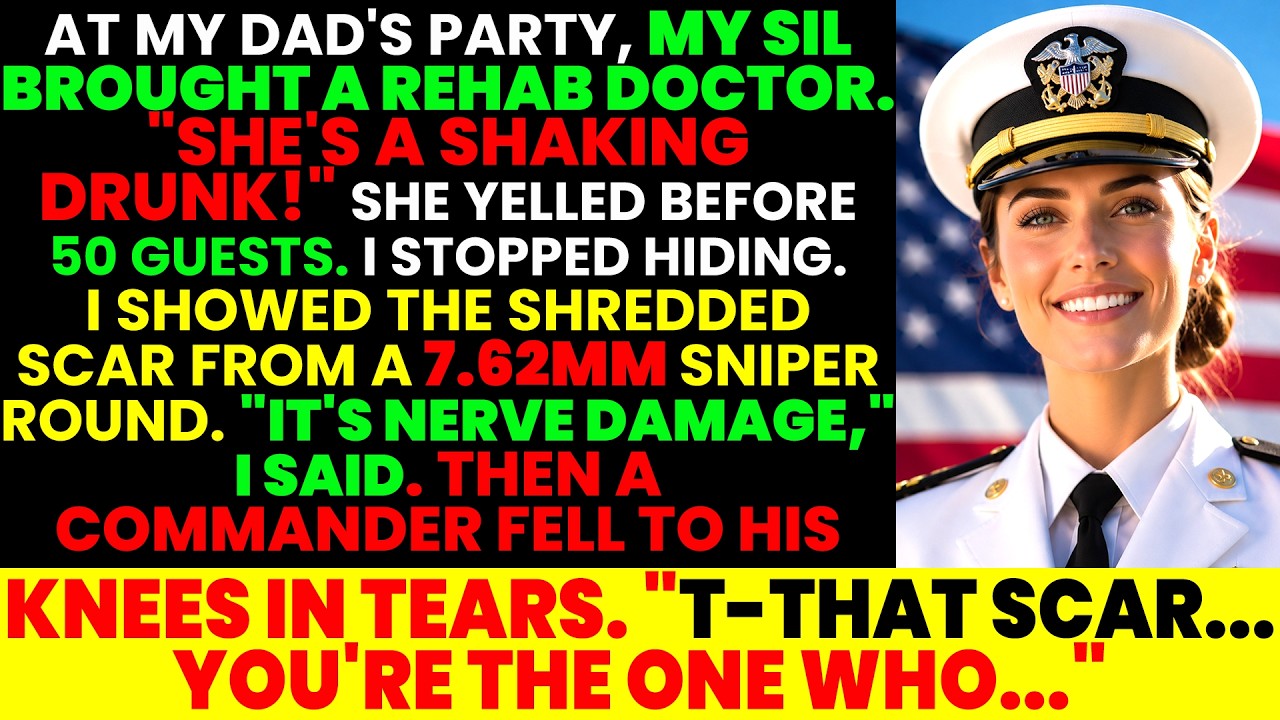
Karen brought a fake doctor to my father’s 70th birthday party and told my entire family I needed rehab.
She didn’t whisper it.
She didn’t pull me aside.
She stood beside the dessert table at the Fairmont Country Club, under a chandelier that probably cost more than my first car, and announced it loud enough for my father’s golf friends, my mother’s bridge group, and half the room of polished strangers to hear.
“Bella,” she said, smiling like she was doing something noble, “we all love you. But we can’t keep pretending your drinking isn’t destroying this family.”
The jazz trio near the bar kept playing, but softer somehow.
Forks stopped scraping plates.
My father, in his navy-blue birthday blazer, froze with one hand on his champagne glass.
My younger brother Daniel stared at the floor.
And every eye in that room dropped to my right hand.
It was shaking.
It always shook.
Not because I was drunk.
Not because I was addicted.
Because three years earlier, a sniper round had torn through my arm while I was dragging one of my sailors out of a kill zone.
But Karen knew that.
She had known that for years.
She just also knew that a trembling hand was easier for a rich room to judge than a war wound was to understand.
I was standing near the head table in my dress uniform, my right sleeve buttoned carefully over a compression brace. I had almost skipped the party. I had been on duty for most of the week, and nerve pain had kept me awake the night before. But my father was turning seventy, and no matter what had happened in our family, I still believed showing up mattered.
Karen had planned the entire event like a campaign.
White roses. Gold menus. Imported wine. A cake shaped like a sailboat because my father once owned a boat for eighteen months and had been talking about it for twenty years.
She floated around the room in a cream designer dress, accepting compliments as if she had personally invented elegance.
“This is what family should look like,” she told a woman from my father’s club.
Then I walked in.
And her smile tightened.
Karen had never liked me. Not openly at first. In the beginning, she called me “intense” and “career-driven” and “not very feminine,” all with that soft laugh people use when they want an insult to sound like concern.
After my injury, she changed tactics.
She started calling me unstable.
Fragile.
Difficult.
A burden.
And Daniel let her.
That was the part that still surprised me, even after everything. My brother had grown up hiding behind me during thunderstorms. I had taught him how to ride a bike. I had sent him money when he said his family was in trouble. I had defended him long before he ever learned how to defend himself.
But marriage had not made Daniel stronger.
It had given his cowardice a spokesperson.
Karen stepped closer to me now, still smiling for the audience.
Beside her stood a thin man in a brown suit with nervous eyes and an expensive leather folder. He looked less like a doctor and more like someone who had googled how a doctor should stand.
“This is Dr. Ellis,” Karen announced. “He specializes in substance dependency. We’ve arranged a private facility. Very discreet. Very compassionate.”
A murmur moved through the room.
My mother pressed a napkin to her mouth.
Daniel finally looked at me, just for a second, then looked away.
I turned to the man in the brown suit.
“What hospital are you affiliated with, Doctor?”
His mouth opened.
Karen answered for him. “Bella, don’t do this.”
I kept my eyes on him. “What hospital?”
He swallowed. “I work primarily in private recovery consulting.”
“That wasn’t my question.”
Karen’s voice sharpened. “This is exactly what we talked about. The aggression. The denial.”
The room leaned in.
That was what people do when humiliation wears formal clothing. They pretend to be concerned while making sure they don’t miss a word.
My right hand trembled harder. The muscles in my forearm pulled in short, electric spasms. Pain climbed from my wrist to my shoulder like a live wire.
Someone whispered, “Oh my God.”
Karen heard it. Her face lit up just slightly.
She pointed at my hand.
“Look at her,” she said. “She can’t even stand here without shaking.”
For one second, I saw the room through her eyes.
A decorated officer with a trembling hand.
A woman who rarely came home.
A sister-in-law who had already planted the story months earlier.
Karen wasn’t improvising.
She had staged this.
And she had chosen my father’s birthday because she knew I would either submit quietly to avoid ruining the night or fight back and look exactly as unstable as she claimed.
So I did what I had been trained to do under fire.
I slowed down.
I breathed once.
Then I unbuttoned my cuff.
The sound was tiny, but in that silent room, it landed like a gunshot.
I rolled my right sleeve up to my elbow.
The first row of guests saw it and recoiled.
The scar ran from below my shoulder to the inside of my forearm, thick and uneven, where surgeons had put me back together with metal, grafts, and a level of optimism I had not always shared. The muscle beneath it was warped. The skin was pale in some places, dark in others. My hand shook openly now, no longer hidden by fabric or shame.
“This,” I said, “is not alcohol withdrawal.”
My voice carried across the room with the tone I used on deck when panic was not an option.
“This is permanent nerve damage from a combat injury sustained during a classified evacuation operation in Helmand Province.”
Karen’s smile flickered.
I looked at the man in the brown suit. “If you are a licensed physician, you already know that tremors can result from traumatic nerve injury.”
He said nothing.
I turned back to Karen.
“And if you are not a licensed physician, then you are participating in a public defamation campaign against an active-duty naval officer.”
That was when the doors behind the bar opened.
A man in uniform entered with two others behind him.
Commander Nathan Vance.
The last time I had seen him, he had been unconscious on a medevac stretcher, blood soaking through three layers of field dressing. He had been younger then. We both had.
Now he crossed the ballroom without looking left or right.
The room parted for him.
He stopped in front of me.
Then, in front of my father, my brother, Karen, the fake doctor, and everyone who had been waiting for my disgrace, Commander Vance lowered himself to one knee.
The sound that moved through the room was not a gasp.
It was something heavier.
Recognition arriving too late.
“Ma’am,” he said quietly, “I never got to thank you properly.”
My throat tightened.
I hated that. I hated public emotion more than I hated pain. But Vance looked up at me with tears in his eyes, and for a moment, the country club disappeared.
I was back in the dust.
Back under fire.
Back with my hand locked around his vest as rounds cracked through the air and someone shouted that we had thirty seconds before the second vehicle burned.
“You don’t owe me anything,” I said.
“Yes, I do,” he replied. “My wife has a husband because of you. My daughter has a father because of you.”
The silence after that was almost violent.
Karen’s face drained of color, but she recovered fast. People like Karen always do. They treat truth like a spill on marble—unpleasant, but manageable if cleaned quickly.
“This is very moving,” she said, her voice trembling with anger beneath the sweetness. “But trauma and addiction can coexist. We’re only trying to help.”
That was the first time Daniel flinched.
Not because she had lied.
Because she had kept going after the room had started turning against her.
But this story had not started at my father’s birthday.
It had started eight months earlier, on Thanksgiving.
I had driven home after a fourteen-hour shift, my right hand burning so badly I had to pull over twice and rest it against the steering wheel until the spasms passed. The drive from base to my parents’ house should have taken ninety minutes. It took almost three hours.
I remember seeing Karen’s new Lexus SUV in the driveway.
White. Shiny. Temporary tags still on.
At the time, I tried not to think about it.
Two months before Thanksgiving, Daniel had called me crying. He said there was black mold inside the walls of their house. He said the kids were coughing at night. He said insurance was dragging its feet and Karen was panicking.
I wired him $20,000 from my hazard pay.
“Pay me back whenever,” I told him.
He said, “You saved us, Bella.”
When I walked into my parents’ house on Thanksgiving, Karen looked me up and down like I had tracked mud onto her reputation.
“You wore your uniform?” she asked.
“I came straight from duty.”
She laughed and glanced toward the kitchen, where my aunts were arranging serving dishes. “Of course you did. Always the dramatic entrance.”
Daniel kissed my cheek, but his eyes were nervous.
That was the first sign.
The second sign was the kitchen.
My parents’ house had always had an old oak kitchen with chipped handles and a refrigerator that hummed like a generator. But that day, I saw Italian granite countertops, new cabinets, brass fixtures, and a refrigerator with a touchscreen panel big enough to navigate a ship.
My mother saw me looking.
“Karen helped us find a contractor,” she said quickly.
Karen appeared beside me with a wine bottle in her hand.
“Isn’t it gorgeous?” she said. “You wouldn’t understand, Bella. When you have a real home, these things matter.”
I looked at Daniel.
He looked into his drink.
At dinner, Karen made sure I was seated where everyone could see me.
She talked about school tuition, home renovations, her charity committee, and how hard it was to host “when certain people just appear exhausted and negative.”
Then she lifted the wine bottle and held it toward me.
“Bella, make yourself useful. Pour for your father.”
I didn’t want to take the bottle. My hand had been bad all day. But refusing would have become its own performance, and I was tired of giving Karen material.
So I reached.
Halfway across the table, my fingers locked.
The nerve spasm hit fast.
The bottle slipped.
Red wine splashed across the white tablecloth. A glass tipped over and shattered against a plate. My youngest nephew jumped.
Before anyone could move, Karen stood up.
“Oh my God,” she said. “Bella.”
I grabbed a napkin. “It was my hand. I’m sorry.”
Karen’s voice rose. “You’re shaking like an addict.”
The room went still.
I looked at Daniel.
He said nothing.
My mother began dabbing at the wine stain without meeting my eyes.
My father cleared his throat and stared at the turkey.
Karen put one hand on her chest, performing concern for an audience that did not ask for tickets.
“We all see it,” she said softly. “The shaking. The mood swings. The isolation. You need help.”
“I have nerve damage,” I said.
She tilted her head. “Is that what you’re calling it now?”
That sentence did more damage than the bullet ever had.
Because bullets are honest.
They hit what they hit.
But lies move through people you love and make them look at you like you are the wound.
After dinner, I found Daniel in the hallway near the laundry room.
“The mold,” I said.
His face went pale.
“What?”
“The $20,000. Did you use it for mold remediation?”
He rubbed his forehead. “Bella, it’s complicated.”
“No. It’s a yes or no question.”
Karen stepped out of the kitchen behind him.
“We used family resources for family needs,” she said.
I stared at her. “You bought a kitchen.”
She smiled. “We increased the value of the home.”
“With money I sent because Daniel said your kids were breathing mold.”
Daniel whispered, “Karen, stop.”
But he did not say, “Bella’s right.”
He did not say, “I lied.”
He did not say, “I’m sorry.”
That night, I drove back to base with one hand wrapped around the wheel and the other pressed against my ribs like I could hold myself together by force.
The next morning, a message from Karen arrived while I was at the Pentagon.
Bella, after yesterday, we’re deeply concerned. Daniel and I believe your drinking is affecting your judgment. We’re willing to help you enter a private rehab program before this damages your career.
I read it twice.
Then I understood.
She wasn’t trying to help.
She was building a record.
If I confronted them about the $20,000, she would say I was unstable.
If I told my parents the truth, she would say I was lashing out.
If I asked Daniel to repay me, she would say addiction had made me paranoid and aggressive.
Karen hadn’t just stolen my money.
She had prepared a story where I was too broken to be believed.
So I stopped replying.
Not because I was weak.
Because arguing with a liar in a room they built is how you become their furniture.
At Walter Reed a week later, I sat in the neurology clinic with my right hand buried in my coat pocket. That was new. I had survived field surgery, rehab, and a year of waking up because my nerves felt like they were being peeled apart.
But Karen had done something the sniper never did.
She made me ashamed of the evidence that I had survived.
In the hospital cafeteria, I was trying to open a bottle of water with my left hand when someone said, “Commander Hale?”
I turned.
Rear Admiral Avery Butcher stood beside my table holding a tray and wearing the kind of expression that made junior officers sit straighter without knowing why.
“Ma’am,” I said, half rising.
She gestured for me to sit.
Her eyes moved to my hand in my pocket.
“Bad day?”
I almost lied.
Instead, I said, “My family thinks the tremor is alcoholism.”
She did not react quickly. That was her gift. She gave the truth space to finish entering the room.
Then she sat across from me.
“Who started that?”
“My sister-in-law.”
“Why?”
I looked down at the water bottle.
“Money.”
Admiral Butcher listened as I told her everything. Thanksgiving. The wine. The remodel. The messages. The fake concern. She didn’t interrupt once.
When I finished, she said, “Do you have the transfer record?”
“Yes.”
“Messages?”
“Yes.”
“Medical documentation?”
“Yes.”
“Witnesses to the injury?”
I looked up.
She nodded toward the entrance.
Commander Vance had just walked into the cafeteria.
I had not seen him in years.
He saw me, stopped, and his face changed.
Not pity.
Respect.
That was the beginning of the counteroffensive.
Not revenge.
Documentation.
Admiral Butcher connected me with legal counsel. Vance gave a sworn statement about the operation and my injury. My neurologist provided medical records explaining the tremor. The finance office helped me print the transfer confirmation. I saved Karen’s messages, including the ones where she mentioned rehab before any doctor had evaluated me.
And Daniel, without knowing it, helped most of all.
Because two weeks before my father’s birthday, he sent me a text at 1:13 a.m.
I’m sorry. There was never black mold. Karen said we needed the kitchen before Dad’s birthday because people would judge the house. I know I messed up. Please don’t tell Mom and Dad until after the party.
I stared at that message for a long time.
Then I took a screenshot.
At the country club, Karen was still trying to regain control.
“This is a family matter,” she said loudly. “And frankly, Bella has always used her service to avoid accountability.”
That was the moment I stopped protecting Daniel.
I took out my phone.
“Dad,” I said, “I didn’t want to do this tonight. But Karen chose the room.”
My father looked older than he had fifteen minutes earlier.
I connected my phone to the projector that had been set up for his birthday slideshow. Karen’s smile vanished.
On the screen behind the cake appeared Daniel’s message.
I’m sorry. There was never black mold.
A sound moved through the guests.
Not loud.
Worse.
The quiet sound of people realizing they had been invited to witness one humiliation and had received another.
Karen turned to Daniel.
He looked like a man searching for a door in a room with no exits.
“Daniel?” my mother whispered.
He opened his mouth, but no words came.
So I showed the bank transfer.
$20,000.
Then the contractor invoice for the kitchen remodel.
Then Karen’s message about rehab.
Then the licensing search for “Dr. Ellis,” whose medical license had been suspended eighteen months earlier after a substance abuse complaint and fraudulent treatment billing.
The man in the brown suit backed away from the table.
Admiral Butcher stepped into the room from behind Commander Vance.
She had arrived quietly, as she always did.
“Mr. Ellis,” she said, “I believe the Virginia Board of Medicine will be interested to know you are presenting yourself as a practicing physician at a private intervention.”
Karen’s mouth opened.
Nothing came out.
For the first time since I had known her, she had no sentence ready.
Her eyes moved from the screen to the guests, from the guests to Daniel, from Daniel to me.
That was her moment of recognition.
Not guilt.
Calculation collapsing.
Her face went slack, like someone had pulled the wire out of the machine that powered her.
My father’s hand trembled as he stood.
“Daniel,” he said, “is this true?”
Daniel’s shoulders folded inward.
“Yes.”
My mother sat down hard, one hand gripping the edge of the table.
Karen whispered, “We were going to pay it back.”
I looked at her. “You weren’t even going to admit you took it.”
A man near the bar muttered, “My God.”
One of my father’s friends, a retired judge, stepped away from Karen as if dishonesty were contagious.
The country club manager approached Mr. Ellis and asked him to leave. He went without protest.
Daniel tried to follow Karen when she stormed toward the exit, but my father stopped him.
“No,” he said. “You stay.”
That was the first brave thing my father had done all night.
And maybe the first honest thing our family had done in years.
The consequences did not arrive all at once. Real consequences rarely do. They come in envelopes, phone calls, canceled invitations, and the sudden absence of people who used to smile when they thought you were useful.
Karen was removed from two charity committees after the story spread through the club. Mr. Ellis was reported. Daniel signed a repayment agreement and moved into my parents’ guest room after Karen left for her sister’s house. My father wrote me a letter by hand because he said he didn’t trust himself to apologize properly out loud.
My mother called me three days later.
She cried before she spoke.
“I saw your hand shaking at Thanksgiving,” she said. “And I chose silence because it was easier than conflict.”
I didn’t tell her it was okay.
It wasn’t.
I said, “Thank you for telling the truth now.”
A month later, my father invited me to lunch at a small diner near the base. No chandeliers. No jazz trio. No imported wine.
Just coffee, eggs, and my father sitting across from me with both hands wrapped around his mug.
“I was proud of your uniform when it made me look good,” he said. “I should have been proud of what it cost you.”
I looked out the window for a moment because some pain deserves privacy before it becomes forgiveness.
Then I placed my right hand on the table.
It was shaking.
My father reached across and covered it gently with his own.
He did not try to stop the tremor.
He just held it.
That was when I understood something I wish more families understood before they break the person who keeps showing up for them.
Not every wound looks noble at the dinner table.
Some wounds spill wine. Some wounds make hands shake. Some wounds make strong people quiet because they are tired of explaining pain to people committed to misunderstanding it.
But a wound is not a weakness just because someone cruel learns how to point at it.
And the people who mistake your scars for shame should be very careful, because sometimes the truth they mock is the very thing that exposes them.
Never let someone who betrayed you write the story of how you survived.