Captain Aria Voss was not the kind of person people noticed when she walked into a room.
At nineteen, she arrived at Fort Benning with one duffel bag, two pairs of worn boots, and the quiet face of someone who had learned early that asking for help usually led nowhere.
She did not come from a military family.
There was no father in uniform whose name opened doors. No uncle with rank. No senator writing letters. No old family friend waiting somewhere in command to pull her forward.
Aria came from a small town in rural Georgia, the kind of place where people knew your business before you did, where the grocery store closed early, and where the same broken roads led everyone either to church, work, or trouble.
Her mother worked long shifts at a factory that smelled like metal, oil, and exhaustion. Her father left when Aria was young enough to still ask when he was coming back, and old enough to understand from her mother’s silence that he wasn’t.
So Aria grew up with a belief that settled deep into her bones:
No one is coming to save you.
If you want something, you get up, you learn, you endure, and you take one more step than everyone expected you to take.
That belief did not make her loud.
It made her focused.
She was not angry in the way people expected wounded people to be. She did not snap at strangers or walk around looking for a fight. She watched. She listened. She remembered names, habits, weaknesses, patterns.
At Fort Benning, that made her easy to underestimate.
The first weeks of training had a way of sorting people quickly. Everyone was being measured, whether they knew it or not. Who complained first. Who broke formation. Who needed attention. Who wanted to be admired. Who could take orders. Who could keep going when their body started bargaining with their mind.
Some recruits announced themselves immediately.
They laughed too loud. Pushed too hard. Tried to dominate every space they entered.

Aria did not.
She did the work, kept her bunk squared away, and spoke only when she had something worth saying. To some, that looked like weakness. To others, it looked like fear.
To one recruit named Callaway, it looked like an invitation.
Callaway was big, broad-shouldered, and always surrounded by noise. He had the kind of confidence that came less from achievement and more from never having been seriously challenged. He liked having an audience. He liked making people laugh, especially when the joke landed on someone smaller, quieter, or less connected.
Aria had been in training less than a month when the moment happened.
It was after a long day under the Georgia heat, the kind that baked sweat and dust into your skin until your uniform felt like sandpaper. Everyone filed into the mess hall hungry, sore, and irritated.
Aria took her tray and moved through the room without looking for anyone’s approval.
She was tired enough that her arms felt heavy. There was dirt on her jawline, a bruise darkening near her elbow, and the blank calm of someone trying to get through dinner without wasting energy.
Halfway across the mess hall, Callaway stepped in front of her.
Two other recruits were with him. A few more turned to watch.
“Where you headed, Voss?” he said, blocking her path with a grin.
Aria stopped.
“To eat,” she said.
Something about her plain answer bothered him. Maybe he wanted fear. Maybe he wanted embarrassment. Maybe he wanted her to shrink.
Instead, she simply stood there holding her tray.
Callaway glanced around at the small audience forming.
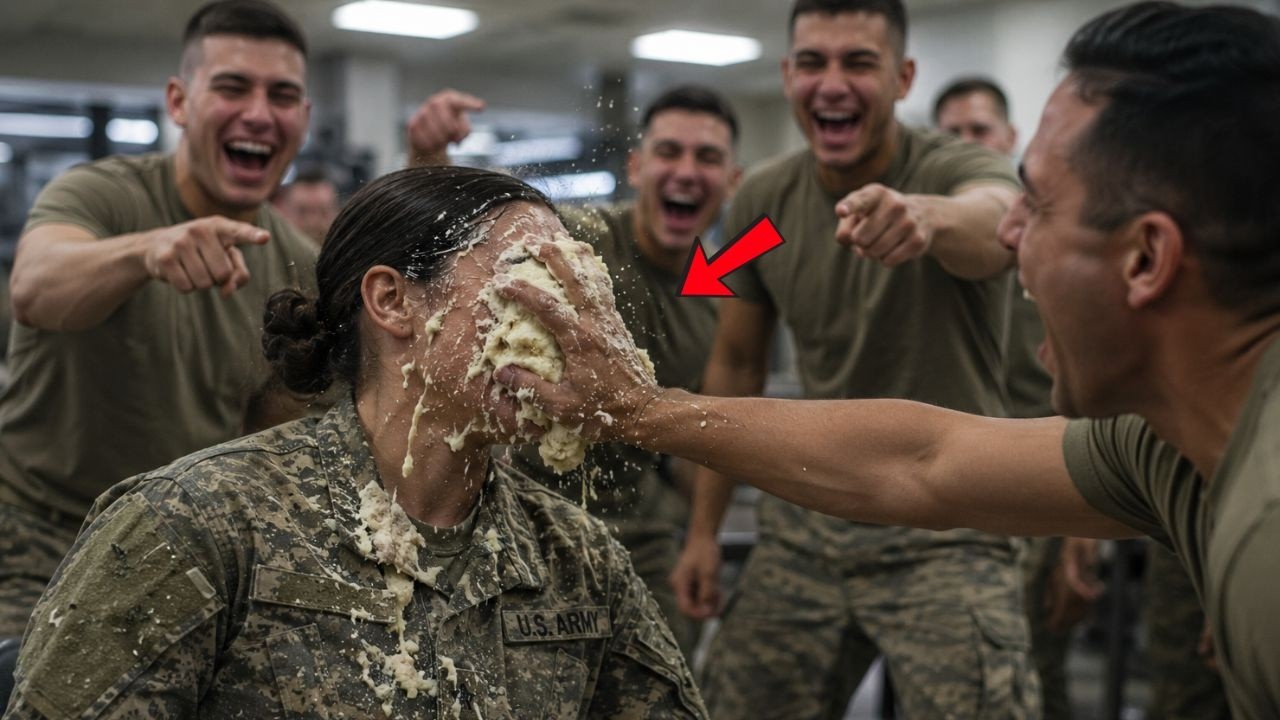
Then he reached down, scooped a handful of food from her tray, and smeared it across her face.
The room erupted.
Some laughed because they thought it was funny. Some laughed because everyone else did. Some looked away because they knew it was wrong but did not want to become the next target.
Gravy slid down Aria’s cheek.
A piece of mashed potato clung near her collar.
Callaway leaned close enough for only those nearby to hear.
“Maybe this place isn’t for you,” he said.
More laughter.
For a few seconds, Aria did nothing.
She did not cry.
She did not throw the tray.
She did not scream, shove him, curse him, or give him the explosion he was hoping for.
She stood still, feeling the heat of the room, the weight of every eye, the sticky food on her skin, the humiliation pressing against her chest like a boot.
Then she lifted one hand, wiped her face slowly, and looked directly at Callaway.
Not with shock.
Not with fear.
With a cold, steady focus that made his grin falter.
The laughter thinned.
A few people stopped mid-sentence.
Callaway’s smile stayed on his face, but something changed behind his eyes. For the first time, he seemed to realize he had not broken her. He had only gotten her full attention.
Aria lowered her hand, walked around him, sat alone in the corner, and ate what was left on her tray.
To everyone in that room, it looked like she had been humiliated.
To Aria, it became a line in the ground.
That night, she lay awake in her bunk while others slept around her. She could still smell the mess hall on her uniform. She could still hear the laughter. She could still see Callaway’s face.
But she did not imagine revenge.
She did not picture herself embarrassing him back.
She asked herself one question:
What kind of person would they never dare do that to?
The next morning, Aria woke forty-five minutes before everyone else.
She ran in the dark.
Not because anyone ordered her to. Not because anyone praised her for it. Not because she wanted witnesses.
She ran because she had decided that meeting the standard was not enough. She would exceed it so clearly that no one could pretend it was an accident.
At first, it was ugly.
Her lungs burned. Her legs shook. Some mornings, she tasted blood at the back of her throat and had to slow down before she fell. But she kept going.
Then she ran faster.
Then farther.
Then with weight.
Then after long days, when everyone else collapsed, she studied.
Military history. Leadership theory. Field manuals. Old campaigns. Mistakes made by commanders under pressure. Decisions that saved lives. Decisions that wasted them.
She did not study to sound intelligent.
She studied because she wanted to understand the machine from the inside.
When unpleasant tasks came up, Aria volunteered.
Night watch.
Cold duty.
Boring administrative work.
Inventory checks that made others groan.
She learned how equipment moved, how paperwork shaped decisions, how delays happened, how small errors grew into large failures. People who dismissed admin work as beneath them missed what Aria saw clearly: systems revealed themselves in the details.
When officers passed through, she asked questions.
Not flattering questions. Not obvious ones.
Questions about timing, risk, terrain, morale, backup plans, communication breakdowns.
At first, some looked at her strangely. A quiet young soldier asking command-level questions made people suspicious.
Then they started answering.
Because her questions were not meant to impress.
They were precise.
When Aria made mistakes, she owned them immediately.
No excuses.
No blaming fatigue.
No pointing at someone else.
Once, during a training exercise, she misread an instruction and caused a delay in her squad’s movement. When the sergeant demanded an explanation, another soldier tried to cover for her.
Aria stepped forward.
“That was mine, Sergeant. I misunderstood the order. I’ll correct it and make sure it doesn’t happen again.”
The sergeant stared at her for a moment.
Then he said, “See that you do.”
She did.
People remember competence.
But they remember accountability even more.
Six months after the mess hall incident, Aria was outperforming most of the people who had laughed at her.
A year later, she was near the top of her group.
Not just physically.
Mentally.
She could read a field problem quickly. She saw weak points in plans. She knew when a solution looked good on paper but would collapse in mud, darkness, confusion, or fear.
Superiors began inviting her into planning discussions even when her rank did not require it.
At first, she stood near the back and listened.
Then someone would ask, “Voss, what do you see?”
And she would answer with the calm precision of someone who had already run the scenario three different ways in her mind.
Meanwhile, Callaway remained nearby in the orbit of her career.
He was not terrible enough to be removed. Not strong enough to rise fast. He moved forward slowly, comfortably, loudly.
He had almost forgotten the mess hall.
To him, it had been a joke.
A rough moment.
Something recruits did.
To Aria, it had become the beginning of a private transformation.
She did not carry it like a wound.
She carried it like coordinates.
After three years, Aria applied to Officer Candidate School.
Some people were surprised.
The officers who had watched her closely were not.
Her evaluations were excellent. Her recommendations were not vague compliments. They were specific.
Disciplined under pressure.
Exceptional situational awareness.
Does not seek credit.
Learns systems quickly.
Owns errors without deflection.
Potential for command.
She was accepted.
OCS did not soften her. It sharpened her.
While others tried to look impressive, Aria tried to be useful. She checked small details because she understood that small details became large outcomes. She polished boots, reviewed maps, studied case files, practiced briefings, and listened for what instructors did not say directly.
She graduated near the top of her class.
When she was commissioned as a second lieutenant, she did not celebrate loudly.
She called her mother.
Her mother cried before Aria finished the sentence.
Aria stood in a hallway afterward, phone still in her hand, and looked out a window at the training grounds.
She thought of the factory.
The small house.
The unpaid bills.
The mess hall.
Then she folded the memory away and went back to work.
Her rise after that was not magical.
It was earned in ordinary, repeated ways that rarely make good stories but always build real careers.
She showed up prepared.
She learned from noncommissioned officers instead of pretending rank made her wise.
She protected her people from unnecessary chaos but held them to standards when standards mattered.
In one training crisis, when a communications failure threw an exercise into confusion, Aria made a decision that technically stepped outside the expected sequence. She did not panic. She assessed the risk, adjusted movement, and prevented two teams from colliding in a dangerous zone.
Later, when questioned, she explained her decision clearly.
What she knew.
What she did not know.
What risk she accepted.
What greater risk she avoided.
A senior officer listened without interrupting.
Then he closed the folder and said, “That was the right call.”
By twenty-six, Aria Voss became a captain.
She received the news alone in a small office with a buzzing light overhead and a half-finished report on her desk.
For a long time, she simply sat there.
No dramatic speech.
No raised fists.
No tears for anyone to see.
Just the quiet recognition that the path she had chosen in the dark, after the worst humiliation of her life, had led somewhere real.
Years later, Captain Aria Voss was assigned back to the same base where she had once arrived as a nobody.
The first morning she walked into the mess hall, nothing about the room had changed enough to matter.
The same kind of trays.
The same noise.
The same smell of coffee, eggs, floor cleaner, and tired bodies.
But everything was different.
No one blocked her path.
No one laughed.
No one asked if she belonged there.
A few soldiers straightened slightly when they recognized the rank on her uniform.
Aria took her tray, moved through the line, and sat where she wanted.
Across the room, Sergeant Callaway saw her.
For several seconds, he did not move.
He had aged, though not dramatically. He was still broad, still recognizable, still carrying that old physical confidence. But life had sanded down some of the shine. His voice was no longer the loudest in every room. His career had continued, but it had not climbed the way he once assumed it would.
And now, by assignment and chain of command, he was under Captain Voss.
Their first official meeting took place that afternoon in a briefing room with twelve soldiers, two lieutenants, and one long table.
Aria entered with a folder under her arm and no need to announce herself beyond the rank on her chest.
Everyone stood.
“At ease,” she said.
Her voice was controlled, professional, and clear.
She briefed the unit on updated procedures, upcoming evaluations, operational priorities, and expectations. She did not perform authority. She occupied it. Every question was answered directly. Every concern was handled without ego. Every standard was tied to a reason.
People listened because she knew what she was talking about.
Callaway sat three seats from the end.
At first, he looked down at the papers in front of him.
Then, as the briefing continued, he started looking at her.
Not staring.
Realizing.
The quiet woman from the mess hall had not disappeared.
She had built herself into someone he now had to stand for when she entered a room.
After the meeting, soldiers filed out in low conversation.
Callaway stayed behind.
Aria closed her folder but did not leave.
He stepped toward her, stopped, then adjusted his posture.
“Captain Voss,” he said.
“Yes, Sergeant?”
The title landed between them.
His mouth tightened.
“I wanted to say something,” he began. “About years ago. Back when we were recruits.”
Aria looked at him calmly.
He swallowed.
“I was young. Stupid. I did some things I shouldn’t have done.”
The words were not smooth. They sounded like they had been dragged out of a place he had avoided for years.
Aria did not help him.
She let the silence do its work.
Callaway glanced once toward the door, as if hoping someone might interrupt.
No one did.
“The mess hall,” he said finally. “What I did to you. That was wrong.”
Aria’s face did not change.
“Yes,” she said. “It was.”
The simplicity of her answer hit harder than anger would have.
Callaway’s eyes dropped.
For the first time, he looked smaller than she remembered.
Not physically.
Morally.
Like a man finally standing inside the full size of a moment he had once treated as harmless.
“I’m sorry,” he said.
Aria placed the folder on the table.
“I remember what happened,” she said. “I also handled it a long time ago.”
He looked up.
She continued, “I don’t need you embarrassed. I don’t need you punished for something I already survived. And I’m not going to run this unit on old debts.”
Callaway’s face shifted.
Relief almost appeared.
Then she added, “What I do need is performance. Discipline. Accountability. Focus. You will give this unit your best work. Not because of what happened then, but because of what is required now.”
The relief disappeared.
In its place came something heavier.
Respect, perhaps.
Or shame.
Maybe both.
“Yes, ma’am,” he said.
Aria nodded once.
“Dismissed.”
Callaway turned to leave, but his steps were slower than before.
At the door, he paused for half a second. He did not look back.
He did not have to.
Everyone who has ever underestimated another human being knows that moment when the memory returns with new meaning.
The joke wasn’t a joke.
The target wasn’t weak.
The person he tried to reduce had become someone he now had to answer to.
That was the punishment.
Not a public shouting match.
Not revenge.
Not humiliation returned with interest.
The consequence was standing in a room where power had reversed quietly, completely, and without needing permission.
Aria never mentioned the mess hall again.
She led the unit by standards, not grudges. People who expected favoritism did not get it. People who expected cruelty did not get that either. What they got was clarity.
Work mattered.
Excuses did not.
Rank mattered only when backed by responsibility.
Over the years, Aria continued to serve.
She became a major.
Then a lieutenant colonel.
Eventually, a colonel.
She trained young officers who thought leadership meant sounding confident and taught them that confidence without competence was just noise. She mentored soldiers who came from small towns, broken homes, empty pockets, and quiet rage. She watched for the ones who did not speak much but noticed everything.
Sometimes she saw her younger self in them.
She never told them the full story unless they needed it.
But she would say, “Do not let one ugly moment become the definition of your life. Let it become the place where you start building.”
When Colonel Aria Voss retired, the room was full.
Officers, enlisted soldiers, former trainees, old colleagues, and people who had once worked under her command stood to honor a career that did not need exaggeration.
Her mother sat in the front row.
Older now.
Still proud in the quiet, overwhelming way of someone who had watched a child build a life from almost nothing.
Aria stepped to the podium in dress uniform.
She looked out at the room, paused, and said, “People often think strength comes from the uniform. It doesn’t. The uniform only reveals what you have already chosen to become.”
No one moved.
She continued, “There will be moments when someone tries to tell you what you are worth. Sometimes they will say it with words. Sometimes with laughter. Sometimes by how they treat you when they think no one important is watching.”
Her eyes moved across the room.
“The mistake is believing they get the final vote.”
Years later, Callaway heard about her retirement through an old contact.
By then, his life had become ordinary in the way most lives do. Work. Bills. Family obligations. A few regrets that arrived at inconvenient times.
When her name came up, he went quiet.
He remembered the mess hall.
The tray.
The laughter.
The look she gave him after wiping food from her face.
At the time, he had thought he was putting someone in her place.
He had no idea he was standing at the starting line of a career that would leave him far behind.
That is the part people forget about humiliation.
Sometimes it destroys a person.
But sometimes, in the right person, it becomes fuel so clean and powerful that it burns for decades.
Aria Voss did not build her life to prove Callaway wrong.
That would have made him too important.
She built her life because, on the worst day of her early career, she made a private decision that no one in that laughing room could see.
She decided she would not break.
She decided she would become undeniable.
And in the end, the most powerful answer to the people who tried to bury her was not revenge.
It was the life she built from the exact place where they thought she had fallen.