On July 4, 1946, a hill in Gdańsk became a courtroom without walls.

People had started gathering long before the condemned were brought out. They came from streets that still carried the dust of war, from homes where empty chairs had not been moved since 1939, from families that had learned to speak around the names of the dead because saying them out loud hurt too much.
The place was Biskupia Górka.
The city was trying to breathe again.
But that morning, no one had come for spectacle alone.
They had come because five women who once held life-and-death power inside Stutthof concentration camp were about to stand before a crowd with no uniforms, no whips, no dogs, no locked gates, and no one left to fear them.
Among them was Jenny-Wanda Barkmann.
She was young. Only twenty-four.
That was part of what made people stare.
In another life, she might have been remembered for her face, her youth, the calm way she carried herself. Instead, survivors remembered something far darker. They remembered a woman whose appearance seemed almost impossible to reconcile with what she had done. The contradiction made her unforgettable.
At Stutthof, beauty had not softened cruelty.

It had disguised it.
Years earlier, the same region had known a different kind of gathering.
In September 1939, shortly after Nazi Germany invaded Poland, Stutthof was established in a wet, wooded area near Sztutowo, east of Danzig, now Gdańsk. At first, it was used to imprison Polish leaders, intellectuals, and people the occupiers wanted removed from public life. Over time, it became a full concentration camp and then a sprawling system of forced labor, punishment, starvation, sickness, and death.
The prisoners did not experience Stutthof as one single dramatic event.
They experienced it as mornings.
As roll calls.
As hunger.
As the sound of boots stopping beside a bunk.
As someone collapsing in the mud and nobody daring to help too quickly.
As a guard’s hand reaching for a whip because the line was not straight enough, because the pace was too slow, because the prisoner looked sick, because cruelty had become a routine that no longer needed a reason.
That was one of the most terrifying truths about places like Stutthof.
Violence did not always arrive as an order shouted from above.
Sometimes it arrived as habit.
The women assigned as guards in the female sections of the camp did not need to command armies to destroy lives. They controlled the daily rhythm of survival. They watched labor details. They enforced rules. They punished weakness. They decided when a prisoner was “disobedient,” when she was “lazy,” when she was no longer useful.
In a camp, small power became total power.
A delay could mean a beating.
A missed instruction could mean death.
A look could be interpreted as defiance.
Inside the barbed wire, the prisoners learned that survival often depended not only on avoiding the obvious monsters, but on reading the mood of the person holding the smallest authority over them.
Jenny-Wanda Barkmann became one of the faces survivors could not forget.
She was not the highest-ranking figure at Stutthof. She did not design the system. She did not invent the hunger, the disease, the forced labor, or the machinery of terror.
But she served it.
And in the daily life of the camp, that was enough.
The prisoners saw her not as an abstract symbol, but as a person who could appear beside them, judge them, strike them, terrify them, and participate in the machinery that decided who remained alive another day.
That is why the crowd at Biskupia Górka mattered.
The people were not simply watching five former guards walk toward punishment.
They were watching power return to human scale.
During the war, the guards had stood behind fences with the full weight of the Nazi state behind them. Their orders carried the threat of punishment. Their uniforms turned cruelty into administration. Their victims were numbered, weakened, starved, and isolated from the world.
Now the uniforms were gone.
The empire that protected them had collapsed.
And the people they once believed would disappear had spoken in court.
That was the part the condemned had not been able to control.
The witnesses survived.
Not all of them. Not even close.
Stutthof consumed tens of thousands of lives. Prisoners died from starvation, epidemics, forced labor, shootings, gassing, lethal injections, and brutal evacuations as the war neared its end. The camp system held enormous numbers of deported people, including Poles, Jews, political prisoners, and people from across occupied Europe.
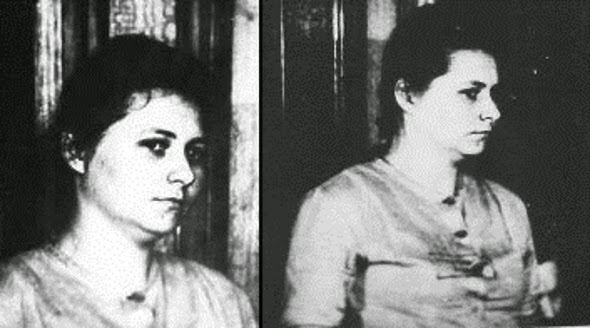 But some survived.
And survival became evidence.
When the Red Army approached in the winter of 1945, Stutthof entered its final, chaotic phase. The camp leadership did not suddenly discover mercy. They did not open the gates and protect the people they had abused for years.
Instead, they tried to keep control until the last possible moment.
The evacuations began.
Prisoners who were already starving were forced westward in freezing weather. Some were marched toward the Baltic coast. Some were forced onto barges. Some were pushed into conditions so deadly that the journey itself became an extension of the camp. The United States Holocaust Memorial Museum records that thousands died during the evacuations from Stutthof and its subcamps, and that some prisoners were forced into the water and shot.
This was not retreat.
It was destruction on the move.
People who could barely stand were made to walk.
People who fell became warnings.
The guards still had weapons. The prisoners still had numbers instead of names. The snow, the sea, and the roads became witnesses to crimes that could no longer be hidden behind camp fences.
But every system built on fear makes the same mistake.
It assumes silence will last forever.
It assumes the weak will never be heard.
It assumes that if enough documents are burned, enough bodies buried, enough prisoners moved, enough witnesses killed, the truth will become too scattered to matter.
Stutthof proved otherwise.
After the war, the testimonies began to gather.
Not all at once. Not cleanly. Not without pain.
Survivors had to describe things no person should have to remember. They had to point to faces. They had to explain routines that sounded unbelievable to people who had not lived inside them. They had to tell courts that cruelty was not an accident, not a rumor, not a misunderstanding, but a working method.
The first Stutthof trial took place in Gdańsk from April 25 to May 31, 1946. Thirteen former camp officials, guards, and prisoner functionaries were tried by a joint Soviet-Polish Special Criminal Court. Several were sentenced to death, including five female guards: Jenny-Wanda Barkmann, Elisabeth Becker, Wanda Klaff, Ewa Paradies, and Gerda Steinhoff.
For the survivors, the courtroom was not only about law.
It was about being believed.
That may be difficult to understand from a distance.
But for years, prisoners had been placed in a world designed to erase them. Their names were reduced. Their bodies were weakened. Their suffering was made ordinary. Their tormentors acted as if the camp was the universe and nobody outside would ever ask questions.
Then came the questions.
Where were you assigned?
Who gave the orders?
Who beat the prisoners?
Who selected the weak?
Who guarded the labor details?
Who stood there when people were taken away?
The accused could no longer hide inside the system.
The system was gone.
They had to answer as individuals.
And that was the first reversal.
Inside Stutthof, a guard could turn a prisoner’s trembling into proof of guilt. In court, a survivor’s trembling became proof of memory.
Inside Stutthof, a prisoner’s voice could be silenced with a blow. In court, the voices kept returning, one after another, until the former guards had to sit and listen.
Inside Stutthof, the women in uniform had watched prisoners stand exposed in roll call. In Gdańsk, they became the ones watched by everyone.
Jenny-Wanda Barkmann’s presence sharpened the tension.
The public found it hard to look away from her.
Not because she deserved fascination, but because she disturbed people’s expectations. Evil, many wanted to believe, should announce itself clearly. It should look monstrous. It should be easy to recognize before it acts.
But Barkmann forced a more frightening recognition.
Cruelty can wear a young face.
A person can look ordinary, even graceful, and still choose to serve a machine that grinds human beings into dust.
That was why her image lingered.
The shock was not simply that she had been cruel.
The shock was that she reminded people how little appearance reveals when conscience is absent.
By the time the condemned were brought to Biskupia Górka, the legal process had already ended. The verdicts had been given. The date had been set. The crowd knew what was coming.
Still, the atmosphere was not simple.
There was anger, yes.
There was grief.
There was also something heavier than revenge.
Many in the crowd had lost people whose bodies never came home. Some did not know the exact place where a parent, child, sister, or husband had died. Some had only fragments: a last transport, a rumor from a survivor, a date when the letters stopped.
For them, the hill was not a place of celebration.
It was a place where the invisible finally became visible.
The condemned stood where everyone could see them.
No fence protected them.
No office title protected them.
No camp command protected them.
No war protected them.
And in that open space, the most important moment was not the execution itself.
It was the silence before it.
Because that was when recognition arrived.
A former guard could still try to hold her face still. She could still look ahead. She could still pretend that the crowd was nothing, that the verdict was only politics, that history had turned against her unfairly.
But the body often confesses before the mouth does.
A tightened jaw.
A flicker of the eyes.
The sudden awareness that the people in front of her were not nameless anymore.
They were witnesses.
They were families.
They were the living remainder of what Stutthof had tried to consume.
And they were looking back.
That was the moment the power shifted completely.
Not when the sentence was read.
Not when the court closed.
Not even when the condemned were led out.
It happened when the former guards realized that the same public gaze they once denied their victims had now fixed itself on them.
They had helped reduce human beings to numbers.
Now history had reduced their excuses to nothing.
The plot twist of Biskupia Górka was not that the cruel were punished.
It was that the people who seemed most powerless inside the camp became the reason punishment was possible at all.
The prisoners who were meant to vanish had carried the truth out with them.
The starving women, the forced laborers, the people marched through snow, the ones who whispered names so they would not be forgotten, the ones who watched and remembered when remembering itself felt like a burden — they became the foundation of the case.
The guards had once believed fear was permanent.
But fear was only temporary.
Testimony lasted longer.
That is why the public nature of the punishment struck so deeply.
It was not merely a legal ending. It was a reversal staged in front of the same society that had been forced to live beside the aftermath. The women who had once controlled barracks, punishments, labor, and terror were shown as what they had always been beneath the uniform: human beings responsible for human choices.
No myth remained.
No glamour remained.
No authority remained.
Only consequence.
For years, the camp had taught prisoners that the powerful could act without accountability. It taught them that a guard’s mood mattered more than a prisoner’s life. It taught them that a uniform could make cruelty look official.
The trial and the execution answered with a different lesson.
A uniform can delay judgment.
It cannot erase it.
The crowd dispersed eventually.
The hill emptied.
Gdańsk continued its slow return to life, though no city touched by war ever returns unchanged. Survivors carried on with memories that no verdict could remove. Families still grieved people who would never walk through the door. The dead were not restored. The stolen years were not returned.
Justice did not heal everything.
It rarely does.
But it did something important.
It named the crime.
It exposed the perpetrators.
It showed that those who had once acted as if they were untouchable could be brought down by the very people they tried to erase.
That is why the story of Stutthof still matters.
Not because punishment is enough.
Not because a public execution can balance the scale of tens of thousands of deaths.
It cannot.
It matters because it shows how ordinary power becomes dangerous when conscience disappears, and how ordinary witnesses become powerful when truth finally has a place to stand.
Jenny-Wanda Barkmann and the other condemned guards are remembered today not as warnings about beauty, youth, or gender, but as warnings about choice.
They were not forced to become symbols of cruelty.
They became that through action.
And the survivors were not expected to become symbols of justice.
They became that by refusing to let the truth be buried with the dead.
In the end, Biskupia Górka was not just the place where five former female guards lost their last claim to power.
It was the place where the people Stutthof tried to silence proved that memory can outlive terror, testimony can outlast uniforms, and no one who builds power on human suffering should ever assume the world will look away forever.