By 1943, Heinrich Himmler had become one of the most feared men in Europe.
His name did not need to be shouted. It moved quietly through occupied cities, through police offices, through concentration camp gates, through memorandums stamped in black ink. He commanded the SS. He controlled the concentration camp system. His authority stretched across the Gestapo, the criminal police, racial policy, forced labor, deportations, and death.

In practical terms, only one man stood above him.
Hitler.
Across Europe, trains were moving toward places from which most passengers would never return. Families were separated on platforms. Names were reduced to numbers. Entire communities were being erased with paperwork, rifles, gas, hunger, and silence.
And while this machinery of destruction operated under his command, Himmler still wrote to his wife.
Not as a monster addressing history.
As a husband.
He asked about household matters. He sent affectionate lines. He worried about health, routine, the garden, the child, the small order of domestic life. The contrast was almost impossible to hold in one mind: the architect of terror, signing off like a family man.
But Margarete Himmler held that contradiction every day.
To the public, she was the wife of the Reichsführer-SS.
Inside the marriage, she was often something far less glamorous: neglected, bitter, pushed aside, left waiting for letters from a husband whose real home had become power. People around the Nazi elite did not always admire her. Some dismissed her as difficult. Others saw her as provincial, sharp-tongued, socially awkward, and resentful.

Yet she was not an innocent woman trapped beside evil without understanding it.
That is what made her story darker.
Margarete shared much of Heinrich Himmler’s worldview. She absorbed and repeated the antisemitism that formed part of their bond. She believed in discipline, German purity, old remedies, strict household order, and the kind of racial thinking that would become deadly when married to state power.
Still, she lived in his shadow.
And shadows can make people cruel in quieter ways.
Margarete was born Margarete Boden in 1893 near Bromberg, in a world that still belonged to Imperial Germany. Her father, Hans Boden, was a landowner, and her mother, Elfriede, raised her in a setting that was stable enough to give her confidence but not grand enough to place her among the old aristocratic families she would later brush against uneasily.
She grew up before Germany’s collapse, before Versailles, before street battles, before brown shirts became uniforms of power.
During the First World War, Margarete trained and worked as a nurse. She served in medical settings connected to the German Red Cross, where order, hygiene, endurance, and obedience mattered. Nursing also gave her something unusual for a woman of her time: a profession, a sense of usefulness, and a claim to competence that did not depend entirely on a husband.
Her first marriage was brief and childless.

After it ended, she did not disappear into family shame. With financial help from her father, she operated a private clinic in Berlin. She had her own work, her own rooms, her own income, and a life that placed her among patients, remedies, schedules, accounts, and practical decisions.
By the time she met Heinrich Himmler, she was not a naive girl waiting to be shaped.
She was older than him.
Divorced.
Experienced.
And, in some ways, more socially capable than the awkward man who would later command armies of fanatics.
Their meeting came in 1926, in the lobby of a hotel in Bad Reichenhall.
Himmler noticed her immediately.
She had the features he had trained himself to admire: blonde hair, blue eyes, a look he could interpret through the racial fantasies already hardening inside him. To other men, she may have been a respectable woman with a medical background and a severe manner. To Himmler, she appeared like an answer to a private checklist.
He was still not the figure Europe would later fear.
In 1926, Heinrich Himmler was ambitious, ideological, and deeply insecure. He had the intensity of a man who wanted to belong to history but had not yet found the doorway. He was shy with women, stiff in conversation, and unsure of himself in the intimate spaces where rank meant nothing. His diaries and later accounts suggest that Margarete may have been the more confident presence between them.
That mattered.
A man can be dangerous long before he looks powerful.
Himmler found in Margarete not only attraction, but confirmation. She did not laugh at his obsessions. She shared enough of them to make him feel understood. They spoke of Jews with hostility. They cared about homeopathy, herbs, natural cures, rural life, farming, thrift, cleanliness, and discipline. Both disliked excess. Both admired order. Both imagined a properly organized German life in which the household, the body, the land, and the nation all obeyed the same severe rules.
It was not a romance built only on affection.
It was recognition.
He saw in her the woman he believed belonged beside him. She saw in him a man who, though awkward and uncertain, carried a frightening certainty about the future. He had no great office yet, but he had faith. Faith in Hitler. Faith in the movement. Faith in a Germany purified by force.
And Margarete did not recoil.
That is the detail that matters.
The woman who would later complain of loneliness, disrespect, and exclusion did not enter this world as a passive bystander. She entered through sympathy. Through shared prejudice. Through the comfort of finding someone who gave political shape to her resentments and domestic ideals.
Their age difference troubled some people. Her divorce would trouble Himmler’s conservative family. Her Protestant background would create another difficulty for a Catholic household. But those objections belonged to the surface of the story.
The deeper bond had already formed.
Himmler, who had struggled with women, came to view Margarete as the first woman with whom he crossed into adult intimacy. She was not merely a wife-to-be. She became proof that he could possess the private life he had imagined for himself: a German home, a disciplined wife, children, land, health, purity, and loyalty.
Margarete, for her part, did not simply marry a man.
She married a movement before it had fully conquered the state.
In the beginning, there were still hotel conversations, letters, family objections, and the awkward courtship of two people drawn together by desire, insecurity, ideology, and control. Nothing about it looked world-historical from the outside.
A divorced nurse from Berlin.
A stiff, ambitious Nazi organizer with pale eyes and a nervous manner.
But between them, something was being built that would later become unbearable to look at closely: a marriage where domestic tenderness could exist beside mass murder, where household complaints could travel in the same emotional world as deportation orders, and where the woman left waiting at home would become both witness and participant in the moral collapse around her.
Margarete had met Heinrich Himmler before the world truly knew what he would become.
But she did not meet him in ignorance.
She recognized enough.
And she stayed.
Heinrich Himmler married Margarete Boden in July 1928.
It should have been a private family event, the kind of wedding that produced stiff photographs, cautious smiles, and polite letters afterward. But even before the ceremony, the marriage carried tension.
Margarete was older than him. She was divorced. She was Protestant. To Himmler’s conservative Catholic family, these were not small details. They were warning signs.
His parents did not attend the wedding.
The groom’s side was almost painfully absent. The bride’s father and brother stood as witnesses instead, giving the ceremony a strange imbalance, as if the marriage had begun with one family stepping forward and the other refusing to fully enter the room.
Later, Himmler’s parents accepted Margarete in the formal way families sometimes accept what cannot be changed. They did not cut her off. They did not create a public scandal. But distance remained. It stayed in visits, in letters, in the way people measured their words.
Margarete had married into a family that never quite embraced her.
But she had also married into something much larger.
The Nazi movement was still fighting for power, still noisy, unstable, and hungry. Its followers gathered in halls, marched in streets, argued in beer rooms, and spoke as if Germany’s humiliation could only be cured by obedience, violence, and racial purification. To many respectable people, they still looked crude and dangerous.
To Heinrich and Margarete, they looked like the future.
In August 1928, only a month after the wedding, Margarete joined the Nazi Party.
That fact matters.
She was not merely the wife who followed her husband because wives were expected to follow. She shared the ideological world he inhabited. She admired Hitler. She accepted the movement’s hatred. She believed, in her own domestic and disciplined way, that the new Germany had to be built by excluding, controlling, and cleansing those it defined as enemies.
At home, the marriage took on the shape both of them seemed to want: strict, orderly, frugal, and serious.
There was little softness in the way they imagined family life. They valued discipline more than comfort. They liked rural simplicity, natural remedies, healthy food, medicinal herbs, small economies, and the dream of a German household that reflected a German nation: clean, obedient, productive, and racially conscious.
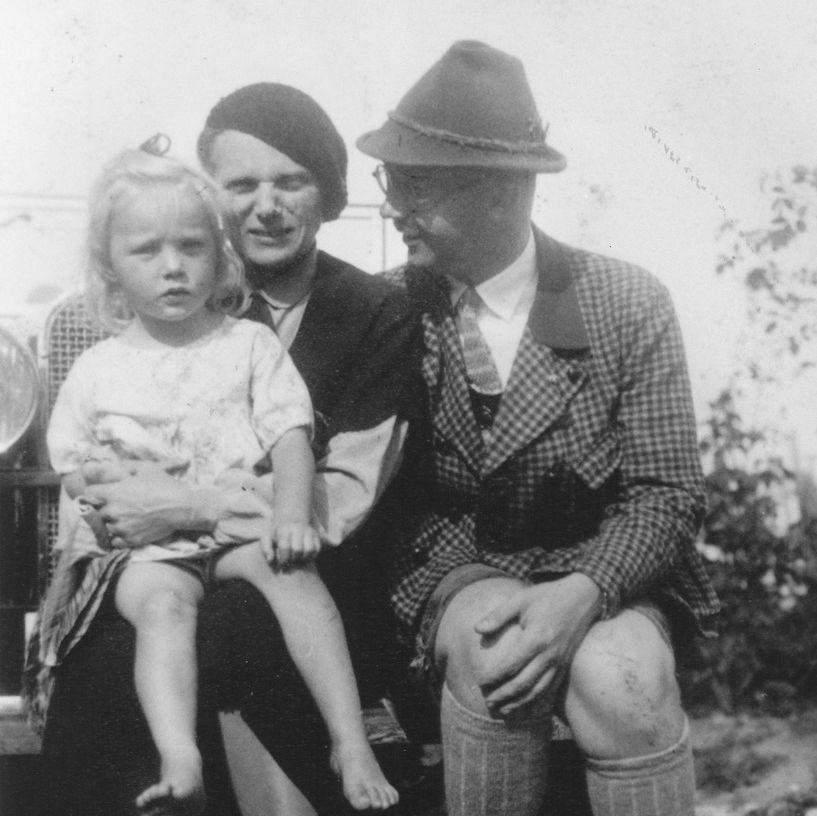
In August 1929, Margarete gave birth to their only biological child, Gudrun.
For Himmler, Gudrun became an object of deep affection. He called her by pet names, wrote tenderly about her, and placed her inside his fantasy of family purity. For Margarete, motherhood offered status, purpose, and a firmer place beside a man whose political life was beginning to consume him.
But even then, there was an uneasiness beneath the surface.
Himmler wanted a family that proved his ideals. Margarete wanted a husband who was present enough to honor the sacrifice she had made for him. Those desires were not the same.
After the marriage, she sold her share in the Berlin clinic and moved with him to Waldtrudering, near Munich. It was a practical decision, but also symbolic. Margarete left behind a life in which she had work, patients, income, and authority. In return, she gained a husband whose future seemed promising but uncertain, a house that needed management, and a movement that demanded loyalty without promising comfort.
Money was tight at first.
They tried to support themselves partly through small agricultural efforts. They kept chickens. They sold produce. They counted costs. Margarete, who had once run a clinic, now found herself measuring the economics of eggs, feed, household repairs, and daily shortages.
It was not yet the life of a powerful man’s wife.
It was the life of a woman waiting for power to arrive.
And when it came, it came soaked in other people’s suffering.
After the Nazis seized power, Himmler’s rise became astonishing. The awkward, insecure man Margarete had met in a hotel lobby began turning into one of the central figures of the regime. The SS expanded. Its black uniforms became symbols of fear and privilege. Himmler’s authority grew not only through titles, but through access: access to Hitler, to police power, to camps, to files, to lives.
As his power grew, so did the family’s material security.
The house became more comfortable. Their status improved. The world that had once looked down on Margarete now had reason to be careful around her. She was no longer simply the older, divorced Protestant wife of an ambitious party man.
She was Frau Himmler.
But that title did not bring the acceptance she wanted.
Inside the SS elite, Margarete was never beloved. Many SS wives came from backgrounds or social circles that made them more polished, more adaptable, more useful in the rituals of Nazi prestige. They hosted, smiled, formed alliances, and understood the strange etiquette of being close to power without appearing too hungry for it.
Margarete struggled there.
She could be blunt. She could be cold. She could offend people. She had strong opinions and little charm in hiding them. Some of the women around the SS leadership saw her as difficult, provincial, and socially clumsy. Others resented her position. A few treated her with politeness because her husband’s authority made honesty unsafe.
That may have wounded her more deeply than she ever admitted.
She had given up her independent life. She had accepted his obsessions. She had entered the party early. She had built the household, borne the child, kept the routines, endured the absences. Yet in the circles surrounding her husband, she remained an outsider.
Even as Himmler became feared across Europe, his own wife felt disrespected at dinner tables.
There was a cruel irony in it. Margarete believed in hierarchy, but hierarchy did not always favor her. She accepted a worldview that ranked people by blood, obedience, and usefulness, only to discover that within the regime’s social world, she too could be measured, judged, and quietly dismissed.
So she held on to what she could control.
The house. The child. The accounts. The rules. The letters.
Letters became the narrow bridge between Margarete and Heinrich as his public role swallowed their private life. He traveled constantly. He attended meetings, inspections, ceremonies, and strategic conferences. He built institutions of terror while still performing the gestures of a family man on paper.
His letters to Margarete could be affectionate. Domestic. Almost ordinary.
That was what made them chilling.
A man who oversaw the machinery of mass murder could still ask after his daughter’s health. He could still discuss food, property, family details, and household concerns. He could still sign himself with tenderness.
Margarete wrote back from the world of home, but her home was no innocent shelter from Nazi violence. The Himmler family’s comfort increasingly depended on the regime’s crimes. Wealth, property, access, privilege, and goods circulated through the Nazi system, often taken from those who had been dispossessed, deported, or murdered.
The family’s stability was not separate from the catastrophe.
It rested near its center.
Margarete knew enough to understand that her husband’s power came from more than speeches and uniforms. She knew Jews were being stripped of rights, property, dignity, and life. She knew the regime rewarded loyalty with material advantage. She knew the new Germany was being built from confiscation as much as from ideology.
And she did not step away.
Instead, she became one of the women who turned political violence into household normality.
A stolen Europe could appear, inside such homes, as furniture, food, land, servants, gifts, and opportunity. The horror did not always arrive covered in blood. Sometimes it arrived as a practical improvement. A better supply. A useful connection. A financial solution.
That was how evil entered domestic life.
Not only through shouting.
Through convenience.
Meanwhile, Himmler’s absence deepened. His schedule belonged to the Reich. His emotional life began to divide. Margarete, who had once seemed to him like the ideal woman, increasingly became the wife at home: complaining, demanding, aging, disappointed, and difficult to fit into the image he wanted to project.
He still wrote to her.
He still maintained the form.
But the distance widened.
Margarete sensed it. Women often know before evidence arrives. She saw it in fewer visits, shorter warmth, changed habits, and the way his attention seemed to pass through the house rather than settle inside it.
Yet she remained tied to him by status, ideology, money, reputation, and their daughter.
She was not powerless.
But she was not cherished in the way she wanted.
Among the SS wives, she had rank without affection. Inside the marriage, she had position without security. In the Nazi world, she had privilege without peace.
And Heinrich Himmler, the man who commanded obedience from thousands, found one place where control was never quite complete.
His own home.
There, waiting behind the title Frau Himmler, was a bitter, watchful woman who knew his weaknesses, shared his hatreds, depended on his power, and resented the humiliations that came with loving a man who belonged more to Hitler than to her.
By the early 1930s, their marriage had become more than a private arrangement.
It was a small domestic mirror of the regime itself: discipline on the surface, resentment underneath, tenderness beside cruelty, family life built beside organized persecution.
And as Himmler climbed higher, Margarete discovered something she had not expected.
Being married to power did not mean possessing it.
[Confirm to continue Part 3]