On the morning of September 1, 1939, Poland woke up to the sound of engines in the sky.
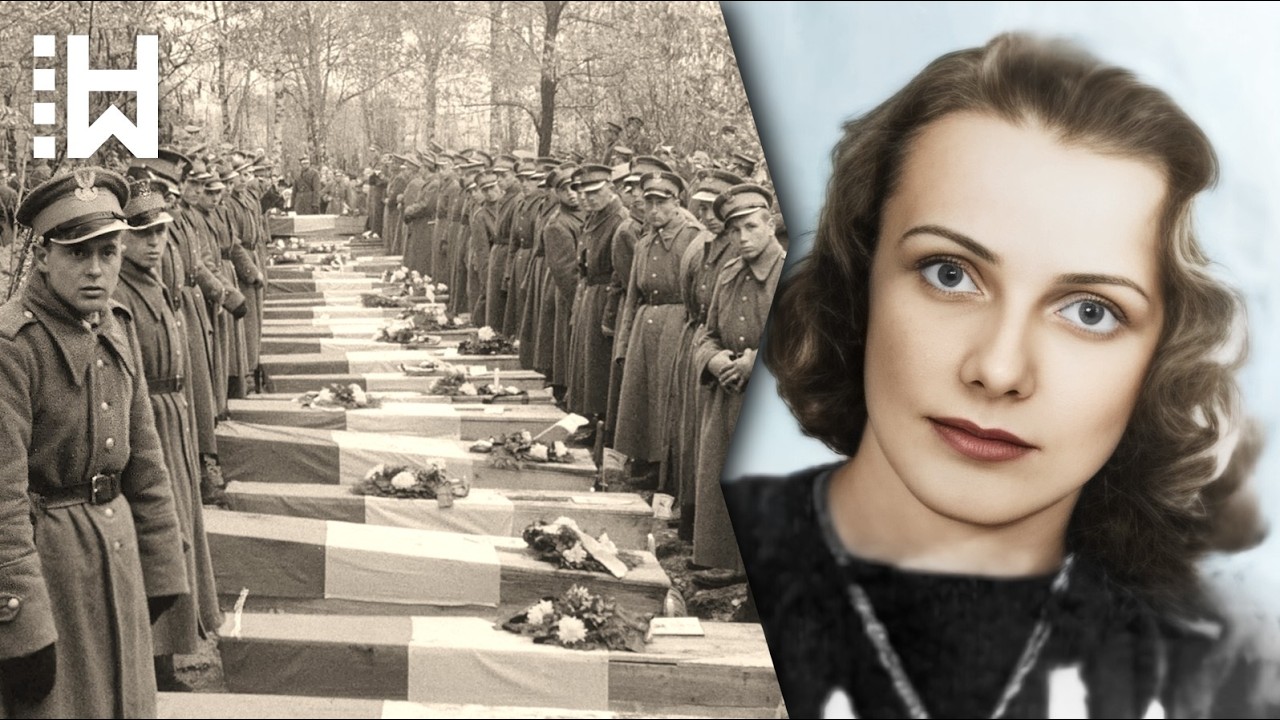
At first, people in the eastern districts of Warsaw thought it was thunder. Then the windows began to tremble. Dogs barked in courtyards. Mothers pulled children away from the streets. Men who had been drinking coffee in silence stood up without finishing their cups.
Germany had crossed the border.
Not from one direction. From several.
By noon, the news was no longer a rumor whispered between neighbors. It was on every face. German forces were pushing into Poland with terrifying speed. Warsaw waited for the thing everyone feared but no one wanted to name. In London and Paris, governments prepared ultimatums. In Poland, fathers buttoned their coats and walked toward mobilization points while their wives packed bread, documents, and family photographs into small bags.
In a house east of Warsaw, a sixteen-year-old girl watched the adults move as if the world had become a courtroom and the verdict had already been read.
Her name was Blanca Kachorovska.
She did not scream. She did not cry in the street. She stood near the window and looked up whenever the sky changed its sound.
That was how people later remembered her: quiet, observant, almost too composed for her age.
Blanca had grown up in a home where discipline was not something announced. It was simply practiced. Her father, Yan Kachorovski, came from an old noble family and carried himself like a man who believed institutions mattered. He had studied engineering in St. Petersburg, served in the Russian army during the First World War, and later given his loyalty to the reborn Polish state. Over the years, he rose through the military legal system until he became an investigating judge, then the head of a regional military court.
In their home, Poland was not an idea from a schoolbook.
It was duty.
It was uniforms brushed clean before dawn. It was careful speech at the dinner table. It was the understanding that personal comfort came after public responsibility.
Blanca was born on October 13, 1922, in Brest Litovsk, when the city still belonged to the Polish Republic. By the time she was a teenager, she had attended schools connected to military families in Warsaw and later studied at respected secondary schools. She joined the Polish scouting movement, where girls learned not only songs and first aid, but punctuality, secrecy, endurance, and service.
Those things sounded harmless in peace.
In war, they became training.
Still, in September 1939, Blanca was not a soldier. She had not even completed her final school examinations. She was sixteen, standing at the edge of adulthood, with her future arranged in the ordinary way families arrange futures for daughters they believe will live in a stable country.
Exams first. Then university, perhaps. A respectable life. A respectable marriage.
Then the planes came.
The first weeks of the invasion broke Poland’s old rhythm with brutal efficiency. Streets that once carried students and clerks filled with soldiers, carts, refugees, and rumors. People learned to recognize the difference between distant artillery and approaching aircraft. They learned which documents to hide and which names not to say aloud. They learned that a knock on the door after curfew could change an entire family’s fate.
For Blanca, the war did not arrive as one dramatic moment. It entered room by room.
A school closed. A neighbor disappeared. A familiar officer stopped visiting. Her father spoke less at home. Her mother began saving small things that would have seemed ridiculous weeks earlier: thread, candles, flour, medicine.
Outside, German power spread across occupied Poland. Inside Polish homes, something else began to form.
Resistance.
Not the kind printed on posters. Not the kind people could speak about openly. It began in lowered voices, in folded papers, in names passed carefully from one trusted person to another. Former officers, teachers, scouts, priests, civil servants, and ordinary clerks became part of a hidden country beneath the occupied one.
Blanca heard things before she was supposed to understand them.
A man came to the house and stopped speaking when she entered. A letter was burned before breakfast. Someone mentioned a “contact” and then changed the subject. She was young, but not careless. She had been raised by a military judge. She knew when adults were hiding fear behind procedure.
And she knew when silence meant danger.
The strange thing was that the war seemed to make her smaller in the eyes of others. To the Germans, she was just a Polish girl. To many adults, she was still a child caught in events too large for her. Even inside her own world, people often underestimated her because she did not push herself forward.
Blanca listened instead.
She listened when men talked too much. She listened when women pretended not to know anything. She listened to the new rules of occupation, to the names of German offices, to the places where food could still be found, to the routes people avoided after dark.
In those months, listening became more valuable than speaking.
By the end of 1939, the life Blanca had expected was gone. The old Polish state had been shattered. Warsaw was no longer simply a capital; it was a city under occupation, watched by men who treated suspicion as law. Families like the Kachorovskis, patriotic and tied to the prewar state, now lived with the quiet knowledge that their background could become evidence against them.
But the same upbringing that put them at risk also pulled Blanca toward the underground.
She had been taught that service mattered. She had been taught that Poland did not disappear just because an enemy raised a flag. She had been taught to keep her composure when others lost theirs.
So when the first doors opened toward secret work, she did not hesitate for long.
At sixteen, Blanca Kachorovska was not yet the woman people would later argue about in courtrooms, archives, and whispered family memories. She was not yet the name attached to betrayal, arrests, executions, and a trail of documents that would survive long after the war.
She was only a girl stepping into history through a side door.
And the most dangerous thing about her was that almost everyone thought they understood which side she was on.
Part 2
Occupation changed Poland in a way that was difficult to explain to anyone who had not lived through it.
The country still had streets, churches, tram stops, markets, school buildings, and apartment blocks. People still stood in lines for bread. Children still grew taller. Women still swept staircases in the morning. But beneath those ordinary movements, everything had been rearranged.
German orders appeared on walls. Curfews cut evenings in half. Names became dangerous. A careless sentence in a queue could travel faster than a train. In Warsaw and the surrounding districts, fear did not always look like panic. Sometimes it looked like a neighbor lowering his voice before saying hello.
Shadowsair, east of Warsaw, fell within the German-controlled General Government, a territory designed not for Polish self-rule but for German control. The old state had been crushed, but not all of its people had accepted defeat. Former soldiers, civil servants, teachers, scouts, railway workers, doctors, and priests began forming the hidden structure that would become the underground Polish state.
To the occupiers, Poland had lost.
To the underground, Poland had gone below the surface.
By 1940, Blanca Kachorovska had found her way into that world.
She was still very young, but youth was useful in occupied Poland. A sixteen- or seventeen-year-old girl could move through certain spaces without attracting the same attention as a former officer. She could carry messages. She could listen. She could be underestimated.
And Blanca was good at being underestimated.
She joined the Union of Armed Struggle, the organization that would later become the Home Army. At first, her work was not heroic in the way people imagine resistance work after the fact. There were no dramatic speeches, no flags hidden beneath coats, no cinematic moments of defiance in crowded squares.
There was labor.
She worked in a kitchen at a German airfield. Later, she worked as a cleaner in a German military hospital. To anyone watching from the outside, these were low positions, the kind of work an occupying force expected from a conquered population.
But those jobs placed her near conversations, movements, schedules, uniforms, wounds, names, and habits.
In a war of occupation, a kitchen could become an observation post.
A hospital corridor could become an intelligence route.
Blanca did not need to ask obvious questions. Obvious questions killed people. She simply noticed things. Which officer arrived late. Which units were mentioned by soldiers who thought Polish workers did not understand enough. Which vehicles came and went. Which names appeared repeatedly. Which men drank too much and spoke too freely.
She passed what she could.
For a time, that was enough.
Then Johannes Barend noticed her.
Barend was a Luftwaffe officer, one of those German men whose authority entered a room before he did. He had the confidence of a uniform, the protection of an empire, and the careless ease of someone who believed the occupied world existed for his convenience.
Blanca attracted his attention. Whether it began with curiosity, vanity, attraction, or simple arrogance on his part, the result was the same: a German officer began seeking contact with a Polish girl tied to the underground.
For most people, that would have been reason to run.
For the resistance, it was more complicated.
Her superiors encouraged her to maintain the connection. Barend might become a source. Even a careless remark from him could matter. Even a small detail could save lives or confirm suspicions. In the underground, morality often arrived covered in mud. People made choices that looked ugly from a distance because the alternative was blindness.
So Blanca stepped into a role that required control far beyond her age.
She had to appear available without being careless. Interested without being loyal. Frightened enough to be believable, calm enough to survive. Every conversation with Barend could be useful. Every conversation could also destroy her.
That was the danger of double lives.
They do not split a person cleanly in two.
They blur the edges.
People around Blanca began to see different versions of her. To some, she was a patriotic young woman doing brave and risky work. To others, she was too close to Germans. To Barend, perhaps, she was someone he thought he could charm or possess. To her commanders, she was a useful contact inside a dangerous system.
And to Blanca herself, the line between performance and reality may already have begun to shift.
In November 1941, the Gestapo arrested her in Shedlitzer.
That should have been the end.
The Gestapo was not a normal police force. It was an institution built to break silence. People disappeared into its offices and returned changed, if they returned at all. During the arrest, incriminating materials were found, including private letters from Barend. In occupied Poland, that was enough to ruin a life in several different directions.
The Germans could accuse her of underground activity.
The underground could accuse her of dangerous intimacy with the enemy.
Either side could decide she was no longer worth trusting.
For several days, Blanca was held.
No one outside could know exactly what was said in those rooms. No one could know what she denied, what she admitted, what names were mentioned, or what bargains were offered. Her age would not have protected her. Her father’s status in the old Polish system would not have protected her. Her connection to Barend might have helped, or it might have made everything worse.
Then, unexpectedly, she was released.
When she returned to the underground, she gave an explanation. She said she had convinced the Germans that the documents had ended up among her things by accident while she was cleaning. A mistake. A misunderstanding. Nothing more.
It was a fragile explanation.
But fragile explanations were sometimes accepted in wartime because people needed them to be true.
The resistance believed her. More than that, they rewarded her. Blanca received a medal for courage, a formal recognition that she had endured danger and survived without betraying the organization.
The document bore the authority of General Stefan Roetski, a leader of the Home Army.
At the time, it looked like a mark of trust.
Years later, it would read like a terrible irony.
Because the man whose signature helped honor Blanca would one day be among the most important victims of the network she became tied to.
At the medal ceremony, Blanca met Ludvik Kstein.
He was not just another underground member. Kstein was an intelligence officer in the Home Army, connected to Group H within the main command structure. He moved in circles where names were guarded, documents mattered, and a single compromised person could endanger dozens.
He also received a medal at that same ceremony.
Two decorated members of the resistance, standing in the same room, both appearing to represent courage under occupation.
That was how it began.
Not with a confession.
Not with a betrayal.
Not with a gun on a table.
Just a ceremony, a few formal words, and the quiet crossing of two paths that should never have crossed so closely.
By late 1941 and early 1942, Blanca was assigned to Kstein’s group. He became her superior. Soon, he became something more personal than that.
The people around them may have seen a practical arrangement: a young resistance worker under the direction of an experienced intelligence officer. In wartime, closeness was often explained away by necessity. Meetings had to happen. Messages had to be delivered. Trust had to be built quickly because there was no time to build it slowly.
But there was another layer forming beneath the official one.
Kstein had access.
Blanca had access.
Both understood the underground well enough to know where its nerves were exposed.
And in a city where the Gestapo hunted shadows, the most dangerous threat was not always the man kicking down the door.
Sometimes it was the person already inside the room, learning where every door led.
[Confirm to continue Part 3]