The boy did not ask for money.
That was the first thing Mama Asha noticed.
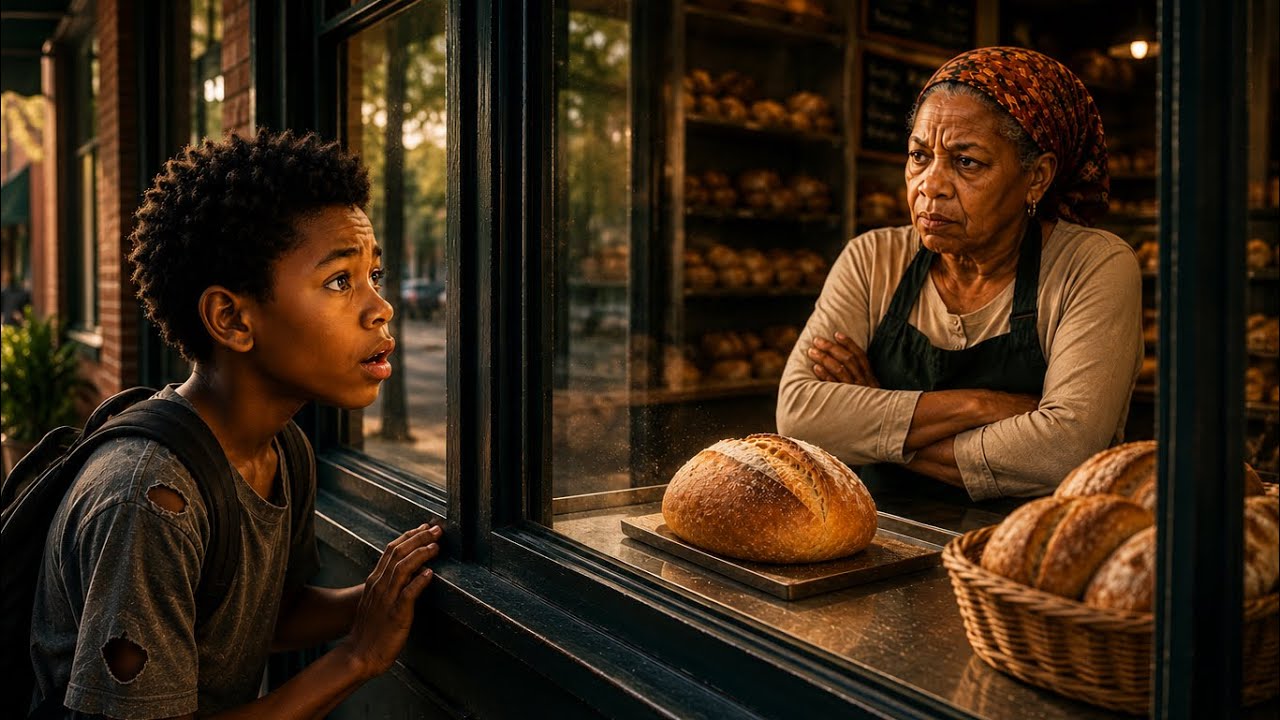
He stood just inside the doorway of her bakery on Kijani Road, small enough to be ignored and tired enough to be noticed, with one hand gripping the strap of a faded school bag that looked older than he was. His shirt had been washed too many times. His shoes were cracked at the sides. Dust clung to his ankles like it had followed him from another life.
The bakery was full that afternoon.
Office workers had come in for tea. Two taxi drivers sat near the window, arguing softly about fuel prices. A young mother was cutting a sweet roll into pieces for her daughter. Behind the counter, trays of warm bread steamed under the yellow lights, and the smell of butter, yeast, and cinnamon made the room feel almost safe.
Then the boy spoke.
“Ma’am,” he said, barely above a whisper, “may I sweep your floor for one piece of bread?”
The room changed.
Not loudly. Not dramatically.
But every spoon stopped touching every cup.
A man in a blue tie looked down at his phone, though the screen had gone dark. The young mother pulled her daughter a little closer. One of the taxi drivers shifted in his chair, uncomfortable, as if hunger were something rude to mention in public.
Mama Asha did not answer immediately.
She had owned that bakery for seventeen years, and before that she had sold mandazi from a metal tray at the bus station. She knew the difference between a child who was lazy and a child who had been trying to be brave for too long. She knew how hunger sat in the shoulders. How it made the eyes too large. How it taught children to apologize before they had done anything wrong.
“What is your name?” she asked.
The boy swallowed. “Tendaji.”
“How old are you, Tendaji?”
“Eleven.”
Mama Asha looked at his hands. They were clean, but not soft. A child’s hands that had already learned adult work.
“When did you last eat?”
Tendaji glanced toward the trays behind the glass. For half a second, his face betrayed him. Then he looked down quickly.
“This morning,” he said.
Mama Asha’s eyes narrowed, but not in anger.
“What did you eat this morning?”
The boy’s fingers tightened around the bag strap.
He opened his mouth.
Closed it.
The silence answered for him.
Someone in the corner let out a small breath. The young mother looked away. Even the taxi drivers stopped arguing.

Tendaji tried again. “I can work first. I can sweep. I can wipe tables. I can carry boxes. I don’t need much.”
Mama Asha came around from behind the counter slowly. She was a broad woman with silver beginning at her temples and flour on the sleeve of her dress. People in the neighborhood called her Mama not because she had given birth to everyone, but because she had fed half of them at one time or another.
She stood in front of Tendaji and looked at him for a long moment.
Then she said, “No.”
The boy’s face fell so quickly it hurt to see.
“I understand,” he whispered.
He stepped backward, already preparing to disappear the way hungry children learn to disappear — quietly, politely, without making anyone feel guilty.
But Mama Asha pointed to the broom leaning beside the kitchen door.
“I said no to one piece of bread,” she said. “If you work in my bakery, you do not get scraps. You get a proper meal.”
Tendaji froze.
The customers looked up.
Mama Asha folded her arms. “Do you know how to sweep corners?”
“Yes, ma’am.”
“Under chairs?”
“Yes, ma’am.”
“Without raising dust into my customers’ tea?”
A small, nervous smile touched his mouth. “Yes, ma’am.”
“Then start there.”
She pointed to the far end of the room.
Tendaji moved as if someone had given him a mission larger than food.
He set his old bag carefully beneath a chair, rolled up his sleeves, and took the broom with both hands. At first, people watched him with the awkward pity adults often give poor children when they do not know what else to offer. But after a few minutes, the pity changed.
The boy worked well.
Not quickly in the careless way of someone pretending to be useful. Carefully. Seriously. He swept beneath every table, moved around shoes without touching them, gathered crumbs into neat little piles, and carried them away. When a customer stood to leave, Tendaji was there before the chair stopped moving, wiping the table with a cloth Mama Asha had handed him.
He did not complain.
He did not ask how long he had to work.
He did not once look back at the bread.
That was what made people notice.
The young mother smiled first. She pushed her daughter’s plate forward and whispered something. The little girl watched Tendaji with round eyes, then took one half of her sweet roll and held it out as he passed.
Tendaji stopped.
He looked at Mama Asha.
She gave the smallest nod.
“Thank you,” he said, accepting it with both hands as if it were something breakable.
But he did not eat it.
He wrapped it carefully in a napkin and placed it beside his bag.
Mama Asha saw that too.
So did the man sitting alone at the back table.
He had entered quietly before Tendaji arrived and had chosen the seat with the clearest view of the counter. His suit was dark, pressed, expensive in a way that did not need to announce itself. His shoes had no dust on them. A leather folder sat unopened beside his tea.
His name was Jabari Mensah, though no one in the bakery knew that yet.
He had not touched his tea for ten minutes.
He simply watched.
Not with pity.
With attention.
There is a difference.
By the time Tendaji finished, the bakery no longer felt like the same room. The customers spoke more softly. Someone ordered an extra loaf and left it on the counter without explanation. One of the taxi drivers cleared his own table for the first time in Mama Asha’s memory.
Mama Asha disappeared into the kitchen.
Tendaji stood near the broom, uncertain whether he was allowed to sit. His stomach made a sound so sharp that the woman near the window pretended not to hear it.
Then Mama Asha returned with a tray.
It was not one piece of bread.
There was a bowl of thick bean stew, two warm rolls shining with butter, a boiled egg, a small banana, and a cup of sweet tea. The steam rose up in front of Tendaji’s face, and for a moment he looked less like a boy being fed and more like someone seeing a miracle he was afraid to touch.
“For you,” Mama Asha said.
Tendaji stared at the tray. “All of it?”
“All of it.”
His eyes filled, but he blinked hard and sat at the small table near the counter. The bakery went quiet again, but this time it was a different kind of quiet.
He picked up a roll.

His hands trembled.
He ate the first bite slowly, as if his body did not trust sudden kindness. Then another. Then a spoonful of stew. Color seemed to return to his face one breath at a time.
Mama Asha turned away, pretending to arrange loaves so he could eat without feeling watched.
But after a few minutes, she heard the soft rustle of paper.
She looked back.
Tendaji had stopped eating.
He was carefully wrapping one of the rolls, half the boiled egg, and a portion of the banana in napkins. Then he opened his old school bag and placed the food inside as gently as if he were putting away treasure.
Mama Asha’s hand paused on the bread rack.
“Tendaji,” she said softly.
The boy looked up, guilty at once. “I’m sorry. I know you gave it to me. I didn’t mean to—”
“I am not angry.” Her voice was low. “Why are you putting food away?”
The question landed in the room like a stone dropped into water.
Every customer heard it.
The man in the dark suit leaned forward slightly.
Tendaji looked at his plate, then at his bag.
For the first time since he had entered the bakery, he seemed truly afraid.
Not of Mama Asha.
Of the answer.
“There is someone,” he said.
Mama Asha waited.
Tendaji’s throat moved.
“His name is Juma,” he whispered. “And he is hungrier than me.”
Part 2
For a moment, no one in the bakery moved.
Not Mama Asha.
Not the taxi drivers.
Not the woman by the window, whose daughter still had sugar on her fingers.
The name seemed to hang above the tables.
Juma.
A person none of them knew, yet suddenly everyone could picture him — someone waiting somewhere beyond the warm smell of bread, beyond the clean tiled floor, beyond the glass counter full of things Tendaji had been brave enough not to ask for twice.
Mama Asha looked at the boy’s bag.
Then at his face.
“You saved half your meal for him?” she asked.
Tendaji nodded, but he did not look proud. He looked worried, as if admitting the truth might cost him the food.
“He is old,” Tendaji said quietly. “He says he is not hungry, but I know when he is lying.”
A few people lowered their eyes.
There are lies that hurt people.
And there are lies poor people tell because they love someone.
Mama Asha understood that kind.
She stepped closer to the table and gently pushed the plate back toward Tendaji.
“Eat what is on your plate.”
“But Juma—”
“I said eat what is on your plate,” she repeated, not harshly, but with the calm authority of a woman who had raised children, buried friends, survived lean years, and learned that mercy sometimes needed a firm voice.
Tendaji froze.
Mama Asha turned and walked into the kitchen.
This time, she did not return quickly.
The bakery remained quiet, but the silence had changed again. It was no longer discomfort. It was waiting.
Jabari Mensah sat at the back table with his hands folded around his untouched cup. His eyes followed the kitchen door. He had seen generosity before, the public kind, the kind that came with cameras and speeches and a logo printed on a banner. This was different.
No one was performing.
That made it harder to look away.
When Mama Asha came back, she carried a brown cardboard food box, the kind she usually used for large family orders. It was tied with string and warm enough that steam softened the edges. She placed it on the table in front of Tendaji.
The boy stared.
“What is that?” he whispered.
“For Juma.”
His lips parted, but no words came out.
Mama Asha untied the string and opened the lid just enough for him to see. Inside were four fresh rolls, a full container of bean stew, rice, two boiled eggs, sliced fruit, and a small packet of tea leaves. Wrapped in wax paper beside it was a piece of honey cake she usually saved for paying customers who came before noon.
Tendaji looked up fast.
“I can’t pay for this.”
“I did not ask you to.”
“I can work more.”
“You already worked.”
“But not enough for all this.”
Mama Asha leaned down, placing both hands on the table so he had to meet her eyes.
“Listen to me, Tendaji. A child who is hungry and still thinks of another hungry person is not asking for charity. He is teaching the rest of us how to be human.”
The boy’s chin trembled.
She softened her voice.
“You wanted to share the little you had. So now you will carry more.”
The young mother by the window wiped her cheek with the edge of her sleeve. One taxi driver cleared his throat and looked toward the ceiling. The other quietly took money from his pocket and placed it beneath his empty cup, much more than the tea had cost.
Tendaji stood slowly, as if his legs were unsure of what to do with this much kindness.
“Thank you, Mama,” he said.
He had not called her that before.
Mama Asha pretended not to notice how much it moved her.
She packed the box carefully, then added another small bag. “This is for later. Not for tomorrow. Later today. Do you understand?”
Tendaji nodded.
“Go before it gets cold.”
He lifted the food box with both arms. It was heavy for him, but he did not complain. He slid the small bag into his backpack, thanked her again, then stepped toward the door.
As he passed the back table, Jabari looked at him fully for the first time.
Tendaji gave a polite nod, the kind poor children give to well-dressed adults because they are used to making themselves harmless.
Jabari nodded back.
But his eyes did not leave the boy.
When Tendaji disappeared into the afternoon light, the bakery slowly began breathing again. Cups touched saucers. Chairs scraped. Someone finally spoke.
Mama Asha returned behind the counter.
Jabari stood.
He left money on the table for tea he had not drunk and picked up his leather folder. At the door, he paused, looking down the road where Tendaji had turned left.
Then he followed.
Not too close.
Not in a way that would frighten the boy.
He followed like a man trying to understand the part of a story that had just walked out of the room.
Tendaji moved quickly through Kijani Road, past the fruit sellers calling out prices, past the bicycle repair stand, past the bus stop where people stood shoulder to shoulder under the sun. The food box was too large for him, so every few minutes he shifted it from one side to the other. Once, he nearly stumbled on a broken curb, but caught himself and held the box tighter.
Jabari saw that.
He also saw that Tendaji did not take even one bite.
The boy passed streets where the buildings grew smaller and the paint began to peel. He crossed behind the market, where the smell of ripe mangoes mixed with exhaust and dust. He avoided a group of older boys near a wall, lowering his head until he was safely past them.
Then the road became narrower.
The shops thinned out.
The sound of traffic faded.
At the edge of the settlement, Tendaji turned down a path between rusted sheets of metal and patched tarpaulin roofs. Children played barefoot around puddles from last night’s rain. A woman washed clothes in a blue basin. Somewhere, a radio played an old song with too much static.
Jabari stopped near a broken fence.
He should have turned back.
A decent man would have said this was none of his business.
But something in Tendaji’s careful hands, in the way he had protected that food as if it belonged to someone more important than himself, kept Jabari there.
Tendaji reached a small shelter near the end of the row. It was made from wood scraps, tin, and a green plastic sheet tied down with rope. Outside the entrance sat a pair of sandals and a walking stick polished smooth from use.
“Juma?” Tendaji called softly.
A voice answered from inside.
“You are late, little lion.”
The voice was weak, but it carried warmth.
Tendaji smiled for the first time that day without fear in it.
“I brought something,” he said.
An old man pulled aside the plastic sheet. He was thin in the way sickness makes people thin, not just hunger. His cheeks had hollowed. His white beard was uneven. But when he saw Tendaji, his face opened with such affection that the little shelter seemed less poor for a second.
“Ah,” Juma said, looking at the box. “You robbed the president?”
Tendaji laughed, and the sound was so sudden that Jabari, hidden farther back by the fence, almost smiled too.
“No. I worked.”
“You worked?”
“At a bakery.”
Juma’s face changed. Pride came first. Then concern. “You should be in school, Tendaji.”
“I know.”
The boy stepped inside before the old man could say more.
Jabari moved just close enough to see through a gap in the patched wall. He hated himself a little for watching, but he stayed.
Inside, there was almost nothing.
A mat.
A low wooden table.
Two cups.
A small pot with no lid.
On the wall hung a torn calendar from three years earlier and a photograph so faded the faces were nearly gone. Beside the mat lay a small pile of folded clothes and a bottle of medicine turned on its side.
Empty.
Tendaji placed the box on the table like he was setting down something sacred.
“Look,” he said.
Juma lowered himself slowly onto the mat, one hand pressed to his chest. Tendaji noticed the movement immediately, but Juma waved him off before he could speak.
“I am fine. Open it before I die of curiosity.”
The joke landed badly.
Tendaji’s hands hesitated.
Then he opened the box.
The smell filled the shelter.
Warm bread. Stew. Rice. Honey cake.
Juma stared at it.
His mouth trembled before he could stop it.
“When did you last eat?” Tendaji asked.
Juma smiled without answering.
It was the same kind of silence Tendaji had given Mama Asha.
The boy saw it.
He took a roll and pushed it toward the old man. “Eat.”
Juma picked it up, but instead of eating, he broke it in half and gave the larger piece back to Tendaji.
“No,” Tendaji said.
“Yes.”
“You need it more.”
“You are growing.”
“You are sick.”
Juma’s eyes flickered.
Only for a moment.
But Jabari saw it through the gap in the wall.
So did Tendaji.
The boy went still.
“Juma,” he said slowly, “why did you do that?”
“Do what?”
“Look away when I said sick.”
The old man sighed, trying to turn the conversation with a smile. “You think too much for a boy who still forgets to wash behind his ears.”
“I washed today.”
“Miracles continue.”
“Juma.”
The old man’s smile faded.
For a few minutes, they ate in quiet. Not because there was nothing to say, but because food had arrived where fear had been sitting. Tendaji watched every bite Juma took. Juma watched every bite Tendaji took. Each pretended to be satisfied sooner than he was.
Then Juma began coughing.
At first, it was small.
Then deeper.
Then his whole body bent forward, one hand gripping the table, the other pressed hard against his chest. Tendaji dropped his bread and rushed to him.
“Juma!”
The cough would not stop.
Jabari’s hand tightened on the fence.
Inside, Tendaji grabbed the cup, filled it from a covered container, and held it to the old man’s mouth. Juma drank, but his breathing came rough and shallow.
“Where is your medicine?” Tendaji asked.
Juma closed his eyes.
“Where is it?”
The boy searched beside the mat and grabbed the bottle. He shook it.
Nothing.
He picked up another packet.
Empty.
His face changed in a way no child’s face should change.
“When did it finish?”
Juma did not answer.
“When?”
“Three days ago.”
“Three days?” Tendaji’s voice cracked. “Why didn’t you tell me?”
“You had enough worry.”
“I could have found money.”
“You already look for work before the sun is up.”
“I could have found more!”
The old man reached for his hand. “Little lion—”
“No.”
Tendaji pulled away and emptied his pockets onto the table. Two coins rolled in a circle before falling flat. A bent bottle cap came with them. A small piece of string. Nothing else.
He stared at the coins as if hatred alone could turn them into enough.
“How much is the medicine?” he whispered.
Juma looked at the table.
Too long.
Tendaji understood.
“It is not just medicine,” the old man said.
The boy looked up slowly.
Juma breathed in, and the sound was thin.
“The doctor at Saint Brigid’s clinic examined me three weeks ago. He said my heart is tired.”
Tendaji did not blink.
“He said I need tests. Treatment. Maybe the hospital.”
“No.”
Juma’s eyes shone.
“I did not tell you because you would stop eating to save money.”
“No.”
“I know you.”
“No.” Tendaji shook his head harder, as if refusing the words could push them back into the old man’s mouth. “You said it was only a cough.”
“I wanted it to be only a cough.”
The shelter became very still.
Outside, a child laughed somewhere down the path. A radio played on. A woman called for someone to bring water.
Inside, Tendaji sat frozen beside the table, staring at the old man who had been his roof, his family, his last safe place in the world.
“You cannot leave,” he said.
It was not a request.
It was not even a sentence that expected an answer.
It was a child trying to give an order to life itself.
Juma reached out and placed his rough palm on Tendaji’s head.
“I am still here.”
Tendaji bent forward then, pressing his face into the old man’s knees, and the sob that came out of him was quiet. That made it worse.
Jabari stepped back from the fence.
He had seen enough.
More than enough.
He looked at the shelter, at the walking stick, at the empty medicine bottle through the gap in the wall. Then he looked at the road back toward the bakery, where a woman named Mama Asha had fed a hungry boy without asking for a receipt from the universe.
Jabari took out his phone.
His thumb hovered for a second.
Then he called someone.
“Yes,” he said, voice low. “I need Dr. Ndlovu. Now.”
He listened.
“No, not tomorrow. Today.”
Another pause.
His face hardened.
“Tell him it is Jabari Mensah. And tell him I am asking personally.”
Inside the shelter, Tendaji was still holding Juma’s hand.
He had no idea that the quiet man from the bakery was standing outside, changing the direction of both their lives.
And Jabari did not want him to know.
Not yet…

:format(jpg)/f.elconfidencial.com%2Foriginal%2F8bd%2F97f%2F1c8%2F8bd97f1c81de75bbca66a308dfc865a0.jpg)