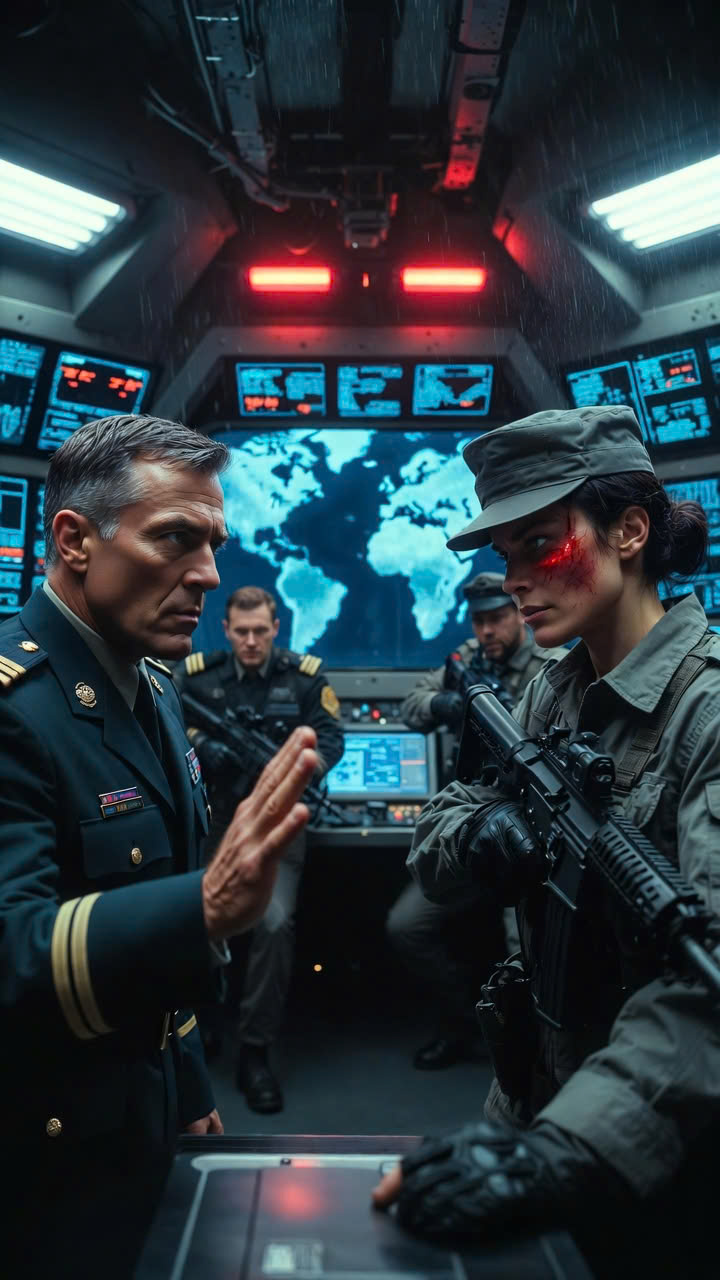
The slap cracked through the command center like a gunshot.
For half a second, every screen kept glowing, every satellite feed kept crawling, every analyst kept breathing through a headset as if the world had not just tilted. Then the room went still.
Colonel Marcus Vey stood with his hand still raised.
Across from him, the woman he had struck did not fall.
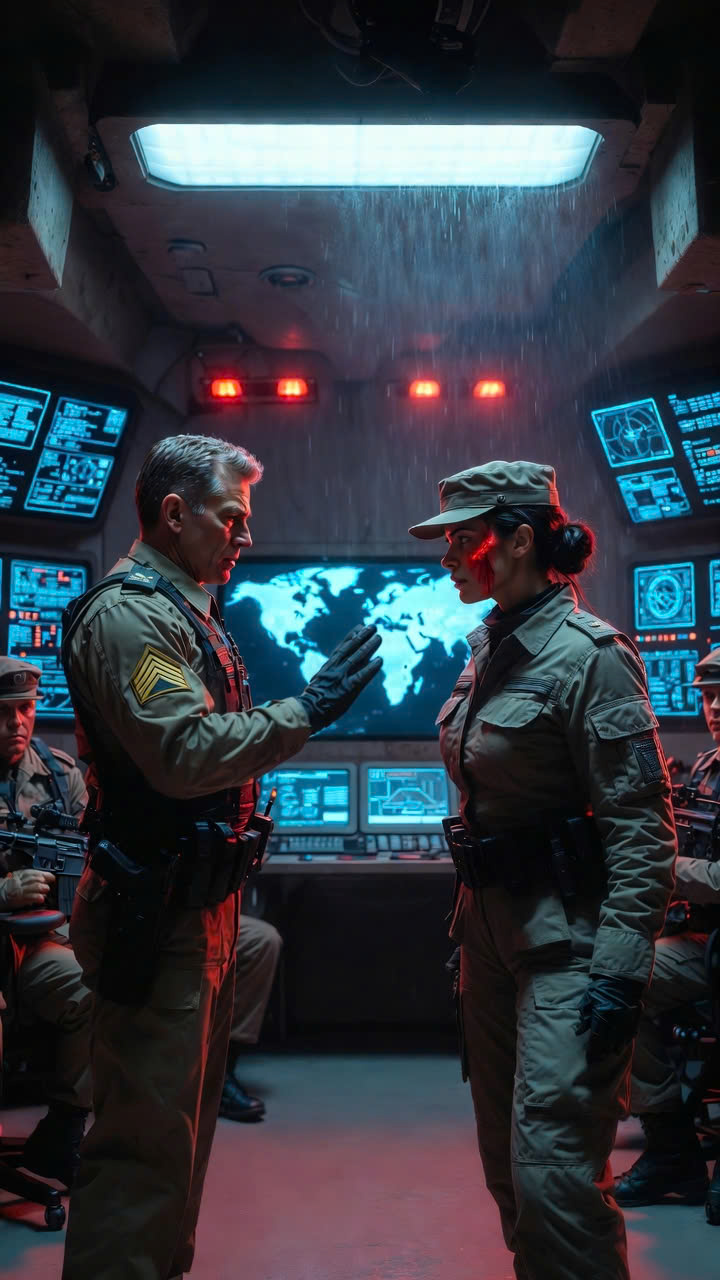
She turned her face back slowly. A thin red mark burned across her cheekbone. Her dark hair was pinned low beneath a plain field cap. No rank was visible on her gray operational jacket. No ribbons. No polished nameplate. No decoration bright enough to stop a man like Vey from deciding she was beneath him.
“You will answer me when I give an order,” he said.
The woman’s eyes did not move from his.
Behind her, two armed security officers shifted their rifles an inch higher—not toward her, but toward him.
That was the first thing Vey noticed.
The second was the silence.
Not fear. Recognition.
A young captain at the communications wall had gone pale. A major near the tactical table lowered his hand from his headset as if even plastic could make too much noise. On the main screen, an infrared map of the Atlantic seaboard flickered green and white, tracking something no civilian would ever know had crossed into restricted airspace.
The woman touched the corner of her mouth.
No blood.
She looked at her fingers anyway.
Then she said quietly, “Colonel, do you know where you are?”
Vey almost laughed.
“Do not play games with me.”
“I’m not.”
The blast doors at the far end opened.
Three military police officers entered first. Behind them came Brigadier General Owen Marr, breathing hard, his dress uniform half-buttoned as if he had run from another building.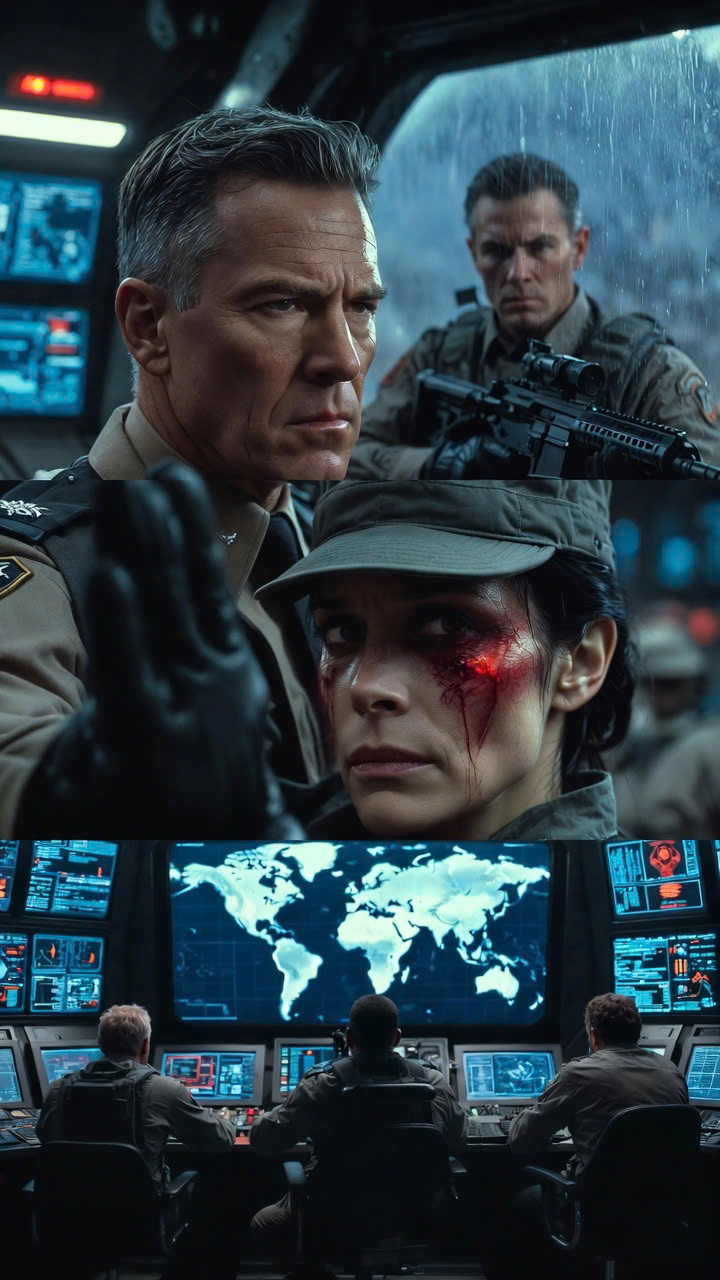
He stopped when he saw her face.
Then he saw Vey’s hand.
The color drained from him.
“Colonel,” Marr said, each syllable scraping out of his throat, “step away from General Cross.”
The word hit the room harder than the slap had.
General.
Colonel Marcus Vey stared at the woman.
For the first time, his hand lowered.
General Elena Cross watched him with the stillness of someone who had survived worse than humiliation. Someone who had learned long ago that pain was most useful when it arrived in public.
Outside the reinforced glass, rain hammered the Nevada desert. Thunder rolled low over the buried facility, shaking dust from the vents. The command center smelled of hot wiring, recycled air, old coffee, and wet wool dragged in from the storm.
No one moved.
Then the alert siren turned from amber to red.
A voice from the communications pit broke. “General Cross… we have a second breach.”
Elena did not look away from Vey.
“Where?”
“Inside the facility, ma’am.”
The room changed again. Not with panic. With dread.
Vey’s eyes flickered once.
Elena saw it.
So did Marr.
The monitors flashed. The facility designed to survive an attack from the outside had already been opened from within.
Elena lowered her hand from her cheek.
“Seal every internal corridor,” she said.
A lieutenant swallowed. “Ma’am… command authentication is rejecting us.”
Vey’s face hardened.
Elena turned toward him at last.
The red alarm painted half her face in blood-colored light.
“Colonel,” she said, “what did you bring into my command?”
Vey said nothing.
Somewhere beneath their feet, behind a door no one was supposed to access, something exploded.
The floor jumped. Coffee spilled across a console. A ceiling panel broke loose and slammed onto the map table. The command center lights cut out, then returned in emergency red.
Someone shouted for medical. Someone else called out a corridor number. The calm machine of military order began to fracture at the edges.
Elena moved first.
Not quickly. Precisely.
“Lock down external exits. Cut nonessential comms. Captain Reed, give me internal cameras on sectors C through F. Major Sloane, isolate the authentication failure.”
Vey found his voice. “You can’t take command of my facility.”
Elena looked at him.
One glance.
Nothing more.
Marr stepped between them. “Colonel, this facility has not been yours for eleven minutes.”
Vey’s mouth tightened.
“Elena,” Marr said, turning to her, “we have casualties below.”
“How many?”
“Unknown.”
“Then we don’t have time for pride.”
She pulled the plain jacket open.
Under it, clipped low and hidden against her side, was a matte-black command badge with two stars etched so faintly they caught only the red emergency light.
Major General Elena Cross.
The room inhaled.
The young captain at communications straightened as if a cable had been pulled through his spine.
Vey stared at the badge with the expression of a man watching a bridge disappear behind him.
Elena walked past him.
Her cheek was still red.
She did not cover it.
“Colonel Vey,” she said, “you will remain where I can see you.”
“That is not an order you get to give me.”
She stopped.
The siren pulsed once, washing the walls in red.
“After what you just did,” she said, “it is the kindest order you will receive tonight.”
No one spoke after that.
The command center beneath Fort Meridian had never appeared on public maps. From the desert highway, it looked like a weather station and three fenced warehouses sinking into dust and sagebrush. Below ground, it was six floors of reinforced concrete, signal vaults, server chambers, operations rooms, and narrow arteries of steel.
It was built to coordinate the response to attacks America would never admit it feared.
And tonight, someone had opened it from the inside.
Elena Cross had not arrived wearing stars because she had not come to impress anyone. She had come to find a leak.
At forty-six, she carried herself like a blade kept in cloth. She was not tall, but rooms adjusted around her. Her left knee still ached before storms because of a convoy ambush in Kandahar. Her right hand sometimes trembled when she was alone, though never when holding a pen, a rifle, or someone’s life in her decision. Her greatest fear was not death. It was command failure—the kind where people followed orders, trusted your voice, and still did not come home.
Marcus Vey was fifty-three, broad-shouldered, square-jawed, and built from old doctrine. He had the polished boots, the iron posture, the kind of voice that could fill a hangar without a microphone. He was not stupid. That made him dangerous. He believed discipline had been weakened by politics, hesitation, and leaders who apologized before they acted. His father had died wearing a uniform. His younger brother had died waiting for permission to fire. Vey had built his life around a single private oath: hesitation kills.
Tonight, that oath had turned into a hand across a general’s face.
But Elena knew men like Vey did not strike without pressure.
And pressure always came from somewhere.
“Internal camera feed is corrupted,” Captain Reed said. His fingers moved fast across the keyboard, but sweat shone at his temple. “We have twelve dead zones. All between sublevel two and the east server spine.”
“Casualties?”
“Two injured security officers near corridor C-9. No confirmed fatalities.”
“Good. Keep confirming.”
Major Sloane leaned over another console. She was thirty-eight, sharp-eyed, with cropped blond hair and the exhausted patience of someone who had spent years explaining cyberwarfare to men who thought passwords were locks. “Authentication override came from a colonel-level command token.”
Every eye moved to Vey.
His nostrils flared. “My token was in my possession.”
Elena’s gaze dropped to his right hand.
His ring finger twitched.
“Was it?” she asked.
He took one step toward her. Marr’s hand moved to his sidearm.
Vey stopped.
“I did not sabotage my own facility,” he said.
“Then someone used your authority better than you did.”
That landed.
Vey’s face shifted—not shame, not yet. Something rawer.
Fear.
Elena saw the first honest thing in him.
“Where is your token?” she asked.
“In my secure case.”
“Bring it.”
Vey turned to a lieutenant. “Get my—”
“No,” Elena said.
The word cut through him.
She looked at Reed. “Send two MPs. No one from Colonel Vey’s staff touches evidence.”
Vey’s voice dropped. “You think this is about me.”
“I think this room has two breaches. One technical. One human.”
His eyes moved briefly to her cheek.
For a moment, he looked older.
Then pride climbed back over his face like armor.
The explosion had damaged the east elevator shaft. Smoke curled through a lower corridor, caught in the blue-white flash of emergency strobes. Elena walked with Marr, Sloane, and four MPs toward the server spine while Vey followed under guard.
The hallway was colder than the command room. The air carried the metallic scent of burned wiring. Water dripped from a ruptured pipe somewhere behind the wall.
“Why were you undercover?” Marr asked quietly.
Elena kept moving. “Because three classified response drills leaked in six weeks.”
“To foreign actors?”
“To someone who wanted us to think foreign.”
Marr’s eyes narrowed. “Internal.”
“Yes.”
“And you suspected Vey?”
“I suspected his command climate.”
Behind them, Vey heard enough to answer. “My command climate keeps people alive.”
Elena did not turn. “Your people are afraid to tell you the truth.”
“They’re afraid to fail.”
“That sounds better only to men who confuse fear with loyalty.”
His boots struck harder against the floor.
Sloane glanced between them but said nothing.
They reached corridor C-9.
Two security officers sat against the wall, faces gray, uniforms torn by shrapnel. One had blood running from his ear. The other clutched his side while a medic wrapped gauze around him.
Elena crouched.
“What happened?”
The wounded officer tried to stand.
She put a hand on his shoulder. “Stay down.”
His throat worked. “Maintenance cart, ma’am. Came through with proper clearance. Then the lights glitched. Door opened behind us. I saw someone in a gray jacket.”
Elena’s eyes sharpened.
“A gray jacket like mine?”
He looked at her, then at the floor.
“Yes, ma’am.”
Vey exhaled through his nose. “Convenient.”
Elena stood.
The second officer lifted a shaking hand. “Ma’am… whoever it was walked like they knew cameras were down before they went down.”
Sloane murmured, “So they knew the timing.”
Elena turned to Vey.
“Who had today’s internal security drill schedule?”
He did not answer fast enough.
Marr noticed.
Elena noticed more.
Vey said, “Senior operations staff.”
“How many?”
“Fourteen.”
“Names.”
“This is not the place.”
Elena stepped closer.
The red mark on her cheek had darkened.
“Colonel, this entire facility is now the place.”
A radio crackled.
“Command, this is MP Team Two. We found Colonel Vey’s secure case.”
Static.
Then the voice came back thinner.
“It’s empty.”
Vey’s face went still.
Elena watched him carefully.
A liar often performs surprise.
Vey did not.
For the first time since the slap, he looked genuinely wounded.
Not because he had been caught.
Because someone had used him.
His anger had nowhere to go.
That made him more dangerous, not less.
They returned to command with the facility half-blind and the storm battering the desert above them. The command center had become a cave of red light and tense faces. No one looked at Elena’s cheek anymore. They looked at her hands, waiting for them to point toward survival.
Sloane pulled fragments of corrupted logs onto the main wall.
“Whoever copied Vey’s token didn’t just access doors,” she said. “They planted a false command chain. If General Cross hadn’t arrived, emergency authority would have defaulted to Colonel Vey after the breach.”
Marr looked at Vey. “And if Vey were compromised?”
Sloane swallowed. “Then all response assets could be redirected.”
Elena stared at the map.
Atlantic seaboard. Restricted airspace. Internal sabotage.
Two breaches.
One story.
“Put the external object back onscreen,” she said.
The infrared feed expanded. A bright, irregular shape moved over dark water.
Reed said, “It entered our detection envelope twenty-six minutes ago. No transponder. Low observable profile. Speed inconsistent with commercial aircraft.”
“Drone?”
“Too large.”
“Missile?”
“Too slow.”
Vey stepped forward despite the MP beside him. “It’s bait.”
Everyone looked at him.
He pointed at the screen. “Something that strange pulls every eye outward. Meanwhile someone opens us from inside.”
Elena studied him.
For once, they agreed.
“Who benefits?” Marr asked.
Sloane answered before anyone else. “Someone who wants command authority transferred during an active threat.”
Elena’s gaze moved to the lower-right corner of the display.
A small line of text blinked beneath the external track.
RESPONSE PACKAGE: PENDING AUTHORIZATION.
Her chest tightened.
“Which assets are pending?”
Reed checked.
His mouth parted.
“Ma’am… domestic rapid interception, cyber countermeasure release, and continuity relocation protocols.”
The room chilled.
Continuity relocation was not routine. It moved people. Leaders. Codes. Decision authority.
Elena looked at Vey.
“Who drafted tonight’s contingency ladder?”
He said nothing.
“Colonel.”
His lips barely moved. “I did.”
The facility lights flickered.
Somewhere in the ventilation system, metal groaned.
Then every screen in the command center went black.
For three seconds, the only light came from emergency strips along the floor.
Then the main screen lit up with a single message.
AUTHORITY TRANSFER INITIATED.
MARCUS J. VEY — ACTING THEATER COMMAND.
The room turned toward him.
Vey stared at his own name.
Elena drew her sidearm and pointed it at his chest.
The MPs did the same.
Vey did not move.
His voice came out rough.
“That is not me.”
Elena looked into his eyes.
She believed him.
That was the problem.
Because the system did not care what she believed.
A countdown appeared.
TEN MINUTES TO FINAL AUTHORIZATION.
Marr whispered, “Elena…”
She kept the pistol steady.
“Major Sloane, can you stop it?”
Sloane was already typing. “Not from here. We need physical access to the cold vault.”
“Where?”
“Sublevel five.”
Vey’s head snapped up. “Impossible. That area is sealed after the blast.”
“Not impossible,” Elena said.
He looked at her.
“Just inconvenient.”
They moved fast.
Elena, Sloane, Marr, Vey, and two MPs descended the emergency stairwell as alarms chased them downward. The concrete walls sweated condensation. Each step rang like a hammer blow. The lower they went, the warmer the air became.
Vey walked with his hands restrained in front of him.
He hated that.
Elena could feel it in the rhythm of his breathing.
At sublevel four, a body lay across the landing.
Not dead.
A man in maintenance coveralls, unconscious, face bruised, wrists zip-tied with military precision.
Sloane crouched beside him. “This is Luis Ortega. Systems engineer. He has cold vault access.”
Elena checked his pulse. “Alive.”
Marr found something tucked beneath Ortega’s shoulder.
A torn patch.
Gray fabric.
Elena looked at her own jacket.
The infiltrator had dressed like her.
Not to hide.
To frame.
Vey looked at the patch. Then at Elena’s cheek.
Something changed in his face.
The memory of his hand striking her seemed to arrive late, heavier now.
He opened his mouth.
Elena stood before he could speak.
“Save it.”
The words were not cruel.
That made them worse.
They reached sublevel five with six minutes left.
The corridor beyond the stairwell was filled with smoke and sprinkler mist. The overhead lights flashed in broken intervals, turning every movement into fragments. A wide blast door stood half-open at the end.
Cold vault.
A place built behind layers of steel, analog locks, biometric plates, and paranoia.
Tonight, it was bleeding light.
One MP raised a fist.
Everyone stopped.
Footsteps echoed inside the vault.
Slow.
Unhurried.
Elena gestured left. Marr moved right. Sloane stayed back with the second MP. Vey stood restrained, watching the doorway like a man seeing the shape of his disgrace.
A voice came from inside.
“General Cross. I wondered if he would actually hit you.”
Elena’s eyes narrowed.
Sloane whispered, “I know that voice.”
A woman stepped into view.
Lieutenant Colonel Dana Rusk.
Forty-one. Vey’s deputy director of operations. Neat uniform. Calm hands. Brown eyes that looked almost kind until they stopped pretending. In her right hand she held a compact pistol. In her left, a drive key.
Vey went white.
“Dana?”
Rusk looked at him with something close to pity.
“You always did make it easy, sir.”
His face twisted. “I trusted you.”
“Yes,” she said. “That was your first mistake.”
Elena’s pistol stayed level. “Put the weapon down.”
Rusk smiled faintly. “You still think this is about a weapon.”
Behind her, the cold vault terminal glowed.
Countdown: four minutes.
Sloane whispered, “She’s at the manual confirmation port.”
Elena kept her eyes on Rusk. “Who are you working for?”
“My country.”
Vey barked, “Don’t you dare.”
Rusk’s calm broke for the first time. She turned on him.
“You buried the report.”
The words froze him.
Marr looked at Vey. “What report?”
Rusk’s fingers tightened around the pistol. “Three years ago, a convoy in Syria was redirected based on bad intelligence. Eleven soldiers died in a dry riverbed while headquarters waited for perfect confirmation.”
Vey’s face had gone rigid.
Elena watched him.
Rusk continued, “My brother was in the third vehicle. He burned alive calling for air support that never came.”
The corridor seemed to shrink.
Vey’s voice dropped. “That report was classified.”
“That report blamed weather, signal confusion, and battlefield chaos.” Rusk’s eyes shone now. “It did not blame the man who delayed the strike because he wanted legal certainty.”
Elena understood.
Not all villains wanted money.
Some wanted correction.
Some wanted the world to hurt in the exact shape they had hurt.
Rusk looked at Elena. “Tonight, command hesitation ends. The system will transfer authority to Vey. Then the forged package will trigger a rapid response posture so aggressive no civilian committee can stop it in time. By morning, every cautious general in Washington will be finished.”
“That isn’t justice,” Elena said.
Rusk laughed once.
“No. It’s evolution.”
Vey took a step forward.
The MP grabbed him.
Vey did not look at the guard. He looked only at Rusk.
“Dana. Your brother died because I failed to challenge a bad chain. Not because restraint exists.”
Rusk’s lips trembled.
For one second, the pistol lowered a fraction.
Then pride saved her from grief.
“You don’t get to confess now.”
Elena saw the movement before anyone else.
Rusk’s thumb shifted toward the drive key.
Elena fired.
The shot struck Rusk’s pistol, tearing it from her hand. Marr lunged. Rusk slammed the drive key into the terminal before he reached her.
The countdown jumped.
Thirty seconds.
Sloane sprinted into the vault.
Elena followed.
Rusk hit the floor under Marr’s weight, screaming—not from pain, but fury. “You can’t stop it. It’s already accepted!”
Sloane grabbed the terminal. “Manual cancel requires two senior command biometrics.”
Elena put her palm on the plate.
The screen flashed.
GENERAL CROSS ACCEPTED.
SECOND AUTHORITY REQUIRED.
Everyone looked at Vey.
His hands were still restrained.
Elena stared at him.
In the space between them stood the slap, the insult, the public humiliation, every ugly assumption he had made because she had entered his command without visible stars.
And now the facility needed him.
Vey lifted his cuffed hands.
“Unlock me.”
The MP hesitated.
Elena nodded.
The cuffs came off.
Vey stepped to the plate.
Rusk twisted beneath Marr. “Don’t you dare help her.”
Vey looked down at her.
His voice was broken glass.
“I am not helping her.”
He placed his palm beside Elena’s.
“I am serving.”
The terminal flashed.
COLONEL VEY ACCEPTED.
CANCEL COMMAND?
Ten seconds.
Sloane shouted, “Voice confirmation!”
Elena leaned toward the microphone. “Cross, Elena. Cancel authority transfer.”
The system beeped.
Vey leaned in.
For once, his voice did not boom.
“Vey, Marcus. Cancel authority transfer.”
Five seconds.
The screen froze.
Then every alarm stopped.
Silence dropped so hard that someone’s distant coughing sounded like thunder.
On the screen, green text appeared.
TRANSFER TERMINATED.
Rusk closed her eyes.
Not defeated.
Empty.
Two hours later, rain still beat the desert above Fort Meridian, but the command center breathed again.
The external object over the Atlantic had been identified as a spoofed composite signature generated through compromised sensor relays. No aircraft. No missile. No drone. A ghost built from stolen trust.
Rusk was taken away without ceremony. She did not ask for mercy. She asked only whether her brother’s name would finally be spoken in the report.
Elena said yes.
Vey stood near the tactical table, no longer under guard, but not free either. His career had ended the moment his hand crossed Elena’s face. He knew it. Everyone knew it.
His secure token had been copied by Rusk during a private review meeting. His staff had obeyed her because she carried his confidence like a signed order. His culture of fear had done the rest. No one questioned. No one slowed her down. No one wanted to be the weak link.
That was how she entered the vault.
Not with genius.
With obedience.
At 0410, the storm passed.
A gray dawn pressed against the reinforced glass. The desert outside looked washed clean and merciless.
Elena stood alone in the observation corridor when Vey approached.
He stopped several feet away.
For the first time all night, he did not invade the space between them.
“General Cross.”
She did not turn.
“I have submitted my statement.”
“I read it.”
“I did not soften what I did.”
“No.”
His throat moved.
“I thought you were sent to inspect me.”
“I was.”
He gave a humorless breath. “And I helped your case.”
“You revealed it.”
That hurt him more than accusation.
For a long moment, only the ventilation hummed.
Then Vey said, “My brother died waiting on permission.”
Elena looked at him then.
He stared through the glass at the wet runway lights outside.
“I was twenty-seven. They patched the audio through by mistake. I heard him asking why no one was firing back. After that, every pause sounded like cowardice.”
Elena’s face softened by almost nothing.
But almost was not nothing.
“My first command loss was a nineteen-year-old medic,” she said. “I gave an order that saved eight people and left him exposed for twelve seconds too long. His mother sent me a letter thanking me for bringing his watch home.”
Vey looked at her.
The red mark on her cheek had faded into a bruise.
He could not stop seeing it.
“I was wrong,” he said.
The words did not come easily. That made them real.
Elena waited.
Vey forced himself to continue.
“I was wrong before I struck you. The strike was only the proof.”
She held his gaze.
“Apology accepted.”
His shoulders dropped with relief he did not deserve.
Then she added, “Accountability remains.”
He nodded once.
“I know.”
Two days later, the hearing took place in a secure chamber without cameras.
Colonel Marcus Vey admitted to assaulting a superior officer, creating a hostile command environment, and failing to safeguard internal authority procedures. He did not blame exhaustion. He did not blame the breach. He did not blame Elena’s concealed rank.
When asked why he struck her, he looked at the table for a long time.
Then he said, “Because I believed authority belonged to the loudest man in the room.”
No one interrupted.
He continued, “I was wrong.”
Lieutenant Colonel Dana Rusk faced separate charges. Her testimony exposed the buried Syria report, not as a simple scandal, but as a chain of failures shared by men and women who had mistaken procedure for truth. Her brother’s name entered the official record. So did the names of ten others.
Justice did not bring them back.
But silence no longer owned them.
Three weeks later, General Elena Cross returned to Fort Meridian.
This time, she wore her stars openly.
The command center stood brighter than before. New glass panels. New access controls. New faces at several stations. But some things remained—the smell of coffee, the soft electric heat of machines, the low murmur of people watching threats move across screens most Americans would never see.
Captain Reed saw her first.
“General on deck!”
Everyone stood.
Elena almost told them to sit.
Then she saw the place where it had happened.
The same stretch of floor.
The same overhead lights.
The same air that had held its breath.
She walked to the center of the room.
“Sit down,” she said.
They did.
Not because they feared her.
Because they trusted the order.
On the main screen, the Atlantic map glowed blue.
No alarms.
No ghosts.
Elena rested both hands on the tactical table.
“Some of you were here the night this facility nearly became a weapon against itself,” she said. “You saw a failure of security. A failure of leadership. A failure of courage.”
No one moved.
“You also saw people correct course under pressure. You saw an analyst refuse to quit a corrupted system. You saw wounded officers report the truth. You saw a colonel who had done wrong still choose to stop something worse.”
Her eyes moved across the room.
“I do not need perfect officers. Perfect officers lie early. I need honest ones. I need people who speak before the door opens, before the token is copied, before the slap, before the explosion.”
A few faces lowered.
Not in shame.
In understanding.
Elena touched the faint bruise still visible on her cheek.
“This mark will fade,” she said. “The lesson does not get to.”
Outside, sunlight broke across the Nevada desert, turning wet concrete silver.
Inside the command center, no one clapped. Soldiers did not clap for that kind of truth.
They returned to work.
Headsets on. Fingers moving. Eyes sharp.
Elena Cross watched the room become alive again—not perfect, not innocent, but awake.
Then Captain Reed called from the communications wall.
“General?”
Elena turned.
“We have an incoming secure message from Washington.”
“Priority?”
Reed looked at the screen.
His face changed.
“Highest.”
The room quieted, but this time it did not freeze.
Elena walked toward the display.
Onscreen, five words appeared beneath the seal of the Joint Chiefs.
FORT MERIDIAN WAS NOT ALONE.
Elena stared at the message.
Then, slowly, she reached for the headset.
Her voice was calm when she spoke.
“Put them through.”


