Emma Carter fired him in front of the entire company because he was 57 minutes late.
Not in private.
Not after a conversation.
Not even after asking why.
She did it while investors sat around a polished glass table, while senior executives stared at their laptops, and while hundreds of Carter Global employees watched the annual strategy presentation through a company livestream.
Daniel Brooks stood near the back of the conference room, still wearing the wrinkled shirt he had pulled on in the emergency room bathroom.
His eyes were red from a sleepless night.
His phone was still buzzing with updates from the hospital.
And before he could say a single word, Emma looked at him from the stage and said, “Professionalism is not optional here.”
The room went still.
Daniel opened his mouth, then closed it.
Emma’s voice was calm, sharp, and public.
“If someone cannot show up when the company needs them most, then they do not belong at Carter Global.”
No one moved.
The CFO lowered his eyes.
A project manager in the second row gripped her pen so tightly it snapped.
Daniel stood there with his laptop bag over one shoulder, looking less angry than exhausted.
Then Emma said the words that would follow her longer than any quarterly report ever had.
“You’re done here, Daniel.”
For years, Emma Carter had been called the Iron CEO.
Business magazines loved the nickname.
They printed it beside photos of her standing in corner offices, arms folded, city lights behind her. They wrote about how she had built Carter Global from a small software startup into one of the fastest-growing enterprise technology firms in the country.
She was admired, feared, quoted, and studied.
Her speeches were full of clean phrases.
“Excellence requires sacrifice.”
“Feelings don’t scale.”
“Pressure reveals value.”
Inside Carter Global, those phrases were not inspirational posters. They were warnings.
People came in early and left late. They answered emails during family dinners. They joined video calls from parking lots, airports, hospital waiting rooms, and once, famously, from a maternity ward.
Emma saw this as commitment.
Many employees saw it as survival.
Daniel Brooks had worked at Carter Global for six years as a senior financial analyst. He was not flashy. He did not dominate meetings. He rarely spoke unless he had checked his numbers twice.
But when Daniel spoke, people listened.
He caught budget risks others missed. He stayed late to help junior analysts fix broken models. He remembered birthdays. He covered for coworkers who had sick parents, school pickups, or panic attacks they did not want HR to know about.
He never made himself the hero of anything.
At home, Daniel was the only parent of an eight-year-old girl named Lily.
His wife, Rachel, had died four years earlier after a long illness that had taught him how quickly life could become divided into before and after.
Lily had her mother’s smile and her father’s quiet stubbornness. She loved drawing whales, hated peas, and carried a purple backpack even on days she did not have school because it made her feel prepared.
That year, Lily had been diagnosed with a serious immune condition.
Some weeks were normal.
Some weeks were a maze of fevers, blood tests, specialist appointments, insurance calls, and nights where Daniel sat beside her bed listening to her breathe.
He never told many people at work.
He did not want pity.
He did not want special treatment.
He only wanted to keep doing his job well enough that no one could say his private pain had become a professional weakness.
The day of the investor presentation was supposed to be flawless.
Carter Global was pitching a major expansion plan. Investors had flown in from New York, London, and Singapore. The board wanted confidence. The press wanted numbers. Emma wanted perfection.
Daniel had spent three weeks preparing the financial analysis behind the presentation.
He had checked revenue projections, risk models, cost assumptions, and cash-flow scenarios. At 1:13 a.m. the night before, he emailed the final file to Emma’s chief of staff with a note that said:
“Final model attached. I’ll bring backup copies in the morning.”
At 5:42 a.m., Lily woke up burning with fever.
At 5:49, she fainted in the hallway while trying to reach the bathroom.
Daniel caught her before she hit the floor.
By 6:08, he was in the car, one hand on the steering wheel, the other reaching back to touch Lily’s ankle every few seconds as if contact alone could keep her there.
At 6:31, he arrived at the emergency room.
At 7:20, a nurse told him they were running tests.
At 8:05, his phone showed twelve missed calls from Carter Global.
At 8:47, the doctor finally said Lily was stable.
Daniel kissed his daughter’s forehead, asked the nurse to call him if anything changed, and ran to his car.
He arrived at Carter Global at 9:57.
The presentation had started at 9:00.
The lobby screens were showing Emma live from the executive floor.
Daniel did not wait for the elevator to close properly before pressing the button again and again, as if urgency could make steel move faster.
When he stepped into the conference room, Emma was midway through a slide on expansion costs.
Every head turned.
His shoes squeaked softly against the floor.
Emma stopped speaking.
For one second, Daniel thought she might ask if everything was all right.
She didn’t.
Instead, she used him as a lesson.
“Everyone in this room should understand something,” she said, still holding the presentation remote. “Talent is common. Reliability is rare.”
Daniel stood frozen.
Someone whispered, “Emma, maybe—”
She raised one hand, and the whisper died.
“This company is not built by excuses,” she continued. “It is built by people who show up.”
Daniel’s throat tightened.
“My daughter was in the—”
“I’m not asking for an explanation,” Emma said.
The sentence landed harder than shouting would have.
Daniel looked around the room. He saw people who knew him. People he had helped. People who had eaten lunch with him, borrowed his work, asked about Lily.
Several looked horrified.
None spoke.
Emma turned slightly so the livestream camera caught her profile.
“Carter Global cannot afford emotional exceptions at critical moments.”
Then she fired him.
Daniel did not argue.
He did not beg.
He did not say the company would regret it.
He simply nodded once, walked to his desk, and placed six years of his professional life into a small cardboard box.
A framed photo of Lily.
A coffee mug from his first year.
A notebook full of formulas.
A paper whale Lily had drawn and taped to his monitor.
In the elevator, a junior analyst named Priya ran in just before the doors closed.
“Daniel,” she said, voice shaking, “I’m so sorry.”
He gave her a tired smile.
“Don’t risk your job.”
That made her cry.
He walked through the lobby carrying the box against his chest. Outside, the Carter Global logo gleamed above the entrance, silver letters against black glass.
Daniel looked back at it once.
Then he turned away and went back to the hospital.
Emma finished the presentation.
The investors applauded.
The board congratulated her on maintaining discipline under pressure.
By that afternoon, the story had traveled through the company faster than any official memo.
Some employees were angry. Some were scared. Most were both.
No one said anything publicly.
That was the culture Emma had built.
Fear could produce silence and still call it alignment.
For the next seven days, Emma believed she had made a difficult but necessary decision.
She told herself Daniel’s firing protected standards.
She told herself people would understand.
She told herself leadership meant being willing to look cold in order to keep a company strong.
Then, seven days later, after a late board meeting, Emma drove home in heavy rain.
The highway was slick and nearly empty.
Her phone sat silent in the cup holder. Her wrist ached from signing documents. Her mind was already on the next morning’s agenda.
The storm thickened.
A truck ahead of her swerved.
In the seconds that followed, Emma saw headlights, water, and the sudden impossible angle of metal coming toward her.
There was a violent sound.
Glass shattered.
Her car spun across two lanes and slammed into the concrete barrier.
Then everything went black.
The news spread quickly.
“Carter Global CEO Injured in Serious Highway Crash.”
Television stations mentioned her name. Industry leaders posted polished messages. Employees filled internal channels with praying-hand emojis and careful sympathy.
Flowers arrived at St. Catherine’s Hospital by the dozen.
White lilies from the board.
Orchids from investors.
A massive arrangement from the executive team with a printed card that read: “Wishing you a speedy recovery.”
For two days, Emma knew none of it.
When she finally woke, her body felt like it belonged to someone else.
Three broken ribs.
A fractured wrist.
Severe bruising.
A concussion.
The doctor told her recovery would take months.
At first, she expected visitors.
Important people always appeared for important people.
But after the cameras left, the room grew quiet.
The board chair sent a message through his assistant.
The CFO was traveling.
The COO had “back-to-back operational meetings.”
Investors sent flowers.
Partners sent emails.
Employees sent cards routed through HR.
No one sat in the chair beside her bed.
No one asked if she was scared when the pain medication wore off at 3 a.m.
No one noticed that she could not open the bottle of water on her tray with one working hand.
For the first time in years, Emma Carter had nothing to command.
No meeting to control.
No room to silence.
No title strong enough to make someone stay.
The hospital room became a mirror.
In that silence, faces began returning to her.
An engineer whose mother had died the week of a launch.
A receptionist who had once asked for two hours off to attend her son’s school ceremony and was told to “manage priorities.”
A marketing manager who cried in a stairwell after being praised for answering emails during chemotherapy.
And Daniel Brooks.
Daniel standing at the back of the conference room.
Daniel trying to say, “My daughter…”
Daniel walking out with a cardboard box and a dignity she had mistaken for weakness.
Emma closed her eyes.
For the first time, the memory did not feel like discipline.
It felt like cruelty.
On the fifth afternoon after the accident, rain tapped softly against the hospital window.
Emma was staring at the untouched flowers on the table when the door opened.
She expected a nurse.
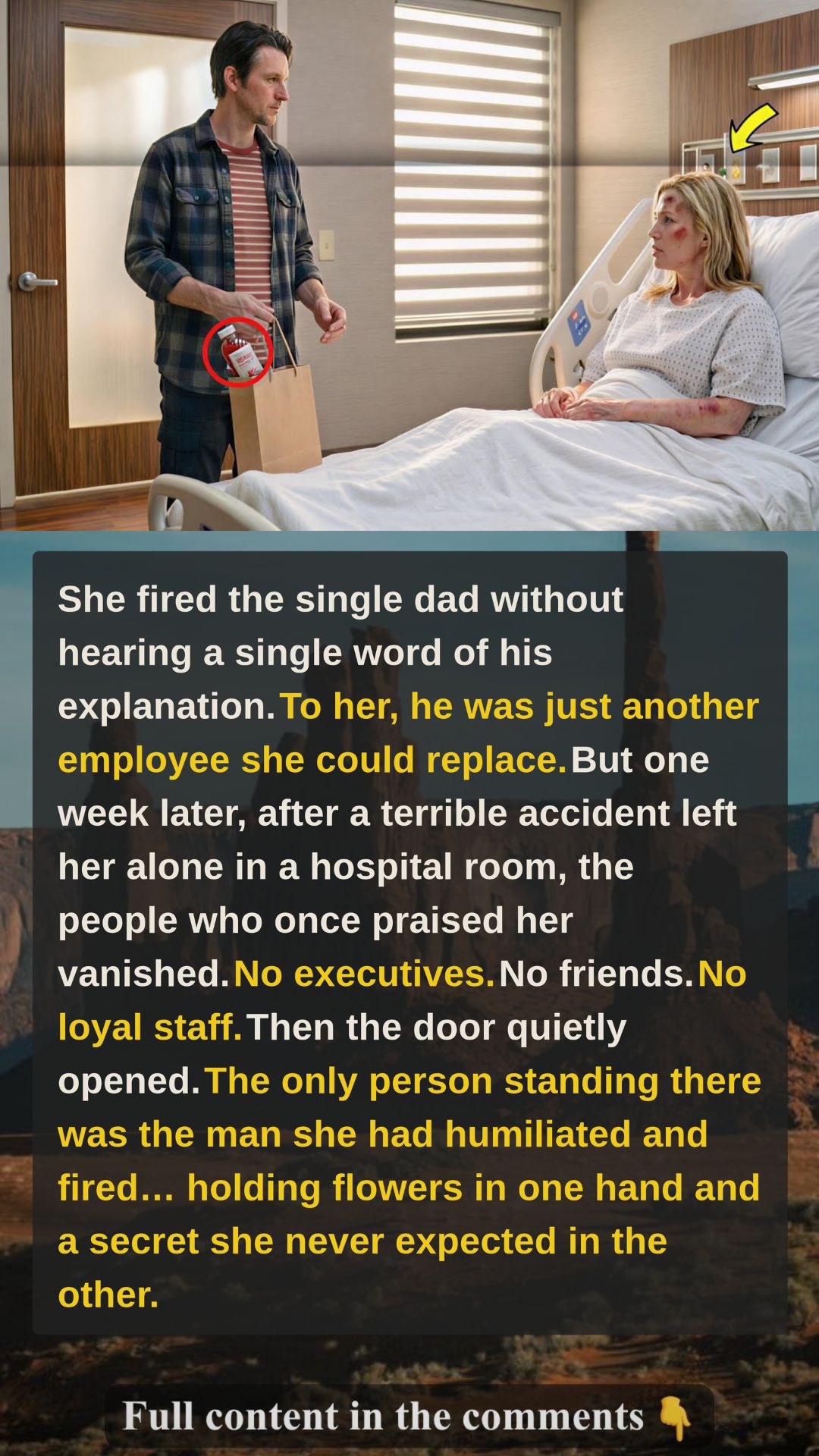
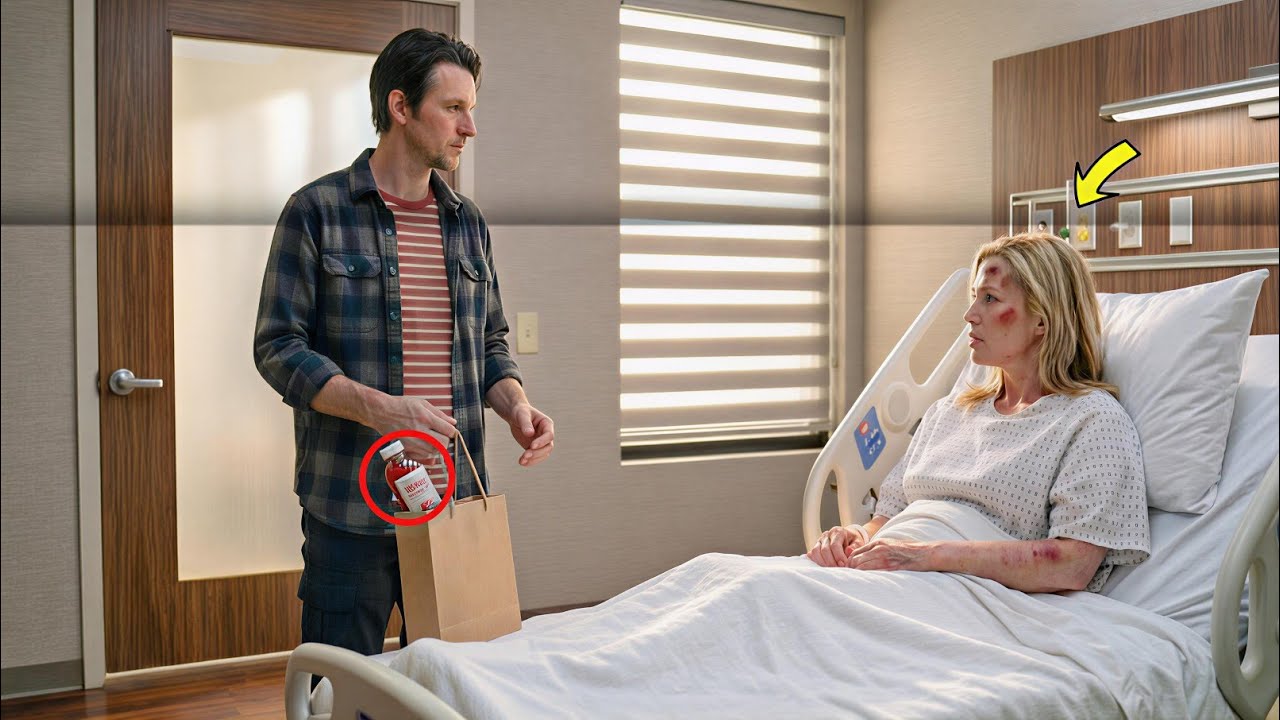
Instead, Daniel Brooks stepped inside.
He wore a faded jacket and carried a small brown paper bag.
For a moment, Emma thought the pain medication was confusing her.
Daniel looked thinner than she remembered. Tired, too. But his expression was calm.
“Hi, Ms. Carter,” he said.
She could not find words quickly enough.
Daniel walked to the side table and gently moved one of the expensive flower arrangements to make room.
“I brought soup,” he said. “It’s nothing fancy. Just chicken and vegetables. Hospital food is usually terrible.”
Emma stared at the bag.
He also took out a small container of cut fruit and a folded card.
“This is from Lily,” he said.
Emma looked down.
The card had a drawing of a woman in a hospital bed, surrounded by crooked yellow stars. In purple crayon, Lily had written:
“Get well soon. My daddy says everyone needs someone when they are hurt.”
Emma’s face changed.
Not dramatically.
Not like in movies.
Her mouth parted slightly. Her eyes moved from the card to Daniel, then back again, as if her mind could not make the two things fit together.
“You came here?” she asked.
Daniel nodded.
“Why?”
The question came out smaller than she intended.
Daniel looked at the floor for a second.
“Because you were hurt.”
Emma swallowed.
“After what I did to you?”
He did not answer immediately.
That made it worse.
Finally, he said, “What you did hurt my family. I won’t pretend it didn’t. I lost my job. I almost fell behind on rent. I’ve been doing delivery shifts during the day and cleaning offices at night.”
Emma looked away.
There was no accusation in his voice.
That was what made it unbearable.
“But Lily heard about your accident,” Daniel continued. “She remembered you from the company picnic two years ago. She asked if you had anyone bringing you soup.”
Emma remembered that picnic only vaguely.
A lawn.
A stage.
A photographer.
A little girl handing her a paper whale.
She had taken it, smiled for the photo, and handed it to an assistant five minutes later.
Daniel placed the card beside her water cup.
“She said people shouldn’t be alone in hospitals.”
Emma’s fingers trembled against the blanket.
“I don’t know what to say,” she whispered.
Daniel gave a faint, tired smile.
“You don’t have to say anything.”
He stayed only seven minutes.
He adjusted the soup container so she could reach it. He opened the fruit cup because her wrist was in a cast. He asked the nurse whether Emma had been eating.
Then he said he had to get to a delivery shift.
At the door, Emma called his name.
He turned.
“I’m sorry,” she said.
It was the first real apology she had given in years.
Daniel looked at her for a long moment.
Then he nodded once.
“I hope you get better.”
After he left, the room felt different.
Not fuller.
Emptier, somehow, because now Emma understood what had been missing.
A nurse came in later to check her vitals and noticed the homemade soup.
“Oh,” the nurse said, smiling. “Your friend came back.”
Emma looked up.
“Back?”
The nurse adjusted the monitor.
“He’s been here every day since you were admitted. Usually while you were asleep. He asked how you were doing, left once he knew you were stable. He asked us not to mention it.”
Emma turned her head toward the window.
Outside, the city lights blurred through the rain.
The most loyal visitor she had was the man she had humiliated.
The man she had fired.
The man who owed her nothing.
The next morning, Emma asked her assistant to find Daniel.
“He may be working,” the assistant said carefully.
“I’ll wait,” Emma replied.
Daniel arrived that evening in the same faded jacket, carrying the exhaustion of someone whose day had already been too long.
This time, Emma asked him to sit.
For several seconds, neither of them spoke.
Then Emma said, “I built a company people are afraid of.”
Daniel did not rush to comfort her.
He simply listened.
“I thought fear created excellence,” she continued. “I thought if people were under enough pressure, they would become strong. But lying here, I realized something.”
She looked at the flowers filling the room.
“All these people respect me. Some need me. Some depend on me. But almost none of them know me. And I made sure I didn’t know them either.”
Daniel’s face remained quiet.
Emma looked back at him.
“I saw employees as performance. As output. As risk. I never asked what they were carrying.”
Her voice broke slightly.
“And when you walked into that meeting, I did not see a father who had just been in an emergency room. I saw a late employee. That is my failure.”
Daniel’s eyes lowered.
For the first time, pain showed plainly on his face.
“Lily asked me that morning if I was going to lose my job,” he said. “I told her no. I told her good companies understand emergencies.”
Emma closed her eyes.
There it was.
Not anger.
Not revenge.
The simple record of what her decision had done.
“I can’t undo that moment,” she said.
“No,” Daniel replied. “You can’t.”
The honesty settled between them.
Then Emma opened her eyes.
“But I can make sure it does not happen to someone else.”
Weeks passed before Emma returned to Carter Global.
When she did, she walked slower. Her wrist was still braced. Her ribs still punished her when she breathed too deeply.
The entire company gathered in the main auditorium.
Most expected a speech about resilience.
A polished comeback story.
A message about strength after adversity.
Emma stood at the podium and looked out at the employees who had learned to hide their fear behind professional smiles.
Then she did something no one expected.
She placed both hands on the podium and said, “I owe Daniel Brooks a public apology.”
A ripple moved through the room.
Daniel stood near the back, the same place he had stood the day he was fired.
This time, every head turned toward him for a different reason.
Emma continued.
“I fired him publicly without asking why he was late. His daughter had been in the emergency room. He had completed his work. He had acted with responsibility under pressure. I acted with arrogance.”
The room was silent.
Not the old silence of fear.
A new silence.
The kind that happens when people are witnessing something real.
“I confused control with leadership,” Emma said. “I confused fear with standards. I confused a person’s worst morning with their worth.”
Several employees wiped their eyes.
Priya, the junior analyst from the elevator, covered her mouth.
Then Emma looked directly at Daniel.
“Daniel, I am sorry. You deserved dignity. You deserved understanding. You deserved better from me.”
Daniel’s face tightened.
For a moment, he seemed unsure where to put all the emotion in the room.
Then he nodded.
Emma turned back to the crowd.
“Today, I am asking Daniel Brooks to return to Carter Global. Not as a senior financial analyst.”
The room shifted.
“As Director of Employee Relations.”
A wave of whispers broke out.
Emma waited.
“He will help rebuild the culture I damaged. And he will have the authority to challenge any policy, any executive, including me, when this company forgets that people are human before they are employees.”
The applause began somewhere in the middle rows.
Then spread.
Then rose.
Daniel stood very still.
Not proud.
Not triumphant.
Just overwhelmed.
Emma saw his eyes shine, and she saw something else too.
The old version of herself would have mistaken his quietness for weakness.
Now she recognized it as strength that had never needed an audience.
The changes came quickly.
Emergency family leave became real, not theoretical.
Flexible schedules were no longer treated as favors.
Managers were trained to ask questions before making judgments.
An employee assistance program was created.
No one was praised for working through medical crises anymore.
No one was punished for having a life that occasionally became heavier than their calendar.
The first time an employee missed a major meeting because his wife went into early labor, his manager said, “Go. We’ll handle it.”
People noticed.
They worked hard not because they were terrified, but because they finally felt safe enough to care.
Productivity rose.
Turnover dropped.
Teams spoke more honestly.
The company became stronger after it became kinder.
Months later, at a leadership conference, Emma was asked about the best investment Carter Global had ever made.
The interviewer expected her to say artificial intelligence, infrastructure, or global expansion.
Emma paused.
Then she said, “Soup.”
The audience laughed softly, unsure if she was joking.
She wasn’t.
She told them about a man she had fired. A hospital room full of expensive flowers. A little girl’s handmade card. A bowl of soup brought by someone who had every reason to stay away.
She did not make herself the hero of the story.
She knew she wasn’t.
Daniel and Lily were seated in the audience that day.
When Emma finished, Lily leaned toward her father and whispered, “Did we help her?”
Daniel looked at Emma standing on the stage, no longer iron, no longer untouchable, no longer alone.
“Yes,” he said quietly. “I think you did.”
Emma ended her speech with one sentence.
“Power can make people afraid of you, but only kindness makes them remember you when you have nothing left to give.”