Part 1 – Bergen-Belsen: The Camp Behind the Verdicts
On the morning of 13 December 1945, three former female SS guards walked one after another toward the execution chamber inside Hamelin Prison. Irma Grese, Elisabeth Volkenrath, and Johanna Borman had each been convicted by a British military court for war crimes committed in Nazi concentration camps. Their executions became some of the earliest and most widely reported punishments imposed on women for atrocities committed during the Holocaust.
To understand why these sentences were handed down, it is necessary to return to Bergen-Belsen itself.
Bergen-Belsen, located in Lower Saxony, Germany, began in 1940 as a prisoner-of-war camp. In 1943, the SS transformed it into a concentration camp. Unlike extermination centers such as Auschwitz-Birkenau, Bergen-Belsen did not contain gas chambers designed for systematic killing. Instead, it became notorious for catastrophic overcrowding, starvation, disease, and administrative neglect. Tens of thousands of prisoners died from typhus, dysentery, malnutrition, and the collapse of basic sanitation.
On 15 April 1945, British forces entered the camp. What they encountered shocked even soldiers who had already witnessed years of war. More than 60,000 surviving prisoners, many little more than skin and bone, were scattered throughout the camp. Around 13,000 unburied bodies lay where they had fallen. Military photographers and journalists documented scenes that would become some of the defining images of Nazi crimes.
The conditions inside Bergen-Belsen were not the result of disease alone. They reflected decisions made by the SS administration and enforced by hundreds of guards responsible for maintaining discipline within the camp.
Among them were both men and women.
Across the Nazi camp system, historians estimate that approximately 3,500 to 3,700 women served as SS female guards (Aufseherinnen). Most were recruited from working-class backgrounds and trained at Ravensbrück, the principal training center for female concentration-camp guards. From there, many were assigned to camps including Auschwitz, Ravensbrück, Majdanek, and eventually Bergen-Belsen.

Their duties extended well beyond routine supervision. Survivor testimony and postwar investigations described female guards participating in beatings, administering punishments, conducting roll calls, overseeing forced labor, and, in some camps, taking part in prisoner selections that determined who would be sent to places where death was highly likely. These findings challenged long-held assumptions that women played only passive roles within the Nazi regime.
Among the women later brought before a British military court, three names became especially well known: Irma Grese, Elisabeth Volkenrath, and Johanna Borman. Each occupied a different position within the camp hierarchy, yet all were accused of participating in a system marked by cruelty and abuse toward prisoners.
Following the liberation of Bergen-Belsen, British investigators collected extensive physical evidence and hundreds of survivor testimonies. The scale of the crimes demanded a legal response. Within months, military authorities prepared one of the first major postwar trials of concentration-camp personnel—a proceeding that would become known as the Bergen-Belsen Trial.
The Executions of the Female Guards of Bergen-Belsen
On the morning of December 13, 1945, three women were escorted from their cells inside Hamelin Prison in British-occupied Germany.
Their names were Elisabeth Volkenrath, Irma Grese, and Johanna Bormann.
They were not being taken to another interrogation. There would be no further testimony, no appeal argued before a courtroom, and no last-minute intervention.
A British military court had convicted them of war crimes.
Now they were being taken to the gallows.
The executions were not public spectacles conducted in a town square, despite the way they have sometimes been described. They took place behind prison walls, before authorized officials. Yet they were hardly secret. Newspapers had followed the trial closely, the condemned were internationally known, and the sentences had been announced to a world still trying to comprehend what Allied troops had discovered inside the Nazi concentration camps.
What made the three cases especially shocking to contemporary observers was not simply that the condemned were women.
It was that the evidence had shown them exercising power inside a system of starvation, degradation, forced labor, arbitrary violence, and mass death.
They had not merely stood nearby while crimes were committed.
According to the court’s findings, they had helped operate the machinery that made those crimes possible.
To understand why these women were standing beneath British nooses less than eight months after Germany’s surrender, it is necessary to return to Bergen-Belsen—and to what British soldiers found there in April 1945.
The camp that did not need gas chambers
Bergen-Belsen was established in northern Germany in 1940 as a prisoner-of-war camp. Beginning in 1943, part of the complex was converted for use as a concentration camp under SS administration. By the final months of the war, it had become a destination for prisoners evacuated from other camps as the Nazi system collapsed before the advancing Allied armies.
Bergen-Belsen was not an extermination center constructed around gas chambers.
It did not need to be.
Overcrowding, starvation, disease, inadequate sanitation, deliberate neglect, and the brutal treatment of prisoners turned the camp into a place of mass death. Transports continued to arrive even after the camp’s food, water, shelter, and medical systems had effectively collapsed.
People slept packed together in filthy barracks.
Others lay outside, too weak to move.
Typhus spread through the camp. Dysentery and tuberculosis followed. Prisoners fought for scraps of food while the SS administration continued to enforce discipline through threats, beatings, and punishment.
On April 15, 1945, British forces entered Bergen-Belsen.
They found approximately 55,000 to 60,000 prisoners, many of them critically ill and severely emaciated. Thousands of unburied bodies lay throughout the camp. The humanitarian disaster did not end with liberation: many prisoners were already too sick to survive, and thousands died in the following weeks despite emergency medical efforts.
The soldiers who entered were prepared to confront an enemy.
They were not prepared for the smell.
They were not prepared for the silence of people too weak to celebrate.
They were not prepared to look at a body on the ground and be unable to tell whether the person was dead or still breathing.
British camera crews documented what they saw. The images were later shown to the public and presented during legal proceedings. Bergen-Belsen became one of the most powerful early symbols of Nazi criminality in British public memory.
The camp’s surviving staff could no longer hide behind uniforms, fences, or official titles.
The prisoners were alive.
They knew names.
They remembered faces.
And some of the faces they remembered belonged to women.
Women inside the concentration-camp system
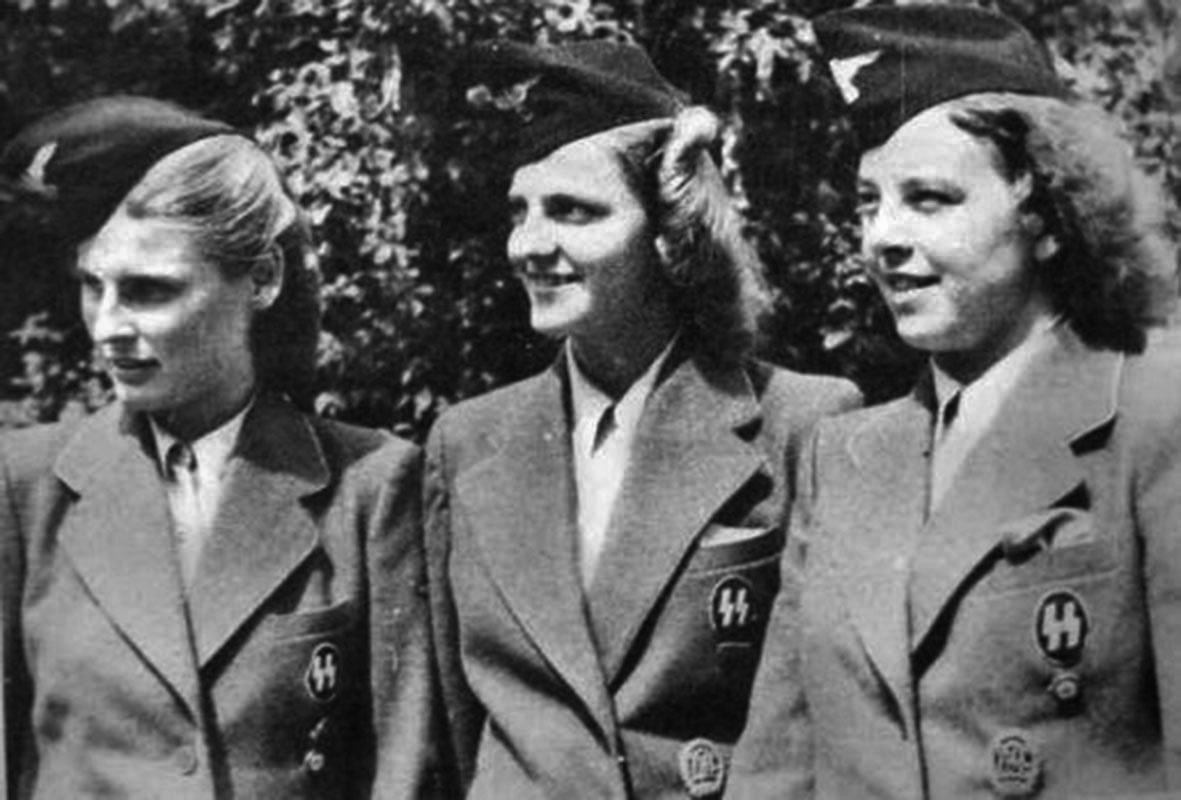
The SS was formally a male organization, but thousands of women served within the wider camp apparatus as female guards, or Aufseherinnen. They were generally employed through the SS auxiliary system and were assigned primarily to supervise female prisoners.
Many came from ordinary backgrounds.
Before joining the camp system, they had worked as shop assistants, factory workers, farm laborers, domestic servants, or nurses. They were not all lifelong political leaders or members of Germany’s social elite. Some responded to recruitment advertisements promising wages, accommodation, uniforms, and greater authority than they could expect elsewhere.
Their ordinary backgrounds later created a disturbing question.
How did apparently ordinary people become willing participants in extraordinary cruelty?
Many female guards received training at Ravensbrück, the principal Nazi concentration camp for women. There they learned the routines of roll calls, work details, searches, punishments, and prisoner control.
They also learned the social order of the camps.
A guard possessed food, clean clothing, physical safety, and the authority to command.
A prisoner could be struck for moving too slowly, speaking at the wrong moment, leaving a line, or attempting to obtain food.
The imbalance of power was nearly absolute.
Within that environment, cruelty did not always require a direct order from Berlin. It could emerge through daily decisions: withholding food, extending roll calls, beating a weakened prisoner, assigning impossible labor, reporting someone for punishment, or participating in selections that separated those temporarily useful to the camp from those marked for death.
At Bergen-Belsen and Auschwitz, survivors described female guards who beat prisoners, used dogs to terrorize them, and participated in violent punishments and selections. The surviving testimony made it impossible to preserve the comforting fiction that women had existed only as passive observers within the Nazi system.
Three defendants would come to represent different forms of that participation.
Irma Grese became associated with visible, personal violence.
Elisabeth Volkenrath represented administrative authority.
Johanna Bormann became notorious for aggression and the use of dogs against prisoners.
Their individual histories were different.
Their destination would be the same.
The first Bergen-Belsen trial
The British authorities moved rapidly.
The official proceeding became known as the trial of Josef Kramer and 44 others. It opened in Lüneburg on September 17, 1945, only five months after the camp’s liberation.
The defendants included former SS personnel and prisoner functionaries associated with Bergen-Belsen, Auschwitz, or both. Sixteen of the defendants were women. One accused man became too ill to continue, but the case remained one of the largest and most closely watched early war-crimes trials conducted after the Second World War.
This was before the major Nuremberg Trial had begun.
The legal vocabulary of the postwar world was still developing. The British military court prosecuted the defendants for violations of the laws and usages of war, focusing on the mistreatment and deaths of Allied nationals held in the camps.
The prosecution presented documentary material, photographs, film, and survivor testimony.
For many observers, the witnesses were the center of the case.
They described beatings administered to prisoners already weakened by hunger.
They described guards who punished people for attempting to obtain food.
They described selections at Auschwitz, where a gesture or a name placed on a list could send a prisoner toward death.
They described individual killings.
They pointed across the courtroom and identified the people they said had tormented them.
During testimony against Irma Grese, one former prisoner became so distressed that she had to be removed from the courtroom. Another witness described two female prisoners attempting to escape after being selected for the gas chamber and accused Grese of shooting them.
The defendants did not all respond in the same way.
Some denied the accusations entirely.
Some disputed particular incidents.
Some claimed witnesses had confused them with other guards.
Others argued that they had merely obeyed orders or fulfilled duties expected of them.
But “duty” could not explain every kick, every beating, every dog attack, or every act of humiliation described by the witnesses.
The court also refused to treat womanhood as an automatic defense.
The female guards had possessed authority. They had worn uniforms, issued commands, imposed punishments, and controlled vulnerable prisoners. The question was not whether a woman could theoretically commit such acts.
The question was whether these women had committed them.
After two months of proceedings, the court delivered its judgments in November 1945.
Eleven defendants were sentenced to death. Fourteen were acquitted. The remaining defendants received prison terms ranging from one to fifteen years, many of which were later reduced.
Among those condemned were three women.
Elisabeth Volkenrath.
Irma Grese.
Johanna Bormann.
Irma Grese: the face the newspapers remembered
Irma Grese was only 22 when she was executed.
Her age and appearance made her the most sensationalized female defendant at the trial. The press attached labels to her that combined fascination with horror, presenting her as a young, physically attractive woman whose appearance seemed incompatible with the crimes described in court.
That contrast helped turn Grese into a symbol.
It also risked distracting from the substance of the case.
Born in 1923, Grese had worked briefly in agriculture and in a hospital setting before entering the camp system. She trained at Ravensbrück and later served at Auschwitz-Birkenau, where she rose to a position of considerable responsibility despite her youth.
At Auschwitz, survivors accused her of carrying a whip, beating prisoners, using or threatening prisoners with dogs, shooting inmates, and participating in selections.
She arrived at Bergen-Belsen in March 1945, during the camp’s final and most catastrophic period.
In the courtroom, Grese did not resemble the raging figure many newspaper readers expected. Photographs showed a young woman seated among the other defendants, wearing a numbered placard and listening through the proceedings.
But the quiet courtroom image did not erase the testimony.
Witness after witness described a guard who had used her authority deliberately and violently.
Grese denied many of the specific accusations, although she admitted carrying a whip and acknowledged participation in aspects of the selection process. The court found her guilty.
When the death sentence was announced, the consequences extended beyond Grese herself. An Imperial War Museums photograph records her sister Helena being assisted from the courtroom after hearing that Irma would be hanged.
There was no victory in that image.
Only the collision of private grief with public accountability.
Grese’s youth did not save her.
Neither did the cultural expectation that women were naturally less violent, less responsible, or less capable of cruelty.
The court had heard what she had done with power.
That was what condemned her.
Elisabeth Volkenrath: authority without spectacle
Elisabeth Volkenrath attracted less sensational attention than Grese, but her position carried greater formal responsibility.
Born in 1919, Volkenrath served at Ravensbrück and Auschwitz before arriving at Bergen-Belsen. She eventually held the role of senior female guard.
Her power was organizational.
She supervised other guards. She helped administer the women’s camp. At Auschwitz, she was accused of participating in selections. At Bergen-Belsen, she occupied a position within the hierarchy responsible for a population descending into hunger, disease, and death.
Volkenrath’s case demonstrated that participation in mass violence did not always appear as uncontrolled rage.
Sometimes it appeared as administration.
A roster.
A punishment report.
An order passed down a chain of command.
A selection conducted efficiently.
A system of abuse depended not only on spectacular acts of violence but also on people capable of making brutality routine.
Survivors described Volkenrath as harsh and cruel. The court rejected the idea that her supervisory position separated her from the suffering beneath her authority.
She was convicted and sentenced to death.
An Imperial War Museums record identifies her as the head wardress of the camp and confirms that she was hanged on December 13, 1945.
Johanna Bormann: the guard remembered with dogs
Johanna Bormann was born in 1893, making her roughly three decades older than Grese.
Before entering the camp system, she had worked as a domestic servant. She began serving as a guard in the late 1930s and held posts at several camps, including Ravensbrück and Auschwitz, before reaching Bergen-Belsen.
Survivors remembered her in connection with dogs.
In the camps, an animal under the control of a guard could become an extension of the guard’s authority. The sight of a dog straining at a leash could force exhausted prisoners to move faster before a command was even given.
Witnesses accused Bormann of setting dogs on prisoners and participating in beatings and abuse.
Bormann denied the most serious allegations. Like other defendants, she attempted to reduce her personal responsibility by presenting herself as a subordinate employee within a much larger organization.
But the witnesses did not describe an invisible bureaucrat.
They described a woman they had seen.
They remembered where she stood, what she carried, how she treated prisoners, and what happened when she approached.
The court found their evidence sufficient.
Bormann was sentenced to death alongside Volkenrath and Grese.
The morning at Hamelin Prison
The condemned were transferred to Hamelin Prison, a fortress-like institution near the Weser River.
Albert Pierrepoint, Britain’s best-known executioner, was assigned to carry out the sentences. A surviving note written by Pierrepoint records the eleven Belsen defendants executed on December 13, along with two other condemned men executed in connection with a separate case.
The executions occurred in sequence behind the prison walls.
The three women were executed individually.
Later accounts have attached dramatic details to their final moments, particularly Grese’s reported use of the German word “Schnell”—“quickly.” The story is often repeated, but versions differ over when she supposedly said it and under what circumstances. It should therefore be treated as a reported recollection rather than an independently established final declaration.
What is certain is less theatrical.
The prison staff prepared the chamber.
The condemned were brought from their cells.
Their identities were confirmed.
The warrants were carried out.
Volkenrath, Grese, and Bormann died by hanging on December 13, 1945. All eleven defendants sentenced to death in the first Belsen trial were executed that day.
There was no cheering crowd beneath the gallows.
No public platform.
No prisoners brought in to watch.
The legal meaning of the event did not depend on spectacle.
The power reversal had already occurred.
Months earlier, the women had controlled prisoners who possessed almost no protection from them.
Now the former guards stood inside a prison governed by procedures they could not command.
At Bergen-Belsen, they had helped decide who was punished, who worked, who ate, and sometimes who lived long enough to see another morning.
At Hamelin, they could no longer give orders.
What the executions meant—and what they could not repair
For many survivors, the trial provided something the camp had denied them: a formal setting in which their words carried authority.
Inside the camps, a prisoner’s testimony meant nothing.
A guard could deny a beating.
An administrator could alter a record.
A dead prisoner could not contradict anyone.
At Lüneburg, survivors spoke under oath while former guards were required to listen.
The proceedings could not restore murdered families.
They could not return years of stolen life.
They could not undo starvation, forced labor, medical neglect, humiliation, or fear.
But they established an official record.
The defendants were not convicted because they were unpopular, because they were women, or because the public demanded revenge. They were tried through a military legal process in which evidence was presented, witnesses were questioned, defenses were heard, and fourteen defendants were ultimately acquitted.
The acquittals mattered.
They demonstrated that the court was capable of distinguishing between accusation and proven responsibility.
The convictions mattered for the same reason.
The trial also forced postwar society to confront a reality that many found deeply uncomfortable: participation in Nazi persecution was not exclusively male.
Women had served as perpetrators, supervisors, informers, clerical workers, medical personnel, and guards. They could operate within violent institutions, benefit from hierarchy, and exercise cruelty over those placed beneath them.
That recognition did not mean that all female guards behaved identically or that every woman employed within the Nazi system bore equal guilt.
It meant that gender could not erase individual responsibility.
The executions also revealed the limits of postwar justice.
Only a fraction of those who served in the concentration-camp system were ever prosecuted. Many received prison sentences rather than death. Some sentences were reduced. Others returned to ordinary life after relatively short periods in custody. Countless victims never saw the people who had abused them brought before any court.
Even the conviction of eleven defendants could not account for the tens of thousands who died at Bergen-Belsen.
Justice after mass atrocity is always incomplete.
The number of offenders is too large.
The dead cannot testify.
Documents have been destroyed.
Witnesses are scattered, traumatized, or missing.
Governments become impatient.
Political priorities change.
Yet incompleteness does not make accountability meaningless.
The first Bergen-Belsen trial placed individual human beings behind the machinery of the camp. It rejected the idea that a uniform, a superior’s command, or a bureaucratic title could transform deliberate cruelty into innocent employment.
That is why the lasting image should not be the gallows.
It should be the courtroom.
Former prisoners sat before military judges and described what had happened to them.
Across the room, the people who had once held nearly unlimited power were numbered, guarded, and required to answer.
For years, the camp system had depended on silence—on the belief that prisoners could be degraded, dispersed, and killed without anyone being forced to account for it.
At Lüneburg, that silence broke.
And when Elisabeth Volkenrath, Irma Grese, and Johanna Bormann were led from their cells on December 13, 1945, they faced the consequence of a principle the concentration camps had tried to destroy:
Power may delay the truth, bury its victims, and terrify its witnesses—but once the witnesses are finally heard, even those who believed themselves untouchable can be made to answer.