The waiter looked at the man sitting at the VIP table and immediately made a judgment.
Not because he was rude.
Not because he caused trouble.
But because he ordered only tea.
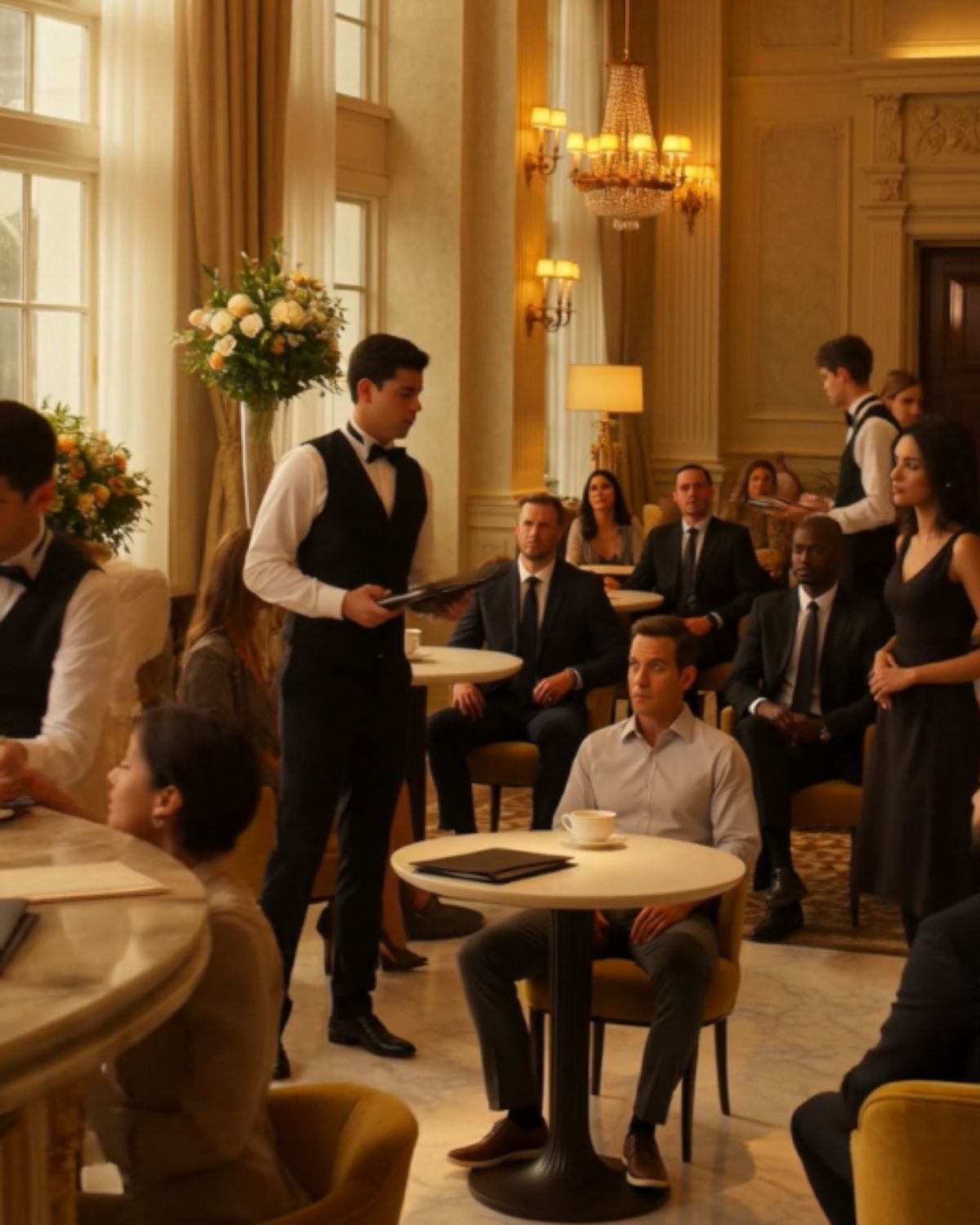
In a luxury hotel lounge filled with business executives, wealthy travelers, and guests celebrating expensive occasions, one quiet man sat alone beside the window with a simple jacket, worn leather shoes, and a small notebook placed neatly beside his chair.
He did not ask for champagne.
He did not order a meal.
He did not mention his name.
He only looked around the room and said:
“May I have a cup of tea, please?”
The waiter smiled politely.
But the smile did not reach his eyes.
“Of course, sir.”
A few minutes later, the tea arrived on a silver tray.
The waiter placed the cup carefully on the marble table.
“Will that be all, sir?”
The man looked up.
“Yes.”
He lifted the cup slightly.
“Tea is enough.”
The waiter paused.
For a second, he looked toward the empty chair across from the man.
Then toward the crowded lounge.
The VIP seating area was usually reserved for guests ordering premium drinks, business meetings, or private celebrations.
A single cup of tea did not seem to belong there.
“Very well, sir.”
The waiter walked away.
The man continued drinking quietly.
His name was Thomas Reed.
He was fifty-eight years old.
Unlike the wealthy guests around him, Thomas did not dress to attract attention.
He wore a dark gray jacket that had been repaired at the sleeve, simple trousers, and an old watch with a scratched face.
He carried no designer bag.
No expensive jewelry.
No assistant followed behind him.
To anyone watching, he looked like someone who had accidentally chosen the wrong table.
But Thomas was not there to impress anyone.
He was there to observe.
For the past six months, he had been negotiating the purchase of the Beaumont Crown Hotel, one of the most prestigious properties in the city.
The final ownership documents were scheduled to be completed that afternoon.
Before signing, Thomas wanted to see the hotel himself.
Not the advertisements.
Not the financial reports.
Not the polished presentations prepared by executives.
He wanted to see how ordinary people were treated when no one knew who they were.
For thirty years, Thomas had invested in real estate.
He had purchased small apartment buildings, renovated old commercial spaces, and rebuilt struggling properties.
He believed a building was never just walls and furniture.
It was the people inside who determined its value.
That was why he came alone.
No introduction.
No announcement.
No special treatment.
Just a cup of tea.
At the bar near the lounge entrance, two employees watched him.
One was a young waiter named Kevin.
The other was a hostess named Rachel.
Kevin glanced toward Thomas’s table.
“He has been sitting there almost twenty minutes.”
Rachel looked over.
“He only ordered tea.”
Kevin lowered his voice.
“That table usually has executives spending hundreds.”
Rachel shrugged.
“Maybe he doesn’t know.”
Kevin smiled.
“Someone should tell him.”
Near the reception desk, the lounge manager, Michael Grant, noticed the same thing.
Michael had worked at the hotel for eleven years.
He prided himself on understanding guests quickly.
He knew who expected privacy.
Who wanted attention.
Who might complain.
Who might leave a large tip.
And in his mind, Thomas belonged in none of those categories.
Michael walked toward the table.
“Good afternoon, sir.”
Thomas looked up.
“Good afternoon.”
Michael forced a professional smile.
“I hope everything is comfortable.”
“It is.”
“The tea is satisfactory?”
“Yes. Very good.”
Michael nodded.
“I’m glad.”
A pause followed.
Thomas waited.
Michael glanced around the lounge.
“May I ask if you are meeting someone?”
“No.”
“Will someone be joining you later?”
“No.”
Michael looked toward the empty chair.
Then back at Thomas.
“Sir, I hope you understand that this section is generally reserved for premium guests.”
Thomas looked around.
The lounge was elegant.
Quiet.
Comfortable.
“I understand.”
“We have regular seating available near the lobby.”
Thomas looked at his tea.
“I’ll only be a few more minutes.”
Michael’s expression remained polite.
But his tone changed.
“I understand, sir. However, this area is intended for guests using our premium services.”
Thomas studied him.
“I ordered tea.”
“Yes, sir.”
“And I paid for it.”
“Yes.”
Michael lowered his voice.
“We simply want to ensure all guests have the experience they expect.”
Thomas understood what he was really saying.
He was not being asked to move because of the tea.
He was being asked to move because of the person drinking it.
“I see,” Thomas said.
Nearby guests began noticing the conversation.
A businessman lowered his newspaper.
A couple near the window stopped talking.
The pianist continued playing softly, but the atmosphere had changed.
Thomas picked up his cup.
“I can move if necessary.”
Before he could stand, the main lobby doors opened.
A man in a navy suit entered carrying a large leather folder.
He immediately looked across the lounge.
“Mr. Reed?”
The room became quiet.
Thomas turned.
“Yes, Daniel.”
The man walked quickly toward him.
His name was Daniel Foster.
He was the attorney handling the hotel acquisition.
He placed the leather folder on the table.
“I apologize for being late. The final documents required one more review.”
Thomas nodded.
“No problem.”
Daniel opened the folder.
Several pages of legal documents were visible.
At the top of the first page was the name:
BEAUMONT CROWN HOTEL PROPERTY TRANSFER AGREEMENT
Michael, standing a few steps away, noticed the title.
His expression changed.
Daniel continued.
“The transfer documents are ready for your signature.”
The lounge went completely silent.
Kevin, the waiter, looked from Daniel to Thomas.
Then back to the documents.
Rachel stopped arranging glasses.
Michael remained frozen.
Daniel smiled.
“Congratulations, Mr. Reed. Once you sign, you will officially become the owner of this building.”
No one spoke.
The man who had been asked to leave the VIP area was the person about to own the entire hotel.
But Thomas did not look pleased.
He did not look angry.
He simply closed his notebook.
Michael slowly stepped forward.
“Mr. Reed…”
Thomas looked at him.
The manager struggled to find words.
“I wasn’t aware.”
Thomas nodded.
“I know.”
“I apologize if there was any misunderstanding.”
“There wasn’t.”
Michael became quiet.
Thomas looked around the lounge.
At the guests.
The employees.
The table where he had been sitting alone.
“I came here today because I wanted to see this place before signing.”
Daniel looked at him.
Thomas continued.
“Not the rooms. Not the financial statements. Not the marketing.”
He touched the tea cup.
“I wanted to see how people were treated when nobody knew their name.”
The words were calm.
That made them heavier.
Michael lowered his eyes.
Thomas continued.
“A hotel can have expensive furniture, beautiful lighting, and five-star decorations.”
He looked toward the entrance.
“But hospitality is measured by how you treat the person who cannot give you anything in return.”
Kevin looked uncomfortable.
He remembered the way he had judged the order.
Rachel looked down.
Michael swallowed.
“Mr. Reed, I sincerely apologize.”
Thomas studied him.
“For what?”
Michael hesitated.
“For assuming.”
Thomas nodded slightly.
“That is usually where poor service begins.”
The manager lowered his head.
“I understand.”
Thomas did not continue criticizing him.
He simply turned back toward the documents.
Daniel placed the signature pen beside the agreement.
Thomas picked it up.
For a moment, the entire lounge watched.
The same employees who had questioned why he occupied a VIP table now watched him sign papers that changed the future of the entire building.
The pen moved across the page.
Thomas Reed.
The new owner of the Beaumont Crown Hotel.
The room remained silent.
Then Thomas closed the folder.
Daniel shook his hand.
“Congratulations.”
Thomas looked around once more.
“I hope this hotel becomes known for something more important than luxury.”
Daniel smiled.
“What is that?”
Thomas looked toward the staff.
“Respect.”
Later that afternoon, Michael gathered the lounge team.
There was no dramatic punishment.
No public humiliation.
Instead, Thomas asked for something simpler.
Training.
A reminder.
A new standard.
Every employee would be taught that guests could not be measured by clothing, orders, or appearances.
Because the quiet man drinking tea had not been poor.
But even if he had been, he would have deserved the same kindness.
Months later, a small sign appeared in the hotel staff area.
It contained only one sentence.
Every guest has a story you do not know. Treat them accordingly.
Many employees believed it came from the new owner.
Thomas never confirmed it.
He continued visiting the hotel quietly.
Sometimes he ordered dinner.
Sometimes coffee.
Sometimes just tea.
And every time he entered the lounge, the staff greeted him warmly.
Not because he owned the building.
But because they had finally learned the lesson he came there to teach.
The greatest test of character is not how people treat those who can reward them.
It is how they treat those they believe cannot.