Chapter 1 — The Girl Who Walked Into the Camp
Hamelin, Germany
December 1945
The courtroom was silent.
Not the silence of respect.
The silence of people waiting for judgment.
Outside, the winter air was cold. Inside the courtroom, survivors sat shoulder to shoulder, carrying memories that no prison wall could contain.
They had waited months.
Some had waited years.
For many, simply seeing the people responsible sitting before them was almost impossible to believe.
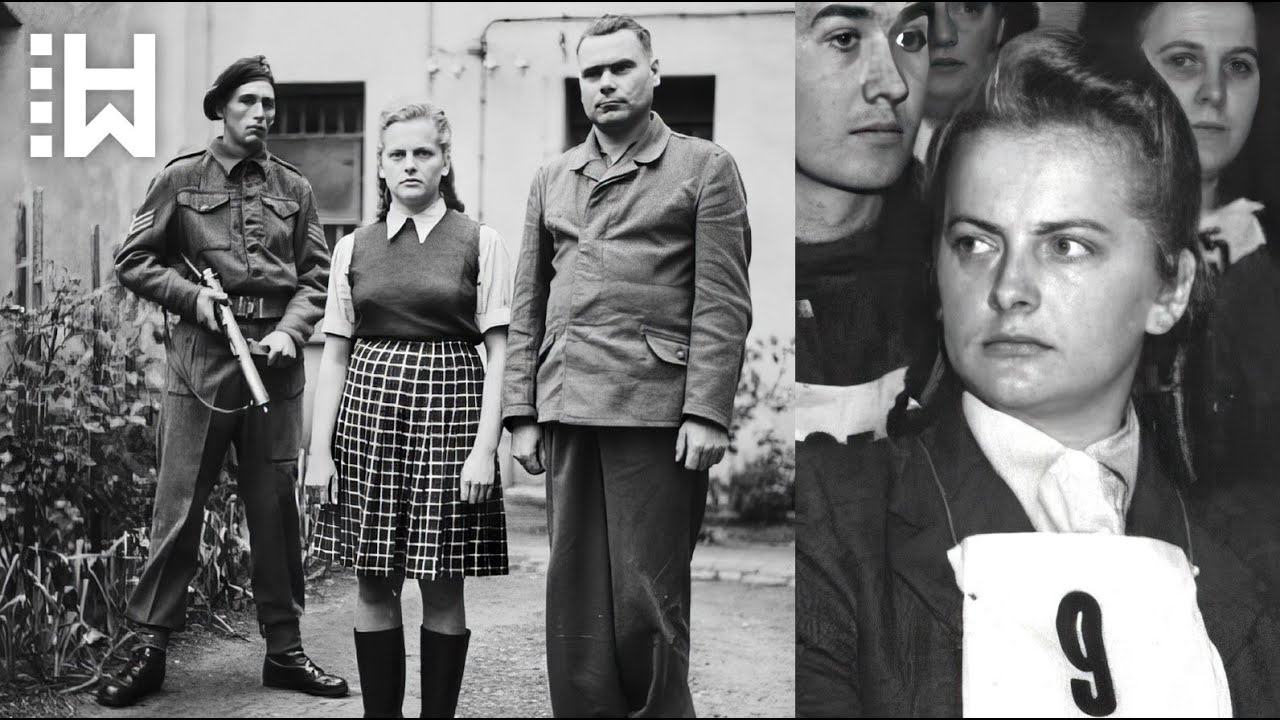
Among the accused was a young woman.
She looked younger than many expected.
Twenty-two years old.
Blonde hair.
Calm expression.
A face that seemed strangely ordinary.
Her name was Irma Grese.
To some outside the courtroom, she was simply a young German woman.
To the survivors who stood before her, she represented something far darker.
A person who had worn the uniform of the SS inside some of the most notorious concentration camps of Nazi Germany.
A woman whose name had become associated with fear.
Auschwitz.
Bergen-Belsen.
The words alone carried memories of hunger, disease, violence, and death.
And now she sat only a few meters away.
Listening.
Watching.
Waiting.
The prosecutor placed documents on the table.
The sound was quiet.
Almost insignificant.
But in that room, every movement mattered.
Every piece of evidence carried the weight of thousands of voices that would never speak again.
The trial was not only about one person.
It was about a system.
A system that had transformed ordinary locations into places of suffering.
A system where uniforms, ranks, and orders became excuses for unimaginable cruelty.
And at the center of this trial was a question that would follow Irma Grese forever:
Was she only a product of the system she served?
Or did she choose the role she played within it?
Before the Uniform
Years earlier, before the camps, before the accusations, Irma Grese was not born into power.
She was born in Germany in 1923.
Her childhood was marked by instability.
Her family life was troubled.
At thirteen years old, she experienced a devastating loss when her mother died by suicide.
For a young teenager, the event left a deep wound.
The world around her became uncertain.
The family structure that should have provided security had already broken apart.
Like many young people growing up in difficult circumstances, she searched for belonging.
And Nazi Germany offered exactly that.
The Nazi state understood something important.
Young people were not only citizens.
They were the future.
Through organizations, propaganda, and social pressure, the regime created an environment where loyalty to Hitler and the Nazi worldview was presented as a path toward purpose.
For someone searching for identity, the promise of belonging could be powerful.
A uniform.
A community.
A role.
A place.
At fifteen, Irma left school.
She worked various jobs, including at a farm and later in nursing-related training.
But Germany was changing rapidly.
The war had transformed society.
Military service and state organizations became central parts of life.
For many young Germans, the Nazi system was not something separate from daily existence.
It surrounded them.
Ravensbrück: The First Step Into the Camp System
In 1942, Irma Grese volunteered for work at the Ravensbrück concentration camp.
She was nineteen years old.
The camp was primarily built for female prisoners.
Inside its walls were women from many backgrounds:
Political opponents.
Resistance members.
Religious minorities.
Those persecuted by Nazi racial policies.
Women who had been stripped of freedom and dignity by a government that defined certain lives as worthless.
At Ravensbrück, Irma entered a world built around control.
Guards learned routines.
Commands.
Punishments.
The distance between authority and cruelty became dangerously small.
The concentration camp system depended on people willing to enforce its rules.
Some prisoners later described guards who appeared to enjoy their power.
Others described guards who followed orders mechanically.
The system created an environment where brutality could become normalized.
Irma was young.
But within that environment, she began adopting the behavior expected of an SS guard.
She received training.
She learned discipline.
She learned the hierarchy.
And she entered a structure where compassion was treated as weakness.
Auschwitz
In 1943, Irma Grese was transferred to Auschwitz-Birkenau.
The name itself became one of the most infamous symbols of the Holocaust.
A vast complex of camps where more than a million people were murdered, primarily Jews, along with other victims of Nazi persecution.
When Irma arrived, Auschwitz was already operating as a machine of mass imprisonment and murder.
The camp was divided into different sections.
Barbed wire separated prisoners from the outside world.
Watchtowers overlooked the compounds.
The air carried smoke from crematoria.
The daily routine was designed to break people physically and mentally.
Hunger.
Exhaustion.
Fear.
Uncertainty.
Every day became a struggle to survive.
Irma rose through the ranks.
By 1944, she had become one of the highest-ranking female guards at Auschwitz.
Her position gave her authority over prisoners.
With authority came responsibility.
And with responsibility came accountability.
Survivors later described her as a figure of terror.
They accused her of participating in beatings and selecting prisoners for forced labor or death.
They described intimidation, violence, and the use of trained dogs to control and frighten inmates.
Her reputation earned her infamous nicknames after the war:
“The Hyena of Auschwitz.”
“The Beautiful Beast.”
The contrast between appearance and actions became part of the horror associated with her name.
The Human Face of a Criminal System
History often creates a dangerous illusion.
People imagine evil as something obvious.
Something that looks different.
Something easy to recognize.
But the reality of the Nazi concentration camp system was more disturbing.
Many perpetrators were not monsters from another world.
They were people who made choices inside a system that rewarded cruelty.
They had ordinary backgrounds.
Families.
Personal histories.
Fears.
Ambitions.
That does not remove responsibility.
But it forces a harder question:
How do ordinary people become capable of extraordinary cruelty?
Irma Grese was not the architect of Nazi genocide.
She did not create the concentration camp system.
But she chose to participate in it.
And the evidence presented after the war would focus on those choices.
The Final Months of the War
As Germany began collapsing in 1945, the concentration camp system entered its final, catastrophic phase.
Resources disappeared.
Food became scarce.
Disease spread.
The Nazi regime attempted to hide evidence of its crimes while evacuating prisoners from camps threatened by Allied forces.
Irma Grese was eventually transferred to Bergen-Belsen.
There, the conditions became even more desperate.
Bergen-Belsen was not originally designed as an extermination camp like Auschwitz.
But by 1945, overcrowding, starvation, and disease created a humanitarian disaster.
Thousands died.
The camp became a symbol of the Nazi regime’s collapse and the suffering it had created.
When British forces liberated Bergen-Belsen in April 1945, they encountered scenes that shocked even experienced soldiers.
Bodies.
Disease.
Starving survivors.
A camp where death had become part of everyday existence.
Among those captured was Irma Grese.
The young woman who had entered the camp system as a teenager was now a prisoner herself.
But unlike the thousands who had suffered under her authority…
she would receive something they never received.
A trial.
The world wanted answers.
The survivors wanted justice.
And Irma Grese was about to discover that the system she served could no longer protect her.
To be continued — Chapter 2: The Bergen-Belsen Trial and the Witnesses Who Spoke


