When the guns of World War II finally went silent, many men who had committed terrible crimes disappeared into the chaos of defeat.

Some escaped.
Some hid behind false names.
Some tried to convince the world they had only been following orders.
But Oskar Dirlewanger met a different fate.
The man who had commanded one of the most feared and brutal units of Nazi Germany was eventually found hiding like a common criminal. The power that had protected him was gone. The uniform that had terrified thousands no longer meant anything.
And the people who recognized him remembered exactly who he was.
For years, Dirlewanger had been more than a soldier.
He had become a symbol of what happens when a government turns hatred into policy and gives violent men permission to act without limits.
His story was not simply about one cruel individual.
It was about how an extremist system could take criminals, fanatics, and violent opportunists — and transform them into instruments of terror.
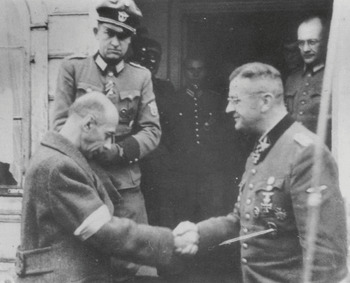
In the late 1930s and early 1940s, Nazi Germany was building a state designed around war and racial ideology.
Under Adolf Hitler and Heinrich Himmler, violence was not a failure of the system.
It was part of the system.
The SS expanded from a political organization into a massive military and security machine. As Germany invaded Eastern Europe, Nazi leaders faced growing resistance movements, especially from partisan fighters operating in forests and rural areas.
Himmler believed these resistance groups had to be destroyed with absolute brutality.
The solution was a strange and horrifying experiment.
Instead of creating a normal military unit, Nazi authorities approved the formation of a special unit made initially from convicted poachers.
The idea was simple: men who had spent years hunting illegally in forests possessed valuable skills. They understood tracking, camouflage, and shooting.
But the experiment quickly became something far darker.
The unit that began with poachers soon expanded to include convicted criminals and men with violent backgrounds. Murderers, abusers, and repeat offenders were brought into its ranks.
Instead of being rehabilitated, they were given weapons.
Instead of being punished, they were given authority.
The result was the creation of one of the most notorious formations of the Second World War:
The Dirlewanger Brigade.
And at the center of it stood a man whose own history was already filled with warning signs.
Oskar Dirlewanger was born in 1895 in Würzburg, Germany.
Like many men of his generation, he was shaped by the First World War. He served in the German army, fought on the Western Front, and was wounded multiple times.
He received military decorations and ended the war as an officer.
To outsiders, his early life could have looked like the story of a decorated veteran.
But beneath that image was a deeply unstable personality.
After the war, Dirlewanger struggled to adapt to civilian life. He became involved with extremist politics and joined the Nazi Party and the SA in 1923.
His loyalty to the movement was not based only on ideology.
It was also a path back to power.
But even within the Nazi movement, Dirlewanger’s behavior became too extreme.
He was convicted of serious sexual crimes, including the abuse of a 13-year-old girl. The scandal damaged his reputation, cost him his academic position, and resulted in imprisonment.
For a normal society, such crimes would have ended any possibility of public authority.
But Nazi Germany was not a normal society.
A system built on racial hatred and political violence had room for men like Dirlewanger.
The same ideology that claimed to defend “order” created opportunities for some of the most dangerous people to rise.

After his release, Dirlewanger did not disappear.
Instead, war gave him another opportunity.
Between 1936 and 1939, he fought with the German-supported Condor Legion during the Spanish Civil War, where Nazi Germany tested military tactics while supporting Francisco Franco’s forces.
His wartime service helped restore his reputation among Nazi officials.
His past crimes became less important than his usefulness.
The regime even helped restore his academic title.
It was a powerful example of Nazi hypocrisy: a man considered unacceptable in ordinary society could become valuable once he served the goals of the dictatorship.
When World War II began, Dirlewanger found his way into the SS.
In 1940, he was placed in command of the special unit that would carry his name.
At first, the unit consisted mainly of poachers.
But soon, its character changed completely.
More criminals were added.
Discipline collapsed.
Violence became normal.
The unit was no longer simply fighting armed opponents.
It became a tool for terror against civilians.
Nazi leaders knew exactly what kind of men they were empowering.
Himmler and other senior officials were aware of the brutality surrounding Dirlewanger’s unit. But because the unit was considered useful in the campaign against resistance movements and populations targeted by Nazi racial policies, they continued to protect it.
The message was clear:
Cruelty was not a mistake.
Cruelty was rewarded when it served the regime.
The Dirlewanger Brigade was first deployed in occupied Poland.
There, its reputation for brutality grew quickly.
The unit was involved in operations against Jewish communities and resistance movements, leaving behind a trail of murder, torture, and destruction.
At places such as Stary Dzików and other occupied areas, prisoners and civilians were subjected to horrific treatment.
Survivors described a unit where violence was not merely a method.
It was part of the culture.
The men under Dirlewanger’s command were not restrained by normal military rules. They operated in an environment where terror itself became the objective.
Later, the unit was sent to Belarus, where Nazi forces were fighting Soviet partisans.
The result was devastating.
Thousands of civilians were killed during anti-partisan operations.
Entire villages were destroyed.
People were executed simply because they were suspected of helping resistance fighters or because Nazi forces considered them expendable.
The pattern repeated again and again:
A resistance movement would appear.
The Nazis would declare an area hostile.
The Dirlewanger Brigade would arrive.
And civilians would pay the price.
The victims were not treated as individuals.
They were treated as obstacles.
That was the true horror of the unit: the transformation of ordinary people into targets through Nazi ideology.
But the darkest chapter of Dirlewanger’s career came in Warsaw.
On August 1, 1944, the Warsaw Uprising began.
Polish resistance fighters attempted to liberate the city from German occupation before Soviet forces arrived.
The Nazi response was brutal.
Hitler ordered the uprising to be crushed with extreme force.
Dirlewanger’s unit was sent into the city.
What followed became one of the most infamous massacres of World War II.
In the Wola district of Warsaw, German forces murdered tens of thousands of Polish civilians.
Dirlewanger’s men participated in the atrocities.
Hospitals were attacked.
Civilians were killed.
Buildings were destroyed.
The distinction between fighter and non-combatant disappeared.
The streets became places of execution.
The uprising lasted 63 days before finally being defeated.
More than 100,000 civilians were killed during the fighting and its aftermath, and Warsaw itself was deliberately destroyed by the German occupiers.
For Dirlewanger, however, there was no punishment.
There was recognition.
Instead of being removed for his crimes, he was rewarded.
He received the Knight’s Cross of the Iron Cross, one of Nazi Germany’s highest military decorations.
It was one of the most disturbing examples of the regime’s values:
The more ruthless a man became, the more valuable he could be considered.
After Warsaw, the Dirlewanger Brigade continued its operations.
It helped suppress the Slovak National Uprising in late 1944 and fought as Soviet forces advanced toward Germany.
But by this point, the Nazi war machine was collapsing.
The empire that had once protected men like Dirlewanger was falling apart.
The same system that had elevated him could no longer save him.
In the final months of the war, soldiers deserted, commands broke down, and Nazi officials fled.
The powerful men who had once given orders were now trying to escape responsibility.
Dirlewanger was no longer a feared commander.
He was a hunted man.
In June 1945, shortly after Germany’s defeat, Dirlewanger was captured while hiding under a false identity.
The exact details of his final days remain debated, but one thing is certain:
The man who had spent years using violence as a weapon died without the protection of the regime that created him.
He was taken into custody and died on June 7, 1945.
Official records attributed his death to natural causes.
However, accounts from the period describe him being recognized by former prisoners and beaten by those who knew his crimes.
Whether every detail can be confirmed or not, the symbolism of his end remained powerful.
A man who had built his life around terror ended his life powerless.
No army protected him.
No political movement defended him.
No crowd mourned him.
The name Oskar Dirlewanger became remembered not as the name of a great commander, but as a warning.
His story shows how dangerous it becomes when a government rewards hatred, removes accountability, and gives violent people authority.
Dirlewanger was not created in a vacuum.
He was enabled by a system that valued cruelty over humanity.
And when that system collapsed, the man who had brought suffering to thousands was left with nothing except the consequences of what he had done.
History remembers many people for the power they held.
But some are remembered for something far more important:
The damage they caused — and the price they eventually paid.