Chapter One
The Dog Beneath Table Seven
The coffee cup shattered three seconds before Everett Sloan fired me.
White ceramic struck the black tile beside Table Seven and broke into pieces beneath the boots of a man old enough to remember wars most people had reduced to documentaries.
The sound was sharp.
Too sharp.
The veteran flinched as if the cup had exploded.
His shoulders rose. His breath stopped. One hand shot toward a pocket that contained no weapon, only a folded handkerchief and a tarnished challenge coin.
Under the table, his service dog moved instantly.
A large black Labrador pressed against the man’s knees, head lifted, eyes fixed on his face. The dog nudged his trembling hand, then leaned its full weight against his shins.
The old man whispered something I couldn’t hear.
The café went quiet around him.
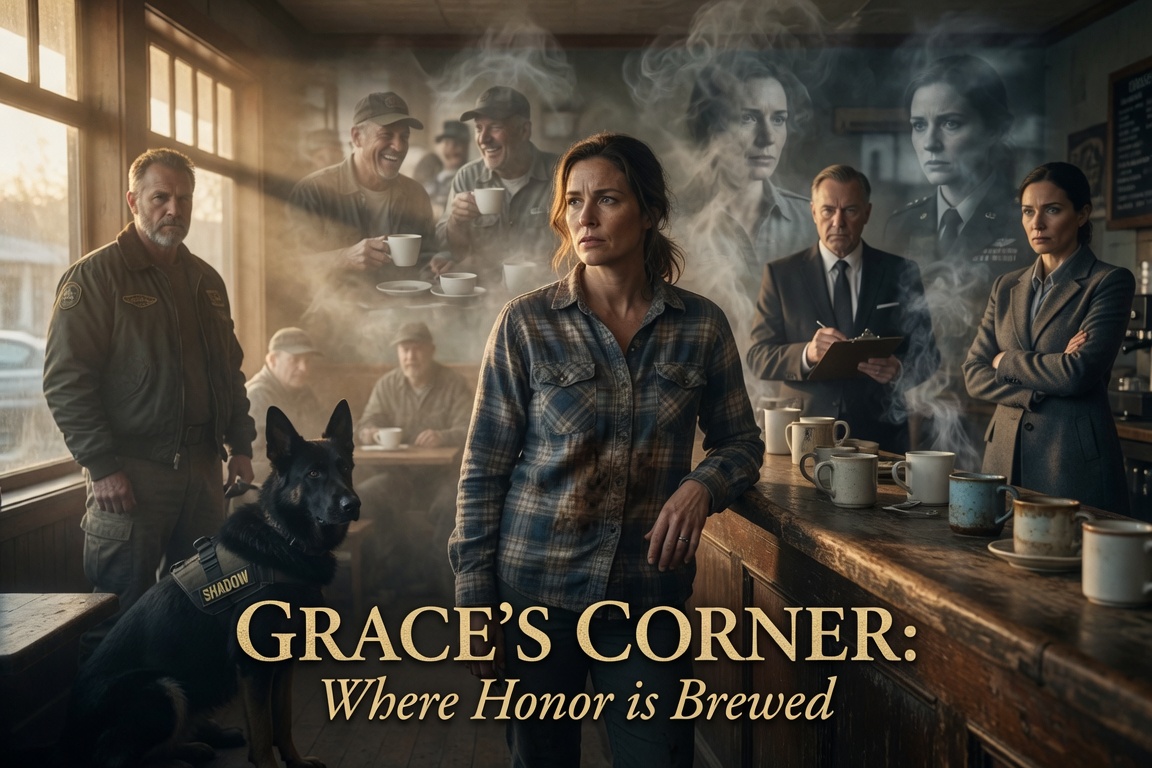
Anchor & Ash usually smelled of dark roast, cinnamon, and butter warmed on cast iron. That morning, rain had blown in from the Atlantic, carrying salt through every opening of the old brick building. Wet coats crowded the hooks near the door. A jazz record played softly over ceiling speakers. Beyond the fogged windows, the harbor lay beneath a lid of gray cloud.
At the center of the room, a woman in a cream-colored suit stood with coffee splashed across one expensive shoe.
“That animal startled me.”
Her voice carried toward every table.
The dog had not moved toward her.
He hadn’t barked.
He had simply risen when she stepped too close to his handler.
“I’m terribly sorry,” I said.
I crouched beside the broken cup, not the dog.
The Labrador wore a blue vest.
SERVICE DOG. DO NOT DISTRACT.
His name, embroidered in white, was Mako.
The old man’s fingertips remained buried in the fur behind Mako’s ear.
His breaths came shallow and fast.
I knew that rhythm.
Four counts in.
Nothing out.
Panic tightening the chest until the body forgot the difference between memory and danger.
“Sir,” I said quietly.
His eyes remained on the floor.
“Can you hear me?”
A nod.
“What color is Mako’s vest?”
He blinked.
The question confused him.
Good.
Confusion could interrupt the spiral.
“Blue,” he said.
His voice sounded scraped raw.
“What color is the table?”
“Brown.”
“And my apron?”
He looked at me.
“Green.”
“That’s right.”
I lowered my voice.
“Nothing in this room is trying to hurt you.”
His jaw worked.
Mako pushed harder against his legs.
The veteran finally exhaled.
The woman in the cream suit crossed her arms.
“I’m waiting for someone to clean my shoe.”
“I’ll bring you a towel.”
“That dog shouldn’t be in here.”
I looked up.
“He’s a trained service animal.”
“I don’t care what the vest says. This is a restaurant.”
Before I could answer, Everett emerged from his office.
He did not walk into problems.
He entered them as though he had already decided who caused them.
Fifty-two years old. Charcoal shirt. Silver cuff links. Hair combed so carefully that rain seemed like a personal insult. He owned Anchor & Ash and two smaller cafés in neighboring towns, though this location was the one he photographed for magazines.
Behind the bar, a chalkboard read:
ROUND UP YOUR CHECK FOR LOCAL VETERANS.
Beside it hung a framed photograph of young Marines beneath an American flag.
My brother Owen was third from the left.
Everett followed the woman’s stare toward Mako.
His lips tightened.
“Grace.”
One word.
My name used as a reprimand.
“I’m handling it.”
“No, you’re not.”
He approached the veteran.
“Sir, I’m going to have to ask you to take the dog outside.”
The old man’s hand stopped moving.
Mako looked at Everett but did not rise.
I stood.
“Everett, he’s a service dog.”
“I heard you.”
“Then you know we can’t throw them out because someone complained.”
The woman in cream lifted her wet shoe slightly.
“He caused a safety issue.”
“The cup fell because you backed into the table.”
Her eyes sharpened.
“You saw that?”
“Yes.”
Everett turned toward me.
The restaurant had gone silent enough for the espresso machine to sound violent.
“We have a private development breakfast starting in twenty minutes,” he said. “The mayor’s office will be here. Two investors are driving down from Raleigh. I am not debating policy in front of customers.”
“This isn’t policy.”
“What is it?”
“A person who needs a minute.”
The veteran raised his face.
Deep lines cut around his mouth. His gray hair had been trimmed recently, though not evenly. A small scar crossed his chin. His coat was old but clean.
He watched Everett with the exhausted caution of someone who had spent too much of his life being evaluated.
“I can leave,” he said.
Mako immediately stood.
The old man reached for the table.
His fingers missed.
I caught his forearm.
Beneath the coat sleeve, his pulse fluttered too quickly.
“No,” I said. “Sit down.”
Everett’s voice dropped.
“Grace.”
“He’s dizzy.”
“He said he can leave.”
“He’s not medically steady.”
The veteran looked at me sharply.
Doctors, nurses, medics—we recognize one another through language even after years.
“You medical?” he asked.
“Not anymore.”
Everett heard me.
His jaw shifted.
That answer always irritated him.
Three years earlier, when he hired me, I told him I had worked in health care. I did not tell him about the Navy uniform packed in a cedar chest beneath my bed. I did not tell him about field hospitals or helicopter decks or the night my brother called me thirteen times while I was stabilizing strangers six thousand miles away.
Everett pointed toward the door.
“The guest and the dog need to leave.”
“No.”
The word came out softly.
It still stopped the room.
Everett took one step closer.
“Excuse me?”
I could feel the eyes of the staff behind the counter.
Luis near the dishwasher.
Nina holding a milk pitcher.
Seventeen-year-old Tyler beside the pastry case, trying to become invisible.
Everett never shouted at employees.
He preferred humiliation delivered quietly enough to sound professional.
“I’m not putting him outside in the rain while he’s disoriented.”
“You are not in charge.”
“Then you do it.”
The veteran began to stand again.
I kept one hand near his elbow.
Everett’s face changed.
Not rage.
Fear.
The development breakfast mattered more than he had admitted. Anchor & Ash had been losing money for months. I had seen invoices left near the office printer and final notices tucked beneath menus. The investors arriving that morning might have been the only thing between Everett and failure.
He looked around the café and saw not people but witnesses to his loss of control.
“Take off your apron,” he said.
Nobody moved.
I thought I had misheard him.
“What?”
“You want to make management decisions? Buy the building.”
“Everett—”
“Take off the apron. You’re done.”
The rain tapped against the windows.
Mako’s tags made a small sound beneath the table.
I untied the apron.
Twenty-three dollars in tips sat inside the front pocket. A pen. Two order slips. A wrapped peppermint I had been carrying for almost a week.
I folded the green fabric once and placed it on the table.
Everett’s eyes flickered.
He had expected an argument.
Maybe tears.
I had spent too many years in rooms where crying changed nothing.
The veteran pushed himself upright.
“This is because of me.”
“No,” I said.
Everett gave a humorless laugh.
“For once, we agree. It’s because Grace has forgotten she works in a café, not an emergency room.”
The words struck closer than he knew.
I looked at my brother’s photograph above the charity sign.
Owen was twenty-six in that picture.
Alive.
Sunburned.
Laughing at something outside the frame.
He had been dead for seven years.
I had not worked as a nurse since the morning after his funeral.
The old man followed my gaze.
Something changed in his face.
“Donnelly,” he whispered.
I turned.
“What?”
He looked from the photograph to me.
“Your name is Grace Donnelly?”
Before I could answer, the sound came from outside.
Low at first.
Diesel engines.
Heavy tires pushing through rainwater.
Every head turned toward the windows.
One military Humvee passed the café.
Then another.
Then a third.
The fourth stopped directly in front of Anchor & Ash.
Marines climbed out into the rain.
They did not draw weapons.
They did not need to.
Dress-blue trousers beneath field jackets. White covers darkening in the weather. Faces set with the urgency of people who had been searching for someone important.
The café door opened hard enough to strike the bell against the wall.
A lieutenant colonel entered first.
Water streamed from his shoulders.
His eyes swept the room, found the veteran beside me, and stopped.
“Sergeant Major Kincaid.”
Every Marine behind him straightened.
The old man closed his eyes.
The officer crossed the room.
Then he saw me.
For several seconds, he forgot the veteran.
“Lieutenant Donnelly?”
The title landed in the café like another shattered cup.
Everett looked at me.
The woman in cream looked at me.
Behind the counter, Nina whispered, “Lieutenant?”
I had not heard the rank spoken aloud in years.
The lieutenant colonel removed his cover.
His expression carried recognition, grief, and something dangerously close to relief.
“We’ve been looking for both of you.”
I stared at him.
“You were looking for me?”
His gaze moved toward Owen’s photograph.
Then back to my face.
“Yes.”
He turned slightly, revealing the Marines waiting behind him.
One of them held a folded ceremonial flag.
Another carried a wooden case with a brass plaque.
The officer’s voice softened.
“Today’s dedication cannot begin without Owen Donnelly’s sister.”
My hands went cold.
I looked at the old man beside me.
Sergeant Major Kincaid.
At Mako.
At the Humvees beyond the rain-streaked glass.
Then at the wooden case.
Nobody had told me about a dedication.
Nobody had told me Marines were coming.
And nobody had explained why the stranger I had just lost my job defending knew my dead brother’s name.
Sergeant Major Kincaid reached into his coat.
He removed a battered envelope.
My name was written across the front in Owen’s handwriting.
“Your brother asked me to give you this,” he said.
“He asked me seven years ago.”
Chapter Two
The Man Owen Trusted
I did not open the envelope inside the café.
Some things should not be witnessed by people who believe emotion is entertainment.
Sergeant Major Walter Kincaid leaned on Mako while Lieutenant Colonel Noah Price asked if he needed medical attention.
“I needed coffee,” Kincaid said.
“You left the veterans’ center without your phone.”
“I have survived worse mistakes.”
“You also missed your medication.”
“That one may qualify.”
Price looked at me.
The same Noah Price who had once sat in my mother’s living room wearing a uniform too formal for grief. He had delivered Owen’s personal effects after the funeral because Owen’s command believed a familiar face would be kinder.
I had not seen him since.
He had been a captain then.
Younger. Leaner. Less gray at the temples.
Now a silver oak leaf rested on his collar.
He nodded toward the envelope in my hand.
“You should read it somewhere private.”
Everett recovered enough to step forward.
“Colonel, I’m sure there’s been a misunderstanding.”
Noah looked at him.
“What kind?”
“I didn’t realize Mr. Kincaid was connected to your event.”
“Sergeant Major Kincaid.”
“Of course.”
Everett glanced toward the investors’ reserved tables.
“I would be honored to provide breakfast for your Marines. On the house.”
Kincaid looked at him.
His expression did not harden.
It became empty.
“No, you wouldn’t.”
Everett’s mouth opened.
The sergeant major continued.
“You’d provide breakfast because four government vehicles parked outside your café.”
Noah stepped closer to Kincaid.
“Sergeant Major—”
“I’m old, not confused.”
His hand rested on Mako’s head.
“This woman helped me before she knew anything about me. That man discarded her before he knew anything about her.”
The woman in cream picked up her purse.
Her chair scraped loudly.
“I’m going to another restaurant.”
Two customers near the window rose with her.
Then another.
Everett watched the room begin to empty.
“Everyone, please. There is no need to turn this into a spectacle.”
I almost felt sorry for him.
Almost.
His worst fear was unfolding in real time—not bankruptcy, not public criticism, but losing control of the story.
I looked toward Nina.
She stood behind the bar with both hands wrapped around the milk pitcher.
“Finish your shift,” I told her.
Everett snapped, “Grace no longer speaks for this business.”
“No,” Nina said.
The word shook.
But she said it again.
“No.”
Everett turned.
She placed the pitcher on the counter.
“I watched what happened.”
Luis removed his apron next.
Then Tyler.
I held up one hand.
“Don’t quit because I was fired.”
Luis looked at Everett.
“We’re not.”
The difference mattered.
They were not following me.
They were leaving him.
Everett’s face went pale.
Noah touched my elbow.
“Grace, we should go.”
Outside, rain swept across the harbor in silver sheets.
A Marine held an umbrella over Kincaid, who ignored it and walked into the weather as if discomfort were an old acquaintance.
Mako stayed against his left leg.
The wooden case was secured in the lead Humvee. The ceremonial flag went into another.
I stopped beneath the café awning.
“I’m not going anywhere until someone explains what this is.”
Noah stood in the rain.
“Owen’s name is being placed on the new service-dog recovery wing at Camp Marlowe.”
I stared at him.
Camp Marlowe lay twelve miles inland, adjacent to the veterans’ rehabilitation center.
“That wing has been under construction for two years.”
“Yes.”
“I donated to it.”
“I know.”
“How?”
His eyes moved toward Kincaid.
The sergeant major studied the wet pavement.
Noah continued.
“The principal donor required anonymity until opening day.”
Kincaid sighed.
“I dislike ceremonies.”
“You funded the wing?” I asked.
He nodded once.
“Why Owen?”
His face changed.
The lines around his mouth deepened.
“Because your brother saved my life.”
I looked at Mako.
“Owen was a dog handler.”
“He was many things.”
Kincaid’s voice became rough.
“He was stubborn. Impatient. He cheated at cards and sang off-key whenever silence would have been preferable.”
A laugh escaped me before I could stop it.
The sound hurt.
Noah lowered his head.
Kincaid reached into his coat again and touched the envelope pocket.
“On his last deployment, Owen found me after an attack. I had a broken leg, internal bleeding, and enough pride to kill us both. He stayed when he had orders to move.”
That sounded like Owen.
“He got you out?”
“No. We got each other out.”
The rain struck the metal roof above us.
“Months later,” Kincaid said, “I found him sitting behind the kennels at three in the morning. He had not slept for four days. He made me promise that if anything happened to him, I would make sure the next Marine who came home broken did not have to beg for help.”
My fingers tightened around the envelope.
“He never told me.”
“He did not know how.”
That sentence entered quietly.
It still found every unprotected place inside me.
I had spent seven years believing Owen chose silence over me.
Perhaps silence had been the only language he possessed.
Kincaid looked toward my former workplace.
“When I saw his photograph, I thought someone inside might know how a private café came to collect donations under Owen’s name.”
“What?”
He pointed through the window at the chalkboard.
ROUND UP YOUR CHECK FOR LOCAL VETERANS.
Beneath it, in smaller lettering:
In memory of Corporal Owen Donnelly.
The campaign had been Everett’s idea.
He introduced it six months after hiring me. He said he wanted Anchor & Ash to mean something to the town. Customers had donated thousands.
I had helped design the cards.
I had spoken at the launch.
“Those donations go to the service-dog center,” I said.
Kincaid’s gaze held mine.
“No money from Anchor & Ash ever reached us.”
A cold sensation moved through my chest.
“How much is missing?”
“We don’t know yet.”
Noah stepped beneath the awning.
“Military investigators contacted Everett last week requesting financial records.”
I looked through the window.
Everett stood alone near Table Seven.
The investors had not arrived.
The employees were outside.
The café seemed suddenly enormous around him.
“He fired me because I helped a veteran,” I said.
Noah’s jaw tightened.
“Maybe.”
Kincaid looked at the fundraiser sign.
“Or because he realized I came to ask where the money went.”
Inside, Everett raised his phone.
He looked directly at us.
Then he pulled the blinds.
Chapter Three
The Letter From My Brother
The dedication was postponed by forty-five minutes.
Noah drove me to Camp Marlowe in the second Humvee. Kincaid sat behind us with Mako’s head resting on his thigh.
The vehicle smelled of wet canvas, diesel, and cold metal.
I held Owen’s envelope without opening it.
The edges had softened from years of handling. A dark stain marked one corner. Across the front, my brother had written:
Grace—only if I don’t get brave enough to say it myself.
“That sounds like him,” I whispered.
Kincaid looked out the window.
“He rewrote it four times.”
“You read it?”
“No.”
“How do you know?”
“He made me burn the first three.”
The road left the coast and entered pine forest. Rain clung to the needles. Mist rose above drainage ditches. Through the windshield, the convoy lights glowed red against the gray afternoon.
Noah drove with both hands steady on the wheel.
“You were a nurse when Owen died,” he said.
“A Navy nurse.”
“I remember.”
“Most people don’t.”
His eyes flicked toward me in the mirror.
“I do.”
I had joined the Navy at twenty-four because I wanted to become the kind of trauma nurse who could function when ordinary hospitals no longer existed. I spent nine years treating blast injuries, burns, crush wounds, and the thousand invisible consequences of military service.
I was good.
Too good, perhaps.
Competence became the place I hid from helplessness.
Owen called from home while I was deployed aboard a hospital ship. I saw the missed calls after a mass-casualty intake.
Thirteen calls.
One voicemail.
I waited until shift change to listen.
By then, police were already inside his apartment.
After the funeral, I resigned my commission.
People called it grief.
It was guilt with paperwork.
The Humvee turned through Camp Marlowe’s gate.
Beyond the checkpoint stood a new brick-and-glass building surrounded by young trees. Marines in dress uniforms lined the walkway. Veterans waited beneath tents. Service dogs lay beside wheelchairs, prosthetic limbs, and polished shoes.
Above the entrance, a cloth covered the building’s name.
I had passed the construction site dozens of times.
I never knew.
Noah parked away from the crowd.
“Take your time,” he said.
I opened the envelope.
The paper inside was lined notebook stock.
Owen’s handwriting leaned hard to the right.
Grace,
If Kincaid gives you this, then I failed at saying the thing while I was alive. That would be on brand.
My vision blurred.
I kept reading.
You always believed I called because I needed you to fix something. Sometimes I called because I wanted to hear the voice of the one person who knew me before I became useful to everyone else.
I stopped.
The Humvee became too small.
Mako lifted his head from the back seat and watched me.
Kincaid said nothing.
I know you think saving people is the same as loving them. It isn’t. You can save a stranger without letting them know you. You can love someone and still fail them. I’m afraid I’ve done both.
My hand shook.
There are things from deployment I cannot bring into Mom’s kitchen. There are nights when every sound becomes the kennel gate, every shadow becomes a road I should have checked twice. I keep thinking if I work harder, train harder, joke louder, nobody will notice part of me is still over there.
The next line had been scratched out, then rewritten.
You noticed. I punished you for it. I’m sorry.
I pressed the page against my mouth.
Kincaid turned his face toward the window.
Noah stared through the windshield.
If something happens to me, do not make a shrine out of the worst thing I ever did. Do not turn your life into evidence that you loved me. I already know.
I closed my eyes.
Seven years of self-punishment cracked along one sentence.
Help the ones who are still here. Start with yourself if you can stand it.
Owen
A second piece of paper slipped from the envelope.
A hand-drawn logo.
A dog’s paw inside a medical cross.
Beneath it, Owen had written:
A recovery place where nobody has to choose between asking for help and keeping their career. Kincaid says it’s impossible. He is usually wrong.
I looked back.
The sergeant major cleared his throat.
“I objected to the budget.”
“You built it anyway.”
“He was persuasive after death.”
I folded the letter carefully.
“Why wait seven years?”
His hand remained on Mako.
“Because I was ashamed.”
“Of what?”
“I knew he was struggling.”
The answer came without protection.
“I told him sleep would return. I told him work would steady him. I told myself he was strong because I needed him to be strong.”
His fingers curled into Mako’s vest.
“The morning he died, he called me too.”
My grief shifted.
Not less.
Wider.
There had always been other people inside it.
“What did he say?”
“He asked if I still believed in the center.”
“And?”
“I told him we would discuss it after inspection.”
Kincaid looked at me.
“He died while I was being punctual.”
I reached back and placed one hand over his.
Mako’s tail struck the seat once.
We sat there—one former nurse, one retired Marine, one dog trained to interrupt panic, and one officer who had spent years carrying other people’s messages.
No heroes.
Only survivors with different versions of the same failure.
A knock sounded against the window.
A young Marine stood outside.
Noah lowered the glass.
“Sir, the investigators need Sergeant Major Kincaid.”
“Why?”
The Marine glanced toward me.
“They found Mr. Sloan’s donation records.”
I wiped my face.
“How much?”
The Marine hesitated.
“Over one hundred and eighty thousand dollars is unaccounted for.”
Kincaid’s expression hardened.
Then the Marine added:
“There’s something else. The café’s security system went offline ten minutes ago.”
Noah turned the engine over.
“Where is Sloan?”
“Still inside.”
My stomach tightened.
Nina, Luis, and Tyler had left their phones and bags behind when they walked out.
Including the notebook where Nina recorded every cash donation Everett insisted she process manually.
Evidence.
“We need to go back,” I said.
Noah looked toward the ceremony.
Hundreds were waiting.
Owen’s name remained hidden beneath the cloth.
Then he looked at me.
The letter lay open across my knees.
“Drive,” Kincaid said.
The convoy turned back toward town.
Behind us, the dedication remained unfinished.
Ahead, smoke had begun rising above the harbor.
Chapter Four
The Fire at Anchor & Ash
The first fire engine passed us on Harbor Road.
Its siren scattered gulls from the telephone wires.
A column of dark smoke climbed above the old waterfront, bending east beneath the wind. Rain had thinned to a cold mist, not enough to slow flames inside a century-old building with wooden floors and dry beams.
Anchor & Ash occupied the ground level.
Three apartments stood above it.
“No,” I whispered.
Noah accelerated.
When we reached the block, firefighters had closed the intersection. The café windows glowed orange behind drawn blinds. Smoke pushed through the roofline.
Everett stood outside wearing no coat.
A police officer held him near the curb.
His face was blackened along one side.
His left hand bled.
Nina was arguing with a firefighter.
“My bag is inside.”
Luis grabbed her shoulders.
“Forget the bag.”
“My notebook—”
“I know.”
I climbed out before the Humvee stopped fully.
Noah shouted my name.
The front window burst outward.
Heat rolled across the street.
People screamed and moved back.
Everett saw me.
For one second, relief crossed his face.
Then shame replaced it.
“There’s someone upstairs,” he said.
A firefighter turned toward him.
“You told us the apartments were clear.”
“The third-floor tenant works nights. She shouldn’t be home.”
“Who?”
“Mrs. Abarca.”
I knew her.
Seventy-four. Arthritis. Used a cane. Slept with the television loud enough for customers to hear through the ceiling.
“Which window?”
Everett pointed toward the upper rear corner.
A firefighter spoke into his radio.
“Possible civilian, third floor.”
The interior stairwell had already collapsed near the second landing.
They began positioning a ladder.
Then Mako barked.
One sharp sound.
Kincaid looked down.
The Labrador pulled toward the alley beside the café.
“Something’s there,” Kincaid said.
I followed.
Behind the building, smoke poured from a broken kitchen vent. Mako stopped beside a cellar door half-hidden beneath stacked delivery crates.
I had worked there three years.
I had never seen it open.
Everett reached the alley behind us.
“No one goes in there.”
Noah turned.
“Why?”
Everett’s chest rose quickly.
“It’s storage.”
Mako scratched once against the door.
Then whined.
Not toward the building.
Toward something beneath it.
I pulled the handle.
Locked.
A firefighter arrived with a pry tool.
Everett stepped in front of him.
“The structure is unstable.”
“Move,” Noah said.
The command voice had returned.
Everett’s eyes darted toward the street.
Then to the cellar.
The firefighter forced the door.
Cool air rushed out.
Not smoke.
The cellar had been sealed from the fire by a concrete wall.
Flashlights cut across shelves of wine, office boxes, and financial records. A metal filing cabinet stood open near the back.
Paper lay scattered across the floor.
Some had been soaked in accelerant.
A portable space heater rested beside them.
The fire had not begun accidentally.
Someone had tried to destroy documents and miscalculated how quickly the flames would spread through the old service shaft.
Nina pushed past me.
“That’s my notebook.”
She pointed toward a black ledger on the floor.
Everett closed his eyes.
Noah looked at him.
“You set the fire?”
“No.”
The answer came too slowly.
A crash sounded above us.
Dust fell from the cellar ceiling.
The building groaned.
A firefighter shouted from the alley.
“Everyone out.”
We backed toward the door.
Mako refused.
He pulled Kincaid toward the far wall.
“Mako, heel.”
The dog whined and pressed his nose against a ventilation grate near the floor.
Behind it came a faint sound.
Tap.
Tap.
Tap.
I dropped to my knees.
“Hello?”
A woman’s voice answered weakly.
“Help.”
Mrs. Abarca.
A dumbwaiter shaft ran between the apartments and the old kitchen. She must have entered the service corridor when smoke filled the upper hall and fallen or climbed down.
The grate had been screwed into masonry.
Firefighters attacked it with tools.
Smoke began entering through cracks above us.
Kincaid coughed.
Noah ordered him out.
He refused.
“Mako found her.”
“Mako has completed his part.”
“So have I, according to several doctors.”
“Sergeant Major.”
The old man looked at me.
The same panic from the café returned around his eyes.
Enclosed space.
Smoke.
Memory.
Mako leaned against him.
I touched Kincaid’s shoulder.
“Take him outside.”
“I can help.”
“You are helping.”
“How?”
“Show everyone out there that leaving is not the same as abandoning someone.”
He stared at me.
Then nodded.
Mako guided him toward daylight.
The firefighters removed the grate.
I crawled into the shaft.
Heat pressed through the wall from the kitchen. The air smelled of old grease, burning wood, and dust. My knees struck metal tracks.
Mrs. Abarca lay six feet inside, one leg trapped beneath a broken shelf.
Her white hair was dark with soot.
“Grace?”
“I’m here.”
“You stopped bringing my tea.”
“I was fired.”
She coughed.
“Then this is very generous.”
Even there, she made me laugh.
I checked her pulse.
Fast but strong.
The shelf pinched her ankle rather than crushing it.
A firefighter crawled in behind me. Together we lifted the frame enough to free her, then pulled her toward the cellar.
The ceiling cracked above us.
A burning fragment fell through the shaft and struck my shoulder.
Pain flashed down my arm.
I kept moving.
At the grate, hands reached in.
Noah’s.
Luis’s.
A firefighter’s.
They pulled Mrs. Abarca free first.
Then me.
We reached the alley as the kitchen roof collapsed.
A roar moved through the building.
Every window on the ground floor erupted.
Fire filled the café where I had spent three years hiding from the life I believed I no longer deserved.
Everett stood behind the barricade.
He watched Anchor & Ash burn with the stillness of a man at a funeral.
An investigator approached him carrying the black ledger.
“Mr. Sloan, we need to ask you several questions.”
Everett looked at me.
“I didn’t mean for anyone to get hurt.”
Not innocence.
Confession.
My shoulder burned.
Smoke scratched my throat.
“Why?” I asked.
His face folded.
Not dramatically.
One muscle at a time.
“Because the bank was going to take everything.”
Flames climbed through the roof behind him.
He had built a business around warmth, community, and military gratitude.
Now the truth illuminated him more clearly than any accusation could.
“I was going to put the money back,” he said.
Noah’s expression remained hard.
“How much?”
Everett looked toward Owen’s photograph, still visible through a broken window. Fire curled along the frame.
“I stopped counting.”
The investigator turned him toward the police car.
Everett resisted only long enough to look at me once more.
“Grace, I kept twelve people employed.”
“You used my brother’s name.”
“I know.”
“You fired me for protecting a man whose foundation you were stealing from.”
His eyes filled.
“I know.”
The repeated words did not repair anything.
But they were the first honest ones he had spoken all day.
Police placed him inside the car.
As it pulled away, the roof of Anchor & Ash collapsed.
The fundraiser sign disappeared into flame.
Owen’s photograph fell with it.
Kincaid stood beside me in the rain.
Mako pressed against my leg.
I thought the loss would feel like losing Owen again.
It didn’t.
A photograph was not my brother.
A café campaign was not his legacy.
And guilt was not love, no matter how faithfully I carried it.
Noah touched the burn on my shoulder.
“You need a hospital.”
“I’m fine.”
Kincaid snorted.
“She says, proving she remains military despite all documentation.”
An ambulance waited nearby.
Mrs. Abarca sat inside under a blanket, arguing with a paramedic about her cat.
I looked at the ruined café.
Nina and Luis stood together near the curb. Tyler sat on a fire hose with his face in his hands.
They had lost their jobs too.
Everett’s crime had not burned only his life.
It had left innocent people standing in the rain.
“What happens to them?” I asked.
Noah followed my gaze.
“I don’t know.”
Owen’s letter pressed against my chest inside my coat.
Help the ones who are still here. Start with yourself if you can stand it.
For the first time in seven years, I did not hear those words as punishment.
I heard an instruction.
And I knew where we needed to begin.
Chapter Five
The Dedication
The next morning arrived bright and cold.
The storm had moved offshore, leaving the sky scrubbed clean. Sunlight flashed across puddles and the wet brass of the Camp Marlowe flagpole.
A white bandage covered my left shoulder.
Mrs. Abarca had a sprained ankle and smoke irritation. She had already complained about the hospital coffee, which reassured everyone.
Everett remained in custody.
Investigators recovered the donation ledger, bank statements, and three boxes of receipts. The fire had damaged part of the cellar, but the concrete room preserved enough evidence to map years of theft.
One hundred eighty-seven thousand, four hundred and sixteen dollars.
Money donated in Owen’s name.
Everett used some to cover payroll, some to delay foreclosure, and some to repay private debts left after his son’s death.
I learned that detail from Nina.
Everett’s son Lucas had joined the Marines at nineteen and died during a vehicle-training accident two years later. Everett never spoke about him. The folded flag remained inside a closet in his office rather than on the café wall.
He resented the military for taking his son.
He also used military symbols to save his business.
People are rarely consistent enough to be pure villains.
Pain had not made Everett cruel.
It had given his cruelty an argument.
That morning, hundreds gathered outside the new recovery wing.
Service dogs lay beneath folding chairs. Veterans wore ball caps embroidered with unit names. Families held photographs. Nurses, trainers, and young Marines crowded the walkway.
Nina, Luis, and Tyler stood near the back.
I had invited them.
Not as employees of Anchor & Ash.
As witnesses to what honest community looked like.
Kincaid wore his dress blues.
The uniform fit more loosely than it once had, but he stood taller inside it. Mako wore a new vest with Owen’s paw-and-cross design embroidered on one side.
Noah approached the podium.
His voice carried through speakers across the courtyard.
“Seven years ago, Corporal Owen Donnelly sketched an idea for a place where service members could seek care without being treated as broken equipment.”
A few veterans smiled.
“He believed service dogs, medical teams, behavioral-health specialists, and families should work together instead of forcing wounded people to navigate separate systems.”
I looked at Kincaid.
He watched the covered name above the entrance.
“Owen did not live to see that idea completed,” Noah continued. “But ideas are strange things. Sometimes they survive the person carrying them.”
Kincaid stepped to the podium.
He unfolded no speech.
“I knew Corporal Donnelly,” he said. “Which means I knew a man who ignored good advice, argued with senior leadership, and once attempted to improve field rations using hot sauce stolen from a chaplain.”
Laughter moved through the crowd.
“He also stayed beside people when leaving would have been easier.”
Kincaid’s hand found Mako’s head.
“I thought strength meant never becoming the problem someone else had to solve. Owen taught me that belief kills people.”
The courtyard became still.
“We do not honor him by pretending he was invulnerable. We honor him by building what he needed and could not find.”
Kincaid looked toward me.
“His sister carried the same false belief.”
Every face turned.
I almost stepped backward.
“Lieutenant Grace Donnelly spent nine years as a Navy trauma nurse attached to Marine units. She saved lives in places where survival was often measured by minutes.”
The title no longer felt like an accusation.
“She left service after her brother died. Yesterday, while believing herself to be only a café server, she protected a veteran in distress, defended his service dog, exposed a theft committed under her brother’s name, and entered a burning building to rescue a woman.”
Kincaid’s eyes held mine.
“Some people spend years waiting for permission to become who they already are.”
He stepped away from the microphone.
Noah gestured toward the entrance.
I joined them beneath the covered sign.
Kincaid placed the rope in my hand.
“You should do it.”
My fingers closed around the cord.
For seven years, I had avoided memorial ceremonies because I hated the moment a cloth fell and a dead person became engraved certainty.
But this was not a tomb.
Behind the glass doors were examination rooms, training spaces, family counseling offices, kennels with heated floors, and a crisis clinic open day and night.
A place designed for the living.
I pulled.
The cloth fell.
OWEN DONNELLY INTEGRATED RECOVERY WING
Beneath the name, a smaller inscription read:
NO ONE SHOULD HAVE TO PROVE THEY ARE HURTING BEFORE THEY ARE ALLOWED TO HEAL.
My knees weakened.
Noah caught my elbow.
Applause rose.
Not the roaring kind used to fill silence.
Steady.
Human.
I saw Nina crying.
Luis had one arm around Tyler.
Mrs. Abarca sat in the front row with her bandaged ankle raised on a second chair. She pointed toward the inscription and nodded as though she had personally approved it.
Kincaid handed me a small brass key.
“What is this?”
“Your office.”
I stared at him.
“My what?”
“The clinical director accepted another position last month.”
“No.”
“Yes.”
“I haven’t practiced in seven years.”
“You maintained your license.”
“How do you know?”
“I funded a building. You think I cannot use a database?”
“Kincaid.”
“You also performed a field assessment on me in a café, identified smoke exposure, stabilized Mrs. Abarca, and argued with paramedics.”
“That does not make me ready.”
“No.”
His voice softened.
“It makes you unfinished.”
I looked through the glass doors.
A young Marine sat in the lobby with a golden retriever beside him. His mother knelt nearby, pretending not to watch him struggle to enter the building.
I knew that hesitation.
The fear that asking for help would become the largest fact about you.
Owen had known it too.
“I can’t promise I’ll stay,” I said.
Kincaid smiled.
“Then promise you’ll enter.”
Mako nudged my hand.
I unlocked the door.
Chapter Six
What Everett Believed He Was Saving
Everett Sloan pleaded guilty six months later.
Before sentencing, he asked to speak with me.
I refused twice.
The third request included a letter from Nina.
You don’t owe him forgiveness. But there are things about the café the investigators don’t understand, and the rest of us may lose our wages unless he explains them.
So I went.
The county detention center smelled of disinfectant and old air. Fluorescent lights flattened every face. Everett entered the interview room wearing a gray uniform and no cuff links.
Without his café, he looked smaller.
Not humbled.
Reduced to scale.
He sat across from me.
“Thank you for coming.”
“I came for the employees.”
“I know.”
A glass partition separated us. We spoke through black telephone receivers.
Everett’s left hand still carried scars from the fire.
“The court appointed accountant found a reserve account,” he said. “It contains enough to pay the staff for four months.”
“Why was it hidden?”
“Because the bank would have seized it.”
“You expect me to help conceal assets?”
“No.”
His eyes lifted.
“I want you to tell Nina where it is so the accountant can distribute it legally.”
He gave me the account information.
I wrote it down.
“Is that all?”
“No.”
Of course not.
Everett looked toward the camera in the corner.
“My son Lucas hated coffee.”
I said nothing.
“He said it smelled like burnt dirt. When he died, Marines came to my house carrying casseroles, paperwork, and phrases polished by repetition.”
His mouth tightened.
“They told me his death served a larger mission. It was a rollover during training. There was no mission.”
“You wanted someone to blame.”
“I wanted the world to admit his death was stupid.”
The honesty surprised me.
“Then why build a military-themed café?”
“Because grief makes hypocrites of people.”
He looked down.
“The first Anchor & Ash opened near the base. Marines came in. They brought friends. Business grew. I learned patriotism sold better than anger.”
“And Owen’s campaign?”
“When I hired you, I looked up your name.”
My grip tightened on the receiver.
“You knew I had served?”
“I knew you were Owen Donnelly’s sister. I found articles about the funeral and your Navy commendations.”
“So you hired me because of him.”
“At first.”
The words stung more than they should have.
“Later, I kept you because you were the best employee I had.”
“That did not stop you from firing me.”
“No.”
His eyes reddened.
“The bank gave me thirty days. The investors coming that morning wanted a clean brand—wealthy clients, no controversy, no people sleeping in booths, no service animals near food photography.”
“Sergeant Major Kincaid was not sleeping in a booth.”
“I know.”
“You made him represent every problem you were afraid of.”
“Yes.”
The word came quickly now.
Practice had stripped the defenses.
“When investigators asked about donations, I thought the café would close. Twelve employees would lose income. The upstairs tenants would be displaced. I told myself burning the records might protect them.”
“You nearly killed one of those tenants.”
“I know.”
His voice cracked.
“I believed the building was empty.”
I thought of my father’s generation of commanders.
I thought of Kincaid telling Owen to wait until after inspection.
I thought of myself ignoring thirteen calls because I believed there would be time after shift change.
Most tragedies contain a sentence like that.
I believed.
I thought.
I didn’t mean.
Intent explains the road.
It does not resurrect anyone harmed along it.
“I’m not forgiving you,” I said.
Everett nodded.
“I didn’t ask.”
“What are you asking?”
“Don’t let the café become another luxury development.”
I almost laughed.
“You no longer own it.”
“The insurance claim will pay the bank. The city will auction the property. Developers are already interested.”
His hand flattened against the glass.
“Make it something better than what I made.”
“You think this becomes redemption?”
“No.”
He looked directly at me.
“I think losing the right to control the ending may be the first honest consequence I’ve had.”
I left with the account information and one uncomfortable truth.
Everett had stolen.
Lied.
Burned evidence.
Nearly killed a woman.
He had also paid employees when the café could not afford it, given free meals to homeless teenagers, and kept Mrs. Abarca’s rent below market for five years.
People are not balanced ledgers.
Good acts do not erase crimes.
Crimes do not make every previous kindness false.
Justice becomes difficult when we insist a person must be only one thing.
Outside the detention center, Kincaid waited in the passenger seat of Noah’s truck. Mako occupied most of the back.
“How was he?” Kincaid asked.
“Human.”
“Unfortunate.”
“He wants us to buy the café.”
Kincaid looked toward the building.
“With what money?”
“You funded an entire medical wing.”
“I am retired, not magical.”
Mako placed his chin between the front seats.
I looked at him.
Then at Kincaid.
Then at the account information in my hand.
“I have an idea.”
He groaned.
“Owen used to say that before every avoidable disaster.”
“This one involves coffee.”
“I dislike coffee.”
“You walked into a café for it.”
“I was confused.”
“You remembered to insult everyone.”
“Instinct survives decline.”
For the first time since the fire, I laughed without immediately feeling guilty.
That was how the next chapter began.
Not with Humvees.
Not with national recognition.
With a retired sergeant major complaining in a parking lot while a dog drooled on the center console.
Chapter Seven
The Place That Replaced the Café
The city auction took place in February.
Developers offered cash.
We offered a plan.
Anchor & Ash would become a worker-owned café and satellite support center connected to the Owen Donnelly Recovery Wing. The ground floor would serve the public. The rear rooms would host peer-support meetings, benefits counseling, and service-dog orientation sessions.
The upstairs apartments would remain affordable housing.
Veterans would not receive free coffee simply for existing.
Kincaid insisted on that provision.
“Charity should not make people perform gratitude before breakfast.”
Nina became operating manager.
Luis ran the kitchen.
Tyler enrolled in community college and worked weekends.
Mrs. Abarca demanded veto power over the tea menu despite owning no shares.
We gave it to her anyway.
Funding came from community donations, a municipal recovery grant, the legal employee reserve Everett disclosed, and thousands of small contributions after footage of the Humvees outside the café circulated online.
The video had been recorded by the woman in the cream suit.
She posted it intending to complain about “military intimidation.”
Instead, viewers noticed the quiet old man with the service dog, the waitress standing between him and the owner, and the Marines arriving with Owen’s ceremonial flag.
National reporters called.
I declined interviews.
Kincaid accepted one and spent twenty minutes criticizing the anchor’s necktie.
Donations tripled.
The rebuilt café opened eleven months after the fire.
We renamed it The Open Door.
The new sign carried no flags, medals, or patriotic slogans.
Only Owen’s paw-and-cross symbol and a line beneath it:
Come in before you know how to ask.
On opening morning, rain fell just as it had the day Everett fired me.
Customers filled every table.
Service dogs rested beneath chairs. Shipyard workers ate beside military spouses. Mrs. Abarca held court near the window. Nina moved behind the counter with the confidence of someone who finally owned the decisions attached to her labor.
I worked one shift each week.
Not because the café needed me.
Because I did.
At the recovery wing, I had begun seeing patients again under supervision. My hands remembered before my confidence did.
The first time an alarm sounded in the clinic, I froze.
Then I breathed.
Four counts in.
Six out.
I entered the room.
Starting again was not cinematic.
It was paperwork, trembling fingers, sleepless nights, and apologizing when fear made me impatient.
It was also the first time I understood that returning to medicine did not betray Owen.
It answered him.
At ten that morning, the front door opened.
Conversation faded.
Everett entered wearing a dark coat.
He had served nine months of an eighteen-month sentence before entering a supervised restitution program. The court permitted him to work but prohibited him from managing financial accounts or charitable funds.
Nina stopped behind the register.
Luis appeared in the kitchen doorway.
Tyler’s face hardened.
Everett remained near the entrance.
“I can leave.”
No one answered.
He looked at me.
“I was told today was public.”
“It is.”
“That doesn’t mean I’m welcome.”
“No.”
Honesty moved through the room.
He nodded.
“I wanted to see what became of it.”
I pointed toward an empty table near the window.
“Coffee?”
His eyes flickered.
“Yes.”
I poured it myself.
Not forgiveness.
Not friendship.
Coffee.
He sat alone.
Mako approached, sniffed his shoe, then returned to Kincaid.
Everett watched the dog leave.
“Fair,” he whispered.
Later, I found a photograph on his table.
Lucas Sloan in Marine dress blues.
Nineteen.
Smiling badly.
Everett had written on the back:
For the wall, only if every name is allowed to be complicated.
We did not create another hero display.
Instead, Nina placed the photograph in the counseling room beside dozens of others—people who had served, struggled, failed, recovered, or died before they could.
No ranks on the labels.
No polished biographies.
Only names and one sentence chosen by family.
For Lucas:
He hated coffee and loved thunderstorms.
For Owen:
He stayed when leaving would have been easier.
For Everett, there was no photograph.
He was still alive.
His sentence was not to become a story.
It was to continue living after other people took control of the narrative.
Chapter Eight
The Small Action and the Long Echo
Two years after the day I lost my café job, Sergeant Major Kincaid died in his sleep.
Mako lay beside the bed until morning.
No emergency.
No hospital corridor.
No unfinished call.
Kincaid left instructions forbidding a “bloated military spectacle.”
The Marines ignored the adjective but respected the spirit.
Four Humvees arrived at The Open Door before dawn.
The same vehicles.
Some of the same Marines.
They came for Mako, who had been retired from service but still wore his blue vest when crowds became overwhelming.
Noah stood beside the lead vehicle.
“Ready?”
“No.”
“Good. Honest answer.”
We drove to the recovery wing.
Hundreds gathered beneath clear autumn light. Veterans stood beside dogs trained through Kincaid’s foundation. Nurses lined the entrance. Young Marines held folded flags.
Kincaid’s coffin rested beneath the name he helped build:
OWEN DONNELLY INTEGRATED RECOVERY WING
Mako walked beside me.
During the memorial, Noah read Kincaid’s final statement.
It contained only three paragraphs.
The last one was addressed to me.
Grace, you once believed helping a stranger cost you a job. It did not. The job was already too small for the person you were becoming. Do not romanticize being fired. It was frightening and financially inconvenient. But remember what happened afterward: people saw one decent choice and recognized permission to make their own.
I looked toward Nina.
Luis.
Tyler.
Mrs. Abarca.
Everett, standing at the back without asking to be seen.
Noah continued.
Courage is rarely contagious because it is impressive. It spreads because someone witnesses it and thinks, perhaps I can do the next small thing.
Mako leaned against my leg.
Take care of the dog. He prefers you, though he lacks judgment.
Laughter broke through tears.
After the service, a young woman approached me wearing a café apron beneath her coat.
“I work at a restaurant in Norfolk,” she said. “Last week, my manager tried to remove a veteran with a service animal.”
I waited.
“I told him no.”
“What happened?”
“I kept my job.”
She smiled.
“Three other employees stood beside me.”
There it was.
The echo.
Not Humvees.
Not ceremonies.
Not online headlines calling me a hero.
A waitress in another town saying no because she had watched someone else do it first.
National recognition faded.
Videos disappeared beneath newer outrage.
The rebuilt café eventually became ordinary to the town.
That was success.
People entered without knowing its history. Veterans drank coffee without being treated as symbols. Service dogs slept beneath tables. Employees made mistakes without being humiliated. The recovery rooms filled and emptied. Some people returned. Some never did.
Mako came home with me after Kincaid’s funeral.
The first night, he sat beside the cedar chest at the foot of my bed.
Inside lay my Navy uniform.
I had not opened it in seven years.
Mako touched the lid with his nose.
“Subtle,” I told him.
He waited.
I lifted the chest.
The uniform smelled faintly of cedar and a life I had treated like evidence from a crime.
I ran my fingers over the lieutenant’s bars.
Then Owen’s letter.
I did not put the uniform on.
I did not need to.
I folded it again and left the chest open.
That was enough.
The next morning, Mako and I walked to The Open Door.
Rain darkened the sidewalk.
Inside, Nina was arguing with the coffee grinder. Luis shouted from the kitchen. Mrs. Abarca complained that the tea water was three degrees too cool.
Ordinary chaos.
A man sat alone near Table Seven.
Young.
Close-cropped hair.
Hands trembling around an untouched cup.
No visible injury.
No service dog.
No way of knowing whether he was a veteran, a dockworker, or someone who had simply reached the limit of what he could carry alone.
People glanced at him.
Then looked away.
Mako saw him first.
The Labrador slowed.
I approached the table.
“Are you all right?”
The man opened his mouth.
Nothing came out.
His breathing shortened.
I pulled out the chair across from him.
“No rush.”
He stared at the floor.
Mako settled beside his legs.
I did not ask for identification.
I did not ask whether he could pay.
I did not wait for Marines, recognition, or proof that helping him would matter.
“What color is the dog’s vest?” I asked.
The man blinked.
He looked down.
“Blue.”
“What color is the table?”
“Brown.”
“And my apron?”
He raised his eyes.
The new apron was deep green, embroidered with a small open door.
“Green.”
“That’s right.”
His breathing began to slow.
Outside, traffic moved along the harbor.
No Humvees.
No cameras.
No applause.
Only a frightened stranger, an old dog, and a cup of coffee growing cold between us.
Years earlier, I had stood up for a veteran and lost my job.
People remembered what arrived afterward—the Marines, the convoy, the revelation, the building carrying my brother’s name.
But that was not the part that changed my life.
The change began before anyone important entered the room.
It began when a man needed dignity more than I needed permission.
And I chose him.