The first time Private Jace Monroe saw Sergeant Riley Dawson, he laughed at the way she walked.
It happened at 05:42 on a fog-heavy morning at Fort Valor, while forty exhausted recruits stood in crooked formation with duffel bags at their feet and uncertainty written across their faces.
The air smelled of wet soil, diesel, and cold metal.
No one had slept properly. Some had arrived only hours earlier. Others were still trying to understand why every door slammed louder on a military base and why every person wearing stripes seemed to know exactly what they were afraid of.
Then Sergeant Dawson stepped onto the training field.
She wasn’t physically imposing.
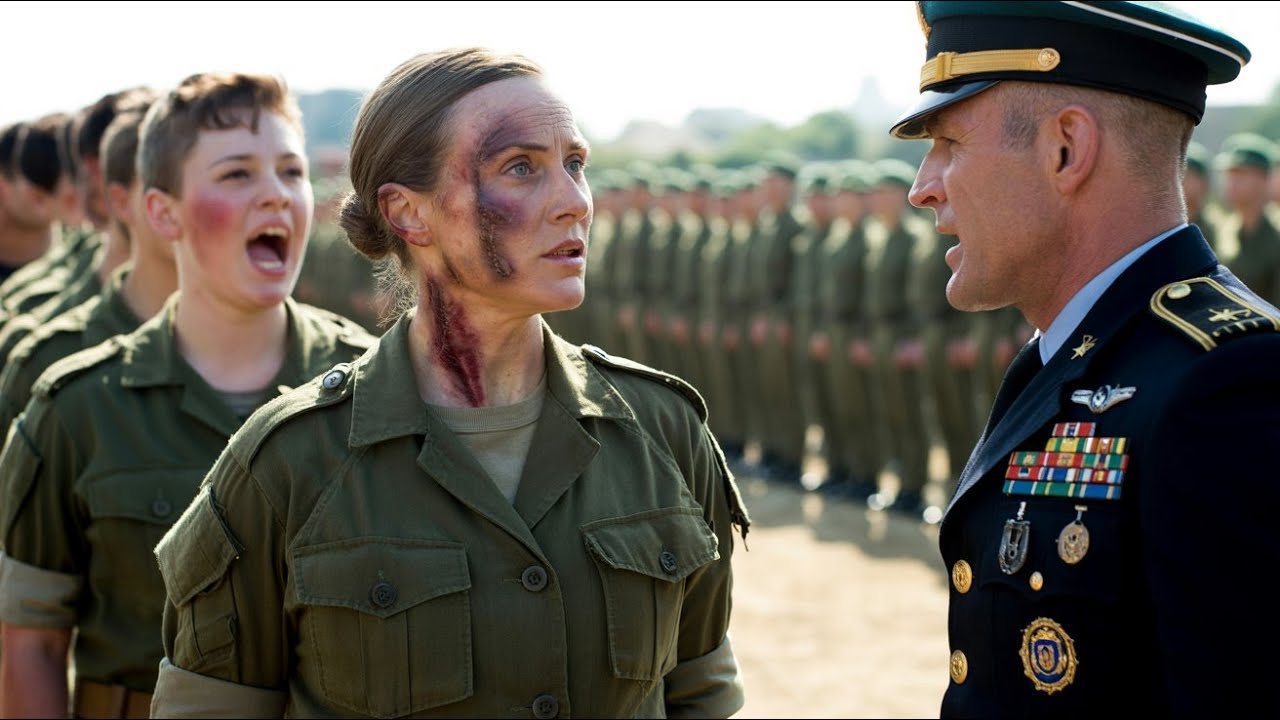
She stood a little over five feet six. Her frame was lean rather than muscular, and her dark hair was pulled into a regulation bun so tight it seemed to sharpen the angles of her face.
But the field went silent anyway.
A pale scar ran from the edge of her right cheek toward her jaw. Another disappeared beneath the collar of her uniform. When she adjusted the clipboard beneath her arm, a recruit in the front row noticed a thick burn scar wrapping around her left forearm.
And when she walked, she favored her right leg.
Only slightly.
But Monroe saw it.
He leaned toward the recruit beside him and whispered, loud enough for several others to hear, “They gave us a broken one.”
A few nervous laughs escaped.
Sergeant Dawson stopped.
She did not turn immediately.
She stood with her back to them for two full seconds, the silence growing heavier with each one. Then she looked over her shoulder and found Monroe without asking who had spoken.
Her eyes rested on him.
No anger.
No embarrassment.
Just recognition.
Monroe straightened, though the smirk remained on his face.
Dawson turned back toward the formation.
“Good morning,” she said. Her voice was calm and low. “I am Sergeant Riley Dawson. For the next eight weeks, I am not your friend, your therapist, or your babysitter.”
She stepped closer.
“I am the wall between who you are now and the person you need to become if someone’s life ever depends on you.”
No one laughed after that.
The company commander, Captain Ellis, stood near the flagpole watching the recruits absorb her words.
“Sergeant Dawson has spent more time operating under fire than most of you have spent doing anything difficult,” he said. “You will listen when she speaks. You will move when she tells you to move. And you will understand that every lesson she gives you has already been paid for somewhere else.”
Monroe glanced at the scar on Dawson’s face.
Then at her limp.
He wasn’t impressed.
Not yet.
The first week stripped away whatever confidence the recruits had brought with them.
They ran before sunrise and after sunset. They carried weighted packs until their shoulders went numb. They crawled through mud, climbed walls, memorized procedures under sleep deprivation, and learned that “almost correct” was simply another way of saying “wrong.”
By the fourth day, two recruits had vomited during the morning run.
By the fifth, one was crying silently in the shower.
By the sixth, even the loudest men had stopped talking after lights-out.
Sergeant Dawson watched all of it with the same controlled expression.
She never mocked weakness.
But she never rewarded it either.

When someone fell, she did not tell them they were strong.
She told them to stand.
When someone said they could not continue, she asked whether exhaustion had broken a bone.
If the answer was no, she pointed forward.
Monroe decided her calmness was an act.
He had grown up being the loudest person in every room. He had been captain of his high school football team, the center of every party, the man friends looked toward when they wanted someone else to become the joke.
At Fort Valor, he found that no one cared what he had been before arriving.
So he created an audience the only way he knew how.
He made Sergeant Dawson the joke.
“Watch the leg,” he whispered during formation. “Old machinery needs time to warm up.”
During equipment inspection, he told another recruit, “I bet the Army keeps her together with duct tape and classified paperwork.”
Most recruits looked away.
A few still laughed.
Dawson heard every word.
She never responded.
Her silence made Monroe bolder.
By the second week, Georgia’s heat had settled over the base like punishment.
The fog disappeared. The ground hardened. Sweat soaked through uniforms before breakfast, and blisters opened inside boots that never seemed dry.
On Tuesday morning, Dawson led the company on a twelve-mile movement through uneven terrain.
Each recruit carried a full pack, rifle, water, and training equipment. Monroe had spent the previous night telling everyone Dawson would probably ride in the support vehicle once they left the main road.
She did not.
She led from the front.
Her limp became slightly more visible on the steep inclines, but her pace never changed. She carried the same load as the recruits and an additional medical bag across her back.
At mile seven, Monroe stopped joking.
At mile nine, he was breathing through his mouth.
At mile ten, Private Lewis, a quiet recruit from Ohio, reached over and steadied Monroe when he stumbled.
Monroe knocked his hand away.
“I’m fine.”
Lewis looked toward Dawson, who was still moving twenty yards ahead of them.
“She’s carrying more than you.”
Monroe’s jaw tightened.
“She’s used to it.”
“So are the scars,” Lewis said. “Doesn’t mean they didn’t cost her something.”
Monroe stared at him.
Lewis moved ahead before the argument could begin.
That afternoon, Dawson made the entire group repeat a casualty evacuation drill because Monroe had failed to secure a strap.
He blamed the equipment.
She made him repeat it alone.
Then she made him teach the correct procedure to everyone else.
He hated her for that.
Not because the punishment was harsh.
Because she never raised her voice.
She stood beside him while he struggled, offering no emotion for him to fight against. She forced him to confront his own mistake without giving him the satisfaction of turning it into a personal conflict.
By dinner, he needed his audience back.
The dining facility was crowded and loud. Metal trays slid across tables. Recruits ate quickly, knowing they had only minutes before the next formation.
Monroe sat with six others near the back.
Sergeant Dawson was nowhere in sight.
He looked around, then leaned toward the table.
“You know what I think happened to her face?”
No one answered.
That should have stopped him.
It didn’t.
“I think somebody finally got tired of hearing her talk.”
A recruit across from him stared at his tray.
Monroe grinned and continued.
“Or maybe she tried smiling once and her face rejected the idea.”
A few weak laughs.
Then he lowered his voice and made a crude remark about the scar disappearing under her collar.
Lewis set down his fork.
“That’s enough.”
Monroe turned toward him. “What, you her bodyguard now?”
“No. I just don’t need to insult an injured soldier to feel important.”
The table went still.
Monroe’s face hardened.
Before he could answer, a calm voice came from directly behind him.
“Private Monroe.”
His fork froze halfway to his mouth.
Sergeant Dawson stood less than three feet away.
No one had seen her approach.
Monroe slowly turned.
Her expression had not changed, but the room around them seemed to have become quieter.
“Yes, Sergeant?”
“Finish your meal.”
He blinked.
“Yes, Sergeant.”
“Then report to Barracks Two with cleaning equipment.”
His smirk returned faintly. “For what duty?”
“Latrines.”
Someone at the table inhaled sharply.
“All of them?” Monroe asked.
Dawson looked at his untouched vegetables.
“You now have thirty seconds less to eat.”
Monroe picked up his fork.
She walked away.
No shouting.
No public speech.
No demand for an apology.
Yet every recruit at the table had just watched Monroe shrink without Sergeant Dawson raising her voice once.
That night, while Monroe scrubbed restroom floors, Lewis helped organize equipment in the supply corridor.
Two instructors were speaking in the office nearby. The door was partially open.
Lewis had no intention of listening until he heard Dawson’s name.
“Medical still wants her off field rotation,” one instructor said.
“They’ve wanted that for three years,” the other replied. “Phoenix doesn’t know how to sit behind a desk.”
Lewis stopped moving.
“Most people wouldn’t have come back after Alpha Seven.”
“Most people wouldn’t have gone back into the vehicle the third time.”
The office door closed.
Lewis stood alone in the corridor, holding a box of training radios.
Phoenix.
Alpha Seven.
He had no idea what either meant.
But he knew they mattered.
The following weeks intensified.
Monroe became more careful about when he made his comments, but he did not stop. He whispered during equipment checks. He mimicked Dawson’s limp when her back was turned. He told recruits she had probably received her position out of pity.
The difference was that fewer people laughed.
Dawson’s authority had begun to settle into the company.
She knew which recruits hid pain and which exaggerated it. She knew who panicked in confined spaces, who rushed procedures, who froze when corrected, and who quietly helped others after lights-out.
She pushed each of them differently.
When Lewis struggled with marksmanship, she stayed after the training block and adjusted his breathing rhythm.
When Private Alvarez had a panic response inside the obstacle tunnel, Dawson crawled in beside her and spoke in a voice only Alvarez could hear.
When Monroe performed well, she acknowledged it without hesitation.
“Good recovery.”
“Correct decision.”
“Improved time.”
That frustrated him more than punishment.
He wanted her to dislike him.
Instead, she treated him as if his behavior were smaller than his potential.
During the fifth week, the company began field exercises.
They trained with simulated casualties, smoke, alarms, and timed decision-making. The objective was not only to test physical strength but to expose what each recruit did when confusion replaced instructions.
Monroe was fast and athletic.
But under pressure, he became reckless.
During one exercise, he moved before receiving confirmation and left his partner exposed. Dawson stopped the drill immediately.
“What did you see?” she asked.
“A clear route.”
“What did you fail to see?”
Monroe glanced around. “Nothing.”
Dawson pointed toward Lewis, who was lying behind cover with a red training marker across his vest.
“Your partner is dead.”
“It’s a simulation.”
Her eyes locked onto his.
“That sentence has buried more inexperienced soldiers than enemy fire.”
The recruits nearby went silent.
Monroe’s face flushed.
“You think hesitation saves people?” he asked.
“No,” Dawson said. “Thinking does.”
He stepped closer than regulations allowed.
“Maybe things were different back when you could still run.”
Lewis looked toward the instructors.
No one moved.
Dawson stared at Monroe for a long moment.
Then she handed him her training rifle.
“Take my equipment.”
He hesitated.
“That wasn’t a request.”
Monroe took the rifle.
She removed her pack and placed it against his chest.
Then the medical bag.
Then her weighted vest.
By the time she finished, Monroe was carrying nearly twice his original load.
“Complete the route,” she said.
“With all this?”
“You said my leg was the problem.”
A few recruits looked down to hide their expressions.
Monroe set off.
He moved quickly for the first hundred yards.
By the first hill, his pace slowed.
By the second, sweat poured from his face.
At the final obstacle, he failed twice to pull himself over the wall. Lewis stepped forward to help, but Dawson raised one hand.
Monroe tried again.
His arms shook.
He dropped into the dirt.
Dawson walked toward him with her uneven stride, climbed the wall using only the side ropes, and landed on the other side without a word.
The company followed.
Monroe remained in the dirt for several seconds before forcing himself up.
That evening, no one laughed when he imitated her limp.
Because no one was listening anymore.
The final week arrived with rumors.
A senior command delegation would observe the graduation exercise. A general was expected to visit Fort Valor to review the training program and address the recruits.
Monroe saw it as an opportunity.
He had recovered some of his confidence. His physical scores were among the highest in the group, and he believed senior officers would notice him.
During rehearsal, he joked that Dawson would probably wear enough medals to distract people from her face.
Lewis turned toward him.
“You still don’t know who she is, do you?”
Monroe smiled. “A drill sergeant with a limp?”
Lewis lowered his voice.
“I heard instructors call her Phoenix.”
For the first time, something uncertain moved across Monroe’s expression.
“What does that mean?”
“I don’t know.”
“Then it means nothing.”
But the name stayed with him.
The next morning, the graduation exercise began under a bright, unforgiving sky.
Families sat beneath temporary canopies near the field. Officers gathered along the observation area. Recruits stood in clean uniforms, shoulders squared, boots polished, every movement sharpened by eight weeks of repetition.
Sergeant Dawson stood at the edge of the formation.
Her scars were visible.
So was the limp.
She had never tried to hide either.
Monroe stood in the first row, waiting for the visiting commander.
A black vehicle stopped near the reviewing stand.
Lieutenant General Marcus Hale stepped out.
He was a broad-shouldered man in his late fifties with silver at his temples and rows of ribbons across his uniform. Conversations stopped as he approached.
Captain Ellis greeted him.
The general shook hands with several instructors, then began walking along the line.
When he reached Dawson, he stopped.
His face changed.
The formal expression disappeared first.
Then his shoulders lowered slightly, as if he had just recognized someone he had once believed he would never see again.
He looked at the scar along her cheek.
Then at her leg.
“Phoenix,” he said.
The word was quiet.
But everyone near the formation heard it.
Dawson’s posture remained straight.
“Sir.”
General Hale did not salute her rank.
He reached out and took her hand with both of his.
“I didn’t know you were back on active training duty.”
“Temporary assignment, sir.”
He studied her for a moment. “Still refusing to stay behind a desk?”
A few instructors smiled.
Dawson’s mouth moved just enough to suggest one.
“Yes, sir.”
Monroe looked from the general to Dawson.
His expression had emptied.
General Hale turned toward the recruits.
“Do you know why they call her Phoenix?”
No one answered.
Dawson’s eyes shifted toward the general, almost warning him not to continue.
He noticed.
Then he continued anyway.
“Seven years ago, Sergeant Dawson was attached to a convoy outside Kandahar. Alpha Seven.”
Lewis inhaled softly.
Monroe went completely still.
“The lead vehicle struck an explosive device,” the general said. “The blast disabled two vehicles and ignited the third. Communications failed. The convoy came under fire from elevated positions.”
The field was silent now.
Not military silence.
Human silence.
The kind created when everyone understands that the next words will change something.
“Sergeant Dawson was thrown from the rear vehicle,” Hale continued. “The blast fractured her pelvis, damaged her right leg, and burned part of her upper body.”
Monroe’s gaze dropped toward the scars he had mocked for eight weeks.
“She regained consciousness while the vehicle was burning.”
Dawson looked straight ahead.
“She pulled one soldier out.”
The general paused.
“Then she went back.”
A breeze moved across the field, lifting the edge of the company flag.
“She pulled out a second soldier.”
No one moved.
“Then she heard someone trapped inside.”
General Hale looked directly at Dawson.
“The fuel line had ruptured. Ammunition was cooking off. Everyone who could still move was ordered to withdraw.”
His voice tightened.
“She went back a third time.”
Monroe’s lips parted.
The smirk he had worn so easily was gone.
“She carried the final soldier nearly sixty yards before the vehicle exploded.”
The general turned slightly, allowing the recruits to see the name on his uniform.
“That soldier was my son.”
A sound moved through the families seated near the field. Not quite a gasp. More like one shared breath.
General Hale looked back at Dawson.
“He survived because she refused to leave him.”
Dawson’s jaw tightened.
She did not look proud.
She looked as though she were standing somewhere else, beneath a different sky, hearing a burning vehicle behind her.
“The medics lost her pulse twice,” Hale said. “She endured fourteen surgeries. Doctors told her she might never walk without assistance.”
His eyes moved toward her right leg.
“She returned to duty twenty-one months later.”
Then he faced the recruits.
“They call her Phoenix because she walked out of a fire that should have killed her.”
No one looked at Monroe.
They did not need to.
His body had already betrayed him.
His shoulders had collapsed inward. The color had drained from his face. His eyes moved from the scar on Dawson’s cheek to the mark beneath her collar, then down to the leg he had imitated for laughs.
He remembered every joke.
So did everyone around him.
Dawson finally turned her head.
Their eyes met.
Monroe looked away first.
General Hale stepped back and addressed the company.
“Some people mistake visible damage for weakness,” he said. “That mistake usually comes from those who have never paid a real price for anything.”
Monroe swallowed.
The general did not know about the jokes.
He did not need to.
Every word landed anyway.
After the ceremony, recruits gathered with their families. Cameras flashed. Parents cried. Officers shook hands.
Monroe stood alone near the barracks.
For once, he had no audience.
Sergeant Dawson approached carrying a folder beneath her arm.
He straightened immediately.
“Sergeant.”
She stopped in front of him.
His eyes stayed fixed somewhere near her shoulder.
“I owe you an apology,” he said.
Dawson waited.
Monroe struggled for the words.
“I made comments about your scars. Your leg. I thought…” He paused. “I thought because you didn’t react, it didn’t matter.”
“It mattered,” she said.
His face tightened.
She did not rescue him from the discomfort.
“I was disrespectful,” he continued. “Not just to you. To what you did. To the uniform.”
Dawson’s expression remained controlled.
“You were disrespectful before you knew what I did.”
Monroe looked at her.
“That is the part you need to remember.”
He nodded slowly.
“Yes, Sergeant.”
“You should not require a heroic story before deciding someone deserves dignity.”
The words hit harder than anything she had shouted during training.
Monroe stared at the ground.
“I understand.”
“No,” Dawson said. “You are beginning to.”
She handed him the folder.
Inside was his final evaluation.
His physical scores were excellent. His technical performance had improved. His leadership assessment was marked below standard.
Monroe read the comments twice.
Demonstrates ability. Lacks judgment under pressure. Seeks attention at the expense of unit trust. Capable of improvement if he learns that leadership is responsibility, not performance.
He looked up.
“You could have failed me.”
“Yes.”
“Why didn’t you?”
“Because humiliation is easy,” she said. “Growth is harder.”
Across the field, Lewis was taking a photograph with his parents. Alvarez was laughing beside two other recruits. Captain Ellis stood near the reviewing stand speaking with General Hale.
Monroe looked at the people he had spent weeks trying to impress.
Then back at the woman he had tried to diminish.
“What happens now?” he asked.
“You report to advanced training on Monday.”
“And the leadership mark?”
“You earn a better one.”
She turned to leave.
“Sergeant Dawson.”
She stopped.
Monroe’s voice was quieter now.
“Why didn’t you tell us?”
She glanced over her shoulder.
“Because scars are not résumés.”
Then she walked away.
Monroe watched her cross the field.
The limp was still there.
So were the scars.
Nothing about her appearance had changed.
Only his ability to see her had.
Months later, Lewis received a message from Monroe during advanced training.
It contained no joke.
No excuse.
Just a photograph of Monroe helping a struggling recruit carry equipment during a long field march.
Beneath it, he had written:
Leadership is responsibility, not performance. I’m still earning the better mark.
Lewis forwarded the message to Sergeant Dawson.
She read it once.
Then she locked her phone and returned to the training field, where another group of nervous recruits stood waiting beneath the morning fog.
Some stared at her scars.
One noticed the limp.
Dawson stepped in front of them and let the silence settle.
She knew people often judged what pain left behind.
They saw damaged skin, uneven steps, quiet voices, and assumed they were looking at weakness.
But scars do not show where someone broke.
They show where someone refused to remain broken.
And the people we dismiss at first glance may be carrying the very courage that would save us when everything else is burning.