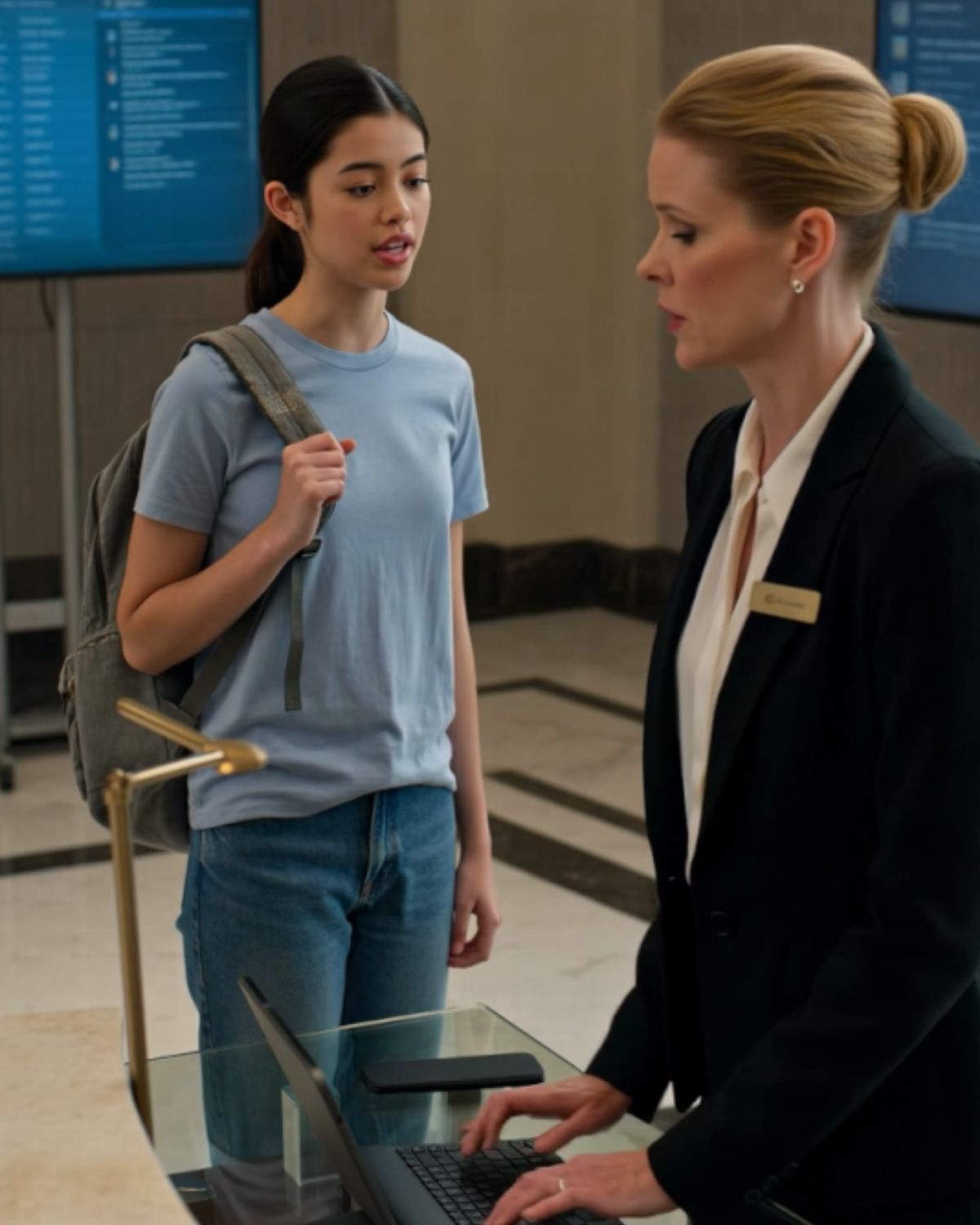
The receptionist looked at the young woman’s worn backpack, faded blouse and rain-marked shoes.
Then she pointed toward the basement elevators.
“Cleaning staff interviews are downstairs.”
The young woman blinked.
For a moment, she thought she had heard incorrectly.
Behind her, the glass doors of the Aurelia Hotel Group headquarters opened and closed as executives hurried in from the rain. Men in tailored suits crossed the marble lobby. Assistants carried laptops and leather folders. A digital wall displayed images of luxury hotels in Paris, Singapore, Dubai and New York.
The young woman tightened her grip on the backpack strap.
“No,” she said politely. “I’m here for the software position.”
The receptionist looked at her again.
This time, more slowly.
Her name tag read CLAIRE BENNETT — EXECUTIVE RECEPTION.
Claire’s eyes moved from the young woman’s inexpensive trousers to the frayed stitching near the top of her backpack.
“The technology interviews are for invited candidates only.”
“I was invited.”
“Do you have the email?”
“Yes.”
The young woman reached into the side pocket of her bag.
Claire sighed.
“Name?”
“Maya Chen.”
Claire typed it into the front desk computer.
Nothing appeared.
She tried again.
“Could it be under another name?”
“No.”
“Recruitment company?”
“I applied directly.”
Claire leaned back.
“The candidates attending today were submitted by partner universities and executive recruiters.”
Maya removed her phone.
The screen was cracked across one corner.
“I received confirmation from Mr. Patel in digital operations.”
Claire glanced at the phone without taking it.
“I’m sure there has been some misunderstanding.”
Maya opened the email.
It clearly displayed the Aurelia Hotel Group logo.
INTERVIEW CONFIRMATION — SOFTWARE SYSTEMS ANALYST.
Today’s date.
Tenth floor.
9:00 a.m.
Claire read it quickly.
Then she looked toward the line forming behind Maya.
A man in a dark suit checked his watch impatiently.
Claire lowered her voice.
“You can wait over there while I verify it.”
She pointed toward a narrow bench near the service corridor.
Maya looked at the main lobby seating area.
Several empty leather chairs stood beneath a sculpture of polished steel.
Then she looked at the bench Claire had chosen.
It sat beside a delivery entrance.
“Of course,” Maya said.
She walked away quietly.
Claire called the next visitor forward.
Within seconds, the lobby continued as though Maya had never arrived.
She sat with her backpack on her knees.
Inside it were two notebooks, a secondhand laptop, a packed lunch and a printed copy of her resume.
The resume was only one page.
Maya Chen.
Twenty-two years old.
Final-year computer engineering student.
Part-time library assistant.
Freelance software developer.
No famous university.
No prestigious internship.
No corporate references.
But one line near the bottom mattered more than all the others.
Lead developer, HavenCore hospitality systems prototype.
Most people at the Aurelia Hotel Group did not know what that meant.
By the end of the morning, they would.
Six months earlier, Aurelia had faced a serious technology problem.
The company operated forty-three hotels across eleven countries.
Each property used different software.
Guest requests were stored in one system.
Maintenance problems were recorded in another.
Room access, energy consumption, staff scheduling and security alerts all ran separately.
When a guest reported a broken air conditioner, reception entered the complaint manually.
Then someone called maintenance.
A technician wrote the repair on paper.
The room status was updated later, sometimes hours later.
During busy periods, requests disappeared.
Rooms were cleaned twice.
Repairs were missed.
VIP preferences did not follow guests from one hotel to another.
Executives called it an integration problem.
Hotel employees called it chaos.
Aurelia had spent nearly four million dollars testing software from three major vendors.
Every system was expensive.
Every demonstration looked impressive.
None worked across the company’s old infrastructure.
Then the chairman approved an open innovation challenge.
Universities, independent developers and small technology firms were invited to submit prototypes for a single platform that could connect all hotel operations without replacing every existing system.
More than eight hundred proposals were submitted.
One prototype performed better than all the others.
It connected reception, housekeeping, maintenance, security and guest services through a simple interface.
It predicted room maintenance needs from equipment patterns.
It translated staff requests into twelve languages.
It worked on old hotel computers and inexpensive mobile devices.
Most importantly, it had been tested in a small family-run guesthouse with fewer than thirty rooms.
The system was called HavenCore.
Its developer identity had been partially hidden during the final evaluation to prevent bias.
The judges knew the creator only as M. Chen.
They assumed M. Chen represented a software company.
Some assumed it was a senior engineer.
One executive referred to the developer as “he” in every meeting.
Nobody corrected him because nobody in the room knew the truth.
Maya had built HavenCore at night.
She worked on it after university classes.
She worked on it during quiet hours at the library.
She worked on it beside her mother’s bed when her mother was recovering from surgery.
The idea had begun years earlier in the small guesthouse owned by Maya’s aunt.
Maya had watched employees run between floors carrying handwritten notes.
She had seen an elderly cleaner blamed for missing a room change that had never reached her.
She had seen a night receptionist manually track maintenance calls in a notebook because the computer system froze whenever more than three screens were open.
Maya did not begin HavenCore to win a competition.
She began it because the people working hardest were being punished by bad tools.
When Aurelia announced the challenge, she submitted the system under her initial because the registration form required a company name.
She entered “M. Chen Independent Systems.”
The judges never asked whether the company had only one employee.
Now Aurelia wanted to hire developers capable of supporting the platform.
Maya had been invited to interview.
At least, she believed she had.
At 8:52 a.m., three candidates entered the lobby together.
All wore dark suits.
One carried a new laptop in a slim aluminum case.
Claire greeted them warmly.
“Technology interviews?”
“Yes.”
“Excellent. Tenth floor. Conference Room C.”
She handed each of them a visitor badge.
Maya watched.
She looked at the clock.
Then she returned to the desk.
“Excuse me.”
Claire continued typing.
“I’m still waiting for confirmation.”
“My interview begins in eight minutes.”
“I understand.”
“Could I go upstairs while you verify it?”
“No.”
“Mr. Patel’s email says Conference Room C.”
Claire stopped typing.
“Miss Chen, I cannot allow someone into an executive interview area without a confirmed appointment.”
“I showed you the confirmation.”
“And your name is not in our visitor system.”
“Could you call Mr. Patel?”
“He is in meetings.”
“Then recruitment?”
Claire’s expression tightened.
“There are procedures.”
Maya glanced toward the elevators.
One of the suited candidates was laughing with another near the doors.
“I traveled two hours to be here.”
“That does not change the procedure.”
“I’m not asking you to change it. I’m asking you to check.”
Claire looked toward the security guard.
The movement was small.
But Maya noticed.
Claire had decided that persistence was becoming a problem.
Maya stepped back.
“I’ll wait.”
At 9:03 a.m., the interview began without her.
On the tenth floor, six executives sat around a long glass table.
Printed resumes had been arranged in front of them.
The candidates included graduates from elite universities, two software consultants and a former systems analyst from an international airline.
At the head of the table sat Daniel Ross, Aurelia’s chief technology officer.
Beside him was recruitment director Helen Ward.
A large screen displayed the company’s technology strategy.
The first candidate entered.
He spoke confidently about cloud architecture.
He described teams he had managed.
He used phrases like enterprise transformation and scalable innovation.
When asked about HavenCore, he said the platform would require “significant professionalization.”
The second candidate had never seen the software outside the company demonstration.
The third suggested rebuilding it entirely.
Helen Ward wrote notes.
Daniel Ross looked increasingly disappointed.
At 9:25, he glanced toward the empty chair at the end of the table.
“Was there not another candidate?”
Helen checked the schedule.
“Maya Chen.”
“Where is she?”
“Not checked in.”
Daniel frowned.
“She confirmed.”
Helen looked toward her assistant.
“Did she withdraw?”
“No message.”
Daniel opened the candidate file.
The resume was missing.
“Who referred her?”
“Arun Patel.”
Daniel’s expression shifted.
Arun Patel was the digital operations manager who had supervised the HavenCore testing process.
“He specifically requested that she be interviewed.”
Helen searched through her emails.
“I have the invitation here.”
“Then call reception.”
In the lobby, Claire’s phone rang.
She answered.
“Executive reception.”
Helen’s voice came through.
“Has a candidate named Maya Chen arrived?”
Claire looked toward the service corridor.
Maya sat on the bench with her hands folded over the backpack.
“Yes.”
Helen paused.
“She is there?”
“She arrived without appearing in the visitor registration system.”
“Send her up immediately.”
Claire’s face changed.
“She said she was here for the software role, but I assumed—”
“Send her up.”
Claire hung up.
She looked at Maya.
Then at the basement elevators.
The cleaning staff interviews had begun downstairs.
For the first time, Claire seemed to understand how close she had come to sending Maya there.
“Miss Chen.”
Maya stood.
“Your appointment has been confirmed.”
Claire printed a visitor badge.
Her earlier tone disappeared.
“You may go to the tenth floor.”
Maya took the badge.
“Thank you.”
Claire hesitated.
“You should hurry. The interviews have already started.”
Maya looked at the lobby clock.
“I arrived before they did.”
Claire did not answer.
Maya walked toward the elevators.
Before she reached them, a group of senior executives entered the lobby from a private corridor.
At the center was the chairman of Aurelia Hotel Group.
Edward Halden was sixty-seven years old and had led the company for nearly three decades.
He was not expected at the candidate interviews.
He was supposed to be preparing for a board meeting.
But ten minutes earlier, a serious problem had appeared during the HavenCore pilot.
A hotel in Singapore had reported that the live operations dashboard was displaying incorrect room energy data.
The board wanted an explanation.
Edward carried a tablet showing the system interface.
Beside him walked Arun Patel and two senior engineers.
“The vendor team cannot identify the problem,” one engineer said.
Edward stopped.
“It is not a vendor platform.”
“Not officially.”
“Then contact the creator.”
“We have been trying.”
“Who is the creator?”
Arun opened a file on his tablet.
“M. Chen.”
Edward’s voice sharpened.
“That is a name, not an answer.”
Arun hesitated.
“The original developer is interviewing here today.”
Edward looked toward him.
“In this building?”
“Yes.”
“Why was I not told?”
“The recruitment team classified the meeting as a junior software interview.”
Edward stared at him.
“The person who built the platform connecting forty-three hotels is being interviewed for a junior position?”
Arun lowered his voice.
“She is still a student.”
Edward looked toward the main elevators.
“Where is she?”
“I’m checking.”
Maya stepped into the elevator before they reached the lobby desk.
The doors closed.
Edward walked directly to Claire.
“Where is the creator of our new hotel system?”
Claire looked startled.
“I’m sorry?”
“HavenCore.”
Employees nearby stopped moving.
Claire glanced toward the executives around him.
“I don’t know, sir.”
Arun placed his tablet on the desk.
“Candidate Maya Chen. She arrived this morning.”
Claire’s face went pale.
“She just went upstairs.”
Edward looked at the visitor record.
“Why was she checked in twenty-seven minutes late?”
Claire opened her mouth.
No answer came.
Edward saw the bench near the service corridor.
A damp mark remained where Maya’s backpack had rested against the wall.
He looked back at Claire.
“What happened?”
“She was not in the registration system.”
“Did she have an invitation?”
“Yes.”
“Then why did she wait?”
Claire swallowed.
“I needed to verify her identity.”
Edward studied her face.
“That is not the whole answer.”
The security guard looked toward the floor.
A bellman nearby became very still.
Claire glanced at them.
Then she said quietly, “I misunderstood which interview she was attending.”
Edward’s eyes narrowed.
“What did you think she was here for?”
Claire did not respond.
Edward followed her earlier line of sight toward the basement elevator sign.
STAFF RECRUITMENT — HOUSEKEEPING AND FACILITIES.
His expression changed.
“You sent the developer of our technology platform toward the cleaning interviews?”
“I only suggested that might be where she needed to go.”
The lobby became silent.
Edward looked at the tablet in his hand.
The HavenCore dashboard displayed live information from hotels across the world.
Room status.
Maintenance requests.
Energy consumption.
Safety alerts.
A system currently being evaluated as one of the most important operational investments in the company’s history.
Then he looked at the elevator doors through which Maya had disappeared.
“She is already here,” he said.
No one moved.
Edward turned to Arun.
“Take me to the interview.”
On the tenth floor, Maya entered Conference Room C at 9:31.
Every person at the table looked at her.
The suited candidates sat along one side.
Maya stood at the door wearing a visitor badge over her faded blouse.
Her hair was still slightly wet from the rain.
The worn backpack remained over one shoulder.
Helen Ward glanced at the clock.
“You’re late.”
Maya looked at her.
“I arrived at 8:41.”
Helen stopped.
Daniel Ross leaned forward.
“What happened?”
“There was a delay at reception.”
Helen looked embarrassed.
“We can discuss that later. Please sit.”
Maya took the empty chair.
One candidate looked at her clothes, then at the other candidates.
His expression suggested he believed a mistake had been made.
Helen opened the digital resume file.
It contained very little information.
“Maya, you are completing a computer engineering degree at Eastbridge Technical College?”
“Yes.”
“Not Eastbridge University?”
“No. The technical college.”
“And you have no full-time corporate software experience?”
“No.”
“Your application mentions freelance development.”
“Yes.”
“What kind?”
“Small business systems. Booking tools. Inventory management. Accessibility features.”
Daniel Ross studied her.
“What accessibility features?”
“Voice-assisted staff requests, high-contrast dashboards, simplified multilingual interfaces.”
“Why those?”
“Because many hotel systems are designed for managers sitting at desks, not staff moving through buildings.”
One of the executives looked up.
Maya continued.
“Housekeepers may be wearing gloves. Maintenance workers may have dirty hands. Some employees are older. Some do not read the hotel’s primary language fluently.”
Daniel’s eyes sharpened.
“So you design for the person using the system, not the person purchasing it?”
“They are both important.”
A suited candidate smiled faintly, as though the answer were too simple.
Helen glanced at Maya’s backpack.
“Why are you interested in Aurelia?”
Maya paused.
“I’m interested in improving HavenCore.”
The room changed.
Daniel looked at her.
“What did you say?”
“HavenCore.”
“You’ve used it?”
“Yes.”
“In what context?”
“I built it.”
The candidate beside her slowly turned.
Helen’s fingers stopped above the keyboard.
Daniel stared.
“You built what?”
“The original platform.”
Silence spread across the room.
Maya opened her backpack.
She removed a thin secondhand laptop covered with two faded stickers.
Then she placed a notebook beside it.
Inside were handwritten architecture diagrams, interface sketches and system maps.
Daniel stood.
“You are M. Chen?”
“Yes.”
Helen looked at the resume again.
The line had been there.
Lead developer, HavenCore hospitality systems prototype.
She had assumed it meant Maya had contributed to a student project.
“You developed the full system?” Daniel asked.
“The first version.”
“Alone?”
“The prototype, yes. My aunt and several hotel employees helped test it.”
The other candidates looked at one another.
One had just spent ten minutes explaining how he would redesign Maya’s work.
Before anyone could speak, the conference room doors opened.
Edward Halden entered holding the tablet.
Everyone stood.
He ignored the executives.
His eyes moved around the room.
“Where is the creator of our new hotel system?”
No one answered immediately.
Then Arun Patel pointed toward Maya.
“She is.”
Edward stopped.
He looked at the young woman in the faded blouse.
Then at the worn backpack beside her chair.
Then at the tablet displaying the platform his entire company was preparing to adopt.
“You are Maya Chen?”
“Yes, sir.”
“You built HavenCore?”
“Yes.”
Edward walked toward her.
“What happened to the Singapore energy dashboard?”
Maya did not appear surprised.
“What is it showing?”
“Occupied rooms are reporting lower energy use than vacant rooms.”
“What time did the error begin?”
“Approximately forty minutes ago.”
“Did the hotel install new smart meters this week?”
Arun checked his notes.
“Yes.”
“Which manufacturer?”
He named it.
Maya opened her laptop immediately.
“That model reverses the occupancy state when connected through an older gateway.”
One senior engineer frowned.
“We checked the gateway.”
“Did you check whether the firmware update changed the data label?”
The engineer looked toward another.
“No.”
Maya connected to the test environment.
Her fingers moved quickly.
The main screen filled with code.
Edward stood beside her.
The executives gathered behind him.
Maya opened the Singapore property log.
She found the device update.
Then she highlighted two lines.
“There.”
The engineer leaned closer.
“The occupied and standby labels were switched.”
Maya nodded.
“The readings are correct. The categories are reversed.”
“How quickly can it be fixed?” Edward asked.
“Locally, five minutes.”
“Across the network?”
“If the same update reached other properties, fifteen.”
Edward looked at his engineers.
They had spent nearly an hour treating the problem as a system failure.
Maya had identified it in less than two minutes.
“Do it,” he said.
Maya paused.
“I don’t currently have production access.”
Arun took out his security key.
“You do now.”
Maya made the correction.
The dashboard refreshed.
Energy readings returned to normal.
A message appeared from the Singapore hotel confirming the fix.
No one in the room spoke.
Edward looked at Maya’s notebook.
Its pages were worn from use.
“You created this platform while studying?”
“Yes.”
“With what funding?”
“None at first.”
“What equipment?”
She looked at the laptop.
“This.”
The screen hinge had been repaired with a strip of black tape.
Edward’s expression shifted.
“How much did the prototype cost you?”
“About six hundred dollars.”
One executive looked stunned.
The company had already paid outside vendors hundreds of thousands of dollars to evaluate similar concepts.
Edward closed the tablet.
“Why did you apply for a junior analyst position?”
“It was the only position listed that matched my experience level.”
“You designed a platform our consultants could not build.”
“I haven’t worked in a large company.”
“That is an organizational gap.”
He pointed toward HavenCore on the screen.
“This is not.”
Helen Ward found her voice.
“Mr. Halden, our hiring framework requires candidates without formal corporate experience to enter through the junior track.”
Edward turned to her.
“Did our framework create this system?”
“No.”
“Did our framework identify the Singapore error?”
“No.”
“Then perhaps the framework is not the smartest thing in the room.”
No one responded.
The suited candidates sat silently.
One closed his notebook.
Edward looked back at Maya.
“Why did you call the system HavenCore?”
Maya hesitated.
“My aunt’s guesthouse was called Haven House.”
“And Core?”
“Because the software was meant to support the people at the center of hotel operations.”
“Guests?”
“Employees first.”
Several executives exchanged glances.
Most hotel technology presentations began with customer data, revenue optimization or executive reporting.
Maya continued.
“If the cleaner does not receive the room update, the guest waits.”
“If maintenance cannot understand the alert, equipment stays broken.”
“If reception cannot see what other departments are doing, guests repeat the same request to three people.”
She looked toward the live dashboard.
“The guest experience depends on whether employees have clear information.”
Edward studied her.
“That is why the interface is so simple.”
“Yes.”
“Our consultants described it as lacking visual complexity.”
“Complexity is not a feature when people are busy.”
Daniel Ross almost smiled.
Edward turned toward the executive team.
“This is the first useful sentence I have heard about hotel software all week.”
A few people lowered their eyes.
Maya did not smile.
She seemed more concerned with closing the production connection securely.
Edward noticed.
“You are not surprised that we want to speak with you.”
“I expected an interview.”
“Not this one.”
“No.”
He looked toward the printed resumes spread across the table.
“May I see yours?”
Maya reached into her backpack.
She removed the single sheet.
The bottom corner had bent during the journey.
She handed it to him.
Edward read it carefully.
Eastbridge Technical College.
Library assistant.
Freelance projects.
No large technology company.
No prestigious scholarship.
No famous mentor.
Then he reached the line describing HavenCore.
“Why is this only one sentence?”
“I was advised to keep my resume to one page.”
“Who advised you?”
“The university career office.”
Edward looked at the page again.
He gave a short, disbelieving laugh.
“You reduced the most important hotel technology project I have seen in years to one sentence because someone told you a resume should fit on one page.”
Maya looked slightly embarrassed.
“Yes.”
Edward handed it to Arun.
“Make copies.”
Helen Ward leaned forward.
“Mr. Halden, we still need to complete the formal evaluation.”
Edward looked at her.
“Evaluate what?”
“Role compatibility. Communication style. Cultural fit.”
Maya’s expression remained neutral.
Edward looked around the table.
“Our culture kept the creator of our platform waiting beside a service corridor because her clothes did not match someone’s expectation.”
The room became still.
Maya looked at him sharply.
She had not told anyone what had happened.
Edward continued.
“Our culture invited candidates to explain how they would improve her work while she sat downstairs.”
Helen’s face changed.
Daniel Ross looked toward the door.
Edward’s voice remained controlled.
“That is the culture requiring evaluation.”
Maya closed her laptop.
“I don’t want anyone dismissed because of a misunderstanding.”
Edward turned to her.
“Why not?”
“Because changing one person will not fix the assumption.”
The answer stopped him.
Maya continued.
“Reception staff see hundreds of people. They follow patterns.”
“That does not excuse what happened.”
“No.”
“Then what are you saying?”
“That the hotel should ask why appearance was allowed to become part of access control.”
The executives listened.
Maya looked toward the glass wall overlooking the lobby below.
“If I had worn a suit, I would have been sent upstairs.”
No one disagreed.
“If another candidate arrived in simple clothes tomorrow, the same thing could happen again unless the process changes.”
Edward stared at her.
“You are interviewing for a job, and you are already redesigning our reception system.”
Maya looked uncertain.
“Is that a problem?”
“No.”
His answer came immediately.
“It is becoming a pattern.”
For the first time, Maya smiled.
The tension in the room shifted.
Edward placed the tablet on the table.
“I want to know exactly what role you believe you should have here.”
Helen began to speak.
“Mr. Halden, compensation and position levels—”
He raised one hand.
“I asked Maya.”
Maya thought carefully.
“I don’t know enough about your organization to name a title.”
“What do you know?”
“I know the platform needs a proper engineering team.”
Edward nodded.
“It also needs security testing, international compliance review and more input from hotel staff before full deployment.”
“Continue.”
“The company should not rebuild it entirely. That would remove the reason it works on old systems.”
Daniel Ross leaned closer.
“What role would you play?”
“Product architecture.”
“You are twenty-two.”
“Yes.”
“You would be directing engineers with more experience than you.”
“I would not direct them alone.”
“What would you do when they disagreed?”
“Ask for evidence.”
“And when you were wrong?”
“Change the system.”
Daniel looked toward Edward.
The chairman saw it.
The chief technology officer was impressed.
More importantly, he was listening.
Edward pulled out the chair beside Maya and sat.
The rest of the room slowly followed.
For the next forty minutes, the interview became a technical review.
Maya explained how HavenCore separated hotel functions without isolating them.
She showed how offline updates could synchronize after unstable internet connections.
She demonstrated an emergency mode allowing staff to use the system during power disruptions.
She also identified weaknesses.
The messaging feature needed stronger encryption.
The predictive maintenance model had been tested on too few elevator brands.
The translation system could misunderstand regional terms.
She did not defend flaws.
She named them before anyone else could.
One senior engineer tested her with increasingly difficult questions.
Maya answered some immediately.
For others, she said, “I don’t know.”
Each time, she followed with, “But I know how I would test it.”
Edward watched the room change around her.
At the beginning, executives had seen a student.
Then they saw a programmer.
Then an architect.
By the end, they were taking notes.
At 10:37, Edward closed the meeting.
“The board session begins in twenty-three minutes.”
He looked at Maya.
“You are coming with us.”
Helen looked surprised.
“To the board meeting?”
“Yes.”
Maya glanced at her backpack.
“I’m not prepared for a board presentation.”
“You just repaired a live system and explained its architecture to our senior team.”
Edward stood.
“You are prepared.”
One of the other candidates spoke.
“Mr. Halden, are the interviews continuing?”
Edward looked toward him.
“Yes.”
The candidate appeared relieved.
Then Edward added, “But not for the same position.”
He turned to Daniel Ross.
“Create a proper role for Maya.”
Daniel nodded.
“Lead systems architect?”
Maya looked startled.
Edward considered it.
“Founding platform architect.”
Helen began typing.
Maya stood.
“I haven’t accepted anything.”
Edward smiled slightly.
“Good.”
The executives looked at him.
He continued.
“Anyone who accepts a title before asking about authority, support and responsibility should not have it.”
He faced Maya.
“What do you need before deciding?”
“A written role description.”
“You will have it.”
“A team structure.”
“Yes.”
“Access to hotel staff during development.”
“Yes.”
“And the system cannot be marketed as fully automated.”
Edward raised an eyebrow.
“Why?”
“Because people will believe it replaces jobs.”
“Does it?”
“No. It replaces repeated paperwork and missed messages.”
“Then we will describe it accurately.”
Maya nodded.
“Then I’ll consider the offer.”
Edward looked toward the senior executives.
Most candidates would have accepted immediately.
Maya had negotiated for the integrity of the work before discussing salary.
He appeared pleased.
“Bring your resume,” he said.
She glanced at the single page.
“You already have it.”
“I want the board to see it.”
“Why?”
“Because they need to understand how little information is required for intelligent people to make a foolish assumption.”
The group entered the hallway.
As they approached the elevators, Edward stopped beside Maya.
“What happened at reception, exactly?”
She hesitated.
He waited.
Maya told him.
Not dramatically.
She repeated the conversation word for word.
Cleaning staff interviews are downstairs.
The technology interviews are for invited candidates only.
You can wait over there.
Edward listened without interrupting.
When she finished, he asked, “How did it make you feel?”
Maya looked toward the elevator numbers.
“I don’t think that matters to the system.”
“It matters to the company.”
She considered the question.
“Like I had to prove I belonged before anyone would verify why I was there.”
Edward nodded slowly.
“That is a precise answer.”
“It has happened before.”
“At hotels?”
“Universities. Conferences. Offices.”
“Why do you think you remained calm?”
Maya looked at him.
“Because getting angry would have become more evidence against me.”
Edward’s expression changed.
The elevator doors opened.
No one stepped inside immediately.
Several executives lowered their eyes.
The sentence exposed a reality none of them had needed to calculate in their own careers.
Maya entered first.
When the elevator reached the ground floor, Claire saw the group approaching.
The chairman walked in front.
Maya walked beside him.
The chief technology officer, recruitment director and senior engineers followed.
Every employee in the lobby noticed.
Claire stood.
Her face lost color.
Edward stopped at the reception desk.
Guests nearby slowed down.
The security guard straightened.
Edward looked at Claire.
“This is Maya Chen.”
Claire nodded quickly.
“Yes, sir.”
“The creator of HavenCore.”
Claire’s eyes moved toward Maya.
“I understand.”
“No,” Edward said. “I do not think you did.”
The lobby became silent.
Claire’s hands tightened beside the keyboard.
Edward held up Maya’s resume.
“She built the technology platform this company is preparing to use around the world.”
Claire swallowed.
“I made a mistake.”
Edward looked at her.
“What was the mistake?”
“I failed to verify her appointment quickly enough.”
“That was one mistake.”
Claire’s eyes filled with discomfort.
She looked at Maya’s clothes.
Then at the worn backpack.
“I assumed she was here for a different position.”
“Why?”
Claire did not answer.
Edward waited.
The silence grew heavier.
Finally, Claire said, “Because of how she was dressed.”
Maya stood quietly.
Claire looked toward the basement elevators.
“I thought she was applying for cleaning work.”
Edward’s face remained firm.
“There is no shame in cleaning work.”
Claire looked up.
“The shame is in believing you can identify someone’s ability by the price of their clothes.”
“Yes, sir.”
Edward turned slightly so the employees nearby could hear.
“Talent does not wear a uniform.”
No one moved.
He continued.
“Neither does intelligence.”
His eyes moved across the lobby staff.
“And dignity should not require a visitor badge.”
Claire looked at Maya.
“I am sorry.”
Maya held her gaze.
“You did not ask my name before deciding where I belonged.”
Claire’s shoulders dropped.
“No.”
“You saw my clothes first.”
“Yes.”
Maya did not humiliate her.
She also did not pretend the apology erased the experience.
“Next time,” she said, “ask the question before choosing the answer.”
Claire nodded.
“I will.”
Edward handed Claire Maya’s original resume.
“Scan this into the executive visitor record.”
Claire accepted it carefully.
“Right away.”
“And correct today’s arrival time.”
She looked at him.
“Sir?”
“She arrived at 8:41.”
Claire typed the correction.
Maya noticed.
It was a small action.
But it mattered.
The official record would no longer suggest she had been late for the opportunity she had nearly been denied.
Edward gestured toward the private elevators.
“The board is waiting.”
Maya adjusted her backpack.
A senior executive reached for it.
“I can carry that for you.”
She shook her head.
“I’ve got it.”
They crossed the lobby.
Claire watched.
So did the security guard.
So did the receptionist beside her who had quietly witnessed everything.
A few minutes earlier, Maya had been sitting beside the delivery corridor.
Now the chairman was personally taking her into the executive meeting room.
The transformation had not happened because Maya suddenly looked different.
Her blouse was still faded.
Her shoes were still rain-marked.
The backpack was still worn.
Only the information had changed.
And that was what made the staff’s embarrassment impossible to escape.
They had not judged what she knew.
They had judged what she could afford to display.
Inside the boardroom, twelve directors sat around an oval table.
A large screen displayed the HavenCore dashboard.
Several directors looked surprised when Maya entered.
Edward did not introduce her as a student.
He did not call her a candidate.
“This is Maya Chen,” he said. “She created the platform you are about to vote on.”
Every face turned.
Maya placed her backpack beside the chair.
Then she connected her old laptop to the boardroom screen.
The image flickered once.
A director glanced at the repaired hinge.
Maya noticed.
“So did the reception team,” she said.
The room went still.
Edward almost smiled.
Maya continued.
“This computer built the first version of the system.”
The director looked embarrassed.
“I see.”
“No,” Maya said calmly. “That is the problem.”
She opened the architecture map.
“People often see the equipment, title or clothing before they see the work.”
Edward leaned back.
He allowed her to continue.
For the next hour, Maya explained the platform.
Not as a miracle.
As a tool.
She described what it could do.
Then she described what it could not do.
She warned the board against using predictive data to punish employees without context.
A delayed room update might mean a cleaner was overloaded.
A repeated maintenance alert might indicate poor equipment, not poor performance.
Technology, she said, could make unfair decisions faster if leaders treated data as truth without asking questions.
One director asked how she had learned that.
Maya looked toward the glass wall overlooking the lobby.
“Observation.”
The board approved the next stage of HavenCore unanimously.
But Edward delayed the public announcement.
First, he changed the project structure.
Maya was offered the role of Founding Platform Architect with authority to approve major product decisions.
She received a full engineering team.
Her final year of tuition was covered through the company’s education program.
She negotiated one unusual condition.
Every new feature had to be tested by hotel employees from at least four departments before release.
Not managers only.
Housekeepers.
Bell staff.
Maintenance technicians.
Night receptionists.
Security guards.
The people whose work had inspired the system.
Edward agreed.
Claire remained at the front desk.
Some employees believed she should have been fired.
Maya did not.
Instead, the company asked Claire to join a review of visitor access and interview procedures.
At the first meeting, she admitted exactly what she had done.
No softened language.
No claim of confusion.
“I judged her by her clothes,” she said.
Then she helped design a process requiring reception staff to verify the purpose of every scheduled visitor before redirecting them.
Candidate photos were removed from early screening files.
Names were hidden during the first resume review for selected technical roles.
Interview invitations included a direct contact number in case the registration system failed.
Three months later, a young man arrived for a finance internship wearing a secondhand jacket and carrying documents in a grocery bag.
Claire greeted him.
“Good morning. May I have your name and appointment time?”
She checked the system.
His record did not appear.
Instead of sending him away, she called recruitment.
The appointment was confirmed.
He reached the interview room on time.
Maya happened to be crossing the lobby.
Claire saw her.
For a brief moment, their eyes met.
Claire did not look for approval.
Maya did not offer praise.
She simply nodded.
The lesson had moved from apology into action.
A year later, HavenCore launched across all Aurelia properties.
It reduced missed maintenance requests.
It shortened room turnaround times.
It allowed staff to communicate across language barriers.
But the feature employees appreciated most was one Maya had added after her first day at headquarters.
Whenever someone reported an operational problem, the system displayed a reminder before escalation:
Verify before assuming.
Executives thought it referred to data.
Hotel staff knew it meant more.
At the launch event, Edward stood before hundreds of employees and industry guests.
A large screen behind him displayed Maya’s original one-page resume.
The audience laughed when they saw how little it revealed.
Then Edward held up the worn paper.
“This company almost missed the person who built its future,” he said.
The room became quiet.
“Not because she lacked talent.”
He looked toward the front row, where Maya sat beside housekeeping employees who had helped test the system.
“We almost missed her because talent arrived in simple clothes carrying an old backpack.”
Maya stood when her name was called.
She walked onto the stage wearing a plain dark suit she had purchased with her first salary.
But the old backpack remained over one shoulder.
Edward noticed.
“You kept it.”
“It still works.”
The audience smiled.
He handed her a framed copy of the first HavenCore interface.
Below it was a sentence chosen from her interview:
Complexity is not a feature when people are busy.
Maya looked at it.
Then she turned toward the employees in the room.
“The software was never the most important part,” she said.
“The most important part was noticing the people powerful systems often overlook.”
She paused.
“Technology failed that morning because the visitor database did not contain my name.”
Claire stood near the back of the room.
Maya continued.
“But a database error was not what kept me waiting.”
The room became silent.
“An assumption did.”
Claire lowered her eyes.
Maya looked across the audience.
“Systems can be repaired quickly.”
Her voice remained calm.
“Assumptions are harder, because people often mistake them for experience.”
She set the framed interface on the podium.
“So when someone arrives without the right clothes, title, accent or connection, ask the question before choosing the answer.”
The applause began before she stepped away.
Years later, new employees at Aurelia still heard the story of the student at reception.
They heard how she had been directed toward the basement.
How the chairman found her name on a computer screen.
How she fixed a global system problem before anyone had finished reading her resume.
And how she entered the executive meeting room carrying the same backpack that had made people underestimate her.
Because a uniform can reveal someone’s position.
A suit can suggest authority.
A polished appearance can open doors.
But none of those things can measure the mind standing in front of you.
The most expensive mistake a company can make is not hiring the wrong person.
It is refusing to see the right one because talent arrived wearing clothes they did not expect.