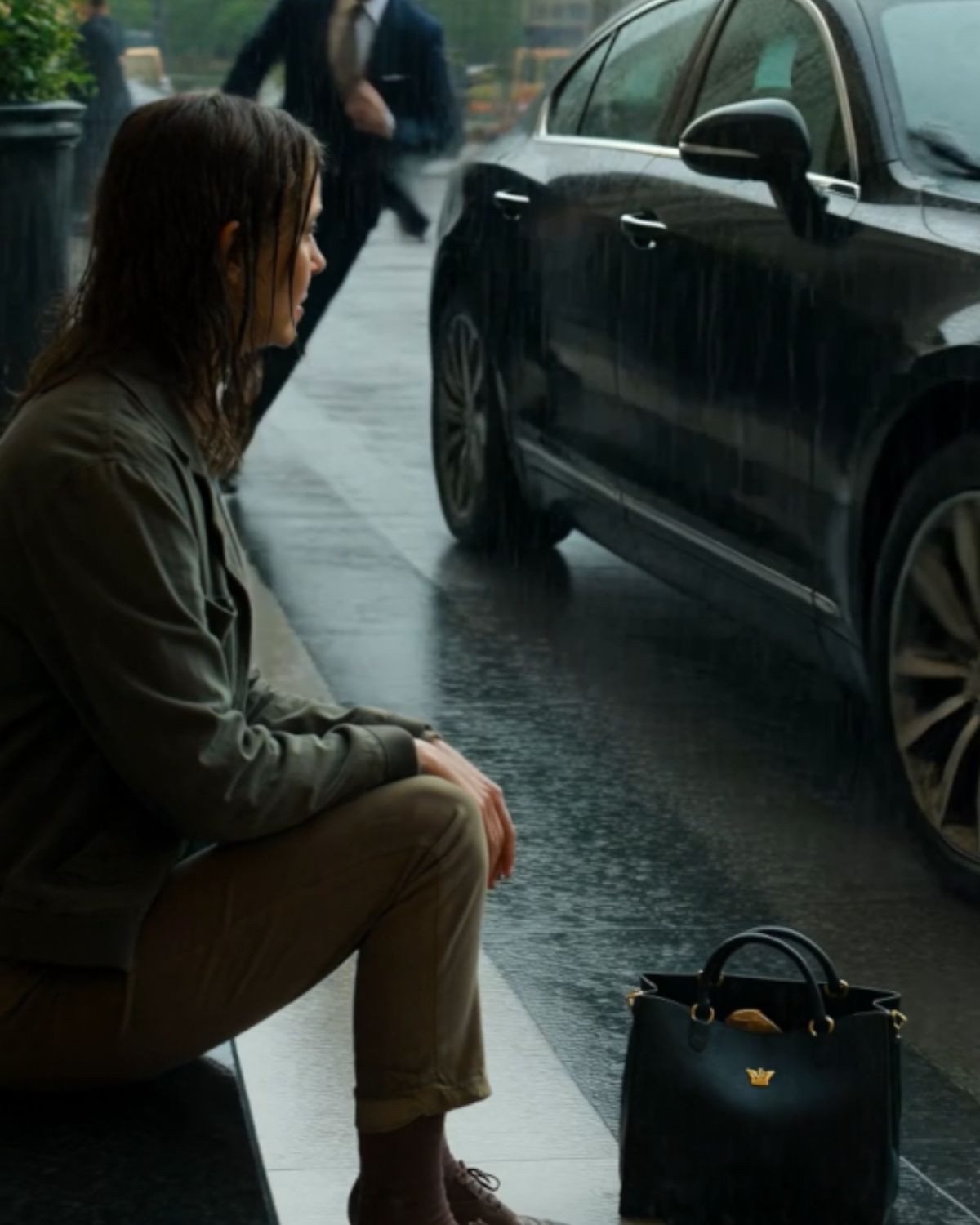
The designer bag sat on the wet pavement beside a black luxury car.
Rainwater ran beneath it.
The gold clasp was open.
Inside, bundles of cash, a leather wallet and a silver watch were clearly visible.
People hurried past the entrance of the Lancaster Crown Hotel without noticing.
One woman did.
Her name was Evelyn Moore.
She was fifty-eight years old, wearing a coat with a torn pocket and shoes that had stopped keeping out the rain months earlier.
She had been sitting beneath the edge of the hotel canopy, trying to stay dry without drawing attention from security.
The bench at the bus station was no longer safe after dark.
The shelter across town had filled before sunset.
So Evelyn sat with her old canvas bag beneath her feet and watched expensive cars arrive beneath the hotel’s golden lights.
Then she saw the luxury bag fall.
A driver had opened the back door of the black car.
A tall businessman stepped out while speaking urgently on his phone. An assistant followed with a briefcase. A bellman removed two suitcases from the trunk.
No one noticed the smaller bag slide from the seat and land near the rear tire.
The car pulled away.
The bag remained.
Evelyn looked toward the glass hotel doors.
The businessman had already disappeared into the lobby.
She looked at the bag again.
Rain struck the soft brown leather.
She stood.
A security guard near the entrance noticed her moving.
His eyes narrowed.
Evelyn knew what he saw.
A homeless woman approaching something expensive.
She reached the bag before he did.
“Leave that alone,” the guard called.
Evelyn picked it up.
It was heavier than she expected.
The clasp had opened when it fell. She could see the money inside without searching.
More money than she had held in years.
Enough for months in a cheap room.
Enough for clean clothes.
Enough to replace the medication she had lost when her backpack was stolen.
Enough to stop sleeping beneath train platforms and church awnings.
Her fingers tightened around the handle.
The guard approached quickly.
“I said put it down.”
“Someone dropped it.”
“I can see that.”
“I’m taking it inside.”
“Give it to me.”
Evelyn looked at his outstretched hand.
She had learned to be careful with belongings passed to people who did not want witnesses.
“I’ll give it to reception.”
The guard’s expression hardened.
“You are not entering the hotel.”
“The owner may be inside.”
“I’ll handle it.”
Evelyn glanced through the glass doors.
A reception desk stood less than thirty meters away.
The lobby was crowded.
There would be cameras.
There would be a record.
“I found it,” she said. “I’ll return it.”
The guard stepped in front of her.
“Ma’am, do not make this difficult.”
Evelyn almost laughed.
Nothing about her life had been easy for a long time.
But she did not want trouble.
She lifted the bag so he could see her hands.
“I haven’t taken anything.”
The guard looked at the open clasp.
“You went through it?”
“No.”
“It’s open.”
“It fell that way.”
A couple waiting for their car turned toward them.
The woman whispered something to her husband.
Evelyn felt the familiar heat of humiliation rise beneath her wet skin.
People often assumed poverty had erased honesty.
As though hunger automatically made every object belong to whoever needed it most.
The hotel doors opened as a family walked out.
Evelyn stepped through before the guard could stop her.
“Ma’am!”
She moved quickly across the marble lobby.
Water dripped from her coat.
Guests turned.
A man carrying a champagne glass stepped aside as though she might stain the air around him.
Evelyn reached the reception desk and placed the bag carefully on the counter.
“Someone lost this,” she said. “I want to return it.”
The receptionist stared at her.
Her name tag read SOPHIA.
She looked at Evelyn’s soaked clothing.
Then at the designer bag.
Then back at Evelyn.
“Where did you get that?”
“Outside. Beside a black car.”
Sophia did not touch it.
“Did you open it?”
“It was already open.”
The security guard arrived behind Evelyn.
“She picked it up near the entrance.”
Evelyn turned.
“I told you I was returning it.”
Sophia glanced inside.
Her eyes widened at the sight of the cash.
She pressed a button beneath the desk.
“Please wait here.”
“I don’t need to wait.”
“We need to document where it was found.”
“I told you where.”
“We may need to verify that nothing is missing.”
The sentence was professionally delivered.
But Evelyn heard the accusation inside it.
She looked around.
Several guests were watching openly now.
A little boy stood beside his mother, staring at Evelyn’s torn sleeve.
Evelyn lowered her voice.
“I did not take anything.”
Sophia gave a tight smile.
“I didn’t say you did.”
No.
She had only placed Evelyn on the wrong side of the counter and suspicion on the correct one.
The security guard moved closer.
“Do you have identification?”
Evelyn’s face tightened.
“No.”
“No identification at all?”
“My wallet was stolen.”
Sophia exchanged a glance with the guard.
It happened quickly.
But Evelyn saw it.
A woman with no address.
No identification.
No one important waiting for her.
Easy to question.
Easy to blame.
“I returned the bag,” Evelyn said again.
Sophia began typing.
“What is your name?”
“Evelyn Moore.”
“Current address?”
Evelyn did not answer.
Sophia looked up.
“Address?”
“I don’t have one.”
The lobby seemed to become quieter.
Sophia’s expression changed.
Not with sympathy.
With confirmation.
The assumptions had found a fact they could use.
Before she could ask another question, the main elevator opened.
A wealthy businessman rushed into the lobby with two assistants behind him.
He was in his early fifties, wearing a dark tailored suit and carrying the tension of someone accustomed to immediate solutions.
His name was Jonathan Mercer.
He was the chief executive of Mercer Development Group and one of the hotel’s largest investors.
He crossed the lobby quickly.
“I left a bag outside.”
Sophia immediately stood straighter.
“What kind of bag, sir?”
“Brown leather. Gold clasp.”
He saw it on the counter.
“That’s mine.”
The relief in his voice was immediate.
Jonathan reached for it.
Sophia lifted one hand.
“This woman brought it in. We were just documenting the circumstances.”
Jonathan looked at Evelyn.
She stood beside the desk, soaked and silent.
“You found it?”
“Yes.”
“Where?”
“Beside your car.”
He opened the bag and checked inside.
Wallet.
Cash.
Watch.
Passport.
Business documents.
Everything appeared untouched.
He looked at Evelyn again.
“You brought this inside?”
“Yes.”
Jonathan removed the wallet.
He counted the cards.
Then the cash.
The security guard watched Evelyn while he did it.
She noticed.
So did Jonathan.
His expression shifted slightly.
“All of it is here,” he said.
Sophia smiled.
“That’s excellent, Mr. Mercer.”
Evelyn stepped away from the desk.
“Then I’ll go.”
Jonathan looked up.
“Wait.”
She stopped.
He reached into the bag again.
Something had caught beneath the inner lining.
A corner of yellowed paper was visible through a small tear in the fabric.
Jonathan frowned.
He pulled gently.
A narrow envelope slid from a hidden pocket.
It was old.
Much older than the bag.
The edges had softened with time. A faded strip of tape sealed the back.
Jonathan stared at the handwriting.
His face changed.
Across the front were four words:
For Jonathan, when ready.
The letters had been written by his mother.
He knew her handwriting instantly.
Jonathan stopped breathing.
His assistant leaned closer.
“Sir?”
Jonathan did not answer.
His mother, Margaret Mercer, had died eight months earlier.
The bag had belonged to her.
He had taken it from her apartment after the funeral, intending to sort through its contents.
He never did.
That morning, he had used it to carry documents because his briefcase clasp had broken.
He had not known about the hidden pocket.
He had not known about the envelope.
Jonathan looked at Evelyn.
“Where did you get this?”
Her expression tightened.
“I found it inside.”
“You opened the hidden compartment?”
“No.”
“I saw you pull it out.”
“I mean I found the bag outside. I didn’t know the envelope was there.”
Jonathan looked at the tear in the lining.
The envelope must have shifted when the bag struck the pavement.
His assistant touched his arm.
“Jonathan, perhaps we should go somewhere private.”
But Jonathan was already turning the envelope over.
His mother’s initials were written on the back.
M.M.
His hands began to tremble.
The lobby watched.
He opened the envelope carefully.
Inside were three folded pages and a small photograph.
The photograph slipped free first.
It landed faceup on the reception counter.
Jonathan stared at it.
A younger version of his mother stood outside a small apartment building.
Beside her was another woman wearing a grocery store uniform.
The second woman was younger too.
Thin.
Dark-haired.
Smiling despite a bruise along one cheek.
Jonathan slowly lifted the photograph.
He looked at Evelyn.
Then at the image.
The shape of the eyes was the same.
The scar near the left eyebrow was faint but visible.
His voice dropped.
“Is this you?”
Evelyn looked at the photograph.
The color left her face.
She moved closer.
For several seconds, she said nothing.
Then she whispered, “Where did you get that?”
“It was in the envelope.”
She touched the edge of the counter.
“That was taken a long time ago.”
Jonathan looked at her.
“How did you know my mother?”
The receptionist stopped typing.
The security guard lowered his hand.
Evelyn’s eyes remained on the photograph.
“Margaret.”
It was the first time anyone in the lobby had heard her speak the name.
Not Mrs. Mercer.
Not ma’am.
Margaret.
Jonathan unfolded the letter.
The first line made his throat tighten.
Jonathan, there is a woman you must know about. Her name is Evelyn Moore.
He looked up sharply.
Evelyn stepped back.
Jonathan continued reading.
His mother’s words had been written nearly twenty years earlier.
She described a night in December when Jonathan was fourteen.
His father had already left the family.
Margaret was working two jobs, struggling to pay rent and hiding how close they were to losing their home.
Jonathan remembered parts of that winter.
The cold apartment.
The refrigerator with almost nothing inside.
His mother insisting she had eaten at work when she had not.
What he did not remember was the night she collapsed.
According to the letter, Margaret had been walking home from a late shift when she became dizzy outside a grocery store.
She had not eaten in almost two days.
She fell near the loading entrance.
Employees had already left.
One woman remained.
Evelyn Moore.
She was a night stock clerk and a single mother with very little money of her own.
Evelyn found Margaret unconscious.
She called an ambulance.
Then she searched Margaret’s purse and found the home address.
Jonathan’s hand tightened around the letter.
He read the next lines slowly.
Evelyn came to our apartment because she knew a child was waiting there alone. She stayed with you until I returned from the hospital. She bought groceries with money meant for her own rent. She never told you how serious the situation was because she did not want you to be afraid.
Jonathan stopped reading.
He looked at Evelyn.
A memory moved through him.
A woman sitting in their tiny kitchen.
A grocery bag on the table.
Tomato soup.
Bread.
A blanket around his shoulders.
He had not remembered her face clearly.
Only her voice.
Your mother is going to be all right.
Eat while it is warm.
He stared at Evelyn.
“That was you.”
Evelyn looked toward the hotel doors.
“I helped for one night.”
Jonathan’s eyes filled.
“You stayed until morning.”
She said nothing.
He returned to the letter.
Margaret wrote that Evelyn had continued helping for weeks.
She brought leftover food from the grocery store.
She watched Jonathan while Margaret worked.
She found a local charity that prevented their eviction.
When Margaret tried to repay her, Evelyn refused.
Then Evelyn disappeared.
The grocery store manager said she had been dismissed after missing too many shifts.
Margaret searched.
She found an old address, but the apartment had been emptied.
No forwarding information remained.
For years, Margaret kept the photograph.
She later built a successful catering company, then invested in property with Jonathan.
Their financial life changed.
But she never forgot the woman who had helped when kindness cost more than she could afford.
Jonathan reached the final paragraph.
If you ever find Evelyn, do not insult her by calling what she did charity. She protected our family’s dignity when we had almost none left. Tell her that every good thing we built began after the night she refused to walk past me.
Jonathan could no longer hide the tears in his eyes.
The lobby had become completely silent.
He placed the letter on the counter.
Evelyn looked at him with a mixture of confusion and fear.
She had spent years learning that sudden attention from wealthy people rarely ended well.
Jonathan lifted the photograph.
“My mother kept this.”
Evelyn’s voice was quiet.
“I thought she forgot.”
“She searched for you.”
“I moved.”
“Why?”
Evelyn looked down.
“My son became ill.”
Jonathan waited.
“I lost the grocery job because I kept taking him to appointments. We stayed with relatives for a while. Then we left the city.”
“Did he recover?”
The answer took too long.
“No.”
Jonathan lowered the photograph.
“I’m sorry.”
Evelyn nodded once.
“He was nine.”
The words shifted the story again.
Margaret had written about Evelyn buying groceries with rent money.
She had not known that Evelyn was also caring for a sick child.
Jonathan looked at her worn coat.
“What happened after that?”
Evelyn’s jaw tightened.
She did not want to become a display of tragedy in a luxury lobby.
“It was a long time ago.”
“You helped my family while your own son was sick.”
“I did what was needed.”
“You lost your home?”
“Not then.”
“Later?”
She looked toward Sophia.
The receptionist lowered her eyes.
Evelyn answered reluctantly.
“I worked for many years. Hotel laundry. Kitchens. Cleaning offices.”
“What changed?”
“My husband died. Then the building where I rented was sold. The new rent was more than I earned.”
“Do you have family?”
“A sister in another state. We haven’t spoken in years.”
“Where are you staying?”
Evelyn’s face hardened.
“That is not your concern.”
Jonathan understood immediately.
Questions that sounded compassionate could still strip away dignity when asked publicly.
He turned toward Sophia.
“Is there a private room nearby?”
“The executive lounge.”
“Open it.”
Sophia reached for a key card.
Evelyn stepped back.
“I’m not going anywhere with you.”
Jonathan looked at her.
“Then we can remain here.”
“I returned your bag. That is all.”
“No.”
His voice broke.
“You returned the last letter my mother wrote to me.”
Evelyn looked at the envelope.
“You would have found it eventually.”
“I had the bag for eight months and never did.”
“That doesn’t mean—”
“It fell beside you.”
He looked at the cash still inside.
“You could have taken everything.”
Evelyn’s expression changed.
“I know.”
The honesty of the answer surprised the room.
She continued.
“I thought about it.”
The security guard shifted.
Evelyn saw him.
“So would you,” she said.
No one answered.
She looked at Jonathan.
“That money could have bought me a room. Food. Medicine. I knew what it could do.”
“Then why bring it back?”
Evelyn touched the torn pocket of her coat.
“Because needing something does not make it mine.”
Jonathan closed his eyes briefly.
That sentence sounded like something his mother would have written.
He turned toward the security guard.
“What happened when she found the bag?”
The guard stiffened.
“She picked it up near the entrance.”
“That is not what I asked.”
The guard glanced toward Sophia.
“I told her to hand it over.”
“Did you let her enter?”
“No.”
“Why?”
“I believed hotel security should handle the property.”
Jonathan looked at Evelyn.
“Is that what happened?”
“She wanted a witness,” Sophia said quietly.
Every face turned toward her.
Sophia swallowed.
“She insisted on bringing it to the desk.”
Jonathan looked at the guard.
“Did you accuse her of taking anything?”
“No, sir.”
Evelyn gave a tired smile.
“No one used the word.”
Jonathan understood.
The guard’s eyes dropped.
Sophia looked at the moved bowl of mints near the register.
She had shifted it when Evelyn approached.
Just as someone had once probably moved food out of Margaret’s reach when she was poor.
The parallel was impossible to ignore.
Jonathan faced Evelyn.
“My mother wrote that you protected our dignity.”
Evelyn looked at the rain beyond the glass.
“I don’t remember feeling noble.”
“She didn’t call you noble.”
“What did she call me?”
Jonathan looked down at the letter.
“The reason our family survived that winter.”
Evelyn’s face tightened.
For the first time, the strength in her posture weakened.
She looked at the photograph again.
“I thought she was dead when I found her.”
Jonathan nodded.
“She nearly was.”
“I remember your apartment.”
“So do I now.”
“You were frightened.”
“I remember soup.”
A faint smile touched Evelyn’s face.
“It was all I knew how to cook.”
“You told me my mother would return before the bread was gone.”
“She did.”
“Yes.”
The smile disappeared as quickly as it came.
Jonathan carefully placed the letter back on the counter.
“My mother spent years trying to find you.”
Evelyn wrapped her arms around herself.
“People say that after someone disappears.”
“She documented every attempt.”
His assistant had been reading the other pages.
She turned one toward Evelyn.
There were dates.
Addresses.
Charity offices.
Former employers.
Margaret had kept records of every search.
Evelyn stared at them.
“She really looked.”
“Yes.”
“Why?”
Jonathan’s answer came quietly.
“Because gratitude bothered her when it had nowhere to go.”
Evelyn looked away.
The sentence reached somewhere she had kept closed for years.
Jonathan took a breath.
“I need to ask what you need.”
“No.”
“Please.”
“I do not want a reward.”
“I know.”
“People always say that before making someone stand in front of a camera.”
“There will be no camera.”
Several guests had raised phones.
Jonathan noticed.
He turned toward the lobby.
“Put them away.”
His voice carried.
Phones slowly lowered.
He looked at the hotel manager, who had arrived during the reading.
“No photographs. No names released. Anyone who records her without permission leaves.”
The manager nodded immediately.
Jonathan turned back to Evelyn.
“My mother would never forgive me if I turned this into publicity.”
Evelyn studied him.
For the first time, some of the fear left her face.
He continued.
“I cannot repay what you did.”
“No.”
“But I can stop pretending that doing nothing is respectful.”
Evelyn remained silent.
Jonathan chose his words carefully.
“Would you accept a room tonight?”
Her eyes moved toward the elevators.
“Here?”
“Yes.”
“I cannot afford—”
“You are not being charged.”
“That is charity.”
“No.”
He pointed toward the bag.
“You protected property worth more than many people earn in a year. The hotel provides rooms to consultants for far less useful work.”
A few employees looked down.
Evelyn almost smiled.
Jonathan continued.
“Stay one night. Shower. Sleep. Tomorrow, you decide everything else.”
She looked at the rain.
Then at her soaked shoes.
“Only one night.”
“Only what you choose.”
Evelyn nodded.
Sophia moved around the desk.
“I’ll prepare a key.”
Jonathan stopped her.
“Not yet.”
Sophia froze.
He looked toward the hotel manager.
“What is the best available suite?”
“The Lancaster Suite.”
“Prepare it.”
Evelyn immediately shook her head.
“No.”
Jonathan turned.
“A normal room.”
“The suite is normal to this hotel.”
“Not to me.”
He saw the discomfort.
“Then choose any room you want.”
“I don’t know the rooms.”
Sophia spoke carefully.
“We have a quiet room on the sixth floor. It faces the garden. No adjoining doors.”
Evelyn looked at her.
Sophia’s voice was different now.
Not overly sweet.
Not performative.
Respectful.
“That would be fine.”
“I’ll arrange it.”
Sophia began typing.
Then she stopped.
She looked directly at Evelyn.
“I’m sorry.”
Evelyn waited.
Sophia glanced at the expensive bag.
“I saw you holding it and decided what had happened before you spoke.”
“Yes.”
“I treated you as a risk after you returned something none of us had even noticed was missing.”
The lobby listened.
Sophia’s eyes filled.
“I was wrong.”
Evelyn did not immediately forgive her.
Instead, she asked, “Will you remember tomorrow?”
Sophia looked at her.
“When someone else walks in looking like me?”
“Yes.”
Sophia nodded.
“I will.”
“That matters more than being sorry tonight.”
Jonathan looked at the security guard.
He did not wait to be confronted.
“I was wrong too,” the guard said.
Evelyn met his eyes.
“You were ready to protect the bag.”
He swallowed.
“Yes.”
“But not the person returning it.”
His face tightened.
“No.”
That was the moment recognition reached him.
It showed in the way his shoulders lowered.
In the way he stopped standing between Evelyn and the rest of the hotel.
In the silence before he stepped aside.
The manager ordered hot food to be sent to the sixth-floor room.
Evelyn refused the champagne, flowers and welcome basket.
She accepted soup.
Tomato.
When Jonathan heard, he had to look away.
Before she went upstairs, he held the old photograph out to her.
“This belongs to you.”
Evelyn shook her head.
“Your mother kept it.”
“She wanted me to find you.”
“Then keep it.”
Jonathan looked at the two women in the image.
One had been poor.
The other had been nearly homeless.
Neither had known that the family in that photograph would one day own companies, hotel investments and buildings across the city.
“I’ll make a copy,” he said.
Evelyn nodded.
“Then I’ll take one.”
They walked toward the elevator.
Guests moved aside.
Not because Evelyn’s clothes had changed.
They had not.
Rain still darkened her coat.
Her old canvas bag remained over one shoulder.
The only difference was that a wealthy man now walked beside her.
That fact embarrassed Jonathan more than anything else.
She had deserved space before anyone knew her story.
She had deserved respect before the letter connected her to someone important.
At the elevator, Jonathan stopped.
“My mother wrote one more line.”
Evelyn looked at him.
He unfolded the final page.
Some people help because they have plenty. Evelyn helped when kindness cost her something. Never confuse those two kinds of generosity.
Evelyn’s eyes filled.
She turned away.
“Your mother always used too many words.”
Jonathan laughed through his tears.
“She did.”
The elevator doors opened.
Before Evelyn entered, Jonathan held out his hand.
She looked at it.
Then she took it.
“You returned more than a bag,” he said.
Evelyn’s fingers tightened around his.
“You returned my mother’s voice.”
The doors closed.
Jonathan remained in the lobby holding the old letter.
That night, he read it more than twenty times.
He remembered his mother carrying grocery bags up three flights of stairs.
He remembered her building a catering business from a borrowed kitchen.
He remembered the first property they purchased.
He had always believed their family story began with Margaret’s hard work.
Now he understood it had begun earlier.
With a stranger outside a grocery store.
A woman who had almost nothing.
A woman who still stopped.
The following morning, Evelyn expected to leave before sunrise.
Instead, Jonathan was waiting in the hotel café.
No assistants.
No lawyers.
No cameras.
Two bowls of tomato soup sat on the table, though it was barely seven.
Evelyn looked at them.
“You remembered.”
“I remembered more than I expected.”
She sat across from him.
Jonathan placed a folder on the table.
Evelyn’s expression hardened immediately.
“What is that?”
“Options.”
“I said I did not want charity.”
“And I listened.”
He opened the folder.
The first page was not a check.
It was an employment offer from a community outreach organization funded by Margaret Mercer years earlier.
The organization helped older adults obtain identification documents, temporary housing and work placement.
They needed a part-time peer coordinator.
Someone who understood the systems from the inside.
“The role comes with pay and housing support,” Jonathan said. “But it is work.”
Evelyn read the description.
“You arranged this overnight?”
“I called the director.”
“Does she know who I am?”
“She knows you returned a bag and that you have lived experience relevant to the job.”
“Does she know about your mother?”
“Only that you once helped our family.”
Evelyn closed the folder.
“I may not be good at it.”
“Then interview.”
“Interview?”
“She insisted.”
A small smile appeared on Jonathan’s face.
“She said gratitude is not a hiring qualification.”
Evelyn looked at him for a long moment.
“I like her.”
“So do I.”
She turned to the second page.
Assistance replacing identification.
A medical appointment.
Temporary housing for thirty days, separate from the job decision.
“This part is not employment.”
“No.”
“Then it is charity.”
“It is emergency assistance from the same foundation that helps hundreds of people.”
“Because of me?”
“Because you qualify.”
She studied him.
“And if I had not found your bag?”
“The help should still exist.”
“That is not what I asked.”
Jonathan lowered his eyes.
“No. I would not have known you needed it.”
Evelyn nodded.
At least he was honest.
She looked toward the lobby.
Sophia was helping a delivery driver locate the restroom.
She did not ask for a room number.
She did not look at his shoes.
She simply pointed him toward the hallway and offered water.
Evelyn noticed.
Jonathan followed her gaze.
“She remembered.”
“For one morning.”
“It has to begin somewhere.”
Evelyn reopened the folder.
“I will interview.”
Jonathan smiled.
“And the temporary room?”
“Seven days.”
“Thirty are available.”
“Seven.”
“Agreed.”
It was not a dramatic rescue.
Evelyn did not become wealthy overnight.
Jonathan did not solve homelessness with a signature.
Real lives do not transform that neatly.
But seven days became a month in transitional housing.
The interview became a job.
Evelyn proved unusually effective at helping people who distrusted offices, forms and polished professionals.
She knew how shame made people leave before asking for help.
She knew why someone might refuse a shelter bed.
She knew how easily a missing document could become a locked door.
Six months later, she moved into a small apartment of her own.
The first object she placed on the wall was a copy of the old photograph.
Margaret stood beside her outside the grocery store.
On the back, Jonathan had written:
Our family began again because you stopped.
At the Lancaster Crown Hotel, the staff training program changed.
The hotel no longer used vague phrases about treating everyone equally.
New employees watched a short reenactment based on security footage from the night the bag was returned.
They saw an expensive object protected immediately.
They saw a poor woman questioned.
Then they were asked one question:
Why did the bag receive trust before the person did?
The hotel also created a secure property-return process so anyone bringing in a lost item could receive a written receipt without being detained or treated as a suspect.
Jonathan funded the change quietly.
He refused to name it after Evelyn.
She had forbidden him.
But inside the management handbook, beneath the lost-property policy, appeared one line from Margaret’s letter:
Never confuse having little with having no honor.
A year after the rainy evening, Jonathan invited Evelyn to a memorial gathering for his mother.
She almost refused.
Then she attended wearing a simple blue coat.
Not expensive.
Not borrowed.
Her own.
At the entrance, the same security guard opened the door.
“Good evening, Ms. Moore.”
Evelyn stopped.
“Do you remember me?”
“Yes.”
“What do you remember?”
He looked at her.
“That you returned the bag.”
She waited.
He continued.
“And that I saw your clothes before I saw what you were doing.”
Evelyn nodded.
“That is the correct answer.”
Inside, Jonathan had placed Margaret’s letter inside a glass case beside the old photograph.
Not as a story about wealthy people rewarding honesty.
As a reminder that the Mercer family’s success had been protected by someone history had nearly erased.
Jonathan stood beside Evelyn beneath the lobby lights.
Guests gathered quietly.
He read only one paragraph aloud.
Then he closed the letter.
“My mother spent years trying to thank the woman who helped us,” he said.
He looked at Evelyn.
“She believed gratitude was unfinished until it changed the way we treated someone else.”
Across the lobby, Sophia helped an elderly man in torn work clothes charge his phone.
No one asked whether he was staying at the hotel.
Jonathan continued.
“Evelyn returned my bag when keeping it might have changed her life.”
He paused.
“But the most important thing she returned was not the cash, the watch or the documents.”
He lifted the old envelope.
“She returned a truth my family had misplaced.”
The room remained silent.
Jonathan looked at Evelyn.
“We did not build our lives alone.”
Evelyn’s eyes filled, but she did not look away.
Outside, rain began striking the hotel windows.
The same sound.
The same entrance.
A different night.
Jonathan held out his hand.
This time, Evelyn took it without hesitation.
Because honesty is easy to praise when it comes from someone comfortable.
Its true weight is revealed when the honest person is cold, hungry and invisible—and still chooses to return what is not theirs.