FICTION — All characters, companies, and events in this story are fictional.
The slap lasted less than a second.
The silence that followed lasted long enough to cost a family one billion dollars.
It happened beneath a crystal chandelier in one of Atlanta’s most exclusive hotel ballrooms, where old money, political influence, and corporate ambition had gathered behind velvet ropes for the annual Sterling Education Foundation Gala.
A string quartet played near the marble staircase.
Champagne moved through the room on silver trays.
Men in tailored tuxedos spoke quietly about acquisitions, government contracts, and market forecasts. Women in couture gowns exchanged compliments that sounded warm but carried the precision of social ranking.
Everyone in the room seemed to know who mattered.
Or at least they thought they did.
At the center of the evening was a transaction few guests knew about in full. An acquisition valued at just over one billion dollars was scheduled to receive its final signatures the following morning.
The buyer was Apex Meridian Technologies.
The company being acquired was Whitmore Industries, one of Atlanta’s oldest manufacturing names.
For eleven months, legal teams, bankers, consultants, and executives had worked through every difficult detail.
The deal was supposed to save Whitmore Industries.
Instead, before dessert was served, it disappeared.
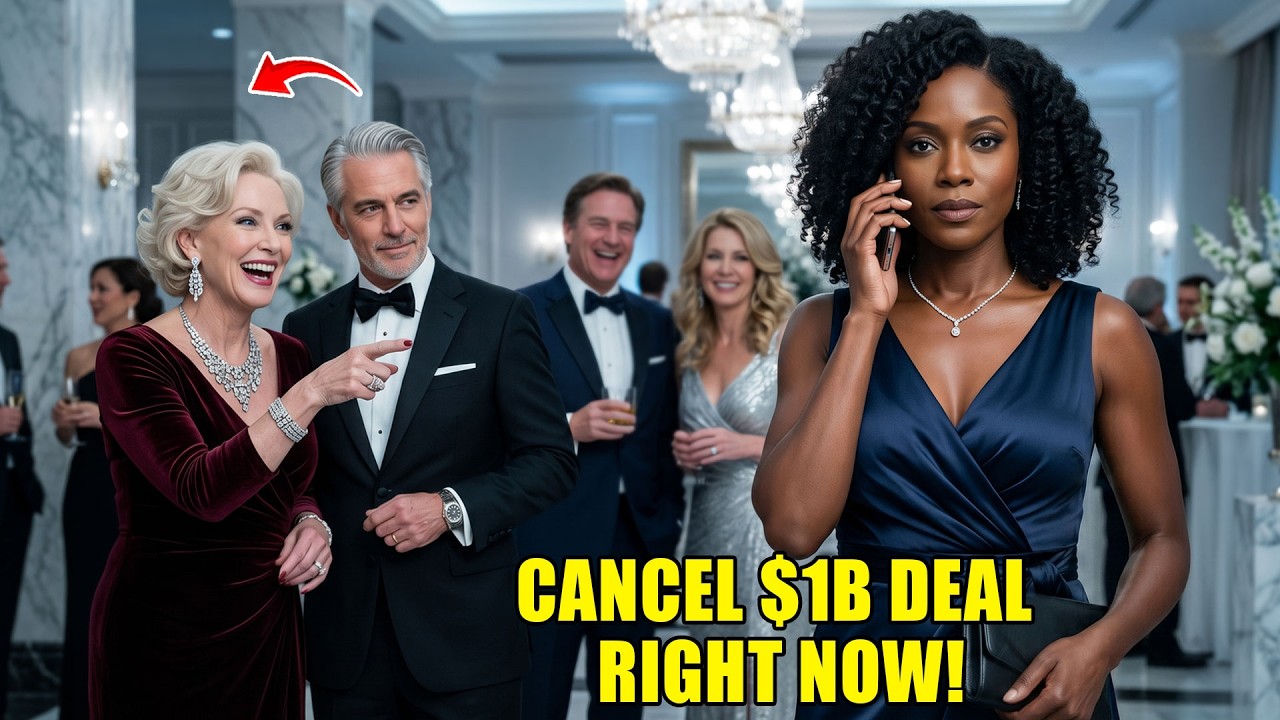
The woman who ended it was standing alone near the entrance to the VIP section, wearing a navy-blue dress with no visible designer label and carrying a small black clutch.
Her name was Maya Brooks.
She was forty-two years old and the founder and CEO of Apex Meridian Technologies, a company valued at nearly forty billion dollars.
Most people in the ballroom did not recognize her.
That was partly intentional.
Maya did not attend many society events. She rarely appeared on magazine covers, declined most television interviews, and had never built her reputation through celebrity.
She had built it through results.
Twenty years earlier, she had started her first company in Memphis with a twenty-thousand-dollar loan, two secondhand computers, and a rented office above a struggling insurance agency.
There had been no inheritance.
No wealthy spouse.
No family network opening private doors.
There had only been long nights, unpaid invoices, calculated risks, and the kind of discipline that comes from knowing failure will not be softened by a safety net.
By thirty-five, Maya had transformed Apex Meridian from a regional logistics software firm into a global technology and infrastructure company.
Her executives described working for her in an unusual way.
They did not say they were managed by Maya.
They said they were considered by her.
She listened before she spoke.
She asked questions other people overlooked.
And when she made a decision, she rarely repeated herself.
That evening, Maya had two reasons for attending the gala.
The first was personal.
For six years, she had quietly funded scholarships through the Sterling Education Foundation for young women from under-resourced communities.
Her name was never printed in the programs.
She had insisted on that.
Maya remembered what it was like to stand in a grocery store calculating whether buying a required textbook meant eating noodles for a week. She remembered avoiding phone calls from the university accounts office. She remembered sitting outside a lecture hall because she had not yet paid enough of her tuition balance to register.
She did not want applause for helping women avoid the same choices.
She wanted the help to reach them.
Her second reason for attending was business.
Richard Whitmore, chairman of Whitmore Industries, had invited several members of the acquisition consortium to the gala. Nothing formal was supposed to happen there, but the evening was expected to serve as a symbolic prelude to the signing.
Richard was sixty-one and had inherited Whitmore Industries from his father.
He spoke often about stewardship, legacy, and preserving what previous generations had built.
What he spoke about less often was innovation.
Under his leadership, Whitmore Industries had missed two major technology shifts, suffered repeated supply-chain failures, lost a government contract worth hundreds of millions, and taken on debt to cover shrinking margins.
The company still looked powerful from the outside.
Its name remained on buildings.
Its executives still attended the right dinners.
Its family still appeared in photographs beside governors, senators, university presidents, and hospital trustees.
But behind the polished image, Whitmore Industries was running out of options.
The Apex Meridian acquisition was not merely attractive.
It was survival.
Richard’s wife, Victoria, understood the social side of survival better than the financial side.
At fifty-eight, she was one of Atlanta’s most recognizable charity figures. She chaired committees, hosted luncheons, and knew which families had belonged to which clubs for generations.
Victoria often said she could read a room in under ten seconds.
What she meant was that she could decide who belonged in it.
She noticed Maya when Maya stepped toward the roped-off VIP section.
Victoria had been speaking to two donors near the entrance when she paused mid-sentence.
Her eyes moved over Maya’s dress, her clutch, her understated jewelry, and the absence of anyone accompanying her.
Then she stepped directly into Maya’s path.
“Excuse me,” Victoria said with a practiced smile. “This section is reserved.”
Maya stopped.
“Yes,” she said. “I know.”
Victoria’s smile tightened.
“May I see your invitation?”
Maya opened her clutch and handed over a thick cream-colored card.
Victoria glanced at it.
The card carried the correct embossed seal. It listed the VIP reception, table number, and private reception access.
But instead of stepping aside, Victoria turned the card over as though expecting to find evidence of fraud on the back.
“Where did you get this?”
Maya looked at her.
“It was sent to my office.”
“By whom?”
“The foundation.”
Victoria gave a short laugh.
“I’m sure there’s been some confusion.”
“There hasn’t.”
The answer was calm.
Not defensive.
That seemed to irritate Victoria more than an argument would have.
She looked around for a staff member, then lowered her voice.
“This area is for principal donors, corporate sponsors, and invited leadership.”
“I’m aware.”
“And you’re saying you are seated here?”
“My table is inside.”
“Name?”
“Maya Brooks.”
Victoria repeated it slowly, but there was no recognition in her face.
Maya waited.
Around them, guests continued moving through the ballroom, though several had begun to notice the delay.
Victoria held the invitation between two fingers.
“I’m going to need you to stand aside while I have this checked.”
“You can check it now,” Maya said. “Call the event director.”
Victoria blinked.
“I said you need to stand aside.”
“And I said you can verify it.”
Maya did not raise her voice.
She did not step forward.
She simply remained where she was.
That refusal, quiet as it was, changed the atmosphere.
Victoria was accustomed to people responding to her status before they responded to her words. Staff members hurried when she frowned. Committee members apologized before understanding why. Guests deferred because they recognized the social risk of not doing so.
Maya showed no sign of recognizing that risk.
Victoria stepped closer.
“You are causing a disruption.”
“I am standing in front of my assigned section.”
“You are refusing a reasonable request.”
“You have my invitation in your hand.”
By then, at least twenty people were watching.
A server had stopped near the wall.
A young event coordinator stood several feet away, uncertain whether she was permitted to intervene.
One man discreetly lifted his phone.
Victoria noticed the attention.
She also noticed that Maya still had not moved.
Her face changed.
The polite expression disappeared first.
Then the voice.
“I don’t know what arrangement you think you have,” she said, “but you do not simply walk into a private area because you’re holding a card.”
Maya’s gaze dropped briefly to the invitation in Victoria’s hand.
“Give it back.”
Victoria stared at her.
“Excuse me?”
“My invitation.”
The room around them seemed to narrow.
Victoria reached out and closed her hand around Maya’s forearm.
It was not a light touch.
She pulled.
“Move aside.”
Maya looked down at Victoria’s hand.
Then back at her face.
“Let go of me.”
The words were clear enough for everyone nearby to hear.
Victoria did not let go.
Instead, perhaps because people were watching, perhaps because Maya had refused to shrink, she tightened her grip.
“You do not dictate terms to me in this room.”
Maya’s voice remained level.
“Take your hand off me.”
What happened next was so sudden that several witnesses later disagreed on the exact movement.
Victoria released Maya’s arm.
Then she lifted her hand and struck her across the face.
The sound cracked through the ballroom.
The string quartet stopped.
A champagne glass tipped from someone’s hand and shattered against the floor.
Maya’s head turned slightly from the impact.
For one second, no one moved.
Not the donors.
Not the executives.
Not the event staff.
Nearly forty people had seen it.
Some looked away.
Some stared.
Two people continued recording.
Maya slowly raised her fingers to her cheek.
She did not cry.
She did not shout.
She touched the spot as though confirming a piece of information.
Her eyes returned to Victoria.
There was no panic in them.
No humiliation.
Only focus.
Victoria took a breath and straightened her shoulders.
For a brief moment, she appeared to believe she had restored order.
Then Richard Whitmore arrived.
He had been speaking with a banker near the bar when the silence drew his attention.
“What happened?” he asked.
Victoria turned toward him.
“This woman refused to leave the restricted section.”
Richard looked at Maya, then at the guests surrounding them.
He did not ask whether his wife had struck her.
He did not ask whether Maya was injured.
Instead, he said, “Victoria is responsible for maintaining standards here. I’m sure this could have been avoided with a little cooperation.”
Maya studied him for a moment.
That sentence mattered more than he understood.
She reached into her clutch and took out her phone.
Victoria folded her arms.
Richard looked impatient.
Maya made one call.
When the person answered, she said only this:
“Daniel, withdraw us from Whitmore. Cancel tomorrow morning. Notify legal and the consortium now.”
She ended the call before anyone could respond.
Then she took her invitation from Victoria’s hand, walked past the velvet rope, and entered the VIP section.
No one stopped her.
At her table, a place card read:
MAYA BROOKS
FOUNDER AND CEO
APEX MERIDIAN TECHNOLOGIES
She sat down.
Several people nearby saw the card.
One woman covered her mouth.
Across the ballroom, Victoria was still speaking to Richard in a low, agitated voice.
Neither of them had understood yet.
Upstairs, in a private conference suite, Daniel Cho, Apex Meridian’s general counsel, was reviewing the final transaction binder when Maya’s call came through.
He did not ask whether she was certain.
People who worked closely with Maya knew that she did not issue emotional instructions disguised as strategic decisions.
If she said withdraw, the decision had already been made.
Within three minutes, the lead acquisition attorney was called.
Within seven, the investment bank advising the transaction was notified.
Within fifteen, the consortium received formal notice that Apex Meridian was suspending and withdrawing its offer.
The signing scheduled for nine o’clock the next morning was canceled.
Eleven months of negotiation ended before the gala served its main course.
Downstairs, Richard was still holding a glass of bourbon when Gerald Pierce, one of the consortium’s senior advisers, approached him.
Gerald’s face was pale.
“We have a problem.”
Richard sighed.
“Not now.”
“The deal is gone.”
Richard lowered the glass.
“What?”
“Apex withdrew.”
“That’s impossible.”
“They notified everyone.”
Richard stared at him.
“Over what?”
Gerald looked toward the VIP section.
“An instruction from their CEO.”
Richard’s expression hardened.
“Their CEO isn’t even here yet.”
Gerald did not answer immediately.
Then he pointed toward Maya’s table.
“Yes,” he said. “She is.”
Richard followed his gaze.
Maya was seated beneath the soft gold light of the chandelier, speaking quietly with the foundation’s executive director.
The woman beside her was showing her a scholarship report.
Maya’s cheek was beginning to redden.
Richard stopped breathing for a moment.
Gerald continued.
“That is Maya Brooks.”
The recognition moved through Richard’s face in stages.
Confusion.
Denial.
Calculation.
Then fear.
He turned to Victoria.
She was standing several feet away, still surrounded by two women who had been assuring her that she had done what anyone would have done.
Richard crossed the floor quickly.
“Who did you hit?”
Victoria frowned.
“What kind of question is that?”
“Who did you hit?”
Her confidence faltered.
“The woman who tried to enter the section.”
“Her name.”
“She said Maya Brooks.”
Richard closed his eyes.
When he opened them again, his face had lost its color.
Around them, the truth was spreading.
A financier recognized Maya.
Then a technology executive.
Then the chair of the foundation board.
The murmurs moved through the ballroom faster than any formal announcement could have.
Victoria looked toward Maya’s table.
For the first time that evening, she saw not a woman she had judged, but a force she had failed to understand.
Her lips parted.
No words came out.
The hand that had struck Maya dropped to her side.
Richard hurried across the room.
By then, everyone was watching.
“Maya,” he said as he reached the table.
She looked up.
He glanced at the people seated around her.
“Could we speak privately?”
“No.”
The answer was quiet.
Richard swallowed.
“Then let me say how deeply sorry I am for this terrible misunderstanding.”
Maya held his gaze.
“What was misunderstood?”
Richard hesitated.
“Your identity. Your role. Victoria had no idea who you were.”
Maya leaned back slightly.
“That is not an apology.”
Richard’s face tightened.
“She believed you weren’t authorized to enter.”
“She had my invitation.”
“She made a mistake.”
“No,” Maya said. “She made a decision.”
The nearby tables had gone silent.
Richard lowered his voice.
“Please understand, this deal affects thousands of employees.”
“I understand exactly what it affects.”
“Then you understand why we cannot allow one personal incident to destroy eleven months of work.”
Maya’s expression did not change.
“This was not a personal incident.”
Richard looked at her.
“Your wife believed I was unimportant,” Maya continued. “She believed I had no influence, no protection, and no one in the room willing to defend me.”
Victoria had approached behind him.
Maya looked at her now.
“And based on that belief, she decided she could humiliate me, put her hands on me, and strike me in public.”
Victoria’s mouth trembled.
“I was trying to maintain order.”
Maya nodded once.
“That is what you call it when the person being hurt has less power than you.”
No one moved.
Richard glanced at the surrounding executives.
“This can be resolved.”
“It already has been.”
“Maya, please.”
She turned back to him.
“If this is how your family treats a stranger you believe does not matter, then I cannot trust you with a billion-dollar partnership.”
Richard had spent his life in rooms where his name carried weight.
At that moment, it carried none.
The gala continued, but the evening never recovered.
By midnight, people in Atlanta’s banking and legal circles were already discussing what had happened.
By the next morning, several business reporters had begun making calls.
A short video of the slap had also started circulating privately among donors and executives.
Maya did not release it.
She did not need to.
The event had too many witnesses.
Whitmore Industries issued a statement describing the incident as “an unfortunate personal misunderstanding during a crowded charitable event.”
The statement did not mention the slap.
It did not mention Maya by name.
It did not explain why the acquisition had collapsed hours later.
That omission made the story worse.
Institutional investors began demanding answers.
Creditors requested updated financial projections.
The board of Whitmore Industries held an emergency meeting that lasted six hours.
Without Apex Meridian’s offer, the alternatives were severe.
Asset sales.
Debt restructuring.
Workforce reductions.
Loss of family control.
For years, Richard had believed that the Whitmore name represented stability, respectability, and civic leadership.
Now he was forced to confront a different possibility.
Perhaps the family had not been preserving a legacy.
Perhaps it had been hiding behind one.
Victoria withdrew from public events.
Friends said she was devastated.
But what unsettled her most was not simply the possibility of public shame.
It was the collapse of her confidence in her own judgment.
For decades, she had believed she could identify value immediately.
She believed clothing, accent, posture, family name, and social familiarity told her who a person was.
That night proved that what she called instinct was often prejudice wearing elegant clothes.
Ten days after the gala, Maya met with Apex Meridian’s senior leadership team.
She did not discuss the video.
She did not describe herself as a victim.
She did not ask the company to issue statements in her defense.
She spoke for less than five minutes.
“We evaluate partners through financial performance, operational discipline, and leadership character,” she said. “Character is most visible when people believe no one important is watching.”
No one interrupted.
“Our decision stands. Move the team to the alternative acquisition list.”
Then she opened the next item on the agenda.
Maya treated the slap as data.
Not identity.
Not destiny.
Data.
Apex Meridian eventually acquired a smaller manufacturing company based in North Carolina.
It had less prestige than Whitmore Industries.
Its headquarters did not occupy a historic downtown tower.
Its founders were not photographed at major galas.
But the company had strong operations, clean governance, and leaders who treated warehouse employees with the same seriousness they gave investors.
The acquisition closed quietly.
Within a year, the combined operation exceeded its performance targets.
Whitmore Industries was not as fortunate.
It entered a restructuring agreement on far harsher terms than the Apex offer.
The Whitmore family retained ceremonial influence but lost much of its practical control.
Richard remained visible at public events, but his presence changed.
People still shook his hand.
They simply no longer waited for his opinion.
Eight months after the gala, Richard requested a private meeting with Maya through a mutual attorney.
No bankers.
No assistants.
No business proposal.
Maya agreed.
They met in a small conference room at a neutral law office.
Richard arrived early.
He looked older than he had at the gala.
For several moments after Maya sat down, he said nothing.
Then he folded his hands.
“I’ve spent eight months thinking about that night.”
Maya waited.
“Not only about what Victoria did,” he continued, “but about what I did. What I assumed. What I defended without even asking what had happened.”
He looked down.
“I told myself for years that my family represented certain values. I now understand that we often expected others to believe that simply because we had always said it.”
Maya remained still.
Richard gave a tired smile.
“I wish we had met under different circumstances.”
Maya looked directly at him.
“We met under the right circumstances.”
He looked up.
“Your family showed me the truth.”
Richard did not argue.
There was no dramatic forgiveness.
No renewed deal.
No promise that everything could be repaired.
Some lessons arrive too late to prevent consequences.
That does not make them meaningless.
It only makes them expensive.
Richard stood and offered his hand.
Maya shook it once.
Then she left.
She did not celebrate the decline of Whitmore Industries.
She did not build a campaign around Victoria’s humiliation.
She returned to her company, her employees, her scholarships, and the work that had brought her into that ballroom in the first place.
The slap lasted one second.
But the decision Maya made afterward carried the weight of eleven months of negotiations, one billion dollars, and generations of unexamined entitlement.
Her strength was not that she shouted louder.
It was that she did not need to.
The woman they believed did not belong in the room was the only person in it who could decide who remained standing when the music stopped.
And that is the thing powerful people often learn too late:
The way you treat someone you believe is beneath you may be the clearest proof that you were never above them at all.