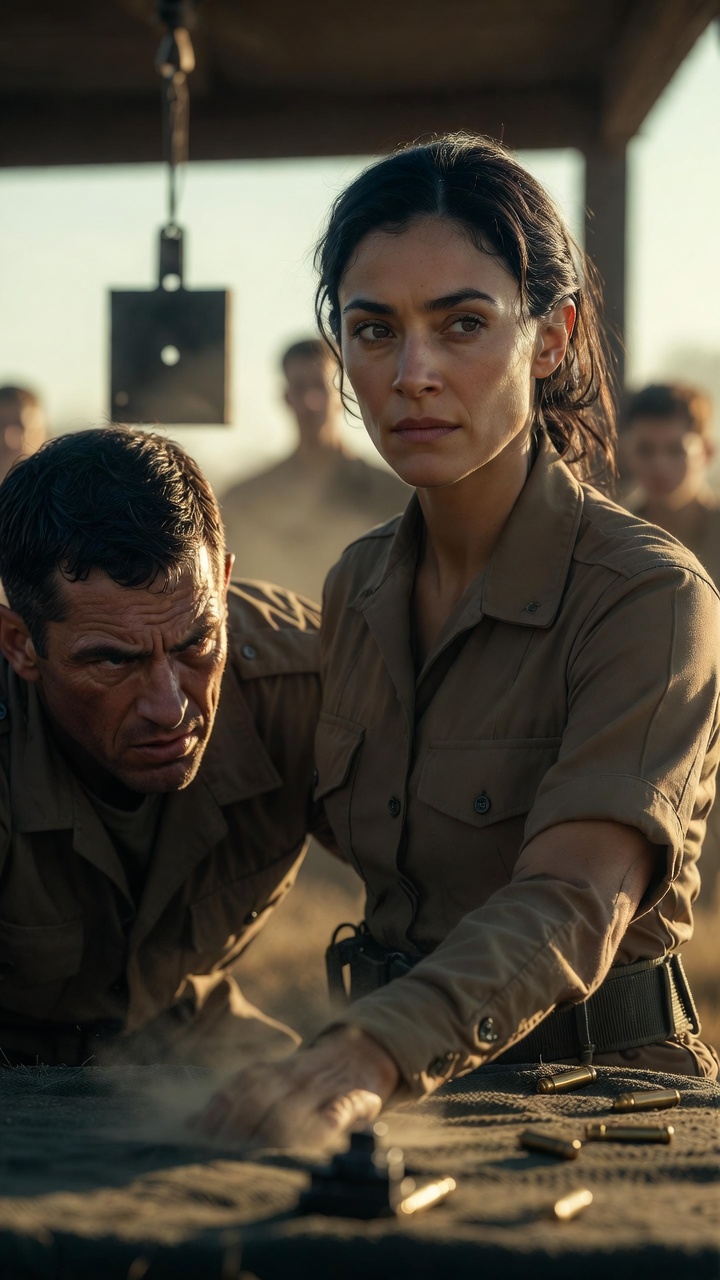
The rifle cracked before anyone gave the command.
For half a second, nobody moved.
Then the steel plate at the far edge of the range—so distant that it looked no larger than a coin through the heat shimmer—snapped backward and split loose from one of its chains.
The sound reached them a moment later.
A sharp metallic scream rolled across the dry ground.
Thirty-two recruits turned toward the firing line.
So did Gunnery Sergeant Daniel Mercer.
The woman behind the rifle did not.
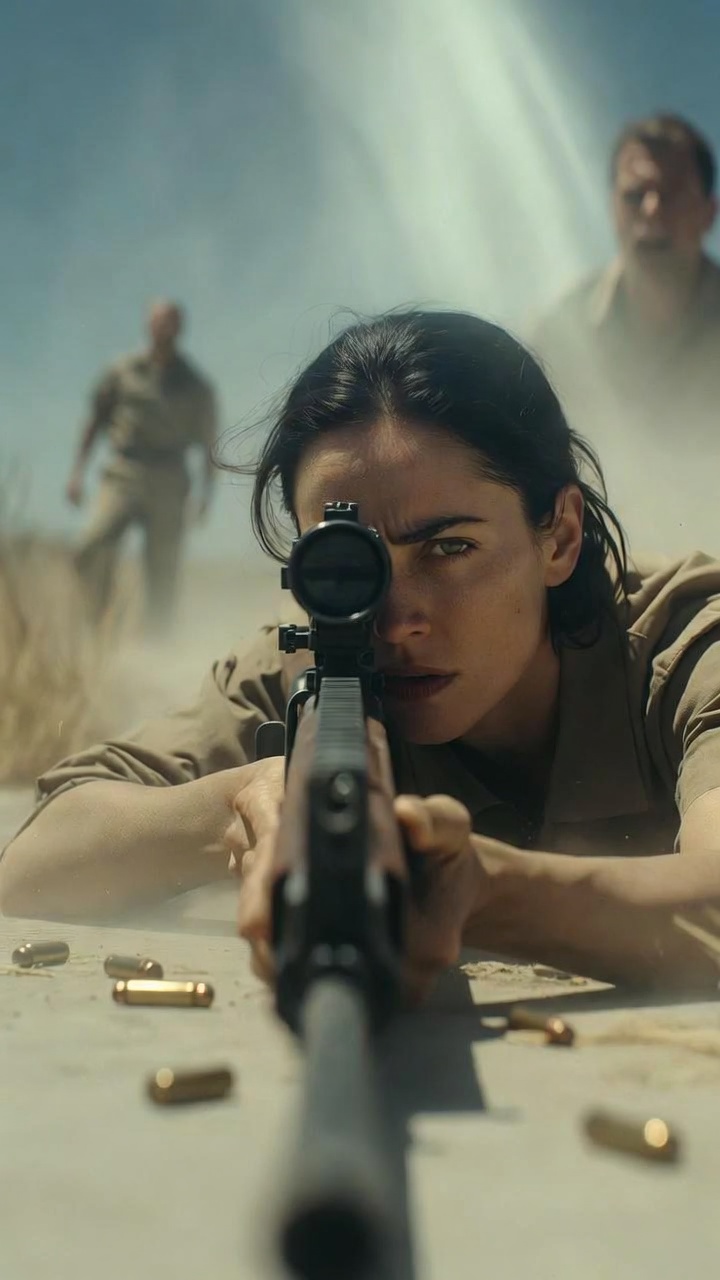
She stayed pressed against the stock, her right eye behind the scope, her breathing slow and controlled as dust drifted around her boots.
Mercer’s face hardened.
“Who authorized that shot?”
The outdoor range had been brutal since sunrise.
Heat pressed down on the concrete firing lanes. Wind dragged fine dust across the ground and sent empty brass rolling in small circles near the benches. The smell of burnt powder hung in the air, mixing with sweat, hot metal, and dry grass.
This was not a demonstration.
It was an elimination test.
Every recruit standing there knew it.
The results from that morning would determine who advanced to the precision rifle program and who returned to a standard infantry assignment. Months of preparation had narrowed down to a handful of targets, a stopwatch, and the ability to remain steady while someone watched for failure.
Mercer had explained the rules only once.
“You hit, or you go home,” he had said. “Out there, nobody gives you a second round because your hands were shaking.”
No one doubted him.
He had spent more than twenty years in the Marine Corps, much of it in places that never appeared in recruitment videos. His left forearm carried a pale scar from wrist to elbow. He walked with a slight stiffness in cold weather. When he spoke, even officers tended to stop talking.
That morning, he had already failed four recruits.
One had rushed his trigger.
One had misread the wind.
Two had simply frozen.
The rest were waiting behind the line, trying not to look nervous.
Then there was the woman.
She appeared to be in her late thirties, perhaps early forties. Her uniform was clean but plain. No rank. No unit patch. No name tape. Nothing that explained why she had arrived with a temporary access badge clipped to her belt.
On Mercer’s roster, she had been listed with a single word.
OBSERVER.
Observers did not fire.
They watched. They took notes. They stayed out of the way.
She had done exactly that for most of the morning.
She stood near the rear barrier with her arms loosely folded, saying nothing while the recruits cycled through the firing positions. She did not criticize their posture. She did not speak to the range staff. She barely reacted when Mercer raised his voice.
The recruits noticed her anyway.
They always noticed someone who did not fit.
A few assumed she was an administrator.
One whispered that she might be from logistics.
Another joked quietly that someone from headquarters had probably sent her to write a report about heat safety.
She heard them.
Her expression never changed.
Mercer had ignored her because he had more important problems.
By noon, his patience was thinning.
He called the remaining recruits forward and looked down the line of tense faces.
“Any actual marksmen here?”
No one answered.
A few recruits lowered their eyes.
Mercer waited.
The silence stretched until it became embarrassing.
That was when the woman stepped toward the empty rifle station at the end of the line.
No announcement.
No request.
She checked the chamber of the rifle resting on the mat, adjusted the stock by less than an inch, and lowered herself into position.
Several recruits looked at one another.
Mercer saw her movement but assumed she was inspecting the equipment.
Then the shot broke.
And the farthest target on the range came apart.
Now Mercer strode toward her.
“I asked who authorized that shot.”
The woman lifted her cheek from the stock.
“No one,” she said.
Her voice was quiet.
Mercer stopped beside the mat.
“You fired a live weapon on my range without a command.”
“Yes.”
A murmur moved through the recruits.
Mercer glanced at the shattered plate in the distance, then back at her.
“That target is nine hundred and eighty meters.”
“I know.”
“The wind is shifting cross-range.”
“I noticed.”
Mercer’s jaw tightened.
“Was that supposed to impress me?”
The woman looked through the scope again.
“No.”
That answer irritated him more than an apology would have.
Behind them, one recruit whispered, “She got lucky.”
The woman’s left hand moved to the adjustment turret.
One click.
Then another.
The range spotter, Corporal Mason, watched her through his binoculars. His posture changed slightly as he realized what she was doing.
“She’s correcting for the gust,” he said.
Mercer turned.
“I didn’t ask you.”
Mason lowered the binoculars.
“Yes, Gunny.”
The woman settled behind the rifle again.
Mercer’s voice dropped.
“Step away from the weapon.”
She did not move.
At that moment, a red moving target began crossing the distant track. It was part of the next test sequence, a narrow steel silhouette pulled laterally by a motorized cable.
The recruits saw it.
So did Mercer.
The woman exhaled.
The rifle fired.
The moving silhouette jerked sideways.
The spotter’s eyes widened.
“Impact,” Mason said.
The target had been in motion for less than three seconds.
Mercer stared at it.
The woman cycled the bolt smoothly.
A spent casing spun through the sunlight and landed near her right elbow.
“Enough,” Mercer said.
She remained behind the scope.
A third target had begun to swing beyond the moving track. It was smaller, suspended between two posts and pushed irregularly by the wind.
The woman watched it.
Mercer watched her.
He had trained enough shooters to recognize the difference between confidence and recklessness.
Reckless shooters moved too quickly.
They forced the shot.
They fought the rifle.
This woman did none of those things.
She did not chase the target through the scope. She allowed it to return into her sight picture. Her shoulder stayed relaxed. Her breathing became almost invisible.
She waited through one swing.
Then another.
The wind lifted dust from the berm.
She fired.
The hanging plate stopped in the center of its arc.
For a moment, it seemed untouched.
Then a dark mark appeared almost perfectly in the middle.
Mason looked down at the range data tablet, then back through his optic.
“That’s an eleven-hundred-meter hit,” he said.
No one spoke.
The recruits who had joked about logistics were no longer smiling.
Mercer looked at the woman as she opened the bolt and inspected the chamber.
Three shots.
Three hits.
Different distances.
Different target movement.
Different wind conditions.
No warm-up round.
No missed correction.
No visible hesitation.
Mercer had seen talented shooters in his career.
He had trained some.
Buried others.
But there was something unsettling about the ease with which she had done it. Not because the shots were technically impossible. They were not.
What bothered him was how ordinary she had made them look.
Like signing a form.
Like closing a door.
He crouched beside her.
“Who are you?”
She removed the magazine.
“An observer.”
“Observers don’t shoot.”
“Today, one did.”
A few recruits lowered their heads, hiding reactions they did not want Mercer to see.
He ignored them.
“Who gave you range clearance?”
“The front office.”
“There’s no unit on your badge.”
“No.”
“No rank.”
“No.”
“No service number on my roster.”
She looked at him for the first time.
Her eyes were calm, but not empty.
“Then your roster is accurate.”
Mercer studied her face.
There was no arrogance in it.
That made the situation worse.
People who wanted to show off usually enjoyed the attention afterward. They smiled. They explained. They looked around to see who had noticed.
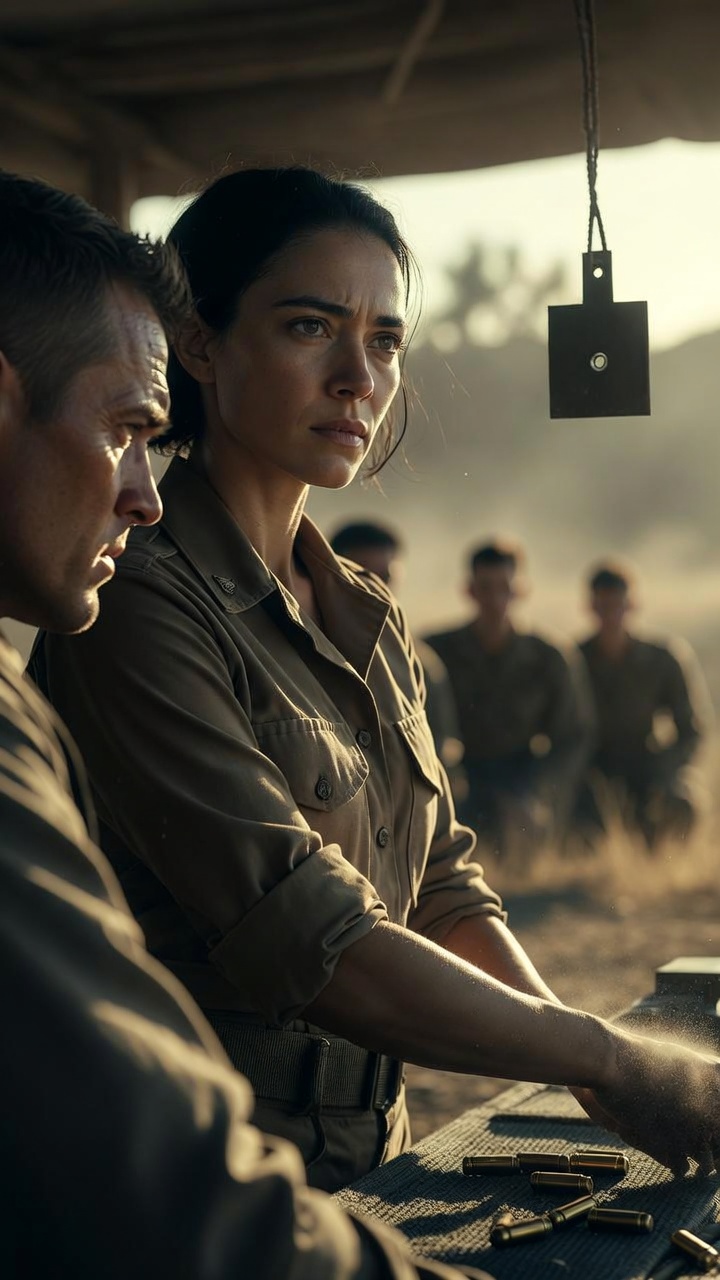
She seemed almost inconvenienced by the conversation.
Mercer pointed toward the broken targets.
“Who trained you?”
Something changed across her expression.
Not fear.
Not pride.
Only a brief stillness, as if the question had opened a door she preferred to keep closed.
Then she stood, placed the rifle safely on the mat, and brushed dust from one sleeve.
“No one still alive,” she said.
The recruits went silent in a different way.
Before, they had been shocked by skill.
Now they were trying to understand the weight of the answer.
The woman picked up her plain canvas bag.
She checked the firing line one final time, then walked toward the gate.
No salute.
No explanation.
She did not look back.
The recruits moved aside before she reached them.
Not because Mercer ordered them to.
They simply did.
He watched her pass through the gate and disappear behind the equipment building.
Then he looked down.
Three brass casings lay on the mat, still warm.
Mercer picked one up between his fingers.
The metal held the heat of the shot.
He turned toward the recruits.
Thirty-two faces waited for him.
Some looked embarrassed. Others looked inspired. A few looked as if they had just realized how far they still had to go.
Mercer slipped the casing into his pocket.
“Back on the line,” he said.
No one moved slowly.
For the rest of the afternoon, there was no complaining.
No joking.
No recruit asked for more time.
When Mercer corrected their breathing, they listened. When he told them their trigger control was poor, they adjusted it. When he said the wind was not an excuse, nobody argued.
Before the final round, Mercer pointed toward the farthest target.
“That,” he said, “is the standard.”
The recruits followed his finger.
The plate still hung at an angle from one remaining chain.
Mercer did not tell them who the woman was.
At that point, he did not know.
By evening, the story had spread across the base.
It changed each time someone repeated it.
Some said the target had been twelve hundred meters away.
Some said she fired without using a scope.
One version claimed she had hit all three plates before the first casing touched the ground.
The exaggerations were easy to dismiss.
The camera footage was not.
The range system had recorded everything from four angles.
At 19:40, two technicians from base security entered the review room and pulled the files.
They watched the first shot in real time.
Then at half speed.
Then frame by frame.
They measured the interval between the target movement and trigger break. They reviewed environmental readings from the weather station. They checked the rifle’s maintenance record and ammunition lot.
Nothing was wrong with the equipment.
Nothing had been edited.
The shots were real.
By 08:00 the next morning, Gunnery Sergeant Mercer had been ordered to report to the administration building.
Colonel Richard Halden was waiting behind a wide metal desk.
Halden was not known for wasting words.
A printed photograph from the range footage lay in front of him. It showed the woman behind the rifle, dust frozen in the air around her.
Mercer stood at attention.
“You let an unidentified civilian fire on a controlled range,” Halden said.
“She wasn’t a civilian, sir.”
“You know that?”
“No, sir.”
Halden leaned back.
“Then why did you say it?”
Mercer looked at the photograph.
“Because civilians don’t make those shots.”
Halden held his gaze for several seconds.
Then he opened a laptop.
“We checked her entry log.”
Mercer waited.
“No legal name,” Halden continued. “No service number. No unit code. Her authorization field contains one line.”
He rotated the screen.
Mercer read the message.
ACCESS APPROVED AT EXECUTIVE LEVEL. DO NOT DELAY. DO NOT QUESTION.
Mercer looked up.
“That was enough to let her onto the base?”
“It was enough to let her onto any base.”
Halden opened a desk drawer and removed a thin folder sealed in a gray security sleeve.
There was no label on the front.
He broke the seal.
Most of the first page was covered by black redaction bars.
So was the second.
On the third page, Mercer saw an old photograph of six people standing in front of a transport aircraft. Their faces were obscured, but one figure had the same posture as the woman from the range.
Straight-backed.
Still.
Separate from the others without appearing distant.
At the top of the page were two visible words.
PHANTOM MARKSMAN.
Mercer had heard the phrase once.
Years earlier.
A senior instructor had mentioned it after too many drinks, then refused to repeat it the next morning.
Mercer had assumed it was a story.
“What was the program?” he asked.
Halden closed the folder halfway.
“It was not a standard sniper unit.”
“Special operations?”
“That description would be incomplete.”
Mercer waited.
Halden glanced toward the closed office door.
“The program studied precision engagement under conditions where conventional doctrine failed. Extreme distance. Limited observation. Unstable platforms. Urban obstruction. High-value targets with narrow exposure windows.”
“And she graduated from it?”
Halden looked at him.
“No.”
Mercer said nothing.
Halden turned to another page.
“She helped build it.”
The room seemed quieter.
“The breathing sequence you teach during final approach,” Halden said, “came from a field document she co-authored.”
Mercer’s eyes moved toward the folder.
“The variable-wind correction table used on your range was adapted from her after-action work.”
Mercer remembered every time he had taught those methods.
Every time he had corrected a recruit.
Every time he had presented the principles as established doctrine.
“She wrote the material?”
“Parts of it.”
“What parts?”
Halden gave a humorless smile.
“The parts I’m permitted to know.”
Mercer looked again at the photograph.
On the range, he had demanded to know who authorized her to fire.
He had treated her like an administrative mistake.
Worse, he had assumed her silence came from inexperience.
Now he understood that her silence came from something else.
She had nothing to prove to him.
The room’s ventilation hummed above them.
Mercer’s gaze fell to the three empty spaces in the photograph where faces had been blacked out.
“How many are still active?”
Halden’s expression closed.
“Classified.”
“How many are still alive?”
The colonel did not answer immediately.
Then he said, “Fewer than there should be.”
Mercer thought of her response on the range.
No one still alive.
The words felt different now.
Not dramatic.
Not threatening.
Literal.
Halden placed the file back inside its sleeve.
“She was not sent to demonstrate.”
“Then why was she there?”
“To observe the evaluation system.”
Mercer almost laughed, but the sound never came.
“She fired three rounds.”
“Yes.”
“Why?”
Halden looked toward the photograph on the desk.
“Maybe she saw something she disliked.”
Mercer understood.
The shaking hands.
The fear of public failure.
His challenge to the recruits.
Any actual marksmen here?
Perhaps she had not been answering him.
Perhaps she had been correcting the room.
Halden slid the photograph into the folder.
“This conversation stays here.”
“Yes, sir.”
“You will not ask her name.”
“Yes, sir.”
“You will not search for the program.”
Mercer hesitated.
“Yes, sir.”
Halden sealed the folder again.
As Mercer turned to leave, the colonel spoke one last time.
“Gunny.”
Mercer faced him.
“There are missions in the official record listed as equipment failures, internal collapses, or unexplained hostile losses.”
Mercer waited.
Halden rested one hand on the sealed file.
“Some of them were none of those things.”
That night, after the range had closed, Mercer returned alone.
The heat had finally broken.
Long shadows stretched across the firing lanes. The wind had died, leaving the hanging targets almost motionless in the distance.
He walked to the position where the woman had fired.
The mat had been removed, but a faint rectangle remained in the dust.
Mercer knelt.
He placed one hand on the wooden rifle support.
For years, he had believed experience gave a person the right to recognize competence on sight.
That morning had proven otherwise.
He had seen a woman without rank insignia, without a unit patch, without visible authority, and decided she did not belong.
The recruits had done the same.
Her first shot had not merely broken a target.
It had broken an assumption shared by everyone on the range.
Mercer reached into his pocket.
He had kept all three casings.
He set them side by side on the wooden support.
Each looked ordinary.
Small brass cylinders.
Nothing about them explained the silence afterward.
Nothing about them revealed the classified pages, the dead instructors, or the doctrine written by a woman whose name could not appear on a roster.
Yet they were proof.
By the next morning, Mercer had contacted the base machine shop.
He gave the technician a simple request.
A small bronze plate.
Two words.
No date.
No name.
No unit insignia.
Three weeks later, the plate was bolted to the wooden post above the farthest target on the range.
SILENT PROOF.
New recruits always asked what it meant.
Mercer never gave them the entire story.
He would point toward the distant plate and tell them that skill did not announce itself, authority did not always wear rank, and the most dangerous person in a room might be the one nobody thought to question.
Some recruits believed him.
Others assumed it was another military legend designed to frighten students into paying attention.
The veterans never laughed.
A few had seen the footage before it disappeared from the local server.
One had been in the review room.
Another had picked up a fragment of the first target after it broke from its chain.
They never shared details.
They only looked toward the bronze plate with the same guarded expression.
Years passed.
Mercer’s hair turned gray at the temples. His old injuries stiffened. The range received new rifles, new optics, and updated electronic targets.
But the plate remained.
And every time a new class lined up under the hard sun, Mercer asked the same question.
“Any actual marksmen here?”
Usually, no one answered.
Mercer would let the silence settle.
Then, almost without meaning to, he would pause and look toward the farthest target.
For the briefest moment, part of him still expected to hear a rifle crack from the end of the line.
He never saw the woman again.
He never learned her name.
But three shots from a person everyone had dismissed changed the standard of an entire training ground.
Because true mastery does not need a title, a uniform, or permission to be recognized.
Sometimes, all it needs is one impossible target—and the silence that follows when everyone realizes how badly they judged the person who pulled the trigger.