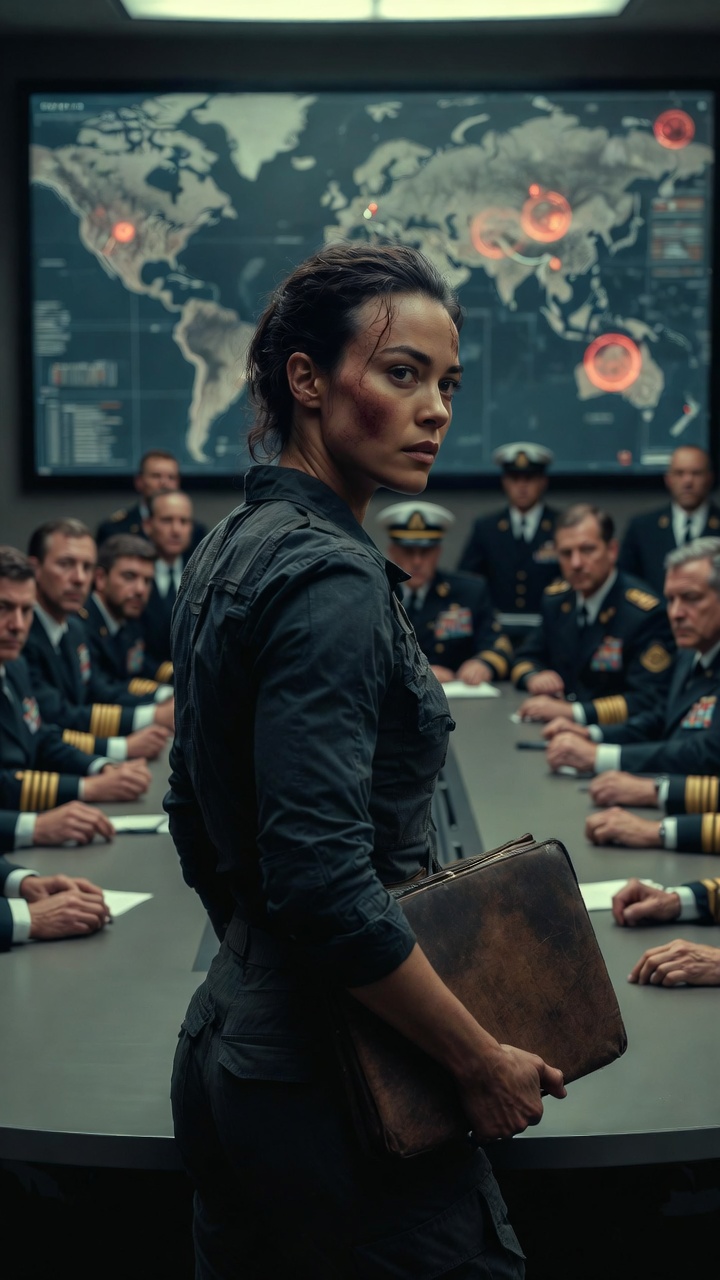
The woman entered the Naval Special Warfare Command briefing room without a uniform, without an escort, and without a single visible credential.
That was the first reason the officers dismissed her.
The second was that she walked directly toward the classified operations map as if the room belonged to her.
Twenty-three men sat around the long steel-gray table, most of them wearing rows of ribbons earned in places the public would never hear about. On the wall behind them, a digital map showed a narrow stretch of jungle, a river crossing, and three red circles marking suspected hostile positions.
At the head of the table, Admiral Thomas Mercer stopped mid-sentence.
“Can we help you?” he asked.
The question sounded polite.
The room heard the warning underneath it.
The woman looked to be in her early forties, though the faint scars near her jaw made age difficult to judge. She wore dark civilian clothes and carried a weathered leather folder under one arm. Her hair was tied back. No jewelry. No unit patch. No visitor badge.
She studied the map for several seconds before answering.
“You moved the insertion point.”
A few officers exchanged amused looks.
Commander Ellis, who had been briefing the mission, leaned back in his chair.
“That information isn’t available to visitors.”
The woman pointed to the northern ridge.
“You originally planned to enter here. Someone changed it to the eastern basin within the last seventy-two hours.”
Ellis gave a quiet laugh.
“Ma’am, unless you’ve been hiding a satellite under that jacket, I suggest you step away from the display.”
Several men smiled.
Admiral Mercer did not.
He was watching the woman’s eyes.
She wasn’t searching the map.
She was remembering it.
Mercer folded his arms. “Who authorized you to enter this room?”
She finally turned toward him.
“No one who still uses their real name.”
The smiles faded slightly.
One captain glanced toward the security officer by the door, but the officer stood perfectly still. His face had gone pale.
Mercer noticed.
“What unit?” the admiral asked.
“No current unit.”
“Rank?”
“Not relevant.”
Commander Ellis shook his head. “This is ridiculous.”
The woman ignored him.
Mercer’s voice hardened. “Then give me something relevant. A name. A designation. A callsign.”
For the first time, she looked directly at him.
“Iron Widow.”
The room went silent.
Not gradually.
Instantly.
A pen slipped from someone’s hand and struck the table.
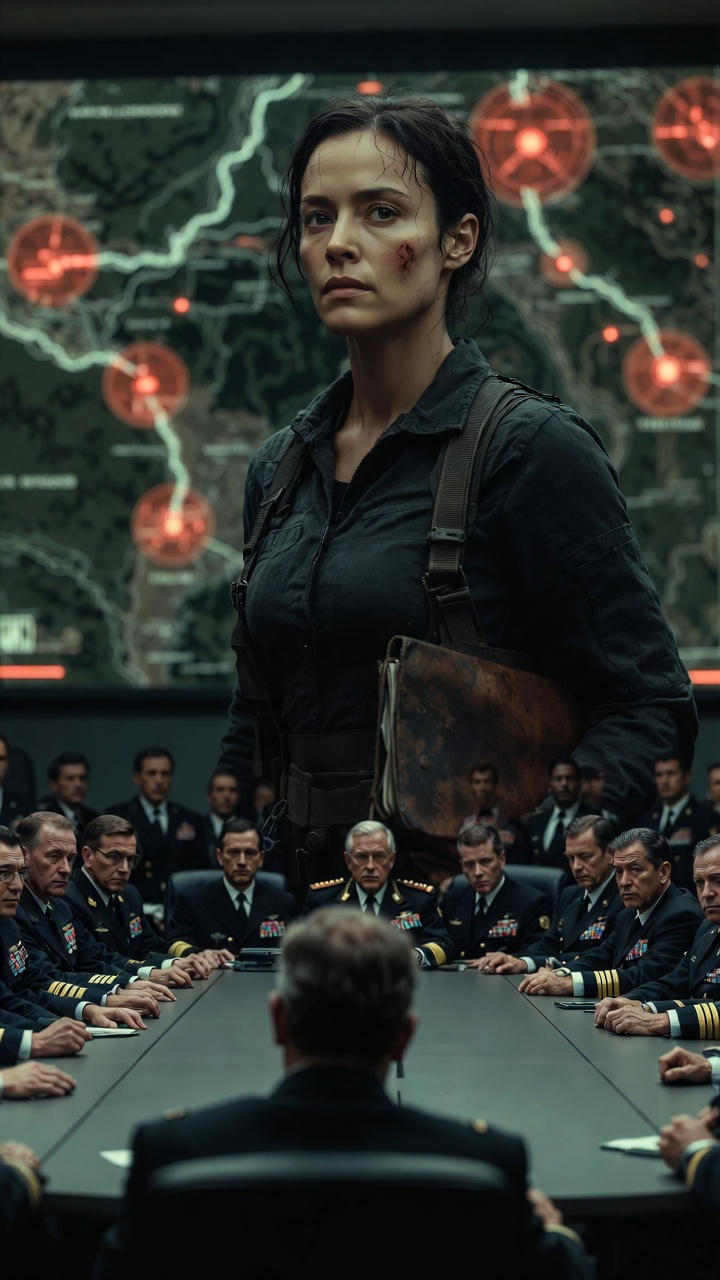
Commander Ellis stopped smiling.
One of the older officers near the wall slowly lowered his coffee. He had served in intelligence before transferring to Special Warfare, and the color drained from his face as if someone had opened a door to a room he had spent years trying to forget.
Admiral Mercer stared at the woman.
“That callsign was retired.”
“No,” she said. “It was buried.”
Mercer’s jaw tightened.
“Iron Widow died twelve years ago.”
“That was the required version.”
No one moved.
The woman placed the leather folder on the table and removed a black document envelope sealed with two red bands. Across the front were markings that only four people in the room were cleared to recognize.
Commander Ellis stood.
“Where did you get that?”
She slid the envelope toward Admiral Mercer.
“From the place your current briefing says doesn’t exist.”
Mercer did not touch it immediately.
The mission on the screen was called Operation Glass Harbor. A six-man team was scheduled to enter the jungle in forty-eight hours, locate three hostages, confirm the presence of an illegal weapons network, and leave before sunrise.
On paper, it was difficult.
Not impossible.
The woman looked again at the eastern basin.
“If you send them through that landing zone, none of them will reach the river.”
Ellis scoffed, but the sound lacked confidence now.
“We’ve had surveillance over that region for six weeks.”
“You’ve had images,” she replied. “That isn’t the same as surveillance.”
“We have thermal passes, intercepted communications, movement analysis—”
“All supplied through the same intelligence channel.”
Ellis paused.
The woman continued.
“The eastern basin is supposed to appear empty. That is its purpose.”
Admiral Mercer finally picked up the envelope.
The seal carried an authorization code issued by the Joint Chiefs more than a decade earlier.
He recognized the date.
He also recognized his own initials.
The briefing room seemed to shrink around him.
“Clear the room,” Mercer said.
No one responded at first.
He looked up.
“Everyone except Commander Ellis. Now.”
Chairs moved quickly. Officers collected notebooks and tablets without speaking. As they passed the woman, none of them made eye contact.
The older intelligence officer stopped at the door.
He looked at her scarred hands.
“House Ion?” he whispered.
She gave no answer.
He left anyway.
When the door closed, Mercer placed the envelope on the table between them.
Commander Ellis remained standing.
Mercer looked at the woman. “If you are who you claim to be, you were killed during Operation Widow.”
“I was declared killed.”
“The extraction team found wreckage. Blood. Equipment.”
“They found what they were instructed to find.”
Mercer broke the seal.
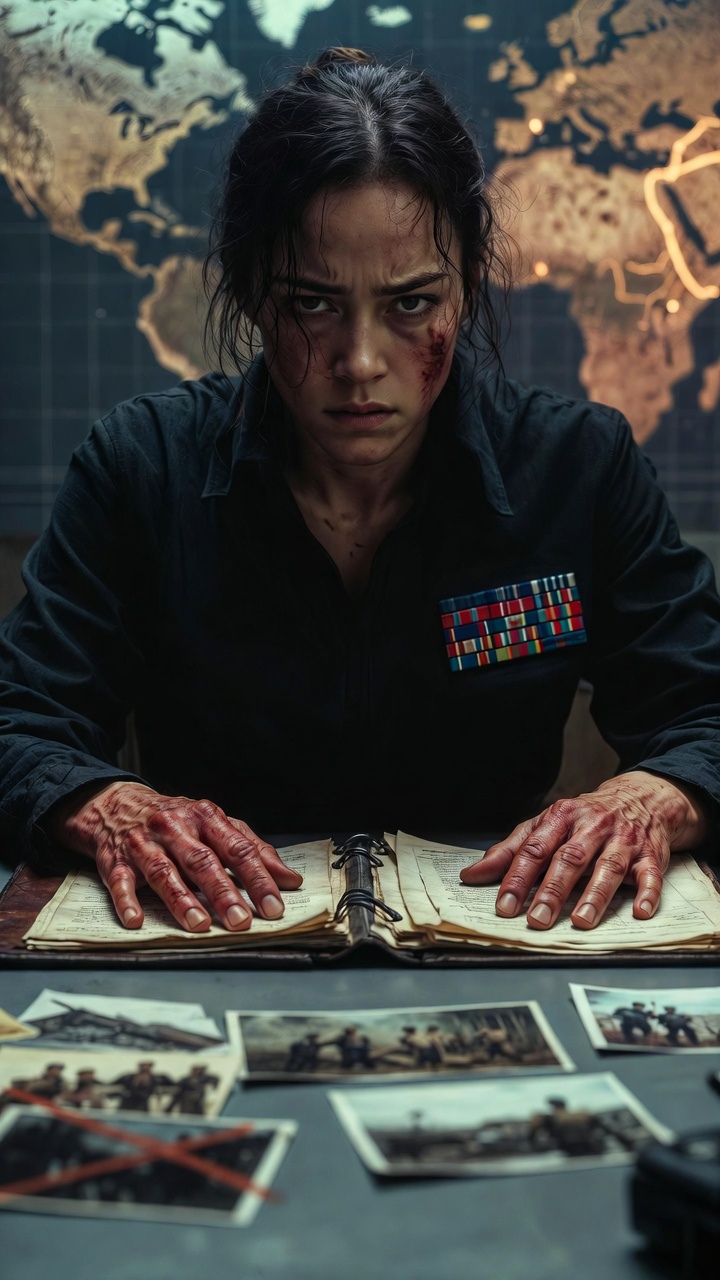
Inside were satellite photographs, drone logs, field reports, and images from a burned section of jungle. One photograph showed the remains of a convoy. Another showed scattered communications equipment near a blackened tree line.
At the bottom of the stack was an image of seven soldiers standing beside an unmarked helicopter.
Six of the faces had been crossed out in black ink.
The seventh belonged to the woman in the room.
Mercer sat down.
Commander Ellis stepped closer to the table.
“That photograph was never in the official archive.”
“There was no official archive,” she said.
Mercer examined the drone identification codes printed beneath the images. They matched systems that had been removed from service years ago. Beside them were timestamps from the night Operation Widow collapsed.
According to the report Mercer had received twelve years earlier, the team’s position had been compromised during a hostage extraction. Enemy forces had surrounded the site. Communications had failed. A secondary explosion had destroyed the transport vehicles.
There had been no survivors.
The operation had been sealed to prevent an international incident.
Mercer had accepted that explanation because accepting it had been convenient.
“I signed the casualty confirmation,” he said quietly.
“Yes.”
“You knew?”
“I watched the transmission go out.”
Mercer looked at her. “From where?”
“Three kilometers south, carrying the only hostage who was still alive.”
Commander Ellis stared.
The official report had listed all hostages as lost.
Iron Widow opened another section of the folder.
A photograph showed a young man wrapped in a military blanket inside a cargo aircraft. His face was bruised. His hands were bandaged.
Mercer recognized him.
Everyone in strategic command would have.
At the time of the operation, the man had been the son of a foreign defense minister. His death would have shattered a fragile alliance and exposed an unauthorized American presence inside disputed territory.
But he had not died.
He had been quietly returned home.
The alliance had survived.
The public had never known how close two governments had come to blaming each other.
“You brought him out alone?” Ellis asked.
Iron Widow looked at him.
“No one does anything alone. Six people bought the distance I needed.”
Her tone remained flat, but her thumb pressed against the edge of the photograph.
It was the first sign that the past had reached her.
Mercer turned to another page.
The report listed multiple hostile positions destroyed across the jungle corridor. For years, intelligence officers had spoken about those strikes as if they were the work of an unidentified allied unit.
They had not been.
“You cleared four positions,” Mercer said.
“Five.”
Ellis looked up sharply.
“The fifth site was House Ion?”
This time, Iron Widow answered.
“Yes.”
House Ion had been a covert detention facility operated through layers of contractors and deniable partnerships. When it burned, evidence of illegal prisoner transfers nearly reached the international press. Three allied intelligence networks had been dismantled within months.
The incident had been blamed on an electrical fire.
Rumors said one surviving operative had destroyed the site after discovering that the mission had been compromised from inside.
Mercer looked toward the door.
The men outside were probably already whispering her name through the building.
He returned his attention to the map.
“What does any of this have to do with Glass Harbor?”
Iron Widow reached into her pocket and placed a small metallic chip beside the folder.
“The briefing you received is incomplete.”
Ellis shook his head. “I built the briefing.”
“You assembled what you were given.”
“I verified every source.”
“You verified that the documents agreed with each other. You never verified who created the documents.”
Ellis’s face reddened.
Mercer raised one hand, stopping him.
Iron Widow pushed the chip across the table.
“This unlocks the source package beneath your source package.”
Mercer studied it.
“Who issued the authorization?”
“The same office that marked me killed.”
The admiral’s eyes narrowed. “Why?”
“To protect the operation.”
“Which operation?”
She looked at the six names listed beneath the mission map.
“The one using your men as evidence disposal.”
The silence became heavier than before.
Mercer stood and walked toward the digital screen.
“The hostages are real.”
“Yes.”
“The weapons network is real.”
“Yes.”
“Then what is false?”
“The reason they are there.”
Iron Widow touched the eastern basin on the map.
“Twelve years ago, our extraction route was changed forty-eight hours before launch. The new route came through a trusted intelligence partner. We were told aerial surveillance showed no movement.”
She moved her finger along the ridge.
“The enemy was already beneath the canopy. Their equipment had been cooled. Their communications were hardwired. The images were clean because someone had designed the site to look clean.”
Ellis stepped closer.
“That kind of preparation would require advance knowledge of the flight plan.”
“It did.”
Mercer’s expression changed.
Not fear.
Recognition.
The mission schedule for Glass Harbor had been shared with only a small group. Mercer had personally approved the eastern insertion point after receiving a late intelligence update.
He remembered defending the change during planning.
He had called it decisive.
He had dismissed one analyst who suggested postponement.
Twelve years earlier, he had done almost the same thing.
Back then, he had been a young operations captain determined to prove that hesitation killed more missions than bullets.
Now six more men were preparing to enter the same kind of trap.
“You said you walked this terrain,” Mercer said.
“I crawled out of it.”
He looked down at the old photographs.
“I thought experience would let us move faster.”
Iron Widow’s eyes remained on the map.
“Experience without humility only makes mistakes more confident.”
The words landed harder than an accusation.
Mercer removed his glasses and pressed two fingers against the bridge of his nose.
“When the operation failed, Command needed an explanation.”
“They needed a ghost,” she said. “Someone who could carry the failure without appearing at a hearing.”
“And they chose you.”
“They chose all of us. I was simply the one who survived long enough to understand it.”
Ellis lowered himself into a chair.
For the first time since she entered, he no longer looked defensive. He looked sick.
Mercer stared at the chip.
“Why come back now?”
Iron Widow studied him for several seconds.
“Because you finally have enough authority to stop repeating yourself.”
The admiral flinched.
She continued.
“For twelve years, I waited for someone in this building to ask the right question.”
“What question?”
“Why was the original mission called Widow before anyone had died?”
Mercer froze.
Commander Ellis looked toward the sealed report.
Operation names were usually meaningless by design. Random combinations. Administrative labels.
But Widow had not been random.
Iron Widow opened the final page in the folder.
It contained a planning memo dated three weeks before the failed extraction.
The mission title appeared at the top.
Below it was a contingency paragraph outlining how the death of an American operative could be used to close diplomatic inquiries if the unauthorized detention site became exposed.
A name had been typed into the proposed casualty narrative.
Her name.
They had selected the dead before the mission began.
Mercer read the paragraph twice.
Then a third time.
His mouth opened, but no words came.
Iron Widow watched the moment the truth reached him.
The admiral’s shoulders, held square through decades of command, lowered by an inch. His eyes moved from the memo to the woman standing across from him. The authority in his face disappeared, replaced by something raw and unmistakable.
Shame.
Commander Ellis looked away.
Mercer did not.
“You were never supposed to come home,” he said.
“None of us were.”
“And Glass Harbor?”
“Same architecture. New title.”
She pointed to a digital signature inside the current intelligence packet.
The approval belonged to Deputy Director Adrian Voss, the senior liaison who had supplied the last-minute change to the landing zone.
Twelve years earlier, Voss had been the intelligence officer responsible for Operation Widow’s route update.
Mercer’s face hardened.
“He told us the source was independently confirmed.”
“He told you what your confidence wanted to hear.”
Mercer reached for the secure phone.
Iron Widow stopped him with one sentence.
“Open the chip first.”
He hesitated.
“Why?”
“Because Voss is not trying to kill six operators.”
Mercer looked at her.
“He is trying to make them discover something that will justify killing them.”
The chip unlocked a hidden briefing file.
Photographs filled the screen.
The supposed weapons facility was not controlled by an isolated militant network. It was a storage and transfer site linked to an intelligence program that had continued after House Ion was officially shut down.
The hostages were former contractors.
They had copied financial records, prisoner logs, and communication chains.
Glass Harbor was not a rescue mission.
It was a cleanup operation disguised as one.
The team would enter, find the evidence, and then be trapped between hostile forces and an extraction plan designed to fail. Their deaths would erase the witnesses, bury the records, and create a public justification for retaliation against a convenient enemy.
Mercer slowly sat down again.
Outside the room, footsteps moved through the corridor.
Inside, no one spoke.
Iron Widow closed the folder.
“In the first hour after our extraction failed, I lost two people.”
Her voice was quieter now.
“By sunrise, I had lost four more.”
She looked toward the burned convoy photograph.
“There was no recovery team. No marker. No flag.”
The muscles in her jaw tightened.
“I buried them with my hands because the ground was too wet to hold a shovel upright. I used pieces of the transport frame to dig. I marked the graves with stones, then removed the stones before I left so no one could find them.”
Mercer looked down.
For twelve years, he had imagined those soldiers dying in an explosion.
The truth was worse.
They had died one by one while waiting for help that had never been sent.
“Why didn’t you expose it?” Ellis asked.
“To whom?”
He had no answer.
“The people who erased us controlled the investigation,” she said. “The people who benefited from our silence controlled the archive. So I stayed outside the system.”
“Doing what?” Mercer asked.
“Watching the routes.”
The admiral looked at her.
She placed one hand on the unlocked file.
“Rewrite the mission. Change the insertion point. Pull every intelligence assumption that originated with Voss. Move the rescue window forward and send a team to extract the hostages before the site is cleared.”
Mercer nodded slowly.
“And Voss?”
“Let him believe the operation is proceeding.”
“You want to catch him.”
“I want your men to come home. Catching him is your responsibility.”
She turned toward the door.
Mercer stood.
“I owe you an apology.”
Iron Widow stopped but did not look back.
“You owe six families the truth.”
Then she left.
No salute.
No escort.
No ceremony.
Admiral Mercer followed her into the corridor and watched officers step aside as she passed. The same men who had smirked when she entered now stood silent, their eyes fixed on the woman with no insignia.
Outside the main building, an unmarked vehicle waited near the gate.
She entered the passenger side.
Within seconds, it was gone.
Commander Ellis joined Mercer at the window.
“Was that really her?”
Mercer kept watching the empty road.
“Yes.”
Ellis swallowed. “Then how bad is this mission?”
Mercer looked back toward the briefing room.
“Bad enough that a dead woman came home to stop it.”
By midnight, Operation Glass Harbor had been dismantled and rebuilt.
The eastern landing zone was abandoned. The intelligence package was isolated. A second team was redirected to secure the hostages before the trap could be activated.
Deputy Director Voss was quietly removed from the communication chain. Investigators intercepted him hours later attempting to destroy classified financial records.
By dawn, his name had disappeared from the command directory.
By the end of the week, it appeared on a federal indictment.
The rescue team returned with all six operators alive and two surviving hostages in custody. The hidden records recovered from the site opened investigations across three agencies and forced the government to acknowledge programs that had existed for years behind sealed budgets and false casualty reports.
Admiral Mercer personally contacted the families of the soldiers lost during Operation Widow.
He did not send an aide.
He did not read from a prepared statement.
Months later, six military markers were placed in a protected section of Arlington. The official ceremony was small, but every person in the front row knew why it had taken twelve years.
Iron Widow did not attend.
There were reports that she had been seen near another command center overseas. Others claimed she still monitored compromised missions through forgotten intelligence channels.
No one could confirm any of it.
But inside Naval Special Warfare Command, her warning became part of every high-risk operational review.
Not as a legend.
As a question.
Who benefits if this mission fails?
Because the most dangerous people are not always the ones hiding in the jungle.
Sometimes they are standing in the briefing room, waiting for confidence to silence the only person who has already survived the truth.