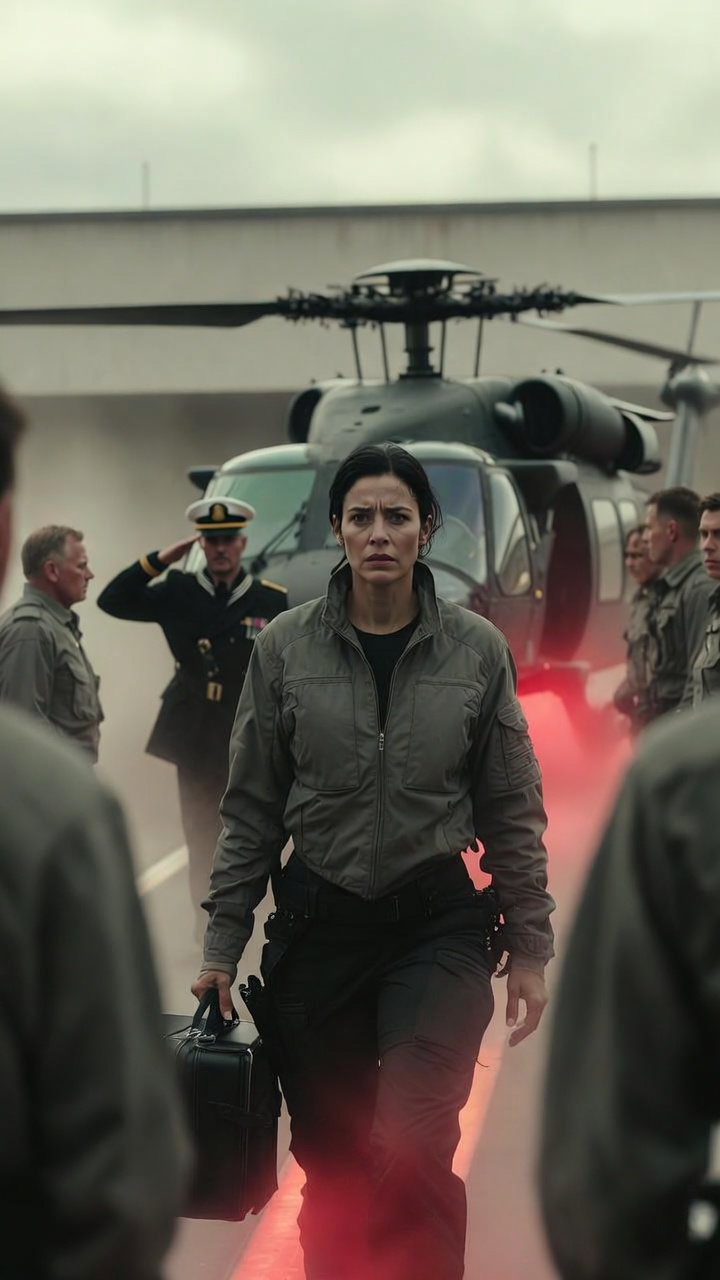
The red warning lights had been flashing for eleven minutes when Serena Vale told the base commander he needed to shut the encrypted uplink down.
Colonel Marcus Hale stared at her across the communications control room as if she had insulted him in front of his entire command.
“Absolutely not.”
Serena kept one hand on the edge of the console. The main display behind her showed packet failures spreading across the regional relay network, each new fault appearing as another amber square.
“Sir, the synchronization layer is degrading,” she said. “If we keep forcing traffic through the primary uplink, the failure will cascade into the satellite relay.”
Hale stepped closer.
“I did not ask for a lecture.”
Around them, technicians sat frozen at their stations. The room was filled with the low hum of servers, clipped radio traffic, and the repeating alarm no one had managed to silence.
Serena did not raise her voice.
“I’m not lecturing you. I’m telling you the network needs to be isolated for three minutes.”
“And during those three minutes,” Hale said, “this base loses secure contact with regional command.”
“For three controlled minutes,” Serena replied. “Or for several uncontrolled hours if the relay collapses.”
The colonel’s jaw tightened.
That was the problem with Serena Vale.
She never sounded afraid of him.
She was a civilian contractor in a room full of uniforms. She wore a gray technical jacket, carried her own tools, and addressed senior officers with professional courtesy—but not with the ceremonial deference Hale believed his rank deserved.
She did not rush when he entered.
She did not straighten her posture when he spoke.
And when he gave a technically dangerous order, she corrected him in the same calm tone she used to explain a damaged circuit board.
For eleven months, Serena had kept the base’s aging communications network operational.
She had repaired hardware no one else could identify, rewritten corrupted routing protocols, and restored secure contact during two regional exercises when the official support teams had failed.
Everyone in the control room knew it.
Everyone except Colonel Hale seemed willing to admit it.
First Lieutenant Daniel Mercer moved away from his station.
“Sir, she may be right. The error rate has tripled in the last four minutes.”
Hale turned toward him.
“Lieutenant, return to your console.”
Mercer hesitated.
“Sir—”
“That was an order.”
The lieutenant sat down, but his eyes remained on Serena.
She glanced at the diagnostic stream again.
The amber squares were turning red.
“Colonel, we have less than two minutes before the encryption clocks fall out of alignment.”
Hale gave a short, humorless laugh.
“You’ve been telling everyone for months that this system cannot function without you.”
“I have never said that.”
“You don’t have to. You walk around here acting as if you own the network.”
Serena looked directly at him.
“No one owns the network. That is why the procedures matter.”
A few technicians lowered their eyes.
Hale noticed.
His face changed.
This was no longer about the uplink.
It was about the fact that a civilian had contradicted him, and everyone in the room had heard it.
He stepped between Serena and the console.
“You are relieved of your duties.”
No one moved.
Serena blinked once.
“Sir?”
“You heard me. Your contract is terminated, effective immediately.”
Mercer stood again.
“Colonel, with respect, she is the only person on-site with full architecture knowledge.”
Hale pointed at him without looking away from Serena.
“One more word and you’ll be explaining your conduct to the executive officer.”
Then he turned back to her.
“Remove your credentials. Collect your equipment. Security will escort you off the installation.”
The warning alarm continued to pulse.
Serena glanced past him at the main display.
“Before I leave, I recommend you disconnect Relay Four from the primary chain.”
Hale’s expression hardened.
“You are no longer authorized to make recommendations.”
“If Relay Four stays connected, it will pull the backup channels down with it.”
“I said you’re finished.”
Serena studied his face for a moment.
There was no anger in hers.
No panic.
No attempt to defend herself.
She removed her access badge, placed it on the console, and began packing her tools.
The quiet click of each instrument entering its case seemed louder than the alarms.
A diagnostic probe.
Two secure interface adapters.
A fiber reader.
A small black notebook covered with handwritten routing sequences no one else in the room understood.

Mercer approached her near the door.
“I’m sorry,” he said quietly.
Serena closed the case.
“You tried.”
“What do we do if it fails?”
Her eyes shifted toward the red-lit display.
“Disconnect Relay Four. Stop all automated restarts. Do not force synchronization.”
Mercer nodded.
Behind them, Hale spoke loudly enough for everyone to hear.
“She no longer works here, Lieutenant.”
Serena gave Mercer a small, courteous nod and walked out.
She passed through the security corridor without protest.
At the outer gate, two military police officers checked the order, returned her civilian identification, and watched as she stepped beyond the barrier.
She had been gone for five minutes when the encrypted uplink failed.
Every screen in the control room went black at once.
Then the backup displays lit up with red text.
PRIMARY AUTHENTICATION LOST.
RELAY SYNCHRONIZATION FAILURE.
REGIONAL COMMAND LINK UNAVAILABLE.
For one second, no one spoke.
Then the room erupted.
“Attempting failover!”
“Backup channel is rejecting the handshake!”
“Relay Four is cycling!”
“Shut it down,” Mercer ordered. “Kill Relay Four now.”
A technician hammered at his keyboard.
“It’s not responding.”
“Manual disconnect.”
“The remote interface is locked.”
Hale moved into the center of the room.
“Restart the uplink.”
Mercer turned.
“Sir, Serena specifically said not to force a restart.”
“She is no longer employed by this base.”
“That doesn’t change the architecture.”
“Restart it.”
The technician looked from Mercer to Hale.
Hale slammed his palm against the nearest console.
“That is a direct order.”
The technician initiated the restart.
The screens flickered.
For half a second, the network map returned.
Then three more relays disappeared.
A new alarm sounded, lower and more urgent than the first.
Mercer stared at the display.
“The failure just propagated to the secondary chain.”
Hale’s face tightened.
“She did this.”
No one answered.
“She sabotaged the network before she left.”
Mercer looked at him in disbelief.
“Sir, the failure occurred exactly where she said it would.”
“That proves she knew about it.”
“She knew because she diagnosed it.”
Hale ignored him.
“Notify security. Stop her vehicle.”
“She left on foot.”
“Then bring her back.”
Before anyone could respond, a new alert appeared on the aviation coordination screen.
INBOUND MILITARY AIRCRAFT.
PRIORITY CLEARANCE.
NAVAL AUTHORITY.
The air traffic technician leaned toward his monitor.
“Colonel, we have an unscheduled aircraft approaching from the east.”
“What aircraft?”
“MH-60 Seahawk.”
“Who authorized it?”
The technician swallowed.
“The clearance is above base level.”
Hale looked toward Mercer.
“Is this some kind of inspection?”
“No scheduled inspection appears on today’s movement log.”
The secure phone on the command desk rang.
Hale grabbed it.
“This is Colonel Hale.”
He listened.
His expression changed slowly.
“What do you mean, do not delay the aircraft?”
Another pause.
“No, I have not received any notification.”
The voice on the other end spoke for several seconds.
Hale lowered the phone.
Outside, the sound of rotor blades began to roll across the installation.
The Seahawk descended directly toward the restricted landing area near the communications building.
There was no ceremonial reception.
No advance team.
No scheduled briefing.
The helicopter touched down, its rotors throwing dust across the concrete.
A Navy captain stepped out carrying a sealed black document pouch. Two security officers followed him.
He did not approach Colonel Hale.
He looked past him.
“Where is Serena Vale?”
Hale stiffened.
“Ms. Vale was a civilian contractor assigned to this base.”
The captain waited.
Hale continued.
“I terminated her contract approximately twenty minutes ago.”
For the first time, the captain looked directly at him.
“You did what?”
“She repeatedly challenged command authority during an operational incident.”
The captain’s expression did not change, but one of the security officers behind him glanced toward the other.
“Where is she now?” the captain asked.
“She was removed from the installation.”
“Find her.”
Hale folded his arms.
“Captain, this is my base. Civilian staffing decisions fall under my authority.”
The captain held out the black pouch.
“Read the first page before you say that again.”
Hale took it reluctantly.
The seal was marked with a classification level rarely handled at the base.
He opened the pouch.
The first page contained Serena’s photograph.
Below it was a list of access authorities.
Hale read the first line.
Then the second.
His posture changed.
Mercer, standing several feet away, could not see the text, but he saw the color drain from the colonel’s face.
The captain spoke quietly.
“Serena Vale is not a standard maintenance contractor.”
Hale kept reading.
“She served for twenty-seven years as the chief systems architect for the Navy’s encrypted regional relay program,” the captain continued. “The network in your control room was built from her original design.”
Mercer stared at him.
The captain nodded toward the communications building.
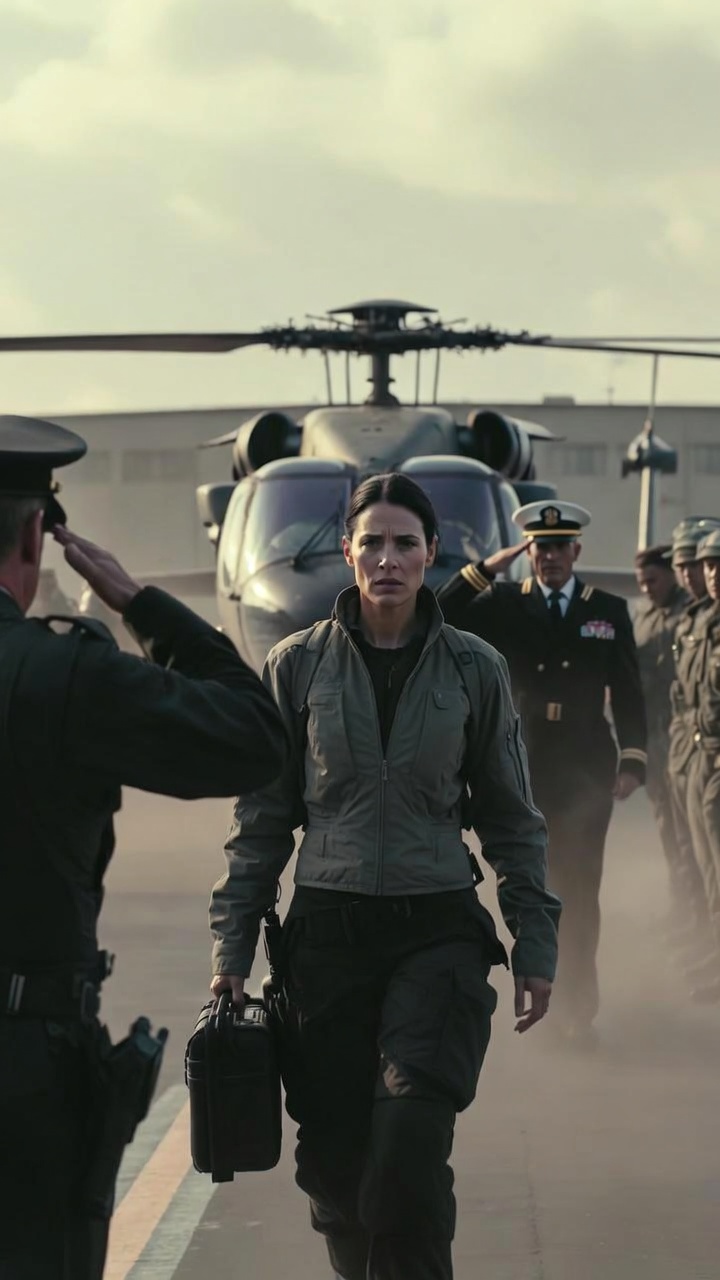
“She wrote the architecture your technicians are trying to repair.”
Hale turned another page.
There were authorization signatures from officers far above his command.
At the bottom of the final page was a direct access order from a vice admiral, granting Serena unrestricted technical authority over designated communications infrastructure during a system threat.
Her clearance exceeded Hale’s.
Her emergency authority bypassed his.
And the person he had just escorted off the base was not merely the only technician who understood the network.
She was the person who had created it.
The captain watched recognition settle across Hale’s face.
The colonel’s mouth opened, but no words came out.
His eyes moved toward the communications building, where alarms could still be heard through the walls.
Then he looked toward the main gate.
For the first time that morning, he appeared uncertain.
Serena was found sitting on a concrete barrier outside the installation, her tool case beside her.
She had not called anyone.
She had not demanded reinstatement.
She had not threatened legal action.
She was simply waiting for a civilian ride to take her to the nearest town.
The Navy vehicle stopped in front of her.
The captain stepped out.
“Ms. Vale.”
Serena stood.
He saluted.
It was not a theatrical gesture. It was formal recognition of her technical authority under the emergency order.
Hale arrived several seconds later, visibly out of breath.
“Ms. Vale,” he began.
Serena looked at the captain.
“Is the network stable?”
“No.”
“Did they force a restart?”
Mercer, who had followed them, answered.
“Yes.”
Serena closed her eyes briefly.
“Relay Four?”
“Still connected.”
She picked up her case.
“I’ll need access to the primary control room.”
Hale stepped forward.
“Ms. Vale, regarding the earlier decision—”
The captain moved between them.
“Colonel, you will not interfere with her work.”
“This is still my installation.”
“Not in matters concerning that network.”
Two military police officers approached.
For a moment, Hale looked as though he might argue.
Then he noticed who was watching.
His lieutenant.
His technicians.
His security staff.
The Navy captain.
Every person who had witnessed him fire Serena now stood waiting to see whether he would make the same mistake twice.
His shoulders dropped slightly.
Serena walked past him without a word.
When she reentered the control room, the alarms were still sounding.
The technicians moved aside.
Her old chair remained where she had left it.
Her access badge was still lying on the console.
She did not pick it up.
Instead, she opened her case, connected a black interface adapter to a port beneath the main terminal, and entered an administrative override sequence.
The technician beside her stared at the screen.
“I’ve never seen that command layer.”
“You weren’t supposed to,” Serena said.
A hidden network map appeared.
It showed routing channels that had never been visible through the base software.
Serena isolated Relay Four.
The primary alarm stopped.
She rerouted satellite traffic through a dormant naval channel.
A row of red indicators turned amber.
Then she entered a second command.
“Encryption clocks resynchronizing,” Mercer said.
“Twenty-eight seconds,” Serena replied.
The room watched the timer.
Twenty-eight.
Twenty-seven.
Twenty-six.
No one spoke.
At twelve seconds, the backup channel stabilized.
At six, the regional relay reappeared.
At zero, the main screen flashed green.
SECURE UPLINK RESTORED.
DATA INTEGRITY CONFIRMED.
The room released one collective breath.
Ninety seconds had passed since Serena sat down.
A brigadier general entered the control room just as the final alarm went silent.
He looked from the restored displays to Serena, then to Colonel Hale, who stood near the door under military police supervision.
“Ms. Vale,” the general said, “I was not informed you were visiting the installation.”
“I wasn’t planning to,” Serena replied.
The general frowned.
She continued.
“I came here because this base reported recurring uplink instability. I was terminating a long-term diagnostic cycle when Colonel Hale dismissed me and ordered me removed.”
The general slowly turned toward Hale.
Serena closed the hidden command layer.
“His decision forced the Navy to dispatch an emergency recovery team and created an avoidable outage across the regional network.”
Hale stared at the floor.
The general’s voice was quiet.
“Colonel, you will surrender operational control until the investigation is complete.”
Hale looked up.
“General, I acted on the information available.”
“No,” Mercer said before he could stop himself.
Every head turned.
The lieutenant stood straighter.
“With respect, sir, she gave us the correct information. We ignored it.”
The general studied him, then looked back at Hale.
“Escort the colonel to his office. Remove his network credentials.”
The military police stepped forward.
Hale did not resist.
As he was led away, Serena remained focused on the console.
She did not watch him leave.
She did not smile.
She did not need to.
The restored network was displaying every message, every routing confirmation, and every secure connection he had nearly destroyed.
Her work had already said everything.
Two hours later, the system was fully stable.
Serena closed her tool case and walked toward the landing area, where the Seahawk was waiting to transport her to another secured facility.
Word had spread across the base.
Soldiers, technicians, and officers stood along the path outside the communications building.
No one had ordered them to form a line.
They simply moved aside as she approached, creating a silent corridor toward the aircraft.
Mercer stood near the front.
Serena stopped beside him.
“You did the right thing in the room,” she said.
“I should have done more.”
“You spoke when it mattered.”
She continued walking.
Colonel Hale stood near the edge of the landing area, accompanied by an administrative officer.
His command badge had been removed.
He looked smaller without it.
As Serena passed, he finally spoke.
“Ms. Vale.”
She stopped.
The rotor blades were beginning to turn.
Hale struggled to meet her eyes.
“I made a serious mistake.”
The people nearby went silent.
“I allowed the situation to become personal,” he said. “I should have listened to your assessment.”
Serena looked at him for a long moment.
There was no triumph in her expression.
Only the cold recognition of how much damage pride could cause when it was protected by authority.
“Listen next time,” she said.
Then she walked to the helicopter.
The internal investigation began three days later.
Colonel Hale was removed from operational command and reassigned to an administrative position with no authority over classified communications systems.
Lieutenant Mercer received a formal commendation for challenging an unsafe technical decision and preserving the incident record.
The technicians revised their emergency procedures.
A new line was added to every communications failure checklist at the base:
Technical warnings will be evaluated by expertise, not rank.
Serena never returned to the installation.
She moved on to another secure facility, where another complicated system needed someone who understood what everyone else had overlooked.
But her name remained.
New technicians heard the story during training.
Young officers heard it when they entered the control room.
They were told about the civilian woman who had warned a commander, been thrown off the base, and returned in a Navy helicopter to repair the network she had designed.
The story was not repeated because a powerful officer had been humiliated.
It was repeated because an entire installation had learned, in ninety terrifying seconds, what happens when authority mistakes obedience for competence.
Real expertise rarely needs to raise its voice—but arrogance usually hears it only after everything goes silent.