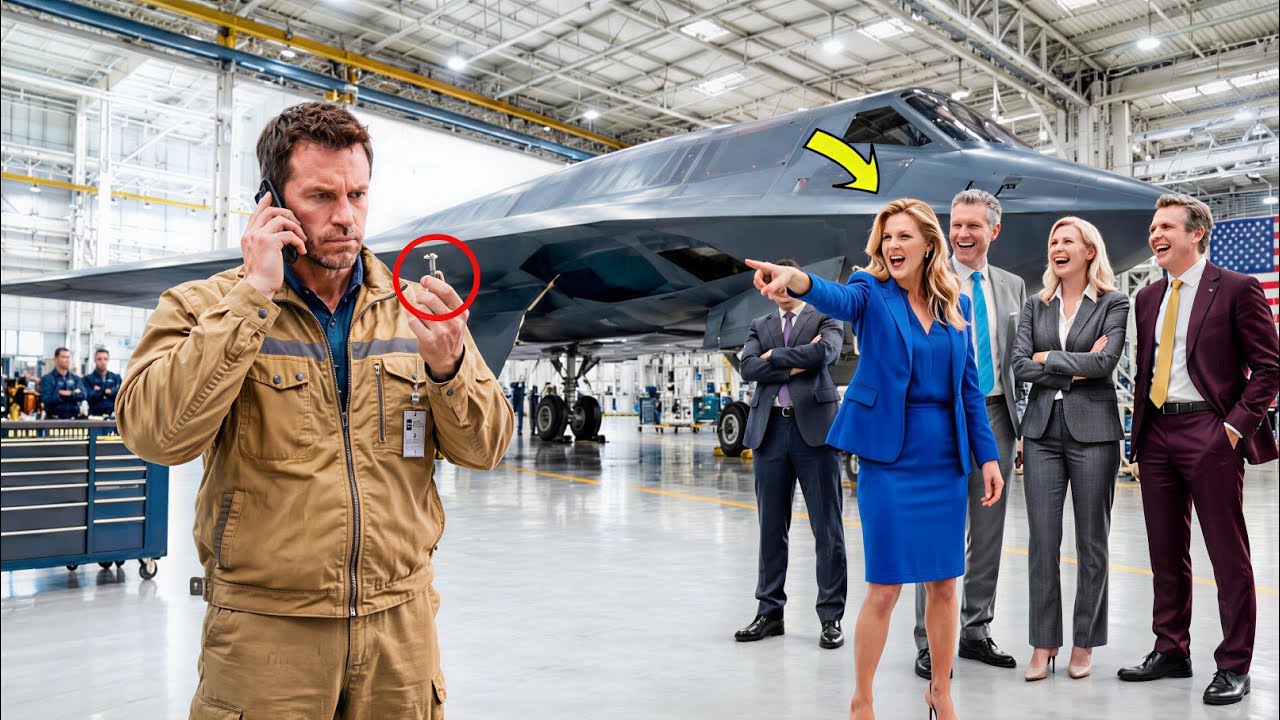
At 9:17 on a Tuesday morning, Daniel Ruiz placed a one-dollar bolt in the center of a polished walnut conference table.
By 9:23, he no longer had a job.
The twelve executives in the room stared at the bolt as if it were something Daniel had dragged in from the parking lot. It was less than two inches long, silver-plated, and almost identical to thousands already installed on the production floor below them.
Victor Hale, CEO of Halcyon Defense Systems, leaned back in his chair.
“Let me understand this,” he said. “You stopped an entire assembly line over that?”
Daniel kept both hands flat on the table.
“It’s the wrong grade.”
Victor looked toward the vice president of procurement, who gave a small shrug.
“The approved bolt costs ninety-eight cents,” the executive said. “This one costs eighty-seven. Same dimensions. Same threading. Same supplier family.”
“It isn’t the same bolt,” Daniel replied.
Victor’s jaw tightened.
Downstairs, 214 employees were waiting for permission to restart production. Four completed actuator assemblies were sitting on carts. Two military inspectors were scheduled to arrive the next morning. Every hour of delay cost the company tens of thousands of dollars.
And Daniel Ruiz—a quiet senior quality technician with a worn lunch bag and a photograph of his daughter taped inside his locker—was refusing to sign the release form.
Victor picked up the bolt and held it between two fingers.
“You’re holding up a forty-million-dollar delivery over eleven cents?”
“I’m holding it because there’s no material certification,” Daniel said. “The approved part is rated for repeated shock loads. This one is commercial grade.”
“The supplier says it meets requirements.”
“The supplier sent an email. They didn’t send a test report.”
Victor dropped the bolt onto the table.
It made a tiny sound.
That tiny sound would eventually cost him $1.2 billion.
Six years earlier, Daniel had joined Halcyon after the manufacturing plant where he worked closed without warning.
He was raising his daughter, Sofia, alone.
Her mother had died after a sudden illness when Sofia was four. Daniel never discussed it at work. He simply arrived early, left on time whenever he could, and kept his phone faceup during afternoon meetings in case the school nurse called.
He was not an executive. He did not have an engineering degree framed on his wall. His office was a metal desk beside the quality lab, wedged between a calibration cabinet and a rack of inspection tools.
But Daniel knew fasteners.
Before Halcyon, he had spent fourteen years inspecting components used in helicopters, armored vehicles, and emergency braking systems. He knew that the cheapest-looking pieces often carried the greatest loads.
The bolt on the conference table secured a pivot point inside Halcyon’s new electromechanical targeting actuator.
That actuator was part of the Sentinel Remote Defense Platform, a weapons system being developed for armored military vehicles. Halcyon had spent three years competing for the program.
If the first production phase went well, the agreement was worth $1.2 billion over seven years.
The company had already expanded the factory, hired hundreds of workers, and promised investors that Sentinel would transform Halcyon from a mid-sized supplier into one of the industry’s major players.
Victor Hale had built his entire public image around winning that contract.
His face appeared in trade magazines beneath headlines about bold leadership. At investor meetings, he described Halcyon as a company that moved faster than older defense manufacturers.
“Speed is our advantage,” he liked to say.
Inside the factory, employees had learned what that meant.
Problems were not supposed to stop production.
Problems were supposed to be managed quietly.
Three weeks before Daniel placed the bolt on the conference table, Halcyon’s approved fastener supplier reported a delay. A heat-treatment furnace had failed, and the next certified shipment would arrive twelve days late.
The production schedule had no room for twelve days.
The procurement team found an alternative supplier that could deliver immediately. The replacement bolts looked correct and fit perfectly.
But when the first boxes arrived, Daniel noticed that the labels contained no lot-traceability numbers.
He pulled three samples and requested material certificates.
Nothing came.
He requested hardness-test results.
Nothing came.
Then he inspected the supplier paperwork more closely. The part description had been copied from Halcyon’s purchase order, but the manufacturer’s internal code belonged to a lower-strength commercial bolt.
Daniel opened a nonconformance report and locked the shipment in the hold area.
Within twenty minutes, his supervisor appeared beside his desk.
“Procurement says these have already been approved.”
“By whom?”
The supervisor looked toward the production floor.
“Daniel, we need the line running.”
“I need the certification.”
“You’re making this harder than it needs to be.”
Daniel turned the monitor so his supervisor could see the specification.
“The approved bolt is designed to handle repeated recoil vibration and impact loading. The replacement hasn’t been tested for either.”
“Then test one.”
“A single test wouldn’t certify the batch.”
His supervisor lowered his voice.
“Victor is asking for hourly updates.”
Daniel nodded.

“Then tell him we’re waiting for the supplier documents.”
The documents never arrived.
Instead, Daniel received an invitation to a meeting on the executive floor.
He had never been in the main boardroom before.
The windows overlooked the entire factory. From the conference table, Victor could see the paused assembly line below.
Production managers stood in small groups between motionless workstations. Forklift drivers waited beside loaded pallets. A digital board that normally displayed output numbers showed a red banner:
QUALITY HOLD — FASTENER LOT 7C-441
Victor pointed toward it.
“That message is visible to our customer representatives.”
“It should be,” Daniel said. “The material is on hold.”
“You understand what happens if we miss tomorrow’s inspection?”
“We explain the delay and install the correct parts when they arrive.”
Victor stared at him.
“You think we tell the Department of Defense that two hundred people stopped working because you didn’t like a bolt?”
“I don’t have to like it. It has to meet the drawing.”
The chief operating officer shifted in his seat. Someone at the far end of the table closed a notebook.
Victor stood.
“I built this company by hiring people who solve problems.”
Daniel remained seated.
“This is me solving it.”
“No. This is you hiding behind procedure because you’re afraid to make a decision.”
Daniel looked through the window at the line below.
Then he looked back at Victor.
“My decision is that the part can’t be used.”
The room went still.
Victor reached for the release form and slid it across the table.
“Sign it.”
“I can’t.”
“You mean you won’t.”
“That too.”
Victor’s face changed.
Not dramatically. His voice did not rise. He simply gave Daniel the flat, impatient look of a man who had stopped seeing another person and started seeing an obstacle.
“You’re done here.”
The human resources director blinked.
“Victor—”
“Effective immediately.”
Daniel glanced around the table. Several executives looked down. The procurement vice president studied his phone. Daniel’s supervisor sat frozen, his pen still touching the paper.
Victor pushed the unsigned form back toward him.
“We cannot employ someone who is willing to endanger a major contract over a one-dollar bolt.”
Daniel stood slowly.
“It’s not the dollar,” he said.
Victor turned toward the window.
“Security will walk you out.”
Two guards met Daniel outside the boardroom.
They took his badge, followed him to his desk, and watched as he placed his personal belongings into a cardboard box.
A coffee mug.
A phone charger.
A small tool catalog.
The photograph from inside his locker showed Sofia missing her two front teeth, holding a handmade sign that read, My Dad Fixes Important Things.
Workers along the production line pretended not to watch him leave.
One young engineer named Leah Morgan did not pretend.
She stepped away from her workstation as Daniel passed.
“What happened?”
“They’re releasing the bolts.”
Her eyes moved toward the hold area.
“Without certification?”
Daniel gave a single nod.
“Did you save the inspection records?”
“They’re in the system.”
Leah lowered her voice.
“They can change the system.”
Daniel looked toward the security guards.
“Not all of it.”
Then he walked out carrying the box against his chest.
That afternoon, production restarted.
The quality hold disappeared from the digital board.
The replacement bolts were moved from quarantine to the assembly line, and the four waiting actuator units were completed before midnight.
Daniel’s name was removed from the nonconformance report. A new entry stated that engineering had reviewed the substitution and determined it posed “no material risk.”
No engineer had signed it.
The next morning, the military inspectors arrived.
Victor personally walked them through the production area. Cameras followed him as he shook hands with employees and described Halcyon’s commitment to safety.
The actuator assemblies passed dimensional inspection.
The paperwork showed no open quality issues.
The first delivery was accepted.
At 3:40 that afternoon, Victor sent a company-wide email congratulating the team.
He wrote that Halcyon had succeeded because it refused to let “bureaucratic thinking interfere with mission-critical execution.”
Most employees understood who the sentence was about.
Daniel read the email in the parking lot outside Sofia’s school.
His severance payment covered six weeks.
His health insurance would expire at the end of the month.
When Sofia climbed into the truck, she saw the cardboard box on the back seat.
“Are you changing offices?”
Daniel started the engine.
“Something like that.”
She studied him for a moment.
“Did you get fired?”
Daniel looked through the windshield.
“Yes.”
“For doing something bad?”
“No.”
Sofia waited.
Daniel reached into the box, removed the silver bolt, and placed it in her hand.
“For not saying something was safe when I didn’t know it was safe.”
She rolled the bolt between her fingers.
“Then why did they fire you?”
Daniel pulled away from the curb.
“Because sometimes telling the truth creates a problem for people who benefit from pretending there isn’t one.”
For the next five weeks, Halcyon accelerated production.
The company announced that the Sentinel program was ahead of schedule. Victor appeared on a financial news program and told investors that Halcyon’s culture rewarded “decisive leadership at every level.”
The stock price climbed.
Managers who had questioned the bolt substitution stopped mentioning it.
Leah Morgan continued documenting serial numbers in a notebook she kept at home.
She had seen Daniel’s original inspection results before his access was removed. She knew the replacement bolts had failed to meet the specified hardness range.
She also knew that no legitimate engineering review had occurred.
But she had a mortgage, two children, and a husband whose medical treatments depended on her insurance.
Each morning, she entered the factory and said nothing.
Then, during a live-fire qualification test at Aberdeen Proving Ground, one of Halcyon’s targeting assemblies locked in place.
The first failure occurred after 312 simulated recoil cycles.
Technicians reset the system and repeated the test.
The second actuator failed after 287 cycles.
When the test team opened the housing, they found metal fragments around the pivot mechanism.
The retaining bolt had sheared beneath the head.
Halcyon’s executives were notified before sunrise.
By 7:00 a.m., Victor had assembled the leadership team in the same boardroom where Daniel had been fired.
The chief engineer displayed photographs from the test site.
Victor barely looked at them.
“Contain the lot. Replace the bolts. We tell the customer this was an isolated supplier defect.”
The chief engineer hesitated.
“They’re requesting the complete material history.”
“Then give it to them.”
“There are inconsistencies.”
The procurement vice president cleared his throat.
“The original certification package was delayed.”
Victor looked at him.
“Delayed or nonexistent?”
No one answered.
Victor walked to the window.
For the first time, the production line below did not look like proof of his authority. It looked like evidence.
“We need one explanation,” he said. “One person made an unauthorized hold, interfered with production, and was terminated. After that, the parts went through the standard approval process.”
The human resources director looked up.
“You want to blame Daniel?”
“I want the record to show that he was acting outside his authority.”
“He was the assigned quality inspector.”
“Not after we terminated him.”
The chief engineer closed the folder in front of him.
“The inspection happened before you terminated him.”
Victor turned.
“Then fix the sequence.”
That was when the conference-room screen lit up.
An incoming call appeared from Colonel Miriam Shaw, the government program director.
Victor straightened his tie and accepted it.
Colonel Shaw appeared with three people seated beside her: a contracting officer, a military quality representative, and an investigator from the Defense Criminal Investigative Service.
No one from Halcyon had been told the investigator would attend.
Victor began with a practiced expression.
“Colonel, we’re treating this with the utmost seriousness. Early indications suggest an isolated fastener defect that was not reasonably detectable during standard inspection.”
Colonel Shaw did not respond.
She opened a digital file.
“Mr. Hale, do you know a former employee named Daniel Ruiz?”
Victor paused.
“He was terminated for misconduct related to this program.”
“What misconduct?”
“He disrupted production and refused a lawful management instruction.”
Colonel Shaw looked toward the investigator.
Then she shared her screen.
A quality notification appeared with a timestamp from the morning Daniel was fired.
It included photographs of the replacement bolt, the missing lot numbers, the supplier code, hardness measurements, and the exact specification the fastener had failed to meet.
At the bottom was Daniel’s electronic signature.
Victor leaned closer.
“That report was removed from our system.”
“Yes,” Colonel Shaw said. “From your internal system.”
She clicked to the next page.
“But Mr. Ruiz had already transmitted it through the contract’s government quality portal.”
No one in the boardroom moved.
For every safety-critical component on the Sentinel program, Halcyon’s contract required unresolved nonconformances to be reported directly to the government’s quality representative.
Most employees did not have access to that portal.
Daniel did.
Two months before production began, Halcyon had named him the company’s official delegated quality liaison because he had more direct experience with traceable fasteners than anyone else in the building.
The designation had been treated as a minor administrative detail.
Victor had signed the authorization himself.
Daniel had submitted the report eleven minutes before entering the boardroom.
He had included one final sentence:
Management has instructed quality personnel to approve this material without objective evidence of compliance. I have declined.
The government portal automatically preserved every version of a submitted report.
Including later edits.
Including deleted names.
Including the unsigned engineering approval.
Including the moment Halcyon’s records were changed after Daniel was escorted from the building.
Victor’s eyes moved across the screen.
The color left his face slowly, beginning around his mouth.
The procurement vice president stopped writing.
The chief operating officer lowered his head.
Through the glass wall, two assistants standing outside the boardroom watched the CEO stare at his own electronic signature on Daniel’s authorization form.
Colonel Shaw spoke again.
“Mr. Hale, this is no longer an isolated component failure.”
Victor opened his mouth, but nothing came out.
“It is evidence that Halcyon identified a safety-critical defect, removed the inspector who reported it, altered the quality record, and knowingly delivered nonconforming equipment to the United States government.”
Victor finally found his voice.
“I was not aware the material had failed testing.”
The investigator leaned toward the camera.
“We have the conference-room recording.”
Victor stopped breathing for a second.
Halcyon recorded executive meetings automatically because sensitive program decisions were sometimes reviewed by outside auditors.
Victor had ordered the system installed.
The investigator played a short clip.
Daniel’s voice filled the boardroom.
The approved bolt is designed to handle repeated recoil vibration and impact loading. The replacement hasn’t been tested for either.
Then Victor’s own voice answered.
Sign it.
The recording continued.
We cannot employ someone who is willing to endanger a major contract over a one-dollar bolt.
No one looked at Victor.
The moment of recognition did not arrive with shouting.
It arrived in silence.
Victor stared at the small black camera mounted above the screen. His shoulders, usually squared for photographs and investor calls, dropped slightly.
For the first time, he seemed to understand that every person in the room had become a witness.
Colonel Shaw closed the file.
“Effective immediately, all deliveries are suspended.”
Within forty-eight hours, the Department of Defense issued Halcyon a formal notice of default.
The Sentinel agreement was terminated two weeks later.
Its potential value was $1.2 billion.
Halcyon’s stock lost 61 percent of its value in three trading days. The board placed Victor on administrative leave, then accepted his resignation before the end of the month.
The procurement vice president was dismissed.
The chief operating officer retired unexpectedly.
Federal investigators seized quality records, supplier communications, and executive emails.
The company spent the next year dealing with lawsuits, contract appeals, and a government suspension review that prevented it from bidding on new defense work.
The one-dollar bolt appeared in every report.
But it was never really about the bolt.
Leah contacted investigators and turned over her notebook. Her records showed which assemblies contained the unapproved fasteners and helped the military locate every affected unit before deployment.
She also gave Daniel’s phone number to Colonel Shaw.
Daniel was washing dishes after dinner when the call came.
Sofia sat at the kitchen table doing math homework.
Colonel Shaw thanked him for following the reporting procedure. She told him his documentation had likely prevented defective assemblies from reaching active service.
Daniel looked toward the silver bolt sitting beside Sofia’s pencil case.
“I only did the inspection,” he said.
“You did more than that,” the colonel replied. “You refused to let pressure change what you knew.”
Three months later, the replacement contract was awarded to a consortium led by another manufacturer.
Daniel accepted a position there as director of supplier quality.
On his first day, he placed the silver bolt inside a small glass case on his desk.
Beneath it was a card with eleven words:
The price of a part is not the cost of its failure.
People often assume companies collapse because employees make mistakes.
Sometimes they collapse because one employee sees the mistake, tells the truth, and the most powerful person in the room decides that silence would be cheaper.
It almost never is.
Because the most expensive component in any organization is not the one-dollar part that failed.
It is the leader who decided integrity cost too much.