The CEO Wrote One Word on a Napkin—And the Stranger Who Found It Uncovered a $912 Million Lie
The woman at Table 15 did not look like someone who needed help.
She looked like the person everyone else in the room needed permission from.
Delaney Ashford sat beneath the amber lights of Calder House, one of the most discreet restaurants in the financial district, wearing a charcoal suit and the expression that had carried her through hostile acquisitions, congressional hearings, and three market crashes.
She was the CEO of Ashford Meridian, a global infrastructure and energy company with more than 12,000 employees.
Yet that evening, she was not allowed to touch her own phone.
It sat inside a black security pouch beside Julian Carrington, the company’s executive chairman and her late father’s closest business partner.
A broad-shouldered man stood near the entrance to the private dining alcove, pretending to study the wine display.
Every time a server approached, Julian’s assistant intercepted them first.
Documents appeared in front of Delaney, page by page, then disappeared before she could keep them.
Across from her, Chief Financial Officer Colin Wexler checked his watch for the fourth time in ten minutes.
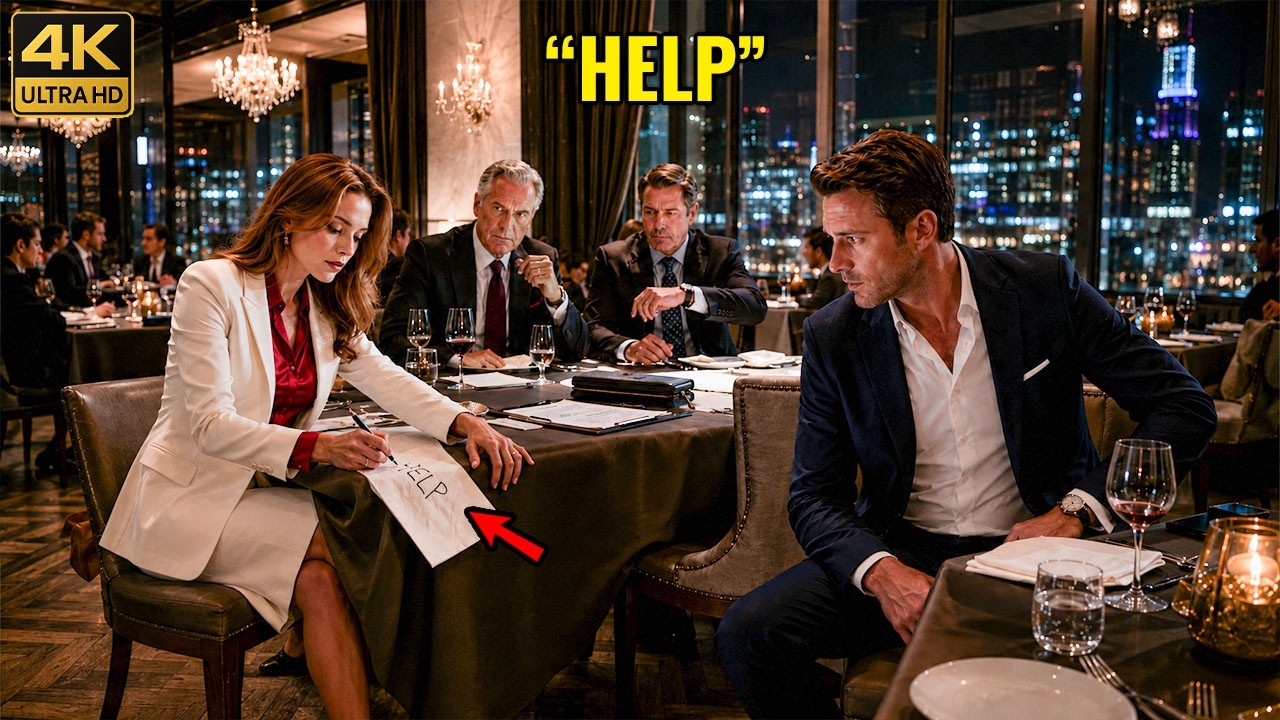
At 8:17 p.m., Delaney unfolded her linen napkin beneath the table.
Using the tip of a borrowed pen, she wrote one word.
HELP.
Then she let the napkin slide from her lap.
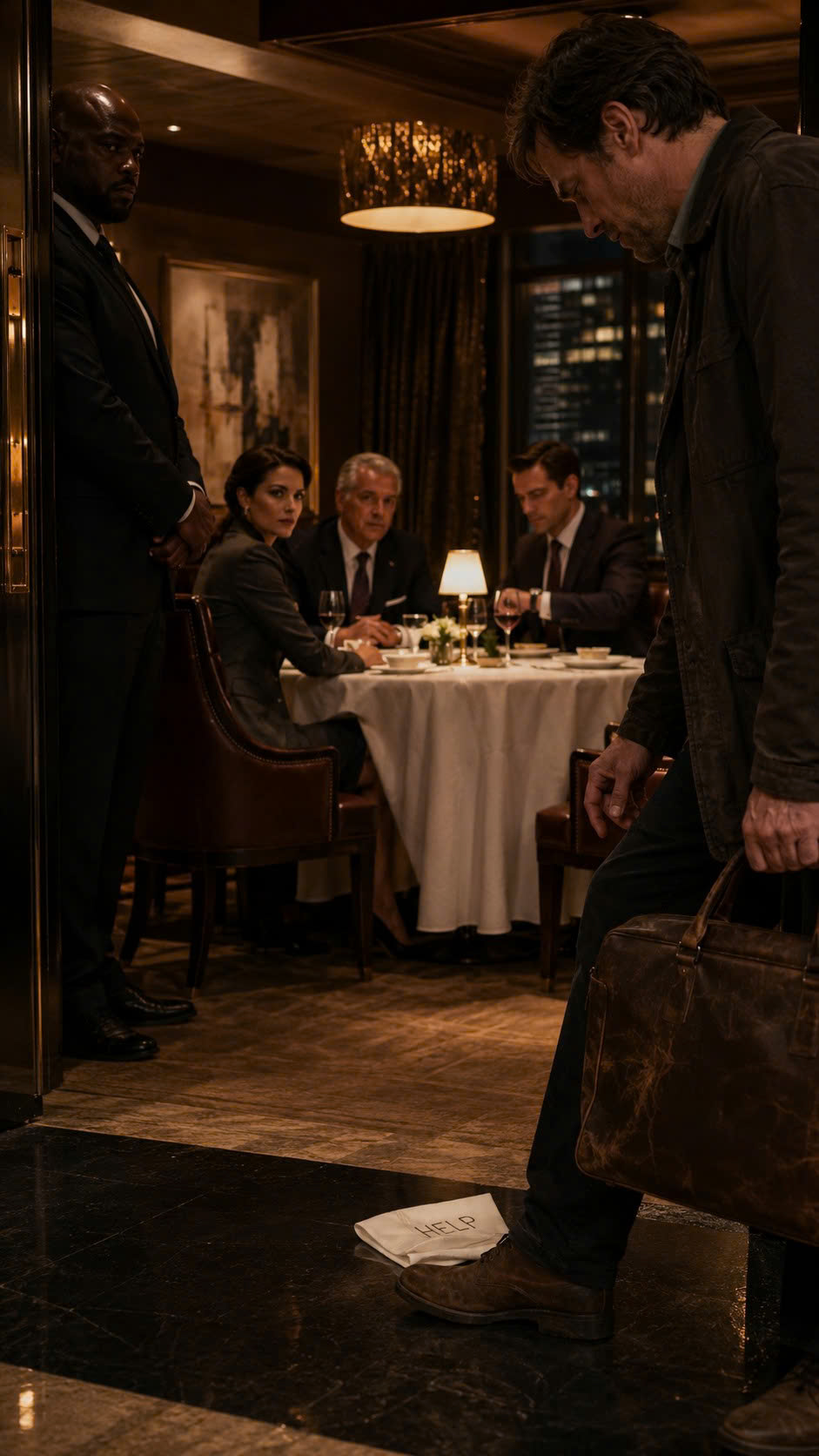
It landed near the polished shoe of a man walking past.
Owen Barrett stopped.
He was not supposed to be at Calder House that night. A corporate client had canceled their meeting fifteen minutes before the reservation, but the restaurant charged for late cancellations, so Owen had decided to stay and eat alone.
Six years earlier, he had been a financial investigator.
Now he ran a small document verification firm from a second-floor office above a locksmith.
Old habits had survived the career change.
He noticed rooms before menus.
He noticed who spoke, who remained silent, who controlled the exits, and who looked at the clock when nobody had somewhere else to be.
When Owen bent to retrieve the napkin, Julian’s assistant took half a step toward him.
Too quickly.
Owen picked it up, glanced at the word, and folded it as though he had found nothing more than discarded linen.
“Excuse me,” he said casually to the nearest server. “I think someone dropped this.”
But he placed it in his coat pocket instead of handing it over.
He returned to his table without looking at Delaney.
Calling the police immediately would have been easy.
It also might have destroyed whatever evidence existed.
If the people surrounding her were prepared, they could claim she had been emotional, confused, or involved in an ordinary internal disagreement. By the time anyone arrived, the documents might be gone and every person at the table might tell the same rehearsed story.
Owen asked to speak with Simon Ward, Calder House’s evening manager.
In the service corridor, he kept his voice low.
“I need you to preserve every camera feed covering Table 15, the hallway, the entrance, and the valet area. Do not confront anyone. Do not alert your staff beyond whoever controls the recording system.”
Simon studied him. “Is this a security issue?”
“It may become a legal one. Record the exact time of this conversation.”
Simon looked at Owen’s identification and nodded.
Back in the dining room, Owen wrote on the back of his reservation card.
CAN YOU LEAVE FREELY?
IF NOT, TOUCH YOUR WATER GLASS TWICE.
He folded the card beneath a clean napkin and handed it to a server with a twenty-dollar bill.
“For the woman at Table 15. Tell her it fell from her folder.”
The server hesitated, then carried it over.
Julian’s assistant reached for it, but Delaney took it first.
She read the message without changing her expression.
Then she placed two fingers against the stem of her water glass.
Once.
Twice.
Owen stepped into the hallway and called an emergency reporting line used for suspected coercion, fraud, and financial crimes.
“My name is Owen Barrett,” he said. “I am a witness to what appears to be a forced execution of corporate documents. The subject has indicated she is not free to leave. I am preserving the scene and creating a time record.”
When he returned, the atmosphere at Table 15 had tightened.
Julian was speaking quietly.
“You understand the deadline, Delaney. This cannot wait until morning.”
Owen approached the alcove.
Julian looked up. “This is a private meeting.”
Delaney answered before Owen could.
“He’s my independent compliance adviser.”
For the first time that evening, something shifted in her voice.
It was still calm.
But now she was choosing the words.
Julian’s eyes moved over Owen’s inexpensive jacket and scuffed leather briefcase.
“Your what?”
“My independent adviser,” Delaney repeated. “Since legal counsel is apparently unavailable.”
Colin stopped checking his watch.
Owen took the empty chair beside Delaney.
“I’ll only need a few minutes.”
Julian leaned back. “This is highly confidential.”
“Then I assume everyone here wants the execution process to be beyond challenge.”
That sentence left Julian with no graceful way to object.
The documents were placed before Owen.
He did not read them like a negotiator.
He examined them like evidence.
The signature page was a slightly different shade of white.
The page numbers moved from 18 to 21.
The notary seal lacked the shallow indentation left by a physical stamp.
The bank default notice used a reference format Owen had never seen from that institution.
He also noticed faint yellow tracking dots near the bottom margin—printer identification marks invisible to most people.
Owen closed the folder.
“I cannot advise Ms. Ashford to sign documents that contain pagination discrepancies, inconsistent paper stock, and an unverified default notice without independent legal review.”
Julian’s jaw tightened. “You are not in a position to advise anyone.”
“Then my presence should not concern you.”
Delaney stood.
“This meeting is over.”
The security man near the wine display moved.
Owen looked directly at him.
“Calder House has already been asked to preserve its security footage. A formal report has been timestamped. Any attempt to prevent Ms. Ashford from leaving will be documented.”
The man froze.
Julian did not.
“You are making a serious mistake, Delaney.”
She picked up the folder.
“No,” she said. “I think I’ve been making the same mistake for years.”
Outside, Delaney’s driver was nowhere to be seen.
Owen’s vehicle was a twelve-year-old Volvo with a cracked cup holder and a stack of verification manuals in the back seat.
Delaney looked at it.
“This is your escape vehicle?”
“It has good brakes.”
She got in.
Only after Calder House disappeared behind them did she release a breath that sounded as though she had been holding it for hours.
But Owen did not drive her home.
He took her to his office.
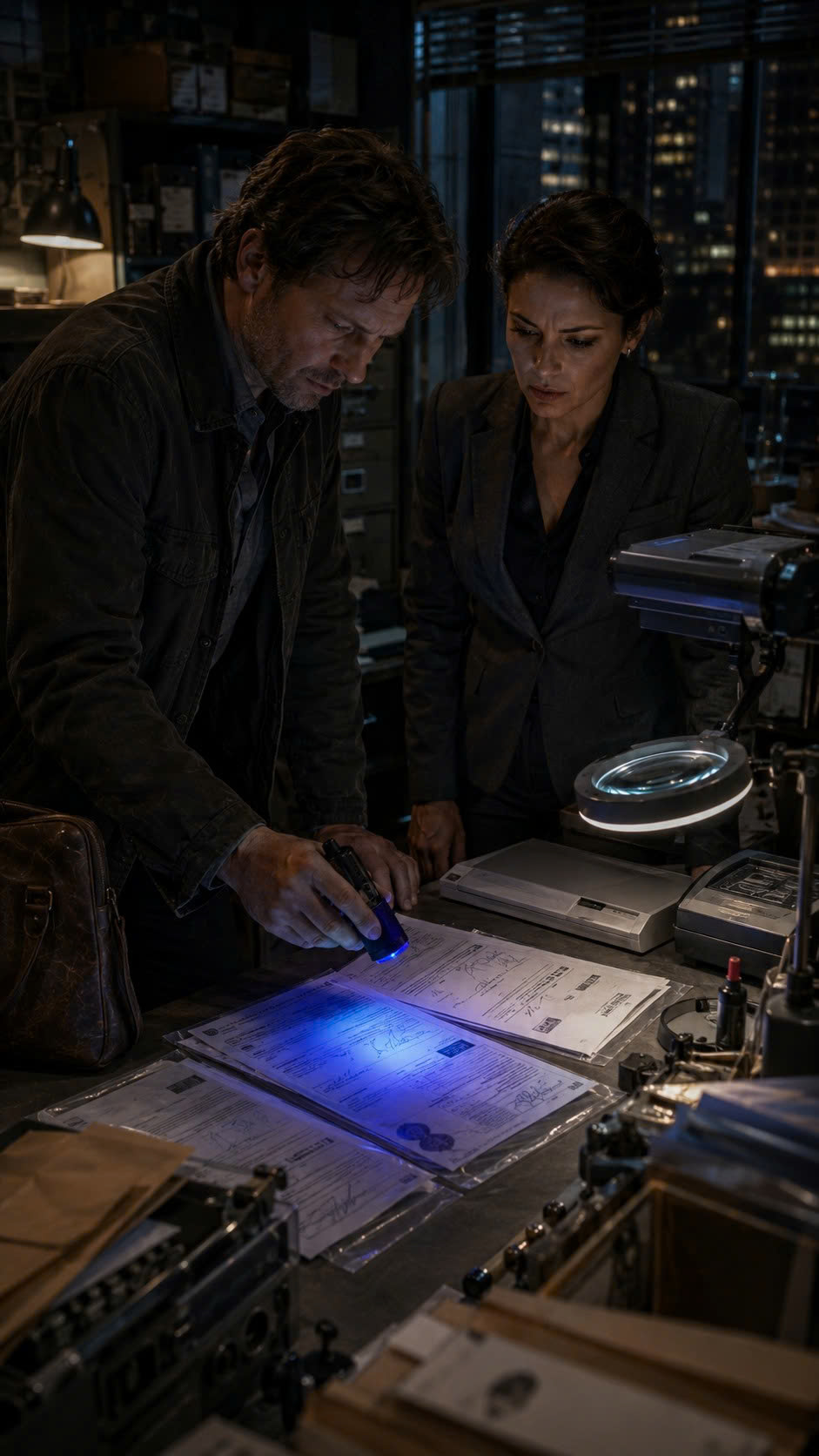
The room above the locksmith was small, secure, and filled with scanners, magnification equipment, archival lamps, sealed evidence bags, and metal cabinets.
Delaney stood among them like someone who had stepped out of a boardroom and into the inside of a machine.
“What exactly were they asking you to sign?” Owen asked.
She placed the folder on his desk.
“Three weeks ago, Julian announced that Ashford Meridian had a $900 million working-capital deficit. This morning, Colin told the board that our bank would issue a covenant default notice tomorrow.”
“And tonight?”
“They wanted me to transfer my voting authority to Julian for ninety days. He said it was the only way to protect the company.”
“What happens during those ninety days?”
“He sells our energy division to an undisclosed buyer. The board suspends me for financial mismanagement. By the time anyone reviews the transaction, I no longer control enough votes to stop it.”
“Where was your general counsel?”
“Julian said she was unreachable.”
“Did you believe him?”
Delaney looked at the floor.
“I believed I had no time.”
Owen examined the bank notice under ultraviolet light.
The security toner was wrong.
The reference number was too short.
The seal had been printed with a high-resolution laser device, not applied by the bank.
“This did not come from the institution named at the top,” he said.
Delaney stared at the page.
“You’re certain?”
“I’m certain it was manufactured.”
She offered him an emergency consulting fee large enough to pay his office rent for five years.
He refused.
She increased it.
He refused again.
Then she stopped speaking like a CEO.
“If we cannot prove this before Monday morning, 12,000 employees will wake up inside a liquidity crisis someone created to remove the one executive who would not approve the sale.”
Owen looked at the folder.
“I have three conditions. You hide nothing. If I find evidence that you participated, I walk away. And everything we uncover goes to regulators. It does not become leverage for a private settlement.”
“Agreed.”
They worked until after midnight.
Vendor lists. Escrow transfers. Board authorizations. Procurement records.
Then Owen saw a name he had spent six years trying to forget.
Harrow Strategic Services.
His hand stopped over the page.
Delaney noticed.
“You know that company?”
“I know the structure behind it.”
Six years earlier, Owen had investigated service contracts linked to an Ashford Meridian subsidiary.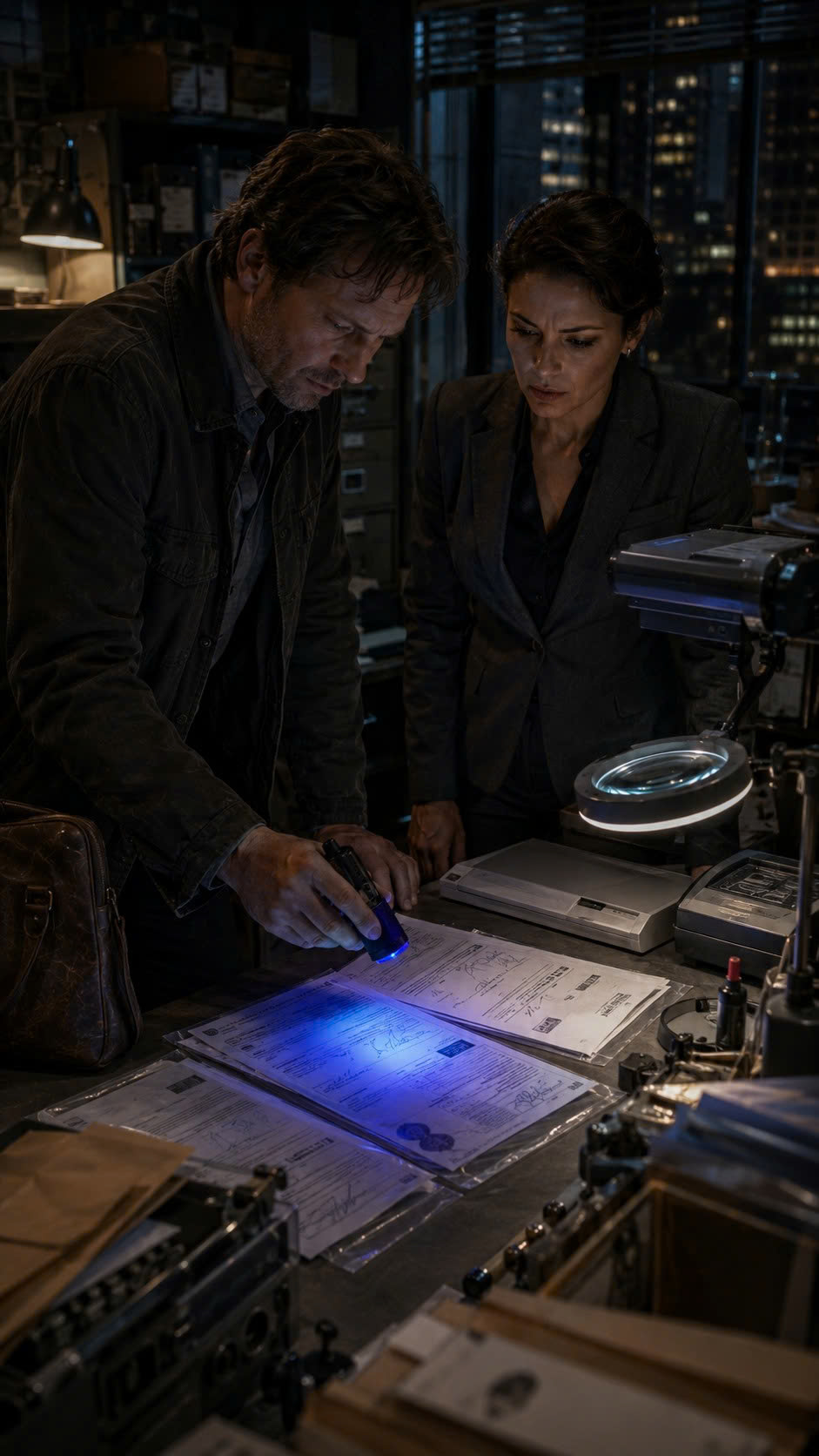
The vendors had no employees.
Their listed offices were mailboxes or vacant rooms.
They shared the same registration agent.
Money passed through layers of shell companies before disappearing into private accounts.
Owen had written a 112-page report recommending criminal referral.
The report was never sent.
Instead, he was investigated for exceeding his authority.
His license was suspended.
Clients left.
Industry publications described him as unstable, vindictive, and unable to separate suspicion from evidence.
“And the authorization to investigate me,” he said, “carried your signature.”
The office went silent.
Delaney did not ask whether he was sure.
She remembered.
“I signed a review package prepared by Julian’s office,” she said. “Your report was not attached.”
“That does not change the signature.”
“No.”
She sat across from him.
“I could tell you I was younger. I could tell you I trusted the wrong people. I could tell you I was handling forty decisions that week.”
Owen waited.
“None of that repairs what happened to you,” she said. “I signed something I did not understand because the people around me made carelessness feel efficient.”
It was not an apology designed to end a conversation.
She did not ask for forgiveness.
She returned to the files.
Owen scanned the restaurant documents at multiple resolutions.
The final signature page had been produced by a different printer than the body of the agreement.
More importantly, the microscopic printer code pointed to a device registered inside Ashford Tower.
The forged documents had not entered the company from outside.
They had been created within the executive floors.
By morning, Julian had made the first public move.
Ashford Meridian announced that Delaney Ashford was taking medical leave.
An emergency board session would consider temporary leadership arrangements.
“They’re turning absence into evidence,” Delaney said.
“So don’t be absent.”
Owen walked beside her into Ashford Tower.
Employees recognized Delaney immediately.
They recognized Owen several seconds later, after searching his name on their phones.
Colin Wexler met them outside the board conference room.
“Mr. Barrett,” he said loudly enough for everyone nearby to hear. “The disgraced investigator.”
Owen opened his notebook.
“I need the current cash position, original bank correspondence, escrow authorizations, vendor registry, board minutes, and executive printer access logs.”
Colin smiled. “You have no authority here.”
“Then provide them to Ms. Ashford.”
Colin produced none of them.
What Owen did obtain was enough to reveal a pattern.
Cash had been moved in small tranches into escrow accounts.
Each payment was classified as contractor expense.
Many passed through an entity called Northumberland Holdings.
Its registered mailing address belonged to the Carrington family office.
Julian dismissed the link as coincidence.
Then he ordered security to remove Owen.
As two guards escorted him toward the elevators, Owen looked at the nearest camera.
“Please record that I was removed at 10:42 a.m. after requesting original financial documents.”
One guard loosened his grip.
Outside the building, a financial news site published a story calling Owen a “vengeful former investigator with a history of professional misconduct.”
The article appeared less than four minutes after his removal.
The media attack had been prepared in advance.
That evening, Owen called his daughter, Piper.
She was sixteen and accustomed to hearing adults speak about her father as though he were either brilliant or broken.
“Are you in trouble again?” she asked.
“Possibly.”
“Real trouble or rich-people trouble?”
“Rich-people trouble with real lawyers.”
“Did you do the right thing?”
“I think so.”
“Then at least be inconvenient.”
Delaney was standing near the office doorway.
After the call, she said, “She sounds like you.”
“That is what concerns me.”
Delaney looked toward the dark window.
“For twenty years, I’ve been told that hesitation is weakness. Uncertainty is weakness. Asking for help is weakness.”
Owen removed the Calder House napkin from an evidence sleeve.
“Writing this was not weakness.”
“It felt like it.”
“Weakness would have been remaining silent because the people controlling you might think less of you.”
The phone rang.
Julian.
Owen placed the call on a secure recording system.
Julian offered him $5 million.
He offered to restore Owen’s license through industry contacts.
He offered a permanent consulting contract.
Then he mentioned Piper.
“A properly funded education trust,” Julian said. “Enough that your daughter never has to inherit your resentments.”
Owen’s face changed.
Not with anger.
With certainty.
“And what would I sign?”
“A statement confirming that Delaney fabricated the events at Calder House.”
Owen looked at the recorder.
“No.”
“You have already lost your reputation once.”
“Then I know I can survive it.”
Within an hour, documents appeared online claiming Barrett Verification had received payments from an Ashford Meridian competitor.
 For several minutes, even Delaney doubted him.
Then she examined the tax number on the alleged account.
Three digits were wrong.
She arrived at Owen’s office after midnight and found the door locked.
Instead of leaving, she sat on the stairs.
When he returned, she held up the forged document.
“I almost believed it.”
“Why didn’t you?”
“Because this time I read the page.”
Before dawn, Simon Ward called from Calder House.
He had copied the camera footage before two men claiming to represent Ashford Meridian’s legal department demanded access to the system.
The video showed Delaney’s phone being taken.
It showed the final contract page being exchanged.
It showed Julian’s assistant diverting a server away from the fallen napkin.
It showed Colin sending a message the moment Owen entered the alcove.
And it showed Julian signaling toward the valet entrance just before Delaney’s car disappeared.
The footage established coordination and coercion.
But not the $900 million fraud.
That proof arrived with Maeve Hollis, Ashford Meridian’s general counsel.
She entered Owen’s office carrying sealed files.
“I was not unavailable,” she said. “Julian suspended my access yesterday morning.”
She placed original board minutes on the desk.
A legal opinion opposing the transfer of Delaney’s voting rights.
Owen’s 112-page report from six years earlier.
And instructions showing that Julian had ordered Maeve’s suspension and the transfer of systems analyst Harper Lane before the board had authorized either action.
Then Maeve looked at Owen.
“Delaney asked me to reopen your case three weeks ago. An internal procurement audit touched the same shell-company structure you identified.”
Owen turned to Delaney.
She had not told him.
“I wanted the report opened before I contacted you,” she said. “I did not want an apology to become another transaction.”
The emergency board meeting began the next morning.
Major shareholders and institutional lenders joined by secure video.
Julian presented three arguments.
The $900 million shortage was real.
Owen was a hostile outsider with a personal grievance.
And Delaney’s napkin proved she had become emotionally incapable of leadership.
Delaney did not deny writing the word.
“I wrote it because my phone had been confiscated, my counsel had been blocked, security controlled my exit, and I was being pressured to sign documents I was not allowed to retain.”
She looked around the table.
“Recognizing coercion is not instability. Asking for help when normal channels have been disabled is evidence that judgment is still functioning.”
Then Owen presented the evidence.
He did not call Julian a thief.
He did not call Colin a conspirator.
He explained what each item proved and what it did not.
The restaurant footage proved coordinated pressure.
Printer codes proved the documents were created inside Ashford Tower.
Access records showed Delaney’s credentials had been used while she was speaking at a conference in New York.
Corporate registrations connected shell vendors to the Carrington family office.
Escrow transfers showed money leaving operating accounts.
Julian requested a private investigation lasting several weeks.
Owen responded, “Every document should be transmitted to regulators today. No party represented in this room should control the review.”
Then Maeve entered with three sealed archive boxes.
Inside was an old board resolution authorizing transfers to the first layer of shell contractors.
It carried the signature of Robert Ashford, Delaney’s father.
There was one problem.
Robert Ashford had died before several of the transfers.
Owen placed the resolution beneath a forensic lamp.
“The ink contains a chemical formulation not commercially available on the date shown.”
He lifted the paper.
“The manufacturing code indicates this sheet was produced fourteen months after the supposed signing date.”
He enlarged the signature.
“The line pressure is uniform in places where natural handwriting changes direction. This was traced from another document.”
Then he displayed the incorporation record.
“The company receiving the funds did not legally exist when Robert Ashford supposedly authorized payment to it.”
Nobody spoke.
Julian stared at the signature.
His face did not collapse all at once.
First, his mouth opened slightly.
Then his eyes moved toward Colin.
Then toward the institutional investors watching on the screens.
He reached for his water glass but stopped before touching it.
For the first time, the man who had controlled every room seemed to understand that silence no longer belonged to him.
Colin’s shoulders dropped.
He requested immunity through counsel and provided administrative access to the escrow system.
The missing money was not missing.
Over twenty-two months, $912 million had been divided into smaller transfers, classified as contractor fees, and routed through North Ember Holdings and related entities controlled by Julian.
A representative from the bank joined the meeting.
“We issued no default notice,” she said. “Ashford Meridian’s credit facilities remain in good standing.”
The document from Calder House was entirely false.
Julian turned toward Delaney.
“You benefited from this system for years.”
Delaney did not retreat.
“Yes,” she said. “I benefited from a culture where documents were treated as formalities and questions were treated as disloyalty. I signed papers I had not properly examined. That failure harmed Owen Barrett and protected people who should have been challenged.”
She looked at the board.
“I am responsible for correcting the culture that made this possible, even where I did not design the crime.”
Julian’s authority was suspended before the meeting ended.
The evidence was transferred to regulators.
Colin entered a cooperation agreement.
The proposed energy sale was frozen.
And the 12,000 employees who had been told the company was hours from financial collapse learned that the crisis had been manufactured by the people claiming they alone could solve it.
Six months later, Ashford Meridian had an independent audit committee, protected whistleblower channels, new vendor verification rules, and limits on family-controlled voting mechanisms.
No third-party contractor could be paid without external validation.
Barrett Verification received the independent verification contract.
Owen refused an executive position.
“Independence only works when it remains independent,” he told Delaney.
His license was restored.
The same publications that once repeated allegations against him now cited his methods as an example of evidentiary discipline.
Clients returned.
Piper occasionally visited Ashford Tower, where she discovered that Delaney was less intimidating when arguing about books than when addressing shareholders.
One evening, Delaney reserved Table 15 at Calder House.
No security.
No advisers.
No folders.
Owen arrived in the old Volvo.
They spoke about Piper’s university applications, Delaney’s attempt to cook without an assistant, and the strange experience of being publicly vindicated after years of private damage.
Near the end of dinner, Delaney took the linen napkin and wrote a question.
DINNER AGAIN NEXT WEEK?
She slid it toward Owen.
He turned it over and wrote his answer.
YES. ONE CONDITION.
She raised an eyebrow.
He added:
YOU KEEP YOUR OWN PHONE.
Delaney laughed so loudly that two diners looked over.
Then she placed the phone in the center of the table, not because anyone had asked for it, but because this time the choice was hers.
They left Calder House together—not as a powerful CEO and the stranger who rescued her, but as two people who had learned the same lesson from opposite sides of the same failure:
The most dangerous systems are not protected by strong people, but by good people who stop reading before they sign.