They Thought I Was Alone at the Memorial — Until I Gave the Signal and a SEAL Team Stood Up
The first lie was printed on cream-colored paper and placed beneath my father’s flag-draped coffin.
TERRI LAWSON IS NOT AUTHORIZED TO SPEAK.
No signature.
No explanation.
Just eight words in black ink, tucked between the memorial programs as neatly as a land mine beneath fresh snow.
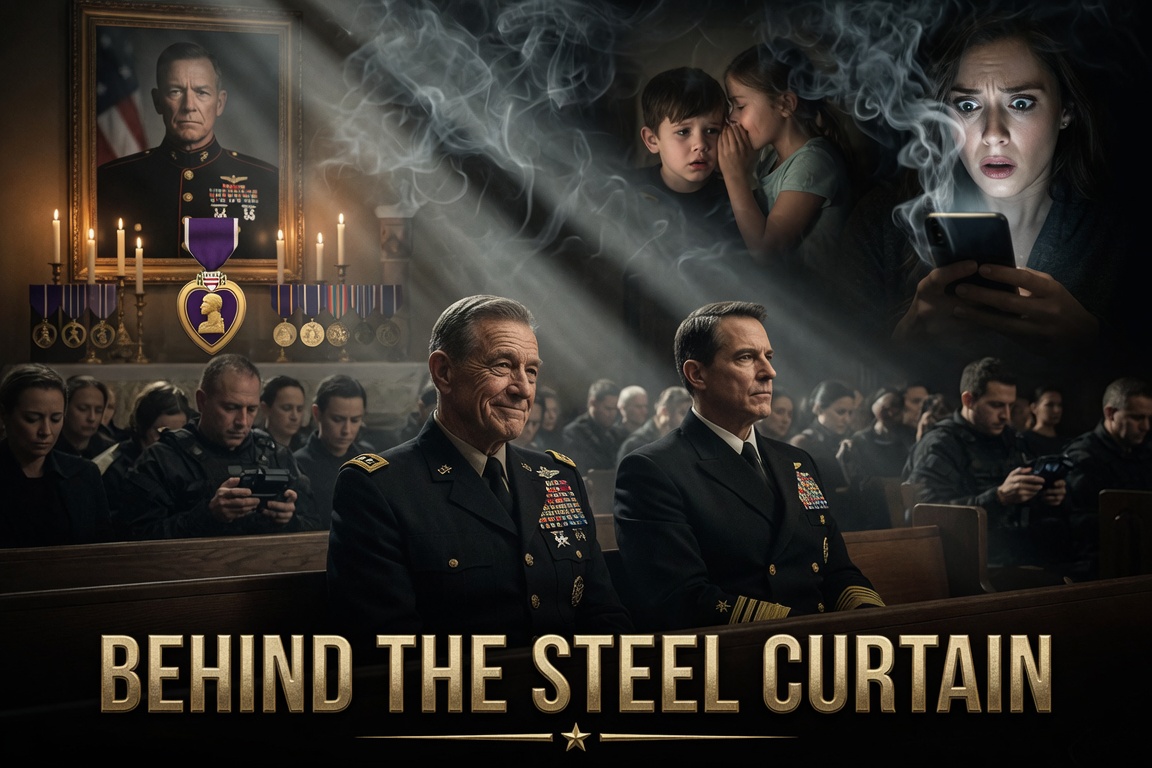
I stood at the entrance of St. Mark’s Veterans Hall with rainwater sliding from the shoulders of my black coat. Beyond the double doors, two hundred people had gathered beneath brass chandeliers and faded Navy banners. Their voices rolled through the room in low, uneasy waves.
Then they saw me.
The conversations thinned.
Faces turned.
Some with sympathy.
Most with suspicion.
My father’s photograph stood on an easel beside the coffin. Captain Walter Lawson at fifty-eight, silver at his temples, dress whites sharp enough to cut glass. He had commanded destroyers, advised admirals, and spent his retirement helping wounded veterans navigate a bureaucracy that seemed designed to outlast them.
In the photograph, he wore the crooked half-smile that had always appeared when he knew more than everyone else in the room.
I looked at that smile and felt the old pressure behind my ribs.
Not grief.
Grief had edges. This was heavier.
This was the knowledge that before they buried my father, my family intended to bury me beside him.
My younger brother, Daniel, intercepted me halfway down the aisle.
He wore a charcoal suit tailored too tightly across his shoulders. At forty-one, Daniel still had the polished face of the congressional candidate he had once hoped to become—white teeth, careful hair, concern practiced in mirrors.
He placed one hand against my arm.
“Terri,” he said quietly, “you shouldn’t have come.”
The room had gone still enough for me to hear rain ticking against the tall windows.
I looked down at his hand.
He removed it.
“That’s a strange thing to say at our father’s memorial.”
His eyes flicked toward the guests. “This isn’t the place.”
“For what?”
“For another scene.”
A muscle moved in his jaw. The cameras were already watching. Two local news crews had set up near the back wall, invited, no doubt, by Daniel himself.
Behind him stood our aunt Celeste, my father’s older sister and executor of his estate. She wore black silk, pearls, and the expression of a woman who had spent sixty-seven years mistaking control for dignity.
Celeste stepped closer.
“You received our message.”
“I received several.”
“Then you understand the family’s position.”
I let my gaze travel past her.
Near the front, men from my father’s old command sat shoulder to shoulder. Retired officers. Shipmates. Veterans he had helped. Beside them were county officials, donors from the Lawson Veterans Foundation, reporters, and neighbors who had known us since childhood.
Among the crowd sat twelve men scattered across separate rows.
One leaned on a cane.
One wore an oxygen tube beneath his nose.
Another had a beard gone mostly gray.
None wore uniforms.
None looked at me.
Not yet.
I returned my attention to Celeste.
“The family’s position,” I said, “is printed beneath Dad’s coffin?”
Her lips tightened.
Daniel lowered his voice. “You have been accused of falsifying your service record, exploiting Dad’s name, and diverting foundation funds. Until those allegations are resolved, you will not speak today.”
A murmur moved through the room.
He had timed it well.
Public enough to humiliate me.
Quiet enough to sound reluctant.
Daniel had always understood that cruelty was most effective when dressed as responsibility.
I glanced toward the coffin.
The folded American flag rested above my father’s heart.
“Who made the accusations?”
Celeste answered. “Several credible individuals.”
“Names.”
“This is neither the time nor the place.”
“It became the place when you invited cameras.”
Daniel’s expression hardened for half a second before softening again.
“You see?” he said, turning slightly toward the room. “This is exactly what we were concerned about.”
Concern.
The word landed cleanly.
He wanted them to believe I was unstable.
It was the final layer of the campaign he had been building for six weeks.
Anonymous emails sent to the foundation board.
Photocopied documents showing medals I had supposedly never earned.
A complaint claiming I had transferred $180,000 from a veterans’ housing account.
A grainy photograph of me entering a federal building beneath the headline:
DECORATED VETERAN OR CAREFULLY CONSTRUCTED LIE?
By the time my father died, strangers had begun leaving messages on my phone.
Fraud.
Thief.
Disgrace.
My father had called me three nights before his stroke.
He had sounded tired.
Not physically tired. Walter Lawson considered fatigue a logistical problem.
This was different.
“There are things I should have told you sooner,” he had said.
“Then tell me now.”
A pause.
In the background, I heard the faint metallic chime of the ship’s clock in his study.
“Not over the phone.”
Those were the last words he ever spoke to me.
Now Daniel stepped between me and the coffin as though protecting our father from contamination.
“You can sit in the rear,” he said. “After the service, you’ll leave through the side entrance. No statements. No confrontations.”
“And if I refuse?”
His face barely changed.
But his eyes did.
There it was.
Fear.
Small. Controlled. Real.
“Then security will remove you.”
I looked toward the two uniformed deputies near the wall. Neither met my eyes.
Daniel believed I had come alone.
That was his first mistake.
His second was believing the memorial belonged to him.
I unbuttoned my coat.
The movement caused both deputies to stiffen.
Beneath it, I wore a plain black dress. No medals. No ribbons. No indication that I had spent fourteen years in Navy intelligence, four embedded with special operations units, and three more helping dismantle financial networks that armed men who never wore uniforms.
I had learned early that authority announced too soon became a target.
So I had come with empty hands.
At least, that was what they could see.
“I’ll sit in the back,” I said.
Daniel’s shoulders loosened.
Celeste released a breath through her nose.
Around us, the room seemed to settle.
They thought I had surrendered.
I walked to the last row and took the seat nearest the aisle.
A woman beside me gathered her purse closer to her body.
At the front of the hall, Daniel approached the podium.
He adjusted the microphone and looked out over the crowd with solemn, measured grief.
“My father believed a person’s name was the only possession that outlived him.”
His eyes found mine.
“And he believed we were responsible for defending it.”
The twelve scattered men remained still.
I folded my hands in my lap.
Beneath my right thumb was a narrow scar, pale against my skin.
My father had once asked me why I touched it before difficult conversations.
“Habit,” I told him.
It was not.
The scar came from Kandahar, from broken glass and a room filling with smoke, from a night when a seven-second delay had nearly killed six men.
Afterward, Chief Nolan Price taught me a rule I never forgot.
Never signal until everyone is ready.
Daniel began telling the room who our father had been.
Half of it was true.
That was what made the lies dangerous.
And somewhere beneath the polished words, beneath the cameras and flowers and carefully arranged grief, I could feel the trap tightening.
What Daniel did not know was that I had spent the last forty-eight hours waiting for him to pull it closed.
Because once a trap closes, the person who built it cannot step away.
And neither can the witnesses.
The Name They Tried to Take
Daniel spoke for fourteen minutes.
He described childhood fishing trips that had never happened and private lessons our father had supposedly taught him. He spoke of honor, service, and stewardship. Each word had been sanded smooth by rehearsal.
When he mentioned the Lawson Veterans Foundation, Celeste lowered her chin in a display of modest sorrow.
The foundation had been my father’s second command.
He created it after retirement when he discovered that three sailors from his old ship were living out of their cars while waiting for disability claims. What began as a rented office above a hardware store had grown into a regional organization with forty-two employees, two transitional housing centers, and an annual budget of eleven million dollars.
Daniel handled public relations.
Celeste chaired the board.
I oversaw compliance and special investigations without salary, because my father had asked me to protect the one thing he feared success would attract.
Predators.
Six months earlier, I found irregular payments buried in the foundation’s redevelopment project.
The invoices were clean.
Too clean.
Three consulting firms billed identical amounts on alternating months. Their addresses led to mailboxes in Delaware and Virginia. The signatures approving the payments belonged to a retired comptroller who had been dead for eleven weeks.
I told my father.
He closed the office door, drew the blinds, and stared at the documents for a long time.
“Who else knows?”
“No one.”
“Keep it that way.”
I expected him to call the board.
Instead, he opened the bottom drawer of his desk and removed a small brass key.
“Terri, there are battles where noise is useful. This is not one of them.”
“You know who’s behind it?”
His mouth formed a hard line.
“I know who could be.”
He never gave me the key.
Not that day.
Two weeks later, the first anonymous complaint against me reached the board.
Then another.
Then the records accusing me of stolen valor appeared.
My security clearance history was selectively edited. Operations were removed. Dates were shifted. A training photograph was circulated with a caption claiming I had posed beside SEALs to impress donors.
The smear was sophisticated enough to survive a casual review.
It was also personal enough to expose the author.
Whoever built it knew where I had served.
They knew which portions of my record remained classified.
And they knew the public tends to mistake missing information for proof of deceit.
I asked my father whether Daniel had access to the foundation’s archived personnel files.
My father looked away.
That was answer enough.
Now Daniel stood beneath a projection of our father’s Navy portrait and invited Celeste to speak.
She approached the podium with a leather folder pressed to her chest.
“Walter’s final months were not easy,” she began.
Her voice carried the soft tremor of practiced pain.
“He was forced to confront questions no parent should face.”
A reporter’s camera clicked.
I watched Daniel.
His hands were folded at his waist, but his right index finger tapped once against his left wrist.
A tell from childhood.
He did it when he was waiting for someone else to deliver the blow.
Celeste opened the folder.
“In the interest of transparency, and in keeping with Walter’s devotion to integrity, the family believes we must address the allegations surrounding his daughter.”
A man near the front shifted in his chair.
Captain Joseph Mercer, my father’s former executive officer, turned toward me. His eyebrows pulled together, not in accusation but confusion.
Daniel had not told everyone what kind of memorial this would become.
That mattered.
Celeste continued.
“Documents received by the foundation indicate that Terri Lawson misrepresented the nature of her military service and used those misrepresentations to gain access to restricted financial accounts.”
The woman beside me exhaled sharply.
“She subsequently authorized unauthorized transfers totaling one hundred and eighty thousand dollars.”
A whisper spread through the hall.
I did not move.
Celeste held up a packet of paper.
“We had hoped to resolve this privately. Terri refused to cooperate.”
That was not merely false.
It was reversible.
I had sent Celeste nine formal requests for a board audit.
She had ignored six and denied three.
Every response existed.
Every email had metadata.
Every deleted attachment had been recovered.
But truth delivered too early becomes an argument.
Truth delivered at the exact moment a liar believes they have won becomes a verdict.
Celeste looked toward me.
“Terri, for the sake of your father’s memory, we ask that you surrender your foundation credentials and refrain from making further public claims regarding military decorations that cannot be verified.”
The room turned.
Two hundred faces.
Some embarrassed.
Some hungry.
A few already convinced.
Daniel stepped toward the aisle carrying a document and a pen.
He stopped in front of me.
“This is a voluntary acknowledgment,” he said. “Sign it, return your credentials, and we can avoid further damage.”
I took the paper.
At the top was the foundation logo.
Beneath it:
STATEMENT OF ADMINISTRATIVE MISREPRESENTATION AND FINANCIAL RESPONSIBILITY
They wanted my signature beneath a confession broad enough to destroy me and narrow enough to shield them.
I read the final paragraph.
It included a waiver.
No future claims against foundation officers, board members, or family representatives.
There it was.
Not grief.
Not reputation.
Liability.
I looked up at my brother.
“When did Dad approve this?”
Daniel’s gaze remained steady. “Before he died.”
“Show me his signature.”
“It’s in the foundation records.”
“Then show it.”
His mouth tightened.
Celeste spoke from the podium. “Must you turn everything into an interrogation?”
Captain Mercer rose halfway from his chair.
“Celeste,” he said, “perhaps this should be handled after the service.”
She gave him a brittle smile.
“We appreciate your concern, Joe. But the family has delayed long enough.”
Daniel extended the pen.
“Sign it.”
My eyes traveled over his face.
When we were children, Daniel used to break things and arrange the pieces beside me. A lamp. A window. Our father’s antique compass. He never accused me directly. He simply created a scene that made innocence difficult to explain.
Our mother died when I was sixteen and Daniel was eleven. After that, I protected him with the seriousness of a second parent.
I took detentions for fights he started.
I lied about money he stole.
At twenty-three, I wired him everything in my savings account after he called from Atlantic City and said men were looking for him.
My father knew about some of it.
Not all.
I had mistaken rescuing Daniel for loving him.
He had mistaken being rescued for proof that consequences were optional.
“You planned this before Dad died,” I said.
A camera shutter snapped.
Daniel glanced toward it.
“Sign the document, Terri.”
“Did you know he called me?”
The tapping finger stopped.
Celeste’s face changed almost invisibly.
“He called many people,” Daniel said.
“Three nights before the stroke.”
“You’re upsetting everyone.”
“He said there were things he should have told me sooner.”
For the first time, Daniel looked toward the coffin.
Not at our father’s photograph.
At the coffin itself.
The reaction lasted less than a second.
But I saw it.
So did one of the twelve men near the front.
Chief Nolan Price sat in the third row wearing a dark suit that hung loosely on his frame. Sixty-two years old. Former command master chief. A man who had walked out of a burning compound with shrapnel in his neck and apologized for bleeding on the helicopter floor.
His gaze moved from Daniel to me.
Then he touched two fingers to his knee.
Ready.
I set the unsigned confession on the chair beside me.
“No.”
Daniel inhaled through his nose.
“You leave us no choice.”
He raised one hand.
The deputies stepped away from the wall.
I remained seated as they approached.
The younger deputy looked sick. The older one avoided my eyes.
Daniel turned toward the cameras.
“We attempted compassion,” he said. “Unfortunately, Terri has chosen disruption.”
The older deputy stopped at the end of my row.
“Ma’am,” he said, “I need you to come with us.”
I looked at the badge on his chest.
Then at Daniel.
“On whose authority?”
“This is a private event,” Daniel replied.
“No. It isn’t.”
Silence.
I stood.
My voice did not rise.
“This hall was paid for by the foundation. The memorial was announced as a public event. The county waived the rental fee because Captain Lawson was being honored for public service.”
Daniel’s nostrils flared.
“You always hide behind technicalities.”
“No. I pay attention to them.”
Celeste closed the folder sharply.
“Remove her.”
The younger deputy reached toward my elbow.
Before he touched me, a voice came from the center of the room.
“Sheriff’s office know you’re doing this, son?”
The deputy froze.
Nolan Price had not stood.
He did not need to.
The older deputy recognized him.
“Chief Price.”
“Retired,” Nolan said. “Which means I have time to ask uncomfortable questions.”
Daniel forced a laugh.
“This doesn’t concern you.”
Nolan looked at him the way a demolition expert might examine a suspicious wire.
“Your sister concerns me.”
A ripple passed through the room.
Daniel’s eyes narrowed.
“Why?”
Nolan said nothing.
Not yet.
I lifted my right hand and touched my thumb to the scar beneath it.
The first signal.
Across the hall, twelve men adjusted in their seats.
Daniel did not notice.
He was too busy believing the room still belonged to him.
Then the side door opened.
And a woman from the foundation’s legal department entered holding a sealed evidence case.
Daniel’s face lost its color.
The Box My Father Left Behind
The woman’s name was Mara Chen.
Thirty-eight. Foundation counsel. Former federal prosecutor. Five feet two in low heels, with black hair cut at the jaw and the unnerving stillness of someone who had already read every version of your lie.
She carried a gray polymer case cuffed to her wrist.
Beside her walked Special Agent Caleb Voss of the Naval Criminal Investigative Service.
He wore no visible badge.
He did not need one either.
Daniel took one step backward.
Celeste gripped the podium.
Mara stopped in the center aisle.
“Terri,” she said, “I apologize for the delay.”
Daniel recovered quickly.
“This is a family memorial. Whatever stunt this is, it can wait.”
Mara looked toward the cameras.
“Actually, your attorney requested that any dispute regarding the foundation be addressed in a setting with independent witnesses.”
Daniel’s lips parted.
Mara lifted one eyebrow.
“I have the email.”
A few people shifted uncomfortably.
Daniel glanced at Celeste.
That was the first crack between them.
Small, but visible.
Celeste spoke with forced composure. “Ms. Chen, you were suspended from foundation duties yesterday.”
“By a board vote taken without quorum.”
“You had access to confidential files.”
“I had access because Captain Lawson appointed me records custodian.”
“Walter was medicated.”
Mara’s gaze cooled.
“I met with him twelve days before his death. His physician, nurse, and two witnesses were present. He was alert, specific, and angry.”
The room tightened around that last word.
Not confused.
Not manipulated.
Angry.
Mara raised the case.
“Captain Lawson instructed me to secure these materials if any member of his family attempted to remove Terri Lawson from the foundation, discredit her service, or compel her to sign a liability waiver.”
Every face turned toward Daniel.
The confession remained on the empty chair beside me.
He looked at it as though seeing it for the first time.
Celeste stepped down from the platform.
“This is absurd. Walter would never create a spectacle at his own memorial.”
“No,” Mara said. “He believed someone else might.”
Daniel’s voice sharpened.
“What’s in the case?”
Mara looked at me.
“Something your father wanted Terri to open.”
The handcuff key was taped beneath the handle. She removed it, unlocked the cuff, and placed the case on a table near the aisle.
A six-digit keypad blinked beside the latches.
Mara held out an envelope.
My name was written across it in my father’s block handwriting.
My fingers went cold.
For six weeks, I had analyzed records, followed shell companies, and reconstructed deleted files. I had slept in ninety-minute intervals and eaten meals standing over a sink.
None of that prepared me to see my father’s handwriting.
I opened the envelope.
Inside was a single index card.
The combination is the day you stopped asking permission.
Daniel gave a short, humorless laugh.
“How theatrical.”
But I knew the date.
November 3.
Fourteen years earlier.
The day I disobeyed an evacuation order in eastern Afghanistan because intelligence indicated a local source and his family would be executed before dawn.
Officially, my team had no authority to intervene.
Unofficially, I had spent nine months cultivating the source, and I knew the men hunting him would not wait for paperwork.
I altered the extraction route.
We recovered the family.
We also uncovered a weapons ledger that prevented three planned attacks.
The decision ended my conventional career path.
It also placed me beside men whose trust could not be earned through rank.
I entered 110314.
The latches clicked.
Inside the case were three objects.
A brass key.
A black data drive.
And my father’s shipboard journal.
Daniel stared at the key.
I saw recognition.
Then fear.
The same key my father had shown me months earlier.
Mara gestured toward the screen behind the podium.
“Agent Voss has verified the drive’s chain of custody. Captain Lawson recorded the file himself.”
Voss connected the device to the projection system.
For a moment, the screen remained black.
Then my father appeared.
Not in uniform.
Not in the carefully lit portrait beside his coffin.
He sat at his desk wearing a blue cardigan, his face thinner than I remembered. Afternoon light cut across the room, revealing dust in the air.
Behind him, the ship’s clock read 1630.
He looked directly into the camera.
“If this recording is being played, then my daughter has been publicly accused, and someone in my family has decided reputation matters more than truth.”
A sound escaped Celeste.
Barely more than breath.
On the screen, my father continued.
“Terri does not know I made this statement. She would have advised against it. She has an unreasonable belief that evidence should be presented without emotion.”
A faint smile touched his mouth.
A few veterans in the room smiled with him.
Then his expression changed.
“The evidence is clear. The betrayal is not.”
Daniel moved toward the projection controls.
Agent Voss stepped into his path.
“Don’t.”
One word.
Daniel stopped.
My father lifted a document toward the camera.
“Five months ago, Terri identified fraudulent transactions connected to the foundation’s Harbor House redevelopment. She reported those transactions to me. I asked her to conduct a confidential review.”
The crowd stirred.
“Terri did not steal one hundred and eighty thousand dollars. She transferred the funds into a protected holding account after I signed an emergency preservation order.”
Mara opened the journal to a marked page and held it up.
My father’s signature appeared beneath the authorization.
Two witnesses had signed below it.
One was Mara.
The other was Captain Mercer.
Mercer stood slowly.
“I witnessed it,” he said.
His voice carried the weight Daniel had tried to manufacture.
“I also witnessed Walter instruct Terri not to inform the board until the source of the false invoices was identified.”
Daniel’s face hardened.
“This proves nothing about her service claims.”
The screen flickered.
My father leaned closer to the camera.
“If the attack extends to Terri’s military record, then the person responsible has accessed sealed files and selectively altered them. I know because I was shown the forged version.”
Daniel’s eyes snapped toward Celeste.
She did not look at him.
My father continued.
“I also know who first gave it to me.”
The room went silent.
I felt Nolan shift in his chair.
This was the threshold.
The point at which a mission stops being recoverable.
My father reached off-camera and lifted a photograph.
It showed Daniel entering a parking garage beside a man I recognized as Everett Shaw, the foundation’s former technology director.
Shaw had disappeared two weeks after I began the audit.
My father placed the photo on his desk.
“Daniel told me he obtained these records from a concerned veteran. That was false.”
My brother’s voice cut through the room.
“This recording could have been manipulated.”
Agent Voss reached into his jacket.
“Mr. Lawson, I recommend you stop speaking.”
Daniel ignored him.
“He was ill. Terri pressured him. She’s been manipulating him for years.”
My father’s recorded voice continued over Daniel’s.
“Everett Shaw provided me with copies of communications proving that Daniel and Celeste Lawson created the accusations against Terri.”
The room reacted as one body.
Heads turned.
Chairs creaked.
Someone near the rear whispered, “My God.”
Celeste’s face seemed to collapse inward.
Daniel stood perfectly still.
On the screen, my father closed his eyes for one long second.
When he opened them, he looked older.
“I do not know whether my son understands the damage he has done. I know only that he has convinced himself it was necessary.”
The recording ended.
Black screen.
Rain against glass.
No one moved.
Then Daniel smiled.
It was the strangest thing he could have done.
Not a broad smile.
Not amusement.
A small, exhausted curve of the mouth, as though my father’s accusation had released him from the burden of pretending.
“You all heard him,” he said. “He didn’t know why.”
He turned toward me.
“You want the truth, Terri?”
His eyes were wet now.
Not with shame.
With fury.
“I did it because he was going to give you everything.”
The Son Who Wanted to Be Chosen
Daniel’s voice changed when he stopped performing.
The polished cadence disappeared. His words came faster, roughened by years he had never spoken aloud.
“The foundation. The house. The board seat. His name.”
I stared at him.
“Dad’s will left the foundation in trust.”
“Don’t insult me.”
He stepped into the aisle.
All around him, people leaned away as though anger had temperature.
“You were always the one he trusted. Terri can handle it. Terri will know what to do. Terri understands duty.”
His mouth twisted around the final word.
“I stayed. You left.”
“I joined the Navy.”
“You escaped.”
The sentence struck harder than I expected.
Daniel saw it.
For a moment, he looked almost relieved.
“You escaped that house, and I stayed with him after Mom died. I listened to him compare every choice I made to what you would have done. Every failure came with your shadow attached.”
Celeste whispered his name.
He swung toward her.
“Don’t.”
She flinched.
There it was again—the widening fracture.
Daniel had not built the scheme alone.
But he had reached the point where allies became witnesses.
He faced the crowd.
“Harbor House was failing. Contractors were walking. Donors wanted results. I moved money to keep the project alive.”
“Through shell companies?” Mara asked.
“Through vendors who could work without eighteen layers of compliance.”
“The vendors belonged to you,” I said.
His eyes returned to mine.
“Not directly.”
A bitter laugh came from somewhere in the room.
Daniel’s head snapped toward it.
I stepped into the aisle.
“You routed foundation money into companies controlled by your college roommate, your campaign treasurer, and Celeste’s property manager.”
“We paid for work.”
“Some.”
“Enough to finish the housing center.”
“And the rest?”
His silence answered.
I took one step closer.
“You were planning another campaign.”
The color in his face changed.
That was not in my father’s video.
I had found it myself.
An exploratory committee registered through a Virginia legal office. Polling invoices. Donor lists. A proposed announcement scheduled three weeks after Harbor House opened.
Daniel wanted the foundation’s success as a launch platform.
He had taken money from wounded veterans to build himself a staircase.
He lifted his chin.
“I could have done more in office than this foundation does in ten years.”
There it was.
His moral logic.
Not greed, at least not in the way he understood it.
Entitlement disguised as scale.
He believed rules were obstacles placed between him and the good he intended to accomplish.
“How much did Celeste know?” I asked.
His eyes moved toward our aunt.
Celeste’s hands clenched around the leather folder.
Daniel gave her a long look.
Then he said, “All of it.”
She recoiled.
“That is not true.”
“You signed the authorizations.”
“Because you said Walter approved them.”
“You knew he hadn’t.”
“You told me the money would be replaced.”
“And you believed me?”
Her face went white beneath the powder.
She looked suddenly old.
Not fragile.
Exposed.
Daniel turned back to me.
“Celeste helped because she understood what Dad never did. Institutions survive through influence. Influence costs money.”
I heard one of the reporters whisper to her cameraman to keep rolling.
Daniel heard it too.
His voice rose.
“You think any of this is clean? You think donors write checks because they care about veterans sleeping in cars? They want photographs. They want tax deductions. They want their names on buildings.”
He pointed toward the coffin.
“Dad knew it. He just preferred to pretend he was above it.”
I felt heat move through my chest.
“Do not use him to excuse yourself.”
“You used him every day.”
The room contracted.
He stepped closer until only a few feet separated us.
“Every time you walked into the foundation with your classified silences and your careful little stare, people treated you like some kind of hero. You never had to say what you did. You let mystery do the work.”
I kept my hands at my sides.
“You forged my record.”
“I corrected the myth.”
“You fabricated a theft.”
“I gave the board a reason to remove you.”
“You sent reporters sealed information.”
“You were going to destroy everything.”
“No,” I said. “I was going to expose you.”
He laughed.
“And replace me.”
“I never wanted your position.”
“That’s worse.”
His voice cracked.
“Do you understand that? You didn’t even want what he was going to give you.”
For one heartbeat, I saw the boy beneath the suit.
Eleven years old, standing at our mother’s funeral in a jacket too large for him, looking at our father and waiting to be told the world would not keep taking things.
No one told him.
I took a breath.
“You should have told me.”
His face went blank.
“About the project. About the debt. About Dad. About how angry you were.”
“And what would you have done?”
“Helped.”
“Exactly.”
He said it with hatred.
“You would have helped. Quietly. Competently. And everyone would have loved you more for it.”
The words hung between us.
Not because they were true.
Because he believed them.
Behind him, Celeste lowered herself into a chair.
Mara stood beside the evidence case, watching without satisfaction.
Agent Voss remained near the projection screen.
He had not arrested anyone.
Not yet.
Daniel noticed.
A dangerous calculation moved behind his eyes.
“You don’t have jurisdiction over foundation finances,” he said to Voss.
“No,” Voss replied.
Daniel glanced toward the deputies.
“And no one here has charged me with anything.”
“Not yet,” Mara said.
He straightened his jacket.
The old polish began returning.
“Then this spectacle is over.”
He turned toward the doors.
I let him take three steps.
“Everett Shaw is alive.”
Daniel stopped.
The back of his neck reddened above his collar.
Celeste whispered, “What?”
I watched my brother’s shoulders rise and fall.
“He disappeared,” Daniel said.
“No. He entered federal protective custody.”
Daniel turned slowly.
For the first time that morning, he looked unsure of what reality contained.
I continued.
“Everett copied every instruction you sent him. Every altered service record. Every fabricated invoice. Every message telling him which journalists to contact.”
Daniel’s lips moved, but no sound came.
“He also recorded the meeting where you told him what would happen if he refused.”
“That’s a lie.”
“Is it?”
I looked toward Agent Voss.
He nodded once.
The screen behind him changed.
A waveform appeared against a dark background.
Then Everett Shaw’s voice filled the hall.
Thin.
Nervous.
Recorded through a phone hidden inside a coat pocket.
“I’m not changing military records, Daniel. That’s federal.”
My brother’s voice answered.
“You’re changing a database entry.”
“You said the files were sealed.”
“I said no one can verify them.”
“And if she can?”
A pause.
Then Daniel spoke.
“If Terri pushes, we make her look unstable. Grief history, combat trauma, obsession with Dad. People don’t need proof. They need permission to doubt.”
No one in the room breathed.
The recording continued.
Everett: “And the money?”
Daniel: “By the time anyone understands the transfers, she’ll have signed responsibility.”
Everett: “She won’t.”
Daniel: “Then we give her the choice at the memorial.”
The audio stopped.
Daniel stared at the screen.
His mouth was open slightly.
The cameras captured everything.
The exact moment recognition arrived.
It began in his eyes.
Not remorse.
Calculation collapsing.
He looked at the reporters.
At Captain Mercer.
At the deputies.
At Celeste, who had begun crying without making a sound.
Then he looked at me.
His shoulders dropped by less than an inch.
But I knew him.
That inch was surrender.
He finally understood there was no private room left where he could rewrite what had happened.
No family loyalty to hide behind.
No grieving father to manipulate.
No sister willing to absorb the impact.
The whole room had heard him.
Still, he tried one final defense.
“You set me up.”
My voice stayed low.
“No, Daniel.”
I looked at the confession he had tried to make me sign.
“You chose the room.”
The Men in the Back Rows
The older deputy stepped toward Daniel.
“Sir, I need you to remain here.”
Daniel turned sharply.
“Am I under arrest?”
“Not at this time.”
“Then move.”
The deputy did not.
Celeste covered her face with both hands.
A board member stood near the front and removed his foundation pin. He placed it on the chair beside him.
Another followed.
The tiny metal clicks were louder than applause.
Daniel watched them abandon him one by one.
His face hardened again.
“All of you benefited,” he said. “Every person in this room who took a photograph at Harbor House, who attended a gala, who put the foundation on a résumé—you benefited.”
No one answered.
That silence was not fear anymore.
It was judgment.
Then a reporter near the back called out.
“Ms. Lawson, can you verify your military decorations?”
Daniel seized the question like a drowning man grabbing wire.
“Yes,” he said, turning toward me. “Ask her. Ask why there are no public citations. Ask why she has spent years implying she served with units she was never part of.”
The reporter looked embarrassed by Daniel’s enthusiasm, but the question remained.
Two hundred faces turned toward me again.
This was the final piece of the smear.
Even with the financial fraud exposed, doubt survives when given a separate place to live.
I could have answered with paperwork.
Mara had copies.
Agent Voss had verification.
But my father had taught me that some truths belong in documents.
Others belong in witnesses.
I looked toward Nolan Price.
He sat motionless in the third row.
A thin scar ran from beneath his left ear into his collar.
Fourteen years earlier, I had pressed both hands against that wound while a helicopter banked through tracer fire. He had remained conscious long enough to insult my field dressing.
Now his eyes held mine.
Waiting.
Around the room, the other eleven men had gone still.
A former breacher with two artificial knees.
A sniper who taught high school physics in Oregon.
A medic who ran a pediatric clinic outside Baltimore.
A communications specialist who had not spoken to me in seven years, but had answered my call on the first ring.
They had come separately.
No uniforms.
No announcement.
Not to intimidate anyone.
To bear witness.
My father had invited them before his death.
That was the final entry in his journal.
I raised my right hand.
Thumb across the scar.
Two fingers down.
A signal once used in a darkened compound where voices would have carried through concrete.
Nolan stood.
The scrape of his chair cut through the hall.
Then another man rose in the rear.
Then another.
One by one, twelve men stood from different rows.
The crowd shifted to see them.
Daniel turned slowly as the pattern became clear.
Nolan buttoned his suit jacket.
“Terri Lawson never claimed to be a SEAL,” he said.
His voice was rough with age and old damage.
“She was better than that.”
A few eyebrows lifted.
Nolan looked around the room.
“She was the intelligence officer attached to our task element when bad information got people killed. She was the person who told us when the map was wrong, when the source was lying, and when the people above us cared more about a clean report than a living team.”
Daniel’s face tightened.
Nolan continued.
“In November 2014, Lieutenant Lawson identified an imminent threat to an Afghan interpreter who had given us information on a weapons network. The extraction request was denied.”
The medic in the fifth row spoke next.
“She went anyway.”
Another man rose straighter despite the brace beneath his pant leg.
“She rerouted us through a dry canal the surveillance team had missed.”
The sniper near the wall said, “She spotted the secondary position before it opened fire.”
The medic touched two fingers to his chest.
“She kept Chief Price alive.”
Nolan looked at me.
“And she brought home a ledger that stopped three attacks.”
The hall was silent.
No music.
No movement.
Only rain and the quiet hum of the cameras.
The reporter asked, “Was she decorated?”
Nolan’s mouth pulled into something that was not quite a smile.
“Yes.”
“Which award?”
“That citation remains partially classified.”
Daniel laughed once.
It sounded broken.
“How convenient.”
Nolan’s head turned.
Men like Nolan did not need volume to create fear.
“Son,” he said, “the only convenient thing in this room is that your sister has spent her entire life choosing not to embarrass you.”
Daniel’s face flushed dark red.
The men remained standing.
Not at attention.
Not performing.
They stood the way veterans stand when the past enters a room and demands space.
The man with the cane spoke.
“Terri never called us here.”
I looked at him.
That was true.
My father had.
He continued.
“Captain Lawson contacted each of us two weeks ago. He said his daughter might need people willing to tell the truth in public.”
My throat tightened.
Nolan reached into his jacket and removed an envelope.
“He asked me to give you this after everyone stood.”
He walked down the aisle.
The crowd parted for him.
When he reached me, he held out the envelope but did not release it immediately.
“Your father knew,” he said.
“Knew what?”
“That you’d try to protect Daniel from the worst of it.”
My brother stared at us.
Nolan’s fingers loosened.
“Captain said not to let you.”
Inside the envelope was another card in my father’s handwriting.
Mercy without consequence is only permission wearing a kinder face.
I read it twice.
The letters blurred.
For years, I had believed restraint was evidence of strength.
Sometimes it was.
Sometimes it was fear dressed in uniform.
My greatest fear had never been losing my reputation.
It was becoming the reason my family finally broke apart.
Daniel knew that.
He had built his entire plan around it.
I folded the card and placed it in my coat.
Then I looked at Agent Voss.
“Play the final file.”
Daniel’s head snapped toward me.
“What final file?”
Mara’s face changed.
She knew.
Celeste did not.
The board did not.
Only Agent Voss, my father, and I understood what came next.
The screen brightened again.
This time there was no video.
Only a spreadsheet.
Rows of dates.
Payments.
Account numbers.
At the top appeared the name of an offshore trust.
LAWSON LEGACY STRATEGIC FUND.
Celeste rose from her chair.
“No.”
Her voice was barely audible.
Daniel turned toward her.
“What is that?”
She began shaking her head.
Mara looked at me.
“You found the beneficiary?”
“Yes.”
I faced my brother.
“The stolen money was not funding only your campaign.”
He looked from me to Celeste.
“You said the remainder was being held for redevelopment.”
Celeste backed away.
“Daniel—”
“How much?”
She said nothing.
His voice exploded through the hall.
“How much?”
I answered.
“Two point four million dollars over four years.”
Daniel stared at her.
“That’s impossible.”
“The Harbor House transfers were only the most recent.”
Celeste’s lips trembled.
“I protected this family for forty years.”
Daniel moved toward her.
“You used me.”
She straightened, and for a moment the old steel returned.
“You were already stealing.”
The sentence cut through him.
“I redirected funds you had already compromised. Funds that would have been lost when your campaign failed.”
“You told me we were building influence.”
“We were.”
“For who?”
Celeste looked toward the coffin.
Not at us.
At my father.
“For the Lawson name.”
Mara’s voice was cold.
“The trust’s sole beneficiary is Celeste Lawson.”
The public humiliation Daniel had designed for me turned and settled over him.
He looked at our aunt as though she had become a stranger.
Perhaps she had.
Perhaps they both had.
Celeste lifted her chin.
“Walter built everything. Terri inherited his respect. Daniel inherited his expectations. And I inherited the duty of cleaning up every disaster neither of you understood.”
“You stole from homeless veterans,” I said.
“I preserved the institution.”
“You purchased a condo in Lisbon.”
Her mouth closed.
A low sound moved through the crowd.
Celeste looked around at the faces that had once welcomed her to galas, board dinners, and dedication ceremonies.
“You think foundations survive on virtue? They survive because someone is willing to do what respectable people refuse to see.”
My father’s recorded image remained frozen on the screen behind her.
His face above hers.
The man who had trusted his sister with his legacy.
Celeste glanced up and saw him.
Her shoulders pulled back as if struck.
For the first time, the certainty left her eyes.
The room watched her recognition unfold.
Her lips parted.
One hand rose toward the pearls at her throat.
She looked at the coffin, then at the foundation employees seated near the front—men and women who had accepted lower salaries because they believed in the work.
A housing coordinator was crying openly.
A double amputee from my father’s first transitional program stared at Celeste with an expression worse than hatred.
Disappointment.
Celeste’s fingers fell from her pearls.
The leather folder slipped from her other hand and struck the floor.
No one bent to retrieve it.
Agent Voss stepped forward.
“Celeste Lawson, Daniel Lawson, you are both being detained pending execution of federal warrants related to wire fraud, obstruction, unlawful access to protected records, and conspiracy.”
Daniel looked at me.
The fury had gone.
So had the charm.
What remained was the boy at the funeral.
“What happens to the foundation?” he asked.
It was the first honest question he had asked all morning.
“That depends on what survives the truth,” I said.
The deputies moved in.
Daniel did not resist.
Celeste did.
Not physically.
She demanded names, titles, jurisdiction, counsel. She spoke faster as the agents led her toward the side exit, as though the right arrangement of words could restore the walls around her life.
The cameras followed.
At the doorway, Daniel stopped.
He turned back toward our father’s coffin.
For a second, I thought he might say goodbye.
Instead, he looked at me.
“Did he ever forgive me?”
The room waited.
I could have lied.
I had lied for him before.
“No,” I said. “But he still loved you.”
Daniel closed his eyes.
The deputy guided him through the door.
And he disappeared into the rain.
The Cost of Winning
After the arrests, no one knew what to do.
The memorial had been scheduled down to the minute. Hymn. Eulogy. Honor detail. Reception.
But truth does not respect agendas.
It leaves debris.
Reporters clustered near the back, speaking into phones. Board members whispered with Mara. Foundation employees stood in small groups, stunned by the realization that the institution they served had been used as both weapon and shield.
The twelve men remained where they had stood.
Waiting for me.
Captain Mercer approached the podium.
His eyes were red.
“Walter hated unfinished ceremonies,” he said.
A few people laughed softly.
The sound broke something open in the room.
Mercer looked toward me.
“Terri, your father asked you to speak.”
On the front row, the printed notice still lay beneath the coffin.
TERRI LAWSON IS NOT AUTHORIZED TO SPEAK.
I walked to it.
Picked it up.
Folded it once.
Then again.
I placed it in my coat pocket beside my father’s card.
The podium felt colder than I expected.
From there, I could see everyone.
The veterans.
The staff.
The neighbors.
The empty chairs Daniel and Celeste had occupied.
Nolan sat with his hands folded over his cane.
I had prepared no speech.
My father would have considered that negligent.
Then again, he had prepared enough for both of us.
“When I was nine,” I began, “my father took Daniel and me aboard a destroyer during a family day.”
A faint smile moved through the older sailors.
“Daniel wanted to see the missiles. I wanted to see the bridge. Dad took us to neither.”
I looked at the coffin.
“He brought us below deck and showed us the damage-control lockers.”
Mercer lowered his head, smiling.
“He told us ships are not saved by the people who stand where everyone can see them. They are saved by the people who know where the valves are when smoke fills the passageway.”
The hall grew quiet.
“For most of his life, my father believed preparation could solve almost anything. He kept flashlights in every room. Spare batteries in every drawer. He once made me write an emergency plan for a family barbecue.”
Laughter rose gently.
“He was less prepared for the people he loved.”
My voice tightened.
I let the silence remain.
“He trusted his sister. He hoped his son would become the man he kept promising to be. And he believed I was strong enough to carry whatever the truth cost.”
I looked toward the side doors where Daniel had disappeared.
“He was wrong about that last part.”
No one moved.
“I am not strong enough to lose my brother and feel nothing. I am not disciplined enough to watch my aunt led away and call it justice without grief. I do not know how to separate the people they were from the things they chose to do.”
Nolan’s eyes stayed on mine.
“But my father’s final lesson was that love cannot require silence from the person being harmed.”
A woman near the front covered her mouth.
“The foundation will undergo a full independent audit. Every misused dollar will be traced. Every donor will receive the findings. No building will carry the Lawson name until the people it serves decide whether that name deserves to remain.”
Several board members looked startled.
Good.
They had expected continuity.
Continuity was how rot survived.
“Mara Chen will oversee the legal review. The housing programs will remain open. Employees who reported concerns will be protected. And anyone who helped conceal the fraud will be removed, regardless of title, relationship, or years of service.”
The room absorbed the words.
Not applause.
Not yet.
This was not a victory speech.
“The name on the building was never the mission,” I said. “The people inside it were.”
Captain Mercer stood first.
Then the housing coordinator.
Then veterans from the front rows.
The sound began as chairs moving against the floor.
Not a cheer.
A rising.
One person, then another.
Soon the room was standing.
I did not mistake it for approval.
Standing is not absolution.
But it was a promise that the institution might outlive what had been done to it.
The honor detail entered through the side doors.
Six sailors in dress blues.
Their shoes struck the floor in precise rhythm.
The room settled.
They approached the coffin.
The flag was lifted, held taut, and folded with movements so exact they seemed to slow time.
I watched the blue field disappear into itself.
My father had spent his life beneath that flag.
He had also spent his life learning that symbols do not protect their own meaning.
People do.
The final fold was pressed into place.
The officer in charge carried the triangle of blue toward me.
I stepped down from the podium.
He stopped in front of me.
“On behalf of the President of the United States, the United States Navy, and a grateful nation…”
His voice remained steady.
Mine would not have.
He placed the flag into my hands.
The weight surprised me.
Not physical weight.
Memory.
My father teaching me to change a tire in freezing rain because “weather does not negotiate.”
My father sitting awake outside Daniel’s bedroom after our mother died.
My father refusing to say he was proud until the words became rare enough to matter.
My father, near the end, recording the truth because he had finally understood that silence was not neutrality.
The bugler raised his instrument.
The first note of “Taps” entered the hall.
It moved through the rafters, thin and clear.
Outside, the rain slowed.
No one filmed during the final notes.
Even the reporters lowered their cameras.
When the last note faded, Nolan approached me.
The other eleven men waited behind him.
“You gave the signal late,” he said.
My throat tightened around a laugh.
“I needed everyone ready.”
He nodded toward the folded flag.
“You were.”
People began leaving in small groups.
Some touched my shoulder.
Some apologized.
A few avoided me, embarrassed by how easily they had believed the accusations.
The woman who had moved her purse away from me stopped near the aisle.
“I’m sorry,” she said.
Her cheeks reddened.
I could have made her suffer.
A cutting sentence would have been easy.
But she was not Daniel.
She had not built the lie.
She had merely accepted it because it arrived on official paper.
“Next time,” I said, “ask who benefits from your suspicion.”
She nodded and walked away.
Near the rear doors, Mara waited with the evidence case.
“What happens now?” she asked.
“We stabilize the housing programs.”
“And after that?”
“Full forensic audit.”
“And after that?”
I looked at the empty hall.
Flowers surrounded the coffin. Programs lay scattered across chairs. One camera cable remained coiled near the wall like an abandoned snake.
“Then we decide what should be rebuilt.”
Mara studied me.
“You know the board will ask you to take over.”
“Yes.”
“Will you?”
I looked at my father’s photograph.
The crooked smile.
The expression of a man who knew more than everyone else in the room.
“No.”
Mara blinked.
“No?”
“I’ll stay through the audit. Then the foundation gets a director chosen by veterans, employees, and independent trustees.”
“Your father wanted you.”
“My father wanted the mission protected.”
I ran my thumb along the edge of the folded flag.
“Those are not the same thing.”
Outside, camera crews waited beneath umbrellas.
By evening, the recording would be everywhere.
Daniel’s words.
Celeste’s face.
The SEALs standing.
People would reduce the day to a moment because moments are easier to consume than consequences.
They would call it revenge.
It was not.
Revenge would have meant enjoying Daniel’s collapse.
I did not.
Justice is colder than revenge.
It asks what must happen next.
What Survived the Truth
The federal investigation lasted eleven months.
The audit uncovered four point seven million dollars in diverted funds, fraudulent contracts, and concealed liabilities.
Some money was recovered.
Some had vanished into legal fees, campaign consultants, luxury property, and bad investments disguised as strategy.
Celeste pleaded guilty to conspiracy, wire fraud, and obstruction. At sentencing, she told the court she had acted to preserve her brother’s legacy.
The judge asked how purchasing a waterfront apartment in Portugal preserved housing for disabled veterans.
Celeste had no answer.
Daniel went to trial.
He rejected two plea agreements because both required him to admit he had fabricated accusations against me.
Even after the evidence became public, he could not tolerate a version of events in which he was merely wrong.
He needed to be misunderstood.
His attorney argued that he had acted under Celeste’s influence and believed the foundation faced financial collapse. Parts of that were true.
Daniel had been manipulated.
He had also manipulated others.
Both things can live inside one person.
The jury convicted him on seven counts.
Before sentencing, he asked to speak with me.
We met in a federal courthouse interview room with a steel table bolted to the floor.
He had lost weight. Gray showed at his temples. Without the expensive suit and practiced smile, he looked more like our father than he ever had before.
For several minutes, neither of us spoke.
Then Daniel placed both hands flat on the table.
“Did you know about Lisbon before the memorial?”
“Yes.”
“Why didn’t you tell me?”
“I needed you and Celeste in the same room.”
His mouth tightened.
“So you used me.”
“I let you reveal yourself.”
He looked toward the narrow window in the door.
“You enjoyed it.”
“No.”
“You expect me to believe that?”
“I don’t expect anything from you anymore.”
The sentence landed.
He looked down at his hands.
“I hated you,” he said.
“I know.”
“No. You don’t.”
He raised his eyes.
“I hated the way people became straighter around you. The way Dad listened when you spoke. The way you could walk away from things.”
“I didn’t walk away.”
“You left.”
“I was nineteen.”
“You left me with him.”
There it was.
The oldest wound.
Not the foundation.
Not the campaign.
Not the inheritance.
A boy standing in a house after his sister packed a duffel bag.
“I thought you wanted me gone,” I said.
His eyes narrowed.
“Why?”
“Because you stopped speaking to me after Mom died.”
“I stopped speaking to everyone.”
“I was nineteen,” I repeated.
For the first time, my voice broke.
“I didn’t know how to save you.”
Daniel leaned back.
The anger drained from his face, leaving something smaller and more dangerous.
Grief without an enemy.
“You always saved everyone else.”
“No,” I said. “I just arrived after the damage had a name.”
He looked at me for a long time.
Then he asked, “Would you have helped me if I had told you about the project?”
“Yes.”
His laugh held no humor.
“That’s what I thought.”
The guard knocked on the door.
Daniel stood.
At the threshold, he stopped.
“Do you still love me?”
The easy answer would have been no.
The clean answer.
The answer people prefer after betrayal because it makes consequence feel uncomplicated.
“Yes,” I said.
He closed his eyes.
“But love is not an appeal.”
He nodded once.
Then the guard led him away.
I never visited him again.
The Lawson Veterans Foundation was renamed Harbor Line.
No family name.
No bronze portrait in the lobby.
The first permanent board included veterans, caseworkers, mental health professionals, and two residents from the transitional housing program.
Mara became interim director and, eventually, permanent director after a national search.
I remained through the audit, then returned to quiet work.
Not secret work.
Quiet work.
There is a difference.
Three years after my father’s memorial, Harbor House opened its second wing.
The building stood near the Chesapeake, where winter wind came off the water sharp enough to make the flag snap above the entrance.
Inside, the floors smelled of fresh wood and coffee.
A former Marine named Luis Alvarez showed me the apartment where he would live with his daughter after eighteen months in a motel.
The girl had drawn stars on a piece of paper and taped it above her bed.
“This place saved my life,” Luis said.
I looked through the window toward the gray water.
“No,” I told him. “It gave you room to save your own.”
At the dedication ceremony, there were no cameras.
That had been my request.
Nolan came with three of the men from the memorial.
He used the cane all the time now.
After the ceremony, we stood outside beneath a pale November sky.
“You ever think about that day?” he asked.
“Every time someone sends me a memorial clip.”
He grunted.
“Internet made me look taller.”
“You were standing next to Mercer.”
“That explains it.”
We watched Luis’s daughter chase leaves across the courtyard.
Nolan shoved one hand into his coat pocket.
“Your father would have liked this.”
“He would have complained about the parking.”
“He would have been right.”
The wind lifted my hair across my face.
For years, I believed the memorial was the day I defended my father’s legacy.
It wasn’t.
His legacy did not need defending.
It needed separating from our family’s hunger to possess it.
Daniel thought legacy meant being chosen.
Celeste thought it meant control.
I once thought it meant carrying every burden without letting anyone see the weight.
My father, in the end, understood something none of us had.
A good name is not protected by silence.
It is protected by what you are willing to expose, what you refuse to inherit, and who still has a home after the powerful lose theirs.
At the memorial, my family believed I had come alone.
They saw one woman in the back row, stripped of rank, reputation, and permission to speak.
They never understood that real authority does not enter a room demanding recognition.
It waits.
It watches.
It lets every lie reach the microphone.
And when the moment comes, it gives one quiet signal—
and the truth stands up.