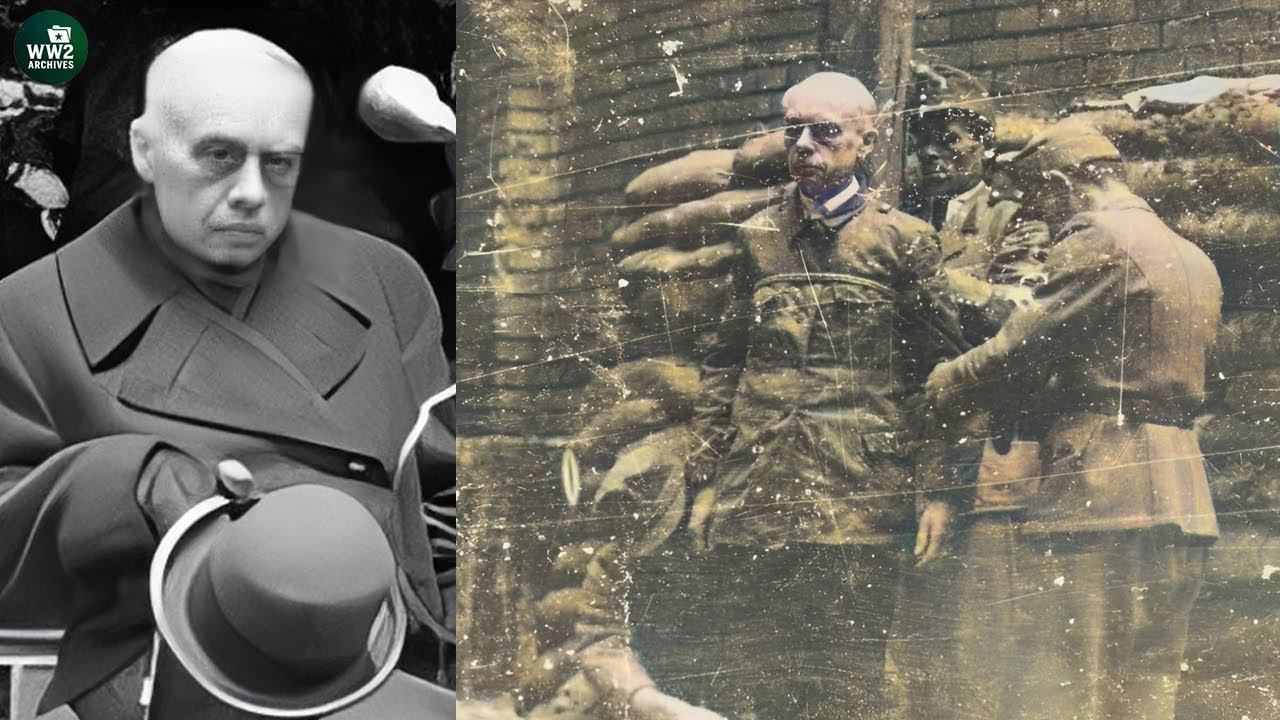
In 1944, a man who had spent nearly a decade representing Hungary in Nazi Germany suddenly found himself leading his own country.
But he did not rise to power through an election.
He was chosen under pressure from Berlin.
His name was Döme Sztójay.
A former diplomat.
A man who had spent years building connections inside Nazi Germany.
When he became prime minister of Hungary, the changes came quickly.
At first, many people noticed only small signs.
The streets became quieter.
Neighbors disappeared.
New orders appeared.
Then came the decree forcing Jews over the age of six to wear the yellow star — a symbol designed to separate, humiliate, and mark an entire population.
Soon after, ghettos began appearing across Hungary.
Families were forced from their homes. Communities that had existed for generations were dismantled almost overnight.
Then came the trains.
In just a matter of weeks, hundreds of thousands of Hungarian Jews were transported in overcrowded cattle cars toward Auschwitz.
The scale was so enormous that even the Nazi killing system struggled to handle the number of victims arriving.
But the most disturbing part was not only the speed of the destruction.
It was who carried it out.
This was not simply a story of German soldiers arriving and imposing their will.
The arrests.
The paperwork.
The organization.
The transportation.
Much of it was carried out by Hungarian authorities under Sztójay’s government.
A man who had once appeared to be an ordinary diplomat became the head of a regime that helped accelerate one of the darkest chapters of the Holocaust.
But history often asks the same haunting question:
How does an ordinary person become part of extraordinary evil?
Was it ambition?
Obedience?
Political loyalty?
Or the willingness to follow a system that had abandoned morality?
During this period, information from inside Auschwitz began reaching the outside world. Two prisoners who escaped from the camp delivered a report describing the horrors taking place behind its fences.
Their testimony revealed the reality of mass murder and became one of the most important warnings about what was happening.
But another question remained:
Why did so many people continue following orders even after the consequences became impossible to ignore?
After the war, Sztójay was arrested, tried in Hungary, convicted of war crimes, and executed in 1946.
His story remains a warning about the danger of power without conscience.
Because some of history’s greatest crimes were not carried out only by people filled with rage.
They were also carried out by officials who signed papers, approved orders, and convinced themselves they were simply doing their jobs.
And sometimes, the most frightening face of evil is not the person holding the weapon.
It is the person holding the pen.