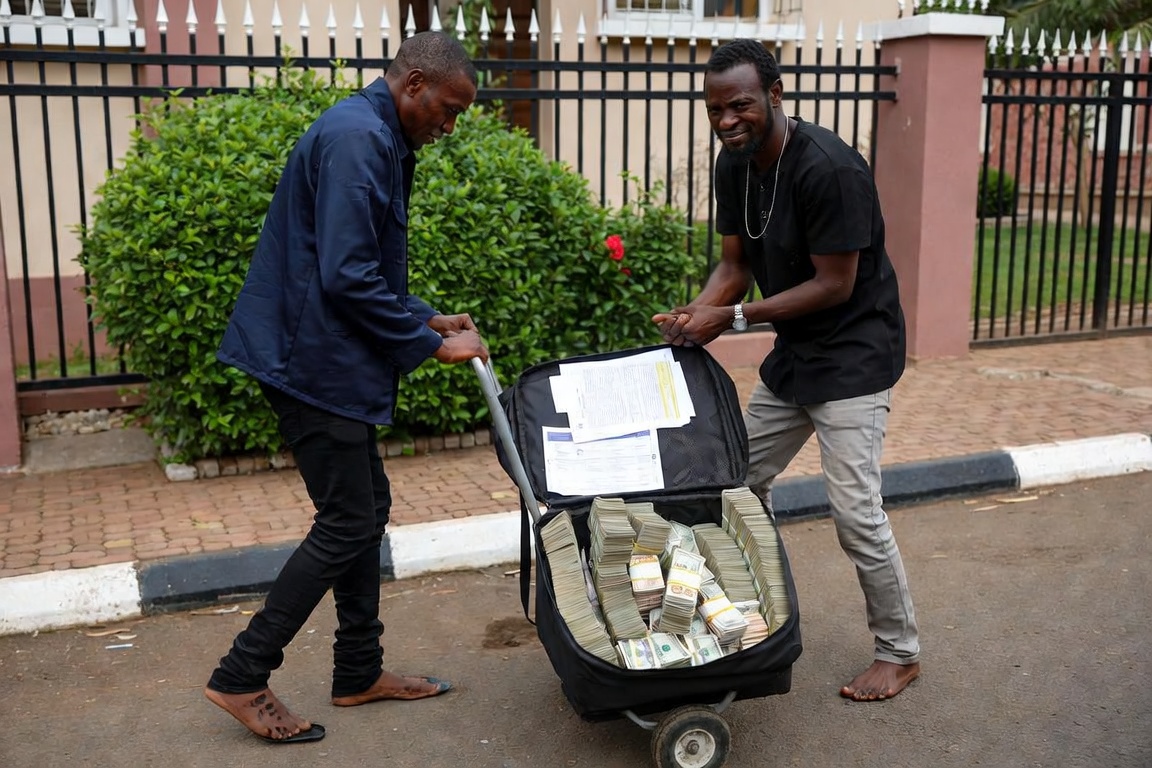
He found the bag on a Tuesday morning, half-hidden beneath a hibiscus bush beside the fence of one of the wealthiest estates in Lagos.
Dammy had been pushing a rusted scrap cart since dawn, stopping whenever he saw an abandoned bottle, a damaged appliance, or a piece of metal he could sell by weight. His shoes had holes in both soles. He had eaten nothing since the previous afternoon.
When he pulled the black travel bag from the bush, its weight nearly dragged him to his knees.
His first thought was that it contained something dangerous.
A bomb.
A body part.
Drugs.
He looked toward the estate’s high walls. Security cameras faced the main gate, but none appeared to point directly at the bush. Beyond the fence, generators hummed behind large houses with swimming pools and imported cars.
Dammy should have called someone.
Instead, fear made him drag the bag onto his cart and cover it with broken aluminum sheets.
Every few meters, he looked over his shoulder.
By the time he reached the single-room apartment he shared with his parents, sweat had soaked through his faded shirt. His heart was beating so violently that he had to sit on the floor before touching the zipper.
Then he opened it.
Bundles of cash filled almost the entire bag.
There were stacks of naira wrapped in bank straps, packets of American dollars, and several bundles of British pounds. Beneath them lay signed documents, a silver flash drive, two mobile phones, and a brown envelope stamped CONFIDENTIAL.
Dammy stared until his vision blurred.
There was enough money in front of him to repair their leaking roof, pay his father’s hospital bills, move his mother away from the roadside, buy a car, rent a proper apartment, and still have more than he could earn in twenty years.
For three hours, he sat alone on the cement floor, surrounded by a fortune that could erase every humiliation his family had endured.
He did not spend a single note.
Instead, he made a decision that could either save his life or end it.
Dammy’s full name was Damilola Adeyemi, but everyone had called him Dammy since childhood.
He was the only child of Bolu and Abigail Adeyemi, two people who had spent most of their lives working hard enough to survive but never long enough to rest.
Bolu was a bricklayer.
Every morning, he woke before sunrise, tied his worn work boots with mismatched laces, and walked to construction sites hoping a foreman would need an extra pair of hands. Some days he returned covered in cement dust with enough money for food.
On other days, he returned with nothing.
Abigail sold boiled groundnuts beside a busy road. She sat under a faded umbrella from morning until evening, breathing vehicle fumes and calling out to passengers whenever buses slowed near her tray.
Their home had thin walls, a bare cement floor, and a roof that leaked in four places.
Whenever it rained, the family placed bowls beneath the holes and moved their mattress toward the driest corner. They owned no television, no refrigerator, and for several years, no reliable electricity.
But Bolu and Abigail had one ambition that poverty could not reduce.
Their son would go to school.
“Your hands must not become like mine,” Bolu often told Dammy, turning his palms upward to reveal cracks hardened by years of carrying blocks.
Abigail would shake her head.
“There is nothing wrong with your father’s hands,” she would say. “But there must be a reward for what those hands have suffered.”
They saved coins in an old powdered-milk tin hidden beneath their bed.
They skipped lunch without telling Dammy.
When he needed new textbooks, Bolu sold the only pair of leather shoes he owned. He attended church the following Sunday wearing plastic sandals and pretended not to notice when people looked at his feet.
Dammy noticed.
He noticed everything.
He remembered the night his mother claimed she had already eaten, then drank two cups of water before going to bed.
He remembered his father working with a fever because school fees were due on Monday.
He remembered Abigail carefully flattening used exercise books so he could write on the empty pages.
Those memories became a kind of debt inside him.
He did not experience education as a privilege. He experienced it as an assignment.
During periods without electricity, Dammy studied beneath a streetlight near a mechanic’s workshop. When the light failed, he used an old rechargeable torch that lasted less than an hour.
He read borrowed textbooks with missing pages and copied entire chapters by hand before returning them.
By secondary school, his teachers had begun to notice something unusual.
Dammy did not merely remember information. He understood how ideas connected.
He could solve mathematics problems using methods his classmates had never seen. He could read a passage once and explain it days later. Before examinations, students gathered around his desk because he could turn difficult lessons into simple explanations.
He never acted superior.
When slower students asked the same question repeatedly, Dammy answered repeatedly.
His mathematics teacher, Mr. Lawal, once watched him spend an entire lunch break helping a boy who had mocked his torn uniform the week before.
“Why are you helping him?” Mr. Lawal asked afterward.
Dammy shrugged.
“The answer will not leave my head because I put it inside his.”
His faith was equally simple.
Dammy prayed when he woke, before studying, before examinations, and before sleeping. He did not speak about God as though he were trying to impress anyone. He spoke quietly, like someone continuing a private conversation.
On the morning of his final examinations, Abigail held his face between both hands.
“You have already made us proud,” she said.
Bolu stood behind her in his construction clothes, unable to speak.
Dammy entered the examination hall carrying a transparent folder, two pens, and the knowledge that his parents had placed years of sacrifice on his shoulders.
Before opening the first paper, he closed his eyes.
“Let their suffering mean something,” he whispered.
Months later, the entire school gathered in the assembly hall for the release of the results.
The principal stepped onto the stage holding a sheet of paper.
When he announced that Damilola Adeyemi had achieved the highest results in the school’s history, the hall erupted.
Students screamed. Teachers clapped. Someone lifted Dammy from his chair.
For several seconds, he stood frozen in the aisle.
Then he looked toward the back of the hall.
His father had arrived directly from a construction site. Cement stained his shirt and trousers. His mother was still wearing the apron she used at her roadside stall.
Abigail covered her mouth with both hands.
Bolu lowered his head and cried.
At the graduation ceremony, Dammy received awards in mathematics, economics, accounting, and overall academic performance. Each time his name was called, his parents stood as though one moment of applause was not enough.
That day, neighbors crowded into their small apartment.
Church members prayed over him. Teachers predicted that he would become a banker, an auditor, or the director of a major company. People who had barely spoken to the family began telling others that they had always known Dammy would succeed.
Everyone believed the difficult years were over.
Dammy believed it too.
With help from a scholarship, he studied accounting at university. He graduated at the top of his department and completed his national service with excellent recommendations.
At the graduation ceremony, Bolu borrowed a suit.
Abigail wore a blue dress she had saved for six years.
When Dammy crossed the stage, they shouted louder than anyone in the hall.
A photograph from that day remained on the wall of their apartment: Dammy in his graduation gown, his parents standing beside him, all three smiling as though poverty had finally received its eviction notice.
The first month after graduation, Dammy sent twelve job applications.
The second month, he sent thirty-seven.
By the sixth month, he had sent more than one hundred.
He applied to banks, audit firms, insurance companies, factories, hotels, schools, shipping companies, and small businesses with handwritten signs outside their offices.
Most never replied.
Those that did sent identical messages.

“We regret to inform you…”
“We have decided to proceed with other candidates…”
“We will keep your résumé on file…”
Dammy attended interviews wearing the same white shirt, washing it at night and ironing it beneath a folded cloth to hide the brown scorch mark near the pocket.
At one company, the interviewer glanced at his results and smiled.
“These are impressive.”
Dammy felt hope rise in his chest.
Then the man leaned backward.
“Who recommended you?”
“No one, sir. I applied online.”
The smile disappeared.
“We will contact you.”
They never did.
At another interview, a manager told him the entry-level position required three years of experience.
“How does someone get experience if no one gives him a first opportunity?” Dammy asked.
The manager looked toward the door.
“Next candidate.”
Weeks became months.
Each morning, Dammy checked his email before leaving bed. Every unknown phone number made him sit upright.
By evening, hope had usually become silence again.
Neighbors who once predicted his success began asking uncomfortable questions.
“So, graduate, where are you working now?”
“Are you still at home?”
“Maybe you should have studied something practical.”
Dammy learned to smile without answering.
The pressure grew worse when Bolu fell from a wooden platform at a construction site.
The fall damaged his hip and lower back. The contractor gave him enough money to reach a public hospital, then stopped answering his calls.
Bolu could no longer lift blocks.
Abigail’s groundnut sales became the family’s only reliable income, but even that was shrinking. Food prices rose. Customers bargained over amounts that were already too small.
Dammy took whatever work he could find.
He carried goods at markets. He cleaned a mechanic’s workshop. He helped a printer enter data during busy weeks. At night, he continued sending applications.
Finally, he borrowed a damaged cart from a scrap dealer and began collecting metal.
On his first morning, he walked past a former classmate leaving a bank in a suit.
The classmate saw him pushing the cart.
For a moment, both men stopped.
Dammy expected a greeting.
Instead, the classmate looked away, entered a car, and drove off.
That evening, Dammy sat outside his home long after dark.
His father limped toward him and lowered himself onto a wooden stool.
“I am sorry,” Dammy said.
Bolu frowned. “For what?”
“For studying so much and still bringing nothing home.”
His father stared at him.
Then he reached out and placed one rough hand on Dammy’s shoulder.
“Work does not disgrace a man,” Bolu said. “What disgraces him is what he is willing to become because life is difficult.”
Dammy remembered those words on the Tuesday morning he found the black bag.
After staring at the money for three hours, he zipped it closed and pushed it beneath the bed.
When Abigail returned from selling groundnuts, she immediately knew something was wrong.
Dammy’s eyes kept moving toward the bedroom curtain. His hands trembled when he lifted a cup.
“What happened?” she asked.
“Nothing.”
She studied him for several seconds.
“Damilola.”
He had never been able to lie when she used his full name.
Dammy pulled the bag into the sitting room and opened it.
Abigail’s tray slipped from her hands.
Bolu struggled up from the mattress, leaning on his walking stick.
No one spoke.
Abigail slowly sat on the floor.
“Where did you get this?”
Dammy explained.
His father listened without interrupting.
When Dammy finished, Bolu looked at the leaking ceiling, then at the unpaid hospital bill beside the window. He looked at his wife’s swollen fingers and his son’s damaged shoes.
For the first time in Dammy’s life, his father appeared tempted.
Bolu reached toward one bundle.
His hand stopped inches above it.
Then he pulled back.
“Close the bag,” he said.
Abigail nodded.
“Money does not become yours because it arrives when you are suffering.”
Dammy swallowed.
“What if the owner is a criminal?”
“Then you must be more careful,” Bolu said. “But you must not become one.”
They searched the documents for information.
The company name appearing repeatedly was Avantex Infrastructure Limited, one of the largest engineering and construction firms in West Africa. Its chief executive officer was Mrs. Tolani Adebayo, a woman whose photograph appeared regularly in business newspapers.
Dammy had heard of her.
Avantex built bridges, industrial parks, and public transportation systems. It employed thousands of people and had recently announced negotiations for a major international partnership.
Several documents in the bag carried Mrs. Adebayo’s signature.
One authorized the transfer of 280 million naira to a consulting company called Redcrest Advisory.
Another appeared to approve the sale of valuable company land at a price far below market value.
There was also a draft resolution recommending Mrs. Adebayo’s immediate removal as CEO for “financial misconduct and unauthorized diversion of corporate funds.”
Something felt wrong.
Dammy read everything twice.
The cash appeared to prove that the CEO had secretly withdrawn company money. The contracts appeared to show that she had transferred assets to a private company. The documents, the signatures, and the money all pointed toward the same conclusion.
But Dammy had studied auditing.
Evidence that appeared too perfect often deserved more attention, not less.
He compared the signatures.
On three separate pages, every curve was identical. Even a tiny break in the ink appeared in exactly the same place.
Real signatures varied.
Copied signatures did not.
He examined the bank straps around the naira bundles. Each carried a transaction code and a date from the previous Friday.
One document claimed the cash had been withdrawn two weeks earlier.
Dammy opened the side compartment and found one of the mobile phones. Its battery was dead.
He charged it using the family’s small power bank.

The phone was locked, but message previews remained visible on the screen.
The first said:
“Board meets at 10. Make sure the bag is inside her property before 7.”
Another message had arrived thirty minutes later.
“Why is your phone off? Kola is asking.”
The third was more threatening.
“If you fail, do not come back.”
Dammy’s skin went cold.
The bag had not merely been lost near Mrs. Adebayo’s estate.
Someone had intended to plant it inside.
He could have taken it to the nearest police station. But the documents contained names of senior executives, government contractors, and legal advisers. If the wrong person learned what he had found, the bag could disappear.
And so could he.
Dammy spent the last money in his pocket at a small cybercafé.
He searched corporate registration records, newspaper reports, and Avantex’s public filings. Redcrest Advisory had been incorporated only six months earlier.
Its registered director was a man named Kunle Adetayo.
Dammy searched the name.
Kunle was the younger brother of Avantex’s chief financial officer, Kola Adetayo.
Dammy printed the registration page, photographed every item in the bag, and emailed copies to three separate accounts. He wrote down the serial numbers of several cash bundles and recorded the messages visible on the phone.
He also left a sealed copy with Mr. Lawal, his former mathematics teacher.
“If I do not call you by tonight, take this to a newspaper,” Dammy said.
Mr. Lawal stared at the envelope.
“What have you entered?”
“I am trying not to enter anything,” Dammy replied. “But I think something has entered me.”
At 8:20 that morning, Dammy carried the bag to Avantex headquarters.
The building had glass walls, polished floors, and a fountain larger than his family’s apartment.
A security officer stopped him before he reached the entrance.
“Deliveries use the back gate.”
“I need to see Mrs. Tolani Adebayo.”
The officer laughed.
People in suits walked past without slowing down.
“Do you have an appointment?”
“No, but I have something that belongs to her.”
“What?”
“I can only show her.”
The officer looked at Dammy’s faded shirt and damaged shoes.
“You people think this is a market. Leave before I remove you.”
Dammy tightened his grip on the bag.
“I will leave after I speak with her.”
The officer reached for the handle.
Dammy pulled it away.
The movement attracted attention.
A second guard approached. Then a third.
Within minutes, Dammy had been forced against a wall while employees gathered near the entrance. One guard searched his pockets. Another opened the bag.
Everything changed.
The guard froze when he saw the cash.
“Where did you steal this?”
“I did not steal it.”
The first officer struck Dammy across the face.
A woman in the crowd gasped.
“Call the police,” someone said.
Dammy tasted blood.
“Call Mrs. Adebayo.”
The security supervisor grabbed his collar.
“You entered the wrong building today.”
At that moment, the private elevator doors opened.
A tall man in a dark suit stepped into the lobby, followed by two assistants.
Dammy recognized him from the company website.
Kola Adetayo, the chief financial officer.
The moment Kola saw the open bag, his steps slowed.
It lasted less than a second, but Dammy saw it.
The man’s face lost color.
Then his expression hardened.
“That is company property,” Kola said. “Where did he get it?”
“He claims he came to see the CEO,” the security supervisor replied.
Kola walked closer.
His eyes moved from the cash to the side compartment where the phone lay.
“Take the bag upstairs,” he ordered. “The police can deal with him.”
Dammy stepped in front of it.
“I will give it only to Mrs. Adebayo.”
Kola looked at him for the first time.
“You have no idea what you are holding.”
“I know exactly what I am holding.”
The lobby became silent.
Kola’s jaw tightened.
“Remove him.”
Two guards grabbed Dammy’s arms.
Then a woman’s voice came from behind them.
“Remove him for what?”
Everyone turned.
Tolani Adebayo stood near the elevator in a cream-colored suit, accompanied by her legal adviser and several board members.

She was sixty-one, though the newspapers often described her as ageless. That morning, however, dark circles showed beneath her eyes.
The company’s emergency board meeting was scheduled to begin in less than an hour.
Kola stepped toward her.
“This man was found with stolen company funds. We are handling it.”
Tolani looked at the bag.
She did not recognize it.
But she recognized the documents lying on top.
For two days, anonymous emails had accused her of withdrawing millions from Avantex accounts. Several board members had received copies of contracts carrying her signature. The board had demanded an emergency meeting.
Tolani had spent the previous night trying to understand how financial transactions she had never approved could carry her authorization codes.
Now the alleged missing money had appeared in the hands of a stranger who claimed to have found it beside her estate.
It was enough to destroy her career.
Possibly enough to send her to prison.
“Where did you get this bag?” she asked.
Dammy wiped blood from his lip.
“Beside the fence of your estate.”
Whispers moved through the lobby.
Kola turned toward the board members.
“You see? She must have arranged—”
Dammy interrupted him.
“It was not dropped there by Mrs. Adebayo.”
Kola’s eyes snapped toward him.
Tolani raised one hand.
“Let him speak.”
Kola forced a laugh. “We are seriously accepting the word of a scrap collector?”
Tolani looked at Dammy’s face, then at the guards holding him.
“Release him.”
They obeyed.
Dammy bent down and carefully closed the bag.
“I will explain everything,” he said. “But not in this lobby.”
Thirty minutes later, Dammy sat at the far end of Avantex’s boardroom.
His shirt was dusty. His cheek had begun to swell. Around the long table sat some of the most powerful businesspeople he had ever seen.
Kola sat opposite him.
Beside Kola was Avantex’s corporate lawyer, Mr. Femi Alade, who repeatedly insisted that the bag should be handed directly to the police.
Tolani sat at the head of the table.
“Begin,” she said.
Dammy opened the bag.
He removed the money, the contracts, the phones, and the flash drive one item at a time. He placed them on the table without touching more than necessary.
“I found this bag at approximately 6:15 this morning,” he said. “Nothing has been removed.”
Kola leaned forward.
“How can we know that?”
“You can compare it with the inventory.”
“What inventory?”
“The one inside the brown envelope. It lists every currency and amount.”
Kola’s mouth closed.
Dammy continued.
“The documents appear to show that Mrs. Adebayo authorized these transactions. But her signatures were copied. The same ink gaps appear on three pages.”
He placed the documents side by side.
The board members leaned closer.
“There are also inconsistencies between the dates on the bank straps and the dates in the withdrawal documents.”
Tolani’s legal adviser examined them.
“He is correct,” she said quietly.
Dammy placed the printed corporate registration page on the table.
“Redcrest Advisory, the company receiving the land and consulting payments, is registered to Kunle Adetayo.”
Every head turned toward Kola.
His expression did not move.
“My brother operates several legitimate businesses.”
“Then perhaps he can explain why his company was about to buy Avantex property worth billions for less than one-tenth of its value,” Dammy said.
Kola pushed back his chair.
“This is absurd. You searched private documents, stole cash, and created a story because you want a reward.”
Dammy reached into the side compartment.
When he placed the locked phone on the table, Kola stopped breathing for a moment.
It was a tiny reaction.
A slight widening of the eyes.
A tightening at the corners of his mouth.
But everyone saw it.
Dammy pressed the power button.
The lock screen appeared.
So did the message previews.
“Board meets at 10. Make sure the bag is inside her property before 7.”
Silence filled the room.
Kola’s face changed.
The confidence that had carried him into the building disappeared. His eyes moved toward the door, then toward the security director standing behind Tolani.
A drop of sweat rolled from his temple.
That was the moment he understood.
The poor man he had ordered guards to remove had not merely returned the missing money.
He had returned the entire plan.
Dammy looked at the board.
“This bag was not stolen from Mrs. Adebayo’s estate. It was supposed to be planted there.”
No one moved.
“The person carrying it probably tried to enter through the side of the property,” Dammy continued. “Perhaps he saw security or heard a dog. He dropped the bag outside the fence and ran. If the bag had been found inside the estate, the money and documents would have made it appear that Mrs. Adebayo diverted company funds and kept the cash at home.”
Tolani stared at Kola.
Her voice was almost a whisper.
“Who sent those messages?”
Kola stood.
“I will not participate in this circus without my lawyer.”
Mr. Alade, the corporate lawyer beside him, also began gathering his papers.
Dammy noticed a movement beneath the table.
The lawyer was reaching for his phone.
“Please ask him not to delete anything,” Dammy said.
Security stepped forward immediately.
Mr. Alade froze.
Tolani looked between the two men.
Then she turned to the company’s independent compliance officer.
“Secure every device. Freeze all pending transactions. Contact the external auditors and the police—not the station Mr. Adetayo normally uses. Contact the financial crimes unit directly.”
Kola’s shoulders dropped.
Around the table, board members who had entered prepared to remove Tolani now avoided her eyes.
The investigation moved quickly after that.
Estate security footage showed a motorcycle stopping near the side fence shortly before Dammy found the bag. The rider disappeared into the bushes carrying it and emerged less than a minute later without it.
Traffic cameras captured the motorcycle’s registration number.
The rider was found that afternoon.
He was a contract driver employed by a logistics company secretly controlled by Kola’s brother.
Faced with the phone messages, bank records, and footage, the driver confessed. He said Kola had ordered him to place the bag inside a utility room near Tolani’s swimming pool.
He had been told the gate would be unlocked.
It was not.
When a security dog began barking, he panicked and pushed the bag beneath the bush before escaping.
The flash drive contained draft press statements announcing Tolani’s resignation, copies of anonymous complaints prepared before the alleged evidence had even been discovered, and spreadsheets tracing diverted funds through Redcrest Advisory.
Investigators also found private messages between Kola and Mr. Alade.
Their plan had been developing for nearly a year.
Kola believed Tolani would oppose the sale of Avantex to a foreign investment group. If she were removed for financial misconduct, the board would be forced to appoint an interim CEO.
Kola expected to receive that position.
Once in control, he planned to approve the sale, receive a hidden payment, and transfer several company properties to businesses connected to his family.
The cash in the bag came from Avantex accounts.
The signatures were forged.
The evidence had been manufactured.
By evening, Kola Adetayo and Femi Alade were in custody.
The board meeting ended very differently from the way it had begun.
The resolution removing Tolani was withdrawn.
Three board members apologized to her privately.
She asked them to repeat their apologies in front of the employees whose jobs had been placed at risk.
Then she went downstairs to find Dammy.
He was sitting alone in a small waiting room with an ice pack against his cheek. No one had offered him food until a junior receptionist quietly brought him rice and water.
Tolani stood at the door for several seconds.
That morning, she had believed she was about to lose the company she had spent thirty-two years building.
She had also known that even if she proved her innocence later, the public accusation could never be completely erased.
A bag planted in her home would have ended everything.
Her reputation.
Her freedom.
The livelihoods of thousands of employees.
The evidence that saved her had been found by a hungry young man who could have disappeared with more money than his family had ever imagined.
Tolani entered the room and sat opposite him.
“I have been told you are unemployed.”
Dammy nodded.
“How much did you count?”
“All of it.”
“And you did not take anything?”
“No.”
“Why?”
Dammy looked at the expensive watch on her wrist, then at the ice melting inside the plastic pack.
“Because suffering explains temptation,” he said. “It does not change ownership.”
Tolani looked away.
For years, she had told herself that everyone had a price.
She had built Avantex from a rented office after banks refused to lend her money. She had slept in unfinished buildings, borrowed transport fares, and negotiated contracts while wearing one repaired pair of shoes.
But success had made her suspicious.
Executives stole. Contractors lied. Friends appeared only when they needed something. Even some relatives treated her like a bank account with a human face.
Gradually, she had stopped trusting people.
Kola’s betrayal seemed to prove she had been right.
Dammy’s honesty proved she had not been completely right.
“How much reward do you want?” she asked.
Dammy shook his head.
“I did not return it for a reward.”
“That does not mean you should leave with nothing.”
“I do not want nothing.”
For the first time, Tolani almost smiled.
“What do you want?”
“A chance to work.”
She studied him.
“Doing what?”
“Accounting. Audit. Compliance. Anything I am qualified to do.”
“And if you are not qualified?”
“Then do not employ me.”
The answer surprised her.
Most people who entered her office performed desperation or confidence. Dammy displayed neither. He simply sat there with a swollen face and asked to be measured fairly.
Tolani contacted the head of internal audit.
“Prepare an assessment,” she said. “Do not make it easy.”
Dammy took the same tests given to experienced graduate applicants.
He achieved the highest score recorded in three years.
The following week, Avantex offered him a position as a junior forensic audit analyst.
He did not receive a corner office.
He did not become an executive overnight.
On his first day, he sat at a shared desk and spent six hours checking vendor invoices.
But the salary paid for Bolu’s medical treatment.
It repaired the roof.
It moved Abigail’s groundnut business from the roadside into a small shop where she no longer inhaled exhaust fumes all day.
Dammy bought his father a new pair of leather shoes.
When Bolu opened the box, he ran his fingers across them and began crying.
“I sold mine for your books,” he said.
“I remember,” Dammy replied.
Within his first year at Avantex, Dammy identified repeated overbilling in a group of equipment contracts. His work saved the company more than 90 million naira.
He was promoted—not because he had returned the bag, but because his performance made ignoring him impossible.
Tolani also changed.
She introduced a recruitment program that removed names, addresses, and family connections from initial job applications. Candidates were judged first through anonymous assessments.
Avantex created paid entry-level positions for graduates who had strong academic results but no professional connections.
The company funded scholarships for children of roadside traders, artisans, cleaners, and construction workers.
Tolani began meeting junior employees every month without their managers present. She visited project sites again. She ate lunch in the staff cafeteria.
And she placed a framed sentence outside the executive boardroom:
“Character is what remains when need has provided an excuse.”
Two years later, Dammy attended Avantex’s annual leadership conference.
He sat in the front row beside his parents.
Bolu wore his new leather shoes. Abigail wore the blue dress she had saved from his graduation, carefully adjusted by a tailor.
Tolani stepped onto the stage.
She told the audience about the morning the company nearly collapsed.
She spoke about the betrayal inside the boardroom and the stranger outside the gate whom security had judged by his clothes.
Then she invited Dammy to stand.
The entire hall rose.
Dammy looked toward his parents.
Abigail was covering her mouth again, exactly as she had when his examination results were announced years earlier.
Bolu was crying without lowering his head this time.
Tolani waited for the applause to stop.
“People often say I changed this young man’s life by giving him a job,” she said. “That is not the truth.”
She turned toward Dammy.
“He changed mine before I knew his name. He reminded me that poverty can empty a person’s pockets without touching his integrity. He reminded me that the people we ignore may be carrying the very thing that saves us.”
At the back of the hall, several security officers stood quietly.
Among them was the supervisor who had ordered Dammy to be struck.
After the investigation, Tolani had dismissed him for using violence and ignoring protocol. She later allowed him to reapply after completing professional training and issuing a personal apology.
When Dammy passed him after the ceremony, the man lowered his eyes.
“I am sorry,” he said again.
Dammy held out his hand.
The man stared at it before shaking it.
The black bag was eventually returned to Avantex as evidence after the criminal trial. Tolani had it placed inside the company’s ethics training center.
It remained empty.
Beside it was a photograph of Dammy pushing the rusted cart he had used to collect scrap metal.
New employees often stopped to read the plaque beneath it.
The plaque did not mention how poor he had been.
It did not mention the holes in his shoes, the leaking roof, the hospital bills, or the hundreds of rejection letters.
It contained only one sentence:
“The value of what you find is never greater than the value of who you choose to become.”
Dammy could have used that money to escape poverty alone.
Instead, by returning it—and by refusing to remain silent about what he had discovered—he saved a woman from prison, protected thousands of jobs, exposed a conspiracy, and opened doors for people whose résumés had been ignored just like his.
Because sometimes the person life has pushed to the bottom is not there because he lacks value.
Sometimes he is there so the world can see how high a person can stand when no one is watching.