The Hostage-Taker Chose the Wrong Nurse — He Had No Idea She Was Special Operations
The first shot shattered the glass doors of Mercy Valley Medical Center at 8:17 on a Tuesday morning.
A second shot punched through the brass lettering above the admissions desk.
The third went into the ceiling.
White dust drifted over the lobby like dirty snow.
For half a second, nobody moved.
Then the screaming began.
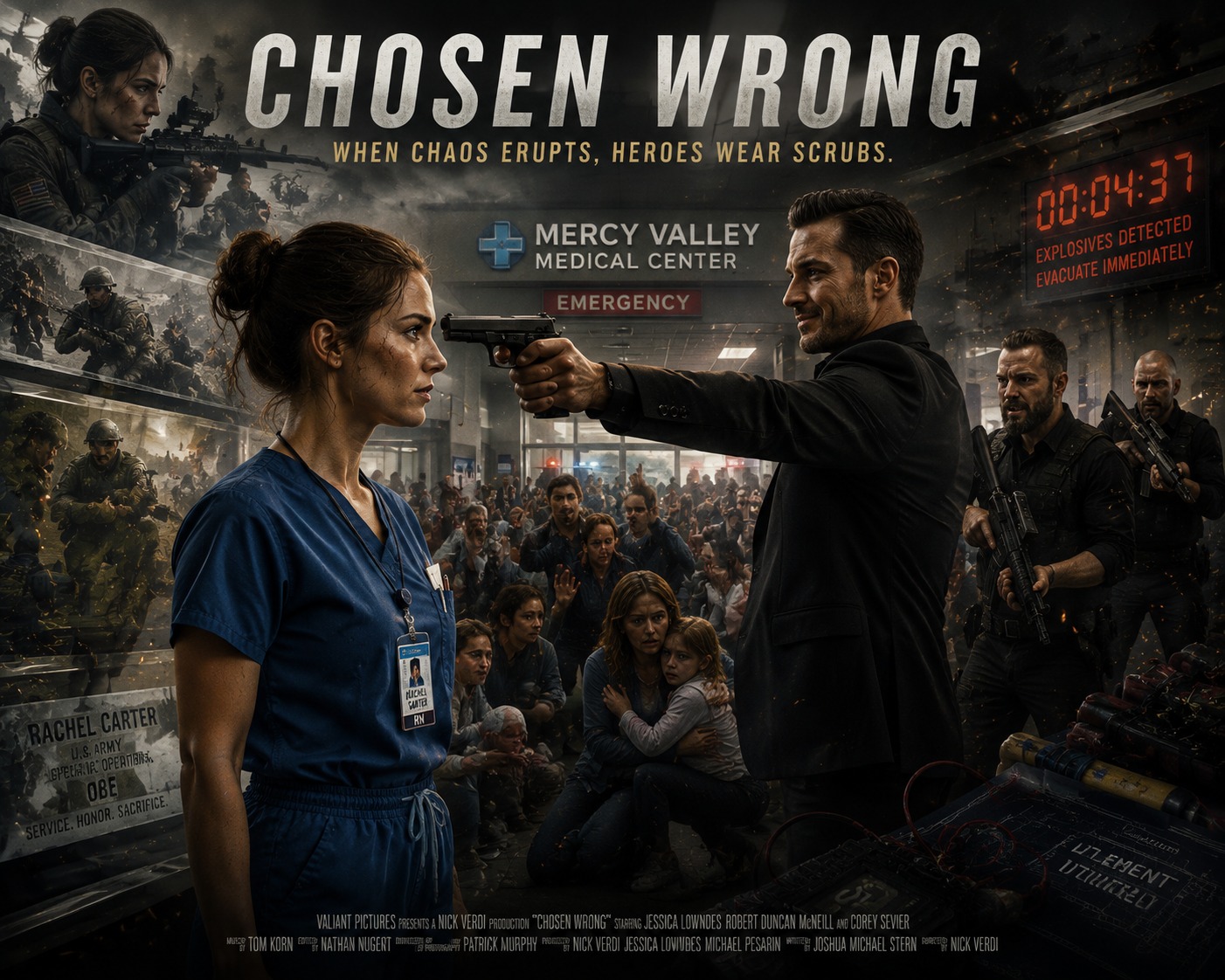
Patients dropped behind chairs. A volunteer overturned a cart of coffee. Two security guards reached for weapons they had never expected to use, and the man in the gray raincoat shot one through the shoulder before either could clear leather.
“Hands where I can see them!”
His voice cracked across the marble atrium.
He was tall, broad through the chest, with rainwater shining on his shaved head. A black tactical vest hugged his torso. A rifle hung from a sling across his body, and a dead-man switch was taped into his left palm.
Behind him, three armed men sealed the entrance.
They wore hospital maintenance jackets over body armor.
The disguise fooled no one now.
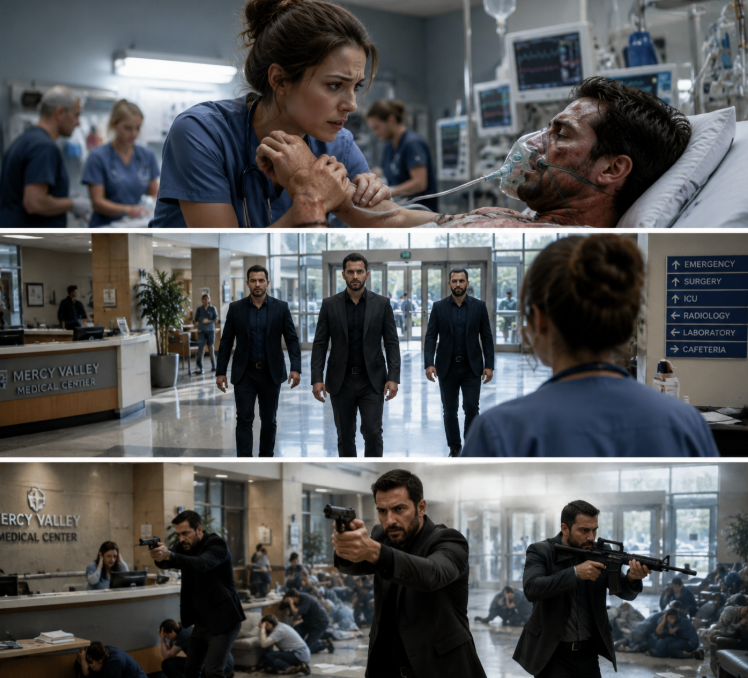
At the center of the lobby, Rachel Carter was kneeling beside a seven-year-old boy whose father had collapsed on top of him.
Rachel wore navy scrubs, white shoes, and a plastic badge that read:
RACHEL CARTER, RN
EMERGENCY SERVICES
A strand of dark hair had fallen loose from her bun. There was blood on her right sleeve, none of it hers.
The boy beneath her was sobbing so hard he could barely breathe.
Rachel placed one hand against his cheek.
“Look at me,” she said.
The boy’s eyes found hers.
“Not the gun. Me.”
The man in the raincoat swung his rifle toward her.
“You deaf?”
Rachel did not flinch.
“He can’t breathe with his father on top of him.”
“Then let him die.”
The boy’s mother made a sound somewhere between a gasp and a prayer.
Rachel looked up.
For the first time, she studied the gunman’s face.
There was a crescent-shaped scar beneath his right ear. His pupils were too wide. His trigger finger rested straight along the frame instead of inside the guard.
Trained.
Not disciplined.
Those were different things.
Rachel lowered her eyes again before he noticed how much she had seen.
“I need ten seconds,” she said.
“You have three.”
Rachel rolled the unconscious father onto his side, pulled the boy free, and pushed him toward his mother.
“One.”
She pressed two fingers to the father’s neck.
“Two.”
No pulse.
“Three.”
Rachel started chest compressions.
The rifle barrel touched the back of her head.
Every sound in the lobby seemed to fold inward.
The rain against the glass.
The hiss of the espresso machine.
A woman whispering, “Please, God.”
The gunman leaned close enough that Rachel smelled peppermint gum beneath the odor of wet nylon.
“I said three.”
Rachel continued compressions.
“Then shoot me,” she said. “But if you do, you lose the only person in this room who can tell you whether that man on the floor is the one you came for.”
The gunman stopped breathing.
Only for a fraction of a second.
But Rachel felt it.
There you are.
He grabbed her by the collar and hauled her upright.
“What did you say?”
Rachel let her knees buckle just enough to appear frightened.
“I said I work in the emergency department. People come in shot all the time.”
His eyes searched hers.
He wanted to know whether she was bluffing.
More importantly, he wanted to believe she was ordinary.
Rachel gave him exactly that.
Her chin trembled.
Her shoulders tightened.
She glanced at the rifle and looked away too quickly.
The gunman’s mouth curled.
He had found his leverage.
“You’re coming with me.”
Rachel looked down at the unconscious father.
“Somebody needs to keep compressions going.”
The gunman seized a gray-haired doctor by the sleeve and shoved him forward.
“You. Do it.”
Dr. Martin Bell, Mercy Valley’s chief of medicine, dropped to his knees beside the man.
He looked up at Rachel.
For seven years, he had known her as the nurse who volunteered for extra night shifts, never joined hospital gossip, and always remembered which patients were afraid of needles.
He had never seen her expression like this.
Not scared.
Not exactly.
Still.
Too still.
The gunman dragged her backward through the lobby.
Rachel’s gaze moved once across the room.
Four attackers visible.
One injured security officer.
Twenty-three civilians in the lobby.
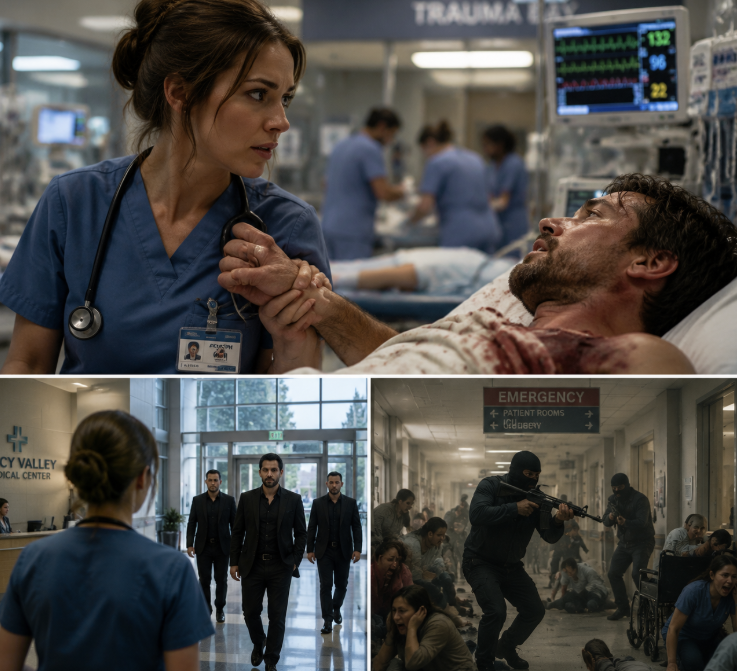
Six cameras.
Two exits blocked.
Emergency stairwell still open.
The shooter pressed the muzzle into her ribs.
“Eyes down.”
Rachel obeyed.
No one noticed her right hand brush the edge of the admissions counter.
No one except an eighteen-year-old hospital volunteer named Noah Kim, who saw Rachel slip a silver trauma shears clip beneath a stack of visitor maps.
He would remember it later.
He would remember because it was the first small thing she did that made no sense.
And by the end of the morning, everyone in Mercy Valley would understand that Rachel Carter had not made a single accidental movement.
The gunman forced her into an elevator and stabbed the button for the seventh floor.
The doors slid shut on the screaming lobby.
Rachel watched their reflection in the polished metal.
The gunman stood behind her, rifle angled down. In the mirrored surface, she counted the screws in his vest, the wire running from the dead-man switch into his sleeve, and the small radio clipped near his left shoulder.
A voice crackled through it.
“Voss, east wing secure. We found the room.”
The gunman’s face changed.
Not much.
Just a tightening around the mouth.
“Is he alive?”
“For now.”
Rachel stared at the floor numbers.
Three.
Four.
Five.
Whoever these men had come for was upstairs.
And the fact that they needed him alive meant the hostage crisis was only camouflage.
The gunman, Voss, caught her watching his reflection.
“You’re very calm for a nurse.”
Rachel let a slow breath leave her nose.
“I work Saturday nights in an emergency room.”
For the first time, Voss smiled.
It was not a pleasant smile.
“Then this should feel familiar.”
The elevator opened on seven.
A man in a maintenance jacket stood outside with a compact rifle tucked against his shoulder. He had a narrow face, a trimmed blond beard, and a plastic hospital access card hanging from his chest.
Rachel glanced at the name.
OWEN LEWIS
FACILITIES
The photograph did not match.
The real Owen Lewis had diabetes, a bad left knee, and carried cinnamon candies in his pocket.
Rachel knew because she had treated him two weeks ago after he fainted in the boiler room.
The armed man nodded toward the corridor.
“Package is in 714. ICU staff are contained. We’re setting the secondary charges.”
Secondary.
Rachel looked at Voss.
He saw the question in her face.
“Walk.”
The seventh floor was unnaturally quiet.
A half-eaten breakfast tray lay on its side near the nurses’ station. Milk crawled across the linoleum in a thin white line. Through the glass walls of the intensive care unit, patients lay beneath blankets while frightened nurses stood with their hands interlocked behind their heads.
An elderly woman on a ventilator began to cough.
One of the armed men shouted at her to be quiet.
Rachel’s jaw tightened.
Voss noticed.
“You care about them?”
“They’re patients.”
“They’re strangers.”
Rachel looked at him.
“Not to us.”
Something passed across his face.
Gone before it could become human.
He dragged her into Room 714.
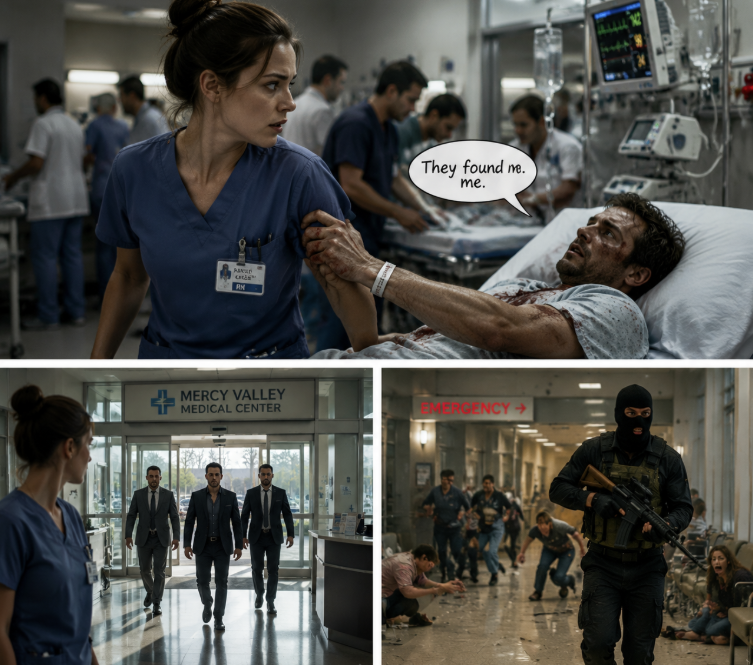
A man lay handcuffed to the hospital bed.
He was in his late fifties, gaunt beneath the blankets, with a gray beard and a bandage wrapped around his abdomen. An IV line ran into his arm. Dried blood darkened the edge of the dressing.
Rachel recognized him.
He had been brought in at 3:42 that morning under the name Thomas Reed.
No wallet.
No identification.
Two gunshot wounds.
One through the abdomen, one across the left shoulder.
He had arrived conscious but refused to say who shot him.
Before surgery, he had gripped Rachel’s wrist and whispered six words.
Don’t let them take the black case.
She had assumed he was delirious.
Now there was a black carbon-fiber case on the floor beneath the bed.
The man opened his eyes.
They moved past Voss and stopped on Rachel.
Recognition flared.
Then fear.
Not fear for himself.
For her.
Voss saw it.
“Well,” he murmured. “You two have met.”
Rachel pulled against his grip.
“I treated him.”
The wounded man looked at her badge.
Then at her face.
His breathing changed.
“Rachel Carter,” he said weakly.
Voss stepped closer.
“You know her?”
The man’s lips parted.
Rachel gave him the smallest possible shake of her head.
He understood.
“No,” he said. “I can read.”
Voss studied them both.
The blond mercenary moved to the black case and knelt beside it.
“It’s biometric.”
“Use his hand.”
“We tried. It requires pulse and retinal confirmation.”
Voss’s patience thinned.
“Then wake him up.”
“He’s awake,” Rachel said. “He’s also bleeding internally.”
Voss turned to her.
“Can you keep him alive?”
Rachel examined the man from where she stood.
Pale skin.
Rapid breathing.
Sweat near the hairline.
Blood pressure likely crashing.
“Yes.”
Voss lifted the rifle and placed the muzzle beneath her chin.
“Good. Because until he opens that case, you breathe when he breathes.”
The wounded man’s eyes closed.
“Leave her out of this.”
Voss smiled down at him.
“That depends on you, Colonel.”
The word landed softly.
Colonel.
Rachel felt an old door open inside her mind.
A door she had spent nine years trying to seal.
The man in the bed was not Thomas Reed.
His real name was Elias Mercer.
Colonel Elias Mercer.
Former director of a special mission unit whose official budget had never existed.
The last time Rachel had seen him, he had been standing in the burning wreckage of a school outside Mosul, shouting her call sign through smoke.
Six soldiers had gone in that night.
Three had come out.
Rachel had been one of them.
Voss leaned close to Mercer.
“Open the case.”
Mercer looked past him at Rachel.
In his eyes, she saw a message older than the room.
Do not reveal yourself.
Voss followed his gaze again.
This time, suspicion sharpened.
Rachel stepped toward the bed.
“He needs fluids, blood, and an operating room.”
“You have this room.”
“He dies here.”
“Then he dies here.”
Voss’s radio crackled.
“Command to all teams. Police perimeter established. Hospital lockdown confirmed. Media arriving.”
A new voice followed.
Calm. Educated. Male.
“Mr. Voss, proceed to phase two.”
Every mercenary in the room straightened.
Rachel heard no distortion from the radio.
The speaker was close.
Possibly inside the hospital.
Voss keyed his mic.
“Mercer won’t open the case.”
“Then motivate him.”
Voss looked at Rachel.
The unseen man continued.
“And remove unnecessary witnesses.”
The blond mercenary raised his rifle toward a respiratory therapist standing in the corner.
Rachel moved before she consciously decided to.
She stepped into the line of fire.
The mercenary blinked.
Voss grabbed the back of her neck.
“What are you doing?”
Rachel’s heart pounded against her ribs.
Not from fear.
From restraint.
Every muscle in her body remembered how to end the man in front of her.
Thumb to the eye.
Palm to the chin.
Strip the rifle.
Pivot.
Fire twice.
She could do it in less than two seconds.
She could also get fourteen patients killed before the third second.
So she lowered her eyes.
“You need the staff,” she said. “Ventilators fail. IV pumps alarm. People crash. Kill the nurses and your hostages become bodies.”
Voss stared at her.
The blond mercenary chuckled.
“She’s got a point.”
Voss pushed Rachel against the wall.
“You keep everyone alive,” he said. “One patient dies, I shoot a nurse. One nurse disobeys, I shoot a patient.”
Rachel looked toward the ICU staff.
Fear had hollowed their faces.
Dr. Bell was not among them. He was still downstairs.
Charge nurse Priya Desai stood near the glass doors with blood on her forehead.
Beside her, twenty-six-year-old nurse Ellie Monroe was trembling so violently that the keys clipped to her waistband jingled.
Rachel met Priya’s eyes.
No words.
Just one look.
Check the patients. Control the room. Wait.
Priya swallowed and gave the slightest nod.
Voss did not notice.
He was watching Mercer.
“Open the case.”
Mercer’s voice was barely audible.
“You don’t know what’s inside.”
“I know exactly what’s inside.”
“No. You know what you were told.”
The blond mercenary glanced at Voss.
A small fracture.
Rachel filed it away.
Voss’s expression hardened.
“I was told it contains authorization codes.”
Mercer almost smiled.
“You were told enough to make you dangerous and not enough to make you cautious.”
Voss struck him across the face.
The heart monitor spiked.
Rachel caught Voss’s wrist before he could hit Mercer again.
The room froze.
For one beat, Rachel held him.
Her grip was not the grip of a frightened nurse.
It was placed precisely between two tendons, where pressure could numb the hand.
Voss looked down at her fingers.
Rachel released him.
“He’s post-op,” she said quietly. “You hit him again, his blood pressure drops.”
Voss flexed his hand.
“What kind of nurse are you?”
Rachel reached for a bag of saline.
“The kind trying to stop you from killing the man you need.”
She adjusted Mercer’s IV, checked his dressing, and leaned over him as though listening to his breathing.
Her lips barely moved.
“How many?”
Mercer stared at the ceiling.
“Eight.”
Rachel changed the saline bag.
“Explosives?”
“Central oxygen.”
Her hand paused.
Mercer’s voice remained a breath.
“Not hostages. Demonstration.”
Rachel looked through the glass wall toward the ICU.
Mercy Valley had nearly six hundred patients.
Hundreds more staff, visitors, contractors, and family members.
The hospital’s central oxygen lines ran through the service core. If shaped charges ruptured the main supply and ignited the gas in sequence, the blast would move through the building’s walls like fire through veins.
This was not a siege.
It was an execution disguised for television.
Rachel lowered her head.
“Who?”
Mercer’s eyes shifted toward the radio on Voss’s shoulder.
“Inside.”
Voss stepped closer.
“What are you whispering?”
Rachel lifted Mercer’s blood-soaked dressing.
“He’s hemorrhaging.”
Voss swore.
Rachel pressed both hands against the wound.
“Get me two units of O-negative, a surgical tray, and someone from anesthesia.”
“You get what’s in the room.”
“Then start saying goodbye to your case.”
The blond mercenary looked at Voss.
“She’s right. We need him.”
Voss keyed his radio.
“Send medical supplies to 714.”
The calm voice replied.
“Denied.”
Voss frowned.
“Mercer is deteriorating.”
“Then accelerate.”
“He dies, we lose access.”
A pause.
The voice on the radio came back colder.
“You are confusing your role, Mr. Voss. The case is preferred. The event is essential.”
Rachel watched the certainty leave Voss’s face.
Not completely.
Just enough.
He had believed he was commanding the operation.
He had just learned he was equipment.
The radio clicked off.
Mercer saw it too.
“You still think you’re leaving this building?” he asked.
Voss slammed the rifle stock into Mercer’s wounded shoulder.
Mercer screamed.
The heart monitor erupted.
Rachel caught the side rail before she attacked.
The old instinct rose inside her like a black wave.
Move.
End him.
Protect the wounded.
For nine years she had trained herself to stand still when that wave came.
She had left the unit after a rescue in northern Syria went wrong. Intelligence had identified six hostages inside a warehouse.
There had been seventeen.
Children among them.
The mission commander ordered withdrawal when the building was rigged to collapse.
Rachel stayed.
She carried out three children before the roof came down.
One survived.
Two did not.
Afterward, the official report praised tactical discipline.
The children were listed as unconfirmed casualties.
Rachel resigned six weeks later.
She became a nurse because hospitals did not pretend that the dead had never existed.
Voss grabbed her hair and pulled her face close.
“You’re going to tell me why he looks at you like that.”
Rachel’s scalp burned.
Mercer’s breathing was shallow now.
Rachel let fear enter her voice.
“He’s scared.”
“No. He trusts you.”
“I’m his nurse.”
“People don’t trust nurses like that.”
Rachel looked directly into Voss’s eyes.
“Maybe nobody ever had a reason to trust you.”
The blond mercenary laughed once before catching himself.
Voss released Rachel and turned toward him.
“You find that funny, Dane?”
The mercenary’s smile vanished.
“No.”
“Then go check the charges.”
Dane hesitated.
“The charges are Rourke’s responsibility.”
“Go.”
Dane left the room.
Rachel watched the door close.
There.
Division.
The radio on Voss’s shoulder crackled again.
“Mr. Voss, transfer the nurse to surgical theater two.”
“Why?”
“She will assist with extraction.”
“Extraction of what?”
Silence.
Then the voice said, “Bring her.”
Voss stared at the radio.
He was beginning to understand that the operation had layers he had not been shown.
Rachel understood something else.
The speaker knew who she was.
Not nurse Rachel Carter.
The woman before.
Voss cut Mercer’s handcuff from the bed rail and replaced it with a portable restraint.
“Move him.”
Two mercenaries wheeled the bed into the corridor.
Rachel walked beside it with one hand pressed over Mercer’s wound.
As they passed the ICU nurses’ station, Priya caught Rachel’s eye.
Rachel tapped her index finger twice against the metal bed rail.
Priya looked confused.
Then she saw Rachel touch the IV pole and tap three more times.
Two.
Three.
A pattern.
Priya’s gaze moved toward the medication cabinet.
Rachel gave the smallest nod.
Mercy Valley had once used a silent disaster code for active violence: two short tones, three long. The system had been retired after a software upgrade.
Most staff had forgotten it.
Priya had not.
She slipped her hand beneath the counter.
The old manual alarm button was still there.
When she pressed it, nothing visible happened.
But in the basement, a red light began flashing inside the facilities control room.
Owen Lewis, the real maintenance supervisor, was hiding beneath a desk with a bullet crease along his temple.
He saw the light.
Then he saw the code.
ACTIVE THREAT — INTERNAL SABOTAGE PROTOCOL
He wiped blood from his eyes and crawled toward the emergency gas shutoff panel.
On the second floor, police negotiator Daniel Cho stood behind an armored shield near the west entrance.
His phone rang.
Unknown number.
He answered.
A whisper came through.
“This is Owen Lewis. Facilities. They’re in the oxygen core.”
Cho straightened.
“How many?”
“I don’t know. But someone triggered internal sabotage protocol.”
“Who?”
Owen looked at the flashing code.
“Only senior nurses know the manual signal.”
Cho glanced through the lobby glass.
A gray-haired doctor was still performing chest compressions under guard.
“Can you shut down the oxygen?”
“Not without killing people on ventilators.”
“Can you isolate sections?”
“Maybe. But someone’s already overridden the system from administration.”
Cho’s eyes narrowed.
“Administration?”
Before Owen could answer, the call went dead.
Upstairs, Rachel entered surgical theater two.
The operating room lights burned white enough to erase shadows.
A single figure stood beside the instrument table.
Dr. Samuel Vale, chief executive officer of Mercy Valley Medical Center.
Sixty-one years old.
Silver hair.
Perfect posture.
A navy suit beneath a surgical gown.
He had spent twenty years transforming Mercy Valley from a bankrupt county hospital into a nationally recognized trauma center. His face appeared on donor walls, business magazines, and billboards along the interstate.
He was also the man whose voice had been coming through the radio.
Rachel stopped.
Vale removed his mask.
“Sergeant Carter.”
Voss turned toward her.
The room seemed to tilt.
“What did he call you?”
Rachel said nothing.
Vale’s gaze moved over her scrubs.
“I wondered what became of you.”
Mercer struggled against the restraint.
“Samuel, don’t.”
Vale looked almost offended.
“You still believe you have the authority to warn me?”
Voss stepped between them.
“Who is she?”
Vale picked up a scalpel.
“Rachel Carter served with Colonel Mercer in Task Group Meridian. Combat medicine. Close protection. Direct action. Hostage recovery.”
Voss stared at Rachel.
Her face had not changed.
That frightened him more than the words.
Vale continued.
“She was exceptionally good.”
One of the mercenaries near the door shifted his rifle toward her.
Rachel saw it.
Vale saw her see it.
For a moment, something like admiration touched his expression.
“Even now,” he said. “You’re counting angles.”
Voss’s hand tightened around his rifle.
“You knew?”
“I knew she worked here.”
“You told me she was a nurse.”
“She is a nurse.”
“You didn’t tell me she was military.”
Vale looked at him with tired contempt.
“You were hired to control civilians. If one unarmed woman changes the equation, I overestimated you.”
The insult landed in front of the entire team.
Voss’s face flushed dark red.
Rachel watched his eyes.
Humiliation made men reckless.
Reckless men could be directed.
“Why the hospital?” Rachel asked.
Vale placed the scalpel beside Mercer.
“You always did prefer the essential question.”
Outside, thunder rolled over Mercy Valley.
Rain streaked the operating room windows, turning the city beyond them into gray smears of light.
Vale rested both hands on the instrument table.
“Six years ago, my daughter died in a subway bombing in Brussels.”
His voice remained steady.
Only the fingers of his left hand moved, rubbing the edge of his wedding ring.
“She was twenty-nine. A pediatric surgeon. She had gone there to volunteer.”
Rachel said nothing.
Mercer closed his eyes.
Vale looked at him.
“Meridian knew an attack was coming. You intercepted communications seventy-two hours earlier.”
“We didn’t have a location.”
“You had enough to warn the public.”
“We had a source inside the network. A warning would have exposed him.”
Vale’s mouth tightened.
“So you protected an asset.”
“We stopped three later attacks with that intelligence.”
“And buried thirty-two people in Brussels.”
The operating room went silent.
Vale looked at Rachel.
“Your government made a calculation. It decided some lives were worth spending to save others.”
Rachel felt the weight beneath his anger.
Not madness.
Arithmetic.
The cruelest kind.
“So you’re going to make the same calculation,” she said.
Vale’s eyes sharpened.
“No. I am going to make it visible.”
He pointed to the black case beneath Mercer’s bed.
“The files inside contain operational records, casualty projections, suppressed warnings, and the names of officials who authorized silence. Not merely Brussels. Damascus. Nairobi. Manila. Places where civilians became acceptable losses in classified equations.”
Voss glanced at the case.
“You said authorization codes.”
Vale ignored him.
“The hospital is full of cameras. News helicopters are outside. In twenty minutes, every major network will be broadcasting live.”
Rachel looked toward the ceiling.
“The explosives.”
Vale’s voice softened.
“A demonstration of consequence.”
“You’ll kill a thousand people.”
“I will expose a system that has killed far more.”
Mercer coughed.
“You don’t expose murder by multiplying it.”
Vale stepped closer to him.
“You had six years to tell the truth.”
“And you had six years to grieve without becoming this.”
Vale’s face changed then.
Not rage.
Pain, raw and immediate.
His daughter still stood somewhere behind his eyes.
Rachel saw the weakness.
Not in his plan.
In his need to be understood.
“You chose a hospital,” she said.
Vale turned toward her.
“Of all places, you chose people who came here because they were already afraid.”
“They are not the target.”
“Then why are they wired to die?”
Vale’s jaw shifted.
“They are witnesses.”
“No,” Rachel said. “They’re leverage. Just like the people you blame used civilians as leverage for secrecy.”
Vale looked away first.
Voss laughed bitterly.
“So the case doesn’t control anything?”
Vale’s attention moved to him.
“It controls the narrative.”
“You told me we were selling access to defense systems.”
“I told you what was necessary.”
Dane, the blond mercenary, appeared in the doorway.
“I checked the east core. The timers are hardwired.”
Vale nodded.
“As instructed.”
Dane looked at Voss.
“There’s no remote disarm.”
The room changed.
Voss raised his rifle toward Vale.
“You locked us in.”
Vale did not move.
“The operation requires commitment.”
“You planned to kill us.”
“I planned for no one involved to be captured.”
Voss stepped forward, muzzle leveled at Vale’s chest.
The dead-man switch trembled in his fist.
Rachel watched the switch.
Not connected to the main charges.
The wire disappeared under his sleeve, but there was no transmitter bulge, no antenna, no trigger housing.
A prop.
Vale had given Voss a fake detonator to make him fearless.
Rachel looked at Dane.
He had noticed her studying it.
Their eyes met.
He looked down at Voss’s hand.
Understanding spread across his face.
Vale saw it a moment too late.
“Mr. Voss—”
Dane lifted his weapon.
Not at Rachel.
At Vale.
“You said extraction routes were secure.”
Vale’s expression hardened.
“They are.”
“Where?”
No answer.
Voss’s humiliation turned to fury.
He grabbed Vale by the throat and slammed him against the instrument cabinet.
“You used us.”
Rachel moved toward Mercer.
One mercenary swung his rifle at her.
Dane shouted, “Leave her!”
The man hesitated.
That was all Rachel needed.
She seized a stainless-steel basin from the table and drove its edge into his wrist.
The rifle discharged into the ceiling.
Rachel rotated under his arm, trapped the weapon against her shoulder, and struck him once beneath the jaw.
His knees folded.
She tore the rifle free before he hit the floor.
Voss released Vale and turned.
Rachel fired.
One round shattered the operating light above him.
Glass rained down.
Voss threw himself sideways.
The room plunged into partial darkness, lit only by red emergency strips along the walls.
Rachel moved through the darkness as if she had been waiting for it.
She fired into the knee of the mercenary near the door.
Spun.
Drove the rifle stock into another man’s throat.
Caught Dane’s weapon with her left hand.
For a breath, they stood face-to-face.
He could have pulled the trigger.
She could have broken his neck.
Neither did.
“Your brother,” Rachel said.
Dane froze.
Earlier, in Room 714, she had seen the tattoo beneath his sleeve.
A pair of coordinates and the initials L.D.
Military memorial ink.
Vale had not recruited random guns.
He had recruited the wounded relatives of people buried by classified decisions.
“Vale told you Mercer abandoned him,” Rachel said.
Dane’s eyes flickered.
“He did.”
“What was his name?”
“Lucas.”
“Fallujah?”
Dane swallowed.
Rachel remembered the report.
A compromised extraction.
Three operators killed.
The official account blamed delayed command authorization.
The truth had been uglier.
Mercer had ordered the aircraft in.
A private contractor had refused to fly without written confirmation.
Dane’s brother had died waiting.
“Mercer sent the helicopters,” Rachel said. “The company Vale invested in refused the mission.”
Dane looked toward Vale.
Vale’s face went still.
That was answer enough.
Dane lowered his rifle.
Voss roared and charged Rachel.
He was faster than he looked.
He struck the rifle from her hands, drove her into the operating table, and wrapped his forearm across her throat.
Metal instruments scattered across the floor.
Rachel’s head struck the edge of the table.
White light burst behind her eyes.
Voss pressed harder.
“You made me look weak.”
Rachel clawed at his arm.
Not to escape.
To let him believe she was trying.
He leaned closer.
She planted one foot against the cabinet, pushed backward, and dropped her weight.
Voss lost balance.
Rachel turned inside his grip, trapped his thumb, and drove him face-first into the wall.
Bone cracked.
He staggered.
She struck the side of his knee.
He dropped.
She took his wrist, twisted the dead-man switch free, and held it up.
The red button blinked.
Voss stared at it.
Rachel tore the wire from the casing.
The end was clean.
Connected to nothing.
The room became silent enough to hear the rain.
Voss looked at Vale.
The rage drained from his face.
What replaced it was worse.
Recognition.
His mouth opened, but no sound came out.
His eyes moved from the fake detonator to Vale, then to the wounded men around him.
Vale had not trusted him with the real explosives.
Vale had not planned an escape.
Vale had never considered him a partner.
Only a body that would be blamed.
The man who had stormed the hospital believing himself in control now stood on one damaged knee, bleeding from the mouth, staring at the proof that he had been disposable from the beginning.
Dane slowly aimed his rifle at Vale.
“You killed Lucas.”
Vale shook his head.
“The contractor made a financial decision.”
“You owned thirty-one percent.”
“I did not control field operations.”
“You funded the people who left him there.”
Vale’s voice sharpened.
“And Mercer designed the mission that put him there.”
Mercer struggled upright on the bed.
“Dane.”
Dane looked at him.
“I signed the order,” Mercer said. “Your brother died under my command. That is mine to carry.”
Vale turned to Dane.
“You hear that? He admits it.”
Mercer continued.
“But Vale has spent years feeding you pieces of the truth because your grief was useful to him.”
Dane’s rifle trembled.
Outside the operating room, alarms began ringing.
Not fire alarms.
Ventilator alarms.
Rachel looked up.
The wall oxygen indicator had dropped.
Owen Lewis had begun isolating the central supply.
Vale smiled.
“Your staff has accelerated the sequence.”
Rachel moved to the control panel.
“Oxygen pressure is falling.”
“When the system reaches thirty percent, emergency reserves engage.”
“And the charges ignite,” Mercer said.
Vale looked at him.
“You always were quick.”
Rachel checked the wall clock.
8:46.
“Time?”
“Eleven minutes,” Vale said.
Voss rose unsteadily.
“Disarm them.”
Vale almost looked sorry.
“I can’t.”
Voss lunged.
Dane fired into the floor between them.
“Enough!”
Rachel picked up a radio from the unconscious mercenary.
“Priya, do you hear me?”
Static.
Then Priya’s voice.
“Rachel?”
“The oxygen system is trapped. Move every ventilated patient to portable tanks. Start on seven and work down.”
“We don’t have enough tanks.”
“Use transport bags. Manual ventilation.”
“For how long?”
Rachel looked at Vale.
“Eleven minutes.”
Priya did not ask what would happen after that.
“Understood.”
The radio filled with movement.
Commands.
Crying.
Wheels rolling across floors.
Nurses began lifting patients from beds. Respiratory therapists disconnected tubing. Doctors squeezed ventilation bags by hand.
All across Mercy Valley, ordinary people started doing extraordinary things without knowing whether it would matter.
Rachel turned to Dane.
“Where are the charges?”
“Three in the central oxygen core. Two in the east riser. Two in the surgical gas manifold. One—”
He stopped.
“One where?”
Dane looked at Vale.
“The last team placed it.”
Vale said nothing.
Rachel walked toward him.
“Where is the eighth charge?”
Vale’s face remained calm.
Rachel studied him.
The surgical gown.
The suit beneath it.
No sweat.
No urgency.
He was not planning to survive.
But he wanted to witness something before he died.
The black case.
“The eighth charge is not in the oxygen system,” Rachel said.
Mercer’s eyes widened.
Vale’s silence confirmed it.
Rachel looked beneath the bed.
The case was gone.
During the fight, someone had removed it.
Dane spun toward the door.
“Rourke.”
A gunshot sounded in the corridor.
Then another.
A mercenary stumbled through the doorway and collapsed.
Behind him stood Dr. Martin Bell.
The sixty-eight-year-old chief of medicine held the injured security officer’s pistol in both shaking hands.
His white coat was soaked with rain and blood.
“I have no idea what I’m doing,” he said.
Rachel took the pistol from him.
“You did enough.”
Bell looked at her, at the unconscious armed men, at Voss on his knees, and at the rifle hanging from Rachel’s hand.
His mouth opened.
Then closed.
“You’re not just an ER nurse.”
Rachel checked the pistol’s magazine.
“I am an ER nurse.”
“Rachel—”
“Where did Rourke go?”
Bell blinked.
“A man took a black case toward the pediatric wing.”
Vale smiled.
Rachel felt cold spread beneath her ribs.
The pediatric wing had been evacuated after a burst pipe two months earlier.
It was now being used for temporary records storage.
Including the hospital’s emergency broadcasting equipment.
Vale wanted the files transmitted before the explosion.
The eighth charge would destroy the evidence after release, ensuring nobody could challenge what the public saw.
Rachel looked at Mercer.
“Can you stop the upload?”
“If I have the case.”
“You can barely sit up.”
“I can still type.”
Rachel turned to Bell.
“Keep pressure on his wound. Dane, get him to communications.”
Dane hesitated.
Mercer looked at him.
“Your brother was brave.”
Dane’s face hardened.
“You don’t get to speak about him.”
“No,” Mercer said. “But I can tell the truth about him.”
Dane stared at him for a long moment.
Then he released the bed brakes.
Voss pushed himself upright.
“What about me?”
Rachel looked at him.
There was blood on his teeth.
His power was gone now.
Not because she had beaten him.
Because everyone had seen through him.
“You can help disarm the charges you planted,” she said.
“I didn’t plant them.”
“Then you can die protecting the man who lied to you.”
Voss looked at Vale.
Vale did not look back.
That decided it.
Voss picked up a rifle.
“I know the access route to the gas manifold.”
Rachel gave him the radio.
“Tell facilities everything.”
Voss glanced at the fake detonator on the floor.
His face twisted.
Then he left with Bell and Dane.
Rachel turned toward Vale.
He stood alone beside the operating table.
“Come with me.”
“No.”
Rachel raised the pistol.
Vale looked at the weapon without fear.
“You won’t shoot an unarmed man.”
“You brought eight bombs into a hospital.”
“And still you hesitate.”
Rachel stepped closer.
“I hesitate because I know what it costs not to.”
For the first time, Vale seemed to truly see her.
Not the soldier.
Not the nurse.
The space between them.
“You think saving them absolves you?” he asked.
“No.”
“Then why do it?”
Rachel’s answer came without effort.
“Because they’re here.”
Vale looked toward the windows.
Below them, police lights painted the rain red and blue.
“My daughter was there,” he said. “In Brussels. She was there, and people like Mercer chose strangers who were not.”
Rachel lowered the pistol slightly.
“What was her name?”
Vale’s throat moved.
“Anna.”
“What did she do when she saw someone hurt?”
He did not answer.
Rachel stepped closer.
“You said she was a surgeon. Did she ask whether they deserved saving?”
Vale’s eyes shone.
“She believed everyone did.”
“And this is how you honor her?”
His face tightened.
“You don’t get to use her against me.”
“I’m not. You are.”
The words struck harder than a blow.
Vale’s hand closed around the scalpel on the instrument table.
Rachel saw it happen.
So did he.
For one suspended second, he looked down at the blade as though surprised by the person holding it.
Then he charged.
Rachel stepped aside, caught his wrist, and turned him against the table.
The scalpel clattered away.
Vale collapsed against the metal, breathing hard.
Rachel cuffed his wrist to the bed rail.
“You could have killed me,” he said.
“Yes.”
“Why didn’t you?”
Rachel looked toward the door.
“Because Anna wouldn’t have.”
Vale shut his eyes.
A tear slipped into the lines beside his nose.
Rachel left him there and ran.
The pediatric corridor was dark.
Emergency lighting pulsed along the baseboards. Cartoon animals smiled from the walls. A painted giraffe stretched its neck toward a ceiling stained by the old pipe leak.
Rachel moved with the pistol close to her chest.
At the far end, the door to records storage stood open.
Inside, server lights blinked in rows.
A man crouched beside the black case.
Rourke.
Heavyset. Black beard. One ear missing at the top.
He connected a cable from the case to the hospital broadcast terminal.
A progress bar glowed on the monitor.
UPLOAD: 62%
Beside the terminal sat a brick of plastic explosive wired to a timer.
04:11.
Rachel aimed.
“Step away.”
Rourke turned.
He held no weapon.
Then he smiled.
“Vale said you’d come.”
His right hand dropped behind the server rack.
Rachel fired.
The bullet struck the metal edge beside his hand.
A submachine gun barked from behind the rack.
Rachel dove as bullets tore through paper boxes.
Patient files burst around her.
She rolled behind a steel cabinet.
Rourke fired again, walking rounds toward her position.
The upload reached 68%.
The timer dropped beneath four minutes.
Rachel looked at the ceiling.
Copper pipes.
Fire suppression.
Electrical conduit.
No clean shot.
Rourke stopped firing.
“You should’ve stayed retired.”
Rachel listened.
His boots moved left.
Slowly.
He expected her to watch the aisle.
Rachel looked down instead.
The polished floor reflected the red timer and the shadow of his legs.
She fired through the bottom of the cabinet.
Rourke screamed.
He fell against the server rack.
Rachel came around the side as he raised the weapon.
She shot him through the shoulder.
The gun spun away.
Rourke collapsed.
Upload: 74%.
Rachel reached the terminal.
The case required biometric access.
Mercer was three floors away.
She grabbed the radio.
“Mercer, I have the case.”
His voice came through, strained.
“Open the side panel.”
“Locked.”
“Emergency latch. Bottom left.”
Rachel found it.
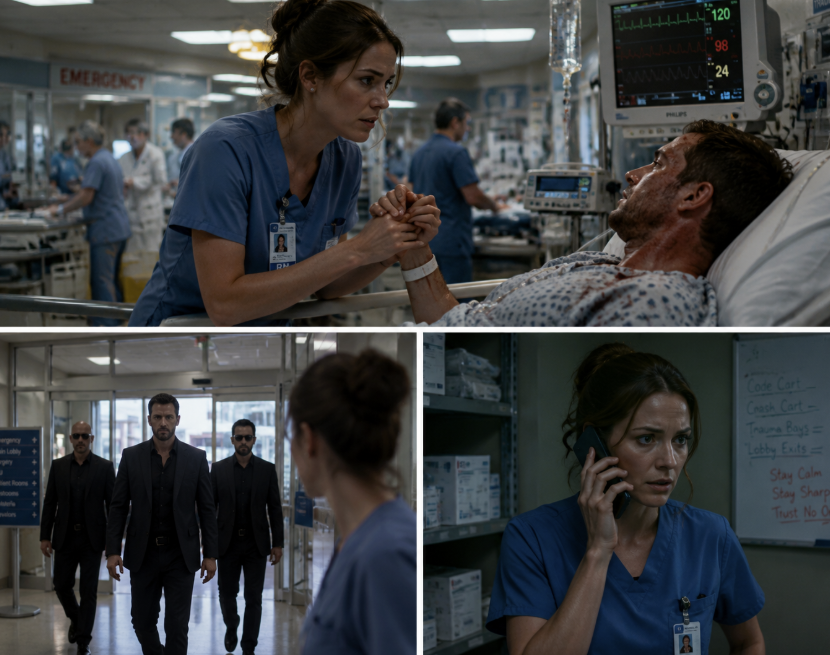
Inside was a compact keyboard and a retinal scanner.
The timer read 03:02.
“Upload is at seventy-six.”
“Disconnecting triggers data purge.”
“Can you override remotely?”
“Not without my retinal scan.”
Rachel looked at Rourke.
Blood spread beneath him.
“Then I’m bringing it to you.”
“You don’t have time.”
She looked at the explosive.
“Tell me how to stop the bomb.”
“That device uses anti-tamper wiring.”
“Tell me anyway.”
Mercer described the circuit.
Rachel opened the casing with a pair of trauma shears taken from the wall kit.
Three wires.
Blue.
White.
Green.
Two mercury switches.
A pressure sensor beneath the charge.
The timer reached 02:31.
Mercer’s voice weakened.
“Rachel, the white wire loops into the trigger relay.”
She followed it.
“No. White is a decoy. It ends at the battery.”
Silence.
Then Mercer said, “Vale altered the design.”
Rachel looked at Rourke.
He was smiling through the pain.
“Hospital electrician built it,” he said. “Man named Lewis.”
Rachel’s eyes narrowed.
Owen Lewis had not built the bomb.
But someone had used his schematics.
The same schematics stored in administration.
She studied the wiring again.
Green ran toward the pressure sensor.
Blue ran to the timer.
White ended at the battery.
None was the trigger.
Then she saw the copper mounting screw beneath the circuit board.
The screw itself completed the firing path.
A design meant to punish anyone who looked only for wires.
“I see it,” she whispered.
Mercer heard the change in her voice.
“What?”
“The screw is the circuit.”
“Can you isolate it?”
Rachel pulled the plastic tube from a pediatric oxygen mask hanging on the wall.
She slid it beneath the circuit board, wrapped it around the copper screw, and tightened until the rubber separated the contact.
The timer continued.
01:49.
“That didn’t stop it,” Mercer said.
“It won’t until I break the battery lead.”
“Rachel—”
She cut the white wire.
The timer froze at 01:42.
The upload froze at 81%.
For half a second, nothing moved.
Then the terminal went black.
Rachel exhaled.
A shot cracked behind her.
Pain ripped across her side.
She hit the floor.
Rourke had retrieved a backup pistol from his ankle.
He aimed again.
Before he could fire, the records-room door slammed open.
Ellie Monroe stood there holding a fire extinguisher.
The young nurse who had been trembling in the ICU swung it with both hands.
The metal cylinder struck Rourke’s wrist.
His pistol skidded away.
Ellie hit him again.
And again.
Rachel caught the extinguisher before the fourth blow.
“That’s enough.”
Ellie stared at her.
Her face crumpled.
“I thought he killed you.”
Rachel pressed one hand to the blood along her ribs.
“Not today.”
Ellie looked at the frozen bomb.
“What do we do now?”
Rachel stood slowly.
“We carry the case.”
Together, they lifted it.
In the communications room, Mercer sat before a bank of monitors while Dr. Bell pressed gauze into his wound.
Dane stood nearby with his weapon lowered.
On the screens, hospital security feeds showed patients being moved through corridors.
Nurses squeezed ventilation bags.
Doctors carried children.
Orderlies pushed beds by hand.
In the basement, Owen Lewis and Voss stood before the gas manifold.
The final oxygen pressure indicator dropped toward thirty percent.
Voss’s voice came through the radio.
“Charges one and two disarmed. East riser team has charge three.”
Owen shouted in the background.
“Pressure at thirty-two!”
Mercer looked at Rachel as she entered.
His face went pale when he saw the blood on her scrubs.
“Sit down.”
“Open the case.”
“Rachel—”
“Open it.”
He placed his eye against the scanner.
The locks released with a heavy click.
Inside were encrypted drives, printed documents, and a small satellite transmitter.
Mercer removed one drive and connected it to the terminal.
Files populated the screen.
Mission reports.
Surveillance photographs.
Casualty estimates.
Signed authorizations.
Rachel saw the Brussels file.
She saw Anna Vale’s name among the dead.
She also saw three later attacks intercepted because the source had remained active.
A school in London.
A concert hall in Madrid.
A train station in Boston.
Hundreds of lives.
Mercer looked at the documents.
“There was no clean choice.”
Rachel leaned against the desk.
“There never is.”
Dane stared at the Fallujah file on the screen.
He found his brother’s name.
Lucas Dane.
Next to it was a flight refusal issued by Orison Strategic Air.
The company’s largest private investor:
Samuel Vale.
Dane’s shoulders collapsed.
For years, he had shaped his grief around Mercer.
Now the truth left him with nowhere simple to place it.
Voss’s voice burst through the radio.
“Pressure thirty-one. We found the final manifold charge.”
Owen shouted, “It’s shielded! We can’t reach the firing screw!”
Rachel keyed the mic.
“Can you remove the entire mounting bracket?”
“Bolted into the pipe.”
“Cut the pipe supports.”
“We’ll rupture the line.”
“Pressure is already falling.”
Owen understood.
“If we rupture before reserve ignition, we vent the gas.”
Voss’s voice followed.
“The blast could take the room.”
Rachel closed her eyes.
“Get everyone out except one person.”
A pause.
Voss knew what she was asking.
“So somebody stays.”
“Yes.”
“No remote option?”
“No.”
Through the security feed, Rachel saw Voss look at Owen.
The maintenance supervisor was bleeding from the head and could barely stand.
Voss took the cutting torch from him.
“Show me the supports.”
Owen shook his head.
“You don’t know the system.”
“I know explosives.”
“You’ll die.”
Voss looked up at the camera.
For the first time since entering Mercy Valley, he did not look powerful.
He looked honest.
“I brought them in.”
Rachel watched his face.
The man who had threatened children in the lobby was not redeemed by one choice.
But a choice still mattered.
“Voss,” Rachel said.
He looked toward the camera.
“The switch was fake,” he said.
“I know.”
“He made me think I was in control.”
“I know.”
Voss nodded once.
“Get the old man out.”
Owen protested, but Voss shoved him toward the door.
The timer on the system reached forty seconds.
Voss positioned the torch against the first support bracket.
Sparks filled the maintenance room.
Thirty seconds.
The first bracket fell.
The oxygen line groaned.
Twenty-two seconds.
Voss cut the second support.
The pipe sagged.
A warning siren screamed.
Fifteen seconds.
He looked up at the camera.
Not at Rachel.
At the world beyond her.
“I wasn’t supposed to be the fool.”
Then he kicked the pipe.
The central oxygen line tore free.
Gas erupted into the room in a roaring white cloud.
The security feed went blind.
An explosion thundered beneath the hospital.
The floor jumped.
Ceiling tiles fell.
Lights died across the communications room.
Rachel hit the ground beside Mercer.
For five seconds, Mercy Valley disappeared into darkness.
Then the emergency generators engaged.
Red lights flickered on.
The hospital remained standing.
The oxygen system alarms went silent.
On the radio, voices shouted from the basement.
Owen Lewis coughed.
“Main charge vented. Fire contained.”
Rachel looked at the dead security feed.
“What about Voss?”
No answer came.
Outside, police breached the hospital.
The remaining mercenaries surrendered after Dane broadcast Vale’s deception across their radio channel.
Some dropped their weapons immediately.
Two tried to escape through the loading dock and were captured.
One barricaded himself in radiology until a technician locked him inside the MRI suite and triggered the magnet, ripping the rifle from his hands.
At 9:14 a.m., Samuel Vale was wheeled through the lobby in handcuffs.
Cameras crowded the rain-slicked entrance.
Reporters shouted his name.
He had built Mercy Valley.
His portrait still hung three stories above the atrium.
Now he passed beneath it with his wrists bound to a transport chair.
Dr. Bell stood beside the admissions desk.
Priya held Ellie’s hand.
Owen Lewis watched from a gurney with his head bandaged.
Mercer was already in surgery under police guard.
Rachel stood near the elevator, one hand pressed to the dressing over her ribs.
Vale saw her.
The officers slowed.
For a moment, the hospital seemed to quiet around them.
Vale looked smaller without the radio, the mercenaries, or the certainty of his plan.
“You saved the files,” he said.
Rachel nodded.
“They’ll be released through legal review.”
“They’ll bury them.”
“Not all of them.”
“Then this changes nothing.”
Rachel looked toward the lobby.
A respiratory therapist was hugging her husband.
A mother held the seven-year-old boy from the first shooting against her chest.
Dr. Bell’s hands were still stained with the blood of the man he had kept alive.
“It changes what happens next,” Rachel said.
Vale’s eyes moved to the families.
His mouth tightened.
“Anna deserved the truth.”
“Yes.”
He looked back at Rachel.
“So did everyone.”
“Yes.”
The answer unsettled him.
He had expected resistance.
Justification.
A defense of the system he hated.
Rachel gave him none.
“What should I have done?” he asked.
It was the first question he had asked that morning without already believing he knew the answer.
Rachel glanced at the handcuffs.
“Something she would have recognized as healing.”
Vale’s face broke.
Not dramatically.
No scream.
No collapse.
His lower lip trembled once.
His eyes moved toward the pediatric wing, where frightened children were being carried into the rain.
Then he bowed his head.
The officers wheeled him outside.
The crowd of reporters erupted.
Hours later, after the last bomb had been removed and the final hostage accounted for, Dr. Bell found Rachel sitting alone in an empty treatment bay.
She had changed into clean scrubs.
Her old ones were sealed in an evidence bag.
A cup of coffee cooled untouched beside her.
Bell stood in the doorway.
“Task Group Meridian.”
Rachel looked up.
He held a tablet displaying a grainy photograph leaked by a national news network.
Six figures stood beside a helicopter in desert camouflage.
Faces blurred.
Names redacted.
One figure was unmistakably Rachel.
Bell entered and pulled the curtain closed.
“Is it true?”
“Some of it.”
“You served in special operations.”
“Yes.”
“You were a medic?”
“Yes.”
“And the rest?”
Rachel looked at her hands.
There were fresh bruises across her knuckles.
“The rest is why the photograph is blurred.”
Bell sat across from her.
For several seconds, neither spoke.
Then he said, “Seven years.”
Rachel waited.
“You let me assign you to bedpan duty during the flu outbreak.”
“Somebody had to do it.”
“You let interns talk over you.”
“They usually stopped after they were wrong.”
“You let everyone believe you were…”
“Ordinary?”
Bell winced.
“I was going to say private.”
Rachel picked up the coffee.
It had gone cold.
“I wanted a life where saving someone didn’t require a classified report.”
Bell looked through the curtain toward the crowded emergency department.
“You have one.”
Rachel followed his gaze.
Priya was arguing with a pharmacist.
Ellie was laughing and crying at the same time.
Owen Lewis was refusing to remain in bed.
The injured security guard was alive.
The unconscious father from the lobby had regained a pulse after nine minutes of CPR.
Mercy Valley smelled of smoke, antiseptic, wet clothes, and burned wiring.
It had never felt more alive.
Bell stood.
“The board will want to recognize you.”
“No.”
“The mayor already called.”
“No.”
“The media knows your name.”
Rachel’s expression tightened.
Bell nodded.
“I thought you’d say that.”
He reached the curtain and stopped.
“Rachel?”
“Yes?”
“When Voss took you, I thought he chose you because you looked harmless.”
Rachel said nothing.
Bell glanced back.
“He chose you because you were protecting a child.”
He left before she could answer.
At sunset, rain still covered the city.
Rachel walked through the lobby carrying her jacket over one arm.
The shattered glass doors had been boarded over. Police tape fluttered near the entrance.
Dozens of staff members stood along the corridor.
Nurses.
Doctors.
Orderlies.
Cafeteria workers.
Volunteers.
No one had organized them.
No one spoke.
Rachel stopped.
Priya stepped forward.
“You’re leaving?”
“For the night.”
“Are you coming back?”
Rachel looked at the faces around her.
Some knew the headlines.
Some knew only that the quiet nurse from the emergency department had walked into a hostage crisis and brought people out.
Ellie held Rachel’s trauma shears clip in her palm.
Noah Kim, the young volunteer, had given it to her after police recovered it from the admissions counter.
Rachel took it.
“Tomorrow,” she said.
A smile moved through the crowd.
Not applause.
Something better.
Recognition.
As Rachel walked toward the boarded entrance, a reporter outside shouted through the gap.
“Sergeant Carter! Were you hiding who you really were?”
Rachel paused.
Camera lights waited beyond the rain.
She turned just enough for the people inside the hospital to hear her answer.
“No,” she said. “I just stopped believing the loudest part of my past was the truest part of me.”
Then she stepped into the evening.
Behind her, Mercy Valley returned to work.
Monitors beeped.
Phones rang.
Shoes moved across polished floors.
Lives continued because hundreds of people had refused to abandon one another.
The world would remember the soldier who stopped the attack.
But the people inside that hospital knew the deeper truth.
Rachel Carter had not saved them because she had once been special operations.
She had saved them because when a violent man decided everyone around him was expendable, the quiet nurse he underestimated had built her entire life around believing the opposite.