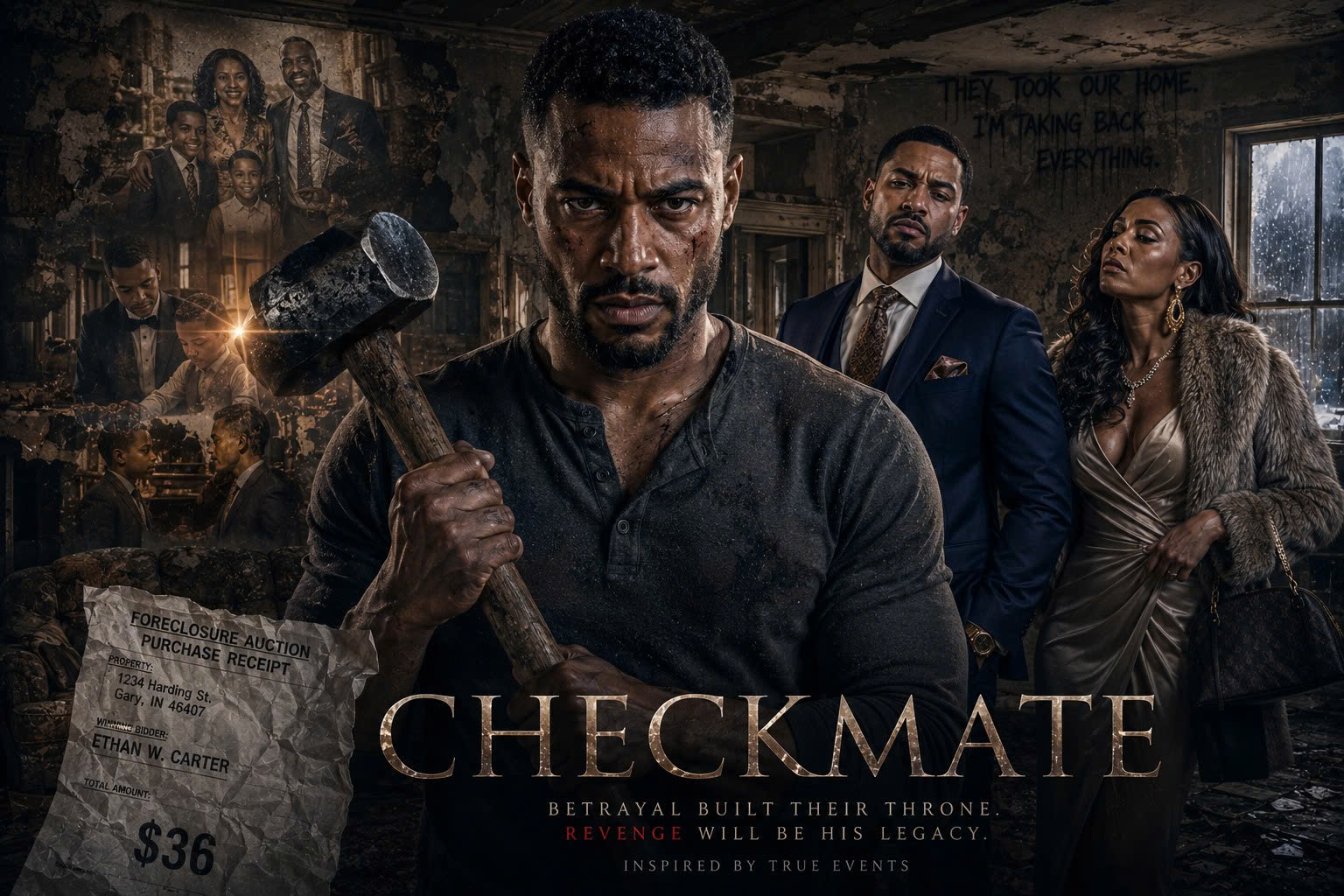
My brother threw the receipt at my chest and laughed.
“Thirty-six dollars,” Harrison said. “You paid thirty-six dollars for this?”
The paper bounced off my jacket and landed in the weeds beside the porch.
Behind him, his new Porsche idled at the curb, polished so perfectly that the abandoned house reflected across its black doors like a stain.
His wife Naomi stood beside him in white designer boots that had no business being anywhere near Gary, Indiana.
She covered her nose with two fingers.
“This place is a biohazard.”
I looked at the house.
The roof sagged above the eastern bedroom. Half the front windows had been boarded up. Gray paint peeled from the siding in long strips, and weeds had swallowed most of the walkway.
A rusted mailbox leaned toward the street.
The city had condemned the rear porch.
From the outside, it looked like the kind of property people bought by accident and regretted for the rest of their lives.
I picked up the receipt.
The tax-sale price was printed clearly near the bottom.
Winning bid: $36.00.
My name is Ethan Mercer.
I was thirty-three years old and worked as a financial auditor in Chicago.
I did not wear expensive suits outside client meetings.
I drove a ten-year-old Honda.
I rented a modest apartment near the train because I preferred investments that produced returns over objects that produced attention.
To Harrison, that meant I had failed.
My older brother had spent most of his life making success visible.
He owned cars people photographed.
He wore watches people recognized.
He founded a technology logistics company called Mercer Axis and described himself online as a “visionary operator reshaping modern commerce.”
Naomi was a luxury real-estate broker who photographed herself in houses she did not own and spoke about wealth as though proximity to it made her an expert.
Our parents, Richard and Patricia, considered them the successful branch of the family.
I was the other branch.
The accountant.
The quiet one.
The son who had never given them a reason to brag at country-club dinners.
Harrison pointed toward the collapsing porch.
“You actually plan to renovate this?”
“I plan to inspect it.”
“There is nothing to inspect.”
Naomi laughed.
“Maybe he can rent it to raccoons.”
Harrison stepped closer.
“You know what your problem is?”
“I assume you are going to tell me.”
“You have zero vision.”
He gestured toward his Porsche.
“I built something from nothing.”
That was not true.
When Harrison started his company, our parents gave him the money that had been saved for my college tuition.
I discovered it three weeks before my first semester.
My father called it a family investment.
My mother said Harrison’s opportunity could not wait.
I attended night classes instead.
I worked double shifts in a refrigerated warehouse, unloading food shipments until my hands cracked from the cold.
I took community-college credits.
Transferred later.
Studied accounting.
Passed every certification exam without a tutor, trust fund, or parent signing a check.
Harrison built his company with $180,000 that had once been intended for my education.
Years later, he still introduced himself as self-made.
“You inherited every opportunity you ever had,” I said.
His smile tightened.
“Still bitter?”
“No.”
“That is exactly what bitter people say.”
Naomi stepped around a broken planter.
“Why this house?”
“It was available.”
“For thirty-six dollars,” she said. “That should tell you something.”
“It tells me the county wanted the unpaid taxes cleared.”
“It tells me nobody else wanted it.”
“That too.”
Harrison glanced toward the boarded windows.
“Sell it back to the city.”
“I just bought it.”
“Then abandon it.”
“I have not inspected it.”
“You are wasting your time.”
I folded the receipt and placed it inside my wallet.
Harrison watched me.
“You are keeping that?”
“Yes.”
“Why?”
“So I remember what certainty sounds like before it becomes embarrassment.”
Naomi stared at me.
Harrison gave a short laugh.
“You always do that.”
“Do what?”
“Talk like you know something.”
“Sometimes I do.”
He shook his head.
“Enjoy your toxic waste dump.”
They returned to the Porsche.
Naomi wiped the bottom of one boot before getting inside.
The engine roared.
They drove away believing they had won something.
I stood in front of the house until the sound disappeared.
Then I unlocked the door.
The smell inside was a mixture of mildew, wet wood, and old plaster.
Sunlight entered through cracks in the boards.
The living room floor sloped slightly toward the center.
A dead ceiling fan hung by exposed wires.
I had bought the property because of a discrepancy.
The county listing described a 1,420-square-foot house.
The original plans showed 1,612 square feet.
A difference of 192 square feet was too large to be explained by wall thickness.
Most buyers had probably seen decay.
I saw an unexplained variance.
Auditors did not trust unexplained variances.
I spent the afternoon measuring every room.
Kitchen.
Living room.
Three bedrooms.
Bathroom.
Rear utility space.
The exterior dimensions still did not match the interior.
The missing area appeared to be located behind the northern wall of the basement.
The wall looked ordinary.
Too ordinary.
The drywall was newer than the surrounding surfaces but had been artificially aged with dust and water stains.
I tapped it with a hammer.
The sound was dense.
Not hollow like a typical partition.
I removed a small section.
There were no pipes.
No insulation.
No framing.
Behind the drywall was steel.
The following morning, my parents arrived in a Range Rover.
My mother stepped out wearing sunglasses large enough to conceal most of her face.
My father looked at the house as if I had purchased a public insult.
“Harrison told us,” Richard said.
“Apparently.”
Patricia remained near the vehicle.
“We had to see it ourselves.”
“Why?”
“To understand what is happening to you.”
“Nothing is happening to me.”
“You bought an abandoned house in Gary for thirty-six dollars.”
“Yes.”
Richard entered without waiting for permission.
He walked through the living room, staring at the damaged ceiling.
“This is madness.”
“It is an investment.”
“This is not an investment.”
“You have not seen the records.”
“I do not need records to recognize a ruin.”
Patricia stepped inside carefully.
“The anniversary gala is next month.”
“I remember.”
“You cannot attend if you are going to behave like this.”
I looked at her.
“Like what?”
“Unstable.”
“I bought a property at auction.”
“You are embarrassing the family.”
“Harrison’s company has been investigated twice for labor violations.”
“That has nothing to do with this.”
“It has more to do with embarrassment than a tax sale.”
Richard’s face hardened.
“This jealousy has gone too far.”
“What jealousy?”
“You have always resented your brother.”
“I resented losing my tuition.”
“We made a decision for the family.”
“You made a decision for Harrison.”
“And he created jobs.”
“I created a career.”
Patricia sighed.
“No one is denying that you have a respectable job.”
Respectable.
The word parents used when they did not mean impressive.
Richard walked toward the basement.
“What are you doing down there?”
“Inspecting the structure.”
“You should hire a contractor.”
“I know how to measure a wall.”
“You are an accountant.”
“Yes.”
He said it as though those two facts contradicted each other.
I followed him downstairs.
The open section of drywall exposed a narrow strip of steel.
Richard stopped.
“What is that?”
“I do not know yet.”
He stepped closer, then caught himself.
“It is probably an old reinforcement.”
“Possibly.”
“You should not touch it.”
“You just told me to abandon the house.”
“I am telling you not to make this worse.”
Patricia called from upstairs.
“We are leaving.”
Richard turned toward me.
“You are no longer invited to the gala.”
“Understood.”
“You do not care?”
“I stopped asking for admission to places where I am only invited to be compared with Harrison.”
For a moment, he looked angry enough to strike me.
Instead, he climbed the stairs.
My mother waited at the door.
“You will regret choosing pride over family.”
I looked at her.
“You taught me family could choose money over me.”
She said nothing.
The Range Rover disappeared down the street.
I returned to the basement.
It took six hours to remove the false wall.
Behind it stood a steel door.
Not a residential safe.
A full industrial security door set into reinforced concrete.
A keypad was mounted beside it.
The frame had been sealed against moisture.
The walls around it contained layers of lead shielding.
Someone had built a panic room beneath an abandoned house and hidden it so carefully that even the city had missed it.
The keypad had no visible brand.
Below it was a mechanical keyway.
I searched the basement and found nothing.
Then I inspected the old workbench.
One drawer was shallower than the others.
I removed it.
A key had been taped to the underside.
The keypad lit when I inserted it.
It asked for an eight-digit code.
I tried the property’s parcel number.
Rejected.
The original construction year.
Rejected.
Then I thought about ownership history.
The house had passed through three shell companies before the county seized it for unpaid taxes.
The oldest company had been formed on August 14, 1987.
I entered 08141987.
The lock released.
Cold, dry air moved through the opening.
I turned on my flashlight.
The room was approximately twelve feet wide and sixteen feet deep.
Its walls were lined with lead panels.
A ventilation unit sat dormant above the door.
Metal shelving covered three walls.
On those shelves were vacuum-sealed bricks of cash.
One hundred thousand dollars per brick.
Ten bricks per row.
Eighteen rows.
I counted twice.
Then a third time.
One hundred eighty bricks.
Exactly $18 million.
I did not touch them.
Cash of that quantity was not a windfall.
It was evidence until proven otherwise.
On top of the center stack sat an envelope.
My name was written across the front.
ETHAN.
The handwriting belonged to my grandfather Theodore.
He had been dead for five years.
The envelope was sealed with dark red wax stamped in the shape of a bear.
Theodore used that seal on birthday letters when we were children.
I opened it carefully.
Inside was a small encrypted USB drive and a single piece of paper.
One word was written on it.
Checkmate.
I left the money where it was.
Photographed the room.
Recorded the count.
Sealed the entrance.
Then I returned to Chicago with the USB inside a locked document case.
My grandfather had loved puzzles.
He had also loved routines.
The encryption prompt requested three words.
The first was the name of the lake where he taught me to fish.
The second was the nickname he used when I found an accounting error in his household ledger at age twelve.
The third was the last word he spoke to me before entering surgery.
I entered them.
The drive opened.
There were spreadsheets, scanned ledgers, corporate records, photographs, and audio files.
I selected the first recording.
My grandfather’s voice filled the apartment.
“If you are hearing this, you found the room.”
There was a pause.
“And if you found the room, I was right about you.”
I sat very still.
“The money is not an inheritance. Do not spend it.”
His voice sounded weaker than I remembered, but his words remained precise.
“It belongs to a crime that has not yet been completed.”
The next file displayed the corporate history of Mercer Industrial Holdings, the manufacturing company Theodore had founded forty-two years earlier.
My father had run it after Theodore retired.
Harrison’s logistics company operated through several affiliated entities connected to it.
Theodore continued.
“Richard began taking money from the company eight years before my death.”
I opened the first ledger.
Pension funds.
Operating reserves.
Vendor rebates.
Loan proceeds.
Money had been moved through consulting companies with no employees.
Then through banks in Delaware, Nevada, and the Caribbean.
“Harrison helped him.”
The next spreadsheet linked my brother to six offshore entities.
“Together, they planned to weaken the company, move valuable contracts into Harrison’s private business, declare the original company insolvent, and leave the pension obligations behind.”
I felt my jaw tighten.
Hundreds of employees depended on those pensions.
“I began a shadow audit.”
That phrase sounded exactly like Theodore.
He trusted, but he verified everything.
“I intercepted funds they believed had moved offshore.”
The $18 million.
“I could not report them immediately without exposing employees to a collapse before the records were complete. So I created a controlled asset outside their view.”
Images of the Gary house appeared.
Theodore had purchased it through a shell company twelve years earlier.
He hired a specialized contractor to build the lead-lined room.
Then he let the property deteriorate.
After his health failed, he stopped paying the taxes deliberately.
He knew the county would eventually auction it.
“I could not leave it directly to you,” he said. “Richard would challenge the estate. Harrison would buy the lawyers. Patricia would call it family loyalty.”
I almost smiled.
“So I left you a discrepancy.”
The property dimensions.
“You always measured what other people assumed.”
The recording continued.
“If you are still the man I believe you are, you will not take the money. You will use it to finish the audit.”
The final folder contained updated instructions.
Corporate accounts.
Beneficial owners.
Transfers.
Dates.
Copies of internal emails.
Theodore had built a case but died before he could complete it.
I spent the next three days reviewing every file.
Harrison’s company was preparing for a major funding round.
Public materials claimed strong cash reserves.
Internal records suggested otherwise.
There was an $18 million liquidity gap hidden across related entities.
The exact amount in the vault.
An IRS audit notice had recently been issued.
Four weeks remained before the first required production date.
The money was not treasure.
It was the missing center of a fraud.
I contacted an attorney named Arthur Pendleton.
Arthur worked from a small office above a pharmacy.
He wore old suits, carried paper files, and had never appeared on television.
That was why I chose him.
He listened carefully.
Then he said, “We need three separate tracks.”
“Property.”
“Criminal evidence.”
“And family litigation.”
I nodded.
“We also need chain of custody,” he added.
“I have photographs and timestamps.”
“Good. Do not move the cash without federal coordination.”
“I was not planning to.”
“Most people would.”
“Most people would not find it.”
Arthur smiled.
We notified the appropriate authorities confidentially through counsel.
The house was secured.
Cameras were installed inside and outside.
Motion sensors covered every entrance.
The vault remained sealed.
Title to the property was transferred into a properly disclosed trust to prevent casual public searching and unauthorized claims.
The arrangement did not conceal ownership from regulators or courts.
It simply prevented Harrison from learning too quickly what I controlled.
I continued analyzing Theodore’s records.
Mercer Axis was over-leveraged.
Several contracts had been pledged twice.
Loans were secured by receivables that did not exist.
The company needed a new funding round to survive the IRS audit.
If investors discovered the $18 million gap, the valuation would collapse.
Two weeks later, Harrison and Naomi entered a café where I was reviewing documents.
Naomi saw me first.
“Well,” she said loudly. “The property tycoon.”
Several people looked up.
Harrison approached my table.
“Still renovating the landfill?”
“Inspecting it.”
“For what?”
“Variances.”
He laughed.
“You need a hobby.”
“I found one.”
Naomi looked at my folder.
“Tax forms? Exciting.”
“More than you would think.”
Harrison ordered coffee and remained beside the table.
“You know, I could still help you.”
“How?”
“I could have the property cleared.”
“At what price?”
“You paid thirty-six dollars.”
“So?”
“I would give you five hundred.”
“That is generous.”
He smiled.
“I am trying to be a brother.”
I closed the folder.
“How is Mercer Axis handling the liquidity shortfall?”
His face changed.
Only slightly.
Naomi did not notice.
“What shortfall?”
“The one between reported reserves and actual unrestricted cash.”
Harrison stared at me.
“You have no idea what you are talking about.”
“Probably not.”
“Where did you hear that?”
“I audit companies.”
“Not mine.”
“No.”
I slipped the folder into my bag.
“Eighteen million is a difficult number to hide.”
The color left his face.
Naomi looked between us.
“What does that mean?”
“Nothing,” Harrison said.
I stood.
“Enjoy the coffee.”
That evening, Harrison called our father.
I knew because two days later, someone entered the storage facility where Theodore’s old business records were kept.
They searched for six hours.
Security logs showed Richard and Harrison removing boxes.
Among them was a manila folder Theodore had planted deliberately.
It contained a property appraisal.
An environmental report.
A survey of the Gary house.
And a note referencing the trust.
They knew.
At 2:07 the following morning, two men approached the property.
I watched from my Chicago apartment through the security feed.
They wore dark clothing and carried bolt cutters.
One examined the rear lock.
The other moved toward a basement window.
I activated the exterior speaker.
“You are being recorded.”
Both men froze.
“One hundred eighty cameras would be excessive,” I continued. “Fortunately, eighteen million reasons were enough.”
The man near the window stepped back.
His partner looked directly toward the camera.
I read the license plate number aloud.
They ran.
The vehicle disappeared before police arrived, but the footage preserved faces, equipment, and plates.
The following morning, my family came to my apartment.
All four of them.
Richard.
Patricia.
Harrison.
Naomi.
They stood in the hallway with the solemn expressions of people attending a funeral they hoped to control.
I let them inside.
My mother spoke first.
“We are worried about you.”
“That is new.”
“Ethan,” Patricia said, “please.”
Richard sat without being invited.
“We have all said things.”
“Yes.”
“Harrison was joking about the house.”
“He hired men to enter it.”
Harrison crossed his arms.
“I did no such thing.”
“I have video.”
Naomi placed a folder on the table.
“We came to solve this.”
Inside was a purchase agreement.
Offer price: $50,000.
“You paid thirty-six dollars,” she said. “This is an extraordinary return.”
“For a condemned biohazard?”
“We may redevelop the land.”
“Harrison called it toxic waste.”
“Markets change.”
“Overnight?”
Richard leaned forward.
“The property is connected to family assets.”
“Which assets?”
“You know.”
“I want to hear you say it.”
Patricia looked at him nervously.
Richard continued.
“Your grandfather concealed company money.”
“Then why offer $50,000 for the property instead of reporting it?”
Silence.
Harrison stood.
“You are in over your head.”
“I was in over my head when I worked nights in a freezer because you took my tuition.”
“You always return to that.”
“Because you always return to acting self-made.”
Naomi rolled her eyes.
“This is childish.”
“You drove to Gary to throw a receipt at me.”
“That was a joke.”
“You called me a failure.”
“We were trying to motivate you.”
Richard struck the table with his palm.
“Enough. Sign the agreement.”
“No.”
“We will sue.”
“I hope you do.”
He stared at me.
“You think you can fight us?”
“I think you should put every claim in writing.”
For the first time, fear appeared plainly in Harrison’s eyes.
I opened the apartment door.
They left without another apology.
The smear campaign began three days later.
Naomi told brokers I had suffered a mental breakdown.
She said I was living inside an abandoned property and threatening family members.
Richard contacted partners at my accounting firm.
He described me as unstable and obsessed with hidden money.
A week later, the firm suspended me without pay.
My access badge was deactivated.
My laptop was collected.
The managing partner avoided eye contact while explaining that the decision was temporary.
I thanked him.
Then I went home and completed the whistleblower report.
Five hundred pages.
Every transaction cross-referenced.
Every shell company mapped.
Every pension withdrawal documented.
Every false vendor payment tied to a beneficiary.
Theodore’s shadow ledger matched public filings, internal emails, bank records, and offshore entities.
The report categorized evidence under possible embezzlement, wire fraud, bank fraud, tax evasion, pension theft, and conspiracy.
I attached the video of the attempted break-in.
The property records.
Vault photographs.
Audio files.
Chain-of-custody statements.
The IRS audit notice.
Two weeks later, Richard and Harrison filed suit in federal court.
They claimed Theodore had suffered cognitive decline.
They alleged the $18 million belonged to Mercer Industrial Holdings.
They accused me of exploiting my profession to seize corporate property.
Arthur read the complaint twice.
“They have done exactly what you wanted.”
“They have claimed the money.”
“In writing.”
“Now we need them to repeat it under oath.”
Their legal team occupied an entire side of the deposition room.
Sterling Crowe, lead counsel, wore a charcoal suit and spoke as though every sentence was being quoted.
Patricia and Naomi sat behind the lawyers.
Harrison smiled when Arthur entered with his worn leather briefcase.
Sterling began with me.
“How did you discover the hidden room?”
“I measured the house.”
“You expect us to believe you purchased an abandoned property for thirty-six dollars and accidentally found $18 million?”
“I did not say accidentally.”
“What made you inspect the basement wall?”
“The dimensions did not match.”
“What dimensions?”
“I do not recall the exact figures.”
I did.
“Did you know the money was there before buying the house?”
“No.”
“Did Theodore Mercer tell you about it?”
“No.”
“Did you damage the property to gain access?”
“I removed drywall.”
His questions became sharper.
My answers remained short.
I allowed him to believe I was defensive.
Then he questioned Richard.
“Mr. Mercer, to whom does the money belong?”
“To the company.”
“All $18 million?”
“Yes.”
“Was it corporate capital?”
“Yes.”
“Did Theodore have authority to remove it?”
“No.”
Harrison testified next.
Sterling asked the same question.
“The money belonged to Mercer Industrial and affiliated companies,” Harrison said.
“All of it?”
“Yes.”
“Was it part of corporate operations?”
“Yes.”
“Did you have knowledge of the missing amount before Ethan located it?”
Harrison hesitated.
Sterling rephrased.
“Did the amount correspond to capital your company expected to control?”
“Yes.”
That was enough.
They had claimed ownership under oath.
Not vague family ownership.
Corporate ownership.
Capital connected to their business operations.
They celebrated afterward at an expensive steakhouse.
Naomi posted a photograph online.
Truth always wins.
I printed it for the file.
The whistleblower package had already been submitted to IRS Criminal Investigation and the FBI two weeks earlier.
The next morning, we entered federal court.
My family arrived dressed as though attending a coronation.
Richard wore a navy suit.
Harrison carried no documents.
Naomi bumped my shoulder in the hallway.
“Cheap suit,” she whispered.
I smiled.
Inside the courtroom, the judge reviewed the civil claim.
Sterling argued that I had unlawfully retained corporate property.
He described me as a disgruntled relative.
He emphasized my recent suspension.
Then the judge looked toward Richard and Harrison.
“Do you both maintain under oath that the $18 million discovered at the Gary property belongs to your companies?”
Richard stood.
“Yes, Your Honor.”
Harrison followed.
“Yes.”
The judge turned toward Arthur.
“Mr. Pendleton?”
Arthur looked at me.
I stood.
“Your Honor, I accept their representation.”
Sterling smiled.
Naomi leaned toward Patricia.
I continued.
“The funds are corporate property connected to the plaintiffs.”
The judge frowned.
“Then why have they not been transferred?”
“Because I reported them.”
“To whom?”
I placed a sealed package on Arthur’s table.
The Treasury receipt was visible across the front.
“To the Internal Revenue Service Criminal Investigation Division and the Federal Bureau of Investigation.”
The room changed.
Sterling stopped smiling.
I opened the first page of the report.
“The funds correspond exactly to amounts removed from pension reserves, operating accounts, loan proceeds, and affiliated corporate entities through a network of shell companies.”
Richard gripped the edge of the table.
Harrison stared at me.
“The plaintiffs have now confirmed ownership under oath twice,” I said. “Once during deposition and again before this court.”
Sterling stood.
“Your Honor, we request a recess.”
The courtroom doors opened.
Federal agents entered.
Two moved toward Richard.
Two approached Harrison.
Patricia made a small sound.
Naomi stood so quickly that her chair fell backward.
An agent addressed my father.
“Richard Mercer, you are under arrest in connection with tax evasion, wire fraud, embezzlement, bank fraud, and conspiracy.”
Another agent turned Harrison around.
The handcuffs closed.
“This is a setup!” Harrison shouted.
“No,” I said. “It is an audit.”
He looked at me with pure hatred.
“You stole that money.”
“You just testified that it was yours.”
Sterling lowered his head.
Naomi rushed toward him.
“I need a divorce attorney.”
Harrison stared at her.
“What?”
She stepped away from him.
“I did not know about any of this.”
The government’s report contained emails she had forwarded and property transactions she had helped structure.
Her distance came too late.
Patricia collapsed into a chair.
The judge dismissed the civil action without prejudice to the government’s seizure proceedings.
The $18 million was taken into federal custody.
The Gary property remained under the trust pending investigation.
Outside the courthouse, reporters gathered.
I did not speak to them.
I had spent too many years in a family where appearances mattered more than facts.
I no longer needed the public to understand immediately.
The records would do that.
The criminal cases lasted almost two years.
Richard and Harrison were convicted of multiple financial offenses.
Evidence showed they had diverted corporate funds, weakened pension accounts, falsified bank documents, hidden income, and planned to abandon liabilities through a manufactured bankruptcy.
Both received fifteen-year federal sentences.
The government seized luxury vehicles, investment accounts, properties, and business interests connected to the fraud.
Mercer Axis collapsed.
Parts of the legitimate business were sold to protect employees and recover pension losses.
Naomi divorced Harrison before sentencing.
It did not save her career.
Investigators found she had participated in property transfers and misrepresented beneficial ownership in several transactions.
Her real-estate license was revoked.
Her social circle disappeared as quickly as her money.
Years later, I heard she was working at a discount home-goods store.
Patricia lost the house.
The country-club membership.
The friends who had praised Harrison at every dinner.
She moved into a small apartment and told relatives I had destroyed the family.
None of them asked why her husband and eldest son had stolen from employee pensions.
My accounting firm reinstated me after federal investigators confirmed I had acted lawfully.
I did not return.
A firm that suspended an auditor for identifying fraud had already answered every question I needed to ask.
I started an independent forensic-audit practice.
My first clients were pension trustees and family-owned companies afraid of internal theft.
The federal whistleblower process took time.
There were reviews, challenges, calculations, and tax assessments.
Eventually, I received an official award.
$5.4 million.
Legitimate.
Reported.
Taxed.
Documented.
The first large sum of money in my life that carried no hidden obligation.
Two years after the arrests, I returned to Gary.
The house still stood behind temporary fencing.
The government had removed the cash and completed its evidence work.
The vault was empty.
I hired a demolition company.
The excavator arrived early on a gray morning.
Its bucket crushed the front porch first.
Then the living room.
Then the basement walls.
The lead-lined room resisted longer than the rest.
Steel bent.
Concrete cracked.
The hidden chamber collapsed beneath its own weight.
Workers loaded the metal into trucks as scrap.
By sunset, the house was gone.
Only a flat section of earth remained.
I found the original receipt in my wallet.
The paper had softened along the folds.
Thirty-six dollars.
Harrison had thrown it at me because he believed price and value were the same thing.
He believed a cheap house had to be worthless.
A quiet brother had to be weak.
An accountant had to be unambitious.
A father’s favorite son had to be untouchable.
He had been wrong about all of it.
I placed the receipt inside a small metal box.
Not as a trophy.
As a reminder.
The house had never made me rich.
The money inside it had never belonged to me.
What changed my life was the discrepancy.
One hundred ninety-two missing square feet.
A false wall.
A gap between what people claimed and what the numbers proved.
That gap existed everywhere in my family.
Between Harrison’s success and the money that created it.
Between my parents’ love and the conditions attached to it.
Between their public respectability and the crimes hidden underneath.
I had spent my career learning that fraud survived because people looked at totals instead of details.
My family survived the same way.
Everyone saw the cars.
The gala.
The company.
The Range Rover.
The Porsche.
Nobody asked where the money came from.
I did.
Not because I wanted revenge.
Because something did not balance.
In the end, I did not beat them with power, violence, or family influence.
I let them speak.
I let them sue.
I let them claim the money.
Then I placed their own sworn words beside the ledger.
Checkmate was never the moment the agents entered the courtroom.
It began years earlier, when my grandfather trusted that I would measure the wall.
And it ended on an empty lot in Gary, Indiana, where nothing remained except level ground and a man who no longer needed his family’s approval.