The message arrived at 2:13 in the morning.
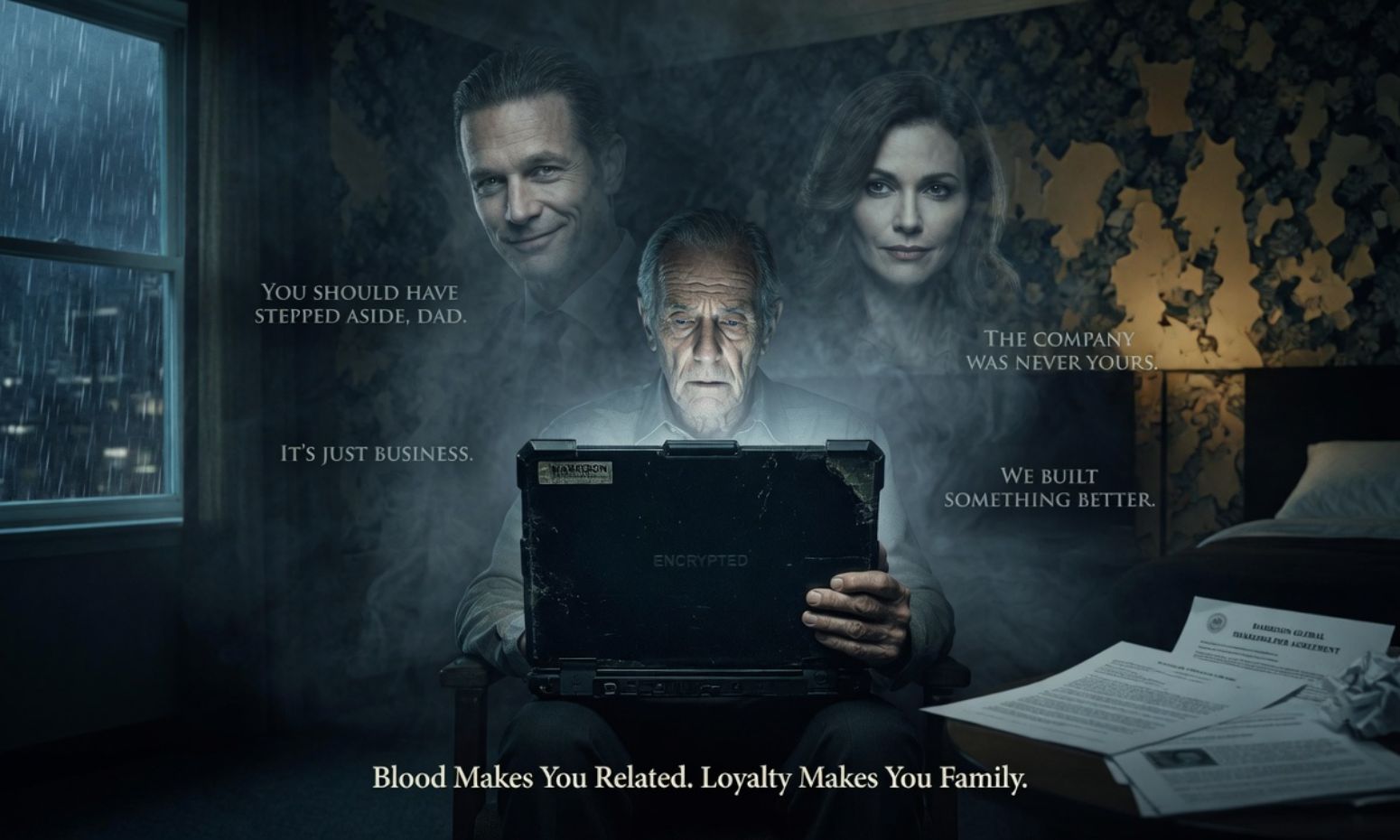
I was sitting alone in a private recovery room at St. Matthew’s Clinic, watching rain crawl down the window and trying to convince my left hand to stop trembling.
Three days earlier, a mild stroke had put me on the floor of my office. The doctors said I had been lucky. No permanent paralysis. No serious loss of speech. A few weeks of therapy, less stress, and I could return to the life I had spent fifty years building.
At seventy-five, I knew luck was rarely free.
I simply had no idea how much my son intended to charge me for it.
My phone vibrated.
The message was from Derek.
Dad, Megan and I have made a decision. You are no longer welcome at the house or the company. Your condition has become a danger to yourself and everyone around you. We’ve arranged professional care. Don’t come back and make this harder than it needs to be.
I read it twice.
Then a third time.
My son had not asked whether I was awake. He had not asked whether I was in pain. He had not even pretended that this was temporary.
He had removed me from my family in four sentences.
I typed one word.
Okay.
Then I opened the locked drawer beside my hospital bed and removed a black laptop that Derek did not know existed.
The machine required my fingerprint, retinal confirmation, and a twelve-character code I had memorized years ago. When the screen lit up, I called the twenty-four-hour private banking desk at Sterling National.
A woman answered immediately.
“Sterling Private Client Services. How may I assist you?”
“This is Harrison Grant. Client authorization Black Seven.”
There was a pause as my voiceprint was processed.
“Identity confirmed. Good evening, Mr. Grant.”
“I want an immediate protective freeze placed on every account under Grant Commercial Holdings, including subsidiaries, revolving credit lines, corporate cards, acquisition facilities, and international transfer permissions.”
The banker became very quiet.
“Sir, that action will suspend billions of dollars in accessible assets.”
“I know.”
“It may also trigger review clauses in several lending agreements.”
“I wrote those clauses.”
“May I ask whether you believe the company has been compromised?”
I looked at Derek’s message again.
“Yes,” I said. “By someone with full internal access.”
She began entering the orders.
I leaned back against the hospital pillow and waited.
Derek believed he had removed an old man from his home.
What he had actually done was wake the man who had built everything he was trying to steal.
Seventy-two hours earlier, I had left the hospital ahead of schedule.
My physician wanted me to remain another week, but I hated the smell of antiseptic and the way nurses watched me walk as if gravity had become my enemy. Derek and his wife, Megan, had visited only twice. They said they were overwhelmed managing the company.
I believed them.
That was my first mistake.
My driver was unavailable, so I took a taxi to my estate in Highland Park. I had bought the original house in 1989, when the surrounding land was still cheap enough for a man with ambition and a dangerous amount of debt.
My late wife, Evelyn, chose the white stone for the entrance. She planted the two oak trees beside the driveway herself. After she died, I could never bring myself to move.
The house was not merely property.
It was the last place where I could still hear her laughter.
The taxi stopped before the gate, but my access code did not work.
I tried again.
Red light.
The intercom remained silent.
Eventually, a security guard I had never seen walked out of the booth.
“This is private property,” he said.
“I’m Harrison Grant.”
His expression changed slightly, but he did not open the gate.
“Mr. Derek Grant instructed us not to admit you.”
“My son does not own this house.”
“I’m only following orders.”
I called Derek.
He declined the call.
Five minutes later, the gate opened just wide enough for him and Megan to walk through.
Derek wore one of my tailored navy suits. At forty-two, he had my height, Evelyn’s eyes, and none of her compassion. Megan followed in a pale cashmere dress, holding a folder against her chest.
“Dad,” Derek said, “you shouldn’t be here.”
“I live here.”
“Not anymore.”
Megan stepped forward with a sympathetic smile.
“We understand this is confusing, Harrison.”
I looked at her.
“What is confusing?”
“Your medical situation. The doctors warned us you might have difficulty accepting changes.”
“My doctor told me to rest.”
“That is exactly why we found you somewhere peaceful,” she replied. “The Lakeshore Residence has private gardens, full-time nursing care, and an excellent memory unit.”
“Memory unit?”
Derek exhaled impatiently.
“Don’t turn this into a scene.”
“I came home from the hospital and discovered that my locks had been changed. I think a scene is already underway.”
He pulled several documents from Megan’s folder.
One appeared to be a medical certification declaring me cognitively impaired. Another gave Derek authority over my healthcare and residential placement. A third granted him temporary control of my personal affairs.
My signature appeared at the bottom of every page.
It was almost perfect.
Almost.
“You signed these in the hospital,” Derek said. “The medication probably affected your memory.”
A blurred image returned to me.
Derek standing beside my bed the night after the stroke. Megan holding a stack of papers. A nurse adjusting my sedative.
Derek telling me the documents were routine insurance authorizations.
“You gave me papers while I was drugged.”
“You were conscious.”
“I could barely recognize you.”
Megan’s smile vanished.
“You should be grateful we are taking responsibility. Many families would simply abandon someone in your condition.”
“Someone in my condition?”
Derek lowered his voice.
“Dad, you’re seventy-five. You had a stroke. You forget meetings. You repeat yourself. You make erratic decisions.”
“I postponed one meeting because I was unconscious.”
He stepped closer to the gate.
“If you try to enter, security will call the police. They already have copies of the medical declaration. If you become aggressive, it will only prove our case.”
That was the moment I understood the precision of the trap.
They wanted me angry.
They wanted me shouting at the gate, grabbing my son, threatening the guards. They wanted a police report describing a confused old man behaving unpredictably.
I looked beyond them at my house.
Through an upstairs window, I saw Megan’s brother carrying boxes from my study.
They had not arranged this after my stroke.
The stroke had merely accelerated a plan already in motion.
“May I collect some clothes?” I asked.
“Everything you need will be delivered to Lakeshore,” Megan said.
“I’m not going to Lakeshore.”
Derek’s expression hardened.
“Then find a hotel.”
I held his gaze for several seconds.
“All right.”
He seemed disappointed that I had not fought.
I returned to the taxi and asked the driver to take me to the Meridian Hotel in downtown Dallas. As we pulled away, I watched the gate close over the home I had built for my family.
I did not cry.
I had learned long ago that grief was useful only after danger had passed.
The hotel gave me a suite on the thirty-first floor. By sunset, the dining table had become a temporary command center. I opened the encrypted laptop, connected through a private network, and attempted to access Grant Commercial Holdings.
My primary executive credentials had been disabled.
Derek had moved quickly.
Fortunately, twenty years earlier, after an internal fraud investigation, I had created a secondary monitoring system known only to me and two original engineers. It could not authorize payments or alter records, but it could observe everything.
We called it the ghost protocol.
Derek had locked the front door.
He had forgotten that I designed the building.
I opened the transaction ledger.
At first, nothing appeared unusual. Routine property maintenance. Vendor invoices. Payroll. Insurance payments.
Then I filtered for new suppliers created during the previous fourteen days.
Twenty-three companies appeared.
Eight shared the same registration agent.
Five used mail-forwarding addresses.
Three had received payments for “strategic consulting,” although no consulting agreements existed.
The total transferred was $537,800.
Most of it had traveled through two domestic accounts before disappearing into a Cayman Islands institution.
Derek was stealing from the company.
But the pattern bothered me.
The invoices were rushed and careless. My son had been raised around accountants and attorneys. He understood audit trails. If greed alone motivated him, he would have hidden the theft more skillfully.
This was desperation.
I continued searching and found a confidential sale memorandum for two South Dallas distribution centers.
The properties generated millions in annual rent. Together, they were conservatively worth twenty-five million dollars. In a competitive bidding process, perhaps thirty.
Derek was trying to sell both for fifteen million.
The buyer had been given only five days for due diligence. The environmental inspection had been waived. The title review was incomplete. Closing was scheduled for Monday morning.
Someone needed cash immediately.
At 11:40 that night, I called Victor Bradley.
Victor had been my attorney for thirty-two years. He had negotiated my first warehouse acquisition, defended us through two recessions, and sat beside Evelyn’s bed during her final week.
He answered in a voice thick with sleep.
“Harrison?”
“My son has declared me mentally incompetent, removed me from my house, and appears to be liquidating company assets.”
Victor was silent for three seconds.
“I’ll be there in twenty minutes.”
He arrived in eighteen.
By midnight, he had two encrypted computers open, a portable scanner connected, and half my dining table covered in documents.
When I showed him the medical certification, his jaw tightened.
“This physician isn’t affiliated with St. Matthew’s.”
“I’ve never met him.”
Victor searched the name.
Dr. Lionel Pierce operated a small private clinic outside Fort Worth. Three disciplinary complaints had been filed against him. Two involved medical reports prepared without proper examinations.
“The healthcare power of attorney is invalid,” Victor said. “The witnessing dates don’t match the hospital records.”
“That will help us regain control.”
“It will. But if Derek forged this, we’re beyond a family dispute.”
“We crossed that line when he changed my locks.”
Victor investigated the shell companies while I traced the distribution-center transaction.
At three in the morning, he turned his laptop toward me.
“The buyer is Red Mesa Logistics LLC. Registered in Delaware six weeks ago.”
“Who owns it?”
“Officially, another holding company.”
“And unofficially?”
Victor enlarged a signature from a financing document.
“Tyler Evans.”
Megan’s younger brother.
I felt something inside me become very still.
Megan was not being manipulated by my son.
She was his partner.
The structure was simple and vicious. Derek would sell Grant Commercial assets worth nearly thirty million dollars to a company secretly controlled by Megan’s family for fifteen million. Red Mesa would finance the purchase with borrowed money, allowing Derek to extract immediate cash. Afterward, the properties could be resold at market value.
They would take the difference.
The company would absorb the loss.
I would be blamed for authorizing the transaction while supposedly suffering from dementia.
Victor found the larger problem just before dawn.
Derek had been trading cryptocurrency through an offshore platform, using extreme leverage and corporate collateral. For months, he had hidden the losses by moving money between subsidiaries.
Then the market turned against him.
He lost everything.
Worse, he owed twelve million dollars to a private lending group operating through Cyprus, Panama, and the Cayman Islands. The contracts contained aggressive default provisions. Several loans were backed by corporate assets Derek had no legal authority to pledge.
“He has to deliver twelve million by Monday,” Victor said. “The warehouse sale gives him fifteen. He pays the lenders, keeps the remaining three million, and disappears.”
“Where?”
“We found two one-way tickets from Dallas to Grand Cayman. Monday afternoon. Derek and Megan.”
“And they leave me with the criminal liability.”
Victor nodded.
“The forged medical reports establish that you lacked capacity. The false power of attorney makes it appear that Derek acted as your legal representative. If the offshore money is traced, he can claim he was following instructions you gave before your condition worsened.”
For fifty years, I had believed that every financial crisis had a number at its center. Find the number, understand who needed it, and the rest of the strategy would reveal itself.
Derek’s number was twelve million.
My number was one.
One son.
One child Evelyn and I had loved, protected, educated, and forgiven too many times.
I walked to the window. Dawn was beginning to stain the Dallas skyline.
Victor came to stand beside me.
“We should call the FBI.”
“Not yet.”
“Harrison, the closing is in less than forty-eight hours.”
“If we stop it now, Derek will claim he misunderstood his authority. His attorneys will turn this into a corporate governance dispute.”
“We already have forged documents.”
“We have evidence that someone forged them. I want proof that Derek knowingly used them to steal fifteen million dollars.”
Victor studied me.
“You want him to complete the transaction.”
“I want him to try.”
“That is dangerous.”
“No. It is measurable.”
Years earlier, after a reckless executive nearly liquidated a subsidiary without board approval, I had inserted a protective clause into our master operating agreement.
Any transaction that liquidated more than thirty percent of a business unit’s assets during a single quarter required enhanced authorization. The seller had to provide a live signature, biometric verification, and special notarized confirmation from the controlling principal.
Me.
If anyone attempted to bypass those safeguards, the banking charter required Sterling National to freeze the transfer, suspend connected credit lines, and issue automatic suspicious-activity reports to federal regulators.
Employees called it the poison pill.
Derek had probably seen references to it.
He had never understood what it did.
“If he submits the transfer using the false power of attorney,” I said, “the system will preserve every document, device signature, IP address, and authorization code.”
Victor slowly sat down.
“It will also report potential bank fraud, money laundering, and identity theft.”
“Exactly.”
“You’re going to let the bank build the case.”
“I’m going to let Derek build it.”
Victor looked toward the medical declaration bearing my forged signature.
“What if he realizes there is a trap?”
“He won’t.”
“How can you be certain?”
“Because he thinks I’m an old man who no longer remembers how his own company works.”
We spent the weekend preparing.
Victor secured emergency orders preventing further alteration of the corporate records. A forensic team copied the servers without alerting Derek. Sterling National agreed to monitor the transaction while allowing his online portal to appear normal.
I returned to St. Matthew’s for an independent cognitive assessment.
The neurologist asked me to identify objects, solve equations, recall lists of words, and draw the hands of a clock.
I passed every test.
When she asked why someone had declared me incompetent, I answered, “Because incompetence is easier to steal from.”
On Sunday afternoon, Derek sent another message.
Your room at Lakeshore is ready. The company will cover the first month, but after that the expenses will come from your personal account. Please cooperate.
I replied with the same word as before.
Okay.
He interpreted silence as surrender.
Monday morning arrived clear and bright.
At 8:55, Victor and I sat in the hotel suite facing the transaction monitor. The distribution-center sale was scheduled to close at nine.
At 9:02, Red Mesa’s lender released fifteen million dollars into escrow.
At 9:06, Derek uploaded the forged power of attorney.
At 9:08, he certified that I had authorized the sale before becoming incapacitated.
At 9:09, he submitted a digital copy of the false medical report.
Each lie appeared on my screen in real time.
Victor stared at the monitor.
“He’s giving us everything.”
“At 9:11, Derek directed the escrow agent to transfer twelve million dollars to an account in the Cayman Islands and three million to a second offshore account belonging to Megan.
The system asked for enhanced verification.
Derek selected OVERRIDE—AUTHORIZED REPRESENTATIVE.
A warning appeared.
LIVE PRINCIPAL CONFIRMATION REQUIRED.
He selected EMERGENCY MEDICAL EXCEPTION and uploaded the forged healthcare documents again.
For three seconds, nothing happened.
Then the screen turned red.
TRANSFER SUSPENDED.
ACCOUNT REVIEW INITIATED.
One by one, every connected account changed status.
FROZEN.
FROZEN.
FROZEN.
Corporate cards were suspended. Credit lines were recalled. International wires were blocked. The Red Mesa loan was placed under fraud review.
Automated reports went to the bank’s compliance division, the Internal Revenue Service, the Securities and Exchange Commission, and the FBI.
Victor released a long breath.
“The trap closed.”
My phone rang.
Derek.
I let it ring.
He called again.
Then again.
By 9:30, I had seventeen missed calls.
At 9:42, there were twenty-eight.
At 10:03, there were forty-three.
The first voicemail was furious.
“Dad, there’s a system error. Call the bank and authorize the transfer immediately.”
The second was less confident.
“I don’t know what you did, but this affects hundreds of employees. You’re putting the entire company at risk.”
The sixth sounded frightened.
“Please call me. This is serious.”
The eleventh contained the truth.
“Dad, I owe people money. Twelve million. They’re not normal lenders. If I don’t pay today, I’m going to prison—or they’re going to find me. I made mistakes, but I can fix this. Open the accounts and I swear I’ll explain everything.”
Victor looked at me.
“You don’t have to listen to the rest.”
“Yes, I do.”
In the final voicemail, my son was crying.
Not because he had betrayed me.
Because his betrayal had failed.
At 10:17, I answered his next call.
“Dad?”
I could hear airport announcements behind him.
“Where are you, Derek?”
“Dallas-Fort Worth. Megan and I had a business trip.”
“With two one-way tickets?”
Silence.
Then his voice changed.
“What have you done?”
“The bank followed its procedures.”
“Stop playing games! They froze everything. My cards don’t work. The tickets were canceled. Even the company payroll account is locked.”
“Temporary compliance hold.”
“You know what this means for me.”
“Yes.”
“You have to call them.”
“No.”
“I’m your son.”
“Three days ago, you informed me that I was no longer part of your family.”
“I was trying to protect you.”
“You changed the locks on my house.”
“Because you were confused!”
“You bribed a doctor to declare me incompetent.”
“That was Megan’s idea.”
There it was.
His first attempt to abandon his wife.
In the background, Megan shouted, “Don’t you dare put this on me!”
Derek covered the phone, but I could still hear them arguing.
Then he returned.
“Dad, listen to me. I was under pressure. The crypto losses got out of control. I only needed a temporary loan.”
“You stole more than half a million dollars through false invoices.”
“I was going to replace it.”
“You sold twenty-nine million dollars in property for fifteen million to your brother-in-law.”
“It was a restructuring.”
“You pledged company assets to criminal lenders.”
His breathing became ragged.
“If you don’t release the transfer, they’ll kill me.”
“Perhaps you should tell the authorities.”
“I can’t go to the police.”
“You won’t have to.”
The airport noise shifted. Someone nearby ordered Derek to step away from the boarding gate.
He whispered, “What does that mean?”
I looked at the clock.
Federal agents had reached Terminal D.
“Have a safe flight, son.”
I ended the call.
According to the arrest report, Derek tried to run.
He made it less than forty feet before two agents stopped him near the security checkpoint. Megan immediately pulled away from him and began shouting that the entire plan had been his idea.
“She knew everything!” Derek screamed as agents forced his hands behind his back. “Her brother owns Red Mesa!”
“I told him not to do it!” Megan shouted. “He threatened me!”
Security footage later showed her throwing a folder of documents onto the floor and pointing at her husband as if she had never met him.
Inside the folder were their offshore account instructions, copies of my forged signatures, and a schedule for transferring the remaining money after they reached the Cayman Islands.
Megan had carried the evidence through airport security herself.
Derek was arrested on charges including wire fraud, money laundering, corporate embezzlement, identity theft, forgery, and conspiracy.
Megan was arrested fifteen minutes later.
Tyler Evans was taken into custody that evening.
Dr. Lionel Pierce tried to destroy his records, but investigators recovered deleted messages in which Megan promised him two hundred thousand dollars for certifying that I suffered from advanced dementia.
He had examined me only through photographs.
When federal agents searched my house, they found shredders running in the study and suitcases packed in the master bedroom. Megan had taken Evelyn’s jewelry from the safe. Derek had removed several paintings and arranged to have them shipped overseas.
They had not merely planned to escape.
They intended to erase every part of my life they could carry away.
Three months later, I sat in the front row of a federal courtroom in Dallas.
Derek entered wearing prison clothes and ankle restraints. He looked smaller than I remembered. His hair had gone gray around the temples, and the arrogance that once filled every room had disappeared.
For several seconds, he stared at me.
Then he mouthed one word.
Please.
My heart responded before my mind could stop it.
I remembered teaching him to ride a bicycle. I remembered holding him after nightmares. I remembered Evelyn crying with happiness when he graduated from college.
But I also remembered the gate closing in my face.
The trial lasted four weeks.
The bank’s poison-pill system had preserved every step of the attempted theft. Prosecutors presented Derek’s device history, his certifications, the forged documents, the transfer instructions, and recordings of calls to the offshore lenders.
Megan accepted a plea agreement and testified against him.
She described Derek as controlling, reckless, and obsessed with proving he could surpass me. She claimed she had acted out of fear.
Then Victor’s team produced messages showing that she had designed the assisted-living plan, selected Dr. Pierce, created the shell-company structure, and told her brother that I would be “legally dead before Harrison realizes what happened.”
Her performance of innocence collapsed.
Tyler pleaded guilty.
Dr. Pierce lost his medical license and received a prison sentence for fraud, conspiracy, and falsifying medical records.
Derek was convicted on all major counts.
Before sentencing, the judge allowed him to speak.
He turned toward me.
“My father built a company but never built a relationship with me,” he said. “I spent my life trying to earn his approval. What happened was the result of pressure, addiction, and fear. I ask him to remember that I am still his son.”
The courtroom waited.
The judge asked whether I wanted to respond.
I stood slowly.
“My son is correct about one thing,” I said. “I worked too much. I missed dinners, birthdays, and moments I can never recover. I believed providing security was the same as providing love. It was not.”
Derek’s eyes filled with hope.
“But absence does not forge signatures. Pressure does not invent dementia. Fear does not force a man to steal his father’s home, frame him for financial crimes, and flee the country with fifteen million dollars.”
His hope disappeared.
“I love my son,” I continued. “That is why I will not use my power to protect him from the consequences of what he chose to do.”
Derek received fifteen years in federal prison.
Megan received nine.
The judge ordered the forfeiture of their offshore assets and imposed restitution for the stolen funds and investigative costs. Her passport was seized, her accounts were frozen, and every luxury item purchased with company money was sold.
When the proceedings ended, I walked out of the courthouse with Victor.
Reporters waited on the steps.
“Mr. Grant, do you feel victorious?”
“No.”
“Do you forgive your son?”
“That is a question for another day.”
“Will he inherit the company?”
I stopped.
“My son tried to inherit from a man who was still alive. He will never make that mistake again.”
Then I left.
Returning home was harder than facing the courtroom.
The locks had already been replaced, but I stood outside the gate for several minutes before entering. I remembered Derek’s body blocking the doorway and Megan explaining that strangers would take better care of me than my own family.
Inside, the house smelled unfamiliar.
They had moved Evelyn’s photographs into storage. Megan had replaced her piano with a glass bar. Derek had turned my library into a private trading room filled with screens.
I ordered the screens removed.
The bar went next.
We returned Evelyn’s photographs to the hallway and placed her piano beside the windows. I hired back Rosa, the housekeeper who had worked for us for twenty years before Megan dismissed her.
When Rosa saw me, she hugged me and cried.
“I knew you weren’t sick in the way they said,” she whispered.
“How?”
“Because you remembered my granddaughter’s birthday while Mr. Derek never remembered my name.”
That sentence stayed with me.
I had spent months trying to understand how my own son could reduce me to an obstacle. The answer was not hidden in cryptocurrency, forged documents, or offshore accounts.
Derek had stopped seeing people.
He saw assets, access, and inconvenience.
Eventually, he looked at his father and saw only an inheritance that had not arrived quickly enough.
The two South Dallas distribution centers were returned to Grant Commercial Holdings. After a full independent valuation and proper bidding process, we sold them for twenty-nine million dollars.
Fourteen million more than Derek had been willing to accept.
I used part of the difference to establish the Harrison Foundation.
The name embarrassed me, but Victor insisted.
The foundation provides scholarships, housing support, and startup funding to young people from disadvantaged neighborhoods in Dallas. Applicants do not need wealthy parents, political connections, or perfect academic records.
They need discipline, a workable idea, and the willingness to account for every dollar.
At the first scholarship ceremony, a nineteen-year-old woman named Camille asked why I had created the program.
I considered giving her the polished answer our public-relations team had prepared.
Instead, I told the truth.
“Because opportunity should go to people who understand that receiving something does not mean they are entitled to everything.”
She nodded as if she understood more than I had said.
Victor joined the company’s board as senior legal adviser. Longtime employees received greater voting authority, and no single relative of mine will ever again control the business without independent oversight.
I also changed my will.
Derek’s personal inheritance was removed.
However, a protected fund will pay for therapy, education, and basic housing after his release—if he completes his sentence, accepts responsibility, and remains free of financial crimes.
Victor questioned that decision.
“After everything he did, you’re still leaving him a path back?”
“A path,” I said. “Not a throne.”
Two years after the arrest, Derek sent me his first letter from prison.
The previous letters had blamed Megan, the lenders, the market, and me. This one was different.
He wrote that he finally understood the moment everything had been lost.
It was not when the bank froze the transfer.
It was not when agents surrounded him at the airport.
It was when I stood outside my own gate and he chose to keep it closed.
He did not ask for money.
He did not ask me to intervene.
He only wrote, I became the kind of man Mom would have been ashamed to know.
I read the sentence several times.
Then I placed the letter in my desk.
I have not decided whether it marks the beginning of remorse or merely a more sophisticated kind of manipulation. A businessman survives by recognizing patterns. A father sometimes survives by accepting that he cannot know the answer yet.
I visit him twice a year.
We sit across from each other beneath fluorescent lights and speak through a telephone. The conversations are short. Some days, he apologizes. Other days, anger returns and he accuses me of destroying his life.
I remind him that I did not place the forged documents in his hands.
I simply refused to remove them.
The house is quieter now.
On Sunday evenings, scholarship students sometimes gather in the dining room for mentoring sessions. Rosa complains that they eat too much, then sends them home with containers of food.
Evelyn’s piano is played again.
The company continues without depending on my daily presence. For the first time in fifty years, I have learned to leave the office before sunset.
People often say I defeated my son with money.
They are wrong.
Money was the weapon Derek understood, but patience defeated him.
He believed age had made me weak. He mistook medication for incompetence, silence for surrender, and love for permission.
When he ordered me out of my house, I could have shouted. I could have called the police, stopped the sale immediately, and dragged our family dispute into civil court.
Instead, I allowed him to believe he had won.
I let him upload the forged medical report.
I let him certify the false power of attorney.
I let him authorize the offshore transfer.
Then I allowed the system he thought he controlled to record every lie.
The hardest thing I ever did was not freezing fifteen million dollars.
It was listening to my son beg and refusing to save him from himself.
A parent spends years protecting a child from fire, traffic, hunger, humiliation, and fear. The instinct never disappears, even when that child becomes an adult capable of terrible things.
But there comes a moment when rescue becomes permission.
There comes a moment when mercy toward the guilty becomes cruelty toward everyone they are prepared to harm.
Derek closed the gate because he thought the house, the company, and the money were his future.
He did not understand that a legacy is not what waits for you when someone dies.
It is what you prove yourself worthy of while they are still alive.
He tried to bury me before my heart had stopped beating.
Instead, he reminded me that I still had a life to rebuild.
And sometimes, the most loving thing a father can say to a son standing inside a trap of his own making is not “I forgive you.”
It is not “I will fix this.”
It is the same word I sent on that cold hospital night.
Okay.