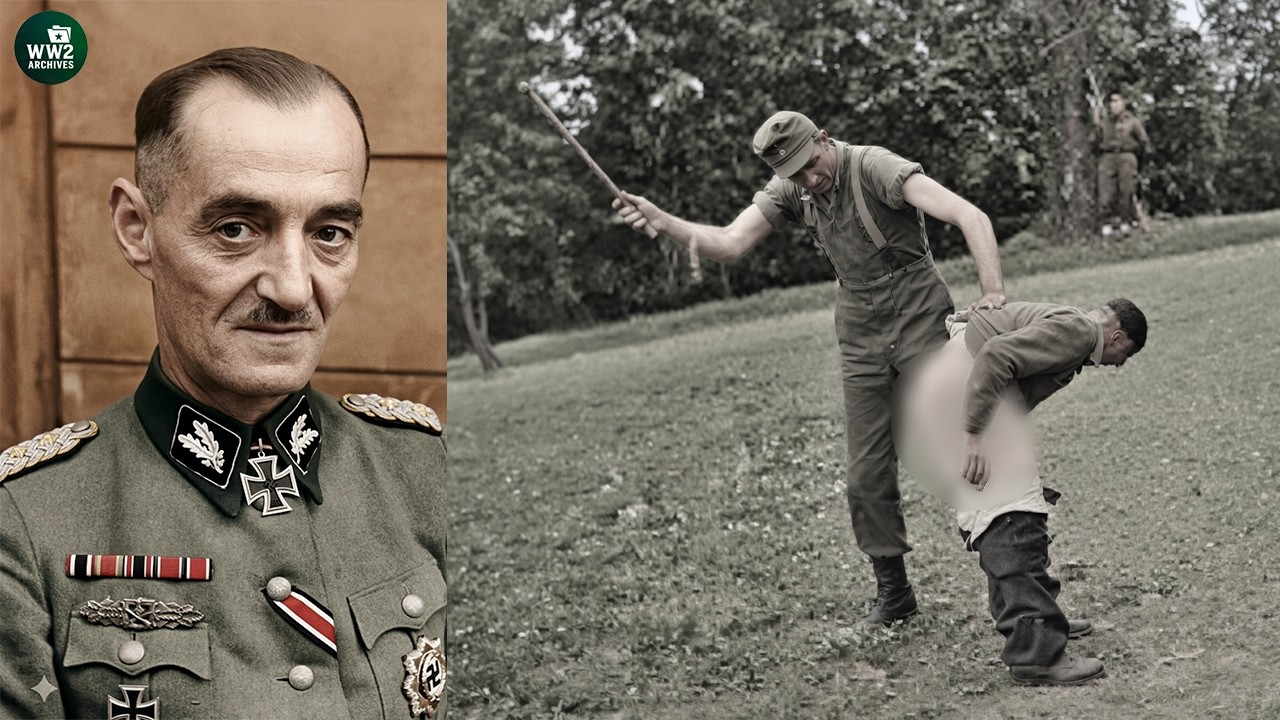
November 1960.
A quiet cemetery in southern Germany.
The morning air was cold, and the ground was hard from the winter frost.
A group of officials stood around a grave that had been forgotten for years.
There was no ceremony.
No honor.
No crowd.
Only a name.
Oskar Dirlewanger.
For fifteen years, the world had tried to understand how a man with a doctorate, a decorated military background, and an educated mind could become one of the most feared figures of Nazi Germany.
The name itself carried a special kind of horror.
Not because he was the highest-ranking Nazi.
He was not.
Not because he created the Nazi ideology.
He did not.
He was remembered because of what he chose to become.
A man who transformed cruelty into a method.
A man who turned prisoners, criminals, and fanatics into a unit built around terror.
A man whose own fellow Nazis sometimes considered him too brutal even for their regime.
He had been called many things after the war.
A criminal.
A sadist.
A warlord.
A murderer.
But perhaps the most disturbing description was the simplest:
A highly educated man who used his intelligence to destroy human beings.
How does that happen?
How does a man who studies political science, who earns academic recognition, who serves his country as a soldier, become someone capable of ordering massacres?
The answer was not found on the battlefield.
It was found in the choices made long before the killing began.
Oskar Dirlewanger was born in 1895 in Würzburg, Germany.
His early life did not reveal the future waiting for him.
Like many young Germans of his generation, his identity was shaped by World War I.
When the war began in 1914, he joined the German army.
He was young.
Ambitious.
Determined to prove himself.
The First World War transformed millions of men.
Some returned home believing war had been a tragedy that must never happen again.
Others returned believing Germany had been betrayed and needed revenge.
Dirlewanger belonged to the second group.
He carried the experience of war with him.
But instead of rejecting violence, he embraced it.
The battlefield became not a warning, but a foundation for his worldview.
After Germany’s defeat in 1918, the country entered a period of political chaos.
The monarchy collapsed.
The economy struggled.
Violence between political groups became common.
Many former soldiers felt lost.
They had lived inside a military structure where obedience and combat gave them identity.
Peace felt like uncertainty.
For men like Dirlewanger, extremist movements offered a replacement.
They offered purpose.
They offered enemies.
They offered a way to continue fighting.
He joined right-wing nationalist groups and eventually became involved with the Nazi movement.
But unlike many ordinary Nazi supporters, Dirlewanger was not simply attracted by propaganda.
He was attracted by power.
The Nazi system rewarded men who were willing to go further than others.
And Dirlewanger was willing.
 The contradiction of his life is one of the most disturbing parts.
He was not unintelligent.
He was not uneducated.
He studied at university.
He earned a doctorate in political science.
He understood philosophy, government, and society.
He was capable of intellectual discussion.
He could write.
He could analyze political ideas.
Yet education did not protect him from becoming a criminal.
Because knowledge without morality can become dangerous.
A person can understand complex theories while ignoring the simplest truth:
Other human beings matter.
Dirlewanger’s intelligence did not make him better.
It gave him more ability to organize his cruelty.
Before becoming infamous during World War II, Dirlewanger had already shown a disturbing pattern of behavior.
In 1934, he was convicted of crimes involving a teenage girl.
The conviction damaged his career.
For many people, such a crime would have ended any possibility of public service.
But Nazi Germany was not a normal society.
Connections mattered.
Political loyalty mattered.
And powerful figures within the Nazi movement helped protect him.
This moment revealed something important about the system he served.
The Nazis claimed to represent morality and order.
But when someone useful committed crimes, the system often looked away.
Ideology became more important than principles.
A man who should have been removed was instead given opportunities.
And those opportunities would have catastrophic consequences.
During World War II, Heinrich Himmler’s SS created special units to fight resistance movements in occupied territories.
These units operated in some of the most brutal environments of the war.
They were given extraordinary freedom.
The line between military action and criminal violence disappeared.
In 1940, Dirlewanger was given command of a special unit initially formed from convicted poachers.
The logic was simple and horrifying:
Men already accustomed to breaking laws could be used for dangerous missions.
The unit would later expand.
Criminals.
SS personnel.
Collaborators.
Men with violent backgrounds.
Many of those recruited were not disciplined soldiers.
They were men attracted to violence because the system rewarded it.
Dirlewanger became their leader.
And under his command, the unit became one of the most notorious formations of Nazi Germany.
The Dirlewanger Brigade was sent primarily to Belarus, where Nazi Germany faced growing partisan resistance.
But instead of focusing only on armed opponents, the unit became associated with brutal attacks against civilians.
Villages were destroyed.
Residents were murdered.
Entire communities were treated as enemies.
The purpose was not simply military.
It was terror.
The message was clear:
Anyone suspected of helping resistance fighters would suffer.
The problem was that suspicion itself became enough.
People did not need proof.
They did not need trials.
They only needed to be in the wrong place.
Under Dirlewanger, violence became a strategy.
Fear became a weapon.
Survivors of these massacres described scenes of unimaginable cruelty.
Families destroyed.
Villages burned.
Civilians killed.
The unit gained a reputation even among Nazi officials for extreme brutality.
This was one of the most disturbing aspects of Dirlewanger’s story.
He was not operating outside the Nazi system.
He was operating inside it.
The same government that created concentration camps and mass murder also sometimes recognized that certain individuals were too violent even by its standards.
That does not make the Nazi system less responsible.
It reveals how extreme Dirlewanger had become.
In 1944, the Dirlewanger Brigade was sent to Warsaw during the Warsaw Uprising.
The Polish resistance had risen against German occupation.
The Nazi response was devastating.
The uprising became one of the bloodiest urban battles of the war.
Dirlewanger’s unit participated in operations marked by extreme violence against civilians.
Hospitals.
Homes.
Neighborhoods.
Places where ordinary people lived.
The purpose was not simply defeating resistance.
It was punishment.
The destruction of Warsaw became a symbol of Nazi brutality.
And Dirlewanger became one of the names attached to that destruction.
 By the final months of the war, Germany was collapsing.
The armies that had once conquered Europe were retreating.
Cities were burning.
The Nazi leadership was desperate.
But men like Dirlewanger continued fighting.
Not because victory was realistic.
But because violence had become their identity.
For years, he had survived because the Nazi system protected men like him.
Now that system was disappearing.
The protection was gone.
The enemies he had created were approaching.
In 1945, Dirlewanger disappeared as Germany collapsed.
He attempted to avoid capture.
But eventually he was arrested by French-controlled forces and later held by Polish guards.
His death remains surrounded by uncertainty.
Historical records indicate that he died in captivity in June 1945 in Altshausen, Germany.
Accounts differ about the exact circumstances.
Some reports claim he was severely mistreated by guards who recognized him as a notorious Nazi criminal.
Others question specific details.
But one fact is clear:
Oskar Dirlewanger, a man who had spent years using violence against helpless people, ended his life as a prisoner with no power.
The man who had commanded terror became powerless.
The man who had decided the fate of others now depended on the decisions of others.
The question surrounding Dirlewanger is not only how he died.
It is how he became who he was.
Because the easiest explanation is that he was simply a monster.
But that explanation is incomplete.
Monsters are easy to separate from humanity.
They allow everyone else to believe:
“I could never become that.”
Dirlewanger’s story is more disturbing because he was human.
He made choices.
Repeated choices.
He chose violence.
He chose revenge.
He chose power.
He chose a system that rewarded his worst instincts.
And every choice moved him further away from the person he might have been.
His education did not save him.
His intelligence did not save him.
His military experience did not make him honorable.
Because intelligence without compassion can become a weapon.
Discipline without morality can create criminals.
Loyalty without conscience can create destruction.
Dirlewanger was not dangerous because he was ignorant.
He was dangerous because he understood enough to organize suffering.
After the war, survivors carried the memories of what his unit had done.
Many never saw justice.
Many families never recovered.
Many victims remained unnamed.
But history preserved the evidence.
Documents.
Testimonies.
Memories.
The crimes committed under Dirlewanger’s command became part of the larger record of Nazi atrocities.
A record that showed what happens when a society allows cruelty to become policy.
The most important lesson of Oskar Dirlewanger’s story is not about one man.
It is about the conditions that allowed someone like him to rise.
A society in crisis.
A government that rewarded brutality.
An organization that valued obedience over humanity.
People who looked away.
People who believed someone else would stop it.
Evil does not always begin with a battlefield.
Sometimes it begins with a choice made in ordinary life.
A choice to ignore wrongdoing.
A choice to accept hatred.
A choice to believe some people deserve less.
Oskar Dirlewanger spent his life searching for power.
He found it.
He used it.
And eventually, it disappeared.
The uniform vanished.
The authority vanished.
The protection vanished.
Only the consequences remained.
History does not remember him as the scholar he wanted to be.
It does not remember him as the soldier he claimed to be.
It remembers the villages destroyed.
The civilians murdered.
The prisoners abused.
The lives erased.
Because in the end, a person is not defined by their education, their position, or their reputation.
They are defined by what they do when they have power over people who cannot fight back.
And that is why the name Oskar Dirlewanger still carries a warning.
The most dangerous person is not always the one who hates loudly.
Sometimes it is the one who learns to justify cruelty so completely that he no longer recognizes it as cruelty at all.
But the story of Oskar Dirlewanger did not end when his body disappeared into an unmarked grave.
Because some people vanish after death.
Others become symbols.
Dirlewanger became a symbol of what happens when a system takes the darkest parts of human nature and turns them into a tool.
His name survived because the crimes connected to him were not the actions of one angry man acting alone.
They were the result of an environment where brutality was rewarded.
Where cruelty became a career.
Where violence became a language of power.
And perhaps the most disturbing question is not why Dirlewanger was cruel.
The more difficult question is why a society created a place where someone like him could rise.
The Nazi state did not discover Dirlewanger’s violence by accident.
It recognized it.
That was the important difference.
In another society, his criminal history might have ended his ambitions.
His conviction involving a minor should have destroyed his reputation.
His violent behavior should have made him dangerous to those around him.
But Nazi Germany viewed the world differently.
Loyalty to the regime mattered more than personal morality.
A person could be corrupt, violent, or criminal and still receive protection if he served the political goals of the state.
The system did not remove dangerous men.
It often empowered them.
And once such men gained authority, their personal cruelty could become government policy.
The men who served under Dirlewanger reflected the same disturbing pattern.
His unit was not built like a traditional military formation.
It became a collection of men from society’s margins.
Convicts.
Criminals.
Ideological extremists.
Men who had already crossed moral boundaries.
The Nazi leadership believed they could control these men and use them against enemies.
But something else happened.
The organization created a space where violence was not only tolerated.
It was encouraged.
The worst behavior became a form of loyalty.
The more ruthless a man appeared, the more valuable he seemed.
In such an environment, compassion was weakness.
Cruelty was strength.
And human life became meaningless.
This was the reality faced by civilians in Belarus.
The people living there were trapped between occupation, resistance movements, and Nazi retaliation.
Most had no power.
They were farmers.
Families.
Children.
Elderly people.
They were not deciding the outcome of the war.
They were simply trying to survive it.
But under Dirlewanger’s command, survival often depended on forces completely outside their control.
A rumor.
An accusation.
A suspicion.
A soldier’s decision.
That is one of the most terrifying aspects of occupation.
The loss of ordinary life.
A person no longer controls their own safety.
They live in a world where another person’s cruelty determines whether they wake up tomorrow.
During operations against partisans, Nazi forces often used collective punishment.
The logic was brutal:
If resistance fighters existed somewhere, the surrounding population could be punished.
This destroyed the distinction between combatants and civilians.
The entire community became a target.
Under this philosophy, killing innocent people was not considered a crime by the perpetrators.
It was described as security.
This transformation of language was essential.
Because people often need words to make violence acceptable.
A murder becomes an operation.
A massacre becomes a measure.
A victim becomes a threat.
The language changes first.
Then the actions follow.
The Warsaw Uprising revealed the full horror of Dirlewanger’s unit.
In August 1944, Polish resistance fighters rose against German occupation in Warsaw.
Their goal was to liberate their city before Soviet forces arrived.
Instead, the uprising was met with overwhelming German retaliation.
The Nazi leadership wanted to destroy the resistance.
But it also wanted to punish the population.
Dirlewanger’s men entered the city as part of this brutal response.
What followed became one of the darkest episodes of the war.
Civilians were murdered.
Buildings were destroyed.
Entire areas were devastated.
Hospitals and places filled with wounded people became scenes of violence.
The city itself became a battlefield.
But the victims were not only fighters.
Thousands of ordinary residents suffered.
People who had nowhere to escape.
People who had no role in military decisions.
People whose only connection to the uprising was that they lived there.
Even within the Nazi command structure, some officers viewed Dirlewanger’s unit with disgust.
This reveals something important.
Not because those officers were morally better.
Many served the same criminal regime.
Many were responsible for terrible actions themselves.
But even among perpetrators, there were levels of brutality that shocked others.
Dirlewanger had crossed boundaries even within a system built around violence.
He represented what happened when there were almost no limits left.
As the war approached its end, the men who had terrorized others began facing the collapse of their own world.
The Allied armies advanced.
Germany’s cities were destroyed.
The Nazi government was falling apart.
The same men who had once believed they were untouchable began searching for ways to survive.
Documents disappeared.
Uniforms were removed.
Identities were changed.
Many perpetrators understood something important:
The world they had helped create would now judge them.
Dirlewanger attempted to escape.
Like many Nazi criminals, he hoped that the chaos of defeat would protect him.
But the war was ending.
The networks that had protected him were breaking.
The authority that had allowed him to command others was gone.
Eventually, he was captured.
And then came the ultimate reversal.
A man who had spent years controlling the fate of prisoners became a prisoner himself.
A man who had ordered violence now depended on the mercy of people who knew what he had done.
The exact circumstances of Dirlewanger’s final days remain debated.
What is known is that he died in captivity in 1945.
Accounts of his death vary.
Some describe severe mistreatment by Polish guards who recognized him.
Others question details that cannot be fully verified.
But perhaps the most important part of the story is not the exact way he died.
It is the fact that the man who had spent years creating suffering finally entered a world where he had no control.
The power was gone.
The fear he created belonged to someone else.
The authority had disappeared.
After the war, survivors continued telling their stories.
This was not easy.
Many survivors carried trauma that lasted decades.
Some lost entire families.
Some returned to homes that no longer existed.
Some struggled with a world that had changed beyond recognition.
But they spoke.
Because silence would have allowed perpetrators to win another victory.
The victims had already lost years of their lives.
They refused to lose their memories as well.
History often focuses on famous leaders.
The people who created policies.
The people who gave speeches.
The people whose names appeared in documents.
But systems of mass violence depend on more than leaders.
They depend on thousands of people who carry out decisions.
People who guard.
People who transport.
People who enforce.
People who participate.
That is why the story of Dirlewanger matters.
Because he was not the architect of Nazi Germany.
He was one of the people who made its crimes possible.
The most uncomfortable truth about him is that he was not always the man history remembers.
There was a time when he was simply a child.
A student.
A soldier.
A young man with choices ahead of him.
The future was not predetermined.
At many points, he could have chosen another path.
But he repeatedly chose violence.
He chose organizations that rewarded violence.
He chose a worldview that justified violence.
And eventually, violence became the center of his identity.
People sometimes ask whether someone like Dirlewanger was born evil.
History rarely gives such simple answers.
Human beings are not born as completed versions of themselves.
They become.
Through decisions.
Through influences.
Through environments.
Through repeated choices.
Dirlewanger’s story is not frightening because he was different from humanity.
It is frightening because he was part of humanity.
He shows what can happen when intelligence, ambition, and opportunity are combined with hatred and the absence of moral limits.
The grave in southern Germany contained only remains.
But the real legacy of Oskar Dirlewanger was never buried there.
It remained in the testimony of survivors.
In the records of massacres.
In the names of villages destroyed.
In the memory of people who never returned home.
The victims are the reason history continues to remember.
Not the killer.
Not the uniform.
Not the power.
The people who suffered.
A man can spend his life trying to become powerful.
He can collect titles.
He can gain authority.
He can command others.
But eventually, every person is reduced to the truth of their actions.
Not what they claimed.
Not what they intended others to believe.
Not what uniform they wore.
Only what they did.
Oskar Dirlewanger wanted to be remembered as a soldier.
History remembered him differently.
It remembered the villages burned.
The civilians murdered.
The prisoners abused.
The lives destroyed.
And perhaps that is the final lesson of his story:
The greatest danger is not only the person who commits cruelty.
It is the system that convinces ordinary people that cruelty is acceptable.
Because once a society teaches people to stop seeing others as human, the distance between civilization and barbarity becomes frighteningly small.
And history has shown, again and again, that the first warning sign is always the same:
Someone decides that another person’s suffering no longer matters.


