The SEAL Admiral Asked the Old Veteran His Call Sign — When He Said “Redeemer,” All Went Silent
CHAPTER ONE
THE BOWL
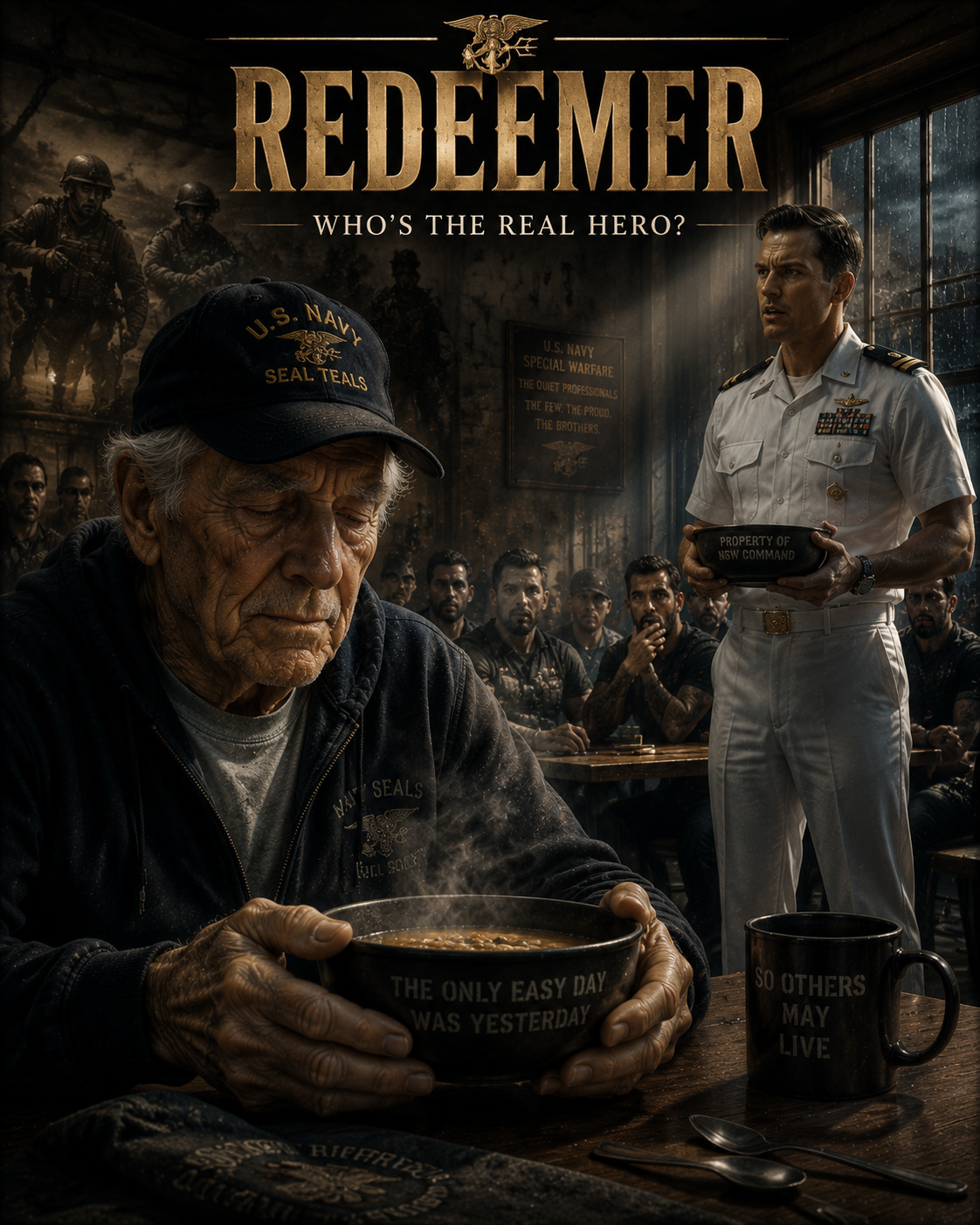
The soup stopped trembling before Thomas Garrett’s hand did.
It was chicken noodle, thin and over-salted, served in a white ceramic bowl stamped with the blue anchor of Naval Special Warfare Command. Steam curled past his face as he guided the spoon toward his mouth, careful not to spill any on the faded gray windbreaker zipped to his throat.
Outside, rain swept sideways across Coronado.
It rattled against the tall reinforced windows of the dining facility and turned the training grounds beyond them into gray streaks of asphalt, concrete, and distant ocean. Every few seconds, a helicopter passed somewhere behind the cloud cover, its rotors beating through the walls like a slow, mechanical pulse.
Inside the galley, thirty active-duty SEALs ate beneath fluorescent lights.
They were men accustomed to measuring danger before it spoke. Their eyes registered everything: the trembling hand, the scuffed brown shoes, the silver hair cut without military precision, the hearing aid tucked behind Thomas’s left ear.
Most dismissed him within seconds.
A lost retiree.
Someone’s father.
Maybe someone’s grandfather who had wandered through the wrong door.
Thomas lifted another spoonful.
At the entrance, Culinary Specialist Second Class Lila Moreno glanced for the third time at the security terminal beside her station.
The old man’s identification card had produced an authorization code she had never seen before.
SAP-JWICS-1.
The terminal had paused for almost six seconds before displaying a single line:
ACCESS VALID.
NO ESCORT REQUIRED.
DO NOT DELAY.
Moreno had followed the instruction.
Now she wondered whether she had just ended her career.
The dining facility doors opened hard enough to strike the rubber stops.
Rear Admiral Marcus Webb entered with rain darkening the shoulders of his uniform.
At forty-one, Webb was the youngest flag officer to command Naval Special Warfare in more than a decade. He was tall without appearing imposing, lean without seeming fragile, and carried himself with the rigid economy of a man who considered wasted movement a form of negligence.
A pale scar crossed the underside of his jaw. It disappeared beneath his collar and reappeared near his left ear.
The room changed when he entered.
Forks slowed.
Backs straightened.
Conversations dropped half a register.
Webb had spent the morning reviewing the aftermath of a security breach at a joint operations center overseas. An unauthorized maintenance contractor had photographed a deployment board with his phone. The image had existed for only nineteen minutes before it was deleted.
Nineteen minutes was enough to bury men.
Webb knew that because six years earlier, a leaked route map had sent his troop into an ambush outside a village that officially did not exist. He had brought home five men in bags and one in pieces small enough to fit inside an ammunition can.
Since then, he had stopped believing in harmless mistakes.
He handed his cover to an aide and moved toward the coffee station.
Then he saw Thomas.
Webb’s gaze remained on the old man for two seconds.
That was longer than anyone else had looked.
He noticed the absence of an escort. The civilian clothing. The dependent identification card resting beside the soup bowl.
His jaw tightened.
“Master Chief.”
Command Master Chief Elijah Ruiz looked up from a table near the windows.
“Yes, Admiral?”
Webb nodded toward Thomas.
Ruiz followed his gaze.
“I don’t know, sir.”
“That wasn’t my question.”
Ruiz rose immediately.
Webb was already walking.
The room tracked him without turning its head.
Thomas heard the boots approaching but did not look up. He broke a cracker over his soup and watched the pieces soften in the broth.
Webb stopped beside the table.
“Sir.”
Thomas stirred the soup once.
Webb waited.
When Thomas finally raised his eyes, Webb saw that they were not cloudy or confused. They were a clear, hard blue, made brighter by the deep grooves surrounding them.
“This dining facility is restricted,” Webb said. “Operators and authorized personnel only.”
Thomas looked around the room as though seeing it for the first time.
“I noticed the haircuts.”
A few men lowered their eyes to hide smiles.
Webb did not.
“Are you authorized to be here?”
“I’m having lunch.”
“That wasn’t what I asked.”
“No,” Thomas said. “It wasn’t.”
The air around the table thinned.
Webb placed two fingers on the identification card.
“May I?”
Thomas released the spoon.
“You already have.”
Webb picked up the card.
The front identified Thomas Garrett as a military dependent. The photograph was recent. The expiration date was valid. Nothing about it explained how he had entered a facility protected by armed security and biometric access.
On the rear of the card, beneath several ordinary classification marks, appeared the code:
SAP-JWICS-1.
Webb turned to Moreno.
“Did you scan this?”
“Yes, sir.”
“And you let him through?”
“The terminal authorized him.”
“Under whose authority?”
“It didn’t display a name.”
Webb’s attention returned to Thomas.
“This is a dependent card.”
“That’s what they gave me.”
“This code does not grant access to this facility.”
Thomas picked up his spoon again.
“The door disagreed.”
A chair scraped somewhere behind Webb.
No one spoke.
Webb lowered his voice.
“Mr. Garrett, stand up and come with me.”
Thomas took a sip of soup.
Webb’s nostrils flared.
He had been awake for thirty-two hours. He had spent the night speaking to the widow of a senior chief whose helicopter had gone into the Arabian Sea. He had just learned that investigators believed the crew had ignored a maintenance warning because the mission schedule was considered more important.
Everywhere Webb looked, he saw rules treated as suggestions.
He had built his command around the belief that discipline was the thin wall separating elite warriors from armed chaos.
Now an old man in a windbreaker was sitting inside that wall, calmly pretending Webb had no authority to question him.
“I said stand up.”
Thomas placed the spoon down.
His hands trembled against the table.
Several of the younger SEALs saw the tremor and looked away. Not out of respect. Out of discomfort.
Thomas noticed.
His mouth tightened almost imperceptibly.
“I heard you,” he said.
“Then comply.”
“I’d prefer to finish my lunch.”
Webb bent closer.
“This is not a request.”
Thomas looked at the bowl.
“So much in life isn’t.”
Webb’s patience broke.
He seized the bowl and pulled it away.
Broth sloshed over the rim, spilling across the tabletop and soaking the sleeve of Thomas’s windbreaker.
The ceramic struck the table with a sharp crack.
Thirty operators stopped moving.
Webb stared down at Thomas.
“I said now. Who the hell do you think you are?”
Thomas looked at the soup dripping from his sleeve.
For the first time, something shifted behind his eyes.
Not fear.
Not anger.
A door opening onto a place no one else in the room could see.
When he spoke, his voice was quiet enough to make everyone lean toward it.
“They used to call me Redeemer.”
The spoon slipped from Master Chief Ruiz’s hand.
It struck his tray and spun in a circle.
Ruiz stared at Thomas’s face.
The color drained from his own.
“No,” he whispered.
Webb turned toward him.
Ruiz stood so quickly that his chair fell backward.
“Sir,” he said, but his eyes never left the old man. “Step away from him.”
Webb’s expression hardened.
“What did you say?”
“Please, Admiral.”
Ruiz’s voice cracked on the final word.
“That’s Thomas Garrett.”
Webb waited for the explanation.
Ruiz swallowed.
“MACV-SOG. Command and Control North.”
A murmur moved through the older operators.
One senior chief went completely still.
Ruiz looked at the wet sleeve, the displaced soup bowl and Webb’s hand resting beside it.
Then he said the words that changed the temperature of the room.
“Sir, you just put your hands on Redeemer.”
The secured doors behind them unlocked.
Four armed security officers entered first.
Then came a four-star admiral wearing the insignia of the Chief of Naval Operations.
Admiral William Carson surveyed the room once.
His gaze stopped on Thomas’s wet sleeve.
“Marcus,” he said, “put the bowl down.”
Webb’s fingers slowly released the ceramic.
Carson stepped closer.
“He has authorization above everyone in this building.”
Webb glanced at the dependent card.
Carson continued.
“Three Navy Crosses. The Medal of Honor. Sixteen men brought home from missions where extraction had been declared impossible.”
No one moved.
“The North Vietnamese placed a fifty-thousand-dollar bounty on his head,” Carson said. “That was fifty thousand dollars in 1971.”
His eyes hardened.
“They called him Redeemer because he went back for the living, the wounded and the fallen. He never left a man where the enemy could reach him.”
Webb looked at Thomas again.
The old man did not appear taller.
His hands had not stopped trembling.
Water and soup continued dripping from his sleeve onto the floor.
Carson moved close enough that only the nearest tables heard his next words.
“And one of the men he brought home, Marcus…”
The four-star admiral paused.
“…was your father.”
CHAPTER TWO
THE MEN IN THE PHOTOGRAPH
Marcus Webb had no memory of his father speaking Thomas Garrett’s name.
Captain Daniel Webb had been a quiet man who polished his boots on Sunday evenings and never attended fireworks displays. He kept the curtains closed during thunderstorms. When Marcus was nine, he found his father asleep beneath the kitchen table with a carving knife clenched in one fist.
Daniel had awakened, stared at his son and said only, “Bad dream.”
Nothing more.
He died from pancreatic cancer when Marcus was twenty-three.
At the funeral, men from three branches of the military stood along the back wall of the chapel. Marcus recognized none of them. They left before the family received condolences.
He had spent his entire career trying to become the kind of officer his father might have respected.
Now a stranger was telling him that the trembling old man whose lunch he had taken had once carried Daniel Webb out of hell.
Webb’s mouth had gone dry.
“My office,” Carson said.
Thomas reached for the bowl.
Carson watched him.
“Tom.”
“I paid for it.”
“I’ll buy you another.”
“This one is already made.”
Moreno hurried forward with a towel.
Thomas accepted it with a small nod.
“Thank you, Petty Officer.”
“I’m sorry, sir.”
“You didn’t spill it.”
Her eyes flicked toward Webb.
Thomas dabbed at his sleeve.
“That was an accident too,” he said.
Webb heard the mercy in the sentence.
It felt worse than accusation.
He turned toward the operators.
Everyone in the galley was watching him.
Some faces remained unreadable. Others showed confusion, embarrassment or the hard satisfaction enlisted men sometimes felt when rank collided with consequence.
Webb could have ordered them back to their meals.
He did not.
He followed Carson from the dining facility.
Thomas walked behind them at a measured pace, refusing assistance. Ruiz carried the soup bowl.
They entered a secure conference room overlooking the rain-darkened training beach. Carson shut the door. The armed security detail remained outside.
Thomas lowered himself into a chair.
Ruiz placed the bowl before him.
“Fresh spoon, sir?”
“This one survived.”
Ruiz stood at attention.
Thomas looked up.
“You’ll make me nervous.”
Ruiz gave a breathless laugh and sat.
Webb remained standing.
Carson removed his cap and placed it on the table.
“Sit down, Marcus.”
Webb complied.
No one spoke for several seconds.
The rain worked against the windows.
Thomas resumed eating.
Webb looked at his shaking hand.
“Parkinson’s?”
Thomas shook his head.
“Shrapnel near the cervical spine. Doctors took out what they could. The rest reminds me when the weather changes.”
Webb glanced toward the storm.
“Does it hurt?”
“Everything hurts at eighty-two.”
Thomas tasted the soup.
“This hurts more than most.”
Ruiz almost smiled.
Webb did not.
“Why were you carrying a dependent identification card?”
“My wife’s benefits.”
“You have your own credentials.”
“Those tend to attract salutes.”
“You entered a restricted facility.”
“The card was authorized.”
“The code isn’t in our access manuals.”
“It wouldn’t be special access if it were.”
Webb looked toward Carson.
The CNO opened a leather folder and removed a single sheet bearing a red border.
“SAP-JWICS-1 is a legacy compartment designation,” Carson said. “Only seven active credentials carry it. The holder may enter any Naval Special Warfare facility without prior notification, escort or command approval.”
“Why?”
“Because the program was created for men whose existence could not be acknowledged by the commands they served.”
“That program ended decades ago.”
“The missions ended. The authorization didn’t.”
Webb’s gaze returned to Thomas.
“So you could walk into any secure space in my command?”
“I could.”
“Armory?”
“Yes.”
“Operations center?”
“Yes.”
“SCIF?”
“If I had reason.”
“And no one would notify me?”
Thomas wiped his mouth.
“You were notified. You were standing over my soup.”
Webb’s jaw flexed.
Carson opened the folder wider.
“Thomas did not come here to test your security.”
“Then why is he here?”
Thomas stared through the window toward the beach.
Several trainees were dragging an inflatable boat through the surf. From a distance they resembled dark insects struggling against a white, violent edge.
“The government found a body,” Thomas said.
Webb waited.
“In Laos,” Carson added. “Three months ago.”
Thomas’s spoon stopped halfway to his mouth.
“A joint recovery team located a collapsed limestone chamber near the old Ho Chi Minh Trail,” Carson continued. “Inside, they discovered human remains, fragments of an American radio, two weapons and a waterproof message cylinder.”
“American remains?” Webb asked.
“One set may be.”
“May be?”
“The bones were mixed.”
Thomas placed the spoon down.
“There were two men in that chamber,” he said. “One wore our uniform. The other wore no uniform at all.”
Carson slid a photograph across the table.
The image had been taken in 1971.
Seven men stood beneath jungle foliage so dense that daylight appeared green around them. Their clothing was mismatched: tiger-stripe fatigues, web gear, scarves, cut-down packs. Several carried weapons without visible serial markings.
Thomas stood in the center, young and narrow-faced, with a bandage above one eye.
Beside him was a smaller man with dark hair, high cheekbones and a calm expression. He held a captured rifle across his chest. Around one wrist was a copper bracelet.
Daniel Webb stood at the far right.
He looked barely twenty.
Webb touched the photograph.
His father had never shown it to him.
“Who is the man beside you?” Webb asked.
Thomas looked at the copper bracelet.
“Nguyen Duc Bao.”
“South Vietnamese?”
“Nùng. Scout, interpreter, tracker, medic when we needed one. He could smell a cooking fire from two ridges away and tell you how many people had eaten.”
“Was he part of your unit?”
“He was part of us.”
Carson removed a small evidence bag from the folder.
Inside lay a tarnished copper bracelet.
Thomas’s trembling hand closed around the edge of the table.
“This was found with the remains,” Carson said.
Thomas did not touch it.
Webb studied the photograph again.
“What happened to him?”
The old man looked toward Daniel Webb’s twenty-year-old face.
“We were told he betrayed us.”
The rain struck the glass harder.
“Did he?” Webb asked.
Thomas’s voice became very soft.
“No.”
Carson slid another document across the table.
A fifty-five-year-old mission report.
The final page bore Thomas Garrett’s signature.
Webb read the concluding line.
INDIGENOUS ASSET NGUYEN DUC BAO PRESUMED HOSTILE.
TERMINATED DURING EXFILTRATION.
Webb looked up.
“You signed this.”
Thomas nodded.
“Then either the report is true,” Webb said, “or you helped bury a lie.”
Thomas met his eyes.
“Yes.”
CHAPTER THREE
NIGHT LANTERN
The mission had been called Night Lantern.
The name appeared nowhere in official histories.
In November 1971, a North Vietnamese logistics commander had moved a ledger through a network of caves west of Khe Sanh. The ledger contained troop movements, supply routes and the identities of double agents operating inside South Vietnamese command.
Thomas Garrett’s team was ordered across the border to retrieve it.
Seven men went in.
Thomas.
Daniel Webb.
Nguyen Duc Bao.
Medic Calvin Shaw.
Sergeant Leo Morrow.
Radio operator Frank Cates.
Explosives specialist Amos Bell.
They were told the mission would last forty-eight hours.
It lasted eleven days.
Thomas spoke without theatrical pauses. He did not describe the operation as though telling a war story. He recited it like a man reading the names on gravestones.
The team found the courier on the second night.
He was already dead.
Someone had reached him first and removed the ledger, leaving behind only a strip of microfilm concealed inside the heel of his sandal.
Bao discovered it.
The film contained half the intelligence they needed and one detail they did not understand: the operation had been compromised before the team crossed the border.
Enemy units were waiting along every planned extraction route.
“What does this have to do with my father?” Webb asked.
Thomas watched rainwater run down the windows.
“Daniel was hit on the fourth day.”
“Where?”
“Upper thigh. Round broke the femur and opened the artery.”
Webb looked at the scar on Thomas’s neck.
“And you carried him?”
“Not alone.”
“Bao?”
Thomas nodded.
“We rotated. Morrow and I took his shoulders. Bao took his legs. When the helicopters couldn’t reach us, we moved north.”
“Why north?”
“Because the enemy expected us to run south.”
For the first time, Webb understood why Thomas’s eyes appeared so clear.
The old man was not remembering the jungle.
Some part of him had never left it.
Thomas saw the wet leaves pressed against his face. Leeches inside his boots. Daniel Webb biting down on a rifle sling while Calvin Shaw pushed bone back beneath torn muscle.
He heard the pursuit behind them.
Whistles in the dark.
Dogs released along the river.
Propaganda speakers promising money to anyone who brought back the American team leader’s head.
Redeemer, they called him later.
But not yet.
On the seventh day, they reached a limestone ravine where an extraction helicopter could hover for less than a minute.
The team formed a perimeter.
Thomas loaded Daniel Webb first.
Then Frank Cates.
Then Calvin Shaw, who had taken shrapnel through his abdomen.
The helicopter lifted under fire.
It was supposed to return.
It never did.
A round had torn through the fuel system. The crew barely reached friendly territory.
Thomas, Bao, Morrow and Bell remained behind.
The enemy closed the ravine from both ends.
“We moved into the caves,” Thomas said.
“And the remains?” Webb asked.
“Bell had been hit. He died before midnight.”
Ruiz lowered his eyes.
Thomas continued.
“Bao found another passage leading west. He said he could draw the enemy away while Morrow and I carried Bell.”
“You took a dead man with you?” Webb asked.
“He had a mother in Iowa.”
Webb had no answer.
“We refused,” Thomas said. “Bao argued. Morrow threatened to knock him unconscious. Then Bao showed us the microfilm.”
“What about it?”
“He had made a copy.”
Carson slid two translucent strips onto the table in protective sleeves.
“One set was recovered from the chamber,” he said. “The second was delivered to American intelligence in 1971.”
Webb examined them.
“Bao stayed behind with the original?”
Thomas nodded.
“He told us someone inside our command had sold the mission. If we all traveled together, the film might be lost. He took the original and the radio. He planned to transmit from a ridge north of the caves.”
“Did he?”
“We heard him.”
Thomas’s fingers tightened around the table.
“For six minutes, he transmitted names and coordinates while the enemy triangulated his position.”
“What happened after six minutes?”
“The transmission ended.”
The fluorescent lights hummed above them.
Thomas looked down at the old mission report.
“Three days later, Morrow and I reached a pickup point carrying Amos Bell between us. I had a round in my shoulder and fragments near my spine. Morrow had malaria. We were told Bao had been identified as the source of the compromise.”
“By whom?” Webb asked.
“Our intelligence liaison, Commander Hollis Reed.”
Carson placed a photograph of a decorated naval officer beside the report.
Reed had died in 1994 and been buried at Arlington.
Thomas’s mouth hardened.
“He said Bao had sold our routes, then staged the radio transmission to protect himself.”
“Did you believe him?”
“No.”
“Then why sign the report?”
Thomas looked directly at Webb.
“Because Reed had your father.”
Webb stopped breathing for a moment.
“What does that mean?”
“Daniel was still in surgery when we returned. Reed told me the helicopter had crossed into restricted airspace to rescue us. He said the crew, the wounded men and the families could all be destroyed if the details became public.”
“Destroyed how?”
“Courts-martial. Loss of benefits. Charges for unauthorized operations. Your father needed eighteen months of treatment. Reed made it clear the Navy could classify his wounds as the result of misconduct.”
Webb pushed back from the table.
“My father received a Silver Star.”
“Years later.”
“He retired as a captain.”
“Because some of us kept our mouths shut.”
The words landed without anger.
That made them heavier.
Webb looked at Carson.
“Did my father know?”
Carson did not answer.
Thomas did.
“Yes.”
Webb turned toward him.
“He let Bao take the blame?”
“He was twenty years old, drugged with morphine and told that speaking would send the rest of us to prison.”
“He could have spoken later.”
“So could I.”
The two men stared at each other.
For the first time since the dining facility, Webb’s anger found somewhere to stand.
“You accepted the Medal of Honor.”
Thomas’s face changed.
Barely.
But Ruiz saw it.
“The citation says you carried three men through enemy fire,” Webb continued. “It says you recovered critical intelligence. It says you held the ravine alone.”
“The citation says many things.”
“Were they true?”
“Parts of them.”
“Did Bao do what they credited to you?”
Thomas looked at the copper bracelet in the evidence bag.
“More than anyone was allowed to know.”
Webb stood.
“So the legend is a lie.”
Carson’s voice sharpened.
“Marcus.”
“No, sir. Everyone in that galley went silent because of a story. Three Navy Crosses. Medal of Honor. Sixteen rescues. The fifty-thousand-dollar bounty.”
“The bounty was real,” Ruiz said.
Webb ignored him.
“He entered my facility under secret authorization, refused a lawful order and allowed my men to believe I had attacked some untouchable war god.”
Thomas remained seated.
“I told you my call sign. Other men built the god.”
“You benefited from it.”
“Yes.”
The answer stopped Webb.
Thomas pushed the soup bowl away.
“I stood beneath chandeliers while presidents described things Bao had done. I let his family believe he had betrayed us. I told myself I was protecting the survivors. Then I told myself the records would be corrected when the war ended.”
His trembling hand rested beside the evidence bag.
“The war ended.”
He looked at the old photograph.
“The lie didn’t.”
Carson removed an envelope from the folder.
It was yellowed, sealed and addressed in block letters.
MARCUS DANIEL WEBB
TO BE DELIVERED WHEN NIGHT LANTERN IS DECLASSIFIED.
Webb recognized his father’s handwriting.
His knees weakened.
“When did he write this?”
“Two weeks before he died,” Thomas said.
Webb reached for the envelope.
Then stopped.
“You had this?”
“Your father sent it to me.”
“In 2008?”
“Yes.”
“You kept it for eighteen years?”
“He made me promise.”
“To do what?”
Thomas looked at him.
“To give it to you only after you learned what kind of man he really was.”
CHAPTER FOUR
THE LETTER
Webb opened the envelope with his thumbnail.
The paper inside had been folded twice.
His father’s handwriting began firm and deteriorated down the page as illness weakened his hand.
Marcus,
There are two kinds of silence.
The first protects people.
The second protects the person remaining silent.
For most of my life, I pretended mine was the first kind.
Webb read the sentence again.
No one interrupted him.
Daniel wrote about the ravine.
About Bao carrying him through waist-deep water while tracer rounds cut the darkness above them. About Thomas refusing morphine because there was not enough for the wounded. About Amos Bell singing “Blue Moon” after he had lost too much blood to know where he was.
Daniel admitted signing statements that identified Bao as a traitor.
He admitted accepting medals.
He admitted allowing his son to believe courage meant never being afraid.
I was afraid every day after that mission, Marcus.
Not of dying.
Of being seen clearly.
You spent your childhood trying to earn my approval, and I let you. That may be the most cowardly thing I ever did.
Webb lowered the page.
His vision had blurred.
He blinked until the room sharpened again.
Thomas looked away, granting him a privacy impossible inside a glass-walled conference room.
Webb continued.
The final paragraph was shorter.
Garrett saved my life, but Bao saved the part of me that deserved saving.
If you ever meet Thomas, do not salute the legend.
Ask him about the man we erased.
Then help him bring Bao home.
Webb folded the letter along its original creases.
For several seconds, he could hear only the rain.
“What do you need from me?” he asked.
Thomas looked toward Carson.
The CNO answered.
“The recovered remains arrive at North Island tomorrow morning. DNA testing indicates the non-American remains belong to Bao. The other set belongs to Amos Bell.”
Webb glanced at Thomas.
“You carried Bell out.”
“We carried what we thought was Bell.”
“What does that mean?”
“The body we recovered in 1971 had no head or hands. Reed identified it through equipment fragments.”
Carson’s expression darkened.
“We now believe Reed substituted another set of remains to close the file.”
“Whose?”
“We don’t know.”
The conference room seemed colder.
Webb looked at the evidence spread across the table.
A compromised mission.
A falsely accused ally.
An American operator abandoned in a cave.
A decorated officer buried at Arlington after engineering the cover-up.
“What was Reed protecting?” Webb asked.
“The microfilm names,” Thomas said.
Carson handed Webb a modern intelligence summary.
Several names belonged to South Vietnamese officers who had died during the war.
One belonged to Commander Hollis Reed.
Another belonged to an American senator’s father.
A third was blacked out even in the declassified copy.
Webb touched the redaction.
“Who is this?”
Carson did not answer immediately.
“A living former intelligence official.”
“Still protected?”
“Until six hours ago.”
Thomas reached inside his windbreaker and removed a small metal cylinder.
It was scratched, dented and dark with age.
Ruiz leaned forward.
“The message container?”
“The recovery team found it sealed beneath Bao’s remains,” Thomas said. “The technicians opened it yesterday.”
“What was inside?” Webb asked.
“A second list.”
Thomas rolled the cylinder between his palms.
“Reed had not compromised Night Lantern alone. Someone at Naval Special Warfare signed the extraction routes and delivered them to him.”
Webb felt the shape of the trap before Thomas closed it.
“You came here because that person served in this command.”
Thomas nodded.
“Who?”
“He died four years ago.”
“Then why does it matter now?”
“Because the program he built still exists.”
Webb’s eyes narrowed.
Carson placed a current organizational chart on the table.
A special-access logistics unit operated through multiple shell contractors. It supplied equipment, communications systems and transportation to clandestine teams.
One of those contractors had been linked to the security breach Webb had reviewed that morning.
The maintenance worker with the phone had not photographed the deployment board by accident.
Webb stared at the chart.
“My men are exposed.”
“We don’t know how many,” Carson said.
“Why wasn’t I briefed?”
“Because we needed to know whether your command was compromised.”
“And bringing Garrett through the front door was your test?”
Thomas shook his head.
“I asked for soup.”
“Stop saying that.”
“I was hungry.”
Despite everything, Ruiz coughed into his fist to hide a laugh.
Webb stood and moved toward the windows.
The trainees outside had disappeared from the beach. Only their footprints remained, filling slowly with rain.
He thought about the dining facility.
Thirty SEALs.
Moreno at the security station.
The unknown contractor network.
Anyone in that room could have sent a message after hearing the code on Thomas’s card.
“Who knew he was coming?” Webb asked.
“Seven people,” Carson said.
“Now thirty-seven know.”
“More,” Ruiz said quietly.
They looked at him.
The master chief removed his phone.
No signal appeared on the screen.
“Cell service went down three minutes ago.”
Webb moved to the secure wall terminal.
The network indicator flashed amber.
A base-wide communications failure.
Not weather.
Not coincidence.
Someone had reacted.
Webb turned toward the door.
“Lock down the command.”
Carson shook his head.
“No general alarm. Whoever is listening will disappear.”
“My operators may be targets.”
“Then choose people you trust.”
Webb looked through the glass at the security officers outside.
Trust had always seemed simple when measured by rank, clearance and procedure.
Now the safest man in the building was an eighty-two-year-old veteran carrying credentials Webb had never seen.
“What does Bao’s second list contain?” Webb asked.
Thomas met his gaze.
“The name of the officer currently selling your teams’ deployment routes.”
CHAPTER FIVE
THE EMPTY CHAIR
The traitor was not one of Webb’s SEALs.
That would have been easier.
Lieutenant Commander Naomi Price served as deputy director of logistical security. Thirty-six years old. Naval Academy graduate. Two deployments. No disciplinary history. A mother with advanced multiple sclerosis and medical bills that exceeded what military insurance covered.
She had not begun selling information for money.
She began by approving inflated maintenance contracts in exchange for private nursing care.
Then the contractor showed her photographs of the forged invoices.
After that, the requests changed.
Equipment serial numbers.
Flight windows.
Training schedules.
Deployment routes.
Each compromise purchased her silence about the last.
“She believes they’re using the information for corporate bidding,” Webb said after reviewing her file.
Carson’s expression remained hard.
“People often believe whatever permits them to sleep.”
They located Price in the communications annex attempting to destroy a classified storage device.
Webb entered alone.
He found her standing beside an industrial shredder with tears running down her face. Her service pistol rested on the desk, untouched.
“Step away from the machine,” he said.
Price looked at him.
“They said no one would get hurt.”
“Five men died in an ambush linked to one of these routes.”
“I didn’t know.”
“You stopped asking.”
Her face folded.
For a moment, she was not an enemy officer or a security threat. She was an exhausted daughter who had made one frightened decision and spent three years feeding lives into it.
Webb understood the first decision.
That frightened him more than hating her would have.
He removed the pistol from the desk.
Price offered no resistance.
As security officers escorted her away, she stopped beside Thomas in the corridor.
The old man had insisted on coming.
Price stared at him.
“My grandfather knew you.”
Thomas waited.
“Colonel Steven Price.”
Recognition passed across Thomas’s face.
“He flew extraction helicopters.”
“He said you were the bravest man he ever met.”
Thomas looked through the glass as rain ran down the building.
“Your grandfather once left two wounded men on a landing zone because his aircraft was on fire.”
Price flinched.
“He never told us that.”
“He came back in another helicopter nine minutes later.”
Thomas turned toward her.
“Courage isn’t what people say after the story is cleaned up.”
The security officers moved her onward.
Webb watched until the elevator doors closed.
“You could have condemned her,” he said.
“She’s already condemned.”
Thomas’s voice carried no softness.
“Mercy and innocence are not the same thing.”
By dawn, investigators had secured the contractor network, frozen accounts and warned teams whose routes might have been compromised.
The crisis ended without gunfire.
That did not make it bloodless.
Careers collapsed.
Families received phone calls.
Men preparing to deploy learned that someone they trusted had converted their movements into currency.
At 0610, the rain stopped.
A military transport aircraft landed at North Island beneath a pale strip of sunrise.
Two flag-draped transfer cases were carried down the ramp.
One bore the flag of the United States.
The second bore the yellow flag of the former Republic of Vietnam.
Thomas stood at attention.
His hand shook beside his brow as he saluted.
Marcus Webb stood to his right.
Behind them waited thirty operators from the dining facility, Culinary Specialist Moreno, Master Chief Ruiz, Admiral Carson and representatives from the recovery team.
No press had been invited.
No cameras were permitted.
The first case contained Amos Bell.
The second contained Nguyen Duc Bao.
When the honor guard passed, Thomas whispered something Webb could not hear.
“What did you say?” Webb asked.
Thomas lowered his hand.
“I told him the helicopter came back.”
The remains were transferred to a chapel on base.
Inside, two rows of chairs faced the flag-draped cases.
An additional chair had been placed between them.
Empty.
Webb stared at it.
“What is that for?”
“The man substituted for Bell,” Thomas said. “Until we know his name, he still gets a place.”
Webb remembered Thomas’s request in the conference room.
What do you want?
One empty chair.
Not a statue.
Not an apology.
A place for the unrecognized dead.
Webb stepped toward the front of the chapel.
The thirty operators took their seats.
Thomas remained standing in the aisle.
Webb turned to face them.
The men who had witnessed his humiliation of Thomas now watched in silence.
Webb could have spoken about the security investigation. He could have described the classified history, the medals or the authority code.
Instead, he removed the stars from his shoulders.
A quiet rustle passed through the room.
He placed the insignia on the empty chair.
“Yesterday,” Webb said, “I saw an old civilian in a restricted facility.”
Thomas watched him.
“I asked for identification. That was my duty.”
Webb paused.
“Then I decided his age, his clothing and his trembling hands made him less deserving of dignity.”
No one moved.
“I used my rank to turn a security question into a public humiliation.”
His gaze passed over each man.
“That was not discipline. It was vanity wearing discipline’s uniform.”
Ruiz lowered his head.
Webb looked at Thomas.
“I cannot undo it.”
“No,” Thomas said.
Several men stiffened at the blunt response.
Thomas stepped forward.
“But you can stop pretending an apology erases what taught you to make it.”
Webb swallowed.
“My father taught me that control kept men alive.”
“Your father was afraid.”
“I know that now.”
“He was also brave.”
Webb looked at the letter in his hand.
“How can both be true?”
Thomas glanced toward Bao’s transfer case.
“Most true things carry their opposite.”
Webb considered the empty chair.
Then he faced the room again.
“Mr. Garrett asked that Bao’s name be added to the memorial wall as an operator attached to Night Lantern.”
One senior officer shifted uncomfortably.
“Regulations require American service status,” he said.
Webb looked at him.
“Then the regulations are incomplete.”
“Sir, the memorial designation—”
“Was written by people who were not in that ravine.”
Webb lifted the stars from the empty chair and pinned them back onto his uniform.
“Begin the review today.”
Thomas’s expression did not change.
But his trembling hand closed slowly around the copper bracelet.
The chapel doors opened.
A woman in her late sixties stood outside with two adult sons and a young girl.
The woman held a black-and-white photograph of Nguyen Duc Bao.
Thomas stopped breathing.
Carson leaned toward him.
“We found his daughter.”
The woman looked past the admirals, the uniforms and the flag-draped cases.
Her eyes settled on Thomas.
She crossed the chapel without speaking.
Thomas seemed suddenly smaller than he had in the dining facility.
The legendary operator who had walked into gunfire sixteen times took one uncertain step backward.
The woman stopped in front of him.
“My name is Linh,” she said.
Thomas’s lips parted.
“I know.”
“My mother waited for him for forty-one years.”
Thomas looked at the floor.
“I’m sorry.”
“She died believing he betrayed you.”
“I know.”
“You wore medals for what he did.”
The chapel tightened around the accusation.
Thomas did not defend himself.
“Yes.”
Linh’s hand rose.
For an instant, Webb thought she might strike him.
Instead, she touched the trembling fingers holding her father’s bracelet.
“You brought him home,” she said.
“Too late.”
“Yes.”
Thomas closed his eyes.
Linh took the bracelet from him.
“My father wrote something inside.”
She turned the copper band over.
Faint Vietnamese words had been carved into the metal.
Thomas had seen them thousands of times but had never known their meaning.
“What does it say?” he asked.
Linh looked at him.
“A man is not redeemed by returning alone.”
Thomas opened his eyes.
Linh placed the bracelet back in his palm.
“My father did not return alone.”
Then she embraced him.
Thomas Garrett, Medal of Honor recipient, survivor of eleven days behind enemy lines, the man enemy soldiers once hunted for money, stood rigid inside her arms.
His face crumpled without sound.
Webb looked away.
So did the thirty SEALs.
Some moments deserved witnesses.
Others deserved shelter.
CHAPTER SIX
REDEEMER
The memorial review took six weeks.
Rear Admiral Webb refused every recommendation to delay it.
Lawyers argued that Nguyen Duc Bao had never formally enlisted in the United States military.
Historians argued that his operational records remained incomplete.
A civilian official warned that revising the memorial might invite hundreds of similar requests.
Webb placed Bao’s recovered radio transcript on the table.
For six minutes in 1971, Bao had transmitted enemy locations while surrounded, wounded and fully aware that every word guided soldiers toward him.
“That is his application,” Webb said.
Bao’s name was approved.
Amos Bell’s remains were returned to Iowa, where three generations of his family gathered beneath an autumn sky. The unidentified remains buried under Bell’s name in 1971 were exhumed for testing.
They belonged to a nineteen-year-old North Vietnamese conscript.
No one knew his name.
Thomas asked that he be buried again with a marker reading:
UNKNOWN SOLDIER.
RETURNED FROM NIGHT LANTERN.
SOMEONE WAITED FOR HIM.
The request was granted.
Lieutenant Commander Price pleaded guilty to espionage-related charges. Webb testified at her sentencing.
He did not ask for leniency.
He did ask the court to ensure her mother’s medical care would not end because of her crimes.
Mercy and innocence were not the same thing.
Thomas attended no ceremonies except one.
On a clear December morning, he returned to the Naval Special Warfare dining facility wearing the same faded windbreaker.
The security terminal accepted his card in less than a second.
Moreno stood at the entrance.
“Good morning, Mr. Garrett.”
“Morning.”
“Chicken noodle today.”
“I was hoping the menu had improved.”
“It hasn’t.”
“Consistency is important.”
She handed him a tray.
Thomas selected a bowl of soup and carried it toward the same table.
The room was crowded.
Conversations faded when operators noticed him.
Several rose.
Thomas waved them down.
“Eat before it gets cold.”
He sat alone.
A minute later, Rear Admiral Webb entered.
He wore his working uniform and carried no aide, no folder and no visible trace of the man who had stormed through the doors months earlier.
He collected a bowl of soup.
Then he walked to Thomas’s table.
“Is this seat taken?”
Thomas glanced at the empty chair.
“Depends.”
“On what?”
“Your authorization.”
Webb placed his identification card on the table.
Thomas examined it.
“This doesn’t grant access.”
Webb almost smiled.
“Should I stand up and come with you?”
“Finish your lunch first.”
Webb sat.
For a while, they ate without speaking.
The thirty operators gradually returned to their conversations.
Rain clouds gathered far out over the Pacific, but sunlight remained on the windows.
Webb broke a cracker over his soup.
“My father wrote about you carrying him.”
“He was delirious.”
“He said you told him he owed you a beer.”
“Your father owed a lot of people beer.”
“Did he ever pay?”
“Once.”
Thomas reached into his windbreaker and placed a tarnished bottle opener on the table.
Daniel Webb’s initials were engraved into the metal.
Webb picked it up.
“Where did you get this?”
“Your father sent it with the letter.”
“Why didn’t you give it to me before?”
“You hadn’t bought lunch.”
Webb looked at the second bowl.
“I thought this counted.”
“It’s Navy soup.”
Thomas tasted it.
“No one should have to pay for this.”
Webb laughed.
It escaped before he could control it.
Heads turned around the galley.
The youngest flag officer in a decade sat across from an eighty-two-year-old man in a faded windbreaker, laughing over terrible soup.
Then a young petty officer approached the table.
He could not have been older than twenty-four. A fresh scar crossed his eyebrow, and uncertainty pulled at the corners of his mouth.
“Mr. Garrett?”
Thomas looked up.
“Yes?”
“My grandfather was Frank Cates.”
Thomas’s spoon lowered.
The young man held out an old photograph.
It showed the seven members of Night Lantern standing beneath green jungle light.
“My family didn’t know this existed,” the petty officer said. “Admiral Webb sent us a copy.”
Thomas looked toward Webb.
The admiral continued eating.
The young man pointed to his grandfather.
“He never talked about the war. But after he died, we found a note in his Bible.”
Thomas waited.
“It said, ‘When I couldn’t walk, Redeemer carried the radio and me.’”
Thomas studied the photograph.
“Your grandfather carried that radio for five days with a broken wrist.”
“He said you saved him.”
“Men remember rescue as one person pulling another from the dark.”
Thomas handed back the photograph.
“It was rarely that simple.”
The young petty officer hesitated.
“Why did they call you Redeemer?”
The room quieted again.
Thomas glanced at Webb.
Then at Master Chief Ruiz near the windows.
At Moreno behind the serving line.
At the photograph of seven exhausted men who had entered the jungle believing courage would be enough.
“They said I brought men back,” Thomas replied.
“Is that true?”
“Sometimes.”
Thomas’s gaze settled on Nguyen Duc Bao’s face.
“Other times, they brought me.”
The petty officer nodded slowly.
He returned to his table.
Webb watched Thomas finish his soup.
“You could tell them what you did.”
“Most of what I did belongs to dead men.”
“You earned your place in the story.”
Thomas pushed the empty bowl away.
“Stories aren’t buildings, Marcus. One man taking up more space means someone else disappears.”
He stood, leaning briefly on the table until his legs steadied.
Webb rose with him.
Around the room, thirty operators began to stand.
Thomas saw them.
“No.”
They paused.
He looked from one face to another.
Some were scarred. Some were young enough to believe they would never become old. A few had already learned otherwise.
“Do not stand because of a call sign,” Thomas said. “Do not stand because someone pinned metal on an old uniform.”
No one sat.
Thomas’s eyes moved to the empty chair at his table.
“Stand for the men whose names were removed.”
Master Chief Ruiz straightened first.
Then Moreno.
Then Webb.
Within seconds, every person in the dining facility was on their feet.
Not saluting Thomas.
Standing with him.
Thomas looked at the empty chair.
His hand began trembling harder.
Webb stepped closer, but did not touch him.
The old veteran regained control on his own.
Outside, waves struck the Coronado shoreline.
A helicopter crossed the sky, banking toward the ocean.
Thomas listened until the sound faded.
For fifty-five years, part of him had waited for a helicopter that never returned.
Now Bao’s name was on the wall.
Amos Bell was home.
Daniel Webb had finally told his son the truth.
The unknown enemy soldier had a marker.
Not every debt had been paid.
Not every name had been recovered.
But the empty chair was no longer invisible.
Thomas zipped his windbreaker.
Webb lifted the identification card from the table and offered it to him.
Thomas slipped it into his pocket.
“Will you be back tomorrow?” Webb asked.
Thomas considered the question.
“Depends on the soup.”
Then he walked toward the doors.
No one blocked his path.
No one asked for proof.
And as the old man crossed the dining facility beneath the eyes of thirty silent warriors, Marcus Webb finally understood what his father had tried to write before death weakened his hand.
Authority could force a room to stand.
Fear could make it silent.
But respect was something else entirely.
Respect was the space men made for a stranger before learning his rank.
It was the chair preserved for someone whose name had been erased.
It was the truth spoken when silence would have been safer.
The doors opened.
Cold sunlight fell across Thomas Garrett’s windbreaker.
For one brief moment, the trembling old man cast the longest shadow in the building.
Then Redeemer stepped outside.
And this time, no one was left behind.