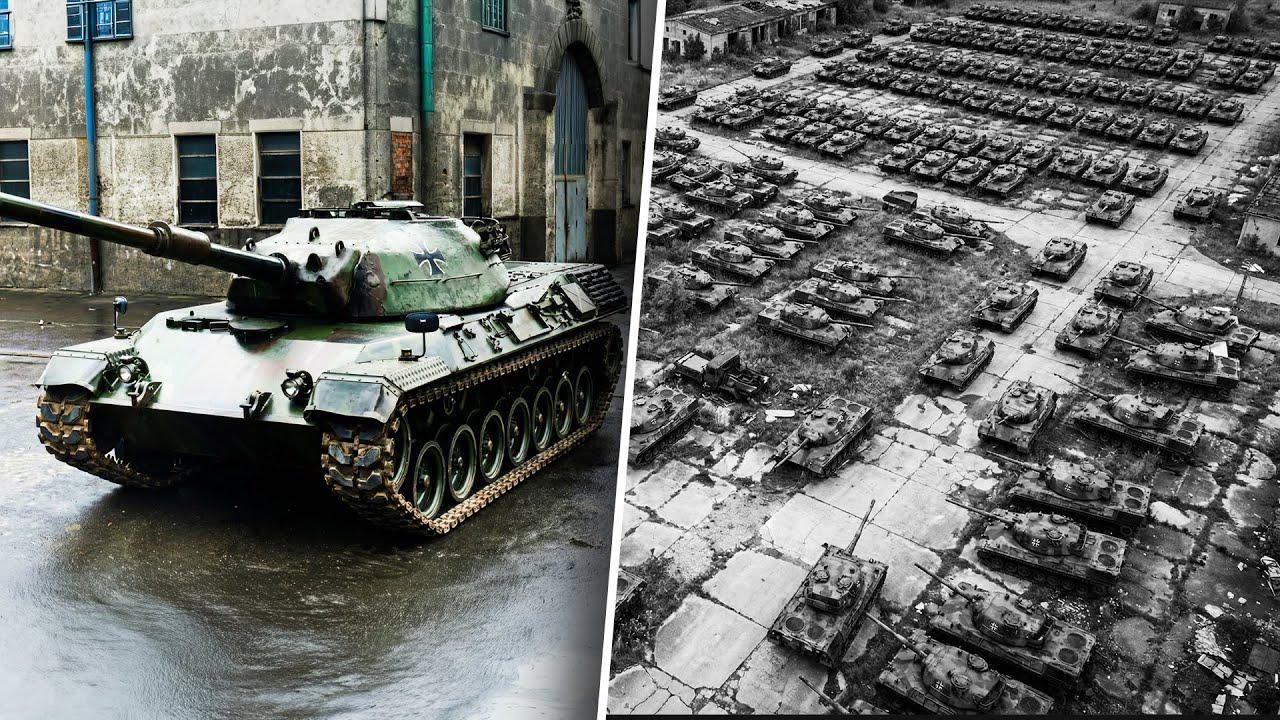
On the morning of May 9, 1945, an American recovery patrol entered a forest road in Bavaria and found a German Panther tank blocking the way.
Its gun was still pointed toward the west.
The tracks were buried in mud. Pine branches had been thrown across the turret as camouflage. One hatch stood open, and beside it lay an empty fuel can, a torn glove, and several pages from a maintenance log darkened by rain.
There were no bodies.
There was no crew.
There was only the tank.
A young soldier approached it cautiously, expecting movement from inside. He raised his rifle, climbed onto the rear deck, and looked through the open hatch.
The fighting compartment smelled of oil, damp leather, burned wiring, and something metallic that had settled into every armored vehicle after years of war.
The ammunition racks were nearly empty.
The radio had been removed.
The gun breech appeared intact.
Then the soldier noticed a block of explosive wedged beneath the transmission housing.
A wire ran toward the driver’s compartment.
The German crew had tried to destroy the Panther before abandoning it—but for some reason, the charge had never detonated.
“Don’t touch anything,” the patrol commander said.
The soldier froze.
Around them, the forest was unnaturally quiet.
Only a few days earlier, a machine like this would have been treated as a deadly enemy. Infantry would have called for artillery, tank destroyers, aircraft, or anything capable of stopping it.
Now it was a silent object in the road.
But it was still dangerous.
And it was far from alone.
Across Europe, the same discovery was being repeated hundreds, then thousands of times.
 Panthers stood beside farmhouses with broken tracks. Panzer IVs were found inside railway yards, their fuel tanks dry. Tiger tanks sat near workshops with their engines removed. Assault guns had been pushed into ditches. Half-finished vehicles remained on factory floors beneath shattered roofs.
Some had been destroyed in combat.
Some had been abandoned after mechanical failure.
Some had run out of fuel.
Others had been sabotaged by their own crews with grenades, demolition charges, or gunfire through the engine compartment.
In the ruins around Berlin, Soviet soldiers found armored vehicles hidden beneath bridges, inside courtyards, behind apartment blocks, and among piles of masonry.
In Saxony and Silesia, tanks stood outside damaged industrial plants, surrounded by machine tools and unfinished components.
In the Ruhr, Allied teams entered factories where assembly lines had stopped in the middle of production. Hulls waited without turrets. Turrets waited without guns. Engines sat on wooden stands beneath dust, broken glass, and sections of collapsed ceiling.
Germany had surrendered.
Its armored forces had not disappeared.
They had simply stopped moving.
That created a question no one had fully prepared to answer.
What should the victors do with the machines that had terrified Europe?
Destroy them?
Study them?
Ship them home?
Give them to friendly armies?
Or preserve them as evidence of what German industry had built—and what it had failed to build reliably?
At first, there was no single answer.
There was only confusion.
American, British, Soviet, and French units began marking captured vehicles with paint. Numbers appeared on hulls. Locations were written into field notebooks. Recovery crews attached cables and dragged tanks from roads, forests, villages, and factory yards.
 Each vehicle had to be treated as a separate mystery.
Was it operational?
Was it booby-trapped?
Was the ammunition safe?
Had the crew damaged the gun?
Was the engine missing because German mechanics had removed it for repair—or because civilians had begun stripping the vehicle for metal?
Sometimes a tank that appeared intact had no final-drive gears.
Sometimes a burned wreck still contained live shells.
Sometimes a Panther with a damaged track could be started after batteries and fuel were installed.
And sometimes a vehicle that looked almost new destroyed its own transmission after moving only a short distance.
Recovery crews quickly learned that appearance meant very little.
One British mechanic described climbing into a captured Panther and finding the controls arranged with a precision that impressed him immediately. The gunner’s position was carefully designed. The optics were excellent. The main gun seemed powerful enough to kill almost any Allied tank at normal battlefield range.
But when the mechanic tried to move the vehicle, the gearbox resisted.
The engine overheated.
An internal component failed.
The Panther traveled less than a mile before it had to be towed.
That contradiction would follow the German tanks everywhere after the war.
They were formidable weapons.
They were also exhausted machines.
Many had been built during a period when German factories were being bombed, raw materials were declining, skilled workers were disappearing, and quality control was becoming increasingly difficult.
A Tiger’s armor might be terrifying.
Its engine might also be near the end of its life.
A Panther’s gun could be superb.
Its final drive could fail before the tank reached the battlefield.
A Panzer IV could be more familiar to mechanics and easier to repair, but many surviving examples had already spent years in combat.
The Allies were not collecting a perfect armored force.
They were collecting the remains of one.
In the first weeks after surrender, captured vehicles were gathered in temporary depots.
Fields filled with rows of tanks.
Some still carried camouflage paint and divisional markings. Some had white surrender flags tied to their gun barrels. Others were blackened by fire or pierced by shells.
The sight was almost surreal.
Machines once dispersed across an entire continent were now parked side by side like unwanted farm equipment.
American officers photographed identification plates and recorded serial numbers.
British technical teams searched for unusual modifications.
Soviet specialists examined armor thickness, gun mechanisms, engines, suspensions, and optical equipment.
Behind them came intelligence officers looking for something less visible but equally valuable: documents.
Maintenance manuals.
Factory reports.
Test results.
Crew instructions.
 Production records.
Correspondence between designers and military officials.
Any surviving paper might explain why a component had failed, what improvement had been planned, or how many vehicles had been produced.
But the documents were often incomplete.
In offices across Germany, filing cabinets had been emptied or burned. Papers lay across floors soaked by rainwater from damaged roofs. Engineers had destroyed records before Allied troops arrived. Soldiers had used technical documents as fuel. Civilians had taken paper for heating, wrapping, or writing.
One recovery team entered a workshop and found the remains of a bonfire in the courtyard.
Pages from armored vehicle reports had been pushed into the flames.
Most had become ash.
But along the outer edge, where the fire had burned unevenly, several sheets survived. The edges were black, yet handwritten notes could still be read.
They described repeated transmission problems.
The weapon the Allies had feared had left behind its own confession.
By the end of the summer, the captured tanks were no longer simply trophies.
They had become evidence.
And every Allied power wanted to examine that evidence before someone ordered it destroyed.
The United States began selecting German vehicles for shipment to proving grounds, including Aberdeen Proving Ground in Maryland.
Getting them there was an operation of its own.
A heavy tank could not simply be driven to a port. Many were mechanically unreliable, damaged, or too heavy for ordinary bridges and transporters. Recovery teams had to secure them, load them onto railcars, move them through disrupted transport networks, unload them near ports, and place them aboard ships.
Every step created new problems.
Tracks shifted.
Cables snapped.
Railway clearances proved too narrow.
Engines leaked.
A vehicle that had survived artillery, mines, and air attacks could be delayed for days because one loading ramp could not support its weight.
But selected Panthers, Tigers, assault guns, and other vehicles eventually crossed the Atlantic.
At Aberdeen, they were no longer symbols.
They were test objects.
American specialists measured armor.
They examined welds and metallurgical quality.
They tested guns and sights.
They studied the layout of the crew compartments.
They drove the vehicles until components failed.
Then they dismantled those components to learn why.
The results were deeply uncomfortable for anyone hoping for a simple conclusion.
German guns and optical systems often deserved their reputation.
The long-barreled weapons mounted on Panthers and Tigers were accurate and powerful. German sights gave trained gunners excellent opportunities to identify and engage targets at distance.
The armor layout of the Panther, particularly its sloped frontal plate, demonstrated how geometry could improve protection without relying only on greater thickness.
But the closer American engineers looked, the more the image of unstoppable German engineering began to crack.
The machines were complex.
Access to internal components could be difficult.
Some repairs required time, lifting equipment, and specialized mechanics.
The transmissions and final drives of certain vehicles were vulnerable to heavy stress.
Parts that worked impressively in controlled conditions could deteriorate rapidly under prolonged battlefield use.
The Germans had created tanks that could be lethal when they were operating properly.
The problem was keeping them operating properly.
That distinction mattered.
A tank did not win a war because it looked powerful on a firing range.
It had to start in freezing weather.
It had to travel hundreds of miles.
It had to cross damaged roads.
It had to survive dust, mud, rushed repairs, inexperienced replacement crews, and shortages of lubricants and spare parts.
It had to be recovered when damaged.
It had to return to battle.
A slightly less powerful tank that could be maintained, fueled, transported, and replaced might contribute more to a campaign than a technically superior tank waiting beside a road with a broken gearbox.
The British reached similar conclusions.
Their specialists repaired captured vehicles in Germany and subjected them to comparisons with Allied designs such as the Sherman and Churchill.
The Panther impressed them.
Its frontal protection was dangerous. Its main gun was excellent. Its optical equipment reflected serious attention to long-range combat.
But British mechanics also encountered the cost of that performance.
The Panther was not a machine that welcomed field improvisation.
When something deep inside the drivetrain failed, the repair could become a major undertaking.
A Sherman might be criticized for its armor or gun in certain confrontations, yet it could often be kept moving by a maintenance system supported by standardized parts, recovery vehicles, trained crews, and vast industrial production.
The Churchill had its own limitations, but British troops understood how to maintain it and how to supply it.
The Panther arrived with no such support network.
Every captured example was effectively an orphan.
To keep one running, mechanics sometimes needed parts from another.
Soon one tank would be stripped to save two.
Then two would be stripped to save four.
Every successful repair created another incomplete hull.
The Soviet Union faced the same reality on a far larger geographical scale.
The Red Army captured enormous quantities of German equipment as it advanced westward. Some vehicles were used temporarily. Others were sent for evaluation or training. Many were abandoned because recovering them was not worth the effort.
Soviet specialists respected German armor and armament.
They also understood the difference between a tank designed for impressive specifications and a tank designed for a brutal logistical environment.
On the Eastern Front, machinery had to survive extreme cold, deep mud, dust, long marches, damaged roads, and maintenance far from well-equipped factories.
A weapon that required delicate treatment could quickly become a liability.
Captured Panthers and Tigers were valuable for study.
They were less attractive as the foundation of a permanent armored force.
There was also a larger political question.
In 1945, the United States, Britain, the Soviet Union, and France were still officially partners in victory.
But their cooperation was already filling with suspicion.
Every captured German tank had two meanings.
It was a relic of the defeated enemy.
It was also a piece of advanced military technology that another Allied power might study first.
American officers worried about what the Soviets were collecting.
Soviet officers watched what the Western Allies were shipping out of Germany.
British teams searched factories before areas were transferred to different occupation authorities.
French units gathered equipment wherever they could.
The war against Germany was over.
The competition over its technology had begun.
At several research and testing sites, Allied investigators found vehicles that had never entered normal service.
Prototype hulls.
Experimental suspensions.
Turrets designed for projects that had been canceled.
Vehicles missing critical components.
Drawings for machines that had existed more clearly on paper than in steel.
The discoveries created sensational rumors.
German engineers, it was said, had been only weeks away from producing indestructible tanks.
Secret underground factories supposedly contained entire armored divisions.
Hidden depots were rumored to hold brand-new Tigers, fueled and ready.
Every unfinished prototype became evidence for someone’s fantasy that the Third Reich possessed miraculous technology just beyond Allied understanding.
The truth was less dramatic—and more revealing.
Germany had pursued many ambitious projects.
But a prototype was not a field army.
A drawing was not a production line.
An experimental turret was not a trained crew, a supply system, a railway network, or a reserve of fuel.
Some projects had been abandoned because they were impractical.
Others had been disrupted by bombing, shortages, political interference, shifting requirements, or the collapse of the state itself.
The unfinished vehicles were not proof that Germany had nearly escaped defeat.
They were proof that technical ambition had outrun industrial reality.
One British officer reportedly stood inside a damaged research facility, looking at a massive incomplete armored structure surrounded by scattered components.
An engineer beside him began describing what the machine might have achieved if development had continued.
The officer listened, then asked a simple question.
“How many were completed?”
The engineer did not answer.
The silence said more than the design drawings.
By late 1945, the Allies had learned most of what the abandoned tanks could teach them immediately.
Now the debate changed.
Keeping thousands of German armored vehicles was expensive.
They occupied land.
They required guards.
They contained ammunition, fuel residue, explosives, oils, and hazardous materials.
Children entered storage areas.
Civilians began removing metal.
Former soldiers knew how to repair some of the machines.
And above all, the occupation authorities feared the possibility of German remilitarization.
A tank without fuel was still a tank.
A warehouse of parts was still a military resource.
A factory capable of building armored vehicles could, under different political conditions, become part of another German army.
The Allies had promised to demilitarize Germany.
That promise had to become visible.
So the orders began to move through occupation offices.
Military equipment would be destroyed, removed, converted, or rendered permanently unusable.
The era of collecting was ending.
The era of cutting was about to begin.
In industrial yards across Germany, torches touched armor plate.
Workers removed guns, engines, radios, tracks, wheels, copper wiring, instruments, and anything else that could be separated.
Turrets were lifted from hulls by cranes.
Armor was cut into transportable sections.
Vehicles that had once required specialized anti-tank weapons to defeat were reduced piece by piece by men in work clothes.
The destruction was not always elegant.
Some tanks were used as targets.
Others were blown apart with demolition charges.
Some were pushed into scrap yards and attacked with cutting equipment until their outlines disappeared.
A Tiger might take days to dismantle.
Its armor resisted the same tools meant to destroy it.
Sparks fell like orange rain.
Metal screamed as plates separated.
Workers climbed over machines that had once carried elite crews into battle and marked the next cutting line with chalk.
There was a bitter symmetry to it.
Germany had consumed vast quantities of iron, labor, fuel, and human life to build its armored forces.
Now the victors were feeding those armored forces back into the ruins.
Steel from military stockpiles entered civilian recovery systems.
Germany needed bridges.
It needed railway equipment.
It needed tools, industrial machinery, housing materials, and repaired infrastructure.
Cities had been shattered.
Factories had to be restarted for peaceful production.
Millions of people needed shelter.
The metal that had once protected tanks could now support reconstruction.
A section of armor did not carry its past into the furnace.
It emerged as something else.
A beam.
A machine component.
A rail.
A tool.
Perhaps part of a bridge over which civilians would travel without hearing aircraft overhead.
For many people, that was the most appropriate fate possible.
But not every tank went directly into a furnace.
Some were used for engineering purposes.
Damaged armored hulls were occasionally placed where their mass could serve as reinforcement, stabilization, or improvised structural material.
Others remained for years in training areas because moving them cost more than leaving them in place.
On British ranges, German tanks became targets.
Crews fired at them to study penetration patterns and weapon performance.
A Panther that had escaped destruction during the war might survive only to be struck repeatedly in peacetime by armor-piercing rounds.
Each impact produced data.
Where did the plate crack?
How did the weld behave?
What happened inside the fighting compartment?
Which angle offered the best protection?
How did ammunition respond?
The tank was destroyed slowly so that future tanks could be designed more intelligently.
At American proving grounds, vehicles met a similar fate.
They were tested, measured, dismantled, neglected, exposed to weather, or used as targets after their technical value declined.
The Soviets conducted their own evaluations at proving grounds, keeping selected examples for study while disposing of many others.
In Czechoslovakia and Poland, recovery teams continued clearing battlefields where the final campaigns had left wrecks in forests, villages, riverbanks, and fields.
This work was not glamorous.
A wreck could contain unexploded ammunition.
It could rest over a mine.
Its interior might hold human remains.
The ground around it might be contaminated with fuel or oil.
Farmers wanted their land back, but removing a thirty-ton vehicle from soft earth demanded equipment many communities did not have.
Some wrecks were cut where they lay.
Others were dragged to collection points.
A few sank deeper into the landscape and remained hidden for decades.
With every year, however, the German armored force became less visible.
Rows of vehicles disappeared from depots.
Factories lost their military machinery.
Prototype projects vanished into scrap.
Technical records were carried abroad or filed in archives.
The rumors of hidden armies continued.
People claimed that sealed tunnels contained intact Tigers.
They said trains loaded with tanks had disappeared into mountains.
They insisted that secret depots were waiting beneath forests.
Searches occasionally found ammunition, spare parts, abandoned workshops, or individual wrecks.
They did not find the mythical armored force.
There was no silent division waiting to restart the war.
The miracle weapons had never been miraculous.
And then came the first twist.
While the Allies were destroying German tanks to ensure that Germany could never use them again, several victorious or newly aligned nations began trying to put the same tanks back into service.
France was among the most notable.
The country had been occupied, fought over, and heavily damaged. Its postwar army needed equipment quickly. Across French territory were German vehicles, spare parts, workshops, and people who understood how to repair them.
French forces recovered Panthers and worked to make them operational.
It was a remarkable reversal.
Only months earlier, the Panther had been a weapon of occupation.
Now French crews climbed into its turret wearing French uniforms.
German markings were replaced.
New insignia appeared.
Orders were translated.
Mechanics studied unfamiliar systems.
The tank had changed sides without moving.
French officers valued its gun, armor arrangement, and optics. Its technical features deserved attention, and Panthers served in French armored formations during the postwar period.
But the old problems returned immediately.
A tank could be captured in an afternoon.
A maintenance system could not.
France needed spare parts that were no longer being produced in a stable German wartime network. Mechanics had to recover components from wrecks or fabricate replacements. Training crews took time. Keeping a group of vehicles operational required a constant struggle against wear, incompatibility, and shortages.
One Panther might look impressive during a parade.
Behind it, several others might be waiting for parts.
The French did not discover a secret weapon.
They inherited a technical burden.
The tanks remained useful for a limited period, but they could not provide a sustainable long-term solution. By the early 1950s, France was moving away from operational reliance on them.
The Panther’s greatest postwar value was no longer what it could do on a battlefield.
It was what engineers could learn from its successes and failures.
Czechoslovakia faced a different inheritance.
Before and during the war, its industrial base had been integrated into German arms production. Factories, machine tools, technical knowledge, and partially completed vehicles survived the collapse.
Postwar authorities could not simply erase that industrial experience.
They used it.
German-derived armored vehicles and components were completed, modified, or adapted. Czechoslovak factories developed postwar production based on wartime platforms, including vehicles descended from German tank-destroyer designs.
Some were retained.
Others were exported.
In one of history’s stranger reversals, machines rooted in the German war economy were rebuilt by a liberated country and sold into new international markets.
The shape remained familiar.
The flag changed.
Romania and Bulgaria also used surviving or transferred German armored vehicles for a time.
But their future increasingly lay with Soviet equipment.
German tanks became transitional machines—useful only until standardized Soviet vehicles, training, ammunition, and spare parts could replace them.
That word, standardized, decided the fate of many postwar armies.
A country could operate a few German tanks.
But a military needed more than a few dramatic silhouettes.
It needed common fuel requirements.
Common ammunition.
Common radios.
Common tools.
Common training.
Reliable parts.
Predictable repairs.
An army built from captured vehicles of different models was not a modern armored force.
It was a mechanical puzzle.
Spain presented another path.
Its Panzer IVs had arrived during the war and remained in service long afterward. They outlasted many German tanks in the countries that had defeated Germany.
For years, Spanish crews maintained them despite their age.
Eventually, Spain no longer needed them.
By then, most observers would have expected the old tanks to enter museums or scrap yards.
Instead, a number of them were sold to Syria.
That was the second twist.
More than two decades after the collapse of Nazi Germany, German-designed Panzer IVs were transported toward another potential battlefield.
Their new crews spoke Arabic.
Their opponents would not be American Shermans advancing through France or Soviet T-34s approaching Berlin.
They would face Israeli forces in the Middle East.
Some of the vehicles Syria acquired came through different European channels, including Czechoslovak, French, and Spanish sources. They were not identical. They arrived with varying histories, modifications, and mechanical conditions.
Keeping them operational demanded extraordinary improvisation.
The original factories were no longer supplying a unified fleet.
Replacement parts had to be found, adapted, recovered, or manufactured.
Mechanics worked on vehicles designed in another country, for another army, in another war.
They made components by hand.
They substituted equipment.
They modified weapons and fittings.
They kept old engines alive because there was no simple replacement waiting in a warehouse.
A Panzer IV in Syrian service was no longer merely German.
It had become a layered object—German in design, European in its postwar journey, Syrian in its final military role.
Some were positioned near the Golan Heights.
From fortified locations, they could fire across contested ground.
By then, the Panzer IV was obsolete as a front-line tank.
Its armor belonged to an earlier era.
Its silhouette was familiar to military historians.
But an old gun could still kill.
An obsolete tank firing from a prepared position was not harmless.
During the conflicts of the 1960s, Syrian Panzer IVs encountered Israeli armor that represented a later generation of design, firepower, and battlefield experience.
The German tank’s postwar journey had reached its final violent chapter.
Vehicles built for Hitler’s armies were now fighting in a war that had nothing to do with Hitler’s strategic plans.
Some were destroyed.
Some were captured.
Some became static positions or training relics.
By the 1970s, their meaningful combat career had ended.
But their existence that late was astonishing.
The nation that built them had surrendered in 1945.
The tanks had continued traveling through history without it.
And that was not the final twist.
For years, popular accounts portrayed German tanks as the direct fathers of nearly every postwar armored vehicle.
The story sounded convincing.
The Panther had sloped armor.
Later tanks had sloped armor.
The Panther had powerful optics and a high-velocity gun.
Later tanks emphasized powerful guns and improved fire control.
Therefore, the legend claimed, the victors had simply copied German genius.
The real lesson was more complicated.
Allied engineers did study German vehicles carefully.
They respected certain features.
They incorporated technical knowledge from captured equipment, documents, and personnel into a much wider body of wartime experience.
But they also studied what had gone wrong.
The Panther did not teach only the value of sloped armor.
It taught the danger of overloading mechanical systems.
The Tiger did not demonstrate only the psychological power of thick armor and a large gun.
It demonstrated the logistical cost of extreme weight, fuel consumption, difficult recovery, and complex maintenance.
German optics showed what excellent target acquisition could achieve.
German drivetrains showed what happened when battlefield demands exceeded component life.
The victors did not simply ask, “How can we build this?”
They asked, “How can we achieve its strengths without inheriting its weaknesses?”
That question shaped early Cold War armored thinking more than imitation alone.
A successful postwar tank needed protection, mobility, and firepower.
But it also needed reliability.
It needed to be produced in numbers.
It needed to travel over bridges.
It needed to be maintained by ordinary military units.
It needed parts that could be replaced without turning every repair into an engineering project.
It needed to fight as part of a system.
The German tanks had been designed as weapons.
Their remains became warnings.
By the late 1940s, most of the captured vehicles had vanished.
They had been scrapped, tested to destruction, abandoned, exported, converted, or dismantled for parts.
The enormous fleets that had once crossed borders were reduced to isolated survivors.
One tank remained because an officer recognized its historical value.
Another survived because it had been sent to a proving ground and never cut apart.
Another was preserved because a museum obtained it before a scrap dealer did.
Another remained in a foreign army until military usefulness gave way to historical significance.
Their survival was often accidental.
A vehicle could escape the Eastern Front, survive mechanical failure, avoid Allied bombing, evade postwar demolition orders, and still be destroyed years later because no institution wanted to pay for storage.
Preservation required someone to intervene.
Someone had to look at a rusting machine and see more than metal.
That idea was not universally accepted.
Europe in 1945 was filled with people who had no desire to preserve the weapons that had destroyed their homes and killed their families.
To them, a German tank was not engineering heritage.
It was occupation.
It was fear.
It was the sound of tracks outside a village.
It was a son who had not returned.
Scrapping such a machine could feel like justice.
Preserving it could feel like honoring the wrong thing.
Museums eventually found another purpose.
A preserved tank did not have to celebrate the regime that built it.
It could expose the reality behind the propaganda.
Visitors could stand beside a Tiger and understand its physical scale.
They could see the thickness of the armor and the cramped positions where men fought.
They could examine the engineering achievement and the industrial waste at the same time.
They could learn that technical sophistication did not make a cause moral.
They could learn that fearsome machines still depended on fuel, labor, railways, mechanics, and political decisions.
They could learn that weapons remembered as invincible were often found abandoned with broken transmissions.
Today, surviving German armored vehicles can be seen in major collections such as Bovington in Britain, Saumur in France, and Kubinka in Russia.
They stand under roofs now.
Their guns do not move toward targets.
Their engines are silent, except for the rare restored vehicle operated during controlled demonstrations.
Museum lights reflect from armor once covered in mud, snow, dust, soot, and blood.
Visitors walk around them with cameras.
Children point toward the tracks.
Experts study weld patterns and production details.
Veterans once approached them with memories that no label could fully describe.
Each surviving vehicle represents thousands that did not survive.
For every preserved Panther, rows of others were cut apart.
For every Tiger displayed behind a barrier, many more ended as firing-range targets or scrap.
For every restored engine, countless damaged engines were melted, discarded, or buried beneath collapsed workshops.
The survivors are rare not because Germany built only a few armored vehicles.
They are rare because Europe had powerful reasons to destroy them.
And somewhere in that story lies the moment Germany’s armored myth finally collapsed.
It did not happen when the last Tiger was knocked out in battle.
It happened after the surrender, when Allied engineers opened the machines, examined the worn gears, read the surviving maintenance records, and compared reputation with reality.
They saw the excellent guns.
They saw the advanced optics.
They saw the sloped armor.
Then they saw the failed bearings, strained transmissions, missing parts, exhausted engines, and abandoned prototypes.
The expression of recognition did not belong to one defeated commander standing before a crowd.
It appeared across an entire continent.
It was visible in the silence of German engineers when asked how many experimental vehicles had actually been completed.
It was visible in the faces of former officers watching tanks dragged toward cutting yards.
It was visible when mechanics discovered that the machine described as unstoppable could not reach the depot under its own power.
The war had wrapped German armor in mythology.
Peace removed the armor plate one section at a time.
The greatest revelation was not that the tanks had been weak.
They were not.
Many were deadly, innovative, and terrifyingly effective in the right circumstances.
The revelation was that technical brilliance had been mistaken for strategic wisdom.
A nation can build a machine that dominates a battlefield and still lose the war.
It can create thicker armor and still run out of fuel.
It can design a more powerful gun and still fail to replace broken gears.
It can produce a masterpiece of engineering that becomes useless because no bridge can carry it, no recovery vehicle can move it, or no factory can provide the parts.
In May 1945, the roads of Europe were filled with proof.
Panthers stood beneath trees.
Tigers waited beside workshops.
Panzer IVs sat in villages where their crews had walked away.
Their guns still pointed toward enemies who were no longer coming.
One by one, they were numbered, photographed, tested, stripped, exported, or destroyed.
Some became French tanks.
Some became Romanian tanks.
Some were rebuilt in Czechoslovak factories.
Some traveled through Spain and ended their careers in Syria.
Some absorbed shell after shell on Allied firing ranges.
Some disappeared into furnaces and returned to Europe as the raw material of reconstruction.
And a precious few entered museums.
Those survivors are often admired for their armor, firepower, and design.
But the deeper lesson is found in the vehicles that did not survive.
The machines Hitler expected to help secure a German empire became scrap for rebuilding the continent his war had shattered.
Their steel repaired a world they had failed to conquer.
And that may be the most complete defeat any weapon can suffer: not merely to be destroyed by the enemy, but to be dismantled, understood, stripped of its mythology—and forced to serve the future it was built to prevent.