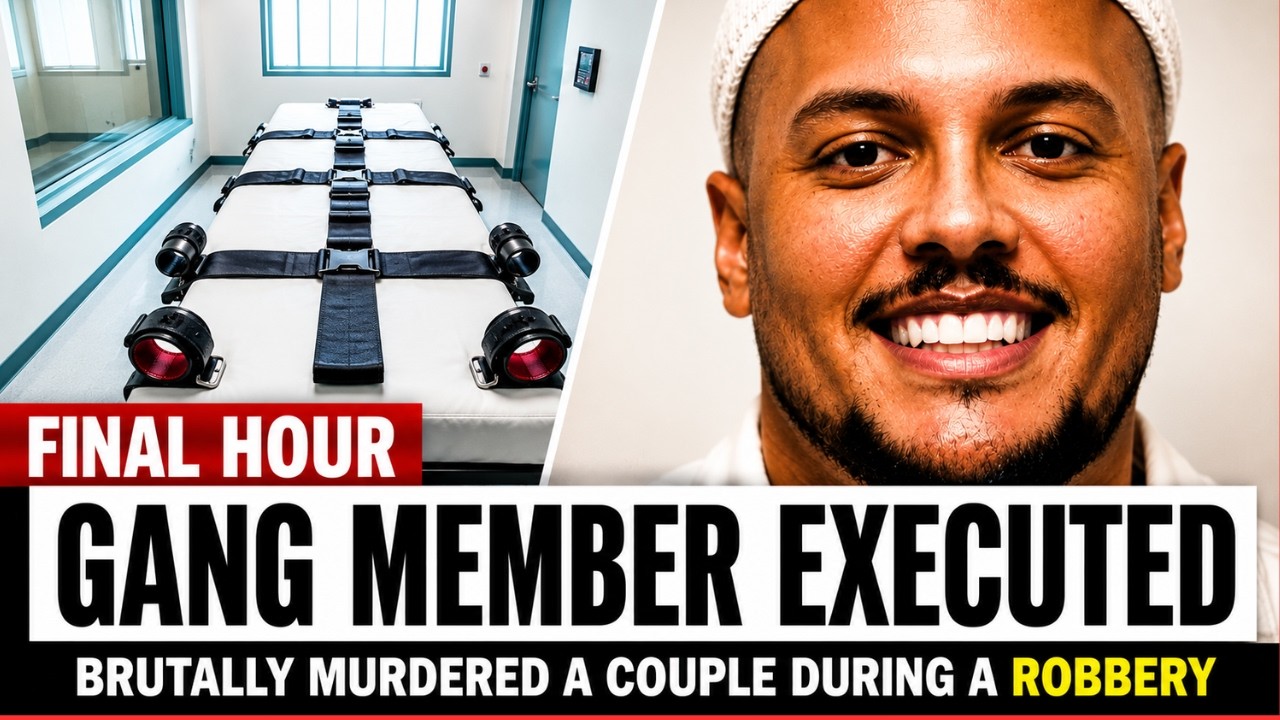
The federal government executed Christopher Andre Vialva on Thursday evening at the United States Penitentiary in Terre Haute, Indiana, ending a 20-year legal battle that divided a nation over whether a teenager who committed murder could ever become a man worthy of mercy.
Vialva, 40, was pronounced dead at 6:46 p. m. Eastern Time after receiving a lethal injection.
 He had spent more than half his life on death row for the 1999 murders of Todd and Stacy Bagley, a young married couple who had stopped to help him and four other young men when they asked for a ride at a convenience store in Killeen, Texas.
Outside the prison, a crowd of protesters gathered in numbers far larger than usual for recent federal executions. The Death Penalty Action Group, joined by local organizations, held a candlelight vigil in Vialva’s name, chanting and holding signs that condemned capital punishment. The scene reflected the deep divisions that surrounded his case.
Vialva was 19 years old when he and his accomplices kidnapped, robbed, and killed the Bagleys. Prosecutors described him as the leader of the group, the one who fired the fatal shots. The couple had pleaded for their lives inside the trunk of their own car, praying and singing about forgiveness.
Their faith did not save them.
But over two decades on death row, Vialva transformed. He became a devout follower of Messianic Judaism, studied scripture, learned Hebrew, and expressed profound remorse for the crime. His supporters argued that the government was preparing to execute a grown man for decisions made by a damaged, immature adolescent who no longer existed.
The Bagley family saw it differently. For them, the passage of time had not changed the fundamental fact that Vialva had taken two innocent lives. Todd Bagley, 26, and Stacy Bagley, 28, were youth ministry volunteers who had dedicated themselves to helping others.
Their kindness was met with violence.
Vialva’s final statement was not a declaration of innocence. He expressed remorse and prayed for the Bagley family, asking God to bring them healing and peace. Shortly before the execution began, he reportedly said, “I’m ready, Father.”
Those words did not satisfy either side of the debate.
The execution was the seventh carried out by the federal government since it resumed capital punishment in July 2020 after a 17-year hiatus. Vialva was the first Black prisoner executed during this renewed series, a fact that added another layer of controversy to an already fraught case.
His attorneys had argued that racial bias may have influenced the jury’s decision to sentence him to death. Vialva was biracial, born to a white mother and a Black father. His childhood was marked by instability, rejection, and exposure to domestic violence.
The defense presented evidence of these hardships at trial.
But the jury in 2000 saw a 19-year-old who had planned a robbery, kidnapped a couple, driven them around for hours, and then shot them both. The crime lasted long enough for multiple opportunities to stop. The jury concluded that his background did not outweigh the deliberate nature of the killing.
Over the next 20 years, every appeal failed. Courts rejected claims about ineffective counsel, racial bias, and the fairness of the proceedings. The Supreme Court declined to intervene.
The president did not grant clemency. On September 24, 2020, the date set for execution arrived.
 Outside the Terre Haute Federal Penitentiary, protesters gathered in larger numbers than usual. The Death Penalty Action Group was joined by local organizations hosting a candlelight vigil in Vialva’s name. They argued that executing someone who had genuinely changed served no purpose beyond vengeance.
Inside the prison, Vialva was 40 years old. He had spent half his life under a death sentence. His mother, Lisa Brown, had visited him through glass for two decades.
She believed the government was killing a man who no longer resembled the teenager condemned by the jury.
The case forces a difficult question. When a teenager commits an unforgivable crime but grows into a different man, which version should the law punish? The boy who made the decision or the adult who lived long enough to regret it?
There is no comfortable answer.
Todd and Stacy Bagley never got 20 more years. They never got to see their marriage grow, their ministry flourish, or their future unfold. Their lives ended on a remote stretch of Fort Hood military land because five young men decided to rob them and then decided to kill them.
Vialva’s childhood was marked by instability and rejection. He was biracial in a racially divided military town. His mother’s family rejected his father.
He grew up without a stable father figure. He turned to the streets and a gang for belonging. Those factors shaped him but did not force him to kill.
The crime itself was brutal. After Todd and Stacy agreed to give the young men a ride, they were threatened with firearms, forced into the trunk, and driven around for hours. They pleaded for their lives, prayed, and sang.
Vialva shot them both. Brandon Bernard later set the car on fire.
Bernard was also executed by the federal government earlier in 2020. The other three participants, who were juveniles at the time, received lesser sentences. That disparity became a point of contention.
Critics argued that the harshest punishment fell on those old enough to face it, not necessarily those most culpable.
Prosecutors maintained that Vialva was the leader and the triggerman. His role set him apart. The evidence showed he controlled the victims and made the decision to kill.
The cooperating witnesses, who had incentives to minimize their own roles, corroborated the physical and financial evidence.
 The execution proceeded despite last-minute legal challenges. Vialva’s lawyers argued that the federal government’s rush to carry out executions during the COVID-19 pandemic was unprecedented and unconstitutional. The courts disagreed.
The lethal injection was administered as scheduled.
For the Bagley family, the execution brought a measure of closure after two decades of waiting. They had attended every hearing, every appeal, every legal maneuver. They had watched the man who killed their loved ones grow older while their loved ones remained frozen in time.
For Vialva’s supporters, the execution was a tragedy. They pointed to his transformation as evidence that the justice system should allow for redemption. They argued that executing someone who had become a different person undermined the very concept of rehabilitation.
The debate over capital punishment in America remains deeply polarized. Cases like Vialva’s highlight the tension between retribution and mercy. They force society to confront whether punishment should be fixed at the moment of the crime or whether it can account for change over time.
Vialva’s final hours were spent with his spiritual advisor and his lawyers. He reportedly remained calm and composed. He expressed gratitude for those who had supported him.
He did not ask for forgiveness for himself but offered it to others. His demeanor did not change the outcome.
The federal government has carried out several executions in rapid succession since July 2020. This has drawn criticism from human rights organizations and death penalty opponents. They argue that the process has been rushed and that cases with serious questions about fairness have been pushed through.
Vialva’s case includes questions about racial bias. His defense argued that jurors may have perceived him as more dangerous because he was a large Black man. No court found sufficient evidence to overturn his sentence, but the concern remains part of the broader conversation about race and the death penalty.
The execution was witnessed by members of the Bagley family and by Vialva’s attorneys. They provided statements afterward. The family expressed relief that the legal process had concluded.
Vialva’s lawyers reiterated their belief that executing a reformed individual was a mistake.
The location of the execution, Terre Haute, Indiana, has become a focal point for death penalty protests. The federal death row is housed there. Each execution draws activists from across the country.
The candlelight vigil for Vialva was one of the largest in recent memory.
Christopher Vialva’s life began in uncertainty and ended in a federal execution chamber. He was born into a family divided by race and rejection. He grew up angry and searching for belonging.
 He committed a horrific crime. He spent 20 years trying to become someone else. In the end, the law judged him by who he was at 19.
The question remains unresolved. Should the justice system have room for the possibility that people can change? Or must punishment be absolute, fixed at the moment of the crime?
Vialva’s case does not provide a clear answer. It only provides the facts of two lives lost and one life taken by the state.
Todd and Stacy Bagley are remembered by their family and their church community. They are remembered for their faith and their willingness to help strangers. Their deaths are a reminder of how quickly kindness can meet violence.
Their memory was invoked throughout Vialva’s legal proceedings.
The federal government’s resumption of executions has been controversial. Some argue that it is a necessary tool for justice in the most heinous cases. Others argue that it is an irreversible punishment that risks executing innocent people and fails to account for human growth.
Vialva’s execution was carried out without major incident. The lethal injection protocol followed standard procedures. Medical personnel declared him dead at the appointed time.
The protesters outside continued their vigil. The Bagley family returned home. The case closed.
But the questions it raises will not disappear. They will follow every future execution. They will be debated in courtrooms, in legislatures, and in public discourse.
Christopher Vialva is dead. The debate about his life and his death will continue.
This story is a reminder that true crime rarely offers clean resolutions. It leaves behind grieving families, conflicting narratives, and moral dilemmas. The facts are clear.
The meaning of those facts is not. That is the nature of justice in a complex world.
The execution of Christopher Vialva marks another chapter in the ongoing story of capital punishment in America. It is a story without a happy ending. It is a story that forces us to ask what we believe about punishment, redemption, and the value of a human life.
There are no easy answers. There is only the weight of the choices we make as a society.