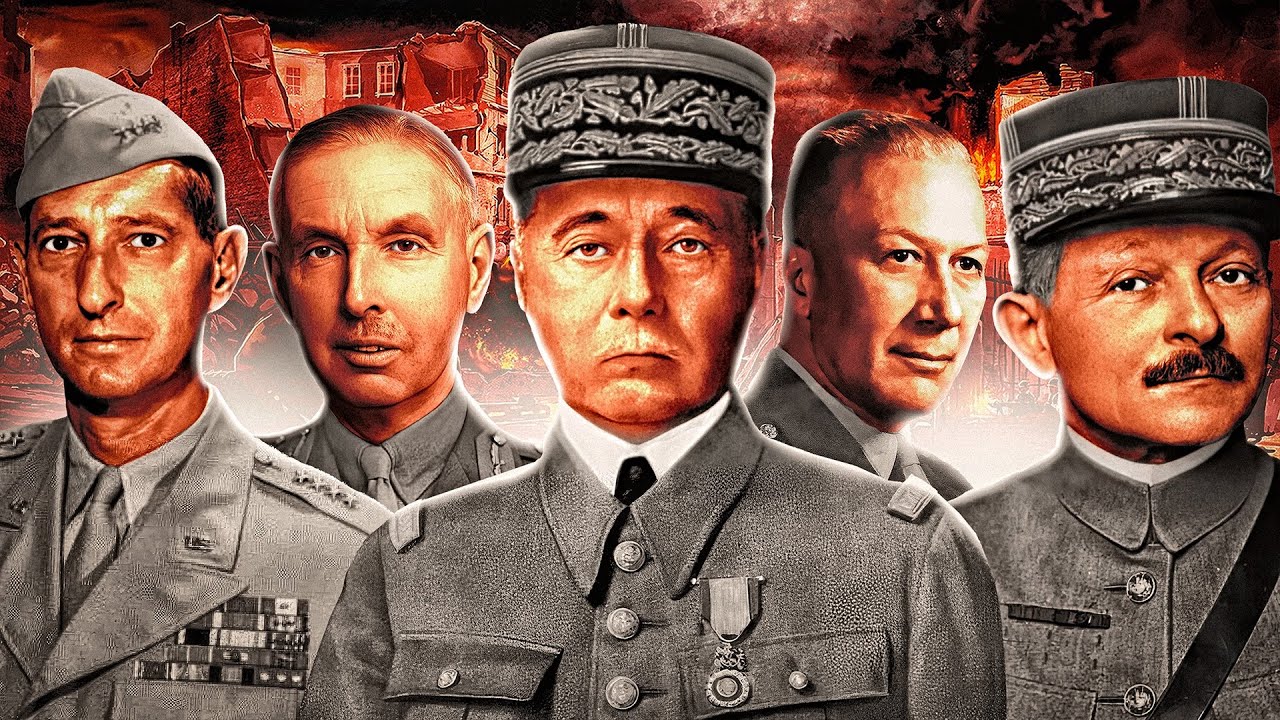
THE 5 WORST GENERALS OF WORLD WAR II — AND THE MEN WHO PAID FOR THEIR MISTAKES
On the afternoon of February 15, 1942, Lieutenant-General Arthur Percival climbed into a car and drove toward a meeting he had spent weeks trying to avoid.
Singapore was collapsing behind him.
Smoke hung over the island. Water supplies were failing. Ammunition was disappearing. Hospitals were overcrowded. Soldiers who had been told for years that Singapore was an impregnable fortress were watching the British Empire’s greatest stronghold in Asia disintegrate around them.
Percival was not going to another headquarters meeting.
He was going to surrender.
Waiting for him was Japanese General Tomoyuki Yamashita, whose army had crossed hundreds of miles of jungle, smashed through British defenses in Malaya, crossed the Johore Strait, and forced a numerically significant Allied garrison into a position that had once seemed impossible.
The British commander sat across from his opponent.
Yamashita pushed for unconditional surrender.
Percival hesitated.
There were tens of thousands of Allied troops under his command. British, Australian, Indian, and local soldiers had fought, retreated, regrouped, and fought again. Many believed Singapore could still hold for a little longer.
But the decision had already escaped the battlefield.
It was now sitting in that room.
Percival surrendered.
And with that signature, one of the most humiliating defeats in British military history became permanent.
For decades, World War II has been remembered through its brilliant commanders.
Eisenhower.
Montgomery.
Patton.
Zhukov.
Nimitz.
MacArthur.
Men whose photographs fill documentaries and history books.
But wars are not shaped only by brilliant decisions.
Sometimes history turns because a commander hesitates for one hour too long.
Sometimes because he refuses to change an outdated plan.
Sometimes because he is hundreds of miles from the front and has convinced himself that everything is under control.
And sometimes thousands of soldiers pay for the vanity of one man who wants a headline.
World War II produced commanders whose failures were not merely embarrassing.
They were catastrophic.
And five Allied generals, in particular, became symbols of what can happen when rank rises faster than adaptability.
Arthur Percival.
Maurice Gamelin.
Maxime Weygand.
Lloyd Fredendall.
Mark Clark.
They were not identical men.
Some were cautious.
Some were rigid.
Some were overwhelmed.
One was openly ambitious.
Several had long military careers and impressive résumés.
None woke up planning to lose an army.
That is what makes their stories disturbing.
Because the greatest military disasters are rarely caused by fools announcing that they are fools.
They are often caused by intelligent, experienced men who become absolutely convinced that the enemy will behave exactly as expected.
And the moment the enemy does something different, the entire system begins to crack.
Arthur Percival had inherited one of the most dangerous illusions in the British Empire.
Singapore looked powerful.
On maps, it appeared almost untouchable.
It possessed naval facilities, coastal defenses, airfields, thousands of troops, and enormous symbolic importance. British propaganda had helped build the image of the island as a fortress guarding the entrance to Southeast Asia.
There was one problem.
Fortresses are only useful when the enemy attacks them the way you expect.
The Japanese did not.
They came down through Malaya.
Quickly.
Aggressively.
And with a level of operational flexibility that shocked British commanders.
Japanese infantry moved through terrain British planners had often considered unsuitable for major military operations. Light forces advanced with bicycles, trucks, captured equipment, and ruthless speed.
Whenever British defenders tried to establish a stable line, Japanese units maneuvered around them.
Then the line collapsed.
Then another.
Then another.
Aircraft that were supposed to support the defense were destroyed, withdrawn, or overwhelmed.
The battleship HMS Prince of Wales and battlecruiser HMS Repulse, sent to deter Japanese expansion, were sunk from the air in December 1941.
The psychological effect was enormous.
The old assumptions were dying faster than the commanders could replace them.
Yet Percival remained trapped inside a command system that reacted too slowly.
He was not a cartoon villain.
He was not a coward hiding beneath a desk.
That would have made the story easier.
Percival was a professional officer facing an extremely difficult situation.
But professionalism is not the same thing as battlefield adaptability.
Again and again, British forces retreated southward.
The Japanese kept coming.
By January 1942, the battle had reached the final approaches to Singapore.
The symbolism was brutal.
For years, many British officials had assumed Singapore’s powerful coastal guns helped make the island nearly impossible to capture.
But the greatest threat was not a fleet attacking from the sea.
It was an army coming from the north.
The Japanese crossed onto Singapore during the night of February 8.
The defenses were thin in critical areas.
Australian units endured heavy attacks.
Communications became confused.
Reserves were moved hesitantly.
Commanders struggled to understand where the main Japanese effort was developing.
Yamashita had his own serious problems.
His forces were tired.
His ammunition situation was not unlimited.
His army had advanced rapidly and could not afford an endless battle.
And here came the first great irony.
The man who looked invincible was not.
The Japanese commander was gambling.
Yamashita needed Percival to believe Japan was stronger than it actually was.
So he applied psychological pressure with extraordinary aggression.
Every British retreat made the bluff more believable.
Every failed counterattack made the defenders feel weaker.
Every hour of confusion increased the psychological advantage.
Soon the British commander was not simply fighting Japanese soldiers.
He was fighting his own perception of inevitable defeat.
Water infrastructure was threatened.
Civilian suffering intensified.
The military position became increasingly dangerous.
By February 15, Percival chose surrender.
Around him, officers understood what that meant.
This was not a battalion giving up a hill.
This was Singapore.
The great imperial fortress.
Tens of thousands of men would enter captivity.
The image of British invincibility in Asia would never recover.
And somewhere in the Japanese command structure was a truth Percival could not fully know at that table:
Yamashita desperately wanted the surrender before his own logistical problems became impossible to conceal.
The defeated side had believed the victorious side possessed endless strength.
It did not.
That realization came too late.
And that is the most painful type of military failure.
Not losing because resistance was impossible.
Losing while never fully discovering how close the enemy might have been to his own breaking point.
But if Singapore was a shock to the British Empire, what happened in France two years earlier had been even more unbelievable.
Because in 1940, one of the strongest armies in the world did not merely lose.
It was psychologically disassembled in weeks.
Before Germany invaded France, General Maurice Gamelin had reasons to feel confident.
France possessed a huge army.
It had tanks.
Artillery.
Fortifications.
Experienced officers.
The memory of World War I was everywhere.
French commanders had spent twenty years studying the previous catastrophe.
They were determined not to repeat it.
That was precisely the problem.
They prepared so carefully for the last war that they struggled to imagine the next one.
At the center of French military planning stood Gamelin.
He was respected, experienced, intelligent, and deeply rooted in the traditions of the French high command.
His plan depended heavily on an Allied advance into Belgium once Germany attacked.
The logic seemed reasonable.
If German forces came through Belgium as they had in 1914, the Allies would move forward and meet them before the battle reached the French heartland.
British and French troops would rush north.
The Germans would be stopped.
The front would stabilize.
That was the expectation.
Germany gave them exactly what they were waiting for.
Then used that expectation against them.
On May 10, 1940, German forces invaded the Low Countries.
Allied armies moved toward Belgium.
The operation appeared to confirm everything French planners had anticipated.
German airborne forces attacked.
Armored units surged forward.
Belgium became the center of attention.
And while Allied commanders looked north, German armored formations were moving through the Ardennes.
For French planners, the Ardennes had been treated as difficult terrain for a major armored breakthrough.
For the Germans, difficult did not mean impossible.
It meant opportunity.
Columns of vehicles packed narrow roads.
Had the Allies struck those columns effectively from the air, or reacted with sufficient speed, German units could have faced severe problems.
But command systems moved slowly.
Information traveled upward.
Orders traveled downward.
Hours disappeared.
And in modern mechanized war, hours were not administrative details.
Hours were territory.
German forces reached the Meuse.
They crossed near Sedan.
Then the nightmare began.
French units cracked.
German armor broke into open country.
Commanders who had prepared for a methodical campaign suddenly confronted movement at a speed their system had not been built to process.
The front was not bending in one place.
It was becoming irrelevant.
Gamelin’s headquarters struggled to regain control.
Maps were updated.
Reports arrived.
Telephone calls multiplied.
But the battlefield was moving faster than the institution designed to command it.
This was not simply a failure of courage among French soldiers.
French units fought hard in many places.
Some tank crews performed with extraordinary bravery.
Individual counterattacks caused the Germans serious trouble.
But bravery at the tactical level cannot rescue confusion at the strategic level forever.
The Germans drove west toward the English Channel.
The Allied armies that had advanced into Belgium suddenly faced the horrifying possibility of being cut off.
Then it happened.
The armored spearheads reached the coast.
The Allied northern armies were trapped.
France’s entire campaign plan had been turned inside out.
Imagine the moment inside a command post when the map no longer tells a coherent story.
Pins that had represented organized armies now showed formations separated from supply routes.
Roads believed to be secure were suddenly threatened.
Units that were supposed to support one another were moving in opposite directions.
The commander-in-chief had planned for an enemy moving according to yesterday’s logic.
The enemy was now behind him.
The political pressure became unbearable.
Gamelin was removed.
And France turned to another famous soldier.
General Maxime Weygand.
To many, this looked like the rescue.
Weygand had prestige.
Experience.
Authority.
He had served at the highest levels during the First World War and was associated with the generation that had helped deliver victory in 1918.
Perhaps, people hoped, the old master could restore control.
Instead, France received one of the cruelest twists of the campaign.
Weygand inherited a disaster already in motion.
But before he could impose a new strategy, precious time disappeared.
He traveled.
He consulted.
He attempted to understand an operational crisis changing by the hour.
The idea of coordinated counterattacks to reconnect the separated Allied forces emerged, but implementation was too slow and fragmented.
The Germans did not stop for committee meetings.
By the time Allied leaders understood the scale of the catastrophe, the British Expeditionary Force and other Allied units were already fighting for survival around Dunkirk.
Hundreds of thousands of troops were evacuated.
Dunkirk would later become a symbol of courage and national endurance.
But the evacuation itself revealed the truth.
The campaign had not been saved.
An army had escaped a strategic disaster.
France still had forces.
Weygand attempted to establish a new defensive position, often associated with the so-called Weygand Line.
French troops fought.
Some formations resisted fiercely.
But the country had already lost enormous quantities of equipment and some of its best formations in the northern encirclement.
German commanders had learned that speed produced panic faster than conventional calculations predicted.
They attacked again.
The line ruptured.
Paris was declared an open city.
Government officials fled.
Roads filled with refugees.
Soldiers moved through crowds of civilians carrying everything they could load into carts, automobiles, bicycles, and their own arms.
A modern European power was collapsing in full public view.
And here the tragedy deepened.
It became convenient to describe France as if its soldiers simply refused to fight.
That was never the full story.
Many fought desperately.
Tens of thousands died.
The deeper failure was institutional.
A command structure had entered the war with assumptions that did not survive contact with German operational methods.
Gamelin represented the paralysis of an old system.
Weygand arrived too late and failed to reverse the catastrophe.
The enemy was not necessarily superior in every tank, every gun, or every soldier.
But Germany had created a faster cycle of decision and movement.
The Allies had more time on paper than they had in reality.
By June 1940, France sought an armistice.
A country that had expected a long war had been defeated in roughly six weeks.
And the photograph that mattered was not merely a destroyed tank or abandoned artillery piece.
It was the faces.
Senior officers staring at maps that no longer mattered.
Government ministers realizing there was no reserve capable of restoring the old front.
Commanders discovering that the rules they had trusted for decades had disappeared.
France’s defeat became a global warning.
But armies do not always learn immediately.
Three years later, American troops entered North Africa believing they were finally ready to fight Germany directly.
Then they met the Afrika Korps.
And one American general discovered that war did not care about his rank.
Major General Lloyd Fredendall had a problem long before the Germans exposed it.
He liked distance.
In Tunisia, where American forces were still learning the realities of modern combat, Fredendall commanded the U.S. II Corps.
He was intelligent.
He had experience.
His superiors had trusted him with a major battlefield command.
But his leadership style created a growing gulf between headquarters and the front.
Rather than establishing himself close to the fighting, Fredendall operated from a headquarters built far from immediate danger.
Engineers carved and blasted facilities into rock.
The commander was physically protected.
His soldiers were not.
That contrast would become impossible to ignore.
American units in Tunisia were inexperienced.
Some officers had never faced German armored formations.
Communications were imperfect.
Coordination between infantry, tanks, artillery, and air power needed improvement.
The enemy, by comparison, included veterans who had been fighting for years.
This was exactly the kind of situation that demanded clear command arrangements and concentrated forces.
Instead, American units were spread across isolated positions.
Fredendall issued confusing instructions.
Defensive deployments lacked cohesion.
Some troops found themselves holding exposed locations without the support necessary to survive a concentrated attack.
Then in February 1943, the Axis forces struck.
The name that entered American military history was Kasserine Pass.
German armor hit American positions.
Units broke.
Vehicles were abandoned.
Roads became clogged.
Officers struggled to locate their commands.
Messages arrived late or contradicted earlier instructions.
Rumors traveled faster than orders.
For soldiers fighting their first major battle against experienced German forces, the psychological shock was severe.
This was not the war shown in recruitment posters.
German tanks did not stop because American troops were brave.
Artillery shells did not care that many of the men had crossed an ocean believing their army was the most technologically powerful force on Earth.
Good soldiers placed in bad positions can still lose.
And they did.
The Germans pushed through.
American casualties mounted.
Equipment was lost.
The defeat became humiliating.
But Kasserine did something important.
It forced the United States Army to look at itself without excuses.
Senior commanders arrived to inspect what had happened.
Among them was General Dwight Eisenhower.
The reports were ugly.
Poor positioning.
Weak coordination.
Command confusion.
Inadequate leadership.
And above it all stood Fredendall.
The commander who had been given the responsibility for preparing American forces to meet the Germans had failed one of the most basic tests of command.
His men did not clearly understand the battlefield.
And he did not clearly understand the experience of his men.
Fredendall was removed from II Corps.
His replacement was George S. Patton.
The change was immediate.
Discipline tightened.
Headquarters practices changed.
Officers were pushed forward.
Standards became visible.
Patton’s theatrical personality later became legendary, but beneath the performance was a hard demand: commanders needed to know what their troops were actually doing.
Kasserine was painful.
But unlike France in 1940, the American Army had something France had not been given.
Time.
It could learn.
It could replace commanders.
It could reorganize.
It could absorb a defeat without losing the war.
Months later, American forces were far more dangerous.
The soldiers who survived Kasserine had been educated in the worst classroom possible.
Combat.
Fredendall’s career became tied permanently to the disaster.
Yet there is an uncomfortable twist in his story.
He did not vanish in total disgrace.
He was reassigned.
He continued serving.
Like many institutions under wartime pressure, the Army dealt with failure pragmatically rather than theatrically.
There was no giant public trial.
No dramatic courtroom confession.
No cinematic moment where Fredendall stood before thousands of soldiers and admitted everything.
Real institutions rarely deliver justice that neatly.
But inside the officer corps, the verdict was obvious.
He had lost the confidence required for frontline command.
The men who had retreated through Kasserine did not need an official statement to understand what had happened.
They had seen it.
They had watched isolated positions crumble.
They had watched inexperienced units pay the price for confusion above them.
And they had learned the lesson military academies teach but battlefields enforce:
A commander’s mistake is rarely paid for by the commander first.
It is paid for by the soldiers closest to the enemy.
By 1944, however, the Allies were no longer mostly reacting.
They were winning.
North Africa had been secured.
Sicily had been invaded.
Italy had changed sides.
German forces were retreating under enormous pressure.
It should have been the moment when Allied commanders proved that the painful lessons of Singapore, France, and Kasserine had been learned.
Then came Italy.
And one American commander showed that even when an army is winning, ambition can still waste an opportunity.
Lieutenant General Mark Clark did not look like the stereotype of a failed commander.
He was energetic.
Driven.
Personally brave.
Highly connected.
He had risen rapidly and received command of the U.S. Fifth Army in Italy.
His forces faced one of the most difficult campaigns of the European war.
The Italian terrain was a defender’s dream.
Mountains.
Rivers.
Narrow valleys.
Limited roads.
Bad weather.
German forces repeatedly transformed geographical obstacles into fortified defensive lines.
Every mile could require enormous effort.
Salerno.
Cassino.
The Gustav Line.
Anzio.
These names became associated with attrition, frustration, and blood.
The Germans were retreating, but they were making the Allies pay for almost every major advance.
Clark faced real difficulties.
This matters.
Because the easiest form of history is to judge every decision with information that commanders did not possess at the time.
But Clark’s most controversial decision was not merely a mistake produced by fog of war.
It reflected something more human.
Something that has destroyed opportunities in armies, governments, corporations, and institutions for centuries.
The desire to be the man in the photograph.
The Anzio landings in January 1944 had been designed to bypass German defenses and threaten the enemy’s rear.
The idea was daring.
The execution became cautious.
The beachhead was established, but Allied forces failed to exploit the early opportunity aggressively enough.
German commanders reacted.
The beachhead became trapped in a brutal battle.
For months, soldiers lived under artillery fire and constant danger.
They called parts of the area names that reflected just how exposed they felt.
Eventually, in May, the strategic situation began to change.
The Allies broke through the Gustav Line.
For the first time in months, the German defense in central Italy was in serious danger.
Now came the opportunity.
American VI Corps under Major General Lucian Truscott broke out from Anzio.
The Germans were retreating.
A critical route, Highway 6, offered the German Tenth Army an escape toward the north.
If Allied forces could cut the route decisively, a significant portion of the German army might be trapped.
This was not theoretical.
It was the kind of operational opportunity commanders spend entire careers waiting to see.
Enemy forces were withdrawing.
Their movement was vulnerable.
The Allied breakthrough created the possibility of turning a hard-earned tactical success into a strategic disaster for Germany.
Then Mark Clark made the decision that has followed his reputation ever since.
He shifted the main thrust toward Rome.
Rome.
The Eternal City.
The first major Axis capital likely to fall to the Western Allies.
Imagine what that meant in 1944.
Newspapers across the world.
Radio broadcasts.
Photographs.
A triumphant army entering one of the most famous cities on Earth.
Clark knew the symbolic value.
He also knew that British forces were advancing nearby.
And he was intensely aware of credit.
The battlefield offered two prizes.
One was military.
The other was historical.
Cut the German escape routes and destroy as much of the retreating force as possible.
Or drive toward Rome and guarantee that the U.S. Fifth Army would enter the city first.
Clark chose Rome.
Truscott was furious.
The German Tenth Army escaped north in significant strength.
And now the story reaches its most revealing twist.
Clark got exactly what he wanted.
On June 4, 1944, American troops entered Rome.
The cameras were there.
The headlines came.
Crowds appeared.
Soldiers moved through the streets of one of the most famous cities in the world.
For a moment, it was one of the greatest Allied propaganda victories of the war.
Clark had his triumph.
The photograph existed.
The city was his.
Then, two days later, the entire world stopped talking about Rome.
June 6, 1944.
D-Day.
Allied forces landed in Normandy.
The greatest amphibious invasion in history began.
France became the center of global attention.
Newsrooms that had celebrated Rome turned instantly toward the beaches of Normandy.
Clark had sacrificed a potentially devastating operational opportunity partly for a moment of glory.
And history gave him roughly forty-eight hours.
That is the kind of irony no novelist would dare write because it would seem too obvious.
Rome was strategically important.
Its capture mattered.
But the German forces that escaped continued fighting.
They withdrew northward.
They established new defensive positions.
The Italian campaign continued.
More mountains.
More rivers.
More artillery.
More dead.
Clark would continue commanding.
He would later receive additional responsibilities.
He was not disgraced like Fredendall.
He was not removed in the middle of catastrophe like Gamelin.
He did not surrender an entire fortress like Percival.
And that is exactly why he belongs in the argument.
Failure does not always look like total defeat.
Sometimes it looks like victory.
Sometimes crowds cheer.
Sometimes cameras flash.
Sometimes the commander receives congratulations.
Only later does someone examine the map and ask the question that changes everything:
What could have happened if he had chosen differently?
That question haunted the Italian campaign.
And it reveals something uncomfortable about military history.
A general can win the headline and lose the opportunity.
At first glance, these five men seem to share little.
Percival lost Singapore.
Gamelin watched France’s strategic plan collapse.
Weygand inherited the disaster and failed to stop it.
Fredendall was humiliated at Kasserine.
Clark entered Rome as a victor.
Different countries.
Different ranks.
Different theaters.
Different outcomes.
But place their maps beside one another, and a pattern appears.
Each man encountered a moment when the battlefield changed faster than his thinking.
For Percival, the Japanese turned jungle and speed into weapons.
For Gamelin, German armor moved through the one region his planning system had treated as a limited threat.
For Weygand, the crisis was already moving at a tempo an old command structure could not match.
For Fredendall, battlefield command demanded concentration, clarity, and proximity, while his forces operated under confusion and dispersion.
For Clark, the danger was not technological surprise at all.
It was ego.
The enemy on his map was retreating.
But another enemy had entered the room.
Ambition.
And that may be the most frightening lesson of the five stories.
The worst commanders are not always the men who know nothing.
They are often men who know a great deal and stop questioning themselves.
They have staffs.
Maps.
Medals.
Cars.
Telephones.
Rank.
People stand when they enter rooms.
Orders are repeated because of the stars on their shoulders.
Eventually, a dangerous illusion can form.
Authority begins to feel like accuracy.
It is not.
A private can be wrong and endanger a fire team.
A lieutenant can be wrong and lose a platoon.
A colonel can be wrong and destroy a regiment.
But when a general becomes trapped inside a bad assumption, entire armies begin moving in the wrong direction.
That is why the most important moments in these stories are not the explosions.
They are the moments of recognition.
Percival sitting opposite Yamashita as the British position collapsed and surrender became unavoidable.
Gamelin seeing the German breakthrough become something no prewar plan had truly prepared France to contain.
Weygand arriving with prestige only to confront a battlefield that prestige could not repair.
Fredendall losing frontline command after senior officers examined the wreckage of Kasserine.
Clark entering Rome in triumph, only for the world’s attention to shift almost immediately to Normandy while German forces he might have trapped escaped north.
You can almost see the silence in each scene.
The map on the table.
The officer beside the door.
The aide waiting for instructions.
The room where nobody wants to say what everyone is beginning to understand.
The plan has failed.
The enemy did not cooperate.
And the soldiers are already paying for it.
There is another reason these stories remain controversial.
None of these defeats or missed opportunities belonged to one man alone.
Singapore’s fall involved years of strategic neglect, inadequate air power, poor assumptions, and weaknesses extending far above Percival.
France’s collapse was the product of political, institutional, doctrinal, and operational failures that cannot honestly be placed entirely on Gamelin or Weygand.
Kasserine exposed widespread American inexperience, not just Fredendall’s weaknesses.
The Italian campaign placed Clark inside complicated multinational command arrangements while confronting a skilled German defense in terrible terrain.
History becomes inaccurate when one commander is turned into a convenient container for every failure around him.
But command exists for one reason.
Responsibility.
A general does not receive stars merely to enjoy authority when plans work.
He receives them because someone must make decisions when plans collapse.
That is the bargain.
More power.
More resources.
More influence.
And when things go wrong, more responsibility.
The soldiers in Malaya could not redesign British imperial strategy.
The infantrymen near Sedan could not rewrite French doctrine.
Young Americans at Kasserine could not reorganize II Corps.
The men breaking out from Anzio did not choose which road their army would prioritize.
Those choices were made higher.
That is why military leadership matters so much.
The difference between a good commander and a disastrous one is not that the good commander never makes mistakes.
Every commander makes mistakes.
War guarantees incomplete information.
Plans fail.
Units get lost.
Weather changes.
Intelligence is wrong.
Subordinates misunderstand orders.
Enemies do unexpected things.
A commander who demands perfection will never find it.
The difference is what happens after reality contradicts the plan.
Does the commander adapt?
Or defend the plan?
Does he move closer to the problem?
Or farther away?
Does he listen to the officer delivering bad news?
Or replace the bad news with a more comfortable report?
Does he ask what the enemy is capable of doing?
Or what the enemy is supposed to do?
And perhaps most importantly:
When glory and military necessity point in different directions, which one does he follow?
That question separates Mark Clark’s story from the others.
Percival, Gamelin, Weygand, and Fredendall are associated primarily with defeat.
Clark complicates the list because he was a commander on the winning side of the war.
He captured Rome.
He remained important.
He continued his career.
Yet his inclusion forces us to examine a form of failure that casualty statistics do not always reveal.
The squandered opportunity.
The victory that could have been larger.
The enemy army that escaped because the symbolic prize became irresistible.
The operation remembered not for what happened, but for what might have happened.
And that is why ranking the “worst generals” of World War II will never produce complete agreement.
Someone will defend Percival.
Someone will argue Singapore was already doomed.
Someone will say Weygand had no realistic chance after inheriting Gamelin’s catastrophe.
Someone will blame French political paralysis rather than the generals.
Someone will insist Fredendall has been used unfairly as the face of an army-wide learning experience.
Someone will defend Clark by pointing to the brutal realities of Italy and the uncertainty surrounding German movements.
Those arguments matter.
Because history should be debated.
But one fact cannot be debated away.
The men beneath these commanders experienced the consequences physically.
They felt the retreat.
They heard the shells.
They abandoned vehicles.
They carried wounded friends.
They watched roads fill with refugees.
They surrendered weapons.
They entered prison camps.
They climbed mountains that might have been unnecessary if an escaping army had been trapped weeks earlier.
Generals move arrows on maps.
Soldiers walk the distance between them.
That is the hidden cost behind every command decision.
And perhaps that is why the image of Percival’s surrender remains so powerful.
Not because one British officer sat at a table.
But because behind him stood an entire chain of assumptions that had collapsed.
Singapore was supposed to be secure.
France was supposed to be prepared.
American power was supposed to overwhelm inexperienced enemies immediately.
Rome was supposed to represent unquestioned triumph.
One by one, reality corrected the story.
Brutally.
Yamashita revealed that a weaker logistical position could still defeat a psychologically shaken opponent.
German armored commanders revealed that supposedly difficult terrain could become the path of greatest opportunity.
Kasserine revealed that industrial power could not instantly substitute for battlefield experience and competent command.
Italy revealed that victory itself could contain failure when ego distorted priorities.
Five commanders.
Five very different warnings.
And one lesson.
No army is stronger than its ability to recognize when its assumptions are wrong.
Technology matters.
Numbers matter.
Weapons matter.
Training matters.
Logistics matter.
But when the battlefield begins changing, one quality becomes priceless.
The courage to admit that yesterday’s plan is dead.
Some generals learn that before thousands of men pay the price.
Others learn it while staring at a map covered in broken units.
And some never truly learn it at all.
That is why the debate over the worst generals of World War II should not really be about insulting men who lived through impossible decisions.
It should be about something much more uncomfortable.
How much damage can one powerful person cause when nobody around him can make him change his mind?
Percival had rank.
Gamelin had experience.
Weygand had prestige.
Fredendall had authority.
Clark had ambition and a victorious army.
None of those things guaranteed the right decision.
And when the moment of recognition finally arrived, it usually appeared in the same way.
A long stare at the map.
A face suddenly emptied of certainty.
A room that had been full of orders becoming strangely quiet.
And somewhere far from headquarters, ordinary soldiers discovering that the situation had changed before their generals were willing to admit it.
History remembers victories with statues.
It remembers disasters with questions.
So here is the question these five commanders leave behind:
If you had to remove ONE name from this list—and replace him with another World War II general—who would it be?
Because wars may be fought by millions of soldiers, but sometimes the fate of those millions turns on the judgment of one man in one room, making one decision he can never take back.