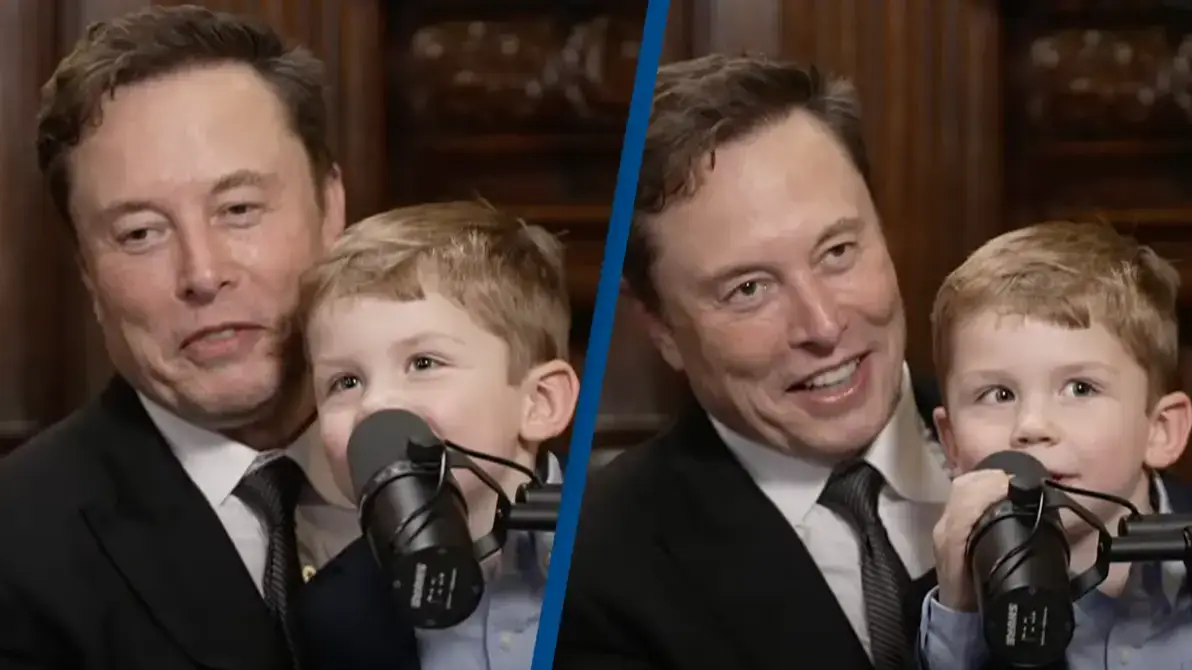
At six years old, most children have a surprisingly small map of the world.
Home. School. A favorite playground. Maybe an airport terminal on a family vacation. Perhaps the office where Mom or Dad works, visited once and remembered mostly because somebody gave them a cookie.
X Æ A-Xii Musk has a different map.
Before he was old enough to finish elementary school, the boy widely known as “X” or “Lil X” had already been photographed at SpaceX’s Starbase, appeared onstage when his father was being honored by TIME, walked through the White House, stood inside the Oval Office beside a sitting U.S. president, accompanied Elon Musk during meetings involving one of the world’s most powerful prime ministers, passed through the U.S. Capitol, and eventually appeared inside Beijing’s Great Hall of the People during one of the most closely watched American presidential visits to China in years.
Read that list again.
Because the strange part isn’t that Elon Musk has a son who sometimes accompanies him to work.
The strange part is what “work” means when your father is Elon Musk.
For Musk, work can mean rockets waiting on a launchpad in Texas.
It can mean a room where the most powerful technology executives in America are discussing artificial intelligence.
It can mean Capitol Hill.
It can mean the Oval Office while a president signs an executive order affecting the federal workforce.
And, as the world discovered in 2026, it can mean walking into the Great Hall of the People in Beijing while the governments of the United States and China are negotiating around some of the most consequential issues on Earth.
There is no need to invent a secret briefing or imagine classified documents lying open on a table.
The publicly documented scenes are extraordinary enough.
And the deeper you follow the timeline, the stranger the story becomes.
Because it didn’t begin in Washington.
It began with rockets.
X was born in May 2020, at a moment when his father’s companies were already pushing into spaces that once belonged almost exclusively to governments.
By 2021, photographs showed the toddler at SpaceX’s Starbase facility in Boca Chica, Texas—the place Musk was trying to turn into a gateway for a future in which enormous spacecraft might eventually carry humans far beyond Earth. TIME itself later included an image of X there in its profile of Musk.
Imagine the scale of that environment from the height of a toddler.
Adults see engineering.
A child sees steel.
Adults see reusable launch architecture, orbital payload capacity and the economics of spaceflight.
A child sees a machine so enormous that the people standing beneath it look tiny.
That could easily have remained the unusual but understandable childhood of a billionaire’s son: hangars instead of ordinary offices, engineers instead of conventional coworkers, rockets instead of company cars.
Then December 2021 happened.
Musk had just been named TIME’s Person of the Year.
The interview took place in New York.
And instead of appearing entirely alone in the polished environment expected of one of the world’s most famous businessmen, Musk had his 18-month-old son with him.
X sat on his father’s knee during the conversation. TIME described Musk balancing the toddler while speaking with editor-in-chief Edward Felsenthal.
The contrast was hard to miss.
Here was a man being interviewed about electric vehicles, wealth, space exploration and the future of civilization.
And on his lap was a child who had barely begun his own life.
People laughed.
Cameras clicked.
The photographs spread.
At the time, it looked charming.
Maybe even ordinary in an unusual way.
A father brought his son.
That was all.
Or at least, that was what it looked like.
Years later, that TIME appearance would feel less like an isolated family moment and more like the first chapter of a pattern.

Because X kept appearing.
And the rooms kept becoming more powerful.
By January 2025, the setting had changed completely.
Donald Trump was returning to the White House, Washington was crowded with supporters and political figures, and on January 19—one day before the inauguration—Musk appeared at the “Make America Great Again Victory Rally” at Capital One Arena.
X came onto the stage with him.
Footage from the event became so widely circulated that a later fact-check had to examine a misleadingly edited clip suggesting Musk had walked away and left his son behind. The longer footage showed otherwise.
But the more important point wasn’t the viral clip.
It was the environment.
A four-year-old child was no longer appearing beside his father only at a technology event or an awards interview.
He was standing inside the theater of American politics.
Crowds.
Security.
Cameras.
Political slogans.
Applause loud enough to fill an arena.
Adults spend careers trying to reach those stages.
X was small enough to be carried away from one.
Then, less than a month later, came the image that changed the conversation.
February 11, 2025.
The Oval Office.
The Resolute Desk.
President Donald Trump sitting behind it.
Elon Musk standing nearby in a black coat.
And between those two men, occasionally climbing onto his father’s shoulders and moving around a room synonymous with American executive power, was four-year-old X.
The photographs looked almost surreal.
Trump was conducting presidential business. Musk was answering questions about the government-efficiency effort with which he had become closely associated. Reporters were packed into the room.
And a preschool-aged boy was touching his father’s face, making expressions and behaving exactly like what he was:
A preschool-aged boy.
ABC reported that at one point Musk apologized for the distraction as X played with him while he spoke.
That tiny detail might have been the most revealing part of the entire scene.
Because the child wasn’t behaving strangely.
The adults had created the strange situation.
X was doing what children do.
He moved.
He fidgeted.
He interacted with his father.
He seemed largely unimpressed by the fact that generations of presidents had made decisions in that room that changed history.
And that innocence created a visual no political consultant could have manufactured convincingly.
A child was treating the Oval Office like a room.
Just a room.
Yet what was happening around him was anything but ordinary.
That same day, Trump signed Executive Order 14210, implementing the administration’s DOGE workforce-optimization initiative. The order instructed agency heads to coordinate with DOGE teams as part of efforts to reduce and reshape the federal workforce. Supporters framed the project as a push against waste and bureaucracy; critics fiercely challenged Musk’s influence, methods and the consequences of the effort.
And standing inside the room as the cameras recorded this collision of government, technology and private power was X.
Four years old.
That was the first major twist.
Because suddenly the question wasn’t, “Why does Elon bring his son to events?”
It became:
What kind of events are these?
A technology conference is one thing.
The Oval Office during a consequential government initiative is something else entirely.
And then came the second twist.
The public wasn’t the only group surprised to see X there.
His mother, musician Grimes, publicly indicated afterward that she had not known about the appearance beforehand and expressed discomfort with having him exposed so publicly. ABC reported her reaction after a social-media user mentioned the child’s behavior during the Oval Office event.
Suddenly, the photographs looked different.
Minutes earlier, the internet had been debating whether X had “stolen the show.”
Now another question entered the room.
Who decides when a child becomes part of the show in the first place?
That question could not be answered by a viral photograph.
And it would be wrong to pretend strangers on the internet know the private arrangements of a family.
But something undeniable had happened.
A disagreement about privacy had itself become public.
The boy had entered one of the most photographed rooms in America.
Then the debate about whether he should have been photographed there became another international story.
You might expect that moment to have ended the pattern.
It didn’t.
Two days later, on February 13, Indian Prime Minister Narendra Modi was in Washington.
This was not a red-carpet entertainment event.
Modi was making an official visit to the United States, with discussions spanning diplomacy, economics and strategic cooperation.
During that visit, Modi met Musk.
According to the Associated Press, Musk arrived accompanied by three of his young children, while Modi was accompanied by senior Indian officials including External Affairs Minister S. Jaishankar and National Security Adviser Ajit Doval.
The discussions, according to Indian officials, covered areas including innovation, space exploration, artificial intelligence and sustainable development.
Pause there.
On one side of the meeting were senior officials representing a nation of more than a billion people.
On the other side sat one of the world’s most consequential businessmen.
And alongside him were his children.
Again, there is no reason to claim the children understood the geopolitical or commercial significance of what adults discussed around them.
That isn’t the fascinating part.
The fascinating part is that they were there at all.
Because childhood is partly an education in what counts as normal.
For most children, seeing a national leader is an event so unusual that a photograph might be framed forever.
For X, within the span of roughly forty-eight hours, cameras had recorded him in proximity to the president of the United States and then around a meeting involving the prime minister of India.
And X’s public journey wasn’t slowing down.
Washington started to look less like a destination and more like another workplace in his father’s universe.
Weeks turned into months.
Political arguments around DOGE intensified.
Federal agencies dealt with a sweeping effort to reduce staffing and restructure operations. Courts, lawmakers, workers, supporters and critics all became part of a conflict far larger than any single viral photograph.
Musk’s public position made him one of the most recognizable figures associated with the effort.
And X remained an occasional figure at his side.
Then came May 21, 2025.
Reuters photographers captured Musk and his son departing the U.S. Capitol in Washington.
Think about that progression.
Starbase.
TIME.
A political rally.
The Oval Office.
A meeting during Modi’s Washington visit.
The Capitol.
Any one of those might become the defining photograph of somebody else’s childhood.
For X, they were accumulating.
But the strangest moment came only nine days later.
May 30, 2025.
Musk was back at the White House for a press appearance as his formal stint in government was coming to an end.
Reporters noticed something immediately.
His eye was bruised.
In almost any other context, that would have triggered an entirely different kind of story.
Instead, Musk gave an explanation nobody in the room seemed prepared for.
He said he had been playing with X, had told his son to hit him, and the five-year-old had actually landed a blow hard enough to leave the visible mark.
Reuters reported the explanation; other outlets covering Musk’s departure from his formal government role reported it as well.
The symbolism was almost too perfect.
For months, Washington had been arguing about Elon Musk’s power.
About his access.
About his influence.
About DOGE.
About government.
About billionaires.
About presidents.
About whether one man had become too powerful or was exactly the disruptive force his supporters believed the federal bureaucracy needed.
And after all those debates, Musk walked into one of his final White House appearances carrying a mark on his face that, according to him, came from his five-year-old son during play.
In the machinery of global power, the smallest person in the story had somehow left the most literal impression.
It could have ended there.
In fact, from a storytelling perspective, it almost should have.
Musk’s formal government chapter was closing.
The Washington experiment had reached a turning point.
You could imagine X disappearing from those political environments and returning to the more familiar orbit of his father’s companies.
That would have made sense.
Instead, the story jumped continents.
Almost exactly one year later, in May 2026, cameras were waiting outside one of the most symbolically powerful buildings in China.
Beijing’s Great Hall of the People.
The place where foreign leaders are received, major state events unfold, and the formal architecture of Chinese political power is put on display.
President Trump was in Beijing for talks with Chinese President Xi Jinping. The summit unfolded amid tensions and negotiations involving trade, Taiwan, artificial intelligence, the war involving Iran and the broader future of U.S.-China relations. Major American business leaders were present during the visit, including Nvidia CEO Jensen Huang and Apple CEO Tim Cook.
Then Elon Musk arrived.
And walking beside him was X.
Now six years old.
Video and photographs showed the boy holding his father’s hand as they entered the Great Hall of the People. Reporting from the event described X wearing a light-colored Chinese-style vest and carrying a small bag as Musk joined a gathering involving American business leaders and Chinese Premier Li Qiang.
Suddenly, every earlier appearance snapped into a different perspective.
The Oval Office was no longer the peak.
It had been one stop.
Washington hadn’t been the destination.
It had been part of a trajectory.
The child who had once sat on his father’s lap during a TIME interview in New York had now walked into political settings in both Washington and Beijing.
And this is where the biggest misconception about the story needs to collapse.
People see those photographs and instinctively ask:
What secrets has this kid heard?
Maybe they imagine classified conversations.
Maybe they imagine world leaders forgetting he’s there.
Maybe they imagine a six-year-old absorbing geopolitical secrets while adults conduct business over his head.
But that turns a remarkable real story into an unsupported fantasy.
The public record does not tell us what X privately heard, what he understood, what conversations occurred away from cameras, or what memories he will eventually carry from these years.
We should not pretend otherwise.
The real story is more subtle.
And perhaps more powerful.
Because X doesn’t need to hear a secret to witness something most people never see.
He has already watched what power looks like at close range.
Not the televised version.
The human version.
He has seen his father approach stages while thousands cheer.
He has seen reporters pack themselves shoulder-to-shoulder into rooms to ask questions.
He has seen security officers appear wherever important people move.
He has been present while adults suddenly straighten their posture because a president or prime minister has entered.
He has walked through hallways that ordinary tourists never experience in the same way.
He has seen cameras turn in his direction before he could possibly understand why millions of strangers might later recognize his face.
And most unusually, he appears to have experienced all of this while still young enough to remain visibly uninterested in the hierarchy adults attach to those spaces.
That may be the most fascinating photograph of all:
A child standing beside people who command companies, governments, militaries, markets and global attention…
while simply being a child.
In the Oval Office, X didn’t suddenly transform into a tiny diplomat.
He fidgeted.
He made faces.
He climbed onto his father.
The adults continued talking.
The cameras continued recording.
And without saying anything politically meaningful at all, his presence created a contrast that dominated coverage.
That contrast is part of why the images became so viral.
Children are immune to status in a way adults rarely are.
A four-year-old does not care that a desk is famous because presidents have used it.
A five-year-old does not care how many billions of dollars somebody controls when he wants to play.
A six-year-old can walk into a grand diplomatic hall carrying a small bag and, for a moment, become more visually interesting than executives whose companies influence entire industries.
That’s not political power.
It’s the absence of reverence for political power.
And it creates an extraordinary reversal.
Every adult in those rooms has spent decades accumulating something.
Votes.
Money.
Expertise.
Connections.
Rank.
Influence.
X accumulated none of those things.
He simply arrived holding his father’s hand.
Yet cameras followed him.
That brings us to the third twist.
Maybe this story isn’t really about what Lil X has seen.
Maybe it’s about what we have seen through Lil X.
Look again at the Oval Office photographs.
Remove the child mentally.
What remains is a familiar image: president, billionaire, reporters, flags, desk.
We’ve seen variations of that photograph for generations.
Put X back into it.
Now the scale changes.
The room feels different.
The adults look more like adults playing extremely serious adult roles.
The famous furniture becomes furniture again.
Power becomes something strangely constructed—something maintained by ritual, attention, security, titles and the agreement of everyone present that what is happening matters enormously.
A small child punctures that illusion without even trying.
And that may explain why those images generate such intense reactions.
Some people see a father who clearly enjoys having his son nearby.
Some see an extraordinary education unavailable to almost any other child.
Some see a boy being given access to history as it happens.
Others see the opposite.
They worry that a child deserves distance from cameras, politics and the enormous public attention attached to his father’s identity.
Grimes’ publicly reported concern sharpened that debate precisely because it reminded everyone that the viral character in these photographs is not actually a character.
He’s a real child.
And that distinction matters.
Because the internet has a way of turning people into symbols.
X becomes “the kid in the Oval Office.”
Or “Elon’s mini-me.”
Or “the child who meets world leaders.”
The meme spreads.
The photograph circulates.
People zoom in on facial expressions.
Strangers build theories from five seconds of video.
Then another event arrives, and the cycle begins again.
But from the child’s perspective—whatever that perspective may actually be—none of those internet labels have to mean anything.
He is six.
That fact is easy to forget when the architecture surrounding him is so enormous.
And then comes another reversal.
For all the extraordinary access X has had, access does not automatically mean understanding.
A child can stand twenty feet from history and still be thinking about something completely ordinary.
Adults assume proximity creates knowledge.
Sometimes it simply creates familiarity.
And that possibility raises the most interesting question of all.
What happens when the impossible becomes normal?
Most people who enter the Oval Office remember the first second vividly.
The doorway.
The desk.
The portraits.
The awareness of where they are.
Politicians rehearse for those moments.
Executives prepare talking points.
Visitors choose their clothes carefully.
Photographers calculate their angles.
Now imagine encountering that environment before you have built the adult mythology around it.
Imagine being carried through security before you understand what security signifies.
Imagine seeing presidents before you learn that seeing a president is rare.
Imagine watching rockets launch before school has taught you how difficult launching a rocket actually is.
Imagine meeting people whose names appear in history books before you’ve finished the books children read at bedtime.
Does the world seem larger?
Or strangely smaller?
Nobody outside X himself will be able to answer that for him.
Not now.
Maybe not for many years.
But the progression is undeniable.
In 2021, he was on his father’s knee while TIME interviewed Musk.
In early 2025, he was on a political rally stage in Washington.
Weeks later, he was inside the Oval Office during an executive-order event connected to DOGE.
Two days after that, he was around his father’s meeting with Prime Minister Modi during an official visit in which technology, space and business were discussed.
By May, Reuters cameras recorded him with Musk at the U.S. Capitol.
And in May 2026, he appeared with his father at Beijing’s Great Hall of the People during President Trump’s high-stakes China visit.
Six years old.
Two superpowers.
Multiple heads of government.
One of the world’s most famous technology entrepreneurs as his father.
And enough globally circulated photographs to make millions of strangers feel as if they have watched pieces of his childhood unfold.
Yet the final twist may be the simplest.
Despite all those rooms, all those leaders and all those cameras, the person with the least control over the larger story may be the child at the center of it.
Adults decide where meetings happen.
Adults decide who gets invited.
Adults decide when cameras are allowed.
Adults choose whether photographs are published.
Adults debate privacy.
Adults turn fleeting moments into political symbolism.
Adults write headlines.
Adults argue in comment sections.
And then the internet looks at the child and asks what he is doing there.
Perhaps the more revealing question is what the adults around him are doing.
Because the story of Lil X isn’t only a story about privilege.
It isn’t only a story about Elon Musk.
And it isn’t really a story about whether a six-year-old has somehow been quietly collecting the secrets of presidents.
It’s a story about proximity to power before a person is old enough to understand what power is.
That is far rarer.
One day, X may look back at a photograph of himself inside the Oval Office and comprehend something he could not possibly have processed in the same way at four.
One day, he may see images from Beijing and understand why hundreds of journalists were waiting outside those doors.
One day, history books may describe arguments, technologies, political conflicts and diplomatic negotiations whose participants were once simply adults standing around him.
And perhaps the strangest discovery will be this:
While millions of adults were desperate to get closer to those rooms, he spent part of his childhood trying only to stay close to his father.
That is the detail hiding underneath every viral photograph.
In one frame, Elon Musk is a billionaire.
In another, he is a political power broker.
In another, he is the CEO of companies trying to reshape transportation, artificial intelligence and spaceflight.
In another, he is walking through one of the most important political buildings in China.
But to the small hand holding his, he is also Dad.
And those two realities keep colliding in public.
That collision is why people cannot stop looking.
The story feels futuristic because it contains rockets, AI, billionaires and world leaders.
It feels political because it passes through Washington and Beijing.
It feels unbelievable because a child has been physically present in settings millions of adults will never enter.
But underneath all of that is an ancient question every powerful family eventually confronts:
What does a child inherit besides money?
Access?
Expectations?
Attention?
Enemies?
Opportunities?
A distorted definition of normal?
A front-row seat to decisions that affect millions of strangers?
Perhaps all of them.
We cannot know yet.
What we do know is that the photographic record of X’s early childhood already looks less like an ordinary family album and more like a strange intersection of technology, politics and global power.
A rocket facility in Texas.
A TIME stage in New York.
A political arena in Washington.
The Oval Office.
A meeting involving India’s prime minister.
The U.S. Capitol.
The Great Hall of the People in Beijing.
And through almost every scene, one recurring image:
A little boy beside his father.
That is why the most dramatic part of the story isn’t some secret X might reveal tomorrow.
There may be no secret.
There doesn’t need to be.
The astonishing part has been sitting in plain sight all along.
Most people spend their entire lives trying to enter one room where history is being made.
Lil X entered several before he was old enough to understand why the adults outside were fighting so hard to get in.
And years from now, when he is finally old enough to understand exactly whose hands he shook, which doors opened for him, and what was happening in those rooms, the world may discover something even stranger:
We were watching his introduction to power long before he was old enough to know that power was supposed to impress him.


